Editorial dossier / Healthcare Apps
AI Use Cases in Healthcare Platforms: Safe Scope, Evidence and Human Review
Evaluate healthcare AI use cases across document intake, search, summarization, scheduling, support and operations with privacy, evaluation and human-review controls.
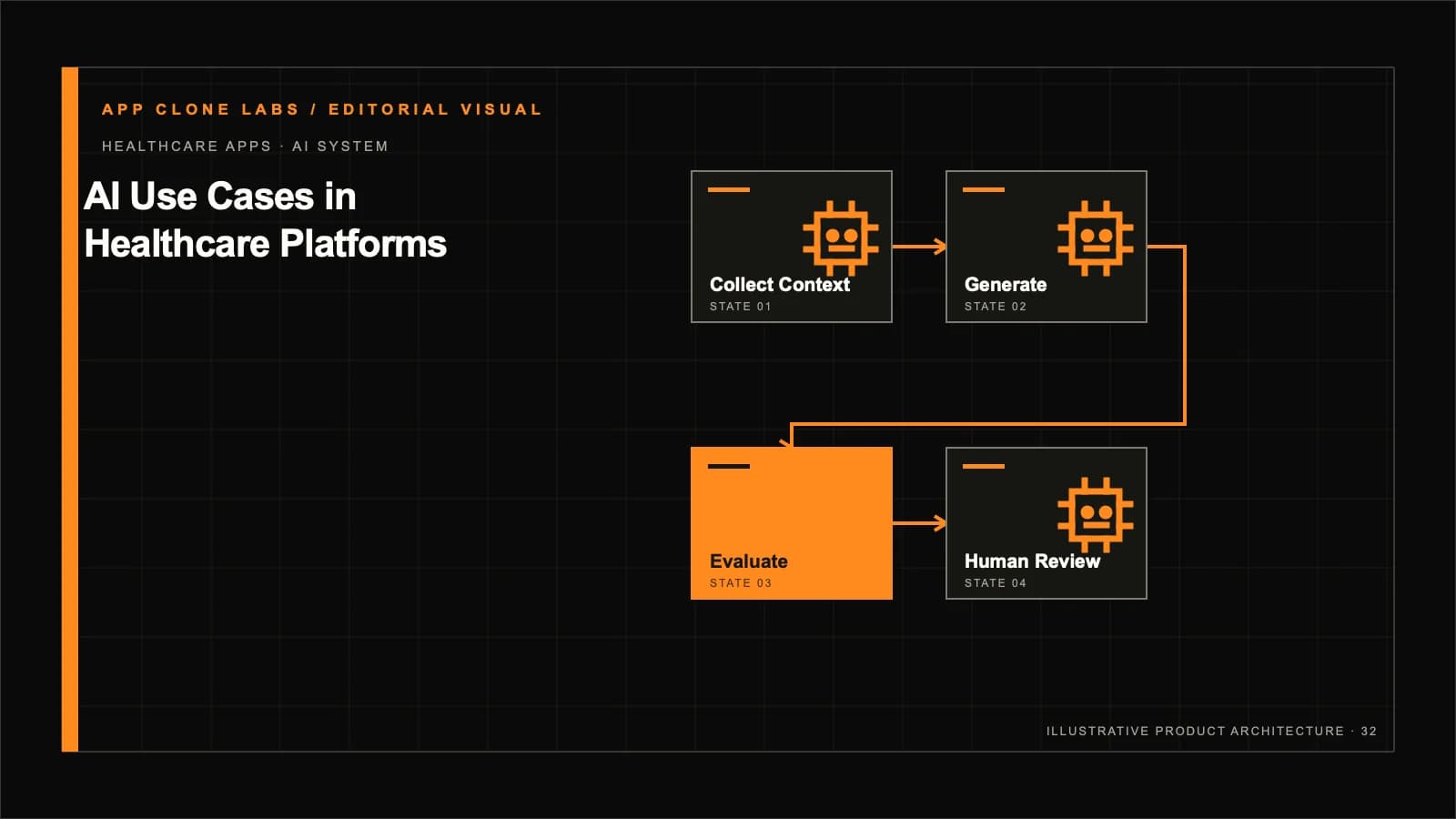
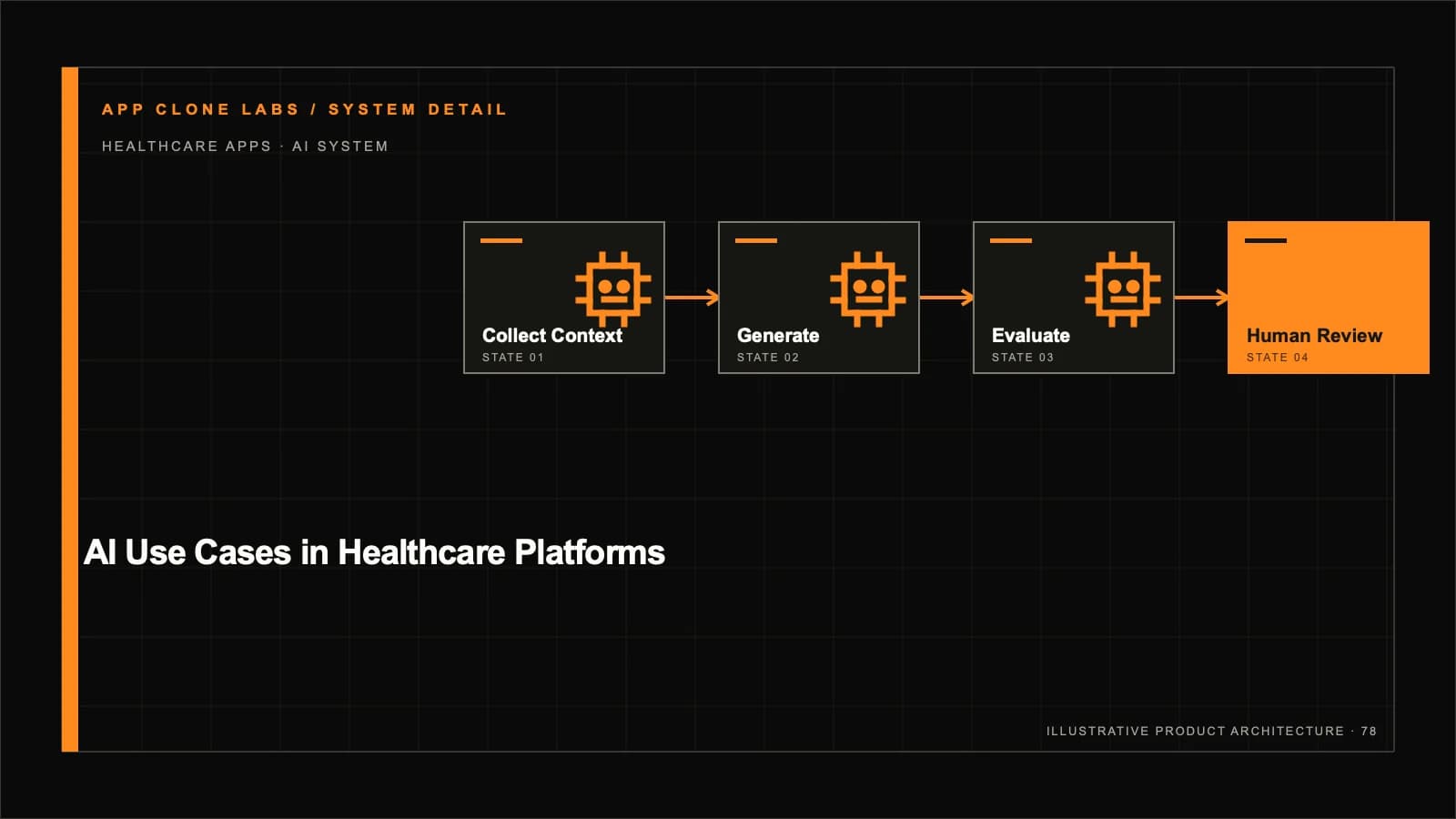
A generated summary can save a nurse several minutes and still create more risk than value if it omits an allergy, blends two encounters or looks authoritative without showing its source. The model output is only one component; the product decides where it appears, who may rely on it and how mistakes are detected.
Healthcare AI should begin with a bounded workflow and measurable failure cost. Administrative assistance, document routing and staff search may offer useful starting points, but even these require privacy, authorization, provenance and human-review design.
This guide evaluates use cases by evidence and operating controls rather than novelty.
Classify the intended use
Administrative support, clinical decision support and autonomous action carry different consequences.
The failure mode is concrete: a feature is called an assistant without defining reliance. This is not solved by adding another screen or background job. The product has to define ownership, permitted transitions, and the evidence retained when the transition occurs.
For the first release, document users, decisions, claims and prohibited uses. Write that decision as an enforceable server-side rule, not guidance that depends on a client, operator, or AI model remembering the intended boundary.
Implementation should include workflow, user, input, output, decision impact, oversight, claim and escalation. Keep the public response smaller than the internal record: users need a clear outcome and recovery path, while authorized operators need correlation IDs, policy versions, timestamps, and the before-and-after state.
Validate it with one expected and one unsafe reliance case. Test the ordinary path, then repeat under timeout, duplicate delivery, stale state, partial failure, revoked authority, and concurrent requests. A feature is not ready when only the demonstration succeeds.
- Owner: clinical product lead
- Release evidence: Classify the intended use acceptance record
- Stop condition: classify the intended use cannot be explained or recovered
Choose a narrow first workflow
A bounded repetitive task is easier to evaluate and recover.
The failure mode is concrete: one assistant searches, summarizes and recommends across all records. This is not solved by adding another screen or background job. The product has to define ownership, permitted transitions, and the evidence retained when the transition occurs.
For the first release, select one corpus, user and action boundary. Write that decision as an enforceable server-side rule, not guidance that depends on a client, operator, or AI model remembering the intended boundary.
Implementation should include trigger, required input, output format, latency, reviewer, fallback and success measure. Keep the public response smaller than the internal record: users need a clear outcome and recovery path, while authorized operators need correlation IDs, policy versions, timestamps, and the before-and-after state.
Validate it with insufficient input and unavailable model. Test the ordinary path, then repeat under timeout, duplicate delivery, stale state, partial failure, revoked authority, and concurrent requests. A feature is not ready when only the demonstration succeeds.
- Owner: product owner
- Release evidence: Choose a narrow first workflow acceptance record
- Stop condition: choose a narrow first workflow cannot be explained or recovered
Minimize health data
Models and observability systems should receive only necessary data.
The failure mode is concrete: full records enter prompts by default. This is not solved by adding another screen or background job. The product has to define ownership, permitted transitions, and the evidence retained when the transition occurs.
For the first release, define purpose-bound field selection and retention. Write that decision as an enforceable server-side rule, not guidance that depends on a client, operator, or AI model remembering the intended boundary.
Implementation should include data element, purpose, source, sensitivity, access, processor, retention and deletion. Keep the public response smaller than the internal record: users need a clear outcome and recovery path, while authorized operators need correlation IDs, policy versions, timestamps, and the before-and-after state.
Validate it with test record and production trace. Test the ordinary path, then repeat under timeout, duplicate delivery, stale state, partial failure, revoked authority, and concurrent requests. A feature is not ready when only the demonstration succeeds.
- Owner: privacy lead
- Release evidence: Minimize health data acceptance record
- Stop condition: minimize health data cannot be explained or recovered
Enforce access before retrieval
AI should not widen a user’s record permissions.
The failure mode is concrete: retrieved context includes another patient or organization. This is not solved by adding another screen or background job. The product has to define ownership, permitted transitions, and the evidence retained when the transition occurs.
For the first release, resolve identity and record authority before candidate selection. Write that decision as an enforceable server-side rule, not guidance that depends on a client, operator, or AI model remembering the intended boundary.
Implementation should include user, role, organization, patient relationship, consent, resource ACL and denial. Keep the public response smaller than the internal record: users need a clear outcome and recovery path, while authorized operators need correlation IDs, policy versions, timestamps, and the before-and-after state.
Validate it with cross-patient query and revoked clinician. Test the ordinary path, then repeat under timeout, duplicate delivery, stale state, partial failure, revoked authority, and concurrent requests. A feature is not ready when only the demonstration succeeds.
- Owner: security owner
- Release evidence: Enforce access before retrieval acceptance record
- Stop condition: enforce access before retrieval cannot be explained or recovered
Checkpoint 4: reconcile the product promise with the recorded state. Support, finance, security, and delivery teams should be able to reach the same conclusion from the same identifiers without reconstructing events from chat messages or screenshots.
Preserve source provenance
Users need to distinguish source facts from generated language.
The failure mode is concrete: the answer has no encounter, document or version reference. This is not solved by adding another screen or background job. The product has to define ownership, permitted transitions, and the evidence retained when the transition occurs.
For the first release, attach stable authorized citations and timestamps. Write that decision as an enforceable server-side rule, not guidance that depends on a client, operator, or AI model remembering the intended boundary.
Implementation should include source ID, type, author, effective time, version, passage and access check. Keep the public response smaller than the internal record: users need a clear outcome and recovery path, while authorized operators need correlation IDs, policy versions, timestamps, and the before-and-after state.
Validate it with amended note and removed document. Test the ordinary path, then repeat under timeout, duplicate delivery, stale state, partial failure, revoked authority, and concurrent requests. A feature is not ready when only the demonstration succeeds.
- Owner: knowledge owner
- Release evidence: Preserve source provenance acceptance record
- Stop condition: preserve source provenance cannot be explained or recovered
Use document intake carefully
Classification and extraction can assist routing but may miss or misread fields.
The failure mode is concrete: extracted values silently become clinical truth. This is not solved by adding another screen or background job. The product has to define ownership, permitted transitions, and the evidence retained when the transition occurs.
For the first release, retain original documents, confidence and review status. Write that decision as an enforceable server-side rule, not guidance that depends on a client, operator, or AI model remembering the intended boundary.
Implementation should include document, page, field, value, confidence, extractor version, reviewer and correction. Keep the public response smaller than the internal record: users need a clear outcome and recovery path, while authorized operators need correlation IDs, policy versions, timestamps, and the before-and-after state.
Validate it with poor scan and conflicting value. Test the ordinary path, then repeat under timeout, duplicate delivery, stale state, partial failure, revoked authority, and concurrent requests. A feature is not ready when only the demonstration succeeds.
- Owner: document operations
- Release evidence: Use document intake carefully acceptance record
- Stop condition: use document intake carefully cannot be explained or recovered
Bound summarization
A summary is a lossy representation that must match a defined job.
The failure mode is concrete: the model compresses an entire history into generic prose. This is not solved by adding another screen or background job. The product has to define ownership, permitted transitions, and the evidence retained when the transition occurs.
For the first release, specify source window, required elements and omission checks. Write that decision as an enforceable server-side rule, not guidance that depends on a client, operator, or AI model remembering the intended boundary.
Implementation should include patient context, time range, included sources, required facts, uncertainty, citation and reviewer. Keep the public response smaller than the internal record: users need a clear outcome and recovery path, while authorized operators need correlation IDs, policy versions, timestamps, and the before-and-after state.
Validate it with allergy, negation and duplicate encounter. Test the ordinary path, then repeat under timeout, duplicate delivery, stale state, partial failure, revoked authority, and concurrent requests. A feature is not ready when only the demonstration succeeds.
- Owner: clinical informatics lead
- Release evidence: Bound summarization acceptance record
- Stop condition: bound summarization cannot be explained or recovered
Use RAG for authorized staff search
Retrieval can reduce navigation but does not guarantee truth.
The failure mode is concrete: the chatbot answers from stale or irrelevant documents. This is not solved by adding another screen or background job. The product has to define ownership, permitted transitions, and the evidence retained when the transition occurs.
For the first release, evaluate retrieval and generation separately with abstention. Write that decision as an enforceable server-side rule, not guidance that depends on a client, operator, or AI model remembering the intended boundary.
Implementation should include corpus, freshness, chunk provenance, ACL, top results, citation, answer and no-answer state. Keep the public response smaller than the internal record: users need a clear outcome and recovery path, while authorized operators need correlation IDs, policy versions, timestamps, and the before-and-after state.
Validate it with conflicting policy and missing evidence. Test the ordinary path, then repeat under timeout, duplicate delivery, stale state, partial failure, revoked authority, and concurrent requests. A feature is not ready when only the demonstration succeeds.
- Owner: search owner
- Release evidence: Use RAG for authorized staff search acceptance record
- Stop condition: use rag for authorized staff search cannot be explained or recovered
Checkpoint 8: reconcile the product promise with the recorded state. Support, finance, security, and delivery teams should be able to reach the same conclusion from the same identifiers without reconstructing events from chat messages or screenshots.
Assist scheduling without inventing availability
AI may interpret requests while deterministic services control slots.
The failure mode is concrete: a model confirms appointments directly from conversation. This is not solved by adding another screen or background job. The product has to define ownership, permitted transitions, and the evidence retained when the transition occurs.
For the first release, separate language understanding from authoritative scheduling transactions. Write that decision as an enforceable server-side rule, not guidance that depends on a client, operator, or AI model remembering the intended boundary.
Implementation should include intent, constraints, patient identity, slot version, hold, confirmation and audit. Keep the public response smaller than the internal record: users need a clear outcome and recovery path, while authorized operators need correlation IDs, policy versions, timestamps, and the before-and-after state.
Validate it with concurrent booking and ambiguous date. Test the ordinary path, then repeat under timeout, duplicate delivery, stale state, partial failure, revoked authority, and concurrent requests. A feature is not ready when only the demonstration succeeds.
- Owner: scheduling owner
- Release evidence: Assist scheduling without inventing availability acceptance record
- Stop condition: assist scheduling without inventing availability cannot be explained or recovered
Support administrative messaging
Drafting can reduce effort but content may affect care and privacy.
The failure mode is concrete: messages are sent automatically without recipient or urgency checks. This is not solved by adding another screen or background job. The product has to define ownership, permitted transitions, and the evidence retained when the transition occurs.
For the first release, require templates, recipient validation and human confirmation for consequential messages. Write that decision as an enforceable server-side rule, not guidance that depends on a client, operator, or AI model remembering the intended boundary.
Implementation should include purpose, channel, recipient, source facts, urgency, draft, approver and send status. Keep the public response smaller than the internal record: users need a clear outcome and recovery path, while authorized operators need correlation IDs, policy versions, timestamps, and the before-and-after state.
Validate it with wrong recipient and urgent symptom. Test the ordinary path, then repeat under timeout, duplicate delivery, stale state, partial failure, revoked authority, and concurrent requests. A feature is not ready when only the demonstration succeeds.
- Owner: communications owner
- Release evidence: Support administrative messaging acceptance record
- Stop condition: support administrative messaging cannot be explained or recovered
Evaluate with representative cases
Average quality hides rare high-impact errors.
The failure mode is concrete: teams review a few polished demonstrations. This is not solved by adding another screen or background job. The product has to define ownership, permitted transitions, and the evidence retained when the transition occurs.
For the first release, build stratified labelled test sets and red-team cases. Write that decision as an enforceable server-side rule, not guidance that depends on a client, operator, or AI model remembering the intended boundary.
Implementation should include use case, population, language, difficulty, expected evidence, unacceptable output and reviewer. Keep the public response smaller than the internal record: users need a clear outcome and recovery path, while authorized operators need correlation IDs, policy versions, timestamps, and the before-and-after state.
Validate it with rare condition, ambiguous note and adversarial document. Test the ordinary path, then repeat under timeout, duplicate delivery, stale state, partial failure, revoked authority, and concurrent requests. A feature is not ready when only the demonstration succeeds.
- Owner: evaluation lead
- Release evidence: Evaluate with representative cases acceptance record
- Stop condition: evaluate with representative cases cannot be explained or recovered
Measure human-AI interaction
Automation can shift workload or create overreliance.
The failure mode is concrete: model accuracy is measured without workflow outcome. This is not solved by adding another screen or background job. The product has to define ownership, permitted transitions, and the evidence retained when the transition occurs.
For the first release, track review time, corrections, overrides and downstream effect. Write that decision as an enforceable server-side rule, not guidance that depends on a client, operator, or AI model remembering the intended boundary.
Implementation should include user role, task, suggestion, acceptance, edit distance, time, escalation and outcome. Keep the public response smaller than the internal record: users need a clear outcome and recovery path, while authorized operators need correlation IDs, policy versions, timestamps, and the before-and-after state.
Validate it with rubber-stamping and alert fatigue. Test the ordinary path, then repeat under timeout, duplicate delivery, stale state, partial failure, revoked authority, and concurrent requests. A feature is not ready when only the demonstration succeeds.
- Owner: human factors owner
- Release evidence: Measure human-AI interaction acceptance record
- Stop condition: measure human-ai interaction cannot be explained or recovered
Checkpoint 12: reconcile the product promise with the recorded state. Support, finance, security, and delivery teams should be able to reach the same conclusion from the same identifiers without reconstructing events from chat messages or screenshots.
Control model and prompt changes
Vendor and configuration updates can alter behavior.
The failure mode is concrete: production quality drifts without release gates. This is not solved by adding another screen or background job. The product has to define ownership, permitted transitions, and the evidence retained when the transition occurs.
For the first release, version every component and compare against a baseline. Write that decision as an enforceable server-side rule, not guidance that depends on a client, operator, or AI model remembering the intended boundary.
Implementation should include model, prompt, retrieval config, tools, safety policy, evaluation result, approval and rollback. Keep the public response smaller than the internal record: users need a clear outcome and recovery path, while authorized operators need correlation IDs, policy versions, timestamps, and the before-and-after state.
Validate it with provider model retirement. Test the ordinary path, then repeat under timeout, duplicate delivery, stale state, partial failure, revoked authority, and concurrent requests. A feature is not ready when only the demonstration succeeds.
- Owner: AI operations
- Release evidence: Control model and prompt changes acceptance record
- Stop condition: control model and prompt changes cannot be explained or recovered
Treat retrieved text as untrusted
Documents can contain misleading or adversarial instructions.
The failure mode is concrete: source text can trigger tools or override policy. This is not solved by adding another screen or background job. The product has to define ownership, permitted transitions, and the evidence retained when the transition occurs.
For the first release, separate data from instructions and constrain tool authority. Write that decision as an enforceable server-side rule, not guidance that depends on a client, operator, or AI model remembering the intended boundary.
Implementation should include content boundary, tool scopes, output validation, suspicious-input signal, confirmation and audit. Keep the public response smaller than the internal record: users need a clear outcome and recovery path, while authorized operators need correlation IDs, policy versions, timestamps, and the before-and-after state.
Validate it with embedded prompt injection. Test the ordinary path, then repeat under timeout, duplicate delivery, stale state, partial failure, revoked authority, and concurrent requests. A feature is not ready when only the demonstration succeeds.
- Owner: AI security lead
- Release evidence: Treat retrieved text as untrusted acceptance record
- Stop condition: treat retrieved text as untrusted cannot be explained or recovered
Plan monitoring and incident response
AI failures may be subtle, repeated and patient-specific.
The failure mode is concrete: operations watch only uptime and latency. This is not solved by adding another screen or background job. The product has to define ownership, permitted transitions, and the evidence retained when the transition occurs.
For the first release, monitor quality signals, access denials, corrections and severe events. Write that decision as an enforceable server-side rule, not guidance that depends on a client, operator, or AI model remembering the intended boundary.
Implementation should include trace ID, use case, versions, sources, reviewer action, severity, containment and notification. Keep the public response smaller than the internal record: users need a clear outcome and recovery path, while authorized operators need correlation IDs, policy versions, timestamps, and the before-and-after state.
Validate it with cross-record exposure and systematic omission. Test the ordinary path, then repeat under timeout, duplicate delivery, stale state, partial failure, revoked authority, and concurrent requests. A feature is not ready when only the demonstration succeeds.
- Owner: incident owner
- Release evidence: Plan monitoring and incident response acceptance record
- Stop condition: plan monitoring and incident response cannot be explained or recovered
Implementation references
Use NIST AI Risk Management Framework and record the version applied to this release.
Validate implementation against NIST AI RMF Generative AI Profile and record the version applied to this release.
Review HL7 FHIR R4 and record the version applied to this release.
Compare with HHS HIPAA Security Rule guidance and record the version applied to this release.
Continue with Healthcare Industry when translating this guide into delivery scope.
Frequently asked questions
What healthcare AI use case should be built first?
A narrow, repetitive workflow with clear human review, measurable benefit and recoverable errors.
Can AI make clinical decisions?
That requires a substantially different evidence, regulatory and risk analysis; do not infer authority from a general-purpose model.
How should patient data be protected?
Minimize inputs, enforce authorization before retrieval, control processors and retention, and audit access.
Are citations enough to make a summary safe?
No. Citations improve inspection, but the product must also evaluate omissions, context, freshness and human reliance.
Can AI book appointments?
It can interpret requests, while deterministic scheduling services should verify current slots and perform the transaction.
What should healthcare AI evaluation include?
Representative and rare cases, unacceptable outputs, retrieval quality, factual support, omissions, human corrections and subgroup performance.
How should model updates be released?
Version prompts, models, retrieval and tools; run regression evaluations; approve material changes and keep rollback.
What should monitoring capture?
Versions, authorized sources, user context, corrections, denials, escalations and severe quality or privacy incidents.
Turn the plan into release evidence
A credible release connects the public promise to durable state, scoped authority and recoverable operations. Ordinary journeys and important exceptions should be explainable from the same evidence.
Keep the initial scope narrow enough to rehearse end to end. Expand only after permissions, financial consequences, data integrity and support outcomes remain consistent under retries, failures and human mistakes.
- 01
- 02
- 03
- 04
- 05
- 06
Reviewed by the App Clone Labs product strategy team
This guide is written for founders and operators planning clone-inspired platforms, SaaS products, marketplaces, and mobile apps. It is reviewed against App Clone Labs delivery patterns, product scoping standards, and current implementation realities before being published.
Review the editorial team structureRelated product paths
Continue with the services, solutions, guides, and articles that connect this topic to a real software build.
Services, solutions, and guides
Read next