Case record / On-demand transport
Mobility Platform Delivery Blueprint
A conceptual delivery blueprint pending verification of project provenance, permissions, implementation status, and outcomes.
Published outcome claim / not independently verified here
Conceptual reference only; no client result is claimed.
Request a similar build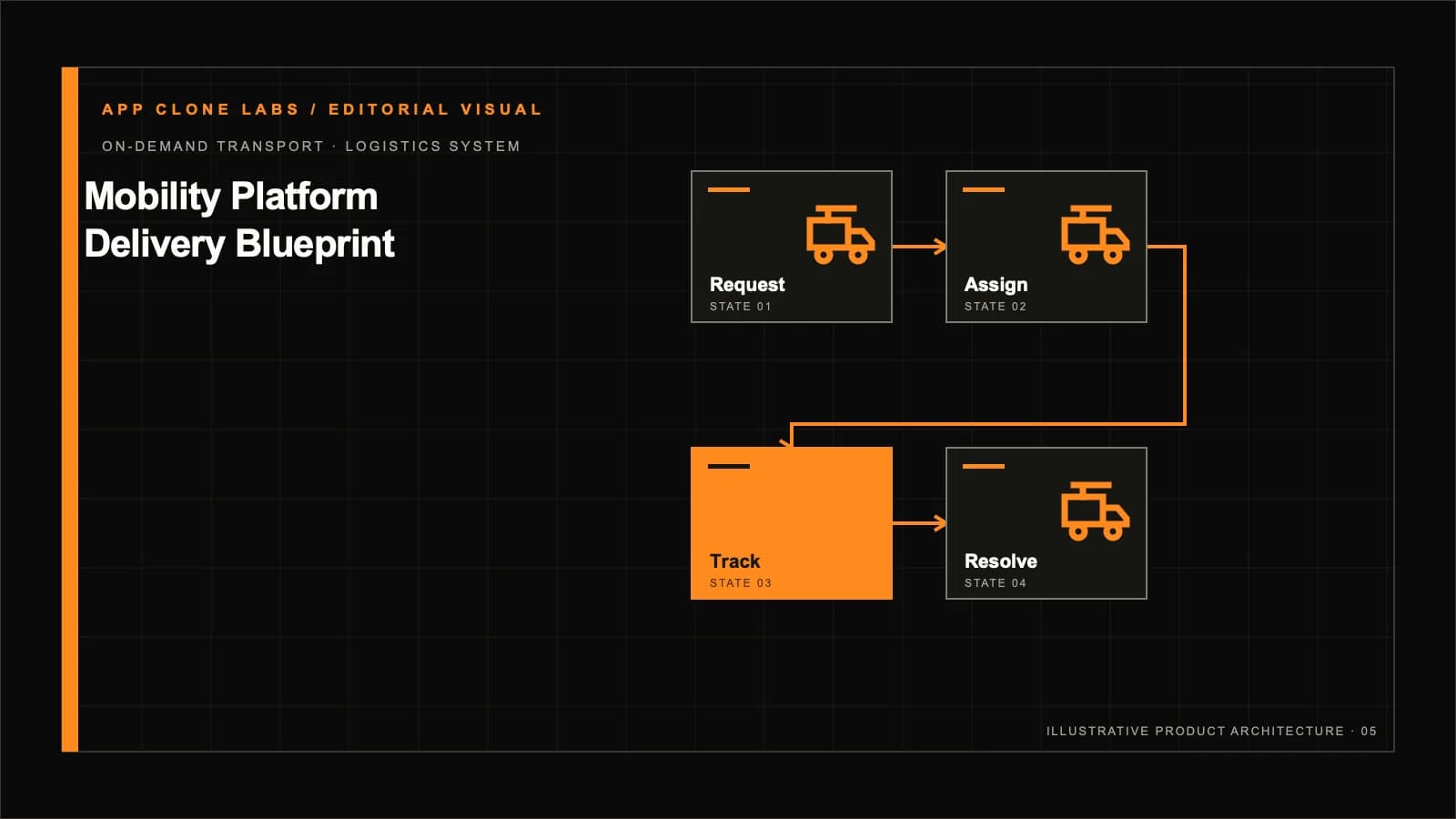
Proof status / evidence boundary
What this record can and cannot establish
Recorded project context
The industry, summary, service list, stack, narrative, and body are fields supplied by the case-study record.
Architecture and workflow
The workflow and technology labels describe the published delivery scope. They are not presented here as a new contractual commitment.
Outcome evidence boundary
Public outcome evidence is not attached to this record.
Evidence status: Blueprint / Last reviewed: Not recorded
Context / delivery read
A mobility launch needs live operations, not just booking screens.
The build prioritized rider booking, driver availability, map-driven dispatch, support visibility, and admin control so the operator could run a regional launch with fewer manual workarounds.
Recorded services
Workflow and deliverables
Driver onboarding and document status
Trip lifecycle, pricing, and cancellation controls
Support dashboards for live ride issues
Production handoff for app and cloud teams
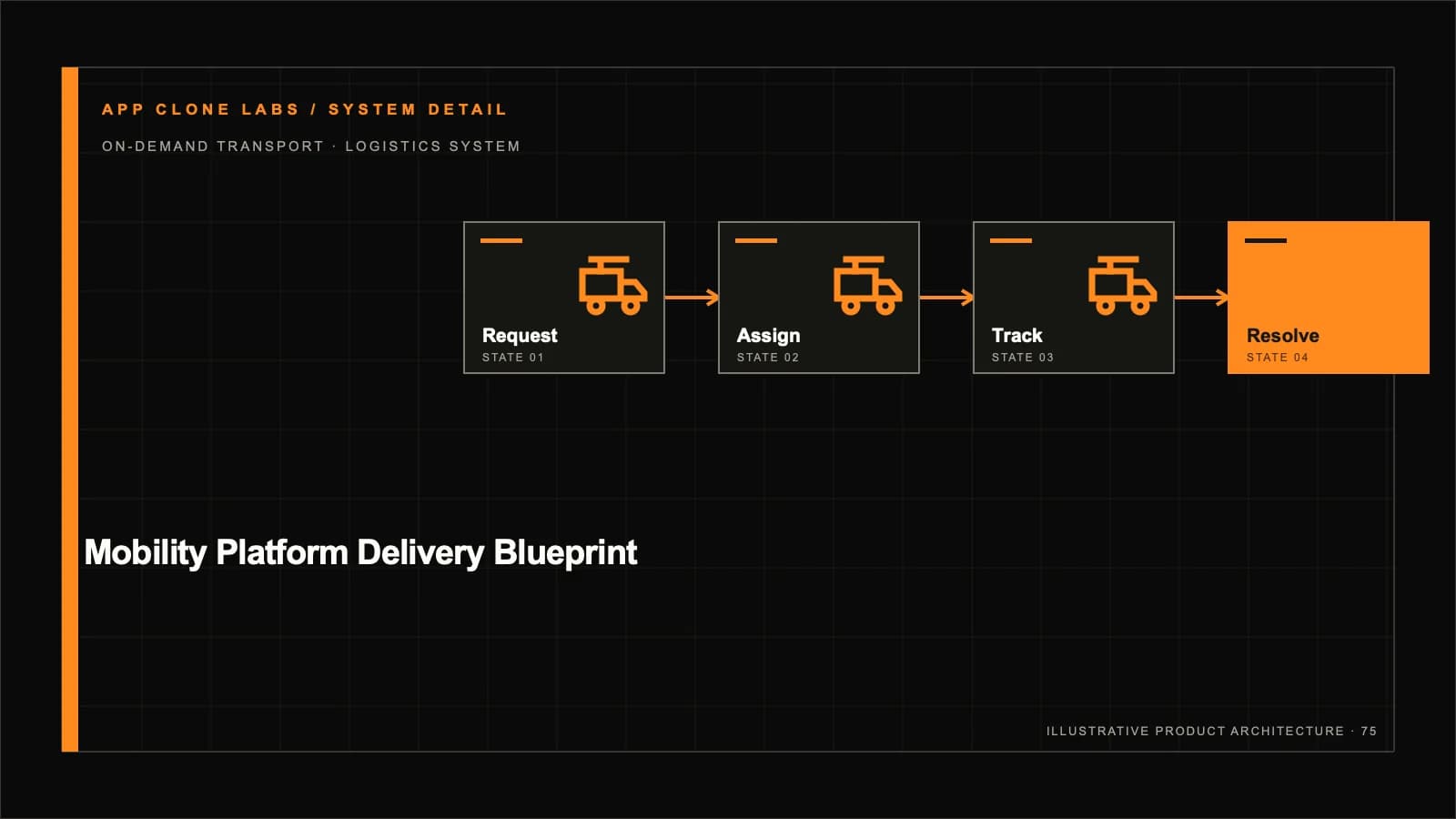
The operator needed a ride-hailing product that could start with one city while still supporting driver verification, trip states, pricing rules, cancellations, support queues, and admin visibility from the first release.
App Clone Labs mapped the rider, driver, dispatcher, and support workflows before interface design. The team separated V1 from later growth modules so the first launch stayed focused on booking, assignment, live status, payment proof, and operational review.
Proof signals included a role matrix, dispatch state map, driver onboarding checklist, admin queue plan, cloud handoff notes, and a release checklist that could be reviewed by the founder before engineering moved into production.
Technical architecture and system design
The UrbanGo platform was architected as a React Native rider and driver app paired with a Node.js service layer and a PostgreSQL primary store on AWS, with the dispatch engine isolated as its own service so trip assignment, pricing recalculation, and live status updates could scale independently of the rider-facing booking API. Real-time requirements were handled through a WebSocket gateway that pushed trip-state changes to riders, drivers, and the dispatcher console without polling, with a fallback to long-polling for devices on unstable networks. The Maps API integration was abstracted behind an internal geocoding and routing interface so the provider could be swapped per region without touching dispatch logic, and so custom routing rules like preferred corridors or avoided zones could be layered in later. Database choices favored PostgreSQL with the PostGIS extension for spatial indexing of driver locations, ensuring nearby-driver queries stayed sub-second as the active fleet grew within a city, and a read-replica strategy was documented for reporting workloads that would otherwise contend with the dispatch write path. Caching was kept deliberately thin on the dispatch path because stale driver locations would corrupt assignment, while pricing rules and city configuration were cached aggressively since they changed rarely and could be invalidated through an admin publish event. The entire stack was containerized and deployed through a CI pipeline that ran the trip-state machine regression suite on every commit, so any illegal transition failed the build before it reached a release candidate.
API design followed a strict role separation across rider, driver, dispatcher, and admin surfaces, with each endpoint scoped to the least privilege its workflow required and every mutating call carrying an idempotency key to survive client retries on flaky mobile networks. Trip state was modeled as an explicit state machine—requested, accepted, en route, in trip, completed, cancelled—so that every transition could be audited, replayed for support disputes, and protected by guard clauses that rejected impossible moves like accepting a trip that was already cancelled. Payment proof was captured as an event rather than a single flag, allowing partial payments, promo adjustments, cash-trip reconciliation, and driver payout splits to coexist without a fragile balance field. The architecture deliberately deferred surge pricing, multi-city orchestration, driver incentive engines, and scheduled rides to later phases so the first release could prove the core booking loop under real load, and each deferred module was documented as a service boundary so it could be added without re-architecting the dispatch core. Observability was built in from the first sprint with structured logs on every state transition, metrics on assignment latency and WebSocket fan-out lag, and traces that followed a trip from request to completion so post-incident reviews could reconstruct any failed journey end to end. A documented data retention policy governed how long raw location pings persisted, balancing support investigation needs against storage cost and privacy obligations, and the policy was reviewed with the founder before the first production deploy so there were no surprises during a later compliance conversation.
Development methodology and sprint breakdown
The build was organized into two-week sprints with a discovery sprint up front to lock the role matrix, dispatch state map, driver onboarding checklist, and pricing rules before any UI work began, because the team had learned that interface design without agreed workflow boundaries produces rework. Sprint one delivered the rider booking flow and driver onboarding checklist against a stubbed dispatch service, letting the team validate the rider and driver app surfaces in parallel before the real assignment engine existed. Sprint two introduced the live assignment engine and the WebSocket status pipeline, wiring the stubbed surfaces to real dispatch and exposing the first end-to-end booking loop for QA. QA ran continuously alongside engineering using device farms for the React Native builds, covering low-end Android handsets, iOS variants, and intermittent connectivity profiles, with each sprint closing on a demoable release candidate reviewed by the founder against the original scope. Release sequencing kept the admin queue and support tooling in the same sprint as the user-facing feature it governed, so operations never lagged behind the rider experience and the founder could see the full operating loop in every demo.
A hardening sprint before launch focused on edge cases that would otherwise surface as support load: cancelled trips mid-assignment, driver app kills during a trip, payment failures, double-assignment races, and dispatcher overrides conflicting with automatic dispatch. Regression checks were automated against the trip-state machine so any illegal transition failed the build, and a chaos test simulated WebSocket disconnects to verify the client reconnected and resynced state without corrupting a trip. The final release checklist covered cloud handoff, monitoring dashboards, on-call rotation, a rollback plan for the dispatch service, and a runbook for the first 48 hours of live operations when most edge cases typically emerge. This sequencing kept the MVP focused on booking, assignment, live status, and payment proof while leaving a documented backlog for growth modules, and it gave the founder a defensible launch plan rather than a feature list. The sprint structure also built in a weekly demo cadence that kept stakeholders aligned without daily status meetings, which mattered for a remote-first team spanning multiple time zones. A shared definition of done, covering code review, QA sign-off, and an operations-readiness check, prevented the common failure mode where a feature was technically complete but operationally unlaunchable, and it gave the founder a reliable signal of progress without requiring them to inspect every pull request.
Operational challenges and resolutions
The most persistent operational challenge was supply-demand balance during peak hours, where rider wait times spiked before enough drivers were online and the absence of surge pricing in V1 meant there was no automatic signal to pull more drivers onto the road. The team resolved this by giving dispatchers a manual boost control and a real-time heat map of unmet demand, rather than shipping automated surge in V1, which let operations learn the demand patterns before committing to an algorithm. Driver verification throughput was another bottleneck, since document review could block onboarding for days and starve the launch city of supply; the resolution was a staged verification path that allowed verified drivers to accept trips while background checks completed, with a hard cap on trip count until full verification cleared. Cancellation abuse by riders was contained through a soft limit tracked in the admin console, with a review queue for repeat offenders and an automatic cooldown that paused booking ability after a configurable threshold within a rolling window.
Payment reconciliation between cash trips, in-app wallet credits, and promo adjustments created accounting ambiguity that surfaced only after real transactions began, because the original reference model assumed a single in-app payment rail. The team introduced a per-trip ledger event stream that fed a nightly reconciliation job, surfacing mismatches to the operations team before payout runs and producing an auditable trail that satisfied the finance review. Live location drift from low-end driver devices was handled with a server-side smoothing and staleness threshold so dispatch never assigned a trip to a ghost location, and a driver-side heartbeat alerted the dispatcher console when a device had not reported for a configurable interval. Each resolution was documented as an operational runbook so the client team could own it after handoff, and the runbooks were reviewed in the final sprint so the operations lead could rehearse the most common escalations before launch day. These fixes were not feature work but they were the difference between a platform that operated and one that merely ran, and they were prioritized explicitly in the backlog alongside user-facing features so they never lost out to a shiny new screen during sprint planning.
Admin and operator tooling
The admin console was built as a first-class product surface rather than an afterthought, covering driver verification queues, trip dispute review, pricing rule configuration, city-level operational toggles, and a configurable cancellation policy editor that let operators tune rules without a deploy. Dispatchers received a live map console with override controls for reassignment, cancellation, and priority trips, plus a support queue that linked each ticket to the underlying trip record, the driver profile, and the payment ledger so agents never had to switch systems to resolve a dispute. Reporting dashboards exposed trip volume, completion rate, average wait time, driver utilization, cancellation reasons, and payout reconciliation status, refreshed on a near-real-time pipeline that aggregated the per-trip ledger events into hourly and daily views. Role-based access ensured support agents could not alter pricing or payouts, while operators could not access rider PII beyond what a ticket required, and every privileged action was written to an immutable audit log.
Operational controls extended to driver onboarding status, document expiry alerts, and a configurable block list for riders or drivers flagged by support, with an automated notification to the operations lead when a block was applied or lifted. The admin dashboard included a release-control surface for toggling features per city, allowing the team to pilot changes in one zone before a full rollout and to kill a problematic feature without a hotfix deploy. Audit logs captured every dispatcher override and admin pricing change so post-incident reviews had a clear trail, and the logs were exported to the cloud log store where they survived beyond the application database. This tooling layer was what made the mobility platform operable at launch, not just bookable, and it absorbed the operational load that would otherwise have landed on engineers as urgent fixes. The console was also designed for mobile use so dispatchers could monitor a city from a tablet during peak hours rather than being tethered to a desktop, and a lightweight read-only view was exposed to the founder so they could check launch health without needing full operator credentials or risking an accidental configuration change.
Launch outcomes and lessons
The MVP launched in a single city with a capped driver pool and a documented expansion playbook, proving the booking loop end to end before any growth features were added and giving the operations team a controlled environment to learn real demand patterns. What worked well was the explicit trip-state machine, which made support disputes resolvable in minutes instead of hours because every transition was logged with a timestamp and actor, and the dispatcher console, which absorbed early supply-demand imbalances without code changes by letting humans smooth what an algorithm would have over-corrected. What did not work was underestimating driver device fragmentation, which caused location drift on lower-end handsets and required the smoothing fix post-launch after a handful of ghost-location assignments eroded rider trust in the first week. The lesson was that operational tooling must ship with the user-facing feature, not after it, because the cost of retrofitting a support queue and a reconciliation job under live load is far higher than building them in the same sprint.
A second lesson was that payment proof as a single flag would have collapsed under cash and promo edge cases; modeling it as an event stream from day one saved a painful refactor and gave the finance team a reconciliation artifact they actually trusted. Founders evaluating a similar ride-hailing build should resist the urge to launch surge pricing or multi-city orchestration early, because the operational overhead of those modules dwarfs the MVP booking loop and they are far easier to add once real demand data exists. The anonymized launch plan captured these lessons as a checklist for the next city rollout, reducing repeat mistakes and giving the second launch a shorter ramp. Overall, the launch validated that clone-inspired mobility products succeed when the operating layer is engineered as carefully as the rider app, and that the familiar booking experience is only as trustworthy as the dispatch and reconciliation machinery behind it. The founder also noted that the discovery sprint, which delayed UI work by two weeks, was the single highest-ROI decision of the engagement because it prevented a week of rework later, and that treating the admin console as a launch-critical surface rather than a phase-two afterthought was the second highest-ROI decision because it kept support load off the engineering team during the fragile first month.
Scalability and post-launch evolution
The architecture was designed to scale horizontally by isolating dispatch, booking, payments, and admin into independently deployable services on AWS, each with its own autoscaling policy so a spike in dispatch load would not force a scale-up of the booking or admin tiers. PostgreSQL with PostGIS handled spatial queries for the launch city, with a sharding plan documented for multi-city expansion keyed by geographic region so each city could own a primary shard and replicate cross-region for reporting without contending with the local dispatch write path. The WebSocket gateway was built to fan out across multiple instances with a shared session store so concurrent trip-status pushes would not bottleneck on a single node, and a sticky-session fallback was documented for regions where the shared store was not yet deployed. Deferred to later phases were surge pricing, driver incentive engines, scheduled rides, and a rider loyalty program, each scoped as a separate service to avoid entangling the core dispatch loop and each with a documented interface so it could be added without a dispatch-core refactor.
Post-launch evolution followed the documented backlog: a second city was added by replicating the deployment with region-specific pricing rules and a localized driver onboarding flow, validated through the per-city feature toggles in the admin console so the team could roll back one city without affecting the other. Real-time analytics were upgraded from near-real-time to a streaming pipeline once trip volume justified the investment, and the per-trip ledger was retained as the source of truth so the analytics layer consumed events rather than querying the transactional database. The dispatch service later absorbed a predictive ETA model, but only after the MVP proved that deterministic ETAs were sufficient for launch and after enough historical trip data existed to train the model responsibly. This phased evolution kept the platform stable under growth while preserving the original clone-inspired speed of the first release, and it let the founder sequence investment against real revenue rather than speculative scale. The architecture choices made in V1, particularly the service boundaries and the ledger-as-truth pattern, paid compounding dividends as each new module was added without destabilizing the booking loop, and the founder credited the discipline of deferring surge, incentives, and multi-city orchestration with keeping the first launch on budget and on schedule while still producing a platform that could absorb those modules later without a rewrite.
Related case records