01Live audio
Hosts, speakers, and listeners
Model room authority, speaker invitations, microphone state, interruption, and recovery.
Live social audio product planning
Plan an original audio-first community with live voice rooms, speaker controls, discovery, moderation, recording consent, virtual gifts, withdrawal safeguards, and operator tooling.
See product screens and demo accessCustom workflows
Brand-safe product strategy
Admin and operations tooling
01 / PRODUCT BOUNDARY
Separate live voice rooms from video broadcasting and persistent workplace chat before choosing scope.
Model room authority, speaker invitations, microphone state, interruption, and recovery.
Use language, topic, follows, schedules, eligibility, and preferences without manufacturing engagement.
Make permissions, connection, mute, speaking, removal, reporting, and room closure legible.
Open registerDeployable Product Architecture
01 / PRODUCT BOUNDARY / system register
Product delivery loop
A distinct audio-first proposition.
A focused release proves one complete workflow
Hosts, speakers, and listeners
Relevant room discovery
Accessible interaction states
Control note
Scope the customer action and the operator response as one system.
Use this chat and conversation category reference to discuss the community around live audio. It is not an audio-room screenshot. Ask for a guided demo of listener entry, host and speaker permissions, moderation and reconnects; confirm the current demo and agreed scope before choosing the build. ChillChat names a familiar product model only; App Clone Labs is not affiliated with or endorsed by ChillChat.
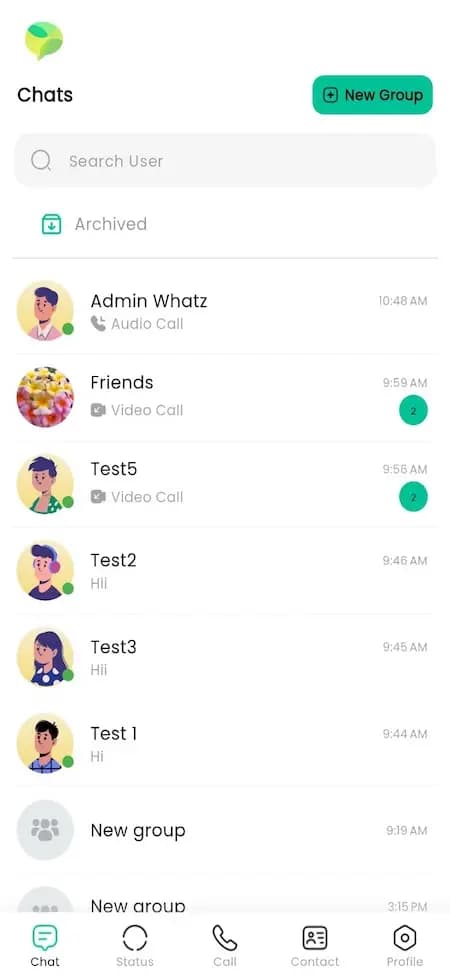
Chat and conversation category reference with source demo branding, sample accounts and avatars. It is not a ChillChat interface or an audio-room screen. Audio Call and Video Call previews do not establish functioning calls, live voice rooms, speaker controls or moderation.
What to check in the walkthrough
02 / OPERATING CONTROL
Give responsible teams the evidence and authority to manage live rooms and financial exceptions.
Connect member controls, host tools, reports, specialist escalation, enforcement, appeals, and audit history.
Separate financial records, reconcile processor events, and govern refunds, fraud holds, and payouts.
Test realtime state, permissions, reporting, repeated callbacks, gift duplication, chargebacks, and recovery.
Compare a host-led video broadcasting model when visual performance and agency operations are central.
A ChillChat-style product is an audio-first social community built around live voice rooms, hosts, speakers, listeners, lightweight social discovery, virtual gifts, and active safety operations. The useful reference is the interaction model, not another company’s branding, interface, content, code, community, or proprietary data. An original product needs its own audience promise, visual identity, room formats, participation rules, monetization boundaries, moderation policies, and operating controls.
This model fits teams that want conversation to be the primary experience: language communities, interest clubs, fan groups, creator sessions, social discovery, facilitated events, or moderated entertainment. It is not simply a smaller live-streaming product. Audio changes the information available to users and moderators, the pace of participation, the accessibility requirements, and the way identity and trust are expressed.
The first product decision is why people should enter a room and remain there. A useful room might offer expert access, guided discussion, companionship, shared listening, language practice, games, community rituals, or creator interaction. Each proposition requires different host tools, discovery signals, scheduling, audience limits, moderation coverage, and success evidence. “Social audio” is a channel; it is not yet a product strategy.
The initial market should be deliberately constrained by audience, language, interest, time zone, or creator cohort. A room directory feels empty when supply is inconsistent, yet filling it with unmanaged rooms can create safety and quality problems. Launch planning therefore needs host recruitment, room programming, moderation coverage, escalation availability, and rules for featured placement alongside application development.
The release should measure an honest participation loop: eligible hosts create scheduled or spontaneous rooms, relevant listeners discover them, users understand who is speaking, moderation tools remain available, and a room closes with a usable record of operational events. Registrations or room impressions alone do not establish community health. Evidence can include qualified host activation, room attendance, listening duration, speaker participation, repeat visits, reports, enforcement outcomes, gift disputes, and operator intervention, provided each metric has a documented definition.
A live-video platform centres a visual broadcaster, camera production, video encoding, visual moderation, and high-bandwidth delivery. An audio-room product centres a stage of hosts and speakers, fast role changes, voice presence, lower-bandwidth participation, and conversation governance. Video may appear later for a proven use case, but adding it to V1 changes infrastructure cost, moderation evidence, device permissions, safety exposure, and creator expectations.
A persistent community workspace is organised around servers, channels, durable member groups, text history, files, integrations, and ongoing administration. A ChillChat-style experience can include follows, clubs, messages, and scheduled rooms, but its core loop is discovering and joining live audio. If the buyer actually needs project coordination, private organisational communication, or an extensible bot ecosystem, a workspace model may be more suitable than an audio-stage product.
These boundaries protect clarity. The proposal should name whether rooms are public, follower-limited, invitation-only, ticketed, or age-restricted; whether clubs persist between events; whether text chat exists during a room; and whether recordings, replays, or clips are included. Each choice changes consent, storage, discoverability, moderation, notification, and rights responsibilities.
Typical roles include listener, speaker, host, co-host, club owner, creator, moderator, trust-and-safety reviewer, support agent, payments reviewer, and platform administrator. A user may hold several roles in different rooms, so authorization should be scoped to the room and action rather than represented by one broad account flag. The server must enforce who can open a microphone, invite or remove a speaker, mute others, end a room, feature content, access reports, issue a gift adjustment, or review sensitive evidence.
A room should have an authoritative lifecycle such as scheduled, open, live, paused, ended, removed, or under review. Speaker invitations, microphone state, reconnection, host transfer, audience limits, and room termination need defined transitions. The client interface reflects this state; it should not be the authority for consequential actions. Repeated or delayed network messages must not produce duplicate speakers, gifts, or enforcement actions.
Identity signals require honest definitions. A host badge may indicate a platform role, completed verification, or membership in a programme, but these are not interchangeable. Display names, profile images, languages, interests, follower counts, and room history can support discovery while also enabling impersonation or harassment. The product should include reporting, blocking, profile review, appeal, and correction routes proportionate to its audience.
The media architecture should account for room size, speaker count, target geographies, device mix, network variability, latency expectations, moderation needs, recording policy, and vendor ownership. A managed realtime provider may reduce initial infrastructure work, while self-managed media infrastructure introduces specialist operational responsibilities. The choice should be recorded with costs, limits, data paths, service dependencies, and an exit or migration consideration.
Mobile users change networks, connect headphones, receive calls, deny microphone access, lock the screen, and return after interruption. The experience should explain connecting, muted, speaking, reconnecting, removed, ended, and unavailable states. Permission prompts need context and denial recovery. Critical controls such as leave room, mute self, block, and report should remain understandable under stress and accessible through assistive technology.
Presence and audience counters should be described carefully. A realtime number may be delayed, sampled, or defined differently across systems. If the product shows listener totals, raised hands, speaker status, or room popularity, the data contract should state how these are calculated. Artificial attendance and misleading engagement indicators weaken trust and should not be used to make an empty launch appear active.
Audio moderation cannot rely on a user taking a screenshot of the harmful moment. The operating model needs immediate participant controls, room-level host controls, platform reporting, triage, escalation, enforcement, and appeal. Report categories should route to an accountable queue and preserve only the evidence permitted by the product policy and applicable review. High-severity threats, exploitation, non-consensual conduct, or risks involving minors require a clearly documented specialist escalation process.
Hosts can manage conversation etiquette, but delegating moderation to hosts does not remove platform responsibilities. Host tools may include muting, moving a speaker to the audience, removing a participant, limiting invitations, slowing requests, appointing co-hosts, and ending the room. Platform operators need additional authority for account restrictions, room removal, safety holds, evidence access, repeat-abuse review, and appeals. Every high-impact action should record actor, reason, time, scope, and outcome.
Automated transcription or audio classification may assist discovery, accessibility, or moderation, but it creates privacy, accuracy, language, bias, retention, and human-review questions. It should not be described as perfect detection. If used, participants need appropriate notice, sensitive decisions need review, and the platform should define what audio is processed, by whom, for what purpose, for how long, and how errors are challenged.
The buyer must decide whether minors are allowed. If the service is adult-only, age assurance and enforcement need to support that promise rather than relying solely on a date-of-birth field. If minors are permitted, the product needs age-appropriate defaults, contact and discovery restrictions, reporting routes, guardian or consent considerations where applicable, moderator training, and an escalation process designed for child safety.
Public voice creates risks that differ from static content: adults can move a conversation into private contact, request identifying information, use coded language, or coordinate harassment in real time. Product design should examine direct messaging, follower discovery, room invitations, profile fields, gifting, private rooms, recording, and location disclosure as connected pathways. The applicable duties depend on audience and jurisdiction and require qualified legal and safety review before launch.
A room can be ephemeral, recorded by the platform, recorded by a host, or made available as a replay. These modes should not be mixed silently. Participants should receive clear notice before joining or speaking when platform recording is enabled, understand the purpose and audience, and be told how long the material is retained. Host controls must not imply that the platform can prevent participants from using external recording tools.
Recording also affects moderation evidence, copyright, music, performer rights, deletion requests, legal holds, and data-subject rights. A consent record should identify the room, policy version, participant action, timestamp, and recording mode where appropriate. If clips or replays are published, the product needs entitlement, editing, reporting, takedown, and rights workflows rather than treating a live conversation as automatically reusable media.
Virtual gifting typically involves at least three separate concepts: a user purchases or receives platform credits, spends those credits on a digital gift, and a creator may become eligible for an earning or withdrawal under platform terms. Credits, gifts, creator earnings, refunds, chargebacks, platform fees, tax records, reserves, and withdrawals should not be collapsed into one editable balance. The system needs durable entries and explicit state transitions so operators can explain how a balance changed.
A gift action should be authorized by the server, priced from an authoritative catalogue, protected against duplicate requests, and linked to the room, sender, recipient, currency package, and resulting ledger events. Processor confirmation can be delayed or repeated. The system should reconcile external payment events and avoid granting irreversible value from an unverified client response. Refund and chargeback rules must define their effect on creator earnings and withdrawals.
Withdrawals create additional eligibility, identity, tax, sanctions, payment-provider, fraud, account-takeover, and support responsibilities. A platform may need minimum thresholds, payout schedules, review holds, beneficiary verification, change controls, reserve policy, and an appeal path. Marketplace or creator-payout capabilities depend on the processor, merchant model, territories, and current terms; software cannot guarantee processor acceptance or lawful availability.
Gifting can also be used for coercion, laundering, stolen-payment abuse, self-gifting, coordinated manipulation, or exploitation of minors. Risk controls can examine velocity, linked accounts, device or payment changes, unusual room activity, rapid withdrawal, disputes, and prior enforcement, while avoiding claims of automatic certainty. Operators need restricted review queues, evidence, reversible holds, documented decisions, and privacy-conscious retention.
The administrative product should expose member and host status, room timelines, speaker and moderation events, reports, enforcement history, appeals, recording status, featured-room decisions, gift and withdrawal records, payment exceptions, risk holds, configuration, and audit logs according to role. Support should not need direct database access to explain why a user cannot speak, why a room ended, or why a withdrawal is pending.
Operational roles should be separated. Community teams may schedule programming and feature rooms without accessing payment evidence. Trust-and-safety reviewers may inspect reports without changing exchange rates. Payments reviewers may investigate withdrawals without publishing content. High-impact changes such as restoring an account, releasing a hold, changing a gift price, or exporting sensitive evidence can require reasons, confirmation, and additional approval.
Feature flags and jurisdiction controls help stage risky functionality. Private messaging, gifting, recording, withdrawal, public discovery, and minor participation can be enabled only when policy, moderation coverage, processor configuration, and support are ready. A configuration surface should show the scope and consequence of a change and preserve a history; it should not become a hidden path for bypassing product safeguards.
Room discovery may use language, topic, followed hosts, club membership, schedule, current activity, safety eligibility, and user preference. Ranking rules should have an accountable owner and exclude rooms or accounts that are not eligible for recommendation. Paid or sponsored placement needs clear disclosure. Popularity should not overpower relevance, diversity, or safety by default, especially when a small number of hosts can dominate a new community.
Notifications should arise from defined events and user preferences: a followed host starts a room, a scheduled event approaches, a speaker invitation arrives, a moderation decision changes, or a withdrawal requires action. Delivery is not guaranteed, so consequential status also belongs inside the product. Frequency controls, quiet hours, language, deep-link destinations, expired events, and promotional consent should be designed rather than delegated to an undifferentiated campaign tool.
A credible V1 can focus on accounts, profiles, follows, scheduled and live public rooms, listener and speaker roles, host controls, discovery, notifications, blocking and reporting, moderation queues, audit records, and basic analytics. Gifting should enter V1 only when payment, ledger, refund, withdrawal, risk, policy, and support boundaries are ready. Recording, private messaging, clubs, games, rankings, agencies, and complex creator programmes can wait unless they are essential to the launch hypothesis.
Acceptance should test more than a successful conversation. The matrix should include denied microphone permission, poor connectivity, reconnection, simultaneous host actions, speaker removal, host departure, room termination, blocked users, report submission, emergency escalation, account restriction, notification expiry, repeated payment callbacks, duplicate gift attempts, refunds, chargebacks, payout holds, and operator recovery. Results should identify release, environment, devices, test identities, expected state, observed state, and unresolved limitations.
The threat model should cover account takeover, impersonation, harassment, microphone abuse, unauthorised room access, invitation spam, scraping, payment fraud, gift manipulation, withdrawal diversion, administrative misuse, sensitive evidence, secrets, and third-party service compromise. Authentication, server authorization, rate limits, session controls, audit trails, encryption, monitoring, backups, incident response, and dependency review should be matched to these actual risks.
A data map should identify profile, social-graph, room, audio, recording, transcription, moderation, device, payment and withdrawal data; its purpose; recipients; location; retention; and access. Accessibility work should cover room discovery, status announcements, controls, focus, labels, contrast, keyboard access on web surfaces, captions or transcripts where included, alternatives for users who cannot speak or hear, and usable error recovery. Applicable legal compliance needs qualified review for the chosen markets.
The signed agreement should define the applicable repositories, design system, schema and migrations, media-provider configuration, mobile and web builds, infrastructure, domains, store accounts, payment and payout accounts, secrets, moderation tools, analytics, monitoring, backups, runbooks, test evidence, policies, licences, reusable components, known limitations, and post-release responsibilities. Production control should not depend on credentials or undocumented knowledge retained by the delivery team.
App Clone Labs can turn familiar audio-community mechanics into an original product scope and implementation, but it does not promise adoption, room liquidity, creator earnings, moderation perfection, processor approval, store approval, legal compliance, or uninterrupted vendor services. Those outcomes depend on product decisions, operations, third parties, market conditions, and specialist review. The deliverable is a transparent, testable system with defined ownership and evidence.
Buyer questions
ChillChat Clone app development means building a custom clone-inspired custom software platform inspired by proven product mechanics, with original branding, workflows, code, admin tools, integrations, and launch support for your market.
ChillChat Clone is best suited for chillchat clone founders, SMBs, agencies, funded startups, and enterprise teams that want a market-ready product without depending on a generic clone script. It works well when you want a proven product category but need original execution, local market fit, and operational ownership.
A clone-inspired product is acceptable when it uses the business model as inspiration but does not copy protected branding, proprietary UI, private data, content, trademarks, or unique assets. App Clone Labs builds original products around familiar mechanics.
The schedule follows the agreed roles, release boundary, integration depth, content readiness, review cadence, testing requirements, and third-party approvals. Multi-role and enterprise builds require broader validation and delivery plans.
V1 should include the smallest complete operating loop for customers, providers, operators, support teams, business admins, and growth teams: onboarding, core workflow, transaction or request state, notifications, admin visibility, support, and analytics.
Advanced personalization, complex loyalty, deep automation, multi-region rules, uncommon integrations, and enterprise analytics should usually wait until real usage proves the core loop.
The applicable agreement defines repository access, bespoke-code assignment or licensing, reusable framework rights, third-party dependencies, deployment context, documentation, and the handover boundary.
Yes. We adapt language, currency, payment methods, compliance needs, business rules, roles, workflows, content, and growth mechanics for your specific market.
Yes. Serious clone-inspired platforms need admin controls for users, transactions, payments, reports, support, moderation, content, settings, and operational exceptions.
The stack depends on scope, but common choices include Next.js web app, React Native or Flutter apps, Node.js APIs, PostgreSQL, Redis queues, cloud hosting, analytics, payment gateways, and role-based admin tooling.
Cost depends on apps required, number of roles, workflow depth, integrations, admin complexity, QA, cloud setup, and launch support. We estimate after mapping the MVP scope and full-build roadmap.
Yes. AI can support search, recommendations, moderation, support copilots, fraud review, document intake, analytics, and workflow automation where it creates real operational value.
We can support post-launch monitoring, bug fixes, analytics review, feature iteration, cloud improvements, app-store updates, and roadmap planning after the MVP goes live.
Solution reference register
01 / Reference and IP
ChillChat is referenced only to describe a familiar audio-community product model. App Clone Labs is not affiliated with or endorsed by ChillChat. The delivered branding, interface, content, rules, and implementation must be original, and launch decisions require independent legal, safety, payment, and operational review.
02 / Regulatory caveat
Age eligibility, child safety, and minor participation require market-specific policy and legal review. · Recording, transcription, moderation evidence, privacy, and retention rules vary by audience and jurisdiction. · Virtual credits, gifts, creator earnings, refunds, fraud controls, tax records, and withdrawals depend on licensed providers and applicable financial rules.
03 / Rights and handover
Original product strategy, design, workflows, content, and implementation only; no third-party code, branding, proprietary data, community, or protected assets are included.
Primary sources
Dated official documentation, standards, and research that support the factual claims on this page.
Primary platform rules relevant to user-generated content, safety, digital goods, privacy, and app quality.
Primary Google Play requirements for applications containing user-generated content.
Primary United States regulatory source for online services directed to children under 13 or knowingly collecting their personal information.
Normative accessibility criteria applicable to web and administrative product surfaces.
Application-security requirements and verification reference for accounts, authorization, data, and transactional workflows.
How to read this page
Scope, cost and timeline figures are planning guidance until confirmed in a written proposal. Diagrams and screens are illustrations, not client deliverables, and source-code rights and handover follow the signed agreement. See the delivery process and the full disclaimer.
Next decision
Bring the audience, room formats, age policy, moderation coverage, recording decision, and gifting model. We will map the smallest complete operating loop.
Commercial rights, repositories, environments, documentation, acceptance and handover remain contract-defined.
App Clone Labs is not affiliated with, sponsored by, or endorsed by ChillChat. The name identifies a familiar product category; every delivered product is independently designed and built, and the mark remains its owner's property. Read the full legal notice.
