
01Participants
Role and authority model
Represent each organisation, person, permission, authority source, and evidence state without implying certification.
B2B freight capacity and load-matching platform
Plan an original freight load board for verified shippers, brokers, and carriers across lanes, offers, dispatch, documents, delivery evidence, fraud operations, and accounting handoffs.
See product screens and demo accessCustom workflows
Brand-safe product strategy
Admin and operations tooling
01 / MARKETPLACE BOUNDARY
Keep shipper, broker, carrier, driver, operator, and accounting responsibilities explicit from listing through closure.
Represent each organisation, person, permission, authority source, and evidence state without implying certification.
Preserve structured freight requirements, bid history, accepted terms, availability, and assignment integrity.
Connect pickup through delivery evidence to governed support and accounting handoffs.
Open registerDeployable Product Architecture
01 / MARKETPLACE BOUNDARY / system register
AI delivery loop
The participant and transaction model.
Useful automation keeps judgment visible
Role and authority model
Lane, offer, and acceptance lifecycle
Dispatch, documents, and exceptions
Control note
Confidence, permissions, fallback behavior, and logs belong in the workflow.
02 / RELEASE EVIDENCE
Prove the selected freight loop with negative cases, reconciliation, operator controls, and accountable ownership.
Test identity changes, stale or contradictory evidence, suspicious listings, document provenance, and restricted access.
Validate offers, acceptance, dispatch, status sources, exceptions, documents, and correction history.
Reconcile obligations and integrations while preserving auditable, scoped operator action.
Compare fleet, dispatch, shipment status, and delivery-evidence workflows outside an open load board.
Review a local same-day delivery model with different participants and commercial states.
Plan an original DAT-style freight marketplace around your lanes, carrier capacity and commercial rules. Use these references to frame a guided demo from equipment intake through posting and assignment. They are separate illustrative workspaces, not DAT screens or evidence of a connected marketplace; freight data sources and integrations need their own agreed scope.
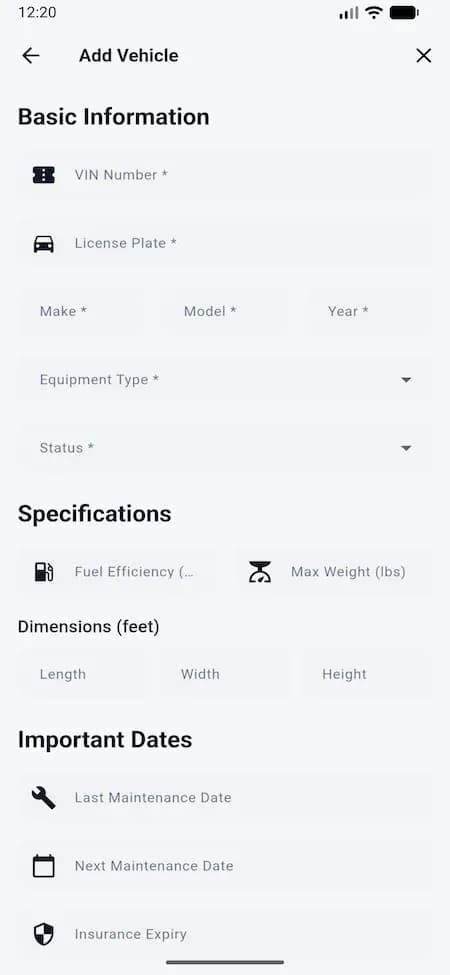
Carrier equipment-intake reference. The blank form shows vehicle specifications and insurance-expiry capture. It does not demonstrate available capacity, carrier authority checks, insurance verification or load matching.
What to check in the walkthrough
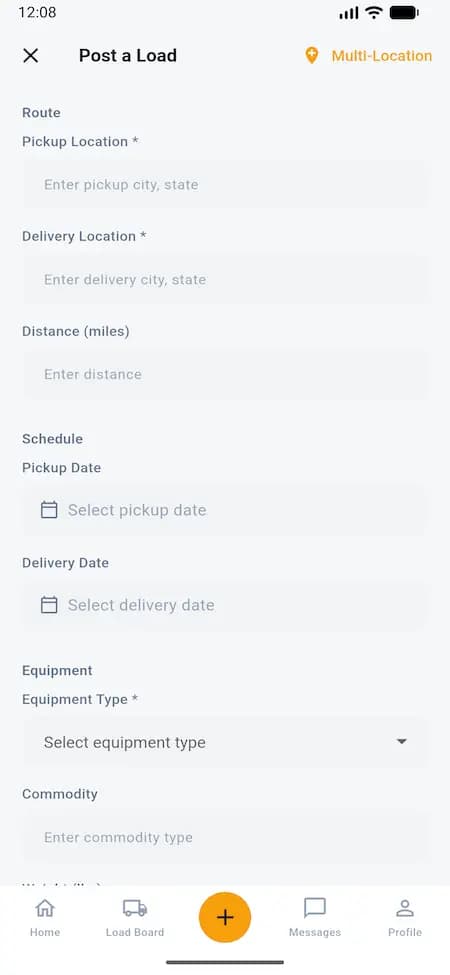
Broker posting reference with route, date, equipment and commodity inputs. The multi-location control does not prove stop sequencing. Carrier search, listing freshness, bids and accepted commercial terms require a demonstrated workflow; no DAT freight feed is shown or included.
What to check in the walkthrough
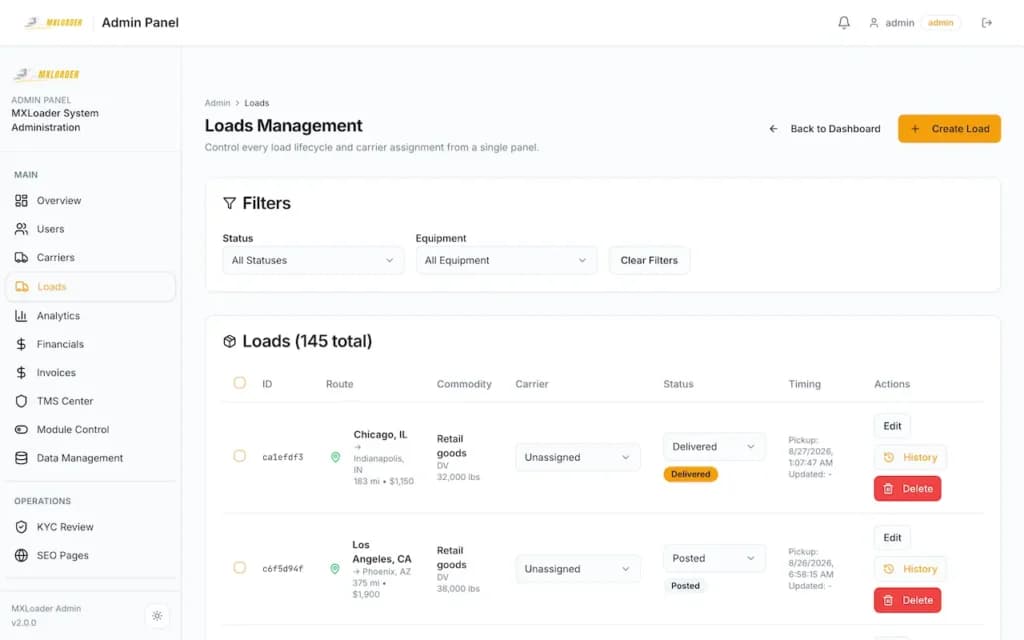
Operations reference with supplied MXLoader branding and sample routes, prices, counts and statuses. It illustrates a load-management table, not DAT affiliation, a live freight network or completed transport. Assignment and history controls need behaviour and permission checks.
What to check in the walkthrough
A DAT-style load board is a business-to-business freight marketplace for publishing loads, discovering carrier capacity, negotiating or accepting commercial terms, verifying counterparties, coordinating dispatch documents, and preserving evidence through delivery and settlement. It is not a local courier application, parcel tracker, consumer moving marketplace, or last-mile dispatch clone. The central problem is matching a shipper or freight broker’s lane demand with an eligible motor carrier while keeping commercial authority, safety information, documents, status, and accounting boundaries clear.
This blueprint is for authorized freight businesses and software teams planning an original load-board product around their own market, participants, rules, integrations, and brand. DAT is referenced only to communicate a familiar category model. App Clone Labs is not affiliated with or endorsed by DAT Freight & Analytics, and the delivered product must not copy proprietary source code, protected branding, private datasets, or restricted marketplace content.
The first decision is who may participate and in what capacity. A shipper may tender its own freight, a property broker may arrange transportation between a shipper and an authorized carrier, and a motor carrier may accept and perform the movement. Some businesses hold more than one authority, but the product should not collapse those responsibilities into one generic company account. Registration, permissions, commercial disclosures, contracts, insurance review, document access, and settlement behavior depend on the role represented in each transaction.
The intended geography also changes the product. Interstate United States freight can require checks against Federal Motor Carrier Safety Administration records, while intrastate or international movements can involve different authorities, documents, tax treatment, cargo rules, and contractual responsibilities. The product can collect and present evidence and enforce configured participation rules, but software does not grant operating authority or certify a party’s legal eligibility. Responsible operators and appropriate specialists must define the requirements for each launch market.
A freight company account can include owners, dispatchers, load planners, carrier sales representatives, drivers, accounting staff, compliance reviewers, and support users. Permissions should follow capabilities and transaction context rather than a single administrator flag. A dispatcher may manage assigned trucks and respond to offers without changing settlement instructions. Accounting may view confirmed charges and remittance records without editing carrier authority evidence. Internal marketplace operators need separate, audited access for verification, disputes, restrictions, and document review.
Identity proofing and business verification are related but separate. The system should record the person acting, the organisation they represent, how that relationship was approved, and which authority or insurance evidence was reviewed. Changes to contact details, bank instructions, ownership, authority status, or administrator access deserve heightened controls because freight fraud often exploits identity changes and urgency. Verification status should include source, time, reviewer or automated check, expiration where applicable, and the limitations of the evidence.
A load listing should express more than an origin and destination. Useful structured fields can include pickup and delivery windows, stops, equipment type, trailer requirements, weight, dimensions, commodity description, handling constraints, temperature needs, hazardous-material indicators, team or solo expectations, appointment rules, accessorial assumptions, and contact procedure. The exact fields follow the market and freight type. Free-text notes can add context, but they should not be the only place where eligibility and operational requirements live.
Locations should preserve the precision appropriate to the stage of negotiation. Search may use market areas, cities, postal regions, radii, or corridors while exact facility details remain restricted until an authorized relationship exists. Time windows need timezone context and a clear distinction between appointment, first-come access, estimated availability, and requested arrival. Equipment taxonomies and units should be controlled so a search for capacity does not silently compare incompatible freight.
Carrier search can consider origin proximity, destination preference, deadhead, pickup timing, equipment, weight, route restrictions, prior relationship, and other declared eligibility. Results should show why a load is a plausible fit and when the listing was last confirmed. A ranking system must not imply that the marketplace guarantees the counterparty, rate, load availability, safety, service, or profitability. Sponsored placement or paid visibility should be distinguishable from organic matching.
Saved searches and alerts can reduce repetitive work, but they require controls for geography, equipment, schedule, notification channel, frequency, duplication, and expiration. A stale load or truck creates wasted calls and mistrust. Listings need ownership, freshness, close or covered states, expiry behavior, and a way to report inaccurate or suspicious information. Search indexes and caches must follow the same eligibility and visibility rules as the authoritative record.
Commercial workflows vary. A load may have a posted rate, invite bids, support a private offer, or require offline negotiation followed by recorded acceptance. The system should identify whether an amount is all-in or line-haul only, which currency and units apply, what accessorials are included, and whether the value is an offer, counteroffer, estimate, benchmark, or accepted term. Rate information without provenance and context can be misleading.
Bids and counteroffers need a lifecycle: submitted, revised, withdrawn, expired, accepted, rejected, or superseded. Acceptance should bind the selected carrier and load version, preserve the agreed commercial snapshot, close competing availability appropriately, and prevent duplicate assignment. If parties negotiate outside the product, the operator should decide what evidence must return to the system before dispatch. No interface label should imply a legally binding contract unless the product’s agreements and workflow actually establish one.
Historic and market-rate information creates additional data-rights and methodology questions. A product should use data it is entitled to process, state the population and freshness behind any aggregate, suppress unsafe small cohorts, and distinguish observed transactions from advertised or user-entered values. This page makes no claim to DAT data or equivalent coverage. An original platform needs its own lawful data supply and a documented method before presenting a benchmark as decision evidence.
For United States interstate operations, FMCSA resources can support checks involving USDOT identity, operating authority, safety information, and insurance or process-agent records. Those sources have different meanings, timing, and limitations. A marketplace should retain the identifier queried, source response, retrieval time, rule applied, and outcome. It should also distinguish a missing, pending, stale, contradictory, inactive, or out-of-scope result instead of reducing every condition to a green badge.
Insurance review may involve insurer or producer documents, policy type, limits, effective and expiration dates, named insured, certificate holder, exclusions, and direct confirmation procedures determined by the operator. A certificate is evidence to review, not a guarantee that a loss is covered. Expiry monitoring, changed authority, identity mismatch, and suspicious document patterns should route to an owned case. Automated extraction may assist a reviewer, but high-consequence eligibility should not depend on unreviewed text recognition.
Load boards can be targeted by account takeover, fictitious pickups, double brokering, identity impersonation, altered contact details, stolen carrier identities, fraudulent documents, payment diversion, cargo theft, and collusion. Controls should combine identity, business records, access history, device and session signals, contact-change review, listing behavior, relationship history, document provenance, and operator investigation. A risk score is only an input; policy determines whether to allow, challenge, restrict, or review an action.
Sensitive details should be released progressively. Pickup numbers, exact addresses, cargo details, driver identity, phone numbers, and documents should be visible only to authorized parties at the appropriate stage. Messaging and file exchange need malware, abuse, retention, and access controls. Reports should create a case with preserved evidence and a clear response path. Restrictions, suspensions, and reinstatement need reason codes, scoped consequences, communication, and appeal or review procedures appropriate to the marketplace.
After acceptance, the workflow can create a tender or confirmation package, capture carrier and equipment assignments, record pickup instructions, and coordinate check calls or structured status events. A defensible load lifecycle can distinguish offered, accepted, tendered, dispatched, arrived, loaded, in transit, delayed, arrived for delivery, delivered, exception, cancelled, and closed states where those states fit the operation. Each transition needs an authorized actor, timestamp, source, prerequisites, and correction process.
Location tracking is not universally required and should not be collected simply because mobile devices permit it. The product must define who is tracked, for which load, during what interval, at what precision, under which notice or agreement, and who can see the result. Telematics, ELD, driver-app, check-call, and partner status can conflict. The interface should expose source and freshness and route material discrepancies to operations rather than present false precision.
Freight transactions can involve rate confirmations, tenders, bills of lading, pickup records, lumper or accessorial receipts, inspection evidence, delivery documents, invoices, and claims material. Document requirements depend on the transaction and agreements. Each file should have a stable identity, uploader, related load, document type, access policy, timestamp, version or supersession state, retention rule, and integrity evidence appropriate to its consequence.
Proof of delivery should not become a single unchecked image. The workflow may capture delivery time, recipient or facility evidence, exceptions, shortage or damage notation, signatures where lawful and required, and document review status. Image enhancement or extraction can assist classification and data entry, but the original evidence should remain available according to policy. Corrections should preserve history rather than overwrite a record involved in settlement or a claim.
A load board may stop at matching and documentation, integrate with a transportation management or accounting system, or support invoicing and payment coordination. These are materially different scopes. The product should identify the party that owes payment, the party that receives it, the agreed charges, accessorial approval, invoice and document prerequisites, payment terms, disputes, offsets, and status reconciliation. It should not describe funds as escrowed, safeguarded, insured, or guaranteed unless the legal and provider arrangements support that statement.
Marketplace fees, subscriptions, and transaction charges require their own records and disclosures. Carrier payment, broker accounting, factoring, quick-pay, and shipper settlement can involve regulated or contract-specific providers. Integrations should use idempotent commands and reconcile provider events with internal obligations. Operators need a read-first timeline and bounded actions for mismatched invoices, duplicate submissions, changed bank instructions, failed transfers, and disputed accessorials. Direct database edits are not an acceptable routine accounting process.
The admin product should organize work by consequence: verification cases, suspicious registrations, expiring evidence, reported listings, duplicate or disputed assignments, document exceptions, tracking gaps, settlement mismatches, complaints, and urgent safety or fraud events. Each queue needs ownership, priority rules, service expectations selected by the operator, evidence, available decisions, escalation, and an audit history. Broad dashboards without actionable queues do not create operational control.
Operators also need governed taxonomies, equipment types, location coverage, marketplace rules, visibility controls, notification templates, fee configuration, role administration, integration health, and feature rollout. High-impact configuration changes should be permissioned, previewable where practical, and traceable. Support access should reveal only the information required for the case. Impersonation, bulk export, restriction, document access, and payment-related changes need stronger controls and review.
Possible integrations include FMCSA data, mapping and routing, transportation management systems, electronic logging or telematics providers, identity and fraud services, communication tools, document processing, electronic signatures, accounting systems, payments, and analytics. Every connection needs an owner, credential boundary, supported workflow, source-of-truth decision, retries, rate-limit behavior, reconciliation, monitoring, and an exit path. A partner logo is not integration acceptance evidence.
APIs and webhooks should carry stable identifiers, tenant and permission context, version expectations, deduplication keys, and observable outcomes. Background imports must not allow one company’s workload or malformed data to affect others. Export and deletion behavior should be documented, especially where commercial records, disputes, tax evidence, safety information, or legal holds require retention. Third-party approval, uptime, coverage, and terms remain outside the software team’s control.
A first release should prove one coherent market loop for a defined participant set, geography, freight profile, and commercial model. That may include verified organisations, structured load posting, compatible search, controlled offers, acceptance, dispatch records, essential documents, status and exception handling, operator cases, and an agreed accounting handoff. It does not need every equipment class, corridor, rate product, automation feature, or financial service on day one.
Success criteria should be operational and reviewable: authorized parties can complete the selected workflow, invalid transitions are prevented, counterparties can understand the current state, operators can investigate exceptions, records reconcile with named external systems, and ownership is clear after handover. We do not promise load volume, carrier participation, rates, savings, revenue, regulatory acceptance, fraud elimination, or a universal implementation timeline.
The signed agreement should define the applicable source code, data schemas, tests, infrastructure, domains, vendor accounts, integration credentials, documentation, operational runbooks, migration work, release process, and support period. It should distinguish client-specific deliverables from reusable know-how, open-source software, pre-existing components, and licensed services. The client should also understand recurring data, mapping, messaging, verification, storage, payment, and monitoring dependencies.
An original load-board marketplace becomes defensible through trusted participation, precise freight data, accountable commercial state, useful operations, and reliable evidence—not by recreating another company’s interface. The objective is a system the operator can govern and improve within its actual authority, contracts, market, and risk appetite.
Buyer questions
DAT Load Board Clone app development means building a custom clone-inspired custom software platform inspired by proven product mechanics, with original branding, workflows, code, admin tools, integrations, and launch support for your market.
DAT Load Board Clone is best suited for dat load board clone founders, SMBs, agencies, funded startups, and enterprise teams that want a market-ready product without depending on a generic clone script. It works well when you want a proven product category but need original execution, local market fit, and operational ownership.
A clone-inspired product is acceptable when it uses the business model as inspiration but does not copy protected branding, proprietary UI, private data, content, trademarks, or unique assets. App Clone Labs builds original products around familiar mechanics.
The schedule follows the agreed roles, release boundary, integration depth, content readiness, review cadence, testing requirements, and third-party approvals. Multi-role and enterprise builds require broader validation and delivery plans.
V1 should include the smallest complete operating loop for customers, providers, operators, support teams, business admins, and growth teams: onboarding, core workflow, transaction or request state, notifications, admin visibility, support, and analytics.
Advanced personalization, complex loyalty, deep automation, multi-region rules, uncommon integrations, and enterprise analytics should usually wait until real usage proves the core loop.
The applicable agreement defines repository access, bespoke-code assignment or licensing, reusable framework rights, third-party dependencies, deployment context, documentation, and the handover boundary.
Yes. We adapt language, currency, payment methods, compliance needs, business rules, roles, workflows, content, and growth mechanics for your specific market.
Yes. Serious clone-inspired platforms need admin controls for users, transactions, payments, reports, support, moderation, content, settings, and operational exceptions.
The stack depends on scope, but common choices include Next.js web app, React Native or Flutter apps, Node.js APIs, PostgreSQL, Redis queues, cloud hosting, analytics, payment gateways, and role-based admin tooling.
Cost depends on apps required, number of roles, workflow depth, integrations, admin complexity, QA, cloud setup, and launch support. We estimate after mapping the MVP scope and full-build roadmap.
Yes. AI can support search, recommendations, moderation, support copilots, fraud review, document intake, analytics, and workflow automation where it creates real operational value.
We can support post-launch monitoring, bug fixes, analytics review, feature iteration, cloud improvements, app-store updates, and roadmap planning after the MVP goes live.
Solution reference register
01 / Reference and IP
DAT is referenced only as a familiar freight load-board category model. App Clone Labs is not affiliated with or endorsed by DAT Freight & Analytics. Any delivered product must use original code, design, branding, workflows, and lawfully obtained data.
02 / Regulatory caveat
Confirm the operating authority, role, contracts, insurance review, and recordkeeping duties applicable to each participant and launch market. · Do not describe verification, insurance, safety data, escrow, settlement, or payment as guaranteed unless the underlying evidence and legal arrangements support that claim. · Use only data, documents, maps, rates, and marketplace information the operator is entitled to collect, process, display, and retain.
03 / Rights and handover
Original solution blueprint only; third-party brands, software, private marketplace data, and protected assets are excluded.
Primary sources
Dated official documentation, standards, and research that support the factual claims on this page.
Official FMCSA public system for carrier licensing and insurance records; interpretations require attention to record type and currency.
Official public company snapshot resource for identifying motor carriers and reviewing available safety-related information.
Official consumer and industry material illustrating identity, authority, and fraud risks in transportation transactions.
Official United States regulation covering property-broker records and duties; applicability requires qualified review.
A requirements-oriented reference for specifying and verifying web application security controls.
How to read this page
Scope, cost and timeline figures are planning guidance until confirmed in a written proposal. Diagrams and screens are illustrations, not client deliverables, and source-code rights and handover follow the signed agreement. See the delivery process and the full disclaimer.
Next decision
Bring the participant roles, geography, lanes, equipment, commercial model, verification policy, integrations, documents, and accounting boundary. We will map the smallest credible operating loop.
Commercial rights, repositories, environments, documentation, acceptance and handover remain contract-defined.
App Clone Labs is not affiliated with, sponsored by, or endorsed by DAT Freight & Analytics. The name identifies a familiar product category; every delivered product is independently designed and built, and the mark remains its owner's property. Read the full legal notice.
