Delivery and local commerce

Deliveroo-style Food Delivery — Custom-Built for Your Market

Restaurant marketplace with courier dispatch and consumer ordering. Planned for food-delivery operators coordinating restaurants, customers, and riders with role-specific workflows, operator controls, integrations, and a handover boundary defined for the selected market.

See product screens and demo access

Custom workflows

Brand-safe product strategy

Admin and operations tooling

Reference walkthrough by arrangement

Review restaurant discovery, merchant operations and marketplace controls.

For a Deliveroo-style food marketplace, use these references to examine how customers discover restaurants, how partners manage service availability and how operators govern a shared catalogue. These are illustrative food-delivery screens, not Deliveroo UI or evidence of affiliation. A guided demo should confirm checkout, dispatch, refunds and local operating rules for your launch markets.

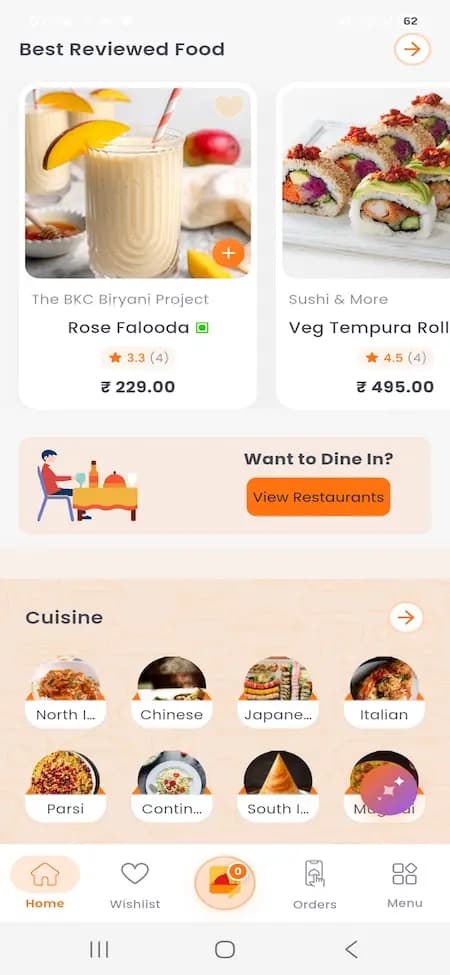
Food marketplace discovery reference with restaurant cards, sample meals, ratings and basket navigation

Food marketplace discovery reference with restaurant cards, sample meals, ratings and basket navigation

Customer discovery reference with sample restaurant names, ratings, prices and cuisine categories. The visual illustrates browsing and a basket entry; search ranking, address eligibility, checkout and delivery estimates require a guided demonstration.

What to check in the walkthrough

  • How are restaurants filtered by delivery area, opening hours, dietary options and estimated arrival time, and which rules are configurable per market?
  • Ask to follow a basket from item customisation through address and payment: where are delivery fees, service charges, minimum spend and the final total made explicit?
  • If an item sells out or a restaurant pauses service after a customer adds to the basket, how are alternatives, fees and customer notifications handled?
Open full-size reference
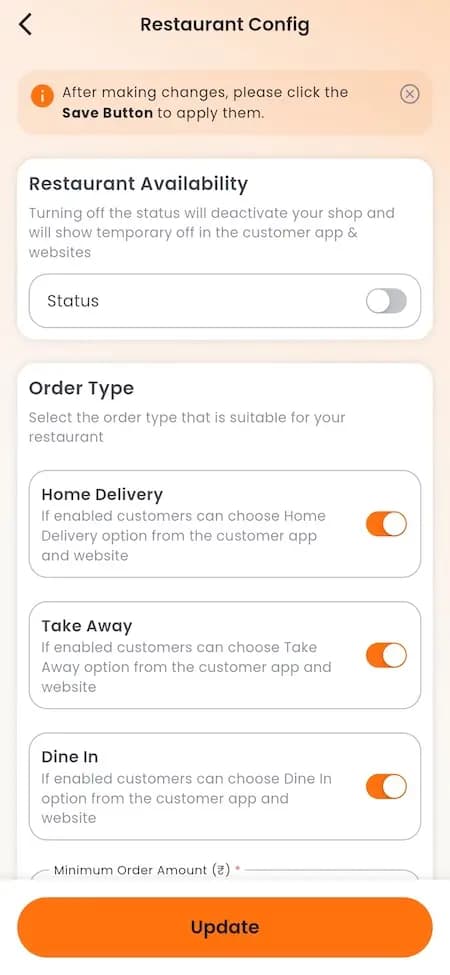
Restaurant operations reference with delivery, takeaway and dine-in availability switches and an update action

Restaurant operations reference with delivery, takeaway and dine-in availability switches and an update action

Restaurant operations reference showing service availability and order-type switches. The controls are illustrative; saving, order acceptance, preparation timing, courier assignment and partner permissions need demonstration.

What to check in the walkthrough

  • Can a partner enable delivery, pickup or dine-in independently, and what happens to open baskets or accepted orders when one service is paused?
  • Who can change preparation times, menus and temporary closures, and is every change recorded with an operator, timestamp and reason?
  • Ask to demonstrate a late preparation or failed courier handoff: which team owns the exception, what does the customer see and how is the partner settlement adjusted?
Open full-size reference
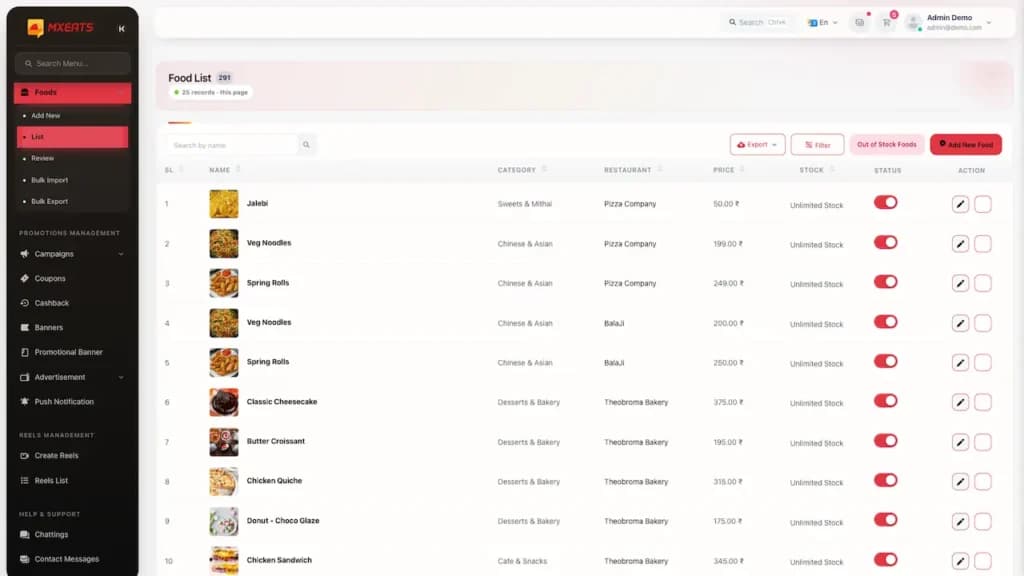
Food marketplace catalogue reference listing restaurant items with categories, prices, stock and status controls

Food marketplace catalogue reference listing restaurant items with categories, prices, stock and status controls

Operator catalogue reference with demo food entries, merchant attribution and stock/status controls. It does not demonstrate payment settlement, courier dispatch, refunds or any Deliveroo integration.

What to check in the walkthrough

  • Which menu, price, allergen and availability changes can partners publish directly, and which changes require marketplace review before going live?
  • How are commissions, customer refunds, promotions and courier charges reconciled when an order is cancelled after preparation starts?
  • What audit trail connects a support decision to the customer notification, payment event and restaurant settlement, and which roles may view or approve it?
Open full-size reference

Solution reference register

01 / Reference and IP

This page references third-party product names only to describe familiar product models and planning references. App Clone Labs is not affiliated with or endorsed by those brands. Build decisions require independent legal, regulatory, and operational review for your market.

02 / Artifact status

Boards, diagrams, screens and workflow descriptions on this page are illustrative planning artifacts, not evidence of a deployed client product.

03 / Regulatory caveat

Food safety and allergen review required · Courier work and insurance rules vary by market

04 / Rights and handover

Source access, licensing, repositories, environments, documentation, acceptance and handover are defined by the signed contract and accepted scope.

Scope

Operating model defined

Roles, workflows, dependencies, exclusions, and assumptions are made reviewable.

Evidence: illustrative

System

Applications connected

Experience, operations, services, data, integrations, and release controls are planned together.

Evidence: illustrative

Handover

Rights stated in writing

Access, assignment, licensing, dependencies, documentation, and support follow the signed agreement.

Evidence: illustrative

Artifact register

Product screens and planning references.

Reference screens illustrate workflows, not a contracted feature list. Sample prices, data, and responses are demonstration content; confirm the current scope during a walkthrough.

Deliveroo-style Food Delivery connected product workflow planning visual
Connected customer, operations, and data workflowEvidence: illustrativeOpen full-size reference
Deliveroo-style Food Delivery product engineering ecosystem visual
Product engineering ecosystem and handover boundaryEvidence: illustrativeOpen full-size reference
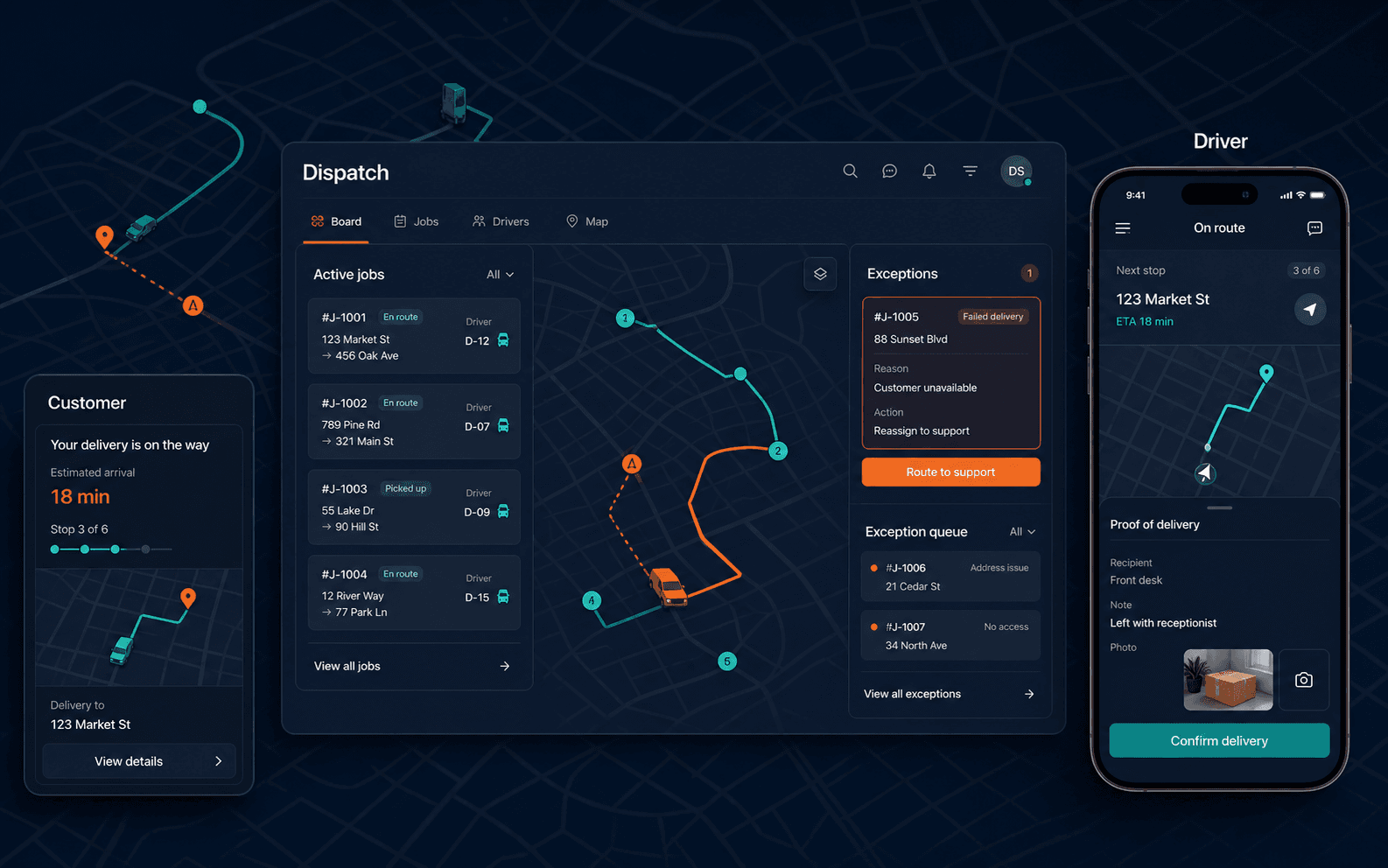
Deliveroo-style Food Delivery operations and dispatch planning visual
Operations, dispatch, and exception handlingEvidence: illustrativeOpen full-size reference

The meal is ready, but the rider is still elsewhere

A restaurant has packed two curries when the assigned rider reports a delay at another collection. The kitchen sees ready, the customer sees an arrival estimate, and dispatch sees a rider moving on a map. Those three views need to converge on one decision: collect within the agreed meal-handling window, reassign, or resolve the order with support. Keeping the original estimate on screen while food waits does not coordinate the delivery.

A Deliveroo-style build is an independently branded restaurant marketplace connecting consumer ordering, merchant acceptance and courier dispatch. The reference describes a product pattern; it includes no Deliveroo affiliation, proprietary software, restaurant contracts or inherited rider network. Start with the restaurant-to-rider handoff and the operator who can resolve a failed collection. That operating brief gives the customer app a credible status to display.

Bound a restaurant marketplace around one service area

Choose a launch area with named restaurant onboarding responsibilities, operating hours and a rider supply plan. State whether dispatch uses contracted fleets, individually onboarded riders or a selected logistics provider. A restaurant shown in search needs permission to trade through the marketplace and a way to pause orders when its kitchen cannot cope. A deliverable address needs supported collection and delivery coverage, rather than only a location inside a drawn boundary.

Compare the Uber Eats-style food and grocery marketplace brief when grocery baskets belong in the plan. This release centers prepared meals, kitchen readiness and courier collection. Grocery substitutions, broader category rules and a multi-market operating structure add separate decisions that should not be hidden inside a restaurant ordering quote.

Make item choices and allergen notes reach the kitchen

A dish with required spice level and an optional side needs a menu contract that survives checkout and kitchen printing. Validate allowed combinations, required choices, price additions and temporary unavailability before the customer pays. Snapshot the accepted dish description and modifiers with the order, so a menu edit cannot change what the customer bought. Explain who can publish merchant changes and how the restaurant confirms that its kitchen receives the same choices.

Show merchant-maintained allergen information before ordering and provide an explicit route for a question the published menu cannot answer. Keep an allergen note visible on the merchant ticket and record its acknowledgement where the agreed workflow requires it. Free text is not a substitute for validated information or a safety assurance. Food handling, allergen responsibilities and escalation language need review by the responsible restaurant and qualified local advisers.

Separate submitted orders from merchant acceptance

A customer submitting a basket does not prove that the restaurant can prepare it. Define placed, accepted, rejected and expired states, with an acknowledgement deadline chosen for the operation. Display a pending state while the kitchen responds and avoid announcing preparation before the acceptance event. A rejection should carry a usable reason, such as unavailable items or a paused kitchen, and explain the payment outcome without forcing the customer to discover it later.

Decide whether the merchant accepts from a tablet or a POS, and which system owns that action. Verify that an order reaches the kitchen once even when a connection retries. Acceptance in the ordering service and successful kitchen injection are related but different facts; a failed injection needs an operator alert and recovery route. Preserve the order reference across both systems so support can inspect the same meal rather than searching several unrelated tickets.

Use ready time as a coordination signal

Track estimated kitchen readiness, preparation started and actual ready as separate events. The restaurant must be able to report a delay with a reason and updated expectation; dispatch must see whether the assigned rider can accommodate it. Define when the kitchen should mark ready, including packing and any final collection checks. Reporting ready to improve a dashboard while cooking continues creates rider waiting and makes the next estimate less useful.

Deliveroo’s Order ready and Need more time guidance describes attempts to adjust rider arrival and explains that an existing rider journey or busy network can limit the response. That is a useful boundary for an independent product: record a timing request and the resulting dispatch decision separately. Neither control should promise that a rider will become available immediately.

Dispatch against kitchen readiness and rider availability

Assign a rider using the agreed service area, available capacity, collection location and supported meal-handling rules. Show dispatch the estimated ready time and the rider’s current collection commitment. An assignment should have an acknowledgement and expiry route; an unanswered offer is not a confirmed collection. If the merchant requests more preparation time, decide whether to retain the rider, adjust the offer or reassign with an accountable reason.

Handle the opposite exception explicitly: the meal is ready but no rider can collect. Surface how long the packed meal has waited and who may make the next decision under the operator’s food-handling policy. Do not silently roll the customer estimate forward forever. A freshness concern may need restaurant consultation, remake, cancellation or another reviewed remedy, with its cost and customer communication recorded rather than a generic delivery-failed label.

Confirm the rider collects the correct package

Rider arrived and meal picked up are different states. At a busy restaurant, several similar bags can share a counter. Give the merchant and rider a common collection reference, a package-count check and a clear way to report a mismatch or missing drink before departure. Avoid showing pickup solely because location data places the rider near the restaurant; proximity cannot prove that the correct food changed hands.

Record the collection confirmation, actor and time, with the minimum evidence agreed for the service. If the rider reports ready food missing, preserve both reports and send the case to dispatch. For an offline rider, distinguish a locally queued update from a server-confirmed pickup and reconcile it on reconnection. Restrict access to customer addresses and contact channels to the people handling the order, with retention and emergency support rules settled before rollout.
Give customers tracking that explains uncertainty

Customer tracking should follow accepted order events: restaurant accepted, preparing, rider assigned, collected and delivered or unresolved. Explain a changed estimate when the kitchen or rider reports a delay. If location updates stop, show the last known update and a support route rather than making a frozen marker appear live. Agree when location sharing starts, who may see it and when it ends after the order closes.

Delivery needs a defined confirmation method and an exception for inaccessible buildings, incorrect addresses or customers who cannot be reached. A failed call is not proof of delivery, and a completed route is not evidence that the meal reached the recipient. Keep customer notifications consistent with the authoritative state. A support agent should see the accepted instructions and relevant handoff events before choosing an eligible remedy under the reviewed customer terms.

Reconcile canceled orders across kitchen, rider and payment

Cancellation before merchant acceptance differs from cancellation after cooking starts or after rider pickup. Define which actions remain possible at each stage, who approves them and how the kitchen and rider are notified. A customer cancellation request should remain visible until its outcome is confirmed. Preserve the original order, cancellation reason and stage of fulfillment; deleting an order hides the evidence needed to explain both food cost and payment.

Separate payment authorization, capture, refund requested and refund confirmed. A timeout can leave a refund outcome unknown; query or reconcile the provider before trying again. Merchant statements and rider compensation must reflect the reviewed allocation of responsibility, including promotions, delivery charges and any approved adjustments. Give support an unresolved reconciliation queue rather than marking every canceled order financially closed as soon as its customer screen changes.

Integrate order events without duplicate kitchen tickets

Agree an authenticated event contract for the POS, dispatch and payment connections. Include the order identifier, source event identifier, status, event time and permitted transitions. Retried notifications should update the existing order instead of printing a second meal ticket or opening another rider task. Late events need reconciliation: a stale accepted event must not reopen a canceled order, and an unconfirmed payment callback must not become evidence that food was delivered.

The Deliveroo Order Integration guide documents order webhooks, distinct tablet and tablet-less acceptance flows, and optional rider events. Use those distinctions to ask precise integration questions. The guide explains a vendor connection; access, credentials and actual endpoint behavior for your chosen systems still require verification. An independent application does not receive Deliveroo API eligibility by resembling its screens.

Ask the demo to survive a delayed meal and a lost callback

Buyer acceptance should follow one meal from discovery through modifiers, merchant acknowledgement, preparation update, rider arrival, collection and customer confirmation. Use redacted people and clearly identified sandbox payments. Illustrative demo artwork helps discuss screen layout but does not establish live dispatch, restaurant participation or delivery reliability. Ask to inspect the shared order history from customer, kitchen, rider and support views, including who can alter each state.

Then force a rejected dish, an unanswered merchant order, a ready-time delay, ready food without a rider and a wrong collection reference. Replay an order notification, disconnect a rider and interrupt a refund callback. Require the operator to find the exception, explain what the customer sees and show the recovery evidence. Record any manual steps and missing provider access in the acceptance report. The demonstration should distinguish configured capabilities from custom work and unresolved operational dependencies.

Bring a kitchen ticket and a cancellation policy to scoping

Bring a redacted menu with required modifiers, an actual kitchen ticket format, preparation events and sample cancellation cases. Name the merchant onboarding owner, dispatch lead, support approver and payment reconciliation owner. Confirm launch coverage, restaurant agreements, rider arrangements and integration access before setting the release plan. Review food safety, allergen handling, worker arrangements, insurance, privacy and consumer terms for the actual jurisdiction; software delivery does not grant permission to operate.

Use a restaurant delivery scope discussion to agree the first meal workflow, provider dependencies and observable acceptance criteria. Include source ownership, deployment access, backups, third-party licences and support responsibilities in handover. Arrival estimates depend on kitchen capacity, rider availability and travel conditions; the application cannot guarantee a delivery time.

Review the delivery process for checkpoints covering menu preparation, merchant and rider walkthroughs, exception testing and operator handover.

Product flow

Role-workflow flow diagram.

A visual map of how each role interacts with each workflow stage, with operator controls and integration boundaries.

Deployable Product Architecture

Deliveroo-style Food Delivery

CONFIRM MENU CHOI…ALIGN A KITCHEN R…TRACE THE MEAL FR…Accept a meal ord…Collect the corre…Coordinate kitche…INTEGRATIONS: Restaurant POS or kitchen display systems with confirmed merchant access, m…OPERATOR CONTROLS: Keep modifiers and allergy messages visible to the kitchen · Escalate a mea…
Illustrative validation artifact — role-workflow flow diagram; final surfaces, boundaries, and integration topology are confirmed during discovery.

User roles

Deliveroo-style Food Delivery roles and workflows.

Clone-inspired platforms usually need several coordinated interfaces, not just a customer app.

Restaurant team

01

Accept a meal order and report kitchen readiness

Review item modifiers and allergen notes, acknowledge the order, update preparation time and mark packed food ready for collection. Own menu availability and the kitchen handoff record.

Delivery rider

02

Collect the correct meal and confirm the customer handoff

Accept an eligible dispatch, report arrival, verify the collection reference and record pickup. Share relevant journey status and use an assigned support route when access or delivery fails.

Dispatch and support

03

Coordinate kitchen capacity, rider arrival and exceptions

Investigate unaccepted orders, changed ready times, rider reassignment and freshness concerns. Keep customer updates, cancellation decisions and settlement adjustments attached to one order.

Workflow

Deliveroo-style Food Delivery workflow stages.

Each workflow stage is mapped to a role, screen, API, notification, admin control, and measurable launch outcome.

Merchant acceptance

01

Confirm menu choices and an achievable preparation plan

Check restaurant hours, available dishes, required modifiers and the delivery address before submission. Capture the accepted item and price snapshot, kitchen acknowledgement and rejection reason when applicable.

Preparation and arrival

02

Align a kitchen ready time with a rider collection

Keep estimated readiness separate from actual ready, rider assigned and rider arrived events. React to kitchen delays or missing riders through a visible dispatch decision and a revised customer estimate.

Handoff and closure

03

Trace the meal from restaurant collection to order reconciliation

Confirm the package reference at pickup, publish supported transit updates and record delivery or an unresolved handoff. Reconcile canceled orders, refunds, merchant amounts and rider compensation under reviewed terms.

Deployable Product Architecture

Workflow / system register

Revision BPlanning surface

Live operations

Deliveroo-style Food Delivery workflow stages.

Every request becomes an observable job

Live operations: Deliveroo-style Food Delivery workflow stages.Every request becomes an observable job. Exceptions and support need the same visibility as the happy path.
01

Confirm menu choices and an achievable preparation plan

02

Align a kitchen ready time with a rider collection

03

Trace the meal from restaurant collection to order reconciliation

Control note

Exceptions and support need the same visibility as the happy path.

Illustrative architecture register; validate against the accepted scope.

Operator controls

Deliveroo-style Food Delivery admin and operator controls.

The control center is scoped as a first-class product surface, not an afterthought.

Menu responsibility

01

Keep modifiers and allergy messages visible to the kitchen

Version merchant menu changes and validate required options. Record who reviewed an allergen question; a customer note alone must not become an assurance that the dish is safe.

Freshness and dispatch

02

Escalate a meal waiting beyond the agreed collection window

Measure ready-to-pickup waiting, distinguish missing rider capacity from kitchen delay and require accountable reassignment or cancellation. A ready button cannot create available riders.

Order evidence

03

Restrict changes and preserve exception decisions

Separate merchant, rider and support permissions. Authenticate external events, deduplicate retries and retain the reason, actor and financial consequence of each cancellation or adjustment.

Monetization

Deliveroo-style Food Delivery monetization models.

We model monetization early so payments, admin controls, and reporting support the business.

State the restaurant charge and settlement basis

Define commission on eligible order components and show tax, promotions, cancellations and refund adjustments in merchant statements. Obtain agreement before exposing a restaurant offer.

Explain what the customer pays for the selected service

Show delivery charges and any other applicable fees before checkout. Define collection failure and refund treatment without presenting an estimate as a guaranteed arrival time.

Offer disclosed paid discovery with a bounded campaign

Label sponsored placements, define their eligibility and billing basis, and preserve organic availability checks. Promotion purchases do not establish fulfillment capacity or promise extra orders.

Integrations

Deliveroo-style Food Delivery integration surface.

External systems that determine launch readiness, data flow, and operational continuity.

Integration

01

Integration 1

Restaurant POS or kitchen display systems with confirmed merchant access, menu and modifier mapping, order acknowledgements and preparation-stage events

Integration

02

Integration 2

Maps and rider dispatch services with licensed access, launch-area coverage, location permissions, arrival events and an owner for failed assignments

Integration

03

Integration 3

Payment and notification providers with scoped accounts, authenticated callbacks, refund reconciliation and customer updates tied to the authoritative order state

Scope drivers

Deliveroo-style Food Delivery scope drivers.

The variables that most influence build effort, cost, and launch readiness.

Kitchen operating model

01

Decide how restaurants accept and update orders

Confirm tablet or POS workflows, peak kitchen capacity, preparation-time ownership and item-modifier rules. Define temporary pauses and the response to a missed acknowledgement.

Courier coverage

02

Bound where and when collection can be supported

Name the rider supply model, eligible service area, reassignment owner and delivery-access constraints. Test arrival and readiness changes rather than assuming a map proves capacity.

Exception economics

03

Agree who bears each cancellation and refund outcome

Separate rejected orders, kitchen-started cancellations, failed collection and customer delivery disputes. Map payment status, merchant liability and rider treatment with the responsible operating team.

Deployable Product Architecture

Scope drivers / system register

Revision EPlanning surface

Live operations

Deliveroo-style Food Delivery scope drivers.

Every request becomes an observable job

Live operations: Deliveroo-style Food Delivery scope drivers.Every request becomes an observable job. Exceptions and support need the same visibility as the happy path.
01

Decide how restaurants accept and update orders

02

Bound where and when collection can be supported

03

Agree who bears each cancellation and refund outcome

Control note

Exceptions and support need the same visibility as the happy path.

Illustrative architecture register; validate against the accepted scope.

V1 scope

Deliveroo-style Food Delivery V1 foundation.

Launch the smallest complete operating loop first, then scale the product with confidence.

Meal ordering

01

Submit one restaurant basket with clear choices

Include merchant discovery, operating hours, dish modifiers, allergen information, checkout and acceptance status. Preserve accepted prices and instructions on the kitchen ticket.

Restaurant-to-rider coordination

02

Make readiness, delay and pickup inspectable

Provide preparation updates, actual ready, rider assignment, arrival and pickup confirmation. Give dispatch an exception queue for food waiting, absent riders and mismatched collection references.

Customer and support closure

03

Follow the order and explain its financial outcome

Include honest tracking, support cases, cancellation handling and reconciled refund and merchant statements. Demonstrate permissions and event recovery with redacted records.

Later phases

Deliveroo-style Food Delivery post-launch expansion.

Capabilities that should usually wait until real usage proves the core loop.

Scheduled meals

01

Add advance orders after kitchen release rules are settled

Separate booking acceptance from preparation start and dispatch timing. Review closing hours, capacity reservations, late changes and failed confirmation before launch.

Grouped rider collections

02

Evaluate batching against freshness and handoff risk

Add multiple pickups only after route constraints and package identification are tested. Measure meal waiting and customer delay rather than treating shorter routes as proof of better service.

Additional food categories

03

Extend menus after handling and support rules are reviewed

Add eligible grocery or specialist food partners with separate stock, substitutions and handling rules. Review restricted items and partner responsibilities for each proposed market.

Deployable Product Architecture

Later phases / system register

Revision BPlanning surface

Live operations

Deliveroo-style Food Delivery post-launch expansion.

Every request becomes an observable job

Live operations: Deliveroo-style Food Delivery post-launch expansion.Every request becomes an observable job. Exceptions and support need the same visibility as the happy path.
01

Add advance orders after kitchen release rules are settled

02

Evaluate batching against freshness and handoff risk

03

Extend menus after handling and support rules are reviewed

Control note

Exceptions and support need the same visibility as the happy path.

Illustrative architecture register; validate against the accepted scope.

Regulatory review

Deliveroo-style Food Delivery regulatory and compliance flags.

Each flag must be reviewed by qualified counsel for your target market before build or launch.

Flag 1

Food safety and allergen review required

Flag 2

Courier work and insurance rules vary by market

Reference walkthrough

Request a Deliveroo-style Food Delivery reference walkthrough.

Ask us to confirm which reference surfaces are currently available for this product model. Rather than publishing shared demo credentials, we schedule a private guided walkthrough for qualified buyers.

Reference surface

01

Restaurant team: Accept a meal order and report kitchen readiness

Request a role-specific demonstration and confirm which capabilities are currently available. Review the proposed responsibility: Review item modifiers and allergen notes, acknowledge the order, update preparation time and mark packed food ready for collection. Own menu availability and the kitchen handoff record.

Reference surface

02

Delivery rider: Collect the correct meal and confirm the customer handoff

Request a role-specific demonstration and confirm which capabilities are currently available. Review the proposed responsibility: Accept an eligible dispatch, report arrival, verify the collection reference and record pickup. Share relevant journey status and use an assigned support route when access or delivery fails.

Reference surface

03

Dispatch and support: Coordinate kitchen capacity, rider arrival and exceptions

Request a role-specific demonstration and confirm which capabilities are currently available. Review the proposed responsibility: Investigate unaccepted orders, changed ready times, rider reassignment and freshness concerns. Keep customer updates, cancellation decisions and settlement adjustments attached to one order.

Next step

04

Book a walkthrough

Request a live, private walkthrough of the reference implementation. We will confirm scope and discuss configured deployment versus custom build for your market.

Open register

Deployable Product Architecture

Reference walkthrough / system register

Revision APlanning surface

Live operations

Request a Deliveroo-style Food Delivery reference walkthrough.

Every request becomes an observable job

Live operations: Request a Deliveroo-style Food Delivery reference walkthrough.Every request becomes an observable job. Exceptions and support need the same visibility as the happy path.
01

Restaurant team: Accept a meal order and report kitchen readiness

02

Delivery rider: Collect the correct meal and confirm the customer handoff

03

Dispatch and support: Coordinate kitchen capacity, rider arrival and exceptions

04

Book a walkthrough

Control note

Exceptions and support need the same visibility as the happy path.

Illustrative architecture register; validate against the accepted scope.

Process

A traceable path from decision to acceptance.

  1. 01

    Model teardown

    We map the reference business model, user roles, monetization path, regulatory needs, and launch constraints.

    Artifact: Product teardown, risk map, role matrix

  2. 02

    Market-fit blueprint

    We reshape the model around your market, operations, pricing, workflows, and first release priorities.

    Artifact: Feature scope, flows, technical plan

  3. 03

    Design and build

    Product, design, engineering, QA, and cloud delivery move in weekly demo cycles with visible progress.

    Artifact: Working releases, QA notes, sprint demos

  4. 04

    Launch and operate

    We support production release, monitoring, handoff, roadmap decisions, and post-launch improvement.

    Artifact: Launch checklist, docs, growth backlog

FAQ

Questions to resolve before the build.

01Does the build include Deliveroo restaurants or riders?

No. Deliveroo is a product reference for an independently branded restaurant marketplace. Its affiliation, software, merchant contracts, customer data and rider network are not included. Restaurant participation, courier supply and provider access need their own agreements.

02What should the first restaurant delivery release cover?

Scope one service area, one restaurant basket, required modifiers, merchant acceptance, preparation updates, rider collection, customer tracking and order reconciliation. Include operator routes for delays, unavailable riders, cancellation and unresolved payment outcomes.

03How do restaurant modifiers reach the kitchen?

Validate required choices and permitted combinations before checkout, then preserve the accepted item, options, prices and notes on the kitchen ticket. Verify POS or tablet mapping with a real ticket example and test retries without duplicate preparation.

04Can an allergen note guarantee a safe meal?

No. Provide merchant-maintained allergen information and a route for questions that need a restaurant response. Keep notes visible and record required acknowledgements. Food safety and allergen responsibilities need qualified review; free text does not establish safety.

05When does an order become accepted?

Only when the responsible merchant workflow confirms acceptance. Keep submitted, accepted, rejected and expired states distinct, with an agreed acknowledgement deadline. Show the customer a pending state and explain payment treatment when acceptance fails.

06Does marking a meal ready guarantee an earlier rider?

No. Actual ready is a coordination signal. Dispatch must consider available riders and existing collection commitments, then record its response. Define an escalation when packed food waits rather than promising immediate capacity or a guaranteed arrival time.

07What happens when the kitchen needs more preparation time?

Record a revised ready estimate and reason, notify dispatch and update customer expectations. Decide whether the assigned rider remains suitable or needs reassignment. Preserve both the timing request and dispatch outcome so support can explain the delay.

08How is the restaurant-to-rider handoff confirmed?

Use a common order reference and agreed package checks, then record pickup separately from arrival. Location near the restaurant does not prove collection. Provide a mismatch or missing-package route before departure and reconcile offline rider updates.

09What should customer tracking show if rider location is stale?

Show the last known update with an understandable uncertainty state and support access. Keep order milestones tied to confirmed events. Agree who sees location, when sharing begins and ends, and which evidence confirms delivery.

10How are canceled orders and refunds reconciled?

Retain the cancellation stage, reason and approvals alongside kitchen and rider events. Track refund requested separately from provider-confirmed refund and investigate ambiguous callbacks. Reconcile merchant and rider amounts under reviewed commercial terms before financial closure.

11Which integrations need verification before rollout?

Verify POS or kitchen display access and modifier mapping, dispatch and map coverage, payment callbacks and notification delivery. Authenticate events, deduplicate retries and assign recovery owners. Deliveroo-style screens do not confer vendor API eligibility.

12What evidence should a buyer request in the walkthrough?

Follow one sandbox meal across customer, kitchen, rider and support views, then test delayed readiness, missing riders, wrong packages, duplicate events and interrupted refunds. Inspect the recovery trail and permission boundaries. Treat illustrative screens as layout references, not operating evidence.

Primary sources

References behind this page

Dated official documentation, standards, and research that support the factual claims on this page.

  1. 01
  2. 02

Citation readiness

How to interpret this page

Published by App Clone Labs Editorial Team

Commercial claims
Scope, cost, and timeline claims are planning guidance and require validation in a current proposal.
Evidence status
Diagrams, boards, examples, and estimates are illustrative planning artifacts unless explicitly identified with a source and measured evidence status.

Next decision

Turn the brief into an accepted product scope.

Define outcomes, constraints, evidence, rights and handover before delivery begins.

Commercial rights, repositories, environments, documentation, acceptance and handover remain contract-defined.

Scope Deliveroo-style Food Delivery

Independent from Deliveroo

App Clone Labs is an independent software development studio. We are not affiliated with, connected to, sponsored by, or endorsed by Deliveroo.

Why this name appears

Deliveroo is referenced descriptively to identify familiar product mechanics and common search terminology. “Clone” describes a planning reference, not a replica.

Original delivery

Any product delivered by App Clone Labs is independently designed and developed for the accepted scope. It does not contain proprietary code, branding, copy, interface assets, or confidential material from Deliveroo.

Trademark ownership

Deliveroo and associated names, logos, and marks remain the property of their respective owners. Their use identifies a reference category and does not imply authorization or endorsement.