
01Contributor
Protected submission boundary
Collect proportionate eligibility signals while minimising public, employer, operational, and analytical identity exposure.
Employer reviews, salaries, interviews, and jobs
Plan an original workplace-intelligence platform with anonymous-review provenance, moderation, employer recourse, salary methodology, privacy, and connected jobs.
See product screens and demo accessCustom workflows
Brand-safe product strategy
Admin and operations tooling
01 / TRUST MODEL
Anonymous workplace intelligence requires provenance, moderation, privacy, and accountable dispute handling.
Collect proportionate eligibility signals while minimising public, employer, operational, and analytical identity exposure.
Verify representatives, label responses, protect contributor data, and preserve accountable review decisions.
Version rules, evidence decisions, escalate sensitive matters, and distinguish fact, opinion, allegation, and abuse.
Deployable Product Architecture
01 / TRUST MODEL / system register
Product delivery loop
The product is a governed evidence system.
A focused release proves one complete workflow
Protected submission boundary
Response and appeal pathway
Policy-led moderation
Control note
Scope the customer action and the operator response as one system.
02 / INTELLIGENCE
Reviews, salaries, and interview summaries should expose provenance, methodology, samples, and limitations.
Structure role, level, location, period, currency, components, date, cohort, and estimation status.
Capture stages and outcomes without soliciting confidential assessments or personal allegations.
Publish authorised vacancies with source, expiry, sponsorship labels, and independent moderation.
Compare the vacancy, candidate, application, and recruiter workflow without workplace-review scope.
Review a job-search and employer-publishing model with a different primary intent.
03 / DELIVERY
Design customer-facing explanations and operator controls together.
Make submission, redaction, moderation, response, notice, and appeal states understandable.
Open registerTest identity separation, permissions, logs, exports, retention, and privileged workflows.
Open registerAdapt proven category mechanics without copying proprietary assets, data, content, or code.
Open registerDeployable Product Architecture
03 / DELIVERY / system register
Product delivery loop
Connect policy to product operations.
A focused release proves one complete workflow
State-aware product design
Privacy and security review
Original solution engineering
Control note
Scope the customer action and the operator response as one system.
Use this original recruitment concept to scope employer, candidate and moderation workflows. It is not Glassdoor UI or proof of employers, salaries, reviews, job listings or platform affiliation.
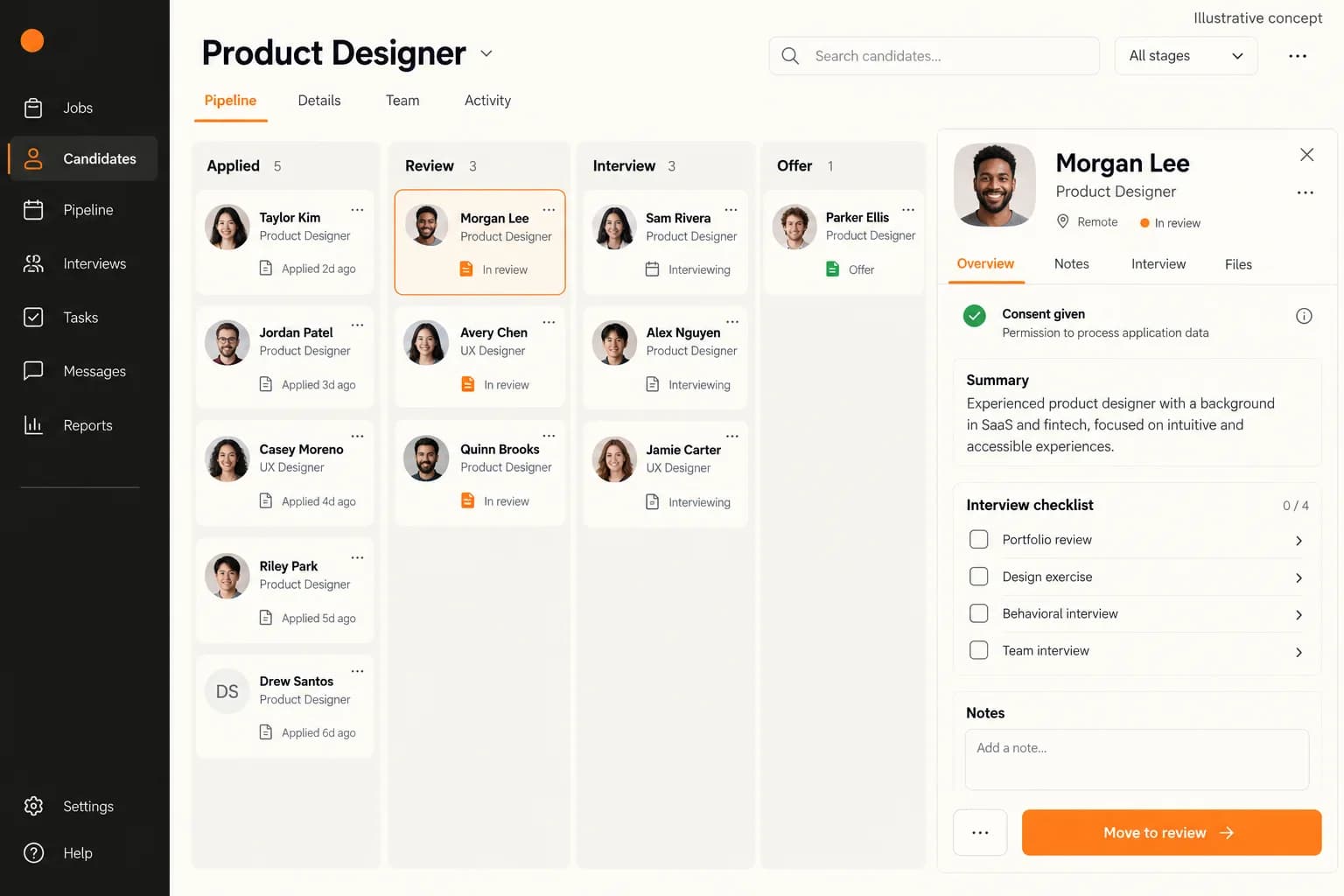
Original App Clone Labs recruitment concept at 1536×1024. Employers, roles, reviews and statuses are sample planning content, not verified workplace evidence or live listings.
What to check in the walkthrough
A Glassdoor-style product is a workplace-transparency platform where workers and candidates can contribute structured employer reviews, salary observations, interview experiences, and workplace information while employers maintain profiles, respond to feedback, and publish relevant jobs. The defining product problem is not ordinary job search. It is how to publish useful employment intelligence when submissions may be sensitive, subjective, anonymous, disputed, incomplete, or capable of affecting real people and organisations.
This solution is an independent reference architecture inspired by a familiar product category. It does not copy Glassdoor branding, content, interface assets, proprietary data, or source code, and it is not affiliated with or endorsed by Glassdoor. A viable implementation needs original research, taxonomy, experience design, moderation policy, evidence model, privacy assessment, and jurisdiction-specific legal review. Software can support those controls; it cannot guarantee that every statement is true, lawful, representative, or harmless.
A job portal primarily matches a vacancy with a candidate. Its core records are jobs, companies, candidate profiles, applications, and recruiter actions. A workplace-intelligence platform adds a separate evidence and governance system: contributor eligibility, anonymity boundaries, review provenance, moderation decisions, employer responses, appeals, salary aggregation, interview-stage observations, retaliation concerns, and publication rules. Those responsibilities remain even if no jobs are listed.
The job marketplace should therefore be connected but not allowed to determine editorial treatment. Employers may purchase recruitment tools or post vacancies, yet commercial status must not silently suppress negative reviews or promote favourable ones. Product policy, permissions, audit records, and public explanations should distinguish advertising, employer-authored content, community submissions, calculated summaries, and platform moderation. This separation protects user understanding and reduces conflicts between revenue and trust.
The system needs explicit roles for current workers, former workers, interview candidates, employers, recruiters, moderators, support staff, legal or policy reviewers, analysts, and administrators. A person may occupy more than one role, but each action requires a clear authority boundary. A contributor can submit and manage eligible content. An employer representative can claim a profile and respond through a verified organisation account. A moderator can review material without gaining unnecessary access to contributor identity. Privileged changes should be attributable in an audit record.
Organisation identity also requires careful modelling. Trading names, legal entities, subsidiaries, locations, franchises, acquired companies, and staffing agencies can be confused or duplicated. The platform needs a process to create, merge, separate, and dispute employer records while preserving review context. A review of one local operation should not automatically be presented as evidence about every entity sharing a brand.
Anonymous should describe what the public and employer can see, not an absence of platform controls. The system can collect proportionate signals that support contributor eligibility and abuse prevention while withholding identifying details from public display. Possible signals include verified access to a controlled channel, employment-period ranges, role categories, location ranges, submission history, device or network risk, and moderator observations. The exact collection must follow necessity, consent, retention, security, and applicable law.
Provenance should be represented as bounded status rather than a claim of absolute truth. A platform may state that an eligibility step was completed, that a submission passed policy review, or that a salary value contributed to an aggregate. It should not imply that every factual assertion has been independently verified unless a defined process genuinely supports that statement. Public labels, internal records, moderator tools, and structured data must use consistent language.
Identity separation should be designed across databases, logs, analytics, support tools, exports, notifications, and administrator access—not only hidden in the interface. Free text can reveal identity through names, projects, dates, teams, or distinctive events. The submission flow should warn contributors, support redaction, and minimise unnecessary metadata. Access to sensitive linkage should be narrowly authorised, logged, reviewed, and governed by a retention and lawful-request process.
Moderation policy should define admissible experience, relevance, harassment, hate, threats, personal data, confidential information, conflicts of interest, incentives, impersonation, coordinated manipulation, duplicate content, and unsupported allegations. It should distinguish a negative opinion from a factual accusation and identify content that requires escalation. Rules need examples, versioning, effective dates, reviewer guidance, and public explanations proportionate to the decision.
Automated classifiers can prioritise queues or identify possible policy signals, but consequential publication and removal decisions should have human oversight where context matters. Models can misunderstand workplace language, dialect, quoted speech, or legitimate criticism. The system should record which rule was applied, what evidence was considered, who or what made the decision, and whether the contributor or employer can seek review. No automated system should be represented as perfectly detecting deception, defamation, harassment, or retaliation.
Pre-publication review, post-publication reporting, trusted-contributor pathways, and sampling each create different speed and safety trade-offs. The operating model should choose them deliberately by content and risk. A credible launch includes moderator staffing assumptions, queue priorities, escalation coverage, quality review, conflict controls, and response expectations defined by policy rather than a promise embedded in marketing copy.
Employer reviews can contain allegations about identifiable people or events. Applicable defamation, privacy, employment, intermediary, consumer, evidence-preservation, and takedown rules vary by jurisdiction. Qualified counsel should approve the publication policy, notice handling, escalation criteria, retention, disclosure process, and terms. The product team should not turn legal conclusions into an automated checkbox.
The platform needs a structured notice pathway that collects the disputed URL or record, claimant authority, affected statement, stated basis, supporting material, contact details, and required declarations without publishing the submission. Operators need tools to preserve relevant records, restrict access when appropriate, request clarification, make a reasoned decision, communicate it, and record review or appeal. Emergency threats and exposure of sensitive personal information need a separate priority path.
A verified employer representative should be able to correct profile facts, publish a clearly labelled response, report policy violations, provide supporting context privately, and appeal a moderation outcome. They should not receive hidden contributor identifiers, private eligibility evidence, or tools to interrogate workers. Response workflows should discourage speculation about identity and prohibit threats or retaliation.
Employer responses are themselves moderated content. The interface should keep the original review, employer response, edits, removals, and decision notices understandable. Material corrections can be recorded without silently rewriting history. If a review is excluded from a score or aggregate, the rule and effect should be traceable internally and described publicly at an appropriate level.
The platform cannot guarantee that a contributor will never face retaliation, but it can reduce avoidable exposure. Controls can include identity minimisation, broad role and date ranges, delayed or batched publication, warnings about self-identifying detail, safe account communication, restricted employer access, suspicious-contact reporting, and escalation instructions. Whether delay or aggregation is appropriate depends on the size of the employer population and the risk that a contribution could be inferred.
Public guidance should explain anonymity limits honestly, including legal demands, account compromise, voluntary disclosure, unique writing, and small-team inference. A contributor should understand what the platform collects, what the employer sees, how deletion or access requests work where applicable, and which records may need to be retained. The product must avoid promising absolute anonymity when its architecture or legal duties cannot support that promise.
Salary records need a defined schema: role family, seniority, employment type, location, currency, pay period, base pay, variable pay, equity or benefits where included, and observation date. Normalisation should not combine unlike values without disclosure. Currency conversion, annualisation, inflation adjustment, total-compensation calculations, outlier handling, and taxonomy mapping are methodological decisions that must be documented and tested.
Aggregates should use minimum cohort and recency rules appropriate to re-identification risk and statistical usefulness. The platform should display sample size, observation period, unit, included components, and whether values are reported or modelled. Small samples should be suppressed or widened rather than presented with false precision. A median, range, or distribution often communicates the evidence more honestly than a single average, but the chosen statistic must match the published methodology.
Salary estimates must be clearly separated from submitted observations. If a model produces an estimate, the page should disclose that status, relevant inputs, coverage, uncertainty, and limitations. It should not imply a guaranteed market rate or compensation outcome. Changes to methodology should be versioned so historical movements are not confused with changes in calculation.
Interview contributions can describe application channel, role family, location, stages, time ranges, communication, assessments, offer status, and the contributor’s experience. Free text should be moderated under the same privacy and allegation rules as employer reviews. Questions must avoid soliciting confidential assessment content, personal data about interviewers, or information a candidate was not permitted to disclose.
Calculated interview indicators need clear denominators and time windows. A percentage based on a small or old sample should not look equivalent to a large recent cohort. The platform should resist turning subjective submissions into an unexplained universal ranking. Filters and summaries should help candidates explore relevant evidence while keeping sample limitations visible.
Jobs can be employer-posted, recruiter-managed, imported from an authorised feed, or linked to an approved applicant-tracking system. Each vacancy needs source, employer entity, location or remote status, employment type, publication and expiry state, application destination, and moderation status. Duplicate detection and stale-job controls protect candidate trust. The platform should not scrape or republish third-party listings without appropriate rights.
Company pages can connect jobs with reviews, salaries, and interview information, but labels must show who supplied each element. Search and recommendation logic should not quietly punish an employer for disputed content or reward a paying customer through an undisclosed editorial score. Sponsored placement must be distinguishable. Candidate applications, tracking consent, and recruitment communication require their own privacy and security boundaries.
The admin console should separate profile claims, new submissions, automated risk signals, user reports, employer disputes, urgent safety matters, privacy requests, and legal notices. Each queue needs role access, priority, evidence, reason codes, internal notes, external communication, and escalation. Metrics should describe operational volume and decision consistency without creating incentives to approve or remove content too quickly.
Abuse controls can evaluate unusual submission velocity, linked accounts, repeated text, conflicts, coordinated rating patterns, incentive campaigns, and attempts to manipulate employer profiles. Signals should initiate review rather than automatically establish guilt. False positives affect legitimate workers and employers, so decisions, overrides, and model changes need quality sampling and appeal paths.
Later phases can add richer benchmarking, employer analytics, verified contributor programmes, multilingual moderation, authorised ATS feeds, or recommendation features after the core trust model is operating. Scope should follow evidence from real moderation and support work. Adding markets or automated decisions before governance is understood can multiply harm and operational debt.
Acceptance should exercise contributor, employer, moderator, support, and administrator journeys across publication, rejection, redaction, response, report, appeal, correction, salary aggregation, job expiry, privacy handling, and access control. Tests need named policy versions, environments, accounts, and representative data. Security and privacy review should inspect identity separation, privileged access, logs, exports, notifications, retention, and incident response.
The signed agreement defines delivery and ownership. Handover may include application and service code, database definitions, moderator console, policy configuration, design files, tests, infrastructure, deployment access, documentation, third-party services, and known limitations. Reusable components and licensed services remain subject to their terms. App Clone Labs does not guarantee contributor volume, review accuracy, legal outcomes, employer participation, salary accuracy, recruitment results, or freedom from abuse.
Buyer questions
Glassdoor Clone app development means building a custom clone-inspired custom software platform inspired by proven product mechanics, with original branding, workflows, code, admin tools, integrations, and launch support for your market.
Glassdoor Clone is best suited for glassdoor clone founders, SMBs, agencies, funded startups, and enterprise teams that want a market-ready product without depending on a generic clone script. It works well when you want a proven product category but need original execution, local market fit, and operational ownership.
A clone-inspired product is acceptable when it uses the business model as inspiration but does not copy protected branding, proprietary UI, private data, content, trademarks, or unique assets. App Clone Labs builds original products around familiar mechanics.
The schedule follows the agreed roles, release boundary, integration depth, content readiness, review cadence, testing requirements, and third-party approvals. Multi-role and enterprise builds require broader validation and delivery plans.
V1 should include the smallest complete operating loop for customers, providers, operators, support teams, business admins, and growth teams: onboarding, core workflow, transaction or request state, notifications, admin visibility, support, and analytics.
Advanced personalization, complex loyalty, deep automation, multi-region rules, uncommon integrations, and enterprise analytics should usually wait until real usage proves the core loop.
The applicable agreement defines repository access, bespoke-code assignment or licensing, reusable framework rights, third-party dependencies, deployment context, documentation, and the handover boundary.
Yes. We adapt language, currency, payment methods, compliance needs, business rules, roles, workflows, content, and growth mechanics for your specific market.
Yes. Serious clone-inspired platforms need admin controls for users, transactions, payments, reports, support, moderation, content, settings, and operational exceptions.
The stack depends on scope, but common choices include Next.js web app, React Native or Flutter apps, Node.js APIs, PostgreSQL, Redis queues, cloud hosting, analytics, payment gateways, and role-based admin tooling.
Cost depends on apps required, number of roles, workflow depth, integrations, admin complexity, QA, cloud setup, and launch support. We estimate after mapping the MVP scope and full-build roadmap.
Yes. AI can support search, recommendations, moderation, support copilots, fraud review, document intake, analytics, and workflow automation where it creates real operational value.
We can support post-launch monitoring, bug fixes, analytics review, feature iteration, cloud improvements, app-store updates, and roadmap planning after the MVP goes live.
Solution reference register
01 / Reference and IP
Glassdoor is referenced only to identify a familiar workplace-transparency product category. This independent planning blueprint is not affiliated with, endorsed by, or a copy of Glassdoor. Branding, content, data, interface assets, and source code are not reused.
02 / Regulatory caveat
Publication, defamation, privacy, employment, notice, evidence-preservation, and disclosure duties require qualified review in each operating jurisdiction. · Do not promise absolute anonymity, truth of user submissions, freedom from retaliation, or universal salary accuracy.
03 / Rights and handover
The signed agreement defines ownership or licensing of bespoke deliverables, reusable components, third-party systems, data, policies, and operational responsibilities.
Primary sources
Dated official documentation, standards, and research that support the factual claims on this page.
Primary US agency guidance explaining protected activity and employment retaliation; legal applicability varies.
Primary regulator guidance on lawful, fair, transparent, purpose-limited, and proportionate personal-data processing.
Primary EU data-protection authority guidance relevant to privacy design and rights handling.
Official risk-management framework for identifying and managing privacy risk.
W3C Recommendation for accessible web content and interactions.
How to read this page
Scope, cost and timeline figures are planning guidance until confirmed in a written proposal. Diagrams and screens are illustrations, not client deliverables, and source-code rights and handover follow the signed agreement. See the delivery process and the full disclaimer.
Next decision
Bring the target jurisdictions, contributor groups, employer model, moderation policy, salary method, job sources, and operating responsibilities.
Commercial rights, repositories, environments, documentation, acceptance and handover remain contract-defined.
App Clone Labs is not affiliated with, sponsored by, or endorsed by Glassdoor. The name identifies a familiar product category; every delivered product is independently designed and built, and the mark remains its owner's property. Read the full legal notice.