Logistics and mobility

inDrive-style Fare Marketplace — Custom-Built for Your Market

Peer-negotiated ride request and driver selection marketplace. Planned for mobility founders exploring rider-driver offer and counteroffer flows with role-specific workflows, operator controls, integrations, and a handover boundary defined for the selected market.

Custom workflows

Brand-safe product strategy

Admin and operations tooling

Working reference implementation available

Solution reference register

01 / Reference and IP

This page references third-party product names only to describe familiar product models and planning references. App Clone Labs is not affiliated with or endorsed by those brands. Build decisions require independent legal, regulatory, and operational review for your market.

02 / Artifact status

Boards, diagrams, screens and workflow descriptions on this page are illustrative planning artifacts, not evidence of a deployed client product.

03 / Regulatory caveat

Qualified transport concept · Fare, driver licensing, and operating rules vary by market · Insurance and safety review required

04 / Rights and handover

Source access, licensing, repositories, environments, documentation, acceptance and handover are defined by the signed contract and accepted scope.

Scope

Operating model defined

Roles, workflows, dependencies, exclusions, and assumptions are made reviewable.

Evidence: illustrative

System

Applications connected

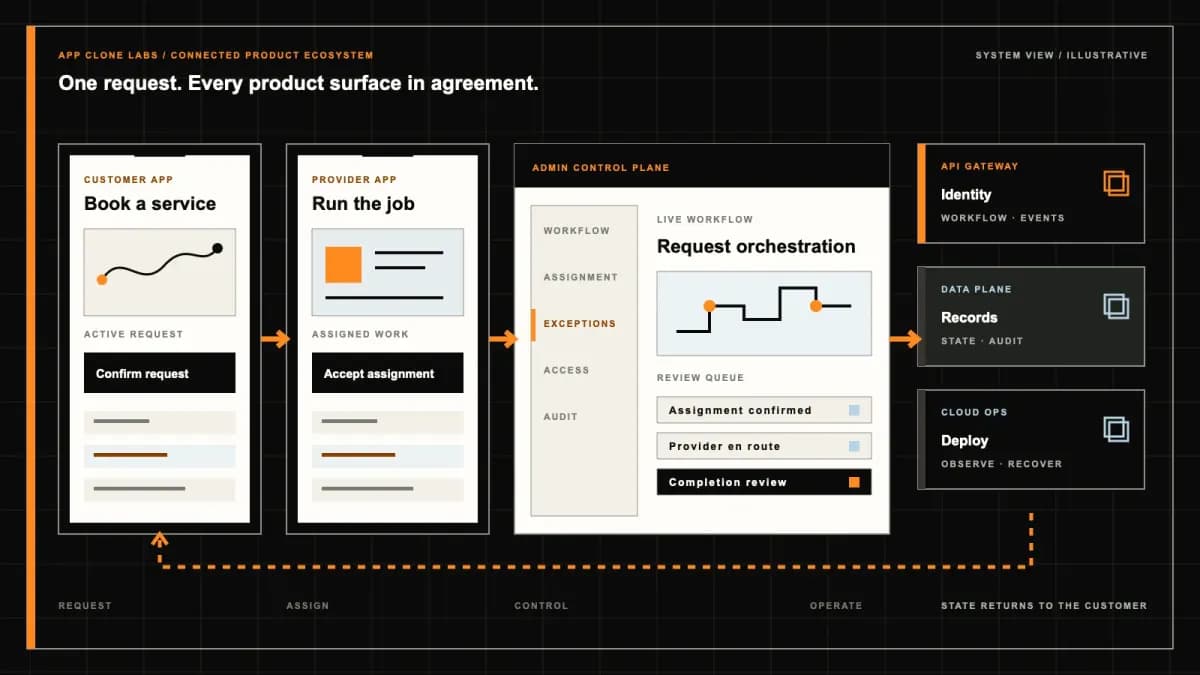
Experience, operations, services, data, integrations, and release controls are planned together.

Evidence: illustrative

Handover

Rights stated in writing

Access, assignment, licensing, dependencies, documentation, and support follow the signed agreement.

Evidence: illustrative

Artifact register

Content-supplied visual references, framed as planning evidence.

Deployable Product Architecture

Marketplace commerce flow / system register

Revision APlanning surface

Marketplace loop

Marketplace checkout and commerce workflow for platform planning

Marketplace loop: Marketplace checkout and commerce workflow for platform planningDemand and supply meet through governed transactions. Trust, payments, support, and operator controls close the commercial loop.
01

Discover

02

Match

03

Transact

04

Resolve

Marketplace commerce flow · Evidence status not supplied

Deployable Product Architecture

Payments and seller operations / system register

Revision DPlanning surface

Financial control loop

Online payment and seller payout workflow for marketplace software

Financial control loop: Online payment and seller payout workflow for marketplace softwareEvery movement needs a verifiable state. The ledger and the operational view must describe the same transaction.
01

Verify

02

Authorize

03

Record

04

Reconcile

Payments and seller operations · Evidence status not supplied

Deployable Product Architecture

Mobile app interface mockups / system register

Revision APlanning surface

Marketplace loop

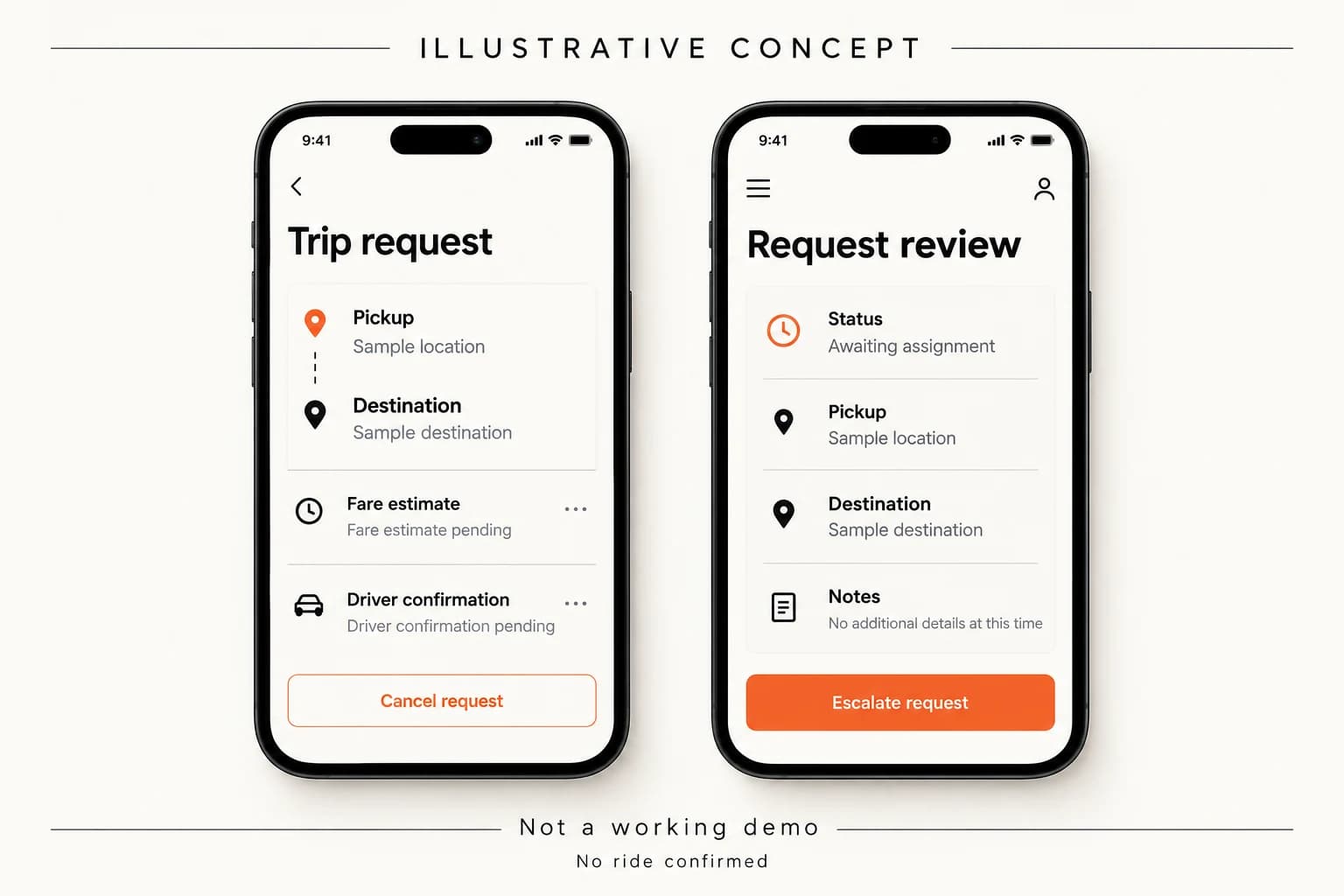
inDrive-style Fare Marketplace mobile app mockup screens

Marketplace loop: inDrive-style Fare Marketplace mobile app mockup screensDemand and supply meet through governed transactions. Trust, payments, support, and operator controls close the commercial loop.
01

Discover

02

Match

03

Transact

04

Resolve

Mobile app interface mockups · Evidence status not supplied

Deployable Product Architecture

Admin dashboard and analytics / system register

Revision FPlanning surface

Marketplace loop

inDrive-style Fare Marketplace admin dashboard analytics mockup

Marketplace loop: inDrive-style Fare Marketplace admin dashboard analytics mockupDemand and supply meet through governed transactions. Trust, payments, support, and operator controls close the commercial loop.
01

Discover

02

Match

03

Transact

04

Resolve

Admin dashboard and analytics · Evidence status not supplied

Executive summary

inDrive-style Fare Marketplace is for mobility founders exploring rider-driver offer and counteroffer flows. Assess a ride marketplace with transparent participant-led fare proposals. inDrive-style Fare Marketplace is referenced descriptively only. The point is not to copy a famous product. The point is to use a familiar market pattern as research, then build a product that is legally original, commercially sharp, and operationally useful for your own customers.

For App Clone Labs, a serious indrive-style fare marketplace starts with the operating model. We define who uses it, what each role can do, what data moves between screens, where money is captured or paid out, what support needs to see, which events should be measured, and which admin controls will keep the business manageable after launch.

This peer-negotiated ride request and driver selection marketplace model matters now because the underlying market conditions that made the original category successful are replicating across new geographies and verticals. Cheaper mobile data, maturing payment rails, growing comfort with on-demand services, and underserved local audiences for mobility founders exploring rider-driver offer and counteroffer flows create a real opening for an operator who can execute the operating loop cleanly. Timing matters: entering too early means fighting infrastructure gaps, while entering too late means competing against entrenched incumbents, so the viable window is the one we plan around.

Product model and audience

The product model is peer-negotiated ride request and driver selection marketplace. The intended audience is mobility founders exploring rider-driver offer and counteroffer flows. This shapes which features belong in V1, which admin controls are non-negotiable, and which integrations determine launch readiness.

User roles and workflows

The important roles for this solution are Requester: People seeking ride requests with participant fare proposals; Driver or carrier: Verified independent drivers and local fleet partners; Network operator: inDrive-style Fare Marketplace operations team. Each role needs its own permissions, navigation, state visibility, notification rules, and support context.

The workflow we plan first moves through browse and compare ride requests with participant fare proposals, publish trip terms, compare driver responses, and confirm a match, confirm completion and handle ride requests with participant fare proposals support. That workflow becomes the backbone for screens, APIs, permissions, notifications, admin actions, QA cases, and analytics.

Monetization models

The strongest monetization paths for indrive-style fare marketplace include Trip marketplace commissions, Driver service programs, Optional business ride accounts. Monetization should be designed before development because it affects database structure, checkout, payout flows, invoices, refunds, plan limits, analytics, and admin reporting.

MVP scope vs full build comparison

For indrive-style fare marketplace, the MVP should focus on Discovery and request flow for ride requests with participant fare proposals and Verified independent drivers and local fleet partners acceptance and status tools and Manual review paths for fare conduct, driver eligibility, trip monitoring, and abuse prevention. The MVP is not a weak product; it is the smallest complete operating loop with enough admin visibility, support readiness, and analytics to learn from real users.

The full build expands into Retention tools tailored to ride requests with participant fare proposals and Rules-based coordination for publish trip terms, compare driver responses, and confirm a match and Intercity rides and eligible courier services. This staged approach protects speed and quality at the same time.

Regulatory and compliance review

Qualified transport concept Fare, driver licensing, and operating rules vary by market Insurance and safety review required

Technical architecture and stack considerations

Because indrive-style fare marketplace is a peer-negotiated ride request and driver selection marketplace serving mobility founders exploring rider-driver offer and counteroffer flows, the architecture is shaped by the product model rather than the other way around. The API surface is split into role-scoped endpoints so that Requester, Driver or carrier, Network operator each receive only the data their permissions allow, with a gateway layer handling auth, rate limiting, and idempotency for transactional calls. Database choices follow the access pattern: a primary relational store for orders, accounts, payouts, and audit trails, paired with a read-optimized cache for catalog, profile, and status lookups that the customer and provider apps hit on every screen.

Real-time features such as live status updates, location tracking, and in-app messaging run over a persistent transport with a fallback to push notifications when the app is backgrounded. A CDN fronts all static assets and media, while file storage is abstracted behind a signed-URL pattern so uploads and downloads never proxy through the application server. Caching, queueing, and push delivery are designed against the workflow stages of browse and compare ride requests with participant fare proposals, publish trip terms, compare driver responses, and confirm a match, confirm completion and handle ride requests with participant fare proposals support so that each state transition is durable, observable, and recoverable even when a downstream provider is temporarily unavailable.

Go-to-market and launch strategy

Launch sequencing for indrive-style fare marketplace starts with a single contained market where supply density and demand can be balanced before any expansion. We select the initial market based on mobility founders exploring rider-driver offer and counteroffer flows concentration, payment and logistics readiness, and the regulatory profile captured above, so that the first cohort can be served end-to-end without stretching operations thin. Supply-side onboarding is sequenced first for Requester, Driver or carrier, Network operator, with verification, training, and a soft cap on volume so quality is protected before demand is turned on.

Demand generation combines targeted acquisition for the first cohort with referral mechanics baked into the V1 scope of discovery and request flow for ride requests with participant fare proposals, verified independent drivers and local fleet partners acceptance and status tools, manual review paths for fare conduct, driver eligibility, trip monitoring, and abuse prevention. Pricing experiments are run against the monetization paths of Trip marketplace commissions, Driver service programs, Optional business ride accounts, holding take rate and payout terms constant while testing signup incentives, bundle offers, and surge or peak pricing. The metrics we track from day one are activation rate, time-to-first-transaction, repeat frequency, fulfillment rate, and support ticket volume, each mapped to a workflow stage so we can tell exactly where the operating loop is leaking.

Unit economics and cost framework

The unit economics for indrive-style fare marketplace are built around revenue per transaction, customer acquisition cost, contribution margin, and the platform take rate set by the chosen monetization model. Because the monetization paths here are Trip marketplace commissions, Driver service programs, Optional business ride accounts, the take rate is not a single knob: it varies by transaction type, tier, and whether the revenue is transactional, subscription, or fee-based. We model each stream separately so that gross margin per transaction is visible to the admin console and to the operator, not buried in an aggregate number.

Customer acquisition cost is tracked by channel and cohort, with payback period as the governing constraint rather than blended CAC, because mobility founders exploring rider-driver offer and counteroffer flows behavior varies enough that a blended number hides unprofitable segments. Contribution margin accounts for payment processing, payouts to Requester, Driver or carrier, Network operator, support cost per transaction, and infrastructure cost that scales with volume. The framework is designed so that scaling the peer-negotiated ride request and driver selection marketplace model either improves unit economics or surfaces the specific cost line that is breaking, rather than masking problems behind top-line growth.

Risk mitigation and failure modes

The most common failure pattern for a peer-negotiated ride request and driver selection marketplace like indrive-style fare marketplace is a supply-demand imbalance: either supply is onboarded with no demand and providers churn, or demand is acquired with no supply and customers leave bad reviews. We mitigate this by sequencing onboarding as described above and by building the V1 scope of discovery and request flow for ride requests with participant fare proposals, verified independent drivers and local fleet partners acceptance and status tools, manual review paths for fare conduct, driver eligibility, trip monitoring, and abuse prevention with explicit density targets per market before any expansion is approved. Trust and safety risks are addressed through verification, rating and review loops, dispute handling, and admin controls that can pause or remove bad actors without a code change.

Regulatory exposure is the second failure mode, and it is why the compliance review above is treated as a build input rather than a launch checklist. The third is operational collapse under edge cases: failed payments, double bookings, offline providers, refund disputes, and support spikes, each of which maps to a workflow stage in browse and compare ride requests with participant fare proposals, publish trip terms, compare driver responses, and confirm a match, confirm completion and handle ride requests with participant fare proposals support and needs a defined recovery path. Mitigation strategies include idempotent transactional APIs, admin override controls, automated alerts on anomaly thresholds, and a support console that gives operators enough context to resolve issues without engineering involvement.

Success metrics and KPIs

The key metrics for indrive-style fare marketplace are activation, retention, transaction frequency, take rate, fulfillment rate, and support ticket volume, each tied back to the workflow stages of browse and compare ride requests with participant fare proposals, publish trip terms, compare driver responses, and confirm a match, confirm completion and handle ride requests with participant fare proposals support. Activation measures how many new mobility founders exploring rider-driver offer and counteroffer flows complete the first transaction within a target window, which maps to the earliest workflow stages and tells us whether onboarding and discovery are working. Retention and transaction frequency then measure whether the operating loop is sticky enough to build a business on, rather than a one-time acquisition machine.

Take rate and fulfillment rate are the operational health metrics: take rate confirms the monetization model of Trip marketplace commissions, Driver service programs, Optional business ride accounts is actually capturing revenue as designed, while fulfillment rate confirms that Requester, Driver or carrier, Network operator are completing the loop without leakage. Support ticket volume, mapped to the later workflow stages, is the leading indicator of product or operational pain before it shows up in churn. Every KPI is wired into the admin console from V1 so the operator can read the business without a data team, and so the later phases of retention tools tailored to ride requests with participant fare proposals, rules-based coordination for publish trip terms, compare driver responses, and confirm a match, intercity rides and eligible courier services are prioritized by what the metrics actually demand.

Live reference walkthrough

A working reference implementation for indrive-style fare marketplace is available for qualified buyers. Rather than publishing shared demo credentials, we schedule a guided walkthrough where you see the customer app, provider or merchant interface, and admin console in action, and ask questions about architecture, operations, and customization for your market.

Book a call to request access. We will confirm the scope of your interest, share the relevant reference surfaces, and discuss whether a configured deployment or a fully custom build is the right path for your market.

Product flow

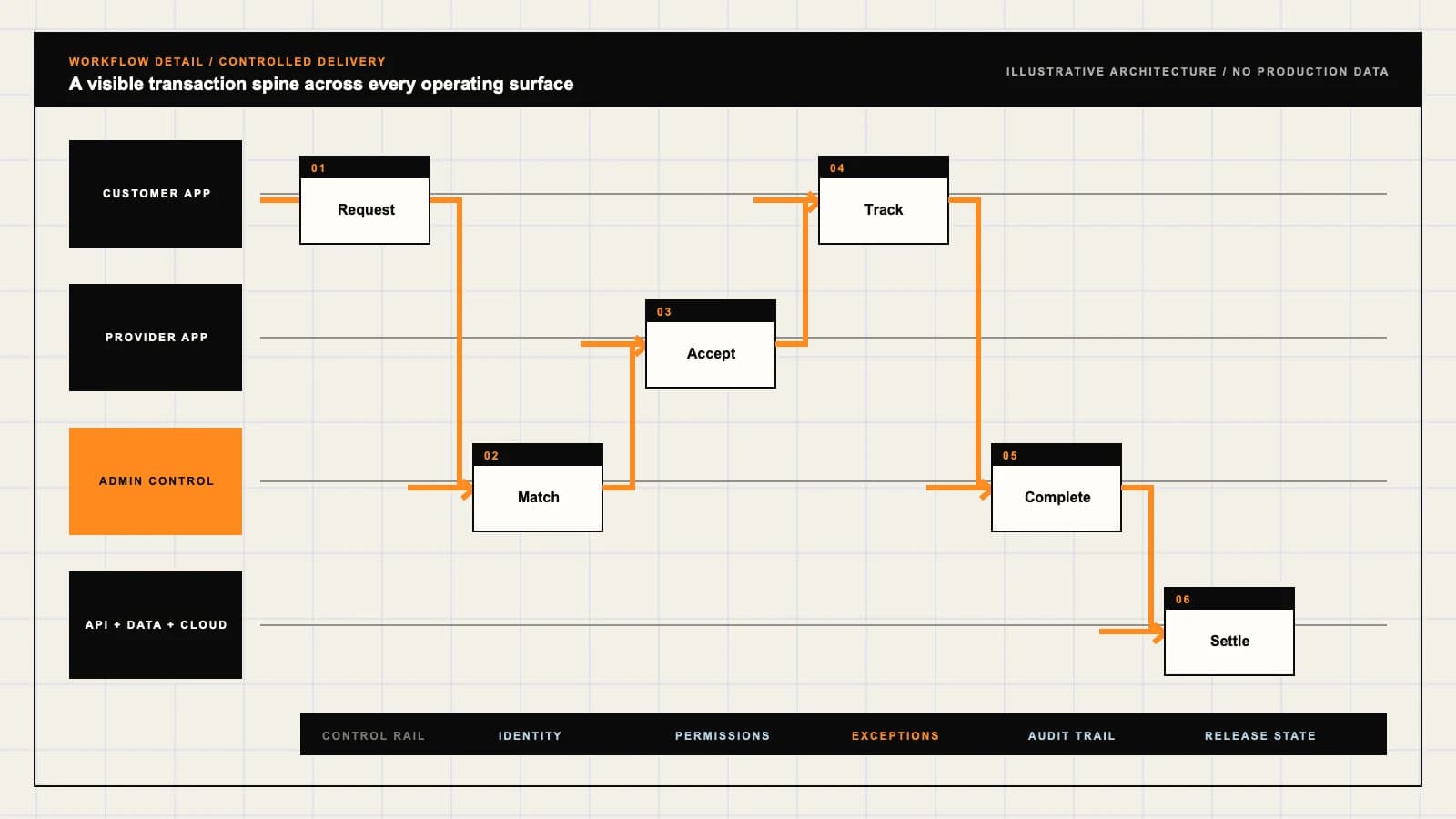
Role-workflow flow diagram.

A visual map of how each role interacts with each workflow stage, with operator controls and integration boundaries.

Deployable Product Architecture

inDrive-style Fare Marketplace

BROWSE AND COMPAR…PUBLISH TRIP TERM…CONFIRM COMPLETIO…People seeking ri…Verified independ…inDrive-style Far…INTEGRATIONS: Mapping, driver verification, and safety support systems · Identity and mes…OPERATOR CONTROLS: Fare conduct, driver eligibility, trip monitoring, and abuse prevention · G…
Illustrative validation artifact — role-workflow flow diagram; final surfaces, boundaries, and integration topology are confirmed during discovery.

User roles

inDrive-style Fare Marketplace roles and workflows.

Clone-inspired platforms usually need several coordinated interfaces, not just a customer app.

Requester

01

People seeking ride requests with participant fare proposals

inDrive-style Fare Marketplace product scope: People seeking ride requests with participant fare proposals.

Driver or carrier

02

Verified independent drivers and local fleet partners

inDrive-style Fare Marketplace product scope: Verified independent drivers and local fleet partners.

Network operator

03

inDrive-style Fare Marketplace operations team

inDrive-style Fare Marketplace product scope: inDrive-style Fare Marketplace operations team.

Workflow

inDrive-style Fare Marketplace workflow stages.

Each workflow stage is mapped to a role, screen, API, notification, admin control, and measurable launch outcome.

Discover

01

Browse and compare ride requests with participant fare proposals

inDrive-style Fare Marketplace product scope: Browse and compare ride requests with participant fare proposals.

Coordinate

02

Publish trip terms, compare driver responses, and confirm a match

inDrive-style Fare Marketplace product scope: Publish trip terms, compare driver responses, and confirm a match.

Complete

03

Confirm completion and handle ride requests with participant fare proposals support

inDrive-style Fare Marketplace product scope: Confirm completion and handle ride requests with participant fare proposals support.

Deployable Product Architecture

Workflow / system register

Revision CPlanning surface

Marketplace loop

inDrive-style Fare Marketplace workflow stages.

Demand and supply meet through governed transactions

Marketplace loop: inDrive-style Fare Marketplace workflow stages.Demand and supply meet through governed transactions. Trust, payments, support, and operator controls close the commercial loop.
01

Browse and compare ride requests with participant fare proposals

02

Publish trip terms, compare driver responses, and confirm a match

03

Confirm completion and handle ride requests with participant fare proposals support

Control note

Trust, payments, support, and operator controls close the commercial loop.

Illustrative architecture register; validate against the accepted scope.

Operator controls

inDrive-style Fare Marketplace admin and operator controls.

The control center is scoped as a first-class product surface, not an afterthought.

Access

01

Fare conduct, driver eligibility, trip monitoring, and abuse prevention

inDrive-style Fare Marketplace product scope: Fare conduct, driver eligibility, trip monitoring, and abuse prevention.

Operations

02

Govern verified independent drivers and local fleet partners participation

inDrive-style Fare Marketplace product scope: Govern verified independent drivers and local fleet partners participation.

Trust

03

Review exceptions, disputes, and ride requests with participant fare proposals evidence

inDrive-style Fare Marketplace product scope: Review exceptions, disputes, and ride requests with participant fare proposals evidence.

Monetization

inDrive-style Fare Marketplace monetization models.

We model monetization early so payments, admin controls, and reporting support the business.

Trip marketplace commissions

inDrive-style Fare Marketplace product scope: Trip marketplace commissions.

Driver service programs

inDrive-style Fare Marketplace product scope: Driver service programs.

Optional business ride accounts

inDrive-style Fare Marketplace product scope: Optional business ride accounts.

Integrations

inDrive-style Fare Marketplace integration surface.

External systems that determine launch readiness, data flow, and operational continuity.

Integration

01

Integration 1

Mapping, driver verification, and safety support systems

Integration

02

Integration 2

Identity and messaging services for ride requests with participant fare proposals

Integration

03

Integration 3

Payments and reporting services for ride requests with participant fare proposals

Scope drivers

inDrive-style Fare Marketplace scope drivers.

The variables that most influence build effort, cost, and launch readiness.

Demand

01

Search and availability depth for ride requests with participant fare proposals

inDrive-style Fare Marketplace product scope: Search and availability depth for ride requests with participant fare proposals.

Supply

02

Onboarding and capacity of verified independent drivers and local fleet partners

inDrive-style Fare Marketplace product scope: Onboarding and capacity of verified independent drivers and local fleet partners.

Complexity

03

Fare conduct, driver eligibility, trip monitoring, and abuse prevention

inDrive-style Fare Marketplace product scope: Fare conduct, driver eligibility, trip monitoring, and abuse prevention.

Deployable Product Architecture

Scope drivers / system register

Revision BPlanning surface

Marketplace loop

inDrive-style Fare Marketplace scope drivers.

Demand and supply meet through governed transactions

Marketplace loop: inDrive-style Fare Marketplace scope drivers.Demand and supply meet through governed transactions. Trust, payments, support, and operator controls close the commercial loop.
01

Search and availability depth for ride requests with participant fare proposals

02

Onboarding and capacity of verified independent drivers and local fleet partners

03

Fare conduct, driver eligibility, trip monitoring, and abuse prevention

Control note

Trust, payments, support, and operator controls close the commercial loop.

Illustrative architecture register; validate against the accepted scope.

V1 scope

inDrive-style Fare Marketplace V1 foundation.

Launch the smallest complete operating loop first, then scale the product with confidence.

Customer core

01

Discovery and request flow for ride requests with participant fare proposals

inDrive-style Fare Marketplace product scope: Discovery and request flow for ride requests with participant fare proposals.

Provider core

02

Verified independent drivers and local fleet partners acceptance and status tools

inDrive-style Fare Marketplace product scope: Verified independent drivers and local fleet partners acceptance and status tools.

Operations core

03

Manual review paths for fare conduct, driver eligibility, trip monitoring, and abuse prevention

inDrive-style Fare Marketplace product scope: Manual review paths for fare conduct, driver eligibility, trip monitoring, and abuse prevention.

Later phases

inDrive-style Fare Marketplace post-launch expansion.

Capabilities that should usually wait until real usage proves the core loop.

Growth

01

Retention tools tailored to ride requests with participant fare proposals

inDrive-style Fare Marketplace product scope: Retention tools tailored to ride requests with participant fare proposals.

Automation

02

Rules-based coordination for publish trip terms, compare driver responses, and confirm a match

inDrive-style Fare Marketplace product scope: Rules-based coordination for publish trip terms, compare driver responses, and confirm a match.

Expansion

03

Intercity rides and eligible courier services

inDrive-style Fare Marketplace product scope: Intercity rides and eligible courier services.

Deployable Product Architecture

Later phases / system register

Revision APlanning surface

Marketplace loop

inDrive-style Fare Marketplace post-launch expansion.

Demand and supply meet through governed transactions

Marketplace loop: inDrive-style Fare Marketplace post-launch expansion.Demand and supply meet through governed transactions. Trust, payments, support, and operator controls close the commercial loop.
01

Retention tools tailored to ride requests with participant fare proposals

02

Rules-based coordination for publish trip terms, compare driver responses, and confirm a match

03

Intercity rides and eligible courier services

Control note

Trust, payments, support, and operator controls close the commercial loop.

Illustrative architecture register; validate against the accepted scope.

Regulatory review

inDrive-style Fare Marketplace regulatory and compliance flags.

Each flag must be reviewed by qualified counsel for your target market before build or launch.

Flag 1

Qualified transport concept

Flag 2

Fare, driver licensing, and operating rules vary by market

Flag 3

Insurance and safety review required

Live walkthrough

See inDrive-style Fare Marketplace in action.

A working reference implementation exists for this product model. Rather than publishing shared demo credentials, we schedule a private guided walkthrough for qualified buyers.

Reference app

01

Customer experience

See the customer-facing app for indrive-style fare marketplace — discovery, ordering, tracking, and account flows.

Reference app

02

Provider or merchant interface

See the provider or merchant panel — onboarding, acceptance, status updates, and operational tools.

Reference app

03

Admin and operations console

See the admin console — users, transactions, content, disputes, reporting, and configuration controls.

Next step

04

Book a walkthrough

Request a live, private walkthrough of the reference implementation. We will confirm scope and discuss configured deployment versus custom build for your market.

Open register

Deployable Product Architecture

Live walkthrough / system register

Revision BPlanning surface

Marketplace loop

See inDrive-style Fare Marketplace in action.

Demand and supply meet through governed transactions

Marketplace loop: See inDrive-style Fare Marketplace in action.Demand and supply meet through governed transactions. Trust, payments, support, and operator controls close the commercial loop.
01

Customer experience

02

Provider or merchant interface

03

Admin and operations console

04

Book a walkthrough

Control note

Trust, payments, support, and operator controls close the commercial loop.

Illustrative architecture register; validate against the accepted scope.

Process

A traceable path from decision to acceptance.

  1. 01

    Model teardown

    We map the reference business model, user roles, monetization path, regulatory needs, and launch constraints.

    Artifact: Product teardown, risk map, role matrix

  2. 02

    Market-fit blueprint

    We reshape the model around your market, operations, pricing, workflows, and first release priorities.

    Artifact: Feature scope, flows, technical plan

  3. 03

    Design and build

    Product, design, engineering, QA, and cloud delivery move in weekly demo cycles with visible progress.

    Artifact: Working releases, QA notes, sprint demos

  4. 04

    Launch and operate

    We support production release, monitoring, handoff, roadmap decisions, and post-launch improvement.

    Artifact: Launch checklist, docs, growth backlog

FAQ

Questions to resolve before the build.

01What is inDrive-style Fare Marketplace?

inDrive-style Fare Marketplace is a peer-negotiated ride request and driver selection marketplace planned for mobility founders exploring rider-driver offer and counteroffer flows. Assess a ride marketplace with transparent participant-led fare proposals. inDrive-style Fare Marketplace is referenced descriptively only. Third-party product names are used only to describe familiar product models and planning references.

02Who is inDrive-style Fare Marketplace best suited for?

inDrive-style Fare Marketplace is best suited for mobility founders exploring rider-driver offer and counteroffer flows. It works well when you need a proven product category adapted to your own market, operations, and brand.

03Is inDrive-style Fare Marketplace legal to build?

A clone-inspired product is acceptable when it uses the business model as inspiration but does not copy protected branding, proprietary UI, private data, content, trademarks, or unique assets. App Clone Labs builds original products around familiar mechanics.

04What roles does inDrive-style Fare Marketplace need?

The primary roles are Requester, Driver or carrier, Network operator. Each role needs its own permissions, navigation, state visibility, notification rules, and support context.

05What should be included in inDrive-style Fare Marketplace V1?

V1 should include discovery and request flow for ride requests with participant fare proposals, verified independent drivers and local fleet partners acceptance and status tools, manual review paths for fare conduct, driver eligibility, trip monitoring, and abuse prevention. The MVP is the smallest complete operating loop with enough admin visibility, support readiness, and analytics to learn from real users.

06What should wait until later?

Advanced capabilities like retention tools tailored to ride requests with participant fare proposals, rules-based coordination for publish trip terms, compare driver responses, and confirm a match, intercity rides and eligible courier services should usually wait until real usage proves the core loop.

07What regulatory review does inDrive-style Fare Marketplace need?

Qualified transport concept Fare, driver licensing, and operating rules vary by market Insurance and safety review required

08Can you customize inDrive-style Fare Marketplace for my country or niche?

Yes. We adapt language, currency, payment methods, compliance needs, business rules, roles, workflows, content, and growth mechanics for your specific market.

09Can I see a demo of inDrive-style Fare Marketplace?

A working reference implementation exists for this product model. Rather than publishing shared demo credentials, we schedule a private guided walkthrough where you see the customer app, provider or merchant interface, and admin console, and ask questions about architecture, operations, and customization. Book a call to request access.

10How much does it cost to build inDrive-style Fare Marketplace?

Cost depends on scope, the number of roles involved, third-party integrations, regulatory requirements, and whether you start with an MVP or a full build. The V1 scope — discovery and request flow for ride requests with participant fare proposals, verified independent drivers and local fleet partners acceptance and status tools, manual review paths for fare conduct, driver eligibility, trip monitoring, and abuse prevention — represents the cost floor, while later phases like retention tools tailored to ride requests with participant fare proposals, rules-based coordination for publish trip terms, compare driver responses, and confirm a match, intercity rides and eligible courier services add incremental cost as the product grows. Regulatory complexity and custom integrations can also shift the budget meaningfully. We recommend a scope review call so we can give you a real estimate based on your market, target launch, and operating model.

11How long does it take to build inDrive-style Fare Marketplace?

Timeline depends on scope depth, the number and complexity of integrations, regulatory review cycles, and QA coverage across all roles. V1 typically takes 8 to 16 weeks depending on complexity, which covers the core operating loop for mobility founders exploring rider-driver offer and counteroffer flows along with admin visibility and analytics. A full build that includes all later phases can extend to 6 to 9 months. We sequence work so that the smallest complete loop ships first, then later capabilities layer on top with real usage informing priorities.

12What tech stack is recommended for inDrive-style Fare Marketplace?

The stack is selected around the product model (peer-negotiated ride request and driver selection marketplace), real-time requirements, expected scale, and your team's expertise. Common choices include React Native or Flutter for mobile, Node or Python for the backend, PostgreSQL or MongoDB for the database, and AWS or GCP for infrastructure. The final selection is driven by the specific workflow — browse and compare ride requests with participant fare proposals, publish trip terms, compare driver responses, and confirm a match, confirm completion and handle ride requests with participant fare proposals support — and the integration needs around Mapping, driver verification, and safety support systems, Identity and messaging services for ride requests with participant fare proposals, Payments and reporting services for ride requests with participant fare proposals. We make the stack call during architecture planning so it fits the operating model rather than forcing the product to fit the stack.

13How does inDrive-style Fare Marketplace handle payments and payouts?

Payment architecture depends on the monetization model, which for this product includes trip marketplace commissions, driver service programs, optional business ride accounts. Depending on the model, we design for marketplace commissions, subscription billing, or per-transaction fees, each with different flow requirements. That includes escrow holding, split payments between platform and providers, provider payout scheduling, refund and dispute flows, and reconciliation reporting for the admin console. Because money movement is regulated, we use licensed payment partners and design the payout logic to satisfy compliance review for your target market.

14What are the biggest risks when building inDrive-style Fare Marketplace?

The biggest risks are supply-demand imbalance, regulatory exposure, trust and safety failures, provider quality inconsistency, and the cold-start problem where one side of the marketplace will not join without the other. Regulatory exposure is especially relevant here: Qualified transport concept Fare, driver licensing, and operating rules vary by market These risks are exactly why we design the operating model, admin controls, and quality safeguards before writing production code. A platform that launches without those controls tends to break on trust and operations, not on technology.

15How is inDrive-style Fare Marketplace different from a white-label solution?

A white-label product gives you a generic, pre-built platform with someone else's branding swapped in, which means you inherit their UX decisions, their workflow assumptions, and their limitations. A clone-inspired build gives you original UX, custom workflows shaped around your specific market, owned source code, configurable admin tools, and a product designed for your operations rather than a generic operator. You control the roadmap, the data, the integrations, and the user experience. The tradeoff is build time and cost, but the result is a product that fits your market instead of forcing your market to fit a template.

Next decision

Turn the brief into an accepted product scope.

Define outcomes, constraints, evidence, rights and handover before delivery begins.

Commercial rights, repositories, environments, documentation, acceptance and handover remain contract-defined.

Scope inDrive-style Fare Marketplace