Logistics and mobility

Lalamove-style Same-day Logistics — Custom-Built for Your Market

On-demand vehicle marketplace for local and regional goods movement. Planned for businesses and individuals matching loads with commercial drivers with role-specific workflows, operator controls, integrations, and a handover boundary defined for the selected market.

See product screens and demo access

Custom workflows

Brand-safe product strategy

Admin and operations tooling

Reference walkthrough by arrangement

Review load suitability, vehicle allocation and goods handoff.

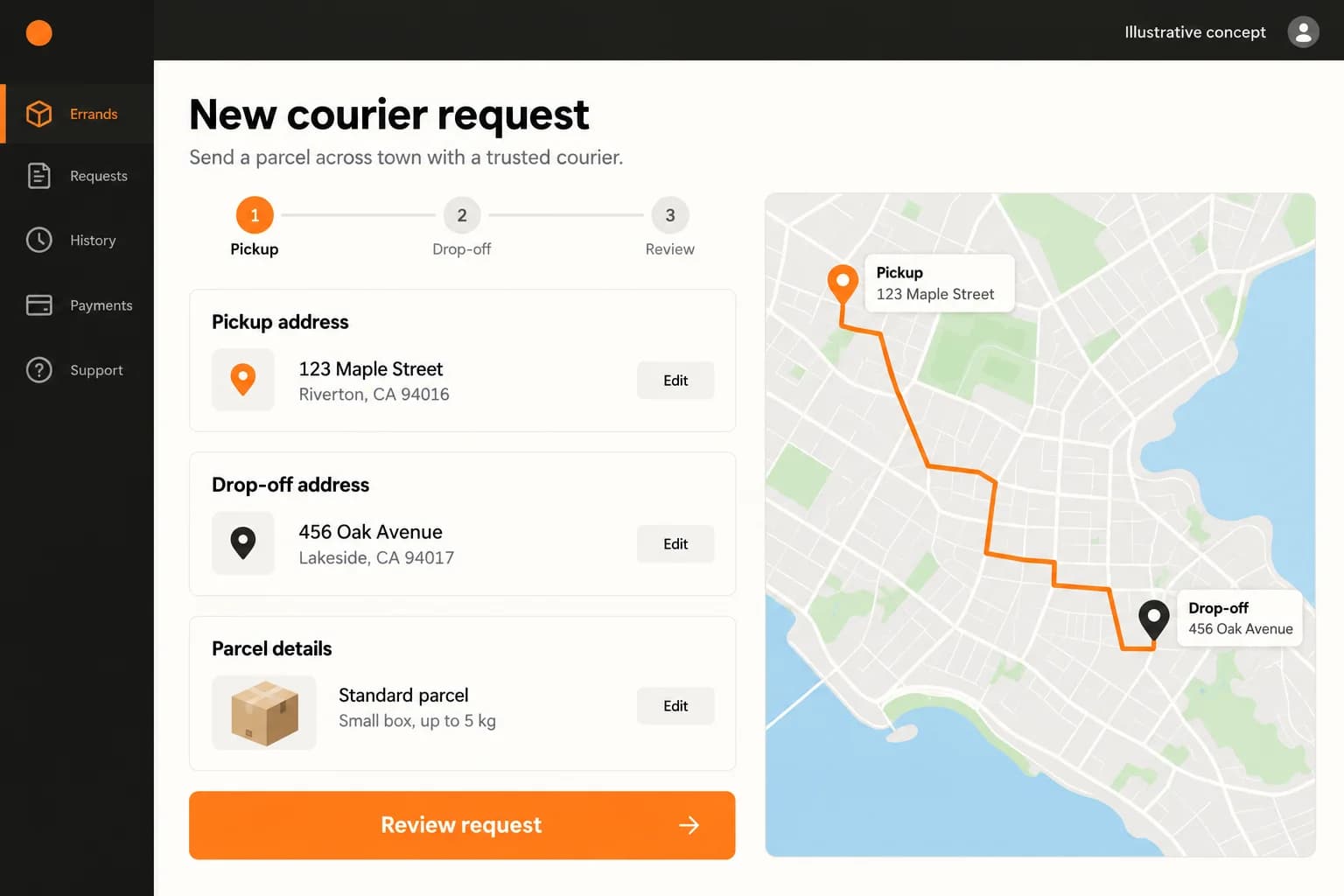
A Lalamove-style logistics marketplace must match the actual load and route to an eligible vehicle and driver. Use this original small-parcel request concept to discuss intake, then request evidence of motorcycle, van or truck selection, scheduled dispatch and delivery proof. The artwork is illustrative, not Lalamove UI, an affiliation claim or a working booking demo; fleet tracking, payments and cargo insurance are not established by this screen.

Original courier-request illustration showing pickup and drop-off addresses, a small-box parcel limit of up to 5 kg, a review button and a drawn route

Original courier-request illustration showing pickup and drop-off addresses, a small-box parcel limit of up to 5 kg, a review button and a drawn route

Original small-parcel intake concept with sample addresses and route. Vehicle classes, commercial-driver authority, loading help, scheduled availability and multi-stop pricing are not shown. The parcel limit belongs to this illustration, not a verified Lalamove service specification; map and Payments labels do not prove live tracking or payment processing.

What to check in the walkthrough

  • Ask to enter cargo dimensions, weight, item count, handling needs and pickup access, then compare eligible motorcycle, van and truck options. What blocks an oversized or prohibited load, and who confirms loading help, route restrictions and the quoted handling charges?
  • Demonstrate both an immediate job and a scheduled pickup matched to a driver with the required vehicle and authority. What happens when the driver rejects the load, becomes unavailable or arrives with an unsuitable vehicle, and how are reassignment and revised costs approved?
  • Follow a business delivery with multiple stops through item-level handoff evidence and account reconciliation. How are partial delivery, recipient absence and cargo damage recorded, who decides return or reattempt charges, and what evidence supports a claim under the agreed coverage terms?
Open full-size reference

Solution reference register

01 / Reference and IP

This page references third-party product names only to describe familiar product models and planning references. App Clone Labs is not affiliated with or endorsed by those brands. Build decisions require independent legal, regulatory, and operational review for your market.

02 / Artifact status

Boards, diagrams, screens and workflow descriptions on this page are illustrative planning artifacts, not evidence of a deployed client product.

03 / Regulatory caveat

Qualified transport concept · Commercial carrier and cargo rules vary by market · Insurance and worker classification review required

04 / Rights and handover

Source access, licensing, repositories, environments, documentation, acceptance and handover are defined by the signed contract and accepted scope.

Scope

Operating model defined

Roles, workflows, dependencies, exclusions, and assumptions are made reviewable.

Evidence: illustrative

System

Applications connected

Experience, operations, services, data, integrations, and release controls are planned together.

Evidence: illustrative

Handover

Rights stated in writing

Access, assignment, licensing, dependencies, documentation, and support follow the signed agreement.

Evidence: illustrative

Artifact register

Product screens and planning references.

Reference screens illustrate workflows, not a contracted feature list. Sample prices, data, and responses are demonstration content; confirm the current scope during a walkthrough.

Lalamove-style Same-day Logistics connected product workflow planning visual
Connected customer, operations, and data workflowEvidence: illustrativeOpen full-size reference
Lalamove-style Same-day Logistics product engineering ecosystem visual
Product engineering ecosystem and handover boundaryEvidence: illustrativeOpen full-size reference
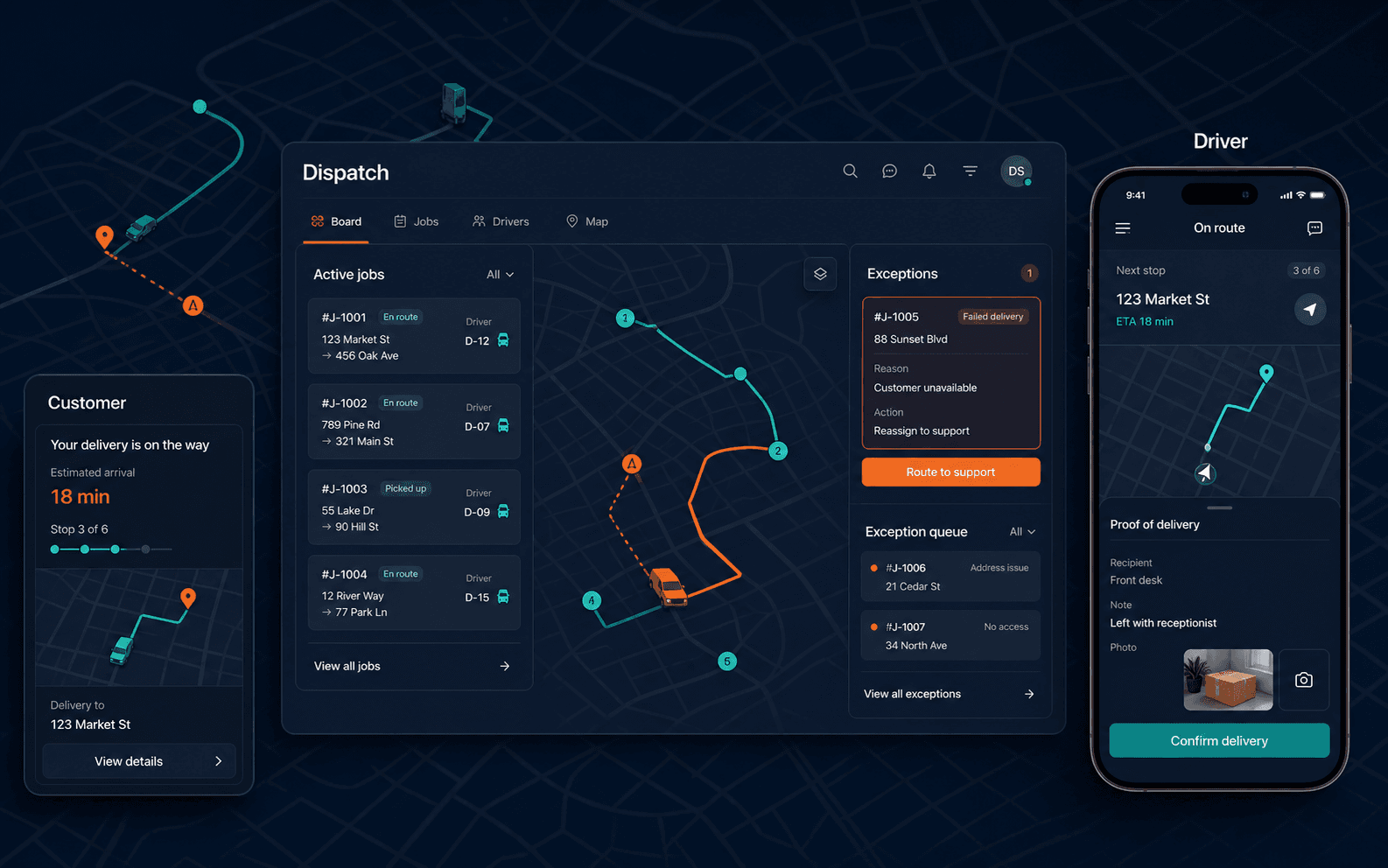
Lalamove-style Same-day Logistics operations and dispatch planning visual
Operations, dispatch, and exception handlingEvidence: illustrativeOpen full-size reference

The van arrives, but the cabinet will not fit through its loading door

A shipper books a van for a cabinet and several cartons. The listed weight seems acceptable, but the cabinet cannot pass through the vehicle opening. The recipient also expects the driver to carry it upstairs, although the booking covers transport only. A map and a vehicle icon do not settle this disagreement. The product needs declared dimensions, actual vehicle suitability, handling responsibilities and an agreed response when collection cannot proceed as booked.

A Lalamove-style same-day logistics app connects shippers with eligible commercial drivers for instant or scheduled goods movement. It is independently branded software, not access to Lalamove’s vehicles, proprietary systems or operating permissions. Buyers should first define which loads their operator can responsibly accept and which party handles each handoff. This is a vehicle-and-load matching business, not simply a parcel tracking screen with a larger truck illustration.

Choose the vehicle from the load, not the shortest arrival estimate

The official Lalamove Singapore vehicle and pricing details distinguish vehicle dimensions, weight limits and additional services. Those market-specific examples show why vehicle choice and handling cannot be one generic delivery option. They are not capacity figures, prices or inclusion promises for your independent operation; define your own reviewed fleet catalogue.

Collect item count, dimensions, weight and relevant handling requirements before presenting suitable classes. Cargo volume alone misses loading-door clearance, awkward shapes and equipment needs. Let the operator reject uncertain declarations or request clarification instead of dispatching the nearest driver automatically. Preserve what the shipper declared and what the driver found. A suitable replacement needs a new capacity check, not merely a different registration number on the same booking.

Loading and unloading need named responsibilities at both ends

Curbside collection, warehouse loading and upstairs placement are different services. The booking should state who supplies labour, whether helpers are included, and which access assumptions support the quote. Record stairs, lifts, loading bays and equipment needs where relevant without exposing unnecessary personal information. A driver must be able to decline an unsafe lift through a defined exception path, rather than negotiate an undocumented obligation beside the vehicle.

If the customer adds a helper or changes the unloading requirement, create an amendment that shows availability and charge consequences. Neither a free-text note nor a support message should silently expand the agreed work. Rehearse a blocked lift, unavailable warehouse staff and a load heavier than declared. Decide who can authorize revised handling, what happens if nobody agrees, and how cargo already collected remains protected while the exception is resolved.

A scheduled booking is not a guaranteed reserved vehicle

A business can request tomorrow’s pickup before a driver has committed. Show requested, accepted and confirmed states separately, with the assumptions attached to each. Define how far ahead matching occurs, what capacity is reserved and how a driver withdrawal is handled. Avoid displaying a precise arrival promise where the operating model provides only an estimated window. Branch staff need an actionable status before they prepare a loading team.

At acceptance, check vehicle eligibility and overlapping assignments against the current job version. Duplicate requests from a business integration should recover the same booking rather than create competing pickups. When a driver becomes unavailable, preserve the accepted terms and explain the replacement process. Rehearse cancellation before collection and cancellation after custody begins; the second case requires a cargo recovery decision, not simply returning the order to a dispatch queue.

Pickup establishes cargo custody rather than merely starting a timer

A driver arriving at the address has not necessarily received the goods. Record the actual collection event, item or package quantities, visible condition and relevant discrepancies. Choose evidence appropriate to the load and privacy requirements; unrestricted photographs can expose labels, addresses or business documents. Keep refused, partially collected and fully collected loads distinct. The shipper should be able to identify which items entered custody and which remained behind.

Where condition is disputed, retain the original declaration and restricted collection evidence instead of replacing them with an administrator’s summary. Explain the limits of photos and acknowledgements: neither proves the contents of a sealed package. If the load differs materially, pause for the reviewed amendment or refusal process. Buyers should test an interrupted pickup upload and a repeated collection event so reconnection cannot create duplicate custody or contradictory item counts.

Multi-stop delivery needs a separate obligation at every address

A route with several recipients is not one order that becomes delivered at the final pin. Give each stop its cargo allocation, contact, authorized handoff method and access constraints. Show the driver what must leave the vehicle there and what must remain aboard. Sequence changes can affect promised windows and loading accessibility, so retain the original route and communicate approved changes to the people whose stops are affected.

If one recipient is absent, preserve successful earlier handoffs and keep later stops actionable. An unsuccessful stop needs an explicit decision: retry, return, hold or another permitted action. Do not invent permission to leave valuable cargo unattended. Test a skipped stop, a recipient address amendment and a partial unload. The operations console should show remaining custody accurately without resetting the journey or marking undelivered items complete to make the route appear finished.

Waiting, tolls and parking must not become unexplained cash demands

Separate the initial transport quote from conditional extras. Explain when waiting starts, which delay is chargeable, how applicable tolls or parking are handled and who may approve them. A vehicle near the pickup is not proof that loading access was available. Keep arrival, customer readiness and loading events distinguishable so an agent can review the circumstances rather than automatically billing every minute between two location updates.

Require an adjustment reason, the relevant evidence and the approving actor. Present the revised total before collection where practical and define what happens when an unexpected charge arises later. A rejected extra must not disappear into a changed base fare. Duplicate events should not add the same toll twice. Buyers should inspect a disputed wait and an unreceipted expense, including how each affects the customer invoice, driver proceeds and unresolved support balance.

Business branches need booking authority, not a shared master login

The official Lalamove business delivery solutions page presents business delivery arrangements and integration options. It is a reference for business logistics needs, not proof that your product has a negotiated fleet relationship, production integration access or the same commercial terms. Obtain permissions and operating arrangements independently before relying on any external provider.

Give each branch a permitted service area, booking roles and reviewed spending authority. Preserve purchase references and distinguish the employee creating a request from the person approving credit or adjustments. A branch template can reduce typing but must not bypass a fresh cargo declaration or vehicle suitability check. Account suspension and staff departure should remove future booking rights without erasing completed-job evidence needed for invoices, customer service or legitimate dispute review.

Delivery proof must say who received which goods

A signature, photo or confirmation code is evidence of a specific handoff under agreed terms, not an unconditional guarantee of delivery quality. Associate it with the correct stop, item quantity and authorized recipient. Record shortage, visible damage or refusal without forcing the driver to select an inaccurate successful outcome. Keep delivery completion separate from a subsequent claim so an investigated incident does not rewrite the physical event history.

Restrict proof access to appropriate customer, driver and operations roles. Set retention and export rules for signatures, telephone numbers, addresses and photographs. A public tracking link should not expose every recipient on a multi-stop route. Rehearse an unauthorized collector, partial acceptance and a disputed proof upload. The buyer should see who can review the evidence, who can correct a clerical error and how the original remains traceable after a permitted correction.

A return journey is a new custody instruction, not a reversed status

When delivery fails, the driver still holds goods. Define who can authorize their return, where they go and whether a revised route or charge needs approval. The original pickup location may be closed by the time the load comes back. An instruction to return therefore needs a receiving contact, access plan and evidence of final handback. Keep the failed outbound stop visible instead of turning it into a successful delivery to the shipper.

Reconcile physical outcomes and money separately. A refunded transport charge does not settle a damage claim, and successful payment does not prove the recipient accepted the cargo. Define liability, exclusions and coverage with appropriate commercial and specialist review rather than promising universal insurance from software. Give operations an accountable queue for outstanding custody and uncertain payments so the job cannot disappear merely because a customer-facing receipt has been issued.

Decide whether you need a local vehicle marketplace or a parcel network

Compare a FedEx-style parcel network if your intended operation relies on labels, depot scans, manifests and carrier services rather than direct vehicle selection for a declared load. These models have different custody boundaries and commercial dependencies. Do not add both to the first release just because they share a tracking map.

For the local marketplace, start with reviewed cargo categories, fleet classes and routes the operator can supervise. Commercial carrier authority, insurance arrangements, road access, worker classification and prohibited goods need market-specific review. Refrigeration, hazardous materials and cross-border freight should not be inferred from a vehicle selector. Expansion is justified when the operator can own the additional obligations, not when another icon can fit on the booking screen.

Approve the difficult delivery walkthrough before approving launch

Illustrative screens explain proposed shipper, driver and control surfaces; they do not prove a working vehicle network or a live commercial integration. Request a controlled walkthrough using sample loads and sandbox payments. Book an unsuitable vehicle, change the unloading requirement, interrupt pickup connectivity and fail one stop on a multi-recipient route. Check that completed handoffs remain intact and that unresolved goods always have an accountable custodian.

Buyer acceptance should include duplicate bookings, unauthorized charge adjustments, a disputed wait, recipient mismatch and a return to a closed warehouse. Inspect readable mobile forms, keyboard access and restricted proof exports. Agree which components are configured, newly engineered or dependent on external access, then document handover responsibilities. A successful demonstration should show recoverable cargo and commercial decisions rather than only a vehicle moving along a colourful route.

Bring a representative load and a failed-handoff example to a same-day logistics scope discussion. Define ownership, integration permissions and operating responsibilities in the applicable agreement.

Use the delivery process to establish checkpoints for vehicle fit, custody, charge reconciliation and support training before launch.

Product flow

Role-workflow flow diagram.

A visual map of how each role interacts with each workflow stage, with operator controls and integration boundaries.

Deployable Product Architecture

Lalamove-style Same-day Logistics

MATCH DECLARED CA…ESTABLISH CUSTODY…CLOSE EACH STOP B…Describe the load…Accept a suitable…Resolve mismatche…INTEGRATIONS: Maps and fleet-location services with vehicle access constraints, stop vers…OPERATOR CONTROLS: Do not dispatch by proximity alone · Keep stop amendments visible to affect…
Illustrative validation artifact — role-workflow flow diagram; final surfaces, boundaries, and integration topology are confirmed during discovery.

User roles

Lalamove-style Same-day Logistics roles and workflows.

Clone-inspired platforms usually need several coordinated interfaces, not just a customer app.

Shipper

01

Describe the load before choosing the vehicle

Enter dimensions, weight, handling needs and stop contacts. Confirm access, loading responsibility and quoted extras before committing a booking.

Commercial driver

02

Accept a suitable load and preserve custody

Review vehicle fit, equipment, route and handling terms. Record pickup condition, stop-level handoff and exceptions without accepting unsafe work.

Logistics controller

03

Resolve mismatches and route exceptions

Review vehicle substitutions, waiting claims and unsuccessful handoffs. Preserve the agreed load and charge history while assigning an accountable next action.

Workflow

Lalamove-style Same-day Logistics workflow stages.

Each workflow stage is mapped to a role, screen, API, notification, admin control, and measurable launch outcome.

Specify and quote

01

Match declared cargo to an eligible service

Check load dimensions, restrictions, vehicle capacity and access. Price the reviewed route, handling and stop requirements against a versioned booking.

Collect and move

02

Establish custody before starting the route

Confirm actual items and loading arrangements. Record differences, obtain approved amendments and protect the remaining stop commitments when collection changes.

Handoff and reconcile

03

Close each stop before closing the job

Record recipient authority, quantity and exceptions separately. Reconcile transport charges, approved extras and unresolved claims rather than marking every stop delivered together.

Deployable Product Architecture

Workflow / system register

Revision FPlanning surface

Live operations

Lalamove-style Same-day Logistics workflow stages.

Every request becomes an observable job

Live operations: Lalamove-style Same-day Logistics workflow stages.Every request becomes an observable job. Exceptions and support need the same visibility as the happy path.
01

Match declared cargo to an eligible service

02

Establish custody before starting the route

03

Close each stop before closing the job

Control note

Exceptions and support need the same visibility as the happy path.

Illustrative architecture register; validate against the accepted scope.

Operator controls

Lalamove-style Same-day Logistics admin and operator controls.

The control center is scoped as a first-class product surface, not an afterthought.

Vehicle suitability

01

Do not dispatch by proximity alone

Validate dimensions, payload, equipment and reviewed cargo permissions. Reconfirm suitability when a replacement vehicle or changed load is proposed.

Route integrity

02

Keep stop amendments visible to affected parties

Version recipient, sequence and access changes. Require authorization for charge consequences and retain completed handoffs instead of resetting the whole journey.

Evidence and adjustment

03

Separate arrival, custody and successful delivery

Capture appropriate loading and handoff evidence with access limits. Require reasons and permissions for waiting, tolls, damage claims and manual charge corrections.

Monetization

Lalamove-style Same-day Logistics monetization models.

We model monetization early so payments, admin controls, and reporting support the business.

Show the commercial basis before commitment

Define the vehicle, route and booking components that determine the charge. Disclose driver proceeds and platform fees under the chosen operating agreement.

Sell controlled booking and reconciliation tools

Scope branch permissions, purchase references, approval limits and invoicing. Account access does not imply guaranteed vehicle availability or unrestricted credit.

Charge for an agreed additional responsibility

Separate helpers, loading services, extra stops and waiting. Explain inclusion, authorization and evidence rather than allowing unreviewed on-site cash demands.

Integrations

Lalamove-style Same-day Logistics integration surface.

External systems that determine launch readiness, data flow, and operational continuity.

Integration

01

Integration 1

Maps and fleet-location services with vehicle access constraints, stop versions, uncertain arrival estimates and appropriate participant location permissions

Integration

02

Integration 2

Booking and business-account systems with branch identity, purchase references, approval authority, idempotent requests and cancelled-job reconciliation

Integration

03

Integration 3

Payment, invoicing and proof-of-delivery services with charge-component history, stop-level evidence, restricted recipient data and unresolved-result handling

Scope drivers

Lalamove-style Same-day Logistics scope drivers.

The variables that most influence build effort, cost, and launch readiness.

Cargo and fleet

01

Define what the launch operation can actually carry

Review permitted goods, vehicle classes, equipment and driver authority. Refrigeration, hazardous loads and heavy lifting require separate operational assessment.

Handling boundary

02

Agree what happens beyond the vehicle door

Specify loading, stairs, helpers, parking and consignee preparation. Do not describe transport as a complete moving service without the appropriate staffing and terms.

Dispatch model

03

Choose dedicated jobs before promising shared capacity

Set service zones, scheduled acceptance and multi-stop responsibilities. Pooling and intercity movement need additional timing, custody and operating controls.

Deployable Product Architecture

Scope drivers / system register

Revision CPlanning surface

Live operations

Lalamove-style Same-day Logistics scope drivers.

Every request becomes an observable job

Live operations: Lalamove-style Same-day Logistics scope drivers.Every request becomes an observable job. Exceptions and support need the same visibility as the happy path.
01

Define what the launch operation can actually carry

02

Agree what happens beyond the vehicle door

03

Choose dedicated jobs before promising shared capacity

Control note

Exceptions and support need the same visibility as the happy path.

Illustrative architecture register; validate against the accepted scope.

V1 scope

Lalamove-style Same-day Logistics V1 foundation.

Launch the smallest complete operating loop first, then scale the product with confidence.

Suitable vehicle booking

01

Prove a declared load can be accepted responsibly

Launch a reviewed vehicle range and service area. Keep dimensions, cargo exclusions, handling responsibilities and quote expiry visible throughout booking.

Stop-level execution

02

Recover from a failed handoff without losing the route

Support pickup condition, recipient verification, partial delivery and return decisions. Preserve completed stops and notify affected contacts about approved changes.

Commercial reconciliation

03

Connect extras to an agreed event and actor

Rehearse waiting, toll and handling approval with traceable evidence. Keep payment uncertainty and damage review separate from physical delivery completion.

Later phases

Lalamove-style Same-day Logistics post-launch expansion.

Capabilities that should usually wait until real usage proves the core loop.

Managed business routes

01

Add repetition only after exceptions are understood

Introduce recurring schedules, branch templates and account reporting with reviewed capacity and change rules. A template is not a guaranteed vehicle reservation.

Regional freight

02

Review the boundary crossed by longer journeys

Assess commercial permits, cargo coverage, handover arrangements and driver working conditions before adding intercity or cross-border services.

Shared capacity

03

Evaluate consolidation without hiding competing loads

Model space, custody and stop commitments across compatible bookings. Test delay propagation and customer disclosures before permitting pooled assignments.

Deployable Product Architecture

Later phases / system register

Revision FPlanning surface

Live operations

Lalamove-style Same-day Logistics post-launch expansion.

Every request becomes an observable job

Live operations: Lalamove-style Same-day Logistics post-launch expansion.Every request becomes an observable job. Exceptions and support need the same visibility as the happy path.
01

Add repetition only after exceptions are understood

02

Review the boundary crossed by longer journeys

03

Evaluate consolidation without hiding competing loads

Control note

Exceptions and support need the same visibility as the happy path.

Illustrative architecture register; validate against the accepted scope.

Regulatory review

Lalamove-style Same-day Logistics regulatory and compliance flags.

Each flag must be reviewed by qualified counsel for your target market before build or launch.

Flag 1

Qualified transport concept

Flag 2

Commercial carrier and cargo rules vary by market

Flag 3

Insurance and worker classification review required

Reference walkthrough

Request a Lalamove-style Same-day Logistics reference walkthrough.

Ask us to confirm which reference surfaces are currently available for this product model. Rather than publishing shared demo credentials, we schedule a private guided walkthrough for qualified buyers.

Reference surface

01

Shipper: Describe the load before choosing the vehicle

Request a role-specific demonstration and confirm which capabilities are currently available. Review the proposed responsibility: Enter dimensions, weight, handling needs and stop contacts. Confirm access, loading responsibility and quoted extras before committing a booking.

Reference surface

02

Commercial driver: Accept a suitable load and preserve custody

Request a role-specific demonstration and confirm which capabilities are currently available. Review the proposed responsibility: Review vehicle fit, equipment, route and handling terms. Record pickup condition, stop-level handoff and exceptions without accepting unsafe work.

Reference surface

03

Logistics controller: Resolve mismatches and route exceptions

Request a role-specific demonstration and confirm which capabilities are currently available. Review the proposed responsibility: Review vehicle substitutions, waiting claims and unsuccessful handoffs. Preserve the agreed load and charge history while assigning an accountable next action.

Next step

04

Book a walkthrough

Request a live, private walkthrough of the reference implementation. We will confirm scope and discuss configured deployment versus custom build for your market.

Open register

Deployable Product Architecture

Reference walkthrough / system register

Revision APlanning surface

Live operations

Request a Lalamove-style Same-day Logistics reference walkthrough.

Every request becomes an observable job

Live operations: Request a Lalamove-style Same-day Logistics reference walkthrough.Every request becomes an observable job. Exceptions and support need the same visibility as the happy path.
01

Shipper: Describe the load before choosing the vehicle

02

Commercial driver: Accept a suitable load and preserve custody

03

Logistics controller: Resolve mismatches and route exceptions

04

Book a walkthrough

Control note

Exceptions and support need the same visibility as the happy path.

Illustrative architecture register; validate against the accepted scope.

Process

A traceable path from decision to acceptance.

  1. 01

    Model teardown

    We map the reference business model, user roles, monetization path, regulatory needs, and launch constraints.

    Artifact: Product teardown, risk map, role matrix

  2. 02

    Market-fit blueprint

    We reshape the model around your market, operations, pricing, workflows, and first release priorities.

    Artifact: Feature scope, flows, technical plan

  3. 03

    Design and build

    Product, design, engineering, QA, and cloud delivery move in weekly demo cycles with visible progress.

    Artifact: Working releases, QA notes, sprint demos

  4. 04

    Launch and operate

    We support production release, monitoring, handoff, roadmap decisions, and post-launch improvement.

    Artifact: Launch checklist, docs, growth backlog

FAQ

Questions to resolve before the build.

01Does this include Lalamove’s drivers or proprietary platform?

No. The scope is independently branded software for a reviewed logistics model. Another company’s driver network, proprietary code, brand rights, operating permissions and commercial integration access are not included.

02How should the app choose a suitable vehicle?

Use declared dimensions, weight, item count, access and handling requirements against the operator’s reviewed fleet catalogue. Recheck suitability when the load or assigned vehicle changes; proximity alone is insufficient.

03Are loading, helpers and upstairs delivery included?

Only where explicitly agreed. State responsibility at pickup and unloading, including helpers, stairs and equipment. An additional service requires availability and approved terms, not an assumption attached to a transport booking.

04Does scheduling guarantee that a vehicle is reserved?

Not automatically. Distinguish the requested time, driver acceptance and confirmed commitment. Explain capacity reservation, withdrawal handling and arrival uncertainty according to the actual operating model.

05When does cargo enter the driver’s custody?

At the recorded collection event, not merely arrival at the address. Preserve quantities, visible condition and discrepancies. Partial or refused collection must remain different from complete pickup.

06How does one unsuccessful stop affect a multi-stop booking?

Keep completed handoffs intact and identify cargo still aboard. Apply an authorized retry, return, hold or other permitted instruction for the failed stop without automatically closing or resetting the remaining route.

07How are waiting, tolls and parking charges controlled?

Define conditional charges before commitment, record relevant events and require adjustment authority. Preserve evidence and distinguish approved extras from disputed amounts; duplicate events must not create repeated charges.

08Can different business branches share one logistics account?

Yes, with scoped branch roles, spending approval and purchase references. Avoid shared master credentials. Templates and account credit do not bypass cargo suitability checks or guarantee vehicle availability.

09What should proof of delivery establish?

The correct stop, goods quantity, recipient authority and recorded exceptions under agreed terms. Restrict evidence access and retention. A photo or signature does not guarantee undisputed condition or prove sealed-package contents.

10What happens when goods need to be returned?

Create an authorized custody instruction with a receiving contact, access plan and agreed charge treatment. Preserve the failed delivery history and capture the final handback rather than simply reversing a status.

11Does the software include carrier licensing or cargo insurance?

No automatic permission or universal coverage is implied. The operator needs appropriate review of commercial authority, cargo restrictions, insurance terms, road access and worker arrangements for each launch market.

12What should a buyer test in the demo?

Test vehicle mismatch, added handling, duplicate booking, interrupted pickup, partial multi-stop delivery, disputed waiting, unauthorized collection and returns. Use controlled sample data and sandbox payments; illustrative media is not a live network demonstration.

Primary sources

References behind this page

Dated official documentation, standards, and research that support the factual claims on this page.

  1. 01
  2. 02

Citation readiness

How to interpret this page

Published by App Clone Labs Editorial Team

Commercial claims
Scope, cost, and timeline claims are planning guidance and require validation in a current proposal.
Evidence status
Diagrams, boards, examples, and estimates are illustrative planning artifacts unless explicitly identified with a source and measured evidence status.

Next decision

Turn the brief into an accepted product scope.

Define outcomes, constraints, evidence, rights and handover before delivery begins.

Commercial rights, repositories, environments, documentation, acceptance and handover remain contract-defined.

Scope Lalamove-style Same-day Logistics

Independent from Lalamove

App Clone Labs is an independent software development studio. We are not affiliated with, connected to, sponsored by, or endorsed by Lalamove.

Why this name appears

Lalamove is referenced descriptively to identify familiar product mechanics and common search terminology. “Clone” describes a planning reference, not a replica.

Original delivery

Any product delivered by App Clone Labs is independently designed and developed for the accepted scope. It does not contain proprietary code, branding, copy, interface assets, or confidential material from Lalamove.

Trademark ownership

Lalamove and associated names, logos, and marks remain the property of their respective owners. Their use identifies a reference category and does not imply authorization or endorsement.