Delivery and local commerce

Rappi-style Delivery Super App — Custom-Built for Your Market

Multi-category local delivery, errands, and merchant services platform. Planned for regional operators unifying restaurants, retail, and courier tasks with role-specific workflows, operator controls, integrations, and a handover boundary defined for the selected market.

See product screens and demo access

Custom workflows

Brand-safe product strategy

Admin and operations tooling

Reference walkthrough by arrangement

Review shared customer identity and the separate rules behind each category.

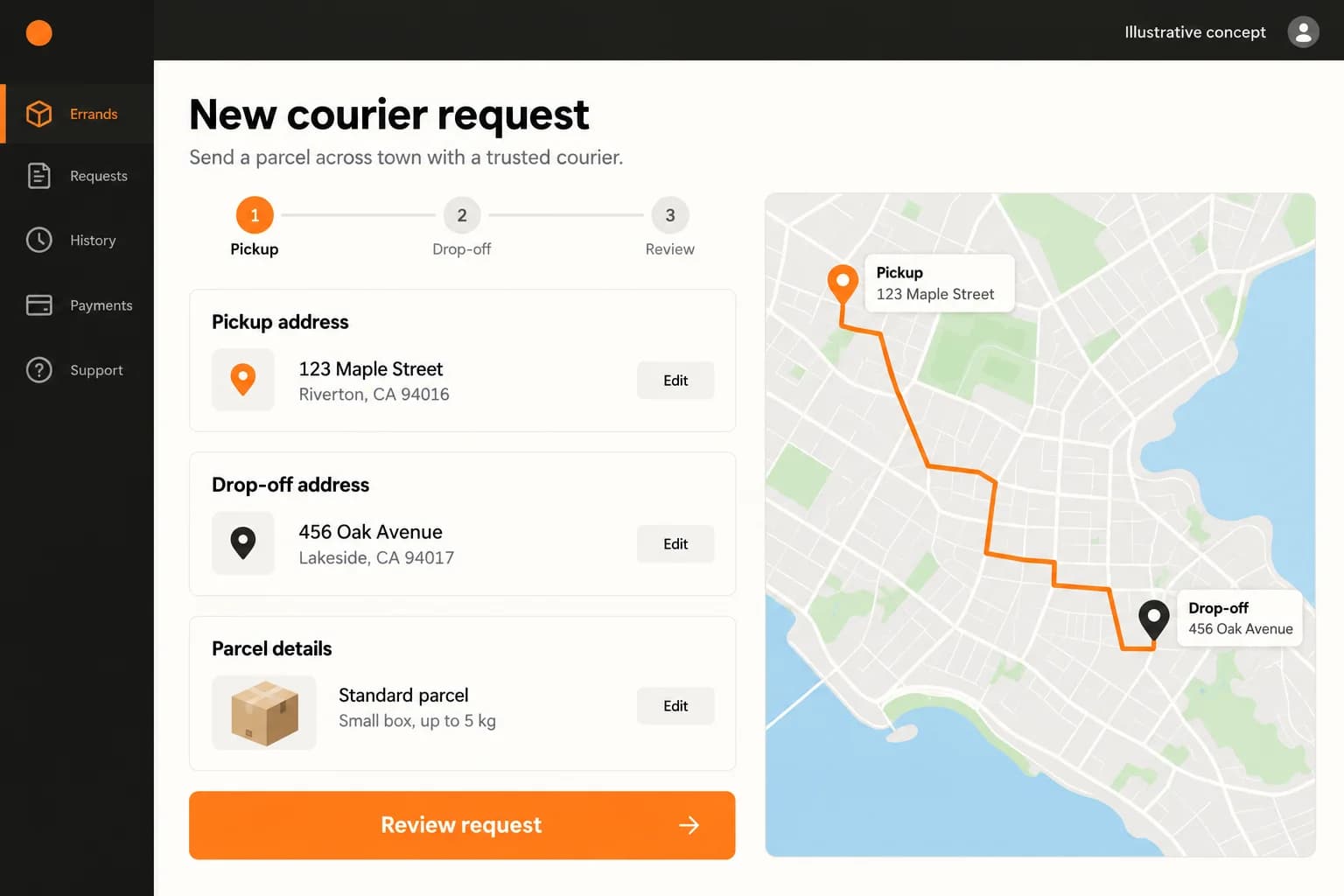
Structure a Rappi-style delivery product around a shared customer account while keeping restaurant, grocery, retail and errand responsibilities explicit. This original parcel concept illustrates only the errands intake foundation; it is not Rappi UI, a working integration or evidence of affiliation. Ask to follow separate category orders through eligibility, payment and support; one account alone does not establish a combined checkout or financial services.

Original local courier concept showing pickup and drop-off address cards, standard parcel details and a route map

Original local courier concept showing pickup and drop-off address cards, standard parcel details and a route map

Original AI-generated illustrative parcel-intake concept used to discuss the errands category. It does not show shared identity, other category orders, courier permissions, payments or a support case. No Rappi affiliation, working integration or courier network is established.

What to check in the walkthrough

  • How do category rules differ for parcel size, food preparation, grocery substitutions, restricted goods and courier eligibility? Ask to attempt assignment to an ineligible courier and see the permission check, reassignment and customer status update.
  • Which customer identity details are shared, and do category orders retain separate identifiers, payment authorisations and cancellation rules? Ask for a successful food payment and a failed parcel payment, then verify recovery without repeating the food charge or exposing unnecessary customer details to another merchant.
  • Who owns support when a customer has both a delayed food order and a failed parcel handoff? Open separate cases, apply the appropriate refund or delivery recovery and verify that resolving one case does not close or alter the other order.
Open full-size reference

Solution reference register

01 / Reference and IP

This page references third-party product names only to describe familiar product models and planning references. App Clone Labs is not affiliated with or endorsed by those brands. Build decisions require independent legal, regulatory, and operational review for your market.

02 / Artifact status

Boards, diagrams, screens and workflow descriptions on this page are illustrative planning artifacts, not evidence of a deployed client product.

03 / Regulatory caveat

Food, courier, and restricted-item rules vary by category · Regulated financial modules require separate qualification

04 / Rights and handover

Source access, licensing, repositories, environments, documentation, acceptance and handover are defined by the signed contract and accepted scope.

Scope

Operating model defined

Roles, workflows, dependencies, exclusions, and assumptions are made reviewable.

Evidence: illustrative

System

Applications connected

Experience, operations, services, data, integrations, and release controls are planned together.

Evidence: illustrative

Handover

Rights stated in writing

Access, assignment, licensing, dependencies, documentation, and support follow the signed agreement.

Evidence: illustrative

Artifact register

Product screens and planning references.

Reference screens illustrate workflows, not a contracted feature list. Sample prices, data, and responses are demonstration content; confirm the current scope during a walkthrough.

Rappi-style Delivery Super App connected product workflow planning visual
Connected customer, operations, and data workflowEvidence: illustrativeOpen full-size reference
Rappi-style Delivery Super App product engineering ecosystem visual
Product engineering ecosystem and handover boundaryEvidence: illustrativeOpen full-size reference
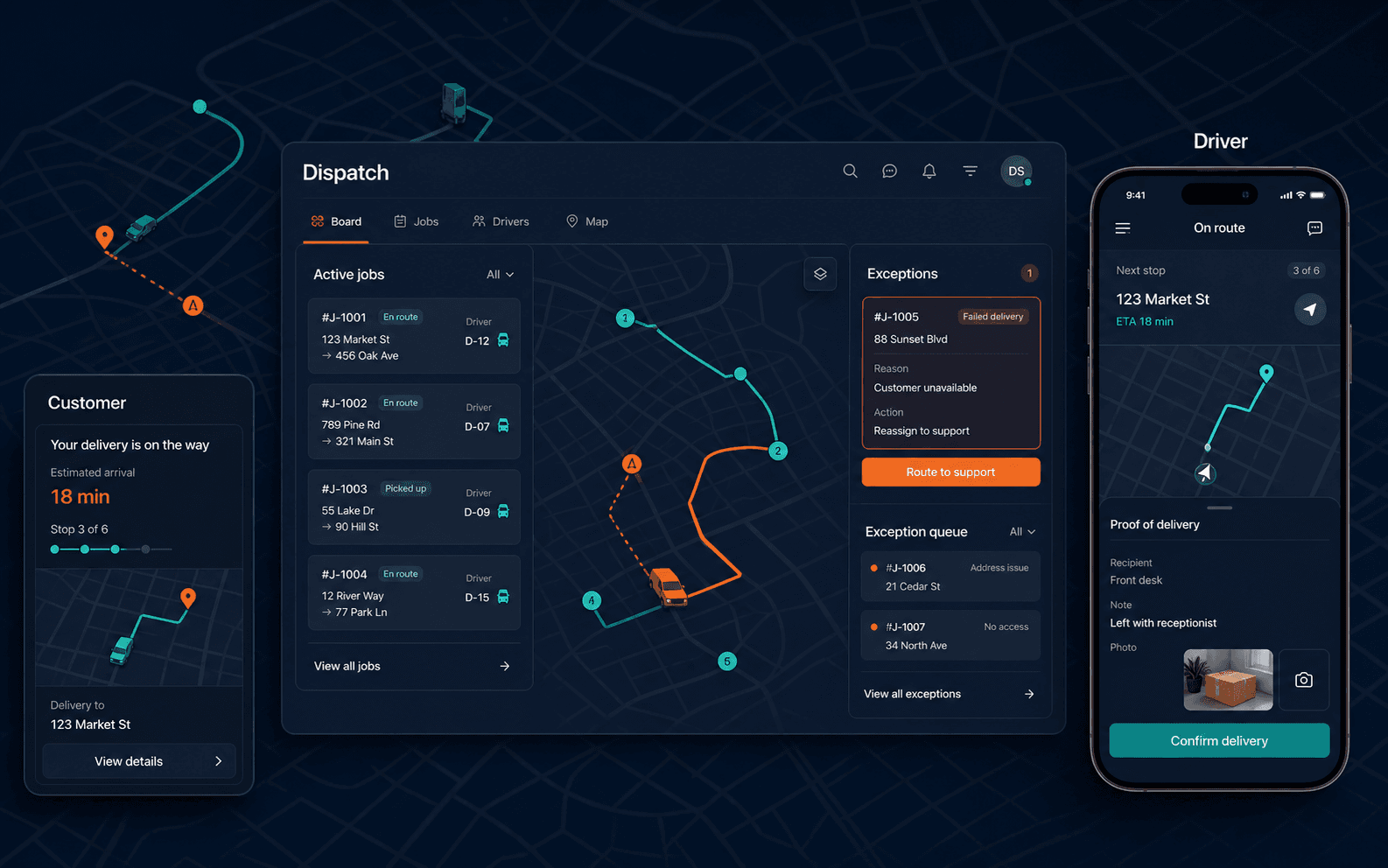
Rappi-style Delivery Super App operations and dispatch planning visual
Operations, dispatch, and exception handlingEvidence: illustrativeOpen full-size reference

A meal, a grocery replacement and an errand cannot share one cancellation rule

A customer orders dinner, approves a grocery replacement and asks a courier to collect a parcel. The restaurant starts cooking while the grocery item remains undecided and the parcel has not been collected. One account can make discovery convenient, but it must not make those obligations indistinguishable. A useful multi-category commerce product explains what each participant has accepted, which changes remain possible and who owns an exception. More service tiles do not solve that operating problem.

This page scopes independently branded software for local commerce across selected merchant and task categories. It does not include Rappi’s merchant network, couriers, proprietary applications, brand rights or financial permissions. A buyer needs an operating owner for every proposed service and authorized access to required providers. The goal is a coherent storefront over different workflows, not a claim that one generic delivery module can reproduce an established company’s whole business.

Choose the category boundaries before designing the super-app home screen

Begin with the work the operator can actually supervise. A restaurant prepares a defined meal; a grocery shopper may discover a different weight or unavailable item; an errand participant follows a bounded instruction. Each has different acceptance evidence, charge assumptions and failure modes. Document what is excluded as carefully as what is offered. Open-ended requests can introduce prohibited goods, uncontrolled spending or work the operator cannot safely support.

Give each vertical an accountable operations team, supported territory and reviewed terms. The first release does not need a financial-services tile simply because a reference platform has one. Stored value, credit, cash withdrawal and other regulated activities require separate qualification and provider authority. Keep them outside scope until those requirements are satisfied. Category selection is an operating decision with software consequences, not a branding exercise or a shortcut to permission.

A shared customer account still needs separate order commitments

The customer should be able to find all active requests without confusing their status or totals. Give each commitment a service type, merchant or task owner, versioned terms and its own identifier. A shared address book can help, but changing the default address must not redirect an accepted meal or parcel silently. Show which change applies to which request and whether its responsible participant has accepted it.

Keep receipts, refunds and support references attached to the original order. A combined dashboard is useful; an unexplained combined financial balance is not. When several services are purchased together, explicitly define whether they remain separate contracts and payments or form an orchestrated commitment. Do not imply atomic fulfillment if one service can succeed while another fails. Buyers should inspect that partial outcome before approving cross-category checkout.

Resolve merchant branch availability before broadcasting delivery demand

Official Rappi México merchant guidance explains that restaurant items can be disabled following stock-related cancellations and encourages merchants to maintain availability. It is an example of availability operations, not proof of this project’s integration access or a recommendation to copy every automatic rule. Define your merchant’s authority and restoration process explicitly.

A branch can be open while particular products or service modes are unavailable. Maintain branch hours, preparation capacity, item availability and temporary pauses separately. Record where menu data originates and how stale updates are detected. A support agent restoring one dish must not reopen a closed branch or another category’s stock. Rehearse a merchant pause after basket creation and show the customer the revised options before payment or dispatch creates further obligations.

Restaurant preparation needs its own change and acceptance boundary

A meal’s modifiers, preparation instructions and accepted price must reach the kitchen together. Distinguish order receipt from acceptance and preparation start. Decide which changes require merchant confirmation and when they are no longer feasible. A courier waiting nearby is not evidence that the restaurant accepted the request. Keep preparation status honest so the customer does not receive a confident arrival estimate for a meal nobody is making.

Record unavailable dishes and rejected modifiers with the order, then apply the reviewed cancellation or partial-order policy. Food information needs accountable merchant review; a free-text note does not guarantee allergy safety. Give support a clear merchant escalation path and prevent chat from silently changing accepted charges. Buyers should test a rejected meal after courier allocation and inspect how staff release the delivery work without losing the restaurant exception.

A shopper discovers a missing item and proposes a replacement with a different pack size. Show the original request, alternative, relevant quantity and charge effect. Record approval, rejection or the agreed fallback when the customer cannot respond. Weighted products need transparent estimate and final-measurement handling. Do not let a restaurant-style fixed total hide a grocery basket that is still being selected and revised.

Keep grocery consent specific to its item and order. An account preference can guide proposals but should not imply unrestricted permission to buy anything available. Reconcile partial fulfillment, promotions and delivery charges under disclosed terms. Test a rejected replacement, a changed weight and a checkout authorization that no longer covers the approved total. The useful demonstration shows the resulting receipt and settlement, not just a chat bubble announcing a substitution.

Errands need a bounded instruction and purchase authority

Collecting an already prepared parcel differs from purchasing goods on someone’s behalf. Record permitted contents, pickup authority, spending limit, receipt requirements and the party responsible for unexpected costs. Do not send a courier an unrestricted request field with no review path. If the task changes materially, preserve the original instruction and require the appropriate approval before additional work or spending occurs.

Custody matters once an item is collected. A cancellation button cannot undo physical possession; support needs a permitted return or redirection decision. Protect access details and recipient information by task role. Financial errands and restricted goods must not be introduced through a generic category label. Rehearse a purchase exceeding the approved budget and an unavailable pickup contact. The buyer should see an accountable stop condition rather than a worker improvising outside the agreed service.

Delivery allocation follows the actual category obligation

A hot meal, a bulky grocery basket and a fragile parcel place different demands on the delivery operation. Check partner eligibility, vehicle suitability, accepted work and handling instructions before allocation. A common map can display them, but it cannot establish safe or permitted combined carriage. Define when batching is allowed and what evidence supports the customer-facing delivery estimate. Avoid unconditional speed promises that ignore merchant readiness and actual partner availability.

Separate arrival at pickup, custody acceptance, arrival at destination and completed handoff. Replayed or delayed updates must not regress a delivered order or close an uncollected parcel. If the courier cannot continue, assign recovery to the correct service owner with permitted instructions. Test a grocery handoff delayed by unresolved replacement approval while another restaurant order is ready. Neither customer should inherit the other order’s status merely because the same partner is involved.

Cancellation terms depend on category, progress and responsible party

Rappi’s published cancellation policy distinguishes restaurant, shopping and errand scenarios using their progress and fulfillment arrangements. That supports the need for separate rulesets; it does not establish the fees or legal terms for your launch. Qualified reviewers should assess applicable customer rights, merchant arrangements and participant obligations before implementing charges.

Store the applicable policy version with the order and show any proposed consequence before confirmation. A merchant rejection, customer change of mind and unavailable courier require different attribution. Preserve who acted, what work was already accepted and what remains unresolved. An order can be canceled operationally while payment reversal is still pending. Explain that distinction instead of displaying a success banner that implies money has already reached the customer.

Promotions and refunds need a service-level financial trail

A grocery discount funded by one merchant should not quietly reduce another restaurant’s payout. Attribute merchandise, delivery, platform charges, tips and promotion funding to the correct commitment and party. Define how partial fulfillment affects eligibility and disclose any changed total before agreement where required. Preserve original amounts and adjustment reasons rather than rewriting the receipt until it matches a settlement export.

Duplicate provider callbacks must resolve to one financial event. Treat missing confirmations as uncertainty to investigate, not automatic authority for another charge or refund. Manual credits need permissions, reasons and reconciliation. A unified customer interface does not require a shared stored-value ledger. If a wallet or cross-service credit is genuinely needed, review its legal and accounting implications separately rather than describing ordinary payment integration as financial authorization.

One support entrance needs accountable category case ownership

A customer reports a missing grocery item and a cold meal in the same conversation. Support can preserve the conversational context while creating distinct issues with order references, evidence and responsible teams. A refund for the meal must not close the grocery investigation. Record handoffs and a visible next owner so the customer does not repeatedly explain the case while every team assumes another service is responsible.

Compare a Gojek-style operating model when shared driver capacity across transport and goods services is the central problem. This page centers the different commitments behind local commerce baskets and tasks. Keep access to addresses, purchase receipts and complaint evidence limited to the staff who need it. Shared support should improve continuity without exposing a customer’s unrelated activity to every merchant or courier.

Validate a mixed-service exception before adding more categories

Illustrative screens do not prove a live merchant network, working provider account or staffed support operation. Request a controlled walkthrough with sample restaurant, grocery and errand orders using sandbox payments. Pause a branch, reject a replacement, exceed an errand budget and cancel a prepared meal. Inspect each customer explanation, partner action, support case and financial record together. The interface should make the differences understandable rather than bury them behind identical status labels.

Buyer acceptance should include a duplicate callback, partially reversed promotion and failed delivery with another service still active. Check mobile readability, keyboard navigation and restricted access to cross-service histories. The proposal should identify reusable software, new rules, third-party dependencies and operator responsibilities. Agree ownership, licensing and handover access in the applicable contract; software delivery does not guarantee demand, approvals or commercial outcomes.

Bring one mixed-service customer complaint to a multi-category commerce scope discussion. Identify its category owners and money movements before choosing launch features.

Use the delivery process to set merchant, fulfillment, support and reconciliation checkpoints before release.

Product flow

Role-workflow flow diagram.

A visual map of how each role interacts with each workflow stage, with operator controls and integration boundaries.

Deployable Product Architecture

Rappi-style Delivery Super App

RESOLVE CATEGORY,…USE THE STATE MOD…CLOSE EACH OBLIGA…Understand which …Fulfill the accep…Own exceptions ac…INTEGRATIONS: Merchant menus, branch schedules and stock interfaces with category-specifi…OPERATOR CONTROLS: Do not inherit permission from a neighboring category · Keep instructions a…
Illustrative validation artifact — role-workflow flow diagram; final surfaces, boundaries, and integration topology are confirmed during discovery.

User roles

Rappi-style Delivery Super App roles and workflows.

Clone-inspired platforms usually need several coordinated interfaces, not just a customer app.

Customer

01

Understand which service is accepting each request

Use a shared account to discover merchants, prepare baskets and request permitted errands. Review the service-specific total, substitution policy, cancellation boundary and responsible support channel before commitment.

Merchant or shopper

02

Fulfill the accepted category-specific instruction

Restaurant teams confirm preparation; grocery shoppers resolve item differences; approved errand participants follow bounded instructions. Keep branch permissions and task evidence specific to the actual service.

Category operations

03

Own exceptions across merchants and delivery partners

Route cases by service, order and accountable party. Preserve shared customer context without mixing financial adjustments, exposing unrelated histories or closing every issue after one refund.

Workflow

Rappi-style Delivery Super App workflow stages.

Each workflow stage is mapped to a role, screen, API, notification, admin control, and measurable launch outcome.

Discover and quote

01

Resolve category, branch and serviceability first

Show the local merchant or task boundary, applicable availability and charge assumptions. Keep separate service commitments visible even when the customer begins from one home screen.

Accept and fulfill

02

Use the state model appropriate to the work

Record restaurant preparation, grocery selection or errand purchase approval independently. Recheck permissions and delivery suitability before handing the accepted work to an eligible partner.

Resolve and reconcile

03

Close each obligation on attributable evidence

Separate delivery outcomes, item claims, cancellation decisions and payment reconciliation. Assign merchant, courier and platform adjustments to their own records rather than netting everything into one unexplained balance.

Deployable Product Architecture

Workflow / system register

Revision FPlanning surface

Live operations

Rappi-style Delivery Super App workflow stages.

Every request becomes an observable job

Live operations: Rappi-style Delivery Super App workflow stages.Every request becomes an observable job. Exceptions and support need the same visibility as the happy path.
01

Resolve category, branch and serviceability first

02

Use the state model appropriate to the work

03

Close each obligation on attributable evidence

Control note

Exceptions and support need the same visibility as the happy path.

Illustrative architecture register; validate against the accepted scope.

Operator controls

Rappi-style Delivery Super App admin and operator controls.

The control center is scoped as a first-class product surface, not an afterthought.

Service boundaries

01

Do not inherit permission from a neighboring category

Review food, parcel, retail and restricted-item obligations for the proposed launch. A courier approved for ordinary goods is not automatically approved for every errand or regulated service.

Order integrity

02

Keep instructions and consent attached to the right basket

Version substitutions, task budgets and revised addresses. Prevent a grocery approval or cancellation response from changing an unrelated restaurant order under the same customer account.

Support attribution

03

Make case ownership and adjustment authority explicit

Link evidence to service and order identifiers. Restrict recipient data and financial corrections; retain a responsible queue when investigation crosses merchant, shopper and delivery teams.

Monetization

Rappi-style Delivery Super App monetization models.

We model monetization early so payments, admin controls, and reporting support the business.

Settle against the applicable merchant agreement

Distinguish restaurant, retail and errand commercial terms. Preserve effective agreement versions, completed work and approved corrections so merchants can understand each settlement line.

Explain what each basket or task pays for

Separate merchandise, shopping work, delivery and other reviewed charges. Show changed estimates before agreement rather than treating a shared account as consent to a larger amount.

Attribute discount funding and placement transparently

Record which party funds the benefit and which products or services qualify. Identify paid placement and reconcile reversals without moving a canceled order’s subsidy into another category.

Integrations

Rappi-style Delivery Super App integration surface.

External systems that determine launch readiness, data flow, and operational continuity.

Integration

01

Integration 1

Merchant menus, branch schedules and stock interfaces with category-specific availability, identifier mapping and explicit acceptance acknowledgements

Integration

02

Integration 2

Authorized shopper, courier and mapping systems with task permissions, purchase evidence, custody transitions and recoverable delivery exceptions

Integration

03

Integration 3

Payment, promotion and support providers with per-order financial references, funding allocation, restricted evidence access and uncertain-result reconciliation

Scope drivers

Rappi-style Delivery Super App scope drivers.

The variables that most influence build effort, cost, and launch readiness.

Initial category mix

01

Select services with distinct operating owners

Map restaurant, grocery and bounded errand responsibilities before combining discovery. Every added vertical needs its own rules, exception workload, permissions and financial treatment.

Merchant operations

02

Define branch availability and who may change it

Choose menu and stock authorities, operating hours, acceptance limits and temporary pauses. Shared branding must not hide that branches have different catalogs and fulfillment capacity.

Financial and support boundaries

03

Plan the cross-service cases before expansion

Define promotion allocation, refunds, cash handling and case handoffs. Stored value, credit and other regulated financial modules remain separate qualified scopes, not automatic super-app features.

Deployable Product Architecture

Scope drivers / system register

Revision APlanning surface

Live operations

Rappi-style Delivery Super App scope drivers.

Every request becomes an observable job

Live operations: Rappi-style Delivery Super App scope drivers.Every request becomes an observable job. Exceptions and support need the same visibility as the happy path.
01

Select services with distinct operating owners

02

Define branch availability and who may change it

03

Plan the cross-service cases before expansion

Control note

Exceptions and support need the same visibility as the happy path.

Illustrative architecture register; validate against the accepted scope.

V1 scope

Rappi-style Delivery Super App V1 foundation.

Launch the smallest complete operating loop first, then scale the product with confidence.

Defined local commerce surface

01

Offer only reviewed merchant categories and zones

Provide discovery, branch catalogs, category-specific basket terms and clear serviceability. Exclude open-ended tasks and unqualified regulated products from the first release.

Service-specific fulfillment

02

Connect preparation or shopping to an accountable handoff

Support restaurant acceptance, grocery replacement consent and bounded errand instructions. Keep customer status, partner action and support ownership aligned for each order.

Per-order reconciliation

03

Resolve money and exceptions without cross-service leakage

Rehearse partial claims, promotion reversals, duplicate callbacks and unavailable merchants. Show finance and support the original commitment and each authorized adjustment separately.

Later phases

Rappi-style Delivery Super App post-launch expansion.

Capabilities that should usually wait until real usage proves the core loop.

Additional commerce categories

01

Add a ruleset and operating queue with each vertical

Review permitted goods, service commitments, staff training and evidence. Do not expose a new tile until its merchant and delivery dependencies can support the promised work.

Cross-service benefits

02

Introduce funded entitlements rather than vague shared credit

Define eligibility, funding, expiry and reversal behavior before memberships or bundled promotions. Review financial implications independently; a software balance does not establish a banking license.

Category performance review

03

Compare outcomes using the correct service definitions

Measure unresolved substitutions, preparation exceptions and errand overruns separately. Preserve denominators and uncertainty rather than publishing a blended speed claim that hides failing categories.

Deployable Product Architecture

Later phases / system register

Revision FPlanning surface

Live operations

Rappi-style Delivery Super App post-launch expansion.

Every request becomes an observable job

Live operations: Rappi-style Delivery Super App post-launch expansion.Every request becomes an observable job. Exceptions and support need the same visibility as the happy path.
01

Add a ruleset and operating queue with each vertical

02

Introduce funded entitlements rather than vague shared credit

03

Compare outcomes using the correct service definitions

Control note

Exceptions and support need the same visibility as the happy path.

Illustrative architecture register; validate against the accepted scope.

Regulatory review

Rappi-style Delivery Super App regulatory and compliance flags.

Each flag must be reviewed by qualified counsel for your target market before build or launch.

Flag 1

Food, courier, and restricted-item rules vary by category

Flag 2

Regulated financial modules require separate qualification

Reference walkthrough

Request a Rappi-style Delivery Super App reference walkthrough.

Ask us to confirm which reference surfaces are currently available for this product model. Rather than publishing shared demo credentials, we schedule a private guided walkthrough for qualified buyers.

Reference surface

01

Customer: Understand which service is accepting each request

Request a role-specific demonstration and confirm which capabilities are currently available. Review the proposed responsibility: Use a shared account to discover merchants, prepare baskets and request permitted errands. Review the service-specific total, substitution policy, cancellation boundary and responsible support channel before commitment.

Reference surface

02

Merchant or shopper: Fulfill the accepted category-specific instruction

Request a role-specific demonstration and confirm which capabilities are currently available. Review the proposed responsibility: Restaurant teams confirm preparation; grocery shoppers resolve item differences; approved errand participants follow bounded instructions. Keep branch permissions and task evidence specific to the actual service.

Reference surface

03

Category operations: Own exceptions across merchants and delivery partners

Request a role-specific demonstration and confirm which capabilities are currently available. Review the proposed responsibility: Route cases by service, order and accountable party. Preserve shared customer context without mixing financial adjustments, exposing unrelated histories or closing every issue after one refund.

Next step

04

Book a walkthrough

Request a live, private walkthrough of the reference implementation. We will confirm scope and discuss configured deployment versus custom build for your market.

Open register

Deployable Product Architecture

Reference walkthrough / system register

Revision EPlanning surface

Live operations

Request a Rappi-style Delivery Super App reference walkthrough.

Every request becomes an observable job

Live operations: Request a Rappi-style Delivery Super App reference walkthrough.Every request becomes an observable job. Exceptions and support need the same visibility as the happy path.
01

Customer: Understand which service is accepting each request

02

Merchant or shopper: Fulfill the accepted category-specific instruction

03

Category operations: Own exceptions across merchants and delivery partners

04

Book a walkthrough

Control note

Exceptions and support need the same visibility as the happy path.

Illustrative architecture register; validate against the accepted scope.

Process

A traceable path from decision to acceptance.

  1. 01

    Model teardown

    We map the reference business model, user roles, monetization path, regulatory needs, and launch constraints.

    Artifact: Product teardown, risk map, role matrix

  2. 02

    Market-fit blueprint

    We reshape the model around your market, operations, pricing, workflows, and first release priorities.

    Artifact: Feature scope, flows, technical plan

  3. 03

    Design and build

    Product, design, engineering, QA, and cloud delivery move in weekly demo cycles with visible progress.

    Artifact: Working releases, QA notes, sprint demos

  4. 04

    Launch and operate

    We support production release, monitoring, handoff, roadmap decisions, and post-launch improvement.

    Artifact: Launch checklist, docs, growth backlog

FAQ

Questions to resolve before the build.

01Does this include Rappi’s merchants, couriers or financial permissions?

No. This is independently branded software. Existing networks, proprietary systems, brand rights, provider access and financial authorization are not included. Establish your own operating and integration arrangements.

02Should every category use the same order states?

No. Restaurant preparation, grocery selection and bounded errands have different commitments and failure modes. A shared interface should explain those differences rather than erase them.

03Can one account contain separate service orders?

Yes. Give each commitment its own service type, responsible party, terms and financial references. Shared discovery or addresses must not silently change accepted orders.

04How is merchant availability controlled?

Separate branch hours, item availability, preparation capacity and service modes. Define the source of truth, temporary pauses and restoration authority. Recheck a basket when availability changes before commitment.

05Can grocery replacement consent apply to a restaurant order?

No. Keep approval attached to the relevant item, order and price effect. A common account preference does not authorize unrelated substitutions or charge changes.

06What limits should an errand have?

Define permitted work, contents, purchase authority, spending limits, evidence and custody responsibilities. Material changes require approval. Generic task fields must not bypass restricted-goods or financial-service review.

07Can a courier carry every category automatically?

No. Check eligibility, vehicle suitability, handling needs, accepted work and permitted batching. A shared map is not evidence of safe or authorized carriage.

08Should cancellation fees be copied from the reference platform?

No. Review local rights, operating arrangements and actual progress. Preserve the applicable policy version, responsible party and disclosed consequence. Operational cancellation and financial reversal are separate outcomes.

09How are shared promotions reconciled?

Attribute discounts and funding to each service and party. Define partial-fulfillment and reversal behavior, preserve original amounts and prevent one merchant’s benefit from silently reducing another merchant’s settlement.

10Does a unified payment screen require a wallet?

No. Per-order payment references can support a shared interface. Stored value, credit or regulated financial modules need separate legal, accounting and provider qualification.

11How should support handle a complaint involving several services?

Keep conversational context while creating attributable issues for each order. Assign responsible teams, preserve handoffs and prevent one resolution from closing unrelated investigations. Restrict cross-service personal data.

12What should buyers inspect in the walkthrough?

Test a paused merchant, rejected grocery replacement, errand overrun, prepared-meal cancellation, duplicate payment event and promotion reversal. Review customer messages, partner actions, support ownership and financial records together.

Primary sources

References behind this page

Dated official documentation, standards, and research that support the factual claims on this page.

  1. 01
  2. 02

Citation readiness

How to interpret this page

Published by App Clone Labs Editorial Team

Commercial claims
Scope, cost, and timeline claims are planning guidance and require validation in a current proposal.
Evidence status
Diagrams, boards, examples, and estimates are illustrative planning artifacts unless explicitly identified with a source and measured evidence status.

Next decision

Turn the brief into an accepted product scope.

Define outcomes, constraints, evidence, rights and handover before delivery begins.

Commercial rights, repositories, environments, documentation, acceptance and handover remain contract-defined.

Scope Rappi-style Delivery Super App

Independent from Rappi

App Clone Labs is an independent software development studio. We are not affiliated with, connected to, sponsored by, or endorsed by Rappi.

Why this name appears

Rappi is referenced descriptively to identify familiar product mechanics and common search terminology. “Clone” describes a planning reference, not a replica.

Original delivery

Any product delivered by App Clone Labs is independently designed and developed for the accepted scope. It does not contain proprietary code, branding, copy, interface assets, or confidential material from Rappi.

Trademark ownership

Rappi and associated names, logos, and marks remain the property of their respective owners. Their use identifies a reference category and does not imply authorization or endorsement.