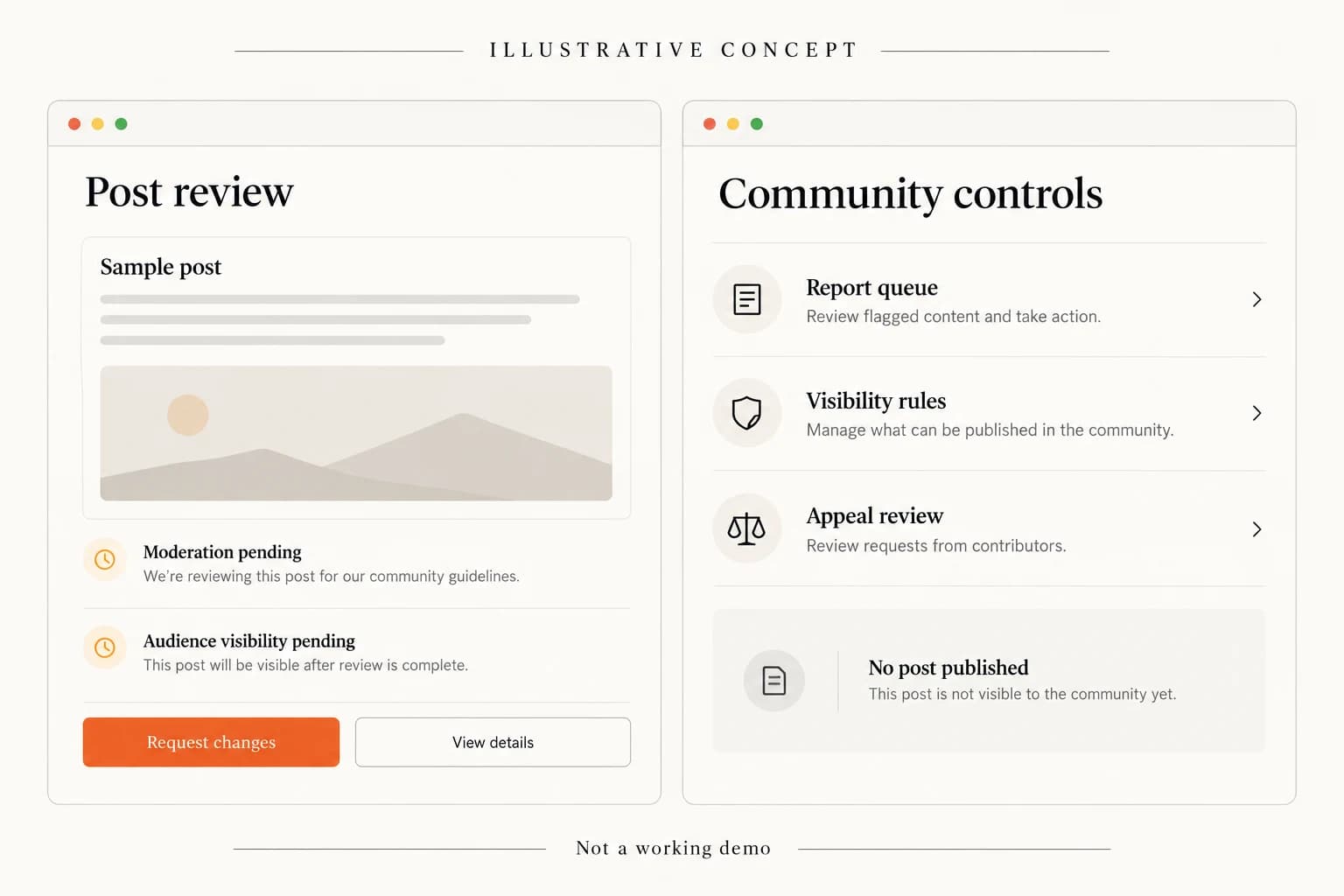
Moderator queues need ownership, reasons and an appeal destination
A queue entry should identify the item, applicable rule and current review state. Assign ownership so two moderators do not issue contradictory decisions from stale screens. Report counts can support triage but do not establish guilt; coordinated reporting can itself be abusive. Preserve necessary thread context and show reviewers which information they may use. Local queue tools should not reveal unrelated private messages or platform investigations merely because they involve the same username.
Provide reasons suited to the decision and the agreed appeal route. A local appeal may require another community reviewer; a platform restriction needs an operator route. Disclose review coverage honestly and define urgent escalation separately. Do not imply a second automated classification is independent human review. Test an appeal after role revocation, a reopened case and a duplicate report without silently losing the member’s request.
Pseudonyms need privacy protections beyond hiding a real name
A pseudonym can protect participation while a profile history, notification or uploaded image reveals identifying details. Decide which posts appear on profiles, whether community memberships are public and how search connects contributions. Explain these choices before publication. Restrict account recovery records and avoid asking volunteer moderators to collect identity documents. A verified email establishes control of an address under the chosen check, not proof of every identity or expertise claim.
Review age eligibility and supported audiences before launch. Private reports, contact details and location clues need a defined response path. Blocking and muting should explain their effects in shared threads, mentions and supported contact surfaces. Test delayed notifications after a block and a username change during review. Privacy protections need consistent enforcement across reader and moderator views, with honest limits for information already copied outside the service.
Cross-community harassment and bans need a network response
A community ban may prevent new participation locally while a platform restriction affects broader account capabilities. Show that difference in notices and permission checks. Do not silently export one community’s ban list into unrelated communities. Coordinated harassment across topics needs operator investigation with restricted context, an identified policy basis and an appeal path. Moderators should escalate patterns without sharing private reporter narratives in public coordination threads.
Define responses to reposted targeting, unwanted mentions and attempts to evade an active restriction. Automated signals can inform review but cannot guarantee that every alternate account is identified. Rehearse two communities reporting the same campaign, a local ban expiring and a platform appeal restoring limited access. Restoring an account should not automatically undo separately justified community decisions or resurrect harmful content removed for its own reason.
Spam controls should respect legitimate newcomers and uncertain evidence
Repeated promotional posts, copied answers and bursts of new accounts can overwhelm volunteer queues. Define submission limits, held-post states and reviewed escalation before opening community creation broadly. Tell members when a submission is awaiting review instead of making it disappear. Account age or a low reputation score may guide review, but neither proves spam. New members still need a usable route to ask a legitimate question and challenge an incorrect restriction.
Rehearse duplicate links, edited spam and a reviewer approving a held post after its author deletes it. The latest valid state should govern distribution. Treat synthetic spam samples as test fixtures, not live community activity or detection accuracy evidence. Review false positives and queue workload using permitted records. A classification service is a possible integration with scoped access and costs; naming it does not establish authorization or operational readiness.
Subscriptions can fund explicit convenience features, and advertising can fund disclosed placements. Neither should grant immunity from community rules or inflate organic vote scores. Define renewal, cancellation, advertiser review and community exclusions in the commercial scope. Keep confidential reports and private participation histories outside advertising audiences. Moderator tools sold to an organization still require bounded permissions and auditable authority.
Compare the Facebook-style community network when the primary need is relationships and audience-controlled publishing. Topic forums place different demands on threaded context, local rule governance and voting; a shared profile component does not erase that distinction.
Choose later features from observed community needs. Live rooms add synchronous review duties, while recommendations increase discovery and integrity work. Budget reviewer coverage alongside infrastructure rather than assuming higher engagement alone pays for safe operation.
Buyer acceptance should follow a disputed post through every authority
Illustrative screens and synthetic fixture discussions demonstrate intended interfaces, not active members, working Reddit connections or proven abuse prevention. Request a sandbox with fictional communities. Submit a flaired post, change a vote, delete a parent comment, revoke a moderator and appeal a restriction. Buyer acceptance should inspect search, notifications, local queues and operator cases together, including keyboard navigation and interrupted requests.
Bring initial topics, membership boundaries and review coverage to a forum-network scope discussion so the proposal states existing capabilities, custom work, service rights and operating duties. Community recruitment, reviewer training and licensed dependencies need explicit owners.
Use the delivery process to agree permission reviews, synthetic fixture scenarios and handover evidence before launch. Accept the documented behaviors and remaining limits rather than assuming a familiar interface guarantees adoption or moderation capacity.