
01Story
Rights-cleared episode progression
Keep series, episodes, assets, language, rating, territory, publication, and access rules distinct.
Performance-led short drama product planning
Plan an original ShortMax-style microdrama product with sampled episodes, paywalls, rewarded ads, campaign attribution, referrals, coin entitlements, rights, ratings, and operator controls.
See product screens and demo accessCustom workflows
Brand-safe product strategy
Admin and operations tooling
01 / VIEWER LOOP
Model each decision across content eligibility, sampling, monetization, playback, and return.
Keep series, episodes, assets, language, rating, territory, publication, and access rules distinct.
Explain the episode, offer, terms, entitlement, and restore route before value changes hands.
Design progress, interruption, captions, controls, paywalls, and error recovery for real devices.
Open registerDeployable Product Architecture
01 / VIEWER LOOP / system register
AI delivery loop
From campaign hook to legitimate episode access.
Useful automation keeps judgment visible
Rights-cleared episode progression
Transparent sample and paywall boundaries
Mobile-first vertical playback
Control note
Confidence, permissions, fallback behavior, and logs belong in the workflow.
02 / GROWTH CONTROL
Give growth, finance, editorial, support, and risk teams separate accountable controls.
Preserve source context, disclose measurement limits, validate rewards, and review abuse.
Reconcile purchases, rewards, spends, refunds, chargebacks, and restores.
Define eligibility, hypothesis, guardrails, exposure, decision records, and stopping conditions.
Compare a catalog-led model centered on rights windows, territories, localization, and publishing control.
Use this microdrama search reference to plan how a campaign promise leads viewers to an eligible story and a clear episode offer. Ask to follow sampling, rewarded access and purchases in a guided demo; those steps are not shown here. Confirm the available demo and agreed scope before selecting your acquisition and monetization model.
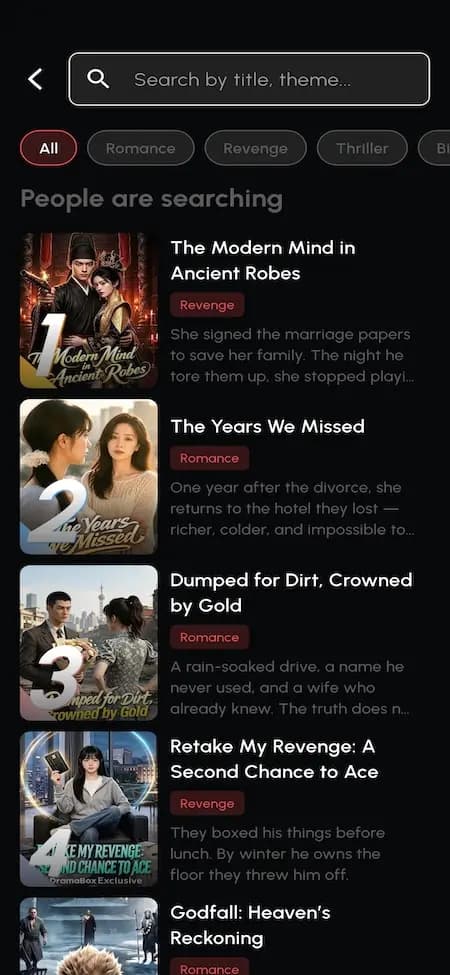
Illustrative series-discovery reference with title and theme search, genre filters and sample artwork. This is not an official ShortMax interface or evidence of affiliation, content licences or a live deployment. Episode playback, unlock offers, credit balances and operator controls are not shown.
What to check in the walkthrough
A ShortMax-style product is a mobile-first microdrama platform where short vertical episodes move viewers from sampled stories into governed access, advertising, paid entitlements, and repeat viewing. The useful reference is the commercial and interaction model—not ShortMax branding, interface, stories, characters, footage, code, catalogue, audience data, or other proprietary assets. An original product needs its own content rights, creative identity, episode structure, pricing, acquisition model, recommendation logic, safety policies, and operator controls.
This model is suitable for studios, publishers, regional media businesses, and entertainment entrepreneurs that can secure a dependable microdrama catalogue and operate a high-frequency release schedule. It is not merely a vertical video feed and not a conventional subscription streaming service compressed onto a phone. The product has to coordinate story sampling, episodic progression, unlock decisions, campaign attribution, advertising, coins or purchases, refunds, rights windows, ratings, support, and content operations as one system.
The core product question is how a viewer moves from an external creative or in-app recommendation into a story, understands its premise quickly, reaches an intentional episode boundary, and chooses a legitimate next action. That action might be watching an eligible rewarded advertisement, using an existing entitlement, spending coins, purchasing an episode bundle, or joining a subscription. The interface should explain the choice before value changes hands.
A useful first market has a defined audience, language, genre mix, catalogue depth, release cadence, and acquisition hypothesis. If campaigns promise stories that are unavailable, poorly localized, incorrectly rated, or impossible to finish under the displayed access model, the product will create refund and trust problems before recommendation quality matters. Catalogue readiness and commercial metadata are launch dependencies.
The growth model should be expressed as observable states rather than broad engagement claims: campaign impression where measurable, attributed install or open, title view, sample start, qualified episode progress, paywall view, offer selection, confirmed access, next-episode start, return session, completed title, refund request, and support resolution. Definitions, time windows, consent, attribution limits, and test traffic should be documented so the team does not confuse a tracking event with a verified business outcome.
A MoboReels-style planning page can centre catalogue breadth, multilingual metadata, subtitle and dubbing workflow, territorial availability, and localized merchandising. The ShortMax-style page should instead centre a performance-led vertical feed: sampled episode hooks, paywall timing, rewarded access, campaign and referral attribution, coin or entitlement state, rapid creative experiments, and retention controls. Localization remains necessary, but it is not the primary buyer intent here.
ReelShort and DramaBox are useful category references for serialized vertical drama, but a separate ShortMax search page must earn its existence through a distinct product decision. Its focus is the connected growth system linking off-platform creatives, feed experiments, sampled episodes, monetization choices, referrals, fraud review, and lifecycle measurement. It should not reproduce the same generic feature list under another brand heading.
This distinction also reduces search cannibalization. The page should answer buyers evaluating a ShortMax-style growth and monetization architecture, while broader vertical-drama pages can cover production, cataloguing, localization, or streaming infrastructure. Internal links should help readers move between those intents rather than presenting every brand page as an interchangeable product.
The content model should distinguish a series, season where applicable, episode, trailer or sample, localized metadata, video asset, caption or subtitle track, artwork, rating, territory, rights window, publication state, and access rule. An episode can have several encodes and language assets without becoming several commercial products. Access should be calculated from current entitlement and policy rather than copied into an editable viewer flag.
Publication requires a reviewable lifecycle: draft metadata, asset processing, editorial review, rights and rating checks, scheduled availability, published, restricted, expired, or removed. Operators need to understand why a title is unavailable. A rights expiry, failed encode, territory restriction, policy hold, or unpublished translation should not all appear to the viewer or support team as an unexplained playback error.
Story order matters. The server should enforce valid episode progression and return enough information for the client to render available, locked, sampled, and previously acquired states. Deep links from campaigns must resolve to an eligible title and safe starting point. When a campaign points to expired or territorially unavailable content, the product needs an approved fallback rather than silently redirecting viewers to an unrelated drama.
Sampling lets a viewer understand format and story before purchasing, but the boundary should be deliberate. The product team should decide which episodes or partial episodes are free, what happens at the end of a sample, whether offers vary by cohort, and how previously unlocked content remains accessible. A cliffhanger can be part of storytelling; hiding price, access duration, recurring terms, or the effect of a coin spend is a product and trust failure.
A paywall should state the object being acquired, price or coin cost, billing type, access duration where limited, renewal terms where recurring, and restore or support route. Offer eligibility should be decided by the server and recorded with an offer version so later configuration changes do not alter the meaning of an earlier transaction. The application should not show a discounted reference price unless the business can substantiate the comparison under applicable consumer rules.
Experiments can compare sample depth, paywall placement, offer presentation, or episode bundle structure, but each test needs an owner, hypothesis, eligible population, guardrails, success measure, and stopping condition. Exclude viewers whose prior purchase or entitlement would make the variant misleading. Experiment assignment must remain stable enough to interpret results, and operational teams should know which experience a viewer received when handling a complaint.
A rewarded advertisement should begin only after an eligible viewer chooses a clearly described exchange, such as watching an advertisement to unlock one episode for a stated period. Reward issuance should follow verified completion information from the advertising integration, tolerate duplicate callbacks, and create an auditable entitlement record. The client should not be able to grant its own reward.
Advertising may be unavailable because of inventory, age, consent, territory, frequency, network, account status, or provider policy. The product needs an honest unavailable state and another route that does not trap the viewer. Reward caps, cooldowns, repeated failure, backgrounding, app interruption, and provider timeouts require acceptance cases. Ads should not be disguised as story controls or positioned to generate accidental taps.
Revenue and fill claims require real evidence from the selected network, audience, geography, format, and measurement window. Engineering can implement placements, consent, event records, frequency rules, and reporting connections, but it cannot promise fill, effective rates, or earnings. Child-directed or mixed-audience treatment, sensitive categories, personalized advertising, and regional consent require specialist review.
Coins are a platform accounting construct, not a substitute for financial architecture. The system should separate coin package purchases, promotional grants, referral rewards, advertising rewards, coin spends, reversals, expiries where lawful, episode entitlements, subscriptions, direct purchases, refunds, and chargebacks. Each change needs a reason, source, actor or system event, timestamp, and link to the affected commercial object.
The authoritative ledger should be append-oriented and protected from arbitrary balance edits. A purchase callback can arrive late, repeatedly, or out of order. Spending should be idempotent so a retry does not unlock the same episode twice while deducting twice. A refund or chargeback policy must define what happens to unused coins, spent coins, acquired entitlements, promotional value, and downstream reporting. Operators need a controlled adjustment workflow with reason and audit history.
Store billing rules differ between digital content, subscriptions, platforms, territories, and device ecosystems. The product should map each offer to the current Apple or Google policy and selected billing mechanism. Restore purchases, family or account behavior where applicable, subscription state changes, grace periods, billing retry, cancellation, and cross-device entitlement need explicit design. App-store acceptance and payment outcomes remain third-party decisions.
A referral programme should define who may refer, the qualifying action, attribution window, reward recipient, reward timing, caps, exclusions, cancellation effects, and dispute process. A link click is usually not enough to earn value. Rewarding an eligible new viewer after a defined purchase or viewing milestone can still create self-referral, device-farm, account-ring, stolen-payment, and refund abuse that the operator must review.
Campaign links should preserve approved source, campaign, creative, title, language, and destination context where the platform and user consent allow it. Attribution is probabilistic across privacy controls, browsers, devices, app stores, reinstallations, and measurement providers. Reports should distinguish directly observed events, provider-attributed conversions, unattributed activity, and modelled estimates rather than representing one system as perfect truth.
Operators need campaign-to-content visibility: which approved creative promised which title and episode, whether the destination remained eligible, what offer appeared, and what complaints, refunds, or abuse signals followed. Creative review should cover rights, ratings, accuracy, disclosure, sensitive content, and territory. Removing a misleading creative must be possible without a mobile release.
Risk signals can include repeated accounts on shared devices, unusual install or referral velocity, circular referral graphs, rapid reward redemption, repeated payment instruments, refund patterns, impossible geography, automation, and mismatches between campaign and in-product activity. Signals should prioritize review, not be presented as certain wrongdoing. Holds, denials, account restrictions, appeals, evidence retention, and operator access need documented policy and proportionate decisions.
The feed may combine continued stories, followed or saved titles, editorial placement, new releases, genre relevance, language, campaign context, and behavioural signals. It should distinguish a title recommendation from a playable episode and avoid resetting story progression merely to increase starts. Ranking inputs, eligibility, sponsored placement, exploration, repetition limits, and removal controls need accountable ownership.
A feed experiment should change one interpretable decision where possible. Variant assignment, exposure, eligible population, primary metric, guardrails, sample sufficiency, and decision record should be captured. Watch time alone can reward repetitive hooks, accidental autoplay, or difficult exits. Guardrails can include report rate, refund rate, playback failure, repeated content, session length, sleep-hour use, and customer-support impact.
Recommendation models require dependable catalogue metadata and event semantics before complex machine learning. A transparent rules baseline can establish language, territory, rating, entitlement, genre, recency, progression, and diversity constraints. Later models should be evaluated against that baseline with offline and controlled online evidence. Sensitive attributes and inferred vulnerability should not enter ranking without deliberate legal, ethical, and product review.
Microdrama naturally encourages the next episode, but retention should not depend on obscuring time, cost, or exit. The product can provide episode progress, watch history, saved series, release reminders, notification preferences, autoplay controls, purchase history, coin history, and spending visibility. Session reminders, quiet hours, age-appropriate defaults, and optional limits may be appropriate for the audience and market.
Notifications should originate from defined events such as a followed series releasing an episode, a saved title becoming available, an entitlement changing, or a refund requiring attention. Frequency, language, expiry, deep-link destination, and consent need design. A notification should not imply a personalized or free offer that the recipient is not eligible to receive.
Retention analysis should use cohorts and defined windows. Return rate, next-episode progression, series completion, paid conversion, repeat purchase, subscription continuation, ad-reward use, refunds, and support contacts answer different questions. The business should avoid declaring success from a single metric or comparing audiences acquired under materially different campaigns without context.
Every series and asset needs documented authority for intended territories, languages, windows, formats, promotional use, editing, subtitles, dubbing, artwork, music, performer likeness, and advertising creatives. Rights metadata should control publication and campaign eligibility. A delivery receipt or uploaded file does not by itself prove all required rights.
Ratings and content advisories should be attached to the title and applied consistently across discovery, samples, episodes, campaigns, notifications, and parental or age controls. Violence, sexual content, self-harm, substance use, and other sensitive themes may require market-specific treatment. App-store age ratings and local classification obligations depend on the catalogue and distribution market and require current specialist review.
Localization is more than translated titles. Subtitles, dubbing, artwork, episode summaries, offers, prices, dates, support content, policy text, and campaign creatives need version and review control. Text expansion, reading speed, subtitle timing, safe areas, cultural context, and rating differences affect the experience. A localized asset should not publish until its rights, quality, and destination metadata are complete.
The administration system should expose series and episode status, asset processing, rights windows, ratings, translations, feed eligibility, experiments, offers, coin packages, entitlements, purchases, refunds, referrals, campaign destinations, advertising rewards, complaints, and audit history according to role. Editorial teams should not need payment access; support should explain an entitlement without changing prices; finance should reconcile value without publishing content.
Playback operations need encoding status, delivery errors, caption or subtitle availability, device and version context, and an escalation path. Commerce operations need unmatched store events, duplicate callbacks, failed restores, ledger inconsistencies, refunds, and chargebacks. Growth operations need creative approval, destination health, attribution limits, referral holds, and experiment status. Bringing these views into governed queues prevents direct database edits from becoming routine support.
A defensible V1 can include accounts, a rights-cleared catalogue, series and episode metadata, vertical playback, sampled access, search or limited feed discovery, watch progress, one compliant purchase model, entitlements, restore behaviour, support visibility, campaign deep links, basic attribution, content administration, analytics, ratings, reporting, and release operations. Add coins, rewarded ads, referrals, and multiple monetization routes only when each complete accounting and abuse-control loop can be operated.
Acceptance should cover unavailable territories, expired rights, unpublished localization, failed encoding, poor networks, playback resume, deep-link mismatch, repeated billing events, restore on another device, duplicate coin spend, refund and chargeback effects, ad interruption, repeated reward callbacks, referral reversal, blocked campaigns, experiment assignment, content reports, rating restrictions, and operator correction.
The threat model should cover account takeover, unauthorized playback, token sharing, asset scraping, entitlement tampering, duplicate spend, billing spoofing, referral farms, advertising abuse, administrative misuse, and leakage of unreleased media. Controls may include server authorization, signed media access, session management, device-risk review, idempotency, audit records, secrets management, rate limits, monitoring, backups, and incident response according to the selected architecture.
A data map should identify account, device, viewing, campaign, referral, experiment, payment, advertising, support, and content-report data; its purpose; recipients; retention; and access. Accessibility should cover playback controls, captions and subtitles, focus, labels, contrast, motion, orientation, screen readers, error messages, purchase confirmation, and alternatives to gesture-only interaction. Legal suitability depends on the audience, catalogue, monetization, and territories.
Handover should define applicable repositories, design files, schema and migrations, media pipeline, encoding and delivery vendors, mobile and web builds, domains, app-store accounts, billing products, advertising accounts, attribution providers, analytics, rights metadata, secrets, monitoring, backups, runbooks, test evidence, licences, known limitations, and post-release responsibilities. App Clone Labs does not guarantee audience growth, retention, revenue, advertising fill, attribution accuracy, rights clearance, classification, store approval, or payment approval.
Buyer questions
ShortMax Clone app development means building a custom clone-inspired custom software platform inspired by proven product mechanics, with original branding, workflows, code, admin tools, integrations, and launch support for your market.
ShortMax Clone is best suited for shortmax clone founders, SMBs, agencies, funded startups, and enterprise teams that want a market-ready product without depending on a generic clone script. It works well when you want a proven product category but need original execution, local market fit, and operational ownership.
A clone-inspired product is acceptable when it uses the business model as inspiration but does not copy protected branding, proprietary UI, private data, content, trademarks, or unique assets. App Clone Labs builds original products around familiar mechanics.
The schedule follows the agreed roles, release boundary, integration depth, content readiness, review cadence, testing requirements, and third-party approvals. Multi-role and enterprise builds require broader validation and delivery plans.
V1 should include the smallest complete operating loop for customers, providers, operators, support teams, business admins, and growth teams: onboarding, core workflow, transaction or request state, notifications, admin visibility, support, and analytics.
Advanced personalization, complex loyalty, deep automation, multi-region rules, uncommon integrations, and enterprise analytics should usually wait until real usage proves the core loop.
The applicable agreement defines repository access, bespoke-code assignment or licensing, reusable framework rights, third-party dependencies, deployment context, documentation, and the handover boundary.
Yes. We adapt language, currency, payment methods, compliance needs, business rules, roles, workflows, content, and growth mechanics for your specific market.
Yes. Serious clone-inspired platforms need admin controls for users, transactions, payments, reports, support, moderation, content, settings, and operational exceptions.
The stack depends on scope, but common choices include Next.js web app, React Native or Flutter apps, Node.js APIs, PostgreSQL, Redis queues, cloud hosting, analytics, payment gateways, and role-based admin tooling.
Cost depends on apps required, number of roles, workflow depth, integrations, admin complexity, QA, cloud setup, and launch support. We estimate after mapping the MVP scope and full-build roadmap.
Yes. AI can support search, recommendations, moderation, support copilots, fraud review, document intake, analytics, and workflow automation where it creates real operational value.
We can support post-launch monitoring, bug fixes, analytics review, feature iteration, cloud improvements, app-store updates, and roadmap planning after the MVP goes live.
Solution reference register
01 / Reference and IP
ShortMax, MoboReels, ReelShort, and DramaBox are referenced only to distinguish familiar vertical-microdrama product models. App Clone Labs is not affiliated with or endorsed by those brands. Delivered branding, stories, footage, interface, code, catalogue, and implementation must be original or properly licensed.
02 / Regulatory caveat
Digital content purchases, subscriptions, coins, rewarded advertising, referrals, refunds, and disclosures must follow current platform and market rules. · Every title, episode, localization, promotion, and territory requires documented rights and appropriate rating or classification review. · Attribution, behavioral personalization, advertising consent, retention, and child or mixed-audience treatment require market-specific privacy review.
03 / Rights and handover
Only original or properly licensed stories, footage, music, artwork, translations, performances, promotional creatives, branding, interface design, and implementation may be used.
Primary sources
Dated official documentation, standards, and research that support the factual claims on this page.
Primary Apple rules relevant to digital content, in-app purchase, subscriptions, advertising, privacy, ratings, and app quality.
Primary Google Play policy for billing and digital in-app purchases.
Primary implementation documentation for rewarded advertising on Android.
Primary Android documentation for retrieving referral content from Google Play.
Primary United States guidance relevant to endorsement and referral disclosures.
Normative accessibility criteria relevant to web playback and administrative interfaces.
How to read this page
Scope, cost and timeline figures are planning guidance until confirmed in a written proposal. Diagrams and screens are illustrations, not client deliverables, and source-code rights and handover follow the signed agreement. See the delivery process and the full disclaimer.
Next decision
Bring the catalogue, rights, audience, sample boundary, monetization model, campaign plan, and operating roles. We will turn them into a reviewable release scope.
Commercial rights, repositories, environments, documentation, acceptance and handover remain contract-defined.
App Clone Labs is not affiliated with, sponsored by, or endorsed by ShortMax, MoboReels, ReelShort, and DramaBox. The names identify a familiar product category; every delivered product is independently designed and built, and the marks remain their owners' property. Read the full legal notice.
