Professional services marketplace

Upwork-style Talent Contracting Market — Custom-Built for Your Market

Curated professional marketplace with proposals, hourly work, and milestones. Planned for organizations engaging independent specialists for ongoing and scoped work with role-specific workflows, operator controls, integrations, and a handover boundary defined for the selected market.

See product screens and demo access

Custom workflows

Brand-safe product strategy

Admin and operations tooling

Reference walkthrough by arrangement

Compare talent sourcing, hourly contracts and milestone controls in one guided review.

Use this illustrative Upwork-style contracting concept to assess discovery, proposals, hourly work records, milestones and client approvals. It is original planning media—not Upwork UI, affiliation or proof of escrow, identity verification, timesheet accuracy, contractor classification, tax handling or successful delivery. Confirm the running demo and provider scope before selecting a build route.

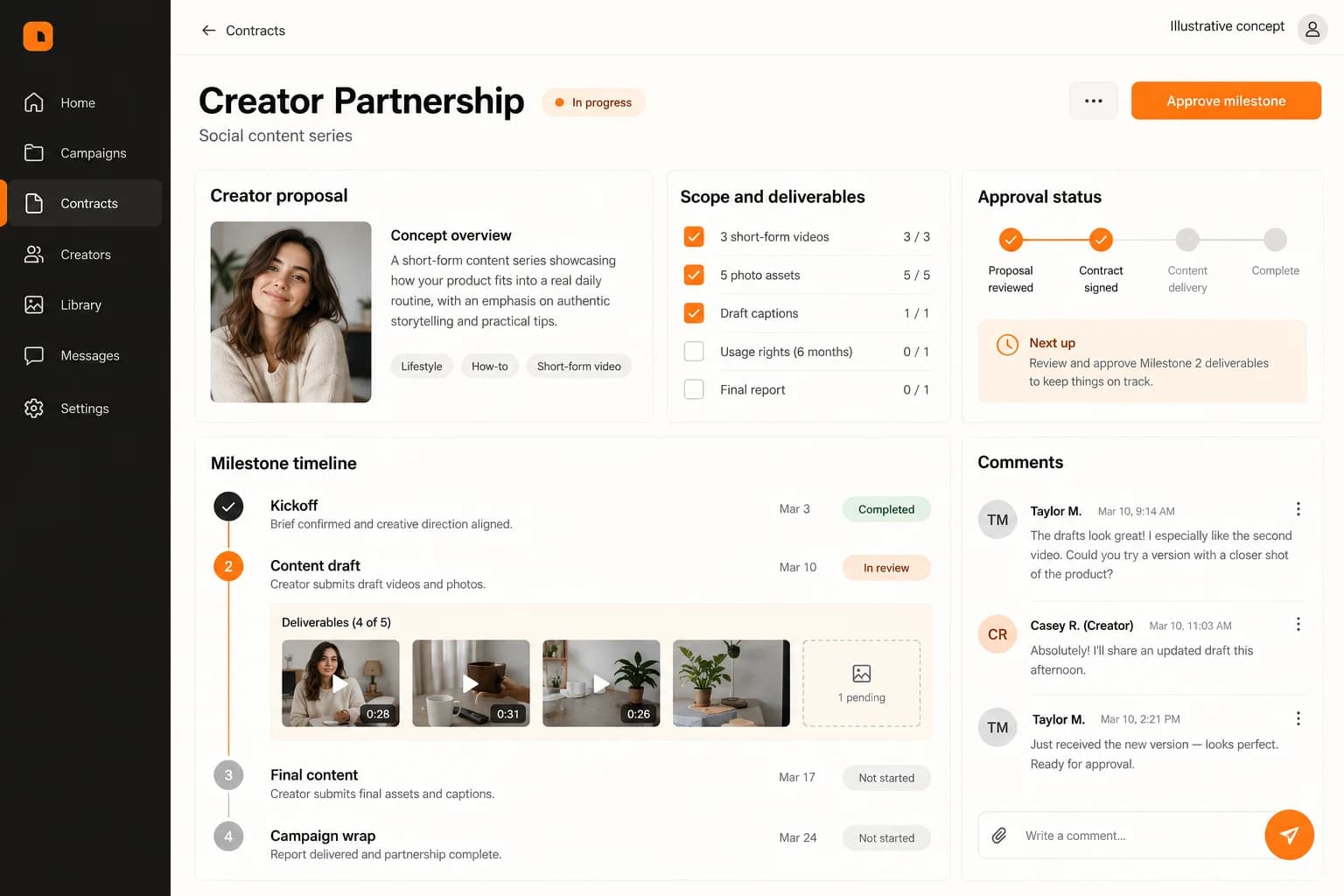
Original illustrative creator-project workspace showing deliverables, milestones, approval status and comments

Original illustrative creator-project workspace showing deliverables, milestones, approval status and comments

Original AI-generated creator-project milestone concept, not Upwork UI or brand affiliation. Deliverables, approval status and comments are sample content. Talent search, proposal comparison and hourly records are not shown; request these in a running demo. The image does not prove escrow, contractor status, payment settlement or client outcomes.

What to check in the walkthrough

  • How are profiles, proposals and contract terms compared without promising a match? Ask to test search facets, proposal revision, client consent, conflict disclosure and role permissions before accepting either hourly or milestone work.
  • What evidence supports an hourly record and what happens when a client disputes it? Ask to review a test time entry, manual correction, approval window, pause, dispute and export. Confirm monitoring, privacy, contractor classification and payment-provider requirements with the project owner.
  • How do milestone approval, refunds and contractor payout decisions stay auditable? Ask to trace a virtual test payment through hold, release, reversal and case review, and confirm that escrow-capable rails, identity verification and tax documents are separately integrated and tested.
Open full-size reference

Solution reference register

01 / Reference and IP

This page references third-party product names only to describe familiar product models and planning references. App Clone Labs is not affiliated with or endorsed by those brands. Build decisions require independent legal, regulatory, and operational review for your market.

02 / Artifact status

Boards, diagrams, screens and workflow descriptions on this page are illustrative planning artifacts, not evidence of a deployed client product.

03 / Regulatory caveat

Clarify independent-provider status and marketplace responsibilities · Review worker classification, tax, sanctions, and payout obligations · Moderate listings and provide IP, fraud, dispute, and takedown workflows · Document monitoring choices for hourly work and obtain appropriate consent

04 / Rights and handover

Source access, licensing, repositories, environments, documentation, acceptance and handover are defined by the signed contract and accepted scope.

Scope

Operating model defined

Roles, workflows, dependencies, exclusions, and assumptions are made reviewable.

Evidence: illustrative

System

Applications connected

Experience, operations, services, data, integrations, and release controls are planned together.

Evidence: illustrative

Handover

Rights stated in writing

Access, assignment, licensing, dependencies, documentation, and support follow the signed agreement.

Evidence: illustrative

Artifact register

Product screens and planning references.

Reference screens illustrate workflows, not a contracted feature list. Sample prices, data, and responses are demonstration content; confirm the current scope during a walkthrough.

Upwork-style Talent Contracting Market connected product workflow planning visual
Connected customer, operations, and data workflowEvidence: illustrativeOpen full-size reference
Upwork-style Talent Contracting Market product engineering ecosystem visual
Product engineering ecosystem and handover boundaryEvidence: illustrativeOpen full-size reference

An accepted talent contract needs separate review and payment authority

A client hires a specialist to migrate a reporting dashboard. The technical reviewer approves a sample export, but finance has not approved the revised budget and the specialist believes a second data source is included. A hiring marketplace needs an accepted engagement that explains scope, work evidence and authority. A proposal, a chat message and a payment receipt cannot independently establish which deliverable the organization agreed to buy or who can authorize its release.

An Upwork-style platform supports professional sourcing and ongoing contracting through proposals, accepted offers, milestones and optional hourly records. App Clone Labs scopes independently branded software with its own talent supply, original profiles and operating terms. It does not provide Upwork’s professional network, account histories, protected assets or payment arrangements. The buyer’s practical question is whether the first contract can be created, reviewed and closed with clear permissions when work or money remains disputed.

Identity checks and professional qualification are different facts

Confirm who controls the professional account and who may represent an agency. Identity checks can support attribution without proving that a person is qualified to advise on every topic or capable of delivering the posted work. Describe credential, portfolio and reference checks separately, including their limits and review dates. Avoid turning an uploaded certificate or successful account verification into a blanket claim of professional competence.

Choose categories the operator can support and establish relevant eligibility rules. Portfolio material requires appropriate rights and a truthful relationship to the professional’s work. Identify conflicts that may affect a proposed engagement, such as competing clients or restricted prior materials. Automated conflict detection can flag signals for review but cannot prove every relationship or clearance. Test expired verification evidence and an agency replacing its named worker before acceptance. Clients need an explained decision rather than a badge that conceals uncertainty.

Hiring requirements should lead to a usable proposal

A job requirement should identify the desired result, client inputs, expected collaboration and constraints. Professionals need enough information to estimate an engagement without receiving unnecessary confidential records during discovery. Distinguish required skills from preferences and avoid promising that a ranked search result is the best or a fully qualified candidate. Explain what profile information and proposal material other applicants can see.

Preserve proposal versions with the proposed rate, scope, availability and assumptions. An interview can refine understanding, but its messages should not silently replace commercial terms. Let the client shortlist, clarify and issue an identifiable offer under delegated authority. Test a proposal withdrawn before an offer is accepted and a recruiter making a commitment outside the approved budget. The contracting flow should expose the unanswered question instead of treating a successful message exchange as a completed hire.

An offer becomes a contract through authorized acceptance

State the parties, selected professional or agency, deliverables, rate or budget, dependencies, review process and applicable terms. Show who may accept for each side. A technical collaborator may discuss implementation without authority to bind their organization. Preserve the accepted version and its effective date; later profile edits must not rewrite the contract. A pending offer needs expiry and withdrawal behavior that all participants can understand.

Define client responsibilities, including access to test systems, timely inputs and approved materials. Changes to quantity, deadline or price need an identifiable amendment and authorized acceptance. Preserve the earlier commitment if a change is declined. Rehearse an offer accepted after withdrawal and two client users approving incompatible amendments. The account should show which commitment governs the work rather than asking support to reconstruct it from whichever conversation looks most recent.

Milestones need inspectable acceptance criteria

Upwork’s official hourly and fixed-price contract guidance distinguishes time-based engagements from defined deliverable milestones. Use that distinction to choose an evidence model; the independent marketplace does not inherit Upwork’s billing periods, protections or financial arrangements.

For fixed deliverables, define each milestone’s output, review criteria, required inputs and submission method. A milestone label such as first phase complete is insufficient when the parties disagree about the files or functions due. Keep formal submissions separate from exploratory drafts. Identify the version reviewed and record approval, requested correction or a scoped dispute. If automatic acceptance is selected, establish notices, timing and exceptions explicitly rather than importing a reference deadline without review.

Milestone approval is not an escrow arrangement

A reviewer’s approval means a stated deliverable passed the agreed review; it does not independently establish permission to move money. Restrict payment approval and budget amendments to authorized roles. Distinguish requested release, provider instruction and confirmed financial outcome. A displayed balance or delayed transfer should not be described as escrow without the appropriate legal and provider arrangement, even when milestone review resembles a familiar marketplace.

Use specialist funds review to establish permitted handling, supported markets and the operator’s obligations before promising payment protection. Disclose client charges, professional earnings and applicable fees separately. Rehearse approval while a funding result is uncertain and a provider timeout after a release instruction. Recover the same financial decision rather than inviting another click that could produce duplicate payment. The professional and client should see which step remains unresolved without losing the underlying work-review evidence.

Hourly time logs need permissions and period boundaries

Hourly contracting needs an agreed rate, allowed time-entry methods, period boundary and review rules. Specify weekly limits or other approved caps and how additional work is authorized. A time log records a billing claim, not proof that the output met every quality expectation. Manual entries and tracked sessions may need different evidence, and an edited entry should retain an attributable history rather than silently changing the client’s reviewed period.

If monitoring includes screenshots or activity capture, establish consent, visibility and retention before implementation. Capture can expose another client’s confidential materials or personal information; more surveillance is not automatically better evidence. Restrict access and provide an appropriate correction or reporting process. Test a session crossing a time-zone boundary, an entry submitted after contract termination and a screenshot containing unrelated credentials. Reviewers should understand the claimed time without every team member receiving unrestricted access to the worker’s screen history.

Client teams need separate hiring and reviewer permissions

A team can include a recruiter, project owner, technical reviewer and finance approver. Define who sees proposals, accepts offers, requests corrections, approves milestones and authorizes financial adjustments. Access to a project channel should not grant every commercial permission. Agency representatives likewise need scoped authority for delegation and submissions; shared account credentials obscure who made a binding decision or accessed confidential client data.

Revoke live permissions when a participant leaves while preserving attributable contract history. Establish temporary delegation with a clear boundary and expiry. Conflicts between reviewers need an escalation owner rather than multiple contradictory approval states. Test a removed reviewer using an old link and a budget approver attempting to change acceptance criteria after submission. The operator should see the relevant decision and authority at the time it was made, without editing history to match the organization’s current staffing.

Deliverable rights require their own contract terms

The Upwork Legal Center includes service contract and intellectual-property terms alongside separate financial agreements. It is a reference for questions to review, not a transfer of those arrangements or rights to an independently operated product.

Define ownership or licensing for commissioned work, pre-existing components and client-supplied materials. Delivery of editable files does not establish unrestricted rights to embedded fonts, stock media or software libraries. Establish when agreed rights take effect and what happens to unfinished or partially accepted work after termination. Confidentiality and public portfolio permission also need explicit treatment. Preserve relevant declarations and route infringement concerns for qualified review rather than promising that automated checks or payment collection establish originality or legal clearance.

Disputes should preserve scope and restricted evidence

A missing output, disputed time entry, unauthorized amendment and ownership complaint need different review paths. State who may raise a case, which evidence is relevant and what authority the operator has under its terms. Let participants respond to the actual issue without exposing every confidential attachment to unrelated support staff. A request for additional work should not automatically become a dispute merely because the earlier milestone was completed.

Keep dispute review, proposed remedy and executed financial adjustment distinguishable. Preserve accepted scope, submission versions and relevant work periods so the case does not depend on a rewritten profile or deleted chat. Test a disputed milestone while a payout is pending and a complaint reopened after an adjustment. Financial reversal must not erase records needed for a rights claim. Software can organize evidence and accountable decisions; it cannot guarantee creative satisfaction or resolve every legal disagreement between contracting parties.

Termination closes authority before it closes every obligation

Define who can terminate, the effective date and what work remains due. Prevent new time claims or submissions according to the agreed rules while preserving already accrued work for review. Closing a contract does not prove every invoice, deliverable or ownership issue is settled. Show the handover status, access revocation and remaining financial exceptions separately so both parties can understand what still requires action.

Compare the Fiverr-style packaged-service model when the buyer needs a repeatable predefined output rather than a continuing talent engagement. For this contracting release, rehearse termination during an upload and removal of client-system access while handover remains incomplete. Agree retention and recovery of relevant files without keeping unnecessary credentials. Ratings and reviews should describe an eligible experience under published rules; payment or participation plans must not buy favorable feedback or removal of an otherwise valid complaint.

Inspect the staged engagement in a synthetic walkthrough

Illustrative screens do not establish an active professional network, approved provider arrangement or operational protected-payment service. Request a sandbox engagement with fictional profiles, files and time records. Stage an offer, accepted amendment, milestone submission and restricted reviewer decision. Then exceed a time limit, dispute a deliverable and terminate while a refund remains uncertain. Buyer acceptance should expose the contract version, responsible role and recoverable next action at each stage.

Bring one hiring requirement and its review criteria to a talent contracting scope discussion to establish client authority, work evidence and the first financial exception cases.

Use the delivery process to agree source-code terms, licensed components, provider permissions, deployment access and support responsibilities. Release acceptance needs privacy, rights and settlement review alongside the successful hiring journey.

Product flow

Role-workflow flow diagram.

A visual map of how each role interacts with each workflow stage, with operator controls and integration boundaries.

Deployable Product Architecture

Upwork-style Talent Contracting Market

TURN HIRING DISCU…TIE WORK TO SCOPE…KEEP TERMINATION …Hire and review w…Work against an i…Resolve work and …INTEGRATIONS: Authorized contract payment and payout providers with specialist funds revi…OPERATOR CONTROLS: Describe checks without overstating competence · Prevent reviewers from sil…
Illustrative validation artifact — role-workflow flow diagram; final surfaces, boundaries, and integration topology are confirmed during discovery.

User roles

Upwork-style Talent Contracting Market roles and workflows.

Clone-inspired platforms usually need several coordinated interfaces, not just a customer app.

Client team

01

Hire and review within delegated authority

Source professionals, compare proposals and agree a contract. Distinguish deliverable reviewers from people authorized to change budgets, approve payments or terminate the engagement.

Professional or agency

02

Work against an identifiable engagement

Declare skills and relevant conflicts, accept scope and preserve work evidence. Give agency collaborators restricted access and explain who is responsible for submissions and time logs.

Contract operator

03

Resolve work and financial exceptions

Review identity, access concerns and disputes with restricted evidence. Reconcile adjustments and provider outcomes without promising guaranteed qualification or protected funds.

Workflow

Upwork-style Talent Contracting Market workflow stages.

Each workflow stage is mapped to a role, screen, API, notification, admin control, and measurable launch outcome.

Source and agree

01

Turn hiring discussion into an accepted offer

Preserve the proposal, rate, deliverables and authorized acceptance. Define dependencies, client inputs and the selected work-record model before the engagement begins.

Record and review

02

Tie work to scope and billing evidence

Version milestone submissions or period-specific time logs. Separate technical review, scope changes and payment authority while protecting confidential client materials.

Resolve and close

03

Keep termination separate from settlement

Preserve outstanding work, rights and authorized adjustment decisions. Reconcile refunds and payouts before describing financial closure as complete.

Deployable Product Architecture

Workflow / system register

Revision DPlanning surface

Delivery team

Upwork-style Talent Contracting Market workflow stages.

Clear ownership turns capacity into outcomes

Delivery team: Upwork-style Talent Contracting Market workflow stages.Clear ownership turns capacity into outcomes. Roles, decision rights, and acceptance criteria keep delivery accountable.
01

Turn hiring discussion into an accepted offer

02

Tie work to scope and billing evidence

03

Keep termination separate from settlement

Control note

Roles, decision rights, and acceptance criteria keep delivery accountable.

Illustrative architecture register; validate against the accepted scope.

Operator controls

Upwork-style Talent Contracting Market admin and operator controls.

The control center is scoped as a first-class product surface, not an afterthought.

Identity and suitability

01

Describe checks without overstating competence

Record professional identity and agency authority separately from credentials, portfolio claims and category-specific suitability. Route conflicts for review rather than claiming automatic qualification.

Contract authority

02

Prevent reviewers from silently changing commercial terms

Restrict offers, amendments, budget changes and payment approval by role. Preserve acceptance and review decisions against the relevant contract and submission version.

Evidence privacy

03

Limit monitoring and dispute access

Define consent for time capture, confidential-file access and evidence retention. Keep screenshots, client briefs and identity records available only to authorized participants and reviewers.

Monetization

Upwork-style Talent Contracting Market monetization models.

We model monetization early so payments, admin controls, and reporting support the business.

Disclose charges separately from professional earnings

Explain client and professional charges, processing costs and adjustment treatment. Completed work does not prove settled funds or guaranteed income.

Sell administrative tools with clear terms

Scope proposal organization, reporting or agency permissions under disclosed subscriptions. Paying for tools cannot guarantee hiring or bypass suitability review.

Charge for defined governance capability

Offer team approvals, procurement records and scoped reporting. Enterprise access must not confer unchecked authority over private professional data or dispute outcomes.

Integrations

Upwork-style Talent Contracting Market integration surface.

External systems that determine launch readiness, data flow, and operational continuity.

Integration

01

Integration 1

Authorized contract payment and payout providers with specialist funds review, creator eligibility, unique financial references and adjustment reconciliation

Integration

02

Integration 2

Identity, credential and business verification services with clearly differentiated checks, restricted evidence and reviewable exceptions

Integration

03

Integration 3

Messaging, file delivery and optional time-record services with scoped permissions, monitoring consent, version history and accountable dispute access

Scope drivers

Upwork-style Talent Contracting Market scope drivers.

The variables that most influence build effort, cost, and launch readiness.

Engagement model

01

Choose fixed deliverables or recorded time deliberately

Milestones and hourly work need distinct acceptance, billing and evidence rules. Select the first operating model before expanding contract types.

Client governance

02

Define who can hire, review and pay

Establish budget owners, technical reviewers and agency representatives. A project conversation should not give every participant authority to bind the organization.

Financial and rights responsibility

03

Review the operator’s commitments before implementation

Establish provider arrangements, settlement duties and contract-specific ownership terms. A payment hold must not receive an unsupported escrow or protection label.

Deployable Product Architecture

Scope drivers / system register

Revision EPlanning surface

Delivery team

Upwork-style Talent Contracting Market scope drivers.

Clear ownership turns capacity into outcomes

Delivery team: Upwork-style Talent Contracting Market scope drivers.Clear ownership turns capacity into outcomes. Roles, decision rights, and acceptance criteria keep delivery accountable.
01

Choose fixed deliverables or recorded time deliberately

02

Define who can hire, review and pay

03

Review the operator’s commitments before implementation

Control note

Roles, decision rights, and acceptance criteria keep delivery accountable.

Illustrative architecture register; validate against the accepted scope.

V1 scope

Upwork-style Talent Contracting Market V1 foundation.

Launch the smallest complete operating loop first, then scale the product with confidence.

Bounded professional hiring

01

Make the accepted offer explainable

Support profiles, job requirements, proposals and versioned contracts. Inspect an offer accepted after a rate change and a profile with unresolved identity evidence.

Inspectable milestone review

02

Preserve submissions and reviewer authority

Provide deliverable versions, approval reasons and explicit amendments. Rehearse wrong-format work and a reviewer attempting to release funds without authority.

Restricted contract resolution

03

Close work without losing evidence

Support disputes, termination and independent financial reconciliation. Inspect a refund while a payout remains pending and a revoked collaborator retaining a file link.

Later phases

Upwork-style Talent Contracting Market post-launch expansion.

Capabilities that should usually wait until real usage proves the core loop.

Hourly work records

01

Add time billing with explicit monitoring rules

Introduce period boundaries, allowed manual time and approved limits. Establish consent and privacy before adopting screenshots or activity capture.

Agency collaboration

02

Delegate work without hiding responsibility

Add named workers, capacity and approved delegation. Contract authority and confidential client access should remain attributable when team membership changes.

Organization talent programs

03

Expand governance after the first loop works

Support procurement approvals, reusable engagement terms and reporting. Separate qualification review from identity checks and keep exceptions visible.

Deployable Product Architecture

Later phases / system register

Revision BPlanning surface

Delivery team

Upwork-style Talent Contracting Market post-launch expansion.

Clear ownership turns capacity into outcomes

Delivery team: Upwork-style Talent Contracting Market post-launch expansion.Clear ownership turns capacity into outcomes. Roles, decision rights, and acceptance criteria keep delivery accountable.
01

Add time billing with explicit monitoring rules

02

Delegate work without hiding responsibility

03

Expand governance after the first loop works

Control note

Roles, decision rights, and acceptance criteria keep delivery accountable.

Illustrative architecture register; validate against the accepted scope.

Regulatory review

Upwork-style Talent Contracting Market regulatory and compliance flags.

Each flag must be reviewed by qualified counsel for your target market before build or launch.

Flag 1

Clarify independent-provider status and marketplace responsibilities

Flag 2

Review worker classification, tax, sanctions, and payout obligations

Flag 3

Moderate listings and provide IP, fraud, dispute, and takedown workflows

Flag 4

Document monitoring choices for hourly work and obtain appropriate consent

Reference walkthrough

Request a Upwork-style Talent Contracting Market reference walkthrough.

Ask us to confirm which reference surfaces are currently available for this product model. Rather than publishing shared demo credentials, we schedule a private guided walkthrough for qualified buyers.

Reference surface

01

Client team: Hire and review within delegated authority

Request a role-specific demonstration and confirm which capabilities are currently available. Review the proposed responsibility: Source professionals, compare proposals and agree a contract. Distinguish deliverable reviewers from people authorized to change budgets, approve payments or terminate the engagement.

Reference surface

02

Professional or agency: Work against an identifiable engagement

Request a role-specific demonstration and confirm which capabilities are currently available. Review the proposed responsibility: Declare skills and relevant conflicts, accept scope and preserve work evidence. Give agency collaborators restricted access and explain who is responsible for submissions and time logs.

Reference surface

03

Contract operator: Resolve work and financial exceptions

Request a role-specific demonstration and confirm which capabilities are currently available. Review the proposed responsibility: Review identity, access concerns and disputes with restricted evidence. Reconcile adjustments and provider outcomes without promising guaranteed qualification or protected funds.

Next step

04

Book a walkthrough

Request a live, private walkthrough of the reference implementation. We will confirm scope and discuss configured deployment versus custom build for your market.

Open register

Deployable Product Architecture

Reference walkthrough / system register

Revision CPlanning surface

Delivery team

Request a Upwork-style Talent Contracting Market reference walkthrough.

Clear ownership turns capacity into outcomes

Delivery team: Request a Upwork-style Talent Contracting Market reference walkthrough.Clear ownership turns capacity into outcomes. Roles, decision rights, and acceptance criteria keep delivery accountable.
01

Client team: Hire and review within delegated authority

02

Professional or agency: Work against an identifiable engagement

03

Contract operator: Resolve work and financial exceptions

04

Book a walkthrough

Control note

Roles, decision rights, and acceptance criteria keep delivery accountable.

Illustrative architecture register; validate against the accepted scope.

Process

A traceable path from decision to acceptance.

  1. 01

    Model teardown

    We map the reference business model, user roles, monetization path, regulatory needs, and launch constraints.

    Artifact: Product teardown, risk map, role matrix

  2. 02

    Market-fit blueprint

    We reshape the model around your market, operations, pricing, workflows, and first release priorities.

    Artifact: Feature scope, flows, technical plan

  3. 03

    Design and build

    Product, design, engineering, QA, and cloud delivery move in weekly demo cycles with visible progress.

    Artifact: Working releases, QA notes, sprint demos

  4. 04

    Launch and operate

    We support production release, monitoring, handoff, roadmap decisions, and post-launch improvement.

    Artifact: Launch checklist, docs, growth backlog

FAQ

Questions to resolve before the build.

01Does this include Upwork professionals or infrastructure?

No. It is independently branded software. Talent supply, original profiles, authorized integrations and provider arrangements require separate establishment.

02How does this differ from packaged services?

Talent contracting turns hiring requirements and proposals into an accepted engagement with ongoing authority and work evidence. Packaged services begin with predefined outputs and package terms.

03Does identity verification prove qualification?

No. Identity, credentials, portfolio claims and category-specific suitability are separate checks. Explain their limits and review relevant conflicts.

04When does a proposal become a contract?

Through authorized acceptance of an identifiable offer covering parties, scope, price, dependencies and applicable terms. Chat participation alone does not confer contracting authority.

05What should milestone review preserve?

Keep agreed criteria, formal submission versions and attributable review decisions. Distinguish drafts, corrections, acceptance and disputes.

06Does milestone acceptance authorize payment?

Not automatically. Define separate reviewer and payment authority, and distinguish release requests from confirmed provider outcomes.

07Can a payment hold be described as escrow?

Only with the appropriate legal and provider arrangement. Use specialist funds review before making escrow or payment-protection claims.

08What does hourly contracting require?

Agree rates, permitted time-entry methods, period boundaries, limits and review rules. Preserve edits and obtain appropriate consent for any monitoring.

09Who may see screenshots and confidential files?

Only authorized roles with an operational need. Restrict capture, downloads, dispute evidence and retention, including access after a collaborator leaves.

10Does delivering a file transfer every intellectual-property right?

No. Contract terms must distinguish commissioned work, existing components, third-party restrictions and the conditions under which agreed rights take effect.

11Does terminating a contract settle outstanding money?

No. Close live authority under the agreed rules while preserving accrued work, handover obligations, disputes and unresolved financial outcomes.

12What should a buyer inspect in the walkthrough?

Use fictional data to stage offers, amendments, review permissions, time limits, disputed deliveries and termination. Inspect privacy and uncertain refunds alongside the successful engagement.

Primary sources

References behind this page

Dated official documentation, standards, and research that support the factual claims on this page.

  1. 01
  2. 02

Citation readiness

How to interpret this page

Published by App Clone Labs Editorial Team

Commercial claims
Scope, cost, and timeline claims are planning guidance and require validation in a current proposal.
Evidence status
Diagrams, boards, examples, and estimates are illustrative planning artifacts unless explicitly identified with a source and measured evidence status.

Next decision

Turn the brief into an accepted product scope.

Define outcomes, constraints, evidence, rights and handover before delivery begins.

Commercial rights, repositories, environments, documentation, acceptance and handover remain contract-defined.

Scope Upwork-style Talent Contracting Market

Independent from Upwork

App Clone Labs is an independent software development studio. We are not affiliated with, connected to, sponsored by, or endorsed by Upwork.

Why this name appears

Upwork is referenced descriptively to identify familiar product mechanics and common search terminology. “Clone” describes a planning reference, not a replica.

Original delivery

Any product delivered by App Clone Labs is independently designed and developed for the accepted scope. It does not contain proprietary code, branding, copy, interface assets, or confidential material from Upwork.

Trademark ownership

Upwork and associated names, logos, and marks remain the property of their respective owners. Their use identifies a reference category and does not imply authorization or endorsement.
