
01Inventory
Structured marine listings
Govern vessel taxonomy, specifications, media, provenance, freshness, and correction.
Marine sales marketplace
Plan an original boat-sales marketplace for structured vessel inventory, broker and seller operations, buyer discovery, qualified inquiries, moderation, and controlled handover.
See product screens and demo accessCustom workflows
Brand-safe product strategy
Admin and operations tooling
01 / MARKET MODEL
Define seller eligibility, inventory authority, discovery, lead routing, and the boundary between platform and broker-led transaction work.
Govern vessel taxonomy, specifications, media, provenance, freshness, and correction.
Separate professional and private-seller onboarding, permissions, publication, and review.
Open registerConnect search and listing evidence to durable lead routing, response, support, and outcomes.
Open registerDeployable Product Architecture
01 / MARKET MODEL / system register
Marketplace loop
A boat-sales marketplace—not charter booking.
Demand and supply meet through governed transactions
Structured marine listings
Broker and seller operations
Qualified inquiry workflow
Control note
Trust, payments, support, and operator controls close the commercial loop.
02 / RELEASE EVIDENCE
Test the complete listing-to-inquiry loop together with moderation, integrations, privacy, and recovery.
Verify categories, units, currencies, locations, missing data, saved searches, and availability states.
Review verification scope, disclosures, moderation, documents, complaints, and audit evidence.
Document code, data, feeds, search, accounts, vendors, monitoring, limitations, and support ownership.
Compare managed charter availability, itineraries, deposits, and trip operations rather than vessel sales.
Review peer or operator boat-rental inventory and booking workflows when temporary access is the core intent.
Use this vessel-intake reference to discuss broker listing requirements, publication review and buyer inquiry routing. It illustrates a boat-sales workflow, not YachtWorld UI or affiliation. Ask for a current demo to follow a listing from seller submission to a qualified inquiry and a broker-led viewing.
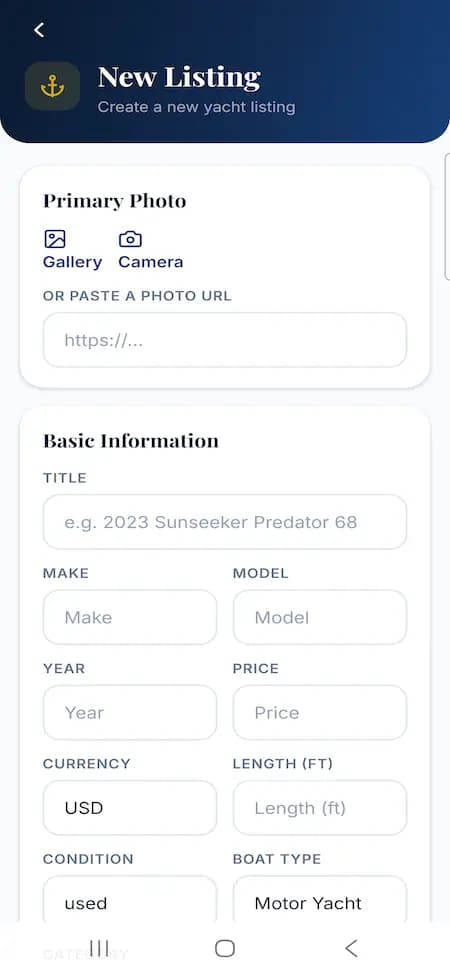
Illustrative vessel-sales intake form with sample placeholders and defaults. It does not establish vessel ownership, seaworthiness, insurance, seller authority or a published listing. YachtWorld is a category reference only; no affiliation or endorsement is implied.
What to check in the walkthrough
A YachtWorld-style product is a boat sales and broker-listing marketplace. It helps buyers discover new and used vessels, compare detailed specifications, save searches, contact an accountable seller or broker, and move an inquiry toward an independently governed transaction. It is not a yacht-charter booking product and it is not a peer-to-peer rental marketplace. The principal object is a vessel offered for sale; the principal conversion is a qualified inquiry, viewing, survey, offer, or broker-led sales step.
This solution is for marine brokers, dealer networks, builders, listing publishers, and specialist marketplaces that can establish reliable inventory sources and an operating process for seller participation, listing quality, inquiries, moderation, and corrections. App Clone Labs uses YachtWorld only as a descriptive reference for familiar category mechanics. The proposed product requires original branding, interface design, content, workflows, software, and commercial rules. No affiliation, endorsement, proprietary data, or copied assets are implied.
The first decision is who may list a vessel and who remains accountable for the information. A marketplace may accept inventory only from approved brokers and dealers, include builders and new-stock feeds, allow eligible private sellers, or combine these sources under different review and display rules. Each model changes onboarding, verification, data quality, moderation, lead routing, advertising disclosures, and support. The proposal should name the initial seller model rather than promising an unrestricted global inventory.
The transaction boundary matters equally. Some platforms publish listings and generate leads while the broker manages qualification, viewings, surveys, negotiation, contracts, escrow, title work, tax, transport, and closing outside the platform. Others add workflow tools for offers, documents, and status coordination. These are materially different responsibilities. V1 should implement the smallest complete and supportable boundary, with visible language explaining what the platform does, what the listing party does, and where qualified marine, legal, financial, insurance, or documentation professionals become responsible.
Boat discovery depends on structured attributes, not only attractive photography. The catalog can include vessel type and class, builder, model, year, condition, length, beam, draft, hull material, propulsion, engines, fuel, location, asking price, currency, tax status, cabins, berths, heads, equipment, usage history, and seller type where applicable. Not every field belongs to every vessel. The model needs category-aware requirements, units, controlled values, source attribution, and a clear distinction between seller-supplied information and platform-derived information.
Identifiers and provenance should be deliberate. A listing may arrive from a broker feed, dealer account, builder inventory, private-seller workflow, or manual editorial operation. The system should retain the source record, seller identifier, timestamps, update history, publication state, and reasons for material corrections. Hull identification numbers, registration details, ownership documents, and personal information are sensitive and should not automatically become public search fields. The product team must decide which evidence is collected, who may inspect it, and how long it remains.
Duplicate and stale inventory weakens buyer confidence. Matching can use source identifiers and carefully selected vessel attributes, but suspected duplicates often need human review. The operating workflow should cover sold, withdrawn, under-offer, unavailable, price-changed, relocated, and relisted vessels. Publication freshness can be supported through feed updates, seller confirmation, expiry rules, and operator queues. The platform should not label a listing verified or available unless the term has a defined method and current evidence.
A buyer may begin with a use case, hull form, builder, location, budget, size, age, propulsion, condition, or a precise model. Search should support broad exploration and narrow specialist criteria without producing misleading combinations. Filter counts, unit conversions, currency display, map results, pagination, sorting, and saved searches all need consistent rules. The experience should explain when a value is missing and avoid converting an absent specification into a false zero or default.
Ranking is a commercial and trust decision. Recency, relevance, completeness, proximity, seller quality, and paid placement may influence visibility, but promoted inventory must remain identifiable and organic relevance should not be silently distorted. Search analytics can expose zero-result terms, high-demand combinations, abandoned filters, and inquiry outcomes. These observations can guide taxonomy and supply acquisition, but they should not be presented as proof of buyer intent beyond the available data.
A useful listing brings specifications, media, description, location context, seller identity, update timing, and inquiry options into one understandable record. Photography and video need ownership or licence confirmation, accurate alternative text, transformation for device performance, and controls against inappropriate or misleading uploads. Descriptions should remain attributable to the seller or publisher. The interface should not turn promotional language into an independent platform guarantee.
Material information can change between publication and inspection. The page should state appropriate limitations and direct buyers to verify specifications, condition, ownership, equipment, tax, documentation, and suitability through the relevant seller and qualified advisers. Currency conversion or finance illustrations, if offered, require sources, timestamps, assumptions, and clear separation from the asking price. Location precision may need to be generalized publicly while allowing a broker to coordinate a viewing with a qualified lead.
A professional onboarding workflow can collect business identity, locations, team members, broker or dealer information, applicable licences or memberships, billing details, feed configuration, listing authority, and marketplace terms. Verification criteria must match the market and must not imply regulatory approval where none exists. Organization accounts need role-scoped permissions for inventory editors, lead managers, office administrators, and billing owners, with access revocation and audit history.
If private listings are permitted, the platform needs a separate eligibility and review path. It may collect identity, relationship to the vessel, listing evidence, contact preferences, payment for publication, and documentation needed under the marketplace policy. The design should minimize public personal information and establish how suspicious listings, impersonation, duplicate inventory, pricing anomalies, and complaints are escalated. A private-seller badge should describe the account type, not assert condition, ownership, or transaction safety.
The inquiry form should gather enough context for a useful response without creating unnecessary friction or collecting excessive personal data. Vessel identifier, source page, preferred contact method, buyer location, question, and consent state may be relevant. The system should protect sellers from automated abuse while preserving accessibility and legitimate international inquiries. It should also state whether the inquiry goes directly to the listing party, to a marketplace team, or through a routing and qualification service.
A durable lead record needs receipt time, recipient, delivery attempts, consent, status, assignment, notes, and outcome categories. Email cannot be the only evidence that a lead exists. Broker teams need queues, ownership, response reminders, deduplication, and controlled reassignment. Buyers need a truthful confirmation and a route to correct their details. Operators need visibility when delivery fails, routing rules conflict, a seller becomes unavailable, or a complaint requires review.
Attribution should be useful without overstating causality. The platform can connect a listing view, inquiry, broker response, and recorded outcome when the evidence exists, but much of a marine sale may happen offline over a long period. Reports should distinguish sent leads, delivered leads, accepted leads, broker-updated outcomes, and confirmed marketplace events. A marketing dashboard should not present every inquiry as a sale or every reported sale as independently verified.
Saved searches can help buyers follow a specialized and changing inventory. The saved definition should preserve filters, units, currency preference, geography, and communication frequency. Alerts should be generated from a defined listing event such as first publication or a material price change, with duplicate prevention and unsubscribe controls. If a listing no longer qualifies or becomes unavailable, the destination should explain the change rather than leading to an unexplained empty state.
Account areas may also support favourites, comparisons, recent inquiries, and contact preferences. These features create personal behavioural data and must follow the agreed privacy, retention, export, and deletion model. Anonymous browsing can remain valuable; registration should be requested when the saved benefit requires it, not imposed on every discovery action by default.
A boat marketplace may introduce buyers to marine lenders, insurers, surveyors, transport providers, documentation specialists, or brokers. These are referral surfaces, not automatic approvals or professional advice. The product should identify the provider, explain whether compensation or sponsorship exists, capture consent before transferring information, and avoid ranking or eligibility claims that the platform cannot substantiate. Regulated activities and required disclosures vary by jurisdiction and need qualified review.
Payment calculators and estimates should show inputs, assumptions, data source, date, and limitations. They should not be represented as an offer, approval, premium, tax result, valuation, or final transaction cost. If the platform later facilitates deposits or other money movement, that requires a separately scoped payment, authorization, refund, dispute, reconciliation, and licensed-provider model. It should not be smuggled into a lead-generation V1 as a minor checkout feature.
Listings may lead to requests for brochures, maintenance summaries, inventories, surveys, registration records, title information, or closing documents. The product should classify public, lead-gated, seller-team, buyer-specific, and restricted documents. Access grants, expiry, download logging, redaction, malware scanning, and removal need deliberate rules. Sensitive identifiers and signatures should not be exposed through guessable URLs or ordinary analytics.
A transaction workspace can coordinate viewings, offers, surveys, sea trials, conditions, document requests, and status, but it should not imply that the platform validates legal title or replaces professional review. Jurisdiction, vessel registration, lien searches, tax, sanctions, import or export, environmental rules, and contract practice can vary. The interface should name accountable parties and preserve an audit record without publishing confidential negotiations.
Operators need queues for new listings, material edits, suspected duplicates, prohibited content, image complaints, identity concerns, misleading claims, unavailable inventory, and reported sellers. Policies should define evidence, possible actions, escalation, communication, and appeal. Automated signals may prioritize review but should not silently establish fraud or ownership. High-impact decisions should be explainable to authorized staff and reversible where policy allows.
Quality controls can measure completeness, source freshness, response status, complaint history, and policy compliance, but labels shown to buyers must use language the evidence supports. A “verified broker” label, for example, needs a documented scope, review date, and renewal process; it cannot reasonably mean that every listing, statement, or future transaction is guaranteed. Operators should be able to withdraw inventory and suspend lead routing without deleting the historical record needed to investigate an issue.
A serious operations console covers organizations, team permissions, listing sources, import failures, moderation, lead routing, billing or plans, complaints, content, referral partners, communications, and audit events. It should surface exceptions that require action rather than only aggregate charts. Support staff need a safe view of the buyer, listing, seller, inquiry, delivery status, and relevant communication without receiving broad system or document access.
Feed operations deserve their own evidence. Imports should be repeatable, validate required attributes, report rejected records, map seller and vessel identifiers, preserve the last known good state, and show when updates stop arriving. An upstream feed should not be allowed to erase or publish large amounts of inventory without preview, thresholds, and recovery controls. Manual changes need a conflict policy so the next synchronization does not silently overwrite an approved correction.
The marketplace can use a transactional data store for organizations, listings, leads, permissions, moderation, and audit history, alongside a search index optimized for complex filtering and ranking. The index is a derived discovery surface, not the only copy of an authoritative record. Publishing and update events should be observable, retryable, and safe against duplication. Caches and content delivery can improve global media and listing performance while respecting withdrawal and correction requirements.
Interfaces with feeds, messaging, identity, maps, currency data, analytics, and referral partners need authentication, mapping, rate-limit, retry, timeout, monitoring, and ownership definitions. A third-party outage should not corrupt the listing record or lose an inquiry. Logs should retain useful event and correlation identifiers without copying private messages, credentials, or sensitive documents into broad operational access.
Buyers may inspect large inventories, detailed specifications, image galleries, comparisons, maps, and forms across phones, tablets, and desktops. The team should measure meaningful discovery and inquiry journeys using representative devices, network conditions, image sets, filter combinations, and listing volumes. Responsive images, explicit dimensions, controlled scripts, server-rendered discovery, caching, and efficient search responses can help, but performance targets should be verified against the chosen architecture rather than promised without evidence.
Accessible implementation includes semantic headings, landmarks, labelled filters, keyboard and focus behaviour, error association, status announcements, text resizing and reflow, contrast, target sizes, and useful alternatives for listing media. Maps and visual comparisons need non-visual routes to the same essential information. The agreed accessibility target should be tested in the implemented product; a design file or automated scan alone does not establish conformance.
A defensible first release may include approved seller organizations, structured listing creation or one governed feed, category-aware search, listing pages, saved inventory, inquiry routing, basic moderation, and operator reporting. Private sellers, complex referrals, transaction workspaces, multiple feed networks, personalization, valuations, and international expansion can wait until the initial supply and lead loop produces reliable operating evidence. Scope depends on the business and cannot be inferred from a reference brand alone.
Handover should define the repository, data model, search index, environments, deployment and rollback, media, feeds, integrations, domains, analytics, vendor accounts, access roles, documentation, tests, known limitations, and support responsibilities. It should distinguish client-specific work from reusable components and third-party services or licences. The outcome is an original boat-sales marketplace the client can inspect and operate—not a copied YachtWorld product or a guarantee of inventory, lead volume, sales, financing, insurance, documentation status, regulatory approval, or commercial performance.
Buyer questions
YachtWorld Clone app development means building a custom clone-inspired custom software platform inspired by proven product mechanics, with original branding, workflows, code, admin tools, integrations, and launch support for your market.
YachtWorld Clone is best suited for yachtworld clone founders, SMBs, agencies, funded startups, and enterprise teams that want a market-ready product without depending on a generic clone script. It works well when you want a proven product category but need original execution, local market fit, and operational ownership.
A clone-inspired product is acceptable when it uses the business model as inspiration but does not copy protected branding, proprietary UI, private data, content, trademarks, or unique assets. App Clone Labs builds original products around familiar mechanics.
The schedule follows the agreed roles, release boundary, integration depth, content readiness, review cadence, testing requirements, and third-party approvals. Multi-role and enterprise builds require broader validation and delivery plans.
V1 should include the smallest complete operating loop for customers, providers, operators, support teams, business admins, and growth teams: onboarding, core workflow, transaction or request state, notifications, admin visibility, support, and analytics.
Advanced personalization, complex loyalty, deep automation, multi-region rules, uncommon integrations, and enterprise analytics should usually wait until real usage proves the core loop.
The applicable agreement defines repository access, bespoke-code assignment or licensing, reusable framework rights, third-party dependencies, deployment context, documentation, and the handover boundary.
Yes. We adapt language, currency, payment methods, compliance needs, business rules, roles, workflows, content, and growth mechanics for your specific market.
Yes. Serious clone-inspired platforms need admin controls for users, transactions, payments, reports, support, moderation, content, settings, and operational exceptions.
The stack depends on scope, but common choices include Next.js web app, React Native or Flutter apps, Node.js APIs, PostgreSQL, Redis queues, cloud hosting, analytics, payment gateways, and role-based admin tooling.
Cost depends on apps required, number of roles, workflow depth, integrations, admin complexity, QA, cloud setup, and launch support. We estimate after mapping the MVP scope and full-build roadmap.
Yes. AI can support search, recommendations, moderation, support copilots, fraud review, document intake, analytics, and workflow automation where it creates real operational value.
We can support post-launch monitoring, bug fixes, analytics review, feature iteration, cloud improvements, app-store updates, and roadmap planning after the MVP goes live.
Solution reference register
01 / Reference and IP
YachtWorld is referenced only to describe familiar boat-sales marketplace mechanics. App Clone Labs is not affiliated with or endorsed by YachtWorld or Boats Group. The delivered product requires original branding, interface design, content, workflows, and implementation. Marine sales, advertising, documentation, finance, insurance, tax, privacy, and consumer obligations require qualified review for each market.
02 / Regulatory caveat
Vessel sale, broker, dealer, advertising, registration, documentation, tax, and consumer rules vary by jurisdiction. · Finance and insurance features require qualified providers, explicit disclosures, consent, and market-specific review. · Seller verification and listing review do not guarantee ownership, vessel condition, documentation status, or transaction outcome.
03 / Rights and handover
Original client-specific software and assets are governed by the signed agreement. YachtWorld trademarks, content, data, imagery, interfaces, and proprietary materials are excluded.
Primary sources
Dated official documentation, standards, and research that support the factual claims on this page.
Public reference for the category’s vessel-search taxonomy and professional/private seller discovery model.
Public reference for YachtWorld’s private-seller and broker-introduction paths; used for category research only.
Primary United States source for federal vessel documentation information; applicability varies by vessel and transaction.
Primary United States guidance on truthful advertising and disclosure considerations.
The W3C recommendation for accessible web content and interaction criteria.
How to read this page
Scope, cost and timeline figures are planning guidance until confirmed in a written proposal. Diagrams and screens are illustrations, not client deliverables, and source-code rights and handover follow the signed agreement. See the delivery process and the full disclaimer.
Next decision
Bring the intended sellers, vessel sources, target buyers, transaction boundary, referral partners, and operating constraints. We will identify a defensible V1.
Commercial rights, repositories, environments, documentation, acceptance and handover remain contract-defined.
App Clone Labs is not affiliated with, sponsored by, or endorsed by YachtWorld. The name identifies a familiar product category; every delivered product is independently designed and built, and the mark remains its owner's property. Read the full legal notice.
