Editorial dossier / Hiring and Teams
Contract Developers vs Managed Product Squads: A Delivery Ownership Guide
Compare contract developers and managed product squads across ownership, planning, architecture, QA, security, continuity, cost and handover.
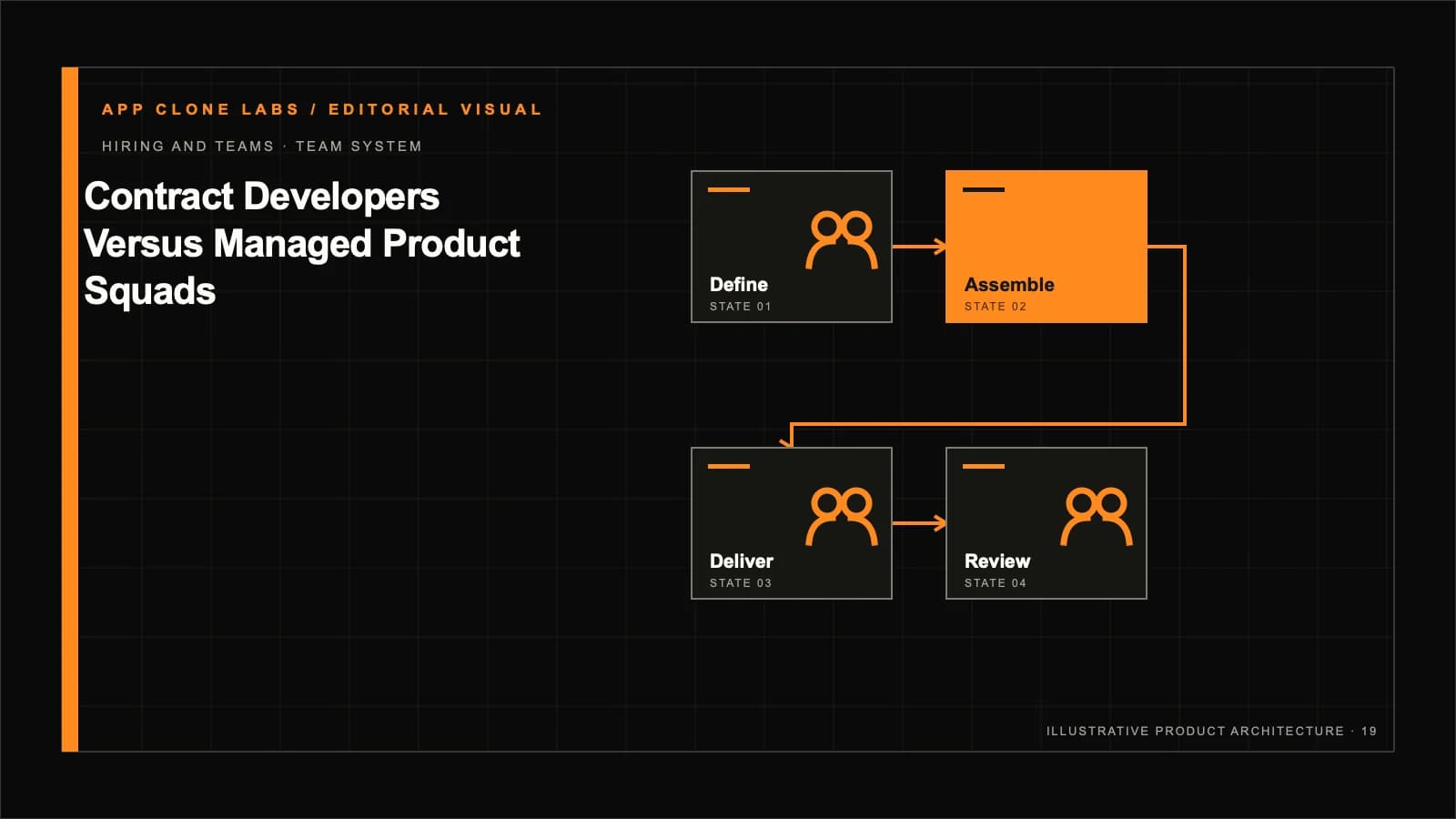
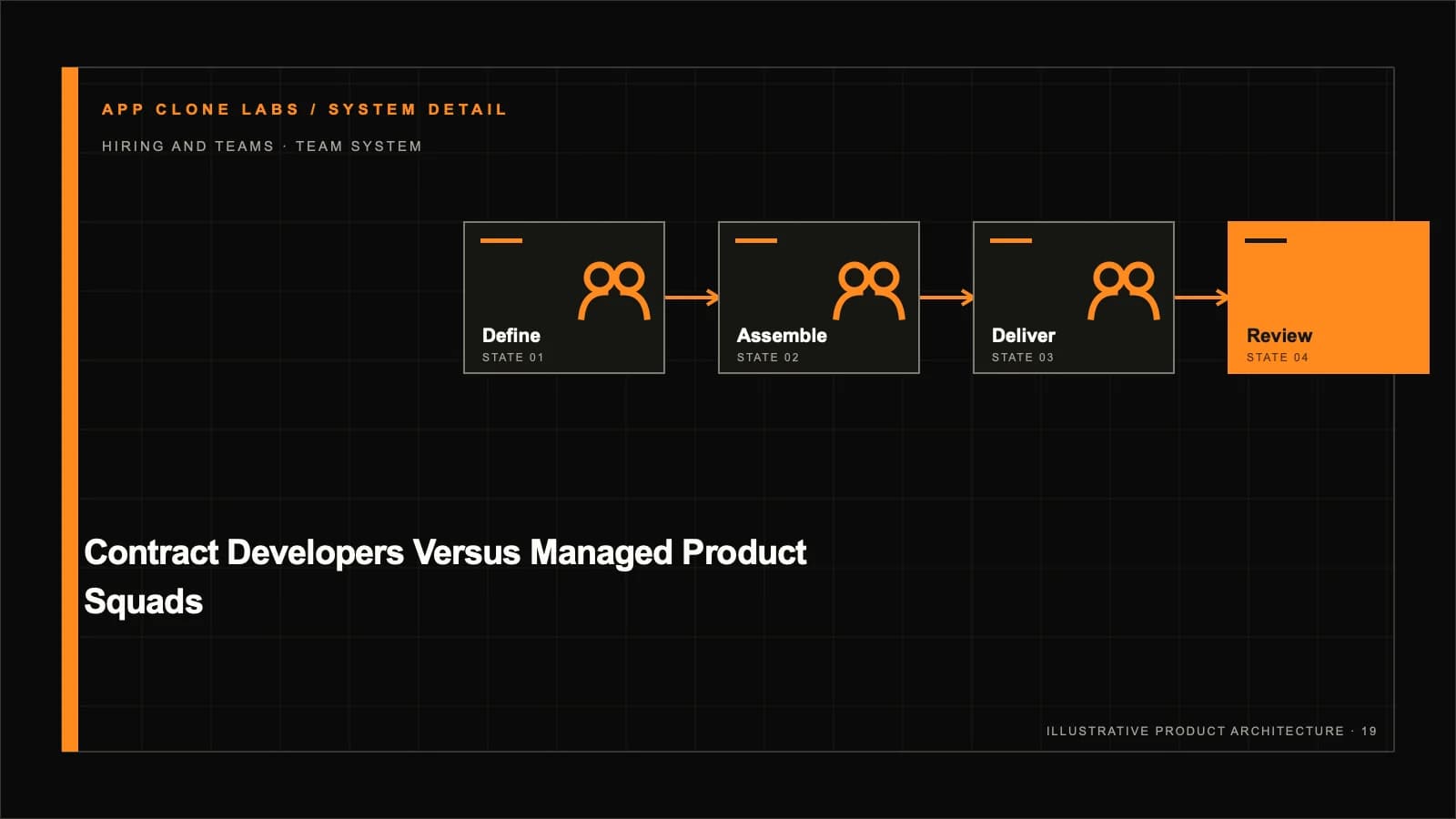
A contractor and a managed squad may write equally good code. The difference appears around the code: who discovers missing requirements, protects architecture, reviews changes, validates releases and carries the operational consequence when a milestone fails.
Choosing between them is an ownership decision before it is a staffing decision. A team that already has strong product and engineering leadership may need capacity; a founder without that layer may need an accountable delivery system.
This guide makes those responsibilities visible so hourly rates do not hide the true engagement model.
Define the business outcome
Define the business outcome is an independent operating decision inside a software-delivery engagement where the client must retain product and technical control. It affects the public promise, the authority of each participant, the evidence retained by the platform and the recovery path when ordinary processing fails.
The failure mode is concrete: the team implements define the business outcome as a screen-level feature, leaving permissions, downstream state, financial effects and support behavior inconsistent. This is not solved by adding another screen or background job. The product has to define ownership, permitted transitions, and the evidence retained when the transition occurs.
For the first release, write the authoritative lifecycle, responsible role, permitted transitions and user-visible outcome for define the business outcome before adding interface breadth. Write that decision as an enforceable server-side rule, not guidance that depends on a client, operator, or AI model remembering the intended boundary.
Implementation should include For define the business outcome, retain stable identifiers, explicit states, server-side authorization, version checks, occurrence and processing times, reason codes, correlation identifiers, audit history and an owned exception route. Keep the public response smaller than the internal record: users need a clear outcome and recovery path, while authorized operators need correlation IDs, policy versions, timestamps, and the before-and-after state.
Validate it with For define the business outcome, run the successful journey followed by duplicate delivery, stale state, concurrent commands, revoked authority, dependency timeout, partial failure, operator correction and later reconciliation. Test the ordinary path, then repeat under timeout, duplicate delivery, stale state, partial failure, revoked authority, and concurrent requests. A feature is not ready when only the demonstration succeeds.
- Owner: product owner
- Release evidence: versioned define the business outcome decision record and acceptance results
- Stop condition: define the business outcome cannot be explained, bounded or recovered from durable evidence
Map client-side ownership
Map client-side ownership is an independent operating decision inside a software-delivery engagement where the client must retain product and technical control. It affects the public promise, the authority of each participant, the evidence retained by the platform and the recovery path when ordinary processing fails.
The failure mode is concrete: the team implements map client-side ownership as a screen-level feature, leaving permissions, downstream state, financial effects and support behavior inconsistent. This is not solved by adding another screen or background job. The product has to define ownership, permitted transitions, and the evidence retained when the transition occurs.
For the first release, write the authoritative lifecycle, responsible role, permitted transitions and user-visible outcome for map client-side ownership before adding interface breadth. Write that decision as an enforceable server-side rule, not guidance that depends on a client, operator, or AI model remembering the intended boundary.
Implementation should include For map client-side ownership, retain stable identifiers, explicit states, server-side authorization, version checks, occurrence and processing times, reason codes, correlation identifiers, audit history and an owned exception route. Keep the public response smaller than the internal record: users need a clear outcome and recovery path, while authorized operators need correlation IDs, policy versions, timestamps, and the before-and-after state.
Validate it with For map client-side ownership, run the successful journey followed by duplicate delivery, stale state, concurrent commands, revoked authority, dependency timeout, partial failure, operator correction and later reconciliation. Test the ordinary path, then repeat under timeout, duplicate delivery, stale state, partial failure, revoked authority, and concurrent requests. A feature is not ready when only the demonstration succeeds.
- Owner: product owner
- Release evidence: versioned map client-side ownership decision record and acceptance results
- Stop condition: map client-side ownership cannot be explained, bounded or recovered from durable evidence
Assign product discovery
Assign product discovery is an independent operating decision inside a software-delivery engagement where the client must retain product and technical control. It affects the public promise, the authority of each participant, the evidence retained by the platform and the recovery path when ordinary processing fails.
The failure mode is concrete: the team implements assign product discovery as a screen-level feature, leaving permissions, downstream state, financial effects and support behavior inconsistent. This is not solved by adding another screen or background job. The product has to define ownership, permitted transitions, and the evidence retained when the transition occurs.
For the first release, write the authoritative lifecycle, responsible role, permitted transitions and user-visible outcome for assign product discovery before adding interface breadth. Write that decision as an enforceable server-side rule, not guidance that depends on a client, operator, or AI model remembering the intended boundary.
Implementation should include For assign product discovery, retain stable identifiers, explicit states, server-side authorization, version checks, occurrence and processing times, reason codes, correlation identifiers, audit history and an owned exception route. Keep the public response smaller than the internal record: users need a clear outcome and recovery path, while authorized operators need correlation IDs, policy versions, timestamps, and the before-and-after state.
Validate it with For assign product discovery, run the successful journey followed by duplicate delivery, stale state, concurrent commands, revoked authority, dependency timeout, partial failure, operator correction and later reconciliation. Test the ordinary path, then repeat under timeout, duplicate delivery, stale state, partial failure, revoked authority, and concurrent requests. A feature is not ready when only the demonstration succeeds.
- Owner: product owner
- Release evidence: versioned assign product discovery decision record and acceptance results
- Stop condition: assign product discovery cannot be explained, bounded or recovered from durable evidence
Assign architecture authority
Assign architecture authority is an independent operating decision inside a software-delivery engagement where the client must retain product and technical control. It affects the public promise, the authority of each participant, the evidence retained by the platform and the recovery path when ordinary processing fails.
The failure mode is concrete: the team implements assign architecture authority as a screen-level feature, leaving permissions, downstream state, financial effects and support behavior inconsistent. This is not solved by adding another screen or background job. The product has to define ownership, permitted transitions, and the evidence retained when the transition occurs.
For the first release, write the authoritative lifecycle, responsible role, permitted transitions and user-visible outcome for assign architecture authority before adding interface breadth. Write that decision as an enforceable server-side rule, not guidance that depends on a client, operator, or AI model remembering the intended boundary.
Implementation should include For assign architecture authority, retain stable identifiers, explicit states, server-side authorization, version checks, occurrence and processing times, reason codes, correlation identifiers, audit history and an owned exception route. Keep the public response smaller than the internal record: users need a clear outcome and recovery path, while authorized operators need correlation IDs, policy versions, timestamps, and the before-and-after state.
Validate it with For assign architecture authority, run the successful journey followed by duplicate delivery, stale state, concurrent commands, revoked authority, dependency timeout, partial failure, operator correction and later reconciliation. Test the ordinary path, then repeat under timeout, duplicate delivery, stale state, partial failure, revoked authority, and concurrent requests. A feature is not ready when only the demonstration succeeds.
- Owner: product owner
- Release evidence: versioned assign architecture authority decision record and acceptance results
- Stop condition: assign architecture authority cannot be explained, bounded or recovered from durable evidence
Checkpoint 4: reconcile the product promise with the recorded state. Support, finance, security, and delivery teams should be able to reach the same conclusion from the same identifiers without reconstructing events from chat messages or screenshots.
Plan backlog decisions
Plan backlog decisions is an independent operating decision inside a software-delivery engagement where the client must retain product and technical control. It affects the public promise, the authority of each participant, the evidence retained by the platform and the recovery path when ordinary processing fails.
The failure mode is concrete: the team implements plan backlog decisions as a screen-level feature, leaving permissions, downstream state, financial effects and support behavior inconsistent. This is not solved by adding another screen or background job. The product has to define ownership, permitted transitions, and the evidence retained when the transition occurs.
For the first release, write the authoritative lifecycle, responsible role, permitted transitions and user-visible outcome for plan backlog decisions before adding interface breadth. Write that decision as an enforceable server-side rule, not guidance that depends on a client, operator, or AI model remembering the intended boundary.
Implementation should include For plan backlog decisions, retain stable identifiers, explicit states, server-side authorization, version checks, occurrence and processing times, reason codes, correlation identifiers, audit history and an owned exception route. Keep the public response smaller than the internal record: users need a clear outcome and recovery path, while authorized operators need correlation IDs, policy versions, timestamps, and the before-and-after state.
Validate it with For plan backlog decisions, run the successful journey followed by duplicate delivery, stale state, concurrent commands, revoked authority, dependency timeout, partial failure, operator correction and later reconciliation. Test the ordinary path, then repeat under timeout, duplicate delivery, stale state, partial failure, revoked authority, and concurrent requests. A feature is not ready when only the demonstration succeeds.
- Owner: product owner
- Release evidence: versioned plan backlog decisions decision record and acceptance results
- Stop condition: plan backlog decisions cannot be explained, bounded or recovered from durable evidence
Set code-review responsibility
Set code-review responsibility is an independent operating decision inside a software-delivery engagement where the client must retain product and technical control. It affects the public promise, the authority of each participant, the evidence retained by the platform and the recovery path when ordinary processing fails.
The failure mode is concrete: the team implements set code-review responsibility as a screen-level feature, leaving permissions, downstream state, financial effects and support behavior inconsistent. This is not solved by adding another screen or background job. The product has to define ownership, permitted transitions, and the evidence retained when the transition occurs.
For the first release, write the authoritative lifecycle, responsible role, permitted transitions and user-visible outcome for set code-review responsibility before adding interface breadth. Write that decision as an enforceable server-side rule, not guidance that depends on a client, operator, or AI model remembering the intended boundary.
Implementation should include For set code-review responsibility, retain stable identifiers, explicit states, server-side authorization, version checks, occurrence and processing times, reason codes, correlation identifiers, audit history and an owned exception route. Keep the public response smaller than the internal record: users need a clear outcome and recovery path, while authorized operators need correlation IDs, policy versions, timestamps, and the before-and-after state.
Validate it with For set code-review responsibility, run the successful journey followed by duplicate delivery, stale state, concurrent commands, revoked authority, dependency timeout, partial failure, operator correction and later reconciliation. Test the ordinary path, then repeat under timeout, duplicate delivery, stale state, partial failure, revoked authority, and concurrent requests. A feature is not ready when only the demonstration succeeds.
- Owner: product owner
- Release evidence: versioned set code-review responsibility decision record and acceptance results
- Stop condition: set code-review responsibility cannot be explained, bounded or recovered from durable evidence
Set QA and acceptance
Set QA and acceptance is an independent operating decision inside a software-delivery engagement where the client must retain product and technical control. It affects the public promise, the authority of each participant, the evidence retained by the platform and the recovery path when ordinary processing fails.
The failure mode is concrete: the team implements set qa and acceptance as a screen-level feature, leaving permissions, downstream state, financial effects and support behavior inconsistent. This is not solved by adding another screen or background job. The product has to define ownership, permitted transitions, and the evidence retained when the transition occurs.
For the first release, write the authoritative lifecycle, responsible role, permitted transitions and user-visible outcome for set qa and acceptance before adding interface breadth. Write that decision as an enforceable server-side rule, not guidance that depends on a client, operator, or AI model remembering the intended boundary.
Implementation should include For set qa and acceptance, retain stable identifiers, explicit states, server-side authorization, version checks, occurrence and processing times, reason codes, correlation identifiers, audit history and an owned exception route. Keep the public response smaller than the internal record: users need a clear outcome and recovery path, while authorized operators need correlation IDs, policy versions, timestamps, and the before-and-after state.
Validate it with For set qa and acceptance, run the successful journey followed by duplicate delivery, stale state, concurrent commands, revoked authority, dependency timeout, partial failure, operator correction and later reconciliation. Test the ordinary path, then repeat under timeout, duplicate delivery, stale state, partial failure, revoked authority, and concurrent requests. A feature is not ready when only the demonstration succeeds.
- Owner: product owner
- Release evidence: versioned set qa and acceptance decision record and acceptance results
- Stop condition: set qa and acceptance cannot be explained, bounded or recovered from durable evidence
Control repositories and credentials
Control repositories and credentials is an independent operating decision inside a software-delivery engagement where the client must retain product and technical control. It affects the public promise, the authority of each participant, the evidence retained by the platform and the recovery path when ordinary processing fails.
The failure mode is concrete: the team implements control repositories and credentials as a screen-level feature, leaving permissions, downstream state, financial effects and support behavior inconsistent. This is not solved by adding another screen or background job. The product has to define ownership, permitted transitions, and the evidence retained when the transition occurs.
For the first release, write the authoritative lifecycle, responsible role, permitted transitions and user-visible outcome for control repositories and credentials before adding interface breadth. Write that decision as an enforceable server-side rule, not guidance that depends on a client, operator, or AI model remembering the intended boundary.
Implementation should include For control repositories and credentials, retain stable identifiers, explicit states, server-side authorization, version checks, occurrence and processing times, reason codes, correlation identifiers, audit history and an owned exception route. Keep the public response smaller than the internal record: users need a clear outcome and recovery path, while authorized operators need correlation IDs, policy versions, timestamps, and the before-and-after state.
Validate it with For control repositories and credentials, run the successful journey followed by duplicate delivery, stale state, concurrent commands, revoked authority, dependency timeout, partial failure, operator correction and later reconciliation. Test the ordinary path, then repeat under timeout, duplicate delivery, stale state, partial failure, revoked authority, and concurrent requests. A feature is not ready when only the demonstration succeeds.
- Owner: product owner
- Release evidence: versioned control repositories and credentials decision record and acceptance results
- Stop condition: control repositories and credentials cannot be explained, bounded or recovered from durable evidence
Checkpoint 8: reconcile the product promise with the recorded state. Support, finance, security, and delivery teams should be able to reach the same conclusion from the same identifiers without reconstructing events from chat messages or screenshots.
Manage release ownership
Manage release ownership is an independent operating decision inside a software-delivery engagement where the client must retain product and technical control. It affects the public promise, the authority of each participant, the evidence retained by the platform and the recovery path when ordinary processing fails.
The failure mode is concrete: the team implements manage release ownership as a screen-level feature, leaving permissions, downstream state, financial effects and support behavior inconsistent. This is not solved by adding another screen or background job. The product has to define ownership, permitted transitions, and the evidence retained when the transition occurs.
For the first release, write the authoritative lifecycle, responsible role, permitted transitions and user-visible outcome for manage release ownership before adding interface breadth. Write that decision as an enforceable server-side rule, not guidance that depends on a client, operator, or AI model remembering the intended boundary.
Implementation should include For manage release ownership, retain stable identifiers, explicit states, server-side authorization, version checks, occurrence and processing times, reason codes, correlation identifiers, audit history and an owned exception route. Keep the public response smaller than the internal record: users need a clear outcome and recovery path, while authorized operators need correlation IDs, policy versions, timestamps, and the before-and-after state.
Validate it with For manage release ownership, run the successful journey followed by duplicate delivery, stale state, concurrent commands, revoked authority, dependency timeout, partial failure, operator correction and later reconciliation. Test the ordinary path, then repeat under timeout, duplicate delivery, stale state, partial failure, revoked authority, and concurrent requests. A feature is not ready when only the demonstration succeeds.
- Owner: product owner
- Release evidence: versioned manage release ownership decision record and acceptance results
- Stop condition: manage release ownership cannot be explained, bounded or recovered from durable evidence
Handle security and privacy
Handle security and privacy is an independent operating decision inside a software-delivery engagement where the client must retain product and technical control. It affects the public promise, the authority of each participant, the evidence retained by the platform and the recovery path when ordinary processing fails.
The failure mode is concrete: the team implements handle security and privacy as a screen-level feature, leaving permissions, downstream state, financial effects and support behavior inconsistent. This is not solved by adding another screen or background job. The product has to define ownership, permitted transitions, and the evidence retained when the transition occurs.
For the first release, write the authoritative lifecycle, responsible role, permitted transitions and user-visible outcome for handle security and privacy before adding interface breadth. Write that decision as an enforceable server-side rule, not guidance that depends on a client, operator, or AI model remembering the intended boundary.
Implementation should include For handle security and privacy, retain stable identifiers, explicit states, server-side authorization, version checks, occurrence and processing times, reason codes, correlation identifiers, audit history and an owned exception route. Keep the public response smaller than the internal record: users need a clear outcome and recovery path, while authorized operators need correlation IDs, policy versions, timestamps, and the before-and-after state.
Validate it with For handle security and privacy, run the successful journey followed by duplicate delivery, stale state, concurrent commands, revoked authority, dependency timeout, partial failure, operator correction and later reconciliation. Test the ordinary path, then repeat under timeout, duplicate delivery, stale state, partial failure, revoked authority, and concurrent requests. A feature is not ready when only the demonstration succeeds.
- Owner: product owner
- Release evidence: versioned handle security and privacy decision record and acceptance results
- Stop condition: handle security and privacy cannot be explained, bounded or recovered from durable evidence
Measure delivery evidence
Measure delivery evidence is an independent operating decision inside a software-delivery engagement where the client must retain product and technical control. It affects the public promise, the authority of each participant, the evidence retained by the platform and the recovery path when ordinary processing fails.
The failure mode is concrete: the team implements measure delivery evidence as a screen-level feature, leaving permissions, downstream state, financial effects and support behavior inconsistent. This is not solved by adding another screen or background job. The product has to define ownership, permitted transitions, and the evidence retained when the transition occurs.
For the first release, write the authoritative lifecycle, responsible role, permitted transitions and user-visible outcome for measure delivery evidence before adding interface breadth. Write that decision as an enforceable server-side rule, not guidance that depends on a client, operator, or AI model remembering the intended boundary.
Implementation should include For measure delivery evidence, retain stable identifiers, explicit states, server-side authorization, version checks, occurrence and processing times, reason codes, correlation identifiers, audit history and an owned exception route. Keep the public response smaller than the internal record: users need a clear outcome and recovery path, while authorized operators need correlation IDs, policy versions, timestamps, and the before-and-after state.
Validate it with For measure delivery evidence, run the successful journey followed by duplicate delivery, stale state, concurrent commands, revoked authority, dependency timeout, partial failure, operator correction and later reconciliation. Test the ordinary path, then repeat under timeout, duplicate delivery, stale state, partial failure, revoked authority, and concurrent requests. A feature is not ready when only the demonstration succeeds.
- Owner: product owner
- Release evidence: versioned measure delivery evidence decision record and acceptance results
- Stop condition: measure delivery evidence cannot be explained, bounded or recovered from durable evidence
Compare total operating cost
Compare total operating cost is an independent operating decision inside a software-delivery engagement where the client must retain product and technical control. It affects the public promise, the authority of each participant, the evidence retained by the platform and the recovery path when ordinary processing fails.
The failure mode is concrete: the team implements compare total operating cost as a screen-level feature, leaving permissions, downstream state, financial effects and support behavior inconsistent. This is not solved by adding another screen or background job. The product has to define ownership, permitted transitions, and the evidence retained when the transition occurs.
For the first release, write the authoritative lifecycle, responsible role, permitted transitions and user-visible outcome for compare total operating cost before adding interface breadth. Write that decision as an enforceable server-side rule, not guidance that depends on a client, operator, or AI model remembering the intended boundary.
Implementation should include For compare total operating cost, retain stable identifiers, explicit states, server-side authorization, version checks, occurrence and processing times, reason codes, correlation identifiers, audit history and an owned exception route. Keep the public response smaller than the internal record: users need a clear outcome and recovery path, while authorized operators need correlation IDs, policy versions, timestamps, and the before-and-after state.
Validate it with For compare total operating cost, run the successful journey followed by duplicate delivery, stale state, concurrent commands, revoked authority, dependency timeout, partial failure, operator correction and later reconciliation. Test the ordinary path, then repeat under timeout, duplicate delivery, stale state, partial failure, revoked authority, and concurrent requests. A feature is not ready when only the demonstration succeeds.
- Owner: product owner
- Release evidence: versioned compare total operating cost decision record and acceptance results
- Stop condition: compare total operating cost cannot be explained, bounded or recovered from durable evidence
Checkpoint 12: reconcile the product promise with the recorded state. Support, finance, security, and delivery teams should be able to reach the same conclusion from the same identifiers without reconstructing events from chat messages or screenshots.
Plan specialist coverage
Plan specialist coverage is an independent operating decision inside a software-delivery engagement where the client must retain product and technical control. It affects the public promise, the authority of each participant, the evidence retained by the platform and the recovery path when ordinary processing fails.
The failure mode is concrete: the team implements plan specialist coverage as a screen-level feature, leaving permissions, downstream state, financial effects and support behavior inconsistent. This is not solved by adding another screen or background job. The product has to define ownership, permitted transitions, and the evidence retained when the transition occurs.
For the first release, write the authoritative lifecycle, responsible role, permitted transitions and user-visible outcome for plan specialist coverage before adding interface breadth. Write that decision as an enforceable server-side rule, not guidance that depends on a client, operator, or AI model remembering the intended boundary.
Implementation should include For plan specialist coverage, retain stable identifiers, explicit states, server-side authorization, version checks, occurrence and processing times, reason codes, correlation identifiers, audit history and an owned exception route. Keep the public response smaller than the internal record: users need a clear outcome and recovery path, while authorized operators need correlation IDs, policy versions, timestamps, and the before-and-after state.
Validate it with For plan specialist coverage, run the successful journey followed by duplicate delivery, stale state, concurrent commands, revoked authority, dependency timeout, partial failure, operator correction and later reconciliation. Test the ordinary path, then repeat under timeout, duplicate delivery, stale state, partial failure, revoked authority, and concurrent requests. A feature is not ready when only the demonstration succeeds.
- Owner: product owner
- Release evidence: versioned plan specialist coverage decision record and acceptance results
- Stop condition: plan specialist coverage cannot be explained, bounded or recovered from durable evidence
Protect continuity and replacement
Protect continuity and replacement is an independent operating decision inside a software-delivery engagement where the client must retain product and technical control. It affects the public promise, the authority of each participant, the evidence retained by the platform and the recovery path when ordinary processing fails.
The failure mode is concrete: the team implements protect continuity and replacement as a screen-level feature, leaving permissions, downstream state, financial effects and support behavior inconsistent. This is not solved by adding another screen or background job. The product has to define ownership, permitted transitions, and the evidence retained when the transition occurs.
For the first release, write the authoritative lifecycle, responsible role, permitted transitions and user-visible outcome for protect continuity and replacement before adding interface breadth. Write that decision as an enforceable server-side rule, not guidance that depends on a client, operator, or AI model remembering the intended boundary.
Implementation should include For protect continuity and replacement, retain stable identifiers, explicit states, server-side authorization, version checks, occurrence and processing times, reason codes, correlation identifiers, audit history and an owned exception route. Keep the public response smaller than the internal record: users need a clear outcome and recovery path, while authorized operators need correlation IDs, policy versions, timestamps, and the before-and-after state.
Validate it with For protect continuity and replacement, run the successful journey followed by duplicate delivery, stale state, concurrent commands, revoked authority, dependency timeout, partial failure, operator correction and later reconciliation. Test the ordinary path, then repeat under timeout, duplicate delivery, stale state, partial failure, revoked authority, and concurrent requests. A feature is not ready when only the demonstration succeeds.
- Owner: product owner
- Release evidence: versioned protect continuity and replacement decision record and acceptance results
- Stop condition: protect continuity and replacement cannot be explained, bounded or recovered from durable evidence
Define handover and exit
Define handover and exit is an independent operating decision inside a software-delivery engagement where the client must retain product and technical control. It affects the public promise, the authority of each participant, the evidence retained by the platform and the recovery path when ordinary processing fails.
The failure mode is concrete: the team implements define handover and exit as a screen-level feature, leaving permissions, downstream state, financial effects and support behavior inconsistent. This is not solved by adding another screen or background job. The product has to define ownership, permitted transitions, and the evidence retained when the transition occurs.
For the first release, write the authoritative lifecycle, responsible role, permitted transitions and user-visible outcome for define handover and exit before adding interface breadth. Write that decision as an enforceable server-side rule, not guidance that depends on a client, operator, or AI model remembering the intended boundary.
Implementation should include For define handover and exit, retain stable identifiers, explicit states, server-side authorization, version checks, occurrence and processing times, reason codes, correlation identifiers, audit history and an owned exception route. Keep the public response smaller than the internal record: users need a clear outcome and recovery path, while authorized operators need correlation IDs, policy versions, timestamps, and the before-and-after state.
Validate it with For define handover and exit, run the successful journey followed by duplicate delivery, stale state, concurrent commands, revoked authority, dependency timeout, partial failure, operator correction and later reconciliation. Test the ordinary path, then repeat under timeout, duplicate delivery, stale state, partial failure, revoked authority, and concurrent requests. A feature is not ready when only the demonstration succeeds.
- Owner: product owner
- Release evidence: versioned define handover and exit decision record and acceptance results
- Stop condition: define handover and exit cannot be explained, bounded or recovered from durable evidence
Implementation references
Use OWASP API Security Top 10 and record the version used for release.
Validate against OWASP Authorization Cheat Sheet and record the version used for release.
Review NIST Cybersecurity Framework 2.0 and record the version used for release.
Compare with W3C WCAG 2.2 and record the version used for release.
Continue with Contract Developers when converting this guide into scope.
Frequently asked questions
When is a contractor the right choice?
When scope and architecture are clear and the client already owns planning, review, QA and release.
When is a managed squad better?
When the outcome requires coordinated product, engineering, QA and delivery ownership.
Which option costs less?
Compare management, rework, QA, continuity and handover—not rates alone.
Who should own the repository?
The client organization.
How should progress be measured?
Accepted working outcomes, quality evidence and operational readiness.
What happens when someone leaves?
Use documented replacement, access removal and knowledge transfer.
Can the models be combined?
Yes, if responsibility boundaries remain explicit.
What proves handover?
The client can build, release, operate and explain the system independently.
Turn the plan into release evidence
A credible release connects its promise to durable state, scoped authority and recoverable operations. The team should explain ordinary journeys and important exceptions from the same evidence.
Keep the first scope narrow enough to rehearse. Expand only after permissions, data, money and support outcomes remain consistent under retries, failures and human mistakes.
- 01
- 02
- 03
- 04
- 05
- 06
Reviewed by the App Clone Labs product strategy team
This guide is written for founders and operators planning clone-inspired platforms, SaaS products, marketplaces, and mobile apps. It is reviewed against App Clone Labs delivery patterns, product scoping standards, and current implementation realities before being published.
Review the editorial team structureRelated product paths
Continue with the services, solutions, guides, and articles that connect this topic to a real software build.
Services, solutions, and guides
Read next