Editorial dossier / Hiring and Teams
CTO Services for MVP Teams: Decisions, Delivery Controls and Handover
Understand fractional CTO services for MVP teams across product scope, architecture, hiring, security, delivery governance, vendor oversight and technical handover.
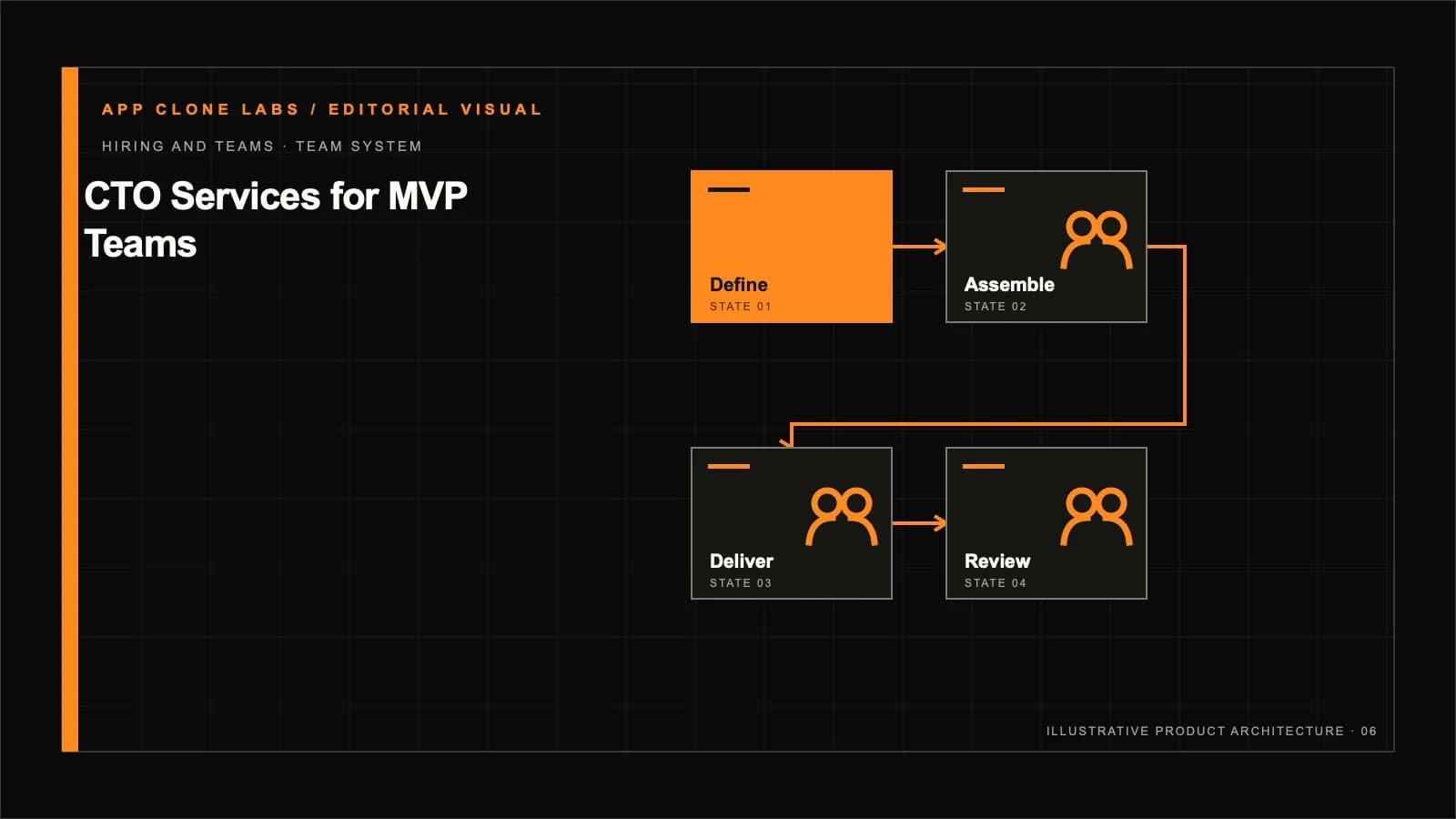
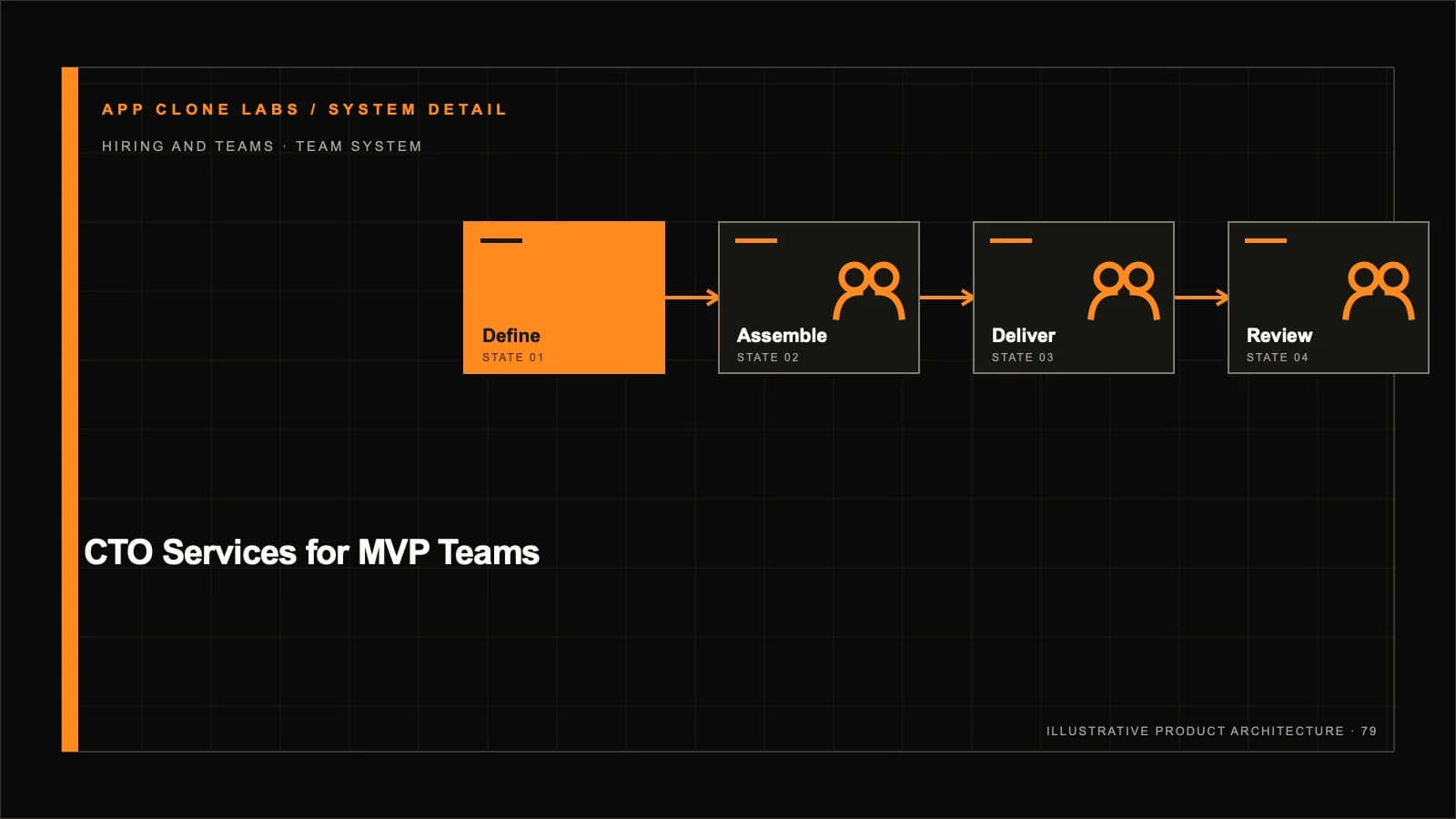
A founder does not need a fractional CTO merely to approve framework choices. The expensive problems are usually unresolved ownership, scope that changes without consequence, vendors who cannot be challenged, production access with no controls, and a codebase that only one person understands.
CTO services are valuable when they convert business uncertainty into technical decisions and durable operating evidence. The role should reduce dependence, make risks explicit and leave the team more capable than before.
This guide defines outcomes, boundaries and artifacts for MVP-stage technical leadership.
Define the leadership mandate
Architecture, hiring, delivery rescue and investor diligence require different emphasis.
The failure mode is concrete: the engagement promises vague strategic support. This is not solved by adding another screen or background job. The product has to define ownership, permitted transitions, and the evidence retained when the transition occurs.
For the first release, write time-bound outcomes, authority and exclusions. Write that decision as an enforceable server-side rule, not guidance that depends on a client, operator, or AI model remembering the intended boundary.
Implementation should include business stage, decisions, deliverables, meeting cadence, escalation, budget authority and success measures. Keep the public response smaller than the internal record: users need a clear outcome and recovery path, while authorized operators need correlation IDs, policy versions, timestamps, and the before-and-after state.
Validate it with normal month and urgent production decision. Test the ordinary path, then repeat under timeout, duplicate delivery, stale state, partial failure, revoked authority, and concurrent requests. A feature is not ready when only the demonstration succeeds.
- Owner: founder and CTO
- Release evidence: Define the leadership mandate acceptance record
- Stop condition: define the leadership mandate cannot be explained or recovered
Translate product intent into scope
The roadmap needs testable journeys and explicit exclusions.
The failure mode is concrete: features enter delivery through informal conversations. This is not solved by adding another screen or background job. The product has to define ownership, permitted transitions, and the evidence retained when the transition occurs.
For the first release, maintain a decision-backed release scope. Write that decision as an enforceable server-side rule, not guidance that depends on a client, operator, or AI model remembering the intended boundary.
Implementation should include user, problem, journey, acceptance evidence, dependency, risk, owner and deferred work. Keep the public response smaller than the internal record: users need a clear outcome and recovery path, while authorized operators need correlation IDs, policy versions, timestamps, and the before-and-after state.
Validate it with new request and missed assumption. Test the ordinary path, then repeat under timeout, duplicate delivery, stale state, partial failure, revoked authority, and concurrent requests. A feature is not ready when only the demonstration succeeds.
- Owner: product leadership
- Release evidence: Translate product intent into scope acceptance record
- Stop condition: translate product intent into scope cannot be explained or recovered
Create an architecture decision record
Important choices should retain context and consequences.
The failure mode is concrete: technology decisions live in chat or vendor memory. This is not solved by adding another screen or background job. The product has to define ownership, permitted transitions, and the evidence retained when the transition occurs.
For the first release, record alternatives, constraints and reversal cost. Write that decision as an enforceable server-side rule, not guidance that depends on a client, operator, or AI model remembering the intended boundary.
Implementation should include decision, status, context, options, rationale, consequences, owner and review date. Keep the public response smaller than the internal record: users need a clear outcome and recovery path, while authorized operators need correlation IDs, policy versions, timestamps, and the before-and-after state.
Validate it with changed scale assumption. Test the ordinary path, then repeat under timeout, duplicate delivery, stale state, partial failure, revoked authority, and concurrent requests. A feature is not ready when only the demonstration succeeds.
- Owner: technical lead
- Release evidence: Create an architecture decision record acceptance record
- Stop condition: create an architecture decision record cannot be explained or recovered
Establish repository ownership
The company must control code, history and release authority.
The failure mode is concrete: a vendor owns the only repository or administrator account. This is not solved by adding another screen or background job. The product has to define ownership, permitted transitions, and the evidence retained when the transition occurs.
For the first release, place assets in company-controlled systems with named access. Write that decision as an enforceable server-side rule, not guidance that depends on a client, operator, or AI model remembering the intended boundary.
Implementation should include repositories, organizations, administrators, branch rules, backups and offboarding. Keep the public response smaller than the internal record: users need a clear outcome and recovery path, while authorized operators need correlation IDs, policy versions, timestamps, and the before-and-after state.
Validate it with vendor departure and lost account. Test the ordinary path, then repeat under timeout, duplicate delivery, stale state, partial failure, revoked authority, and concurrent requests. A feature is not ready when only the demonstration succeeds.
- Owner: governance owner
- Release evidence: Establish repository ownership acceptance record
- Stop condition: establish repository ownership cannot be explained or recovered
Checkpoint 4: reconcile the product promise with the recorded state. Support, finance, security, and delivery teams should be able to reach the same conclusion from the same identifiers without reconstructing events from chat messages or screenshots.
Set engineering quality gates
Speed without repeatability accumulates launch risk.
The failure mode is concrete: done means the developer demonstrated a happy path. This is not solved by adding another screen or background job. The product has to define ownership, permitted transitions, and the evidence retained when the transition occurs.
For the first release, define proportional review, test and security gates. Write that decision as an enforceable server-side rule, not guidance that depends on a client, operator, or AI model remembering the intended boundary.
Implementation should include code review, automated tests, type checks, dependency review, acceptance evidence and exceptions. Keep the public response smaller than the internal record: users need a clear outcome and recovery path, while authorized operators need correlation IDs, policy versions, timestamps, and the before-and-after state.
Validate it with urgent fix and failed test. Test the ordinary path, then repeat under timeout, duplicate delivery, stale state, partial failure, revoked authority, and concurrent requests. A feature is not ready when only the demonstration succeeds.
- Owner: engineering lead
- Release evidence: Set engineering quality gates acceptance record
- Stop condition: set engineering quality gates cannot be explained or recovered
Design environments and access
Development, staging and production require clear separation.
The failure mode is concrete: shared credentials and production data enter local machines. This is not solved by adding another screen or background job. The product has to define ownership, permitted transitions, and the evidence retained when the transition occurs.
For the first release, use managed identities, least privilege and environment-specific secrets. Write that decision as an enforceable server-side rule, not guidance that depends on a client, operator, or AI model remembering the intended boundary.
Implementation should include identity, role, environment, secret owner, expiry, logs and emergency access. Keep the public response smaller than the internal record: users need a clear outcome and recovery path, while authorized operators need correlation IDs, policy versions, timestamps, and the before-and-after state.
Validate it with contractor offboarding. Test the ordinary path, then repeat under timeout, duplicate delivery, stale state, partial failure, revoked authority, and concurrent requests. A feature is not ready when only the demonstration succeeds.
- Owner: security lead
- Release evidence: Design environments and access acceptance record
- Stop condition: design environments and access cannot be explained or recovered
Build a release process
Production changes need responsibility and rollback.
The failure mode is concrete: deployments are manual rituals known by one developer. This is not solved by adding another screen or background job. The product has to define ownership, permitted transitions, and the evidence retained when the transition occurs.
For the first release, document repeatable release and recovery steps. Write that decision as an enforceable server-side rule, not guidance that depends on a client, operator, or AI model remembering the intended boundary.
Implementation should include candidate, approvals, migration, monitoring, communication, rollback trigger and owner. Keep the public response smaller than the internal record: users need a clear outcome and recovery path, while authorized operators need correlation IDs, policy versions, timestamps, and the before-and-after state.
Validate it with failed migration and partial rollout. Test the ordinary path, then repeat under timeout, duplicate delivery, stale state, partial failure, revoked authority, and concurrent requests. A feature is not ready when only the demonstration succeeds.
- Owner: delivery lead
- Release evidence: Build a release process acceptance record
- Stop condition: build a release process cannot be explained or recovered
Make observability actionable
Logs and dashboards should answer operational questions.
The failure mode is concrete: telemetry is added without ownership or thresholds. This is not solved by adding another screen or background job. The product has to define ownership, permitted transitions, and the evidence retained when the transition occurs.
For the first release, define service objectives and incident signals. Write that decision as an enforceable server-side rule, not guidance that depends on a client, operator, or AI model remembering the intended boundary.
Implementation should include critical journey, indicator, target, alert, runbook, owner and retention. Keep the public response smaller than the internal record: users need a clear outcome and recovery path, while authorized operators need correlation IDs, policy versions, timestamps, and the before-and-after state.
Validate it with slow dependency and silent queue failure. Test the ordinary path, then repeat under timeout, duplicate delivery, stale state, partial failure, revoked authority, and concurrent requests. A feature is not ready when only the demonstration succeeds.
- Owner: reliability owner
- Release evidence: Make observability actionable acceptance record
- Stop condition: make observability actionable cannot be explained or recovered
Checkpoint 8: reconcile the product promise with the recorded state. Support, finance, security, and delivery teams should be able to reach the same conclusion from the same identifiers without reconstructing events from chat messages or screenshots.
Plan data ownership
Schemas, retention and backups should match product obligations.
The failure mode is concrete: the database grows without classification or recovery tests. This is not solved by adding another screen or background job. The product has to define ownership, permitted transitions, and the evidence retained when the transition occurs.
For the first release, maintain data inventory and restore evidence. Write that decision as an enforceable server-side rule, not guidance that depends on a client, operator, or AI model remembering the intended boundary.
Implementation should include entity, sensitivity, owner, system of record, retention, deletion and backup objective. Keep the public response smaller than the internal record: users need a clear outcome and recovery path, while authorized operators need correlation IDs, policy versions, timestamps, and the before-and-after state.
Validate it with accidental deletion and restore. Test the ordinary path, then repeat under timeout, duplicate delivery, stale state, partial failure, revoked authority, and concurrent requests. A feature is not ready when only the demonstration succeeds.
- Owner: data owner
- Release evidence: Plan data ownership acceptance record
- Stop condition: plan data ownership cannot be explained or recovered
Oversee vendors through evidence
External teams need clear interfaces and acceptance.
The failure mode is concrete: progress is reported through screenshots and percentages. This is not solved by adding another screen or background job. The product has to define ownership, permitted transitions, and the evidence retained when the transition occurs.
For the first release, review working increments, decisions and repository state. Write that decision as an enforceable server-side rule, not guidance that depends on a client, operator, or AI model remembering the intended boundary.
Implementation should include scope, artifacts, demo, tests, risks, access, invoices and handover status. Keep the public response smaller than the internal record: users need a clear outcome and recovery path, while authorized operators need correlation IDs, policy versions, timestamps, and the before-and-after state.
Validate it with missed milestone and disputed completion. Test the ordinary path, then repeat under timeout, duplicate delivery, stale state, partial failure, revoked authority, and concurrent requests. A feature is not ready when only the demonstration succeeds.
- Owner: vendor manager
- Release evidence: Oversee vendors through evidence acceptance record
- Stop condition: oversee vendors through evidence cannot be explained or recovered
Build the hiring scorecard
Early hires must match ownership gaps, not trend keywords.
The failure mode is concrete: interviews test framework trivia alone. This is not solved by adding another screen or background job. The product has to define ownership, permitted transitions, and the evidence retained when the transition occurs.
For the first release, assess product judgment, delivery discipline and communication. Write that decision as an enforceable server-side rule, not guidance that depends on a client, operator, or AI model remembering the intended boundary.
Implementation should include role outcomes, scenarios, code exercise, review behavior, references and decision. Keep the public response smaller than the internal record: users need a clear outcome and recovery path, while authorized operators need correlation IDs, policy versions, timestamps, and the before-and-after state.
Validate it with strong coder with weak ownership. Test the ordinary path, then repeat under timeout, duplicate delivery, stale state, partial failure, revoked authority, and concurrent requests. A feature is not ready when only the demonstration succeeds.
- Owner: hiring lead
- Release evidence: Build the hiring scorecard acceptance record
- Stop condition: build the hiring scorecard cannot be explained or recovered
Manage technical debt explicitly
Shortcuts may be rational if consequences and removal triggers are known.
The failure mode is concrete: temporary decisions become invisible permanent dependencies. This is not solved by adding another screen or background job. The product has to define ownership, permitted transitions, and the evidence retained when the transition occurs.
For the first release, record debt with risk, owner and exit condition. Write that decision as an enforceable server-side rule, not guidance that depends on a client, operator, or AI model remembering the intended boundary.
Implementation should include location, reason, impact, workaround, trigger, estimate and target window. Keep the public response smaller than the internal record: users need a clear outcome and recovery path, while authorized operators need correlation IDs, policy versions, timestamps, and the before-and-after state.
Validate it with launch shortcut and scale threshold. Test the ordinary path, then repeat under timeout, duplicate delivery, stale state, partial failure, revoked authority, and concurrent requests. A feature is not ready when only the demonstration succeeds.
- Owner: architecture owner
- Release evidence: Manage technical debt explicitly acceptance record
- Stop condition: manage technical debt explicitly cannot be explained or recovered
Checkpoint 12: reconcile the product promise with the recorded state. Support, finance, security, and delivery teams should be able to reach the same conclusion from the same identifiers without reconstructing events from chat messages or screenshots.
Report to founders in business terms
Leadership needs consequences, options and decisions.
The failure mode is concrete: status reports list tickets without exposure or learning. This is not solved by adding another screen or background job. The product has to define ownership, permitted transitions, and the evidence retained when the transition occurs.
For the first release, report outcomes, risks, evidence and required choices. Write that decision as an enforceable server-side rule, not guidance that depends on a client, operator, or AI model remembering the intended boundary.
Implementation should include release confidence, customer impact, spend, reliability, security, staffing and decisions. Keep the public response smaller than the internal record: users need a clear outcome and recovery path, while authorized operators need correlation IDs, policy versions, timestamps, and the before-and-after state.
Validate it with bad news and uncertain estimate. Test the ordinary path, then repeat under timeout, duplicate delivery, stale state, partial failure, revoked authority, and concurrent requests. A feature is not ready when only the demonstration succeeds.
- Owner: CTO
- Release evidence: Report to founders in business terms acceptance record
- Stop condition: report to founders in business terms cannot be explained or recovered
Prepare diligence evidence
Investors and buyers may inspect ownership, security and delivery maturity.
The failure mode is concrete: documents are assembled reactively and contradict reality. This is not solved by adding another screen or background job. The product has to define ownership, permitted transitions, and the evidence retained when the transition occurs.
For the first release, keep a current, access-controlled evidence room. Write that decision as an enforceable server-side rule, not guidance that depends on a client, operator, or AI model remembering the intended boundary.
Implementation should include architecture, IP ownership, dependencies, incidents, access, roadmap, costs and key risks. Keep the public response smaller than the internal record: users need a clear outcome and recovery path, while authorized operators need correlation IDs, policy versions, timestamps, and the before-and-after state.
Validate it with request under time pressure. Test the ordinary path, then repeat under timeout, duplicate delivery, stale state, partial failure, revoked authority, and concurrent requests. A feature is not ready when only the demonstration succeeds.
- Owner: governance lead
- Release evidence: Prepare diligence evidence acceptance record
- Stop condition: prepare diligence evidence cannot be explained or recovered
Design the handover from day one
A good engagement reduces key-person dependency.
The failure mode is concrete: the CTO retains unwritten context and privileged access. This is not solved by adding another screen or background job. The product has to define ownership, permitted transitions, and the evidence retained when the transition occurs.
For the first release, transfer decisions, runbooks, relationships and authority progressively. Write that decision as an enforceable server-side rule, not guidance that depends on a client, operator, or AI model remembering the intended boundary.
Implementation should include decision index, system map, access register, vendor contacts, risks, roadmap and successor. Keep the public response smaller than the internal record: users need a clear outcome and recovery path, while authorized operators need correlation IDs, policy versions, timestamps, and the before-and-after state.
Validate it with abrupt departure. Test the ordinary path, then repeat under timeout, duplicate delivery, stale state, partial failure, revoked authority, and concurrent requests. A feature is not ready when only the demonstration succeeds.
- Owner: founder and successor
- Release evidence: Design the handover from day one acceptance record
- Stop condition: design the handover from day one cannot be explained or recovered
Implementation references
Use NIST Cybersecurity Framework 2.0 and record the version applied to this release.
Validate implementation against Google SRE Workbook and record the version applied to this release.
Review OWASP Application Security Verification Standard and record the version applied to this release.
Compare with GitHub documentation on protected branches and record the version applied to this release.
Continue with CTO Services when translating this guide into delivery scope.
Frequently asked questions
When should an MVP team use fractional CTO services?
When consequential technical decisions, delivery governance or hiring exceed the team’s current leadership capacity.
What should a CTO engagement deliver?
Decisions and operating artifacts: scope, architecture records, access controls, quality gates, release process, risk register and handover.
Is a fractional CTO the same as a project manager?
No. Project management coordinates work; technical leadership owns architecture, engineering risk and technical accountability.
Should the CTO write code?
Sometimes, but implementation should support leadership outcomes rather than create another key-person dependency.
How should vendors be managed?
Through company-controlled repositories, working increments, tests, decision records, access oversight and explicit acceptance.
What should founders receive in reports?
Business outcomes, exposure, evidence, options and decisions required—not only ticket counts.
How long should the engagement last?
Long enough to reach defined outcomes and transfer ownership; the mandate should include review and exit conditions.
What proves a successful handover?
A successor can release, respond to incidents, explain key decisions and manage access without relying on the outgoing CTO.
Turn the plan into release evidence
A credible release connects the public promise to durable state, scoped authority and recoverable operations. Ordinary journeys and important exceptions should be explainable from the same evidence.
Keep the initial scope narrow enough to rehearse end to end. Expand only after permissions, financial consequences, data integrity and support outcomes remain consistent under retries, failures and human mistakes.
- 01
- 02
- 03
- 04
- 05
- 06
Reviewed by the App Clone Labs product strategy team
This guide is written for founders and operators planning clone-inspired platforms, SaaS products, marketplaces, and mobile apps. It is reviewed against App Clone Labs delivery patterns, product scoping standards, and current implementation realities before being published.
Review the editorial team structureRelated product paths
Continue with the services, solutions, guides, and articles that connect this topic to a real software build.
Services, solutions, and guides
Read next