Editorial dossier / Social Apps
Instagram-Style Social App Scope: Content, Discovery and Safety
Scope a social media app across identity, profiles, publishing, feeds, engagement, discovery, messaging, moderation, notifications, privacy and analytics.
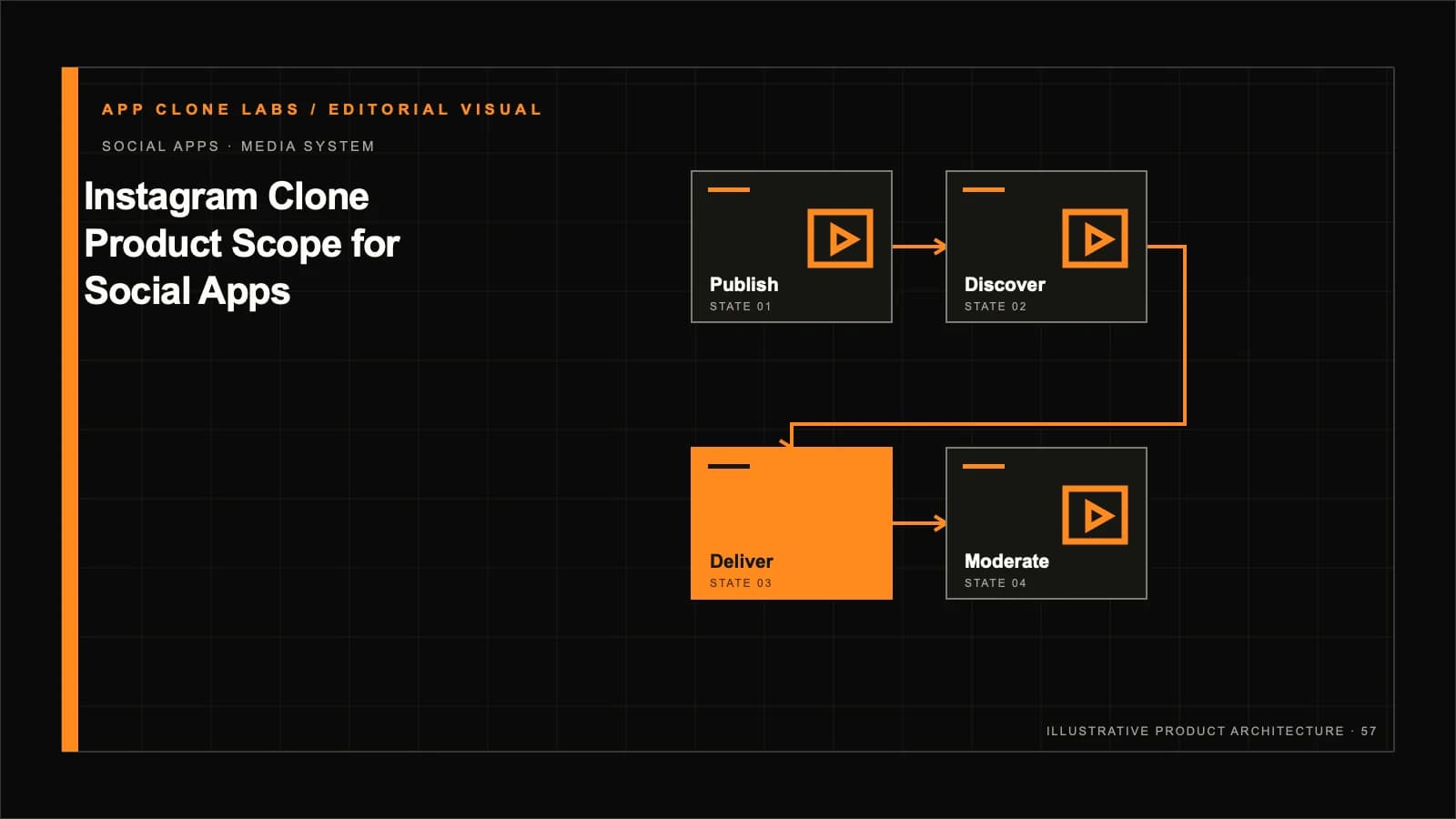
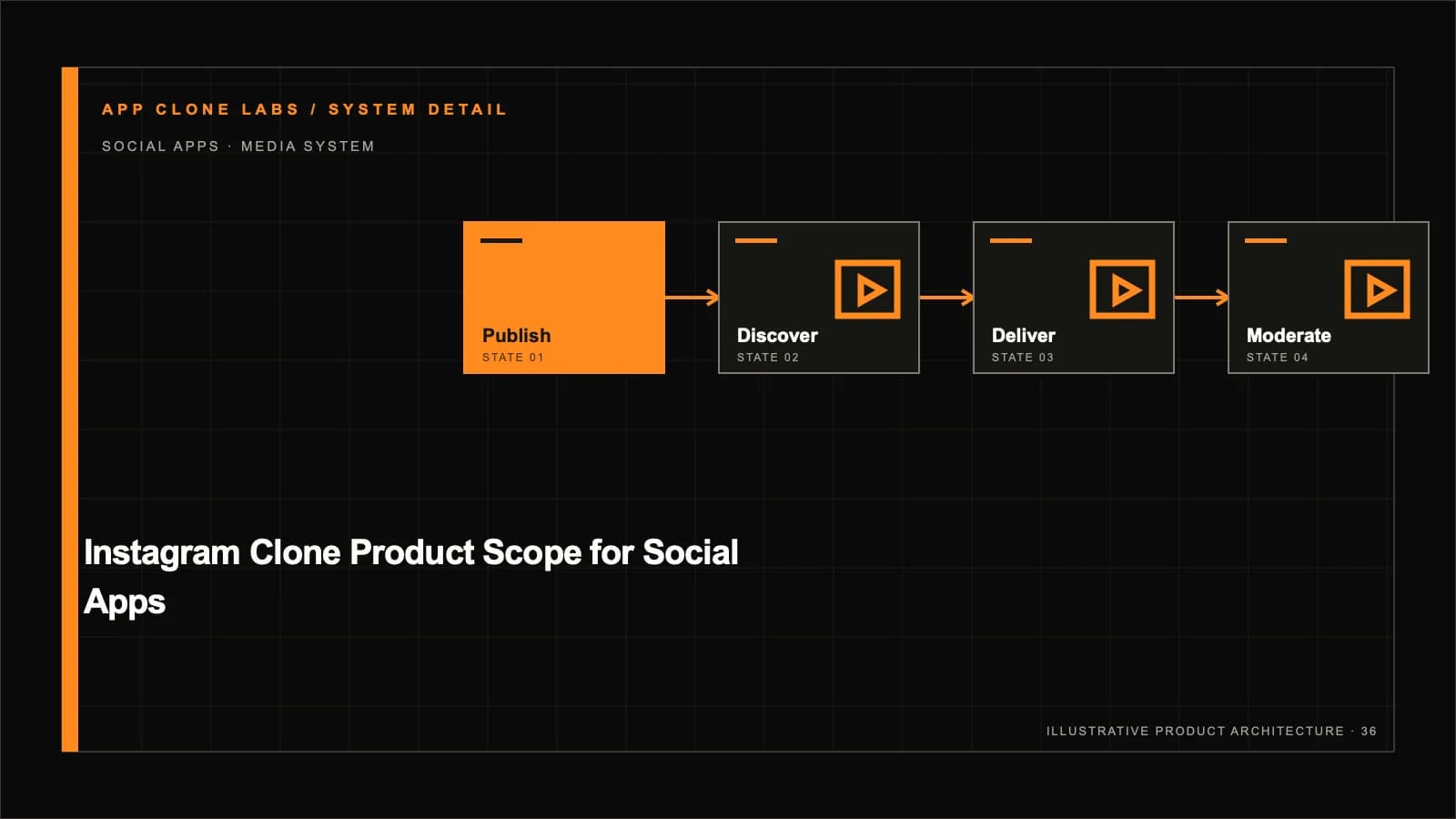
A social app is not a feed surrounded by familiar icons. Every post creates storage, distribution, privacy, notification, moderation and deletion obligations that follow the content across several surfaces.
Trying to launch posts, stories, reels, live video, messaging, commerce and creator monetization together hides whether one social loop is valuable and safe.
This guide scopes a coherent first network while protecting the data and control foundations needed for expansion.
Define the core social loop
Define the core social loop is a separate product and operating decision within a media-sharing social platform coordinating creators, audiences, messaging, discovery and moderation. It changes the promise made to users, the authority of each role, the evidence the platform retains and the recovery route when normal processing fails.
The failure mode is concrete: the team treats define the core social loop as a screen requirement while lifecycle, permissions, downstream consequences and exception ownership remain implicit. This is not solved by adding another screen or background job. The product has to define ownership, permitted transitions, and the evidence retained when the transition occurs.
For the first release, define the authoritative lifecycle, accountable owner, allowed transitions, user-visible result and exception route for define the core social loop before implementation. Write that decision as an enforceable server-side rule, not guidance that depends on a client, operator, or AI model remembering the intended boundary.
Implementation should include For define the core social loop, retain stable identifiers, explicit states, server-side authorization, version checks, event and processing timestamps, reason codes, correlation IDs, audit history and a bounded recovery command. Keep the public response smaller than the internal record: users need a clear outcome and recovery path, while authorized operators need correlation IDs, policy versions, timestamps, and the before-and-after state.
Validate it with For define the core social loop, test the successful journey followed by stale state, duplicate delivery, concurrent commands, revoked authority, dependency timeout, partial completion, operator correction and reconciliation. Test the ordinary path, then repeat under timeout, duplicate delivery, stale state, partial failure, revoked authority, and concurrent requests. A feature is not ready when only the demonstration succeeds.
- Owner: product owner
- Release evidence: versioned define the core social loop decision, acceptance criteria and recovery record
- Stop condition: define the core social loop cannot be explained or restored from durable evidence
Model accounts and identities
Model accounts and identities is a separate product and operating decision within a media-sharing social platform coordinating creators, audiences, messaging, discovery and moderation. It changes the promise made to users, the authority of each role, the evidence the platform retains and the recovery route when normal processing fails.
The failure mode is concrete: the team treats model accounts and identities as a screen requirement while lifecycle, permissions, downstream consequences and exception ownership remain implicit. This is not solved by adding another screen or background job. The product has to define ownership, permitted transitions, and the evidence retained when the transition occurs.
For the first release, define the authoritative lifecycle, accountable owner, allowed transitions, user-visible result and exception route for model accounts and identities before implementation. Write that decision as an enforceable server-side rule, not guidance that depends on a client, operator, or AI model remembering the intended boundary.
Implementation should include For model accounts and identities, retain stable identifiers, explicit states, server-side authorization, version checks, event and processing timestamps, reason codes, correlation IDs, audit history and a bounded recovery command. Keep the public response smaller than the internal record: users need a clear outcome and recovery path, while authorized operators need correlation IDs, policy versions, timestamps, and the before-and-after state.
Validate it with For model accounts and identities, test the successful journey followed by stale state, duplicate delivery, concurrent commands, revoked authority, dependency timeout, partial completion, operator correction and reconciliation. Test the ordinary path, then repeat under timeout, duplicate delivery, stale state, partial failure, revoked authority, and concurrent requests. A feature is not ready when only the demonstration succeeds.
- Owner: engineering owner
- Release evidence: versioned model accounts and identities decision, acceptance criteria and recovery record
- Stop condition: model accounts and identities cannot be explained or restored from durable evidence
Design profiles and privacy
Design profiles and privacy is a separate product and operating decision within a media-sharing social platform coordinating creators, audiences, messaging, discovery and moderation. It changes the promise made to users, the authority of each role, the evidence the platform retains and the recovery route when normal processing fails.
The failure mode is concrete: the team treats design profiles and privacy as a screen requirement while lifecycle, permissions, downstream consequences and exception ownership remain implicit. This is not solved by adding another screen or background job. The product has to define ownership, permitted transitions, and the evidence retained when the transition occurs.
For the first release, define the authoritative lifecycle, accountable owner, allowed transitions, user-visible result and exception route for design profiles and privacy before implementation. Write that decision as an enforceable server-side rule, not guidance that depends on a client, operator, or AI model remembering the intended boundary.
Implementation should include For design profiles and privacy, retain stable identifiers, explicit states, server-side authorization, version checks, event and processing timestamps, reason codes, correlation IDs, audit history and a bounded recovery command. Keep the public response smaller than the internal record: users need a clear outcome and recovery path, while authorized operators need correlation IDs, policy versions, timestamps, and the before-and-after state.
Validate it with For design profiles and privacy, test the successful journey followed by stale state, duplicate delivery, concurrent commands, revoked authority, dependency timeout, partial completion, operator correction and reconciliation. Test the ordinary path, then repeat under timeout, duplicate delivery, stale state, partial failure, revoked authority, and concurrent requests. A feature is not ready when only the demonstration succeeds.
- Owner: operations owner
- Release evidence: versioned design profiles and privacy decision, acceptance criteria and recovery record
- Stop condition: design profiles and privacy cannot be explained or restored from durable evidence
Build media ingestion
Build media ingestion is a separate product and operating decision within a media-sharing social platform coordinating creators, audiences, messaging, discovery and moderation. It changes the promise made to users, the authority of each role, the evidence the platform retains and the recovery route when normal processing fails.
The failure mode is concrete: the team treats build media ingestion as a screen requirement while lifecycle, permissions, downstream consequences and exception ownership remain implicit. This is not solved by adding another screen or background job. The product has to define ownership, permitted transitions, and the evidence retained when the transition occurs.
For the first release, define the authoritative lifecycle, accountable owner, allowed transitions, user-visible result and exception route for build media ingestion before implementation. Write that decision as an enforceable server-side rule, not guidance that depends on a client, operator, or AI model remembering the intended boundary.
Implementation should include For build media ingestion, retain stable identifiers, explicit states, server-side authorization, version checks, event and processing timestamps, reason codes, correlation IDs, audit history and a bounded recovery command. Keep the public response smaller than the internal record: users need a clear outcome and recovery path, while authorized operators need correlation IDs, policy versions, timestamps, and the before-and-after state.
Validate it with For build media ingestion, test the successful journey followed by stale state, duplicate delivery, concurrent commands, revoked authority, dependency timeout, partial completion, operator correction and reconciliation. Test the ordinary path, then repeat under timeout, duplicate delivery, stale state, partial failure, revoked authority, and concurrent requests. A feature is not ready when only the demonstration succeeds.
- Owner: product owner
- Release evidence: versioned build media ingestion decision, acceptance criteria and recovery record
- Stop condition: build media ingestion cannot be explained or restored from durable evidence
Checkpoint 4: reconcile the product promise with the recorded state. Support, finance, security, and delivery teams should be able to reach the same conclusion from the same identifiers without reconstructing events from chat messages or screenshots.
Create posts idempotently
Create posts idempotently is a separate product and operating decision within a media-sharing social platform coordinating creators, audiences, messaging, discovery and moderation. It changes the promise made to users, the authority of each role, the evidence the platform retains and the recovery route when normal processing fails.
The failure mode is concrete: the team treats create posts idempotently as a screen requirement while lifecycle, permissions, downstream consequences and exception ownership remain implicit. This is not solved by adding another screen or background job. The product has to define ownership, permitted transitions, and the evidence retained when the transition occurs.
For the first release, define the authoritative lifecycle, accountable owner, allowed transitions, user-visible result and exception route for create posts idempotently before implementation. Write that decision as an enforceable server-side rule, not guidance that depends on a client, operator, or AI model remembering the intended boundary.
Implementation should include For create posts idempotently, retain stable identifiers, explicit states, server-side authorization, version checks, event and processing timestamps, reason codes, correlation IDs, audit history and a bounded recovery command. Keep the public response smaller than the internal record: users need a clear outcome and recovery path, while authorized operators need correlation IDs, policy versions, timestamps, and the before-and-after state.
Validate it with For create posts idempotently, test the successful journey followed by stale state, duplicate delivery, concurrent commands, revoked authority, dependency timeout, partial completion, operator correction and reconciliation. Test the ordinary path, then repeat under timeout, duplicate delivery, stale state, partial failure, revoked authority, and concurrent requests. A feature is not ready when only the demonstration succeeds.
- Owner: engineering owner
- Release evidence: versioned create posts idempotently decision, acceptance criteria and recovery record
- Stop condition: create posts idempotently cannot be explained or restored from durable evidence
Represent follow relationships
Represent follow relationships is a separate product and operating decision within a media-sharing social platform coordinating creators, audiences, messaging, discovery and moderation. It changes the promise made to users, the authority of each role, the evidence the platform retains and the recovery route when normal processing fails.
The failure mode is concrete: the team treats represent follow relationships as a screen requirement while lifecycle, permissions, downstream consequences and exception ownership remain implicit. This is not solved by adding another screen or background job. The product has to define ownership, permitted transitions, and the evidence retained when the transition occurs.
For the first release, define the authoritative lifecycle, accountable owner, allowed transitions, user-visible result and exception route for represent follow relationships before implementation. Write that decision as an enforceable server-side rule, not guidance that depends on a client, operator, or AI model remembering the intended boundary.
Implementation should include For represent follow relationships, retain stable identifiers, explicit states, server-side authorization, version checks, event and processing timestamps, reason codes, correlation IDs, audit history and a bounded recovery command. Keep the public response smaller than the internal record: users need a clear outcome and recovery path, while authorized operators need correlation IDs, policy versions, timestamps, and the before-and-after state.
Validate it with For represent follow relationships, test the successful journey followed by stale state, duplicate delivery, concurrent commands, revoked authority, dependency timeout, partial completion, operator correction and reconciliation. Test the ordinary path, then repeat under timeout, duplicate delivery, stale state, partial failure, revoked authority, and concurrent requests. A feature is not ready when only the demonstration succeeds.
- Owner: operations owner
- Release evidence: versioned represent follow relationships decision, acceptance criteria and recovery record
- Stop condition: represent follow relationships cannot be explained or restored from durable evidence
Generate the home feed
Generate the home feed is a separate product and operating decision within a media-sharing social platform coordinating creators, audiences, messaging, discovery and moderation. It changes the promise made to users, the authority of each role, the evidence the platform retains and the recovery route when normal processing fails.
The failure mode is concrete: the team treats generate the home feed as a screen requirement while lifecycle, permissions, downstream consequences and exception ownership remain implicit. This is not solved by adding another screen or background job. The product has to define ownership, permitted transitions, and the evidence retained when the transition occurs.
For the first release, define the authoritative lifecycle, accountable owner, allowed transitions, user-visible result and exception route for generate the home feed before implementation. Write that decision as an enforceable server-side rule, not guidance that depends on a client, operator, or AI model remembering the intended boundary.
Implementation should include For generate the home feed, retain stable identifiers, explicit states, server-side authorization, version checks, event and processing timestamps, reason codes, correlation IDs, audit history and a bounded recovery command. Keep the public response smaller than the internal record: users need a clear outcome and recovery path, while authorized operators need correlation IDs, policy versions, timestamps, and the before-and-after state.
Validate it with For generate the home feed, test the successful journey followed by stale state, duplicate delivery, concurrent commands, revoked authority, dependency timeout, partial completion, operator correction and reconciliation. Test the ordinary path, then repeat under timeout, duplicate delivery, stale state, partial failure, revoked authority, and concurrent requests. A feature is not ready when only the demonstration succeeds.
- Owner: product owner
- Release evidence: versioned generate the home feed decision, acceptance criteria and recovery record
- Stop condition: generate the home feed cannot be explained or restored from durable evidence
Control engagement actions
Control engagement actions is a separate product and operating decision within a media-sharing social platform coordinating creators, audiences, messaging, discovery and moderation. It changes the promise made to users, the authority of each role, the evidence the platform retains and the recovery route when normal processing fails.
The failure mode is concrete: the team treats control engagement actions as a screen requirement while lifecycle, permissions, downstream consequences and exception ownership remain implicit. This is not solved by adding another screen or background job. The product has to define ownership, permitted transitions, and the evidence retained when the transition occurs.
For the first release, define the authoritative lifecycle, accountable owner, allowed transitions, user-visible result and exception route for control engagement actions before implementation. Write that decision as an enforceable server-side rule, not guidance that depends on a client, operator, or AI model remembering the intended boundary.
Implementation should include For control engagement actions, retain stable identifiers, explicit states, server-side authorization, version checks, event and processing timestamps, reason codes, correlation IDs, audit history and a bounded recovery command. Keep the public response smaller than the internal record: users need a clear outcome and recovery path, while authorized operators need correlation IDs, policy versions, timestamps, and the before-and-after state.
Validate it with For control engagement actions, test the successful journey followed by stale state, duplicate delivery, concurrent commands, revoked authority, dependency timeout, partial completion, operator correction and reconciliation. Test the ordinary path, then repeat under timeout, duplicate delivery, stale state, partial failure, revoked authority, and concurrent requests. A feature is not ready when only the demonstration succeeds.
- Owner: engineering owner
- Release evidence: versioned control engagement actions decision, acceptance criteria and recovery record
- Stop condition: control engagement actions cannot be explained or restored from durable evidence
Checkpoint 8: reconcile the product promise with the recorded state. Support, finance, security, and delivery teams should be able to reach the same conclusion from the same identifiers without reconstructing events from chat messages or screenshots.
Design discovery eligibility
Design discovery eligibility is a separate product and operating decision within a media-sharing social platform coordinating creators, audiences, messaging, discovery and moderation. It changes the promise made to users, the authority of each role, the evidence the platform retains and the recovery route when normal processing fails.
The failure mode is concrete: the team treats design discovery eligibility as a screen requirement while lifecycle, permissions, downstream consequences and exception ownership remain implicit. This is not solved by adding another screen or background job. The product has to define ownership, permitted transitions, and the evidence retained when the transition occurs.
For the first release, define the authoritative lifecycle, accountable owner, allowed transitions, user-visible result and exception route for design discovery eligibility before implementation. Write that decision as an enforceable server-side rule, not guidance that depends on a client, operator, or AI model remembering the intended boundary.
Implementation should include For design discovery eligibility, retain stable identifiers, explicit states, server-side authorization, version checks, event and processing timestamps, reason codes, correlation IDs, audit history and a bounded recovery command. Keep the public response smaller than the internal record: users need a clear outcome and recovery path, while authorized operators need correlation IDs, policy versions, timestamps, and the before-and-after state.
Validate it with For design discovery eligibility, test the successful journey followed by stale state, duplicate delivery, concurrent commands, revoked authority, dependency timeout, partial completion, operator correction and reconciliation. Test the ordinary path, then repeat under timeout, duplicate delivery, stale state, partial failure, revoked authority, and concurrent requests. A feature is not ready when only the demonstration succeeds.
- Owner: operations owner
- Release evidence: versioned design discovery eligibility decision, acceptance criteria and recovery record
- Stop condition: design discovery eligibility cannot be explained or restored from durable evidence
Add search and hashtags
Add search and hashtags is a separate product and operating decision within a media-sharing social platform coordinating creators, audiences, messaging, discovery and moderation. It changes the promise made to users, the authority of each role, the evidence the platform retains and the recovery route when normal processing fails.
The failure mode is concrete: the team treats add search and hashtags as a screen requirement while lifecycle, permissions, downstream consequences and exception ownership remain implicit. This is not solved by adding another screen or background job. The product has to define ownership, permitted transitions, and the evidence retained when the transition occurs.
For the first release, define the authoritative lifecycle, accountable owner, allowed transitions, user-visible result and exception route for add search and hashtags before implementation. Write that decision as an enforceable server-side rule, not guidance that depends on a client, operator, or AI model remembering the intended boundary.
Implementation should include For add search and hashtags, retain stable identifiers, explicit states, server-side authorization, version checks, event and processing timestamps, reason codes, correlation IDs, audit history and a bounded recovery command. Keep the public response smaller than the internal record: users need a clear outcome and recovery path, while authorized operators need correlation IDs, policy versions, timestamps, and the before-and-after state.
Validate it with For add search and hashtags, test the successful journey followed by stale state, duplicate delivery, concurrent commands, revoked authority, dependency timeout, partial completion, operator correction and reconciliation. Test the ordinary path, then repeat under timeout, duplicate delivery, stale state, partial failure, revoked authority, and concurrent requests. A feature is not ready when only the demonstration succeeds.
- Owner: product owner
- Release evidence: versioned add search and hashtags decision, acceptance criteria and recovery record
- Stop condition: add search and hashtags cannot be explained or restored from durable evidence
Scope messaging boundaries
Scope messaging boundaries is a separate product and operating decision within a media-sharing social platform coordinating creators, audiences, messaging, discovery and moderation. It changes the promise made to users, the authority of each role, the evidence the platform retains and the recovery route when normal processing fails.
The failure mode is concrete: the team treats scope messaging boundaries as a screen requirement while lifecycle, permissions, downstream consequences and exception ownership remain implicit. This is not solved by adding another screen or background job. The product has to define ownership, permitted transitions, and the evidence retained when the transition occurs.
For the first release, define the authoritative lifecycle, accountable owner, allowed transitions, user-visible result and exception route for scope messaging boundaries before implementation. Write that decision as an enforceable server-side rule, not guidance that depends on a client, operator, or AI model remembering the intended boundary.
Implementation should include For scope messaging boundaries, retain stable identifiers, explicit states, server-side authorization, version checks, event and processing timestamps, reason codes, correlation IDs, audit history and a bounded recovery command. Keep the public response smaller than the internal record: users need a clear outcome and recovery path, while authorized operators need correlation IDs, policy versions, timestamps, and the before-and-after state.
Validate it with For scope messaging boundaries, test the successful journey followed by stale state, duplicate delivery, concurrent commands, revoked authority, dependency timeout, partial completion, operator correction and reconciliation. Test the ordinary path, then repeat under timeout, duplicate delivery, stale state, partial failure, revoked authority, and concurrent requests. A feature is not ready when only the demonstration succeeds.
- Owner: engineering owner
- Release evidence: versioned scope messaging boundaries decision, acceptance criteria and recovery record
- Stop condition: scope messaging boundaries cannot be explained or restored from durable evidence
Coordinate notifications
Coordinate notifications is a separate product and operating decision within a media-sharing social platform coordinating creators, audiences, messaging, discovery and moderation. It changes the promise made to users, the authority of each role, the evidence the platform retains and the recovery route when normal processing fails.
The failure mode is concrete: the team treats coordinate notifications as a screen requirement while lifecycle, permissions, downstream consequences and exception ownership remain implicit. This is not solved by adding another screen or background job. The product has to define ownership, permitted transitions, and the evidence retained when the transition occurs.
For the first release, define the authoritative lifecycle, accountable owner, allowed transitions, user-visible result and exception route for coordinate notifications before implementation. Write that decision as an enforceable server-side rule, not guidance that depends on a client, operator, or AI model remembering the intended boundary.
Implementation should include For coordinate notifications, retain stable identifiers, explicit states, server-side authorization, version checks, event and processing timestamps, reason codes, correlation IDs, audit history and a bounded recovery command. Keep the public response smaller than the internal record: users need a clear outcome and recovery path, while authorized operators need correlation IDs, policy versions, timestamps, and the before-and-after state.
Validate it with For coordinate notifications, test the successful journey followed by stale state, duplicate delivery, concurrent commands, revoked authority, dependency timeout, partial completion, operator correction and reconciliation. Test the ordinary path, then repeat under timeout, duplicate delivery, stale state, partial failure, revoked authority, and concurrent requests. A feature is not ready when only the demonstration succeeds.
- Owner: operations owner
- Release evidence: versioned coordinate notifications decision, acceptance criteria and recovery record
- Stop condition: coordinate notifications cannot be explained or restored from durable evidence
Checkpoint 12: reconcile the product promise with the recorded state. Support, finance, security, and delivery teams should be able to reach the same conclusion from the same identifiers without reconstructing events from chat messages or screenshots.
Build reporting and blocking
Build reporting and blocking is a separate product and operating decision within a media-sharing social platform coordinating creators, audiences, messaging, discovery and moderation. It changes the promise made to users, the authority of each role, the evidence the platform retains and the recovery route when normal processing fails.
The failure mode is concrete: the team treats build reporting and blocking as a screen requirement while lifecycle, permissions, downstream consequences and exception ownership remain implicit. This is not solved by adding another screen or background job. The product has to define ownership, permitted transitions, and the evidence retained when the transition occurs.
For the first release, define the authoritative lifecycle, accountable owner, allowed transitions, user-visible result and exception route for build reporting and blocking before implementation. Write that decision as an enforceable server-side rule, not guidance that depends on a client, operator, or AI model remembering the intended boundary.
Implementation should include For build reporting and blocking, retain stable identifiers, explicit states, server-side authorization, version checks, event and processing timestamps, reason codes, correlation IDs, audit history and a bounded recovery command. Keep the public response smaller than the internal record: users need a clear outcome and recovery path, while authorized operators need correlation IDs, policy versions, timestamps, and the before-and-after state.
Validate it with For build reporting and blocking, test the successful journey followed by stale state, duplicate delivery, concurrent commands, revoked authority, dependency timeout, partial completion, operator correction and reconciliation. Test the ordinary path, then repeat under timeout, duplicate delivery, stale state, partial failure, revoked authority, and concurrent requests. A feature is not ready when only the demonstration succeeds.
- Owner: product owner
- Release evidence: versioned build reporting and blocking decision, acceptance criteria and recovery record
- Stop condition: build reporting and blocking cannot be explained or restored from durable evidence
Operate moderation and appeals
Operate moderation and appeals is a separate product and operating decision within a media-sharing social platform coordinating creators, audiences, messaging, discovery and moderation. It changes the promise made to users, the authority of each role, the evidence the platform retains and the recovery route when normal processing fails.
The failure mode is concrete: the team treats operate moderation and appeals as a screen requirement while lifecycle, permissions, downstream consequences and exception ownership remain implicit. This is not solved by adding another screen or background job. The product has to define ownership, permitted transitions, and the evidence retained when the transition occurs.
For the first release, define the authoritative lifecycle, accountable owner, allowed transitions, user-visible result and exception route for operate moderation and appeals before implementation. Write that decision as an enforceable server-side rule, not guidance that depends on a client, operator, or AI model remembering the intended boundary.
Implementation should include For operate moderation and appeals, retain stable identifiers, explicit states, server-side authorization, version checks, event and processing timestamps, reason codes, correlation IDs, audit history and a bounded recovery command. Keep the public response smaller than the internal record: users need a clear outcome and recovery path, while authorized operators need correlation IDs, policy versions, timestamps, and the before-and-after state.
Validate it with For operate moderation and appeals, test the successful journey followed by stale state, duplicate delivery, concurrent commands, revoked authority, dependency timeout, partial completion, operator correction and reconciliation. Test the ordinary path, then repeat under timeout, duplicate delivery, stale state, partial failure, revoked authority, and concurrent requests. A feature is not ready when only the demonstration succeeds.
- Owner: engineering owner
- Release evidence: versioned operate moderation and appeals decision, acceptance criteria and recovery record
- Stop condition: operate moderation and appeals cannot be explained or restored from durable evidence
Measure healthy network outcomes
Measure healthy network outcomes is a separate product and operating decision within a media-sharing social platform coordinating creators, audiences, messaging, discovery and moderation. It changes the promise made to users, the authority of each role, the evidence the platform retains and the recovery route when normal processing fails.
The failure mode is concrete: the team treats measure healthy network outcomes as a screen requirement while lifecycle, permissions, downstream consequences and exception ownership remain implicit. This is not solved by adding another screen or background job. The product has to define ownership, permitted transitions, and the evidence retained when the transition occurs.
For the first release, define the authoritative lifecycle, accountable owner, allowed transitions, user-visible result and exception route for measure healthy network outcomes before implementation. Write that decision as an enforceable server-side rule, not guidance that depends on a client, operator, or AI model remembering the intended boundary.
Implementation should include For measure healthy network outcomes, retain stable identifiers, explicit states, server-side authorization, version checks, event and processing timestamps, reason codes, correlation IDs, audit history and a bounded recovery command. Keep the public response smaller than the internal record: users need a clear outcome and recovery path, while authorized operators need correlation IDs, policy versions, timestamps, and the before-and-after state.
Validate it with For measure healthy network outcomes, test the successful journey followed by stale state, duplicate delivery, concurrent commands, revoked authority, dependency timeout, partial completion, operator correction and reconciliation. Test the ordinary path, then repeat under timeout, duplicate delivery, stale state, partial failure, revoked authority, and concurrent requests. A feature is not ready when only the demonstration succeeds.
- Owner: operations owner
- Release evidence: versioned measure healthy network outcomes decision, acceptance criteria and recovery record
- Stop condition: measure healthy network outcomes cannot be explained or restored from durable evidence
Implementation references
Use Apple App Review Guidelines and record the version applied during release review.
Validate against Google Play policy center and record the version applied during release review.
Review W3C Web Content Accessibility Guidelines and record the version applied during release review.
Compare with OWASP API Security Top 10 and record the version applied during release review.
Continue with Instagram Clone Blueprint when converting this operating model into delivery scope.
Frequently asked questions
What belongs in a social MVP?
One complete creation, distribution, engagement and safety loop for a defined community.
Should stories and short video launch together?
Only if both are necessary to prove the same user outcome and operations can support them.
How should private accounts work?
Enforce audience authorization on every content and relationship access path.
What happens when a user blocks another?
Remove discovery, relationship, messaging and notification authority promptly.
How should media deletion work?
Propagate deletion through derivatives, indexes and delivery caches under a defined retention policy.
What should feeds optimize?
Useful and healthy engagement, not raw interaction at any cost.
Which moderation tools are essential?
Reporting, blocking, queues, evidence, proportionate enforcement and appeals.
What should be measured first?
Successful creation, meaningful consumption, healthy relationships, retention and safety signals.
Turn the plan into release evidence
A credible release joins the customer promise to durable state, scoped authority and an owned recovery route. Product, engineering, operations, security and support should reach the same conclusion from the same identifiers.
Keep the first scope narrow enough to rehearse under failure. Expand only after permissions, data, financial consequences and customer remedies stay consistent through retries, dependency outages and human mistakes.
- 01
- 02
- 03
- 04
- 05
- 06
Reviewed by the App Clone Labs product strategy team
This guide is written for founders and operators planning clone-inspired platforms, SaaS products, marketplaces, and mobile apps. It is reviewed against App Clone Labs delivery patterns, product scoping standards, and current implementation realities before being published.
Review the editorial team structureRelated product paths
Continue with the services, solutions, guides, and articles that connect this topic to a real software build.