Editorial dossier / Social Apps
TikTok-Style App Moderation Features to Plan Before Launch
Plan short-video moderation across policy, upload screening, reports, queues, enforcement, appeals, youth safety, live content, copyright and transparency.
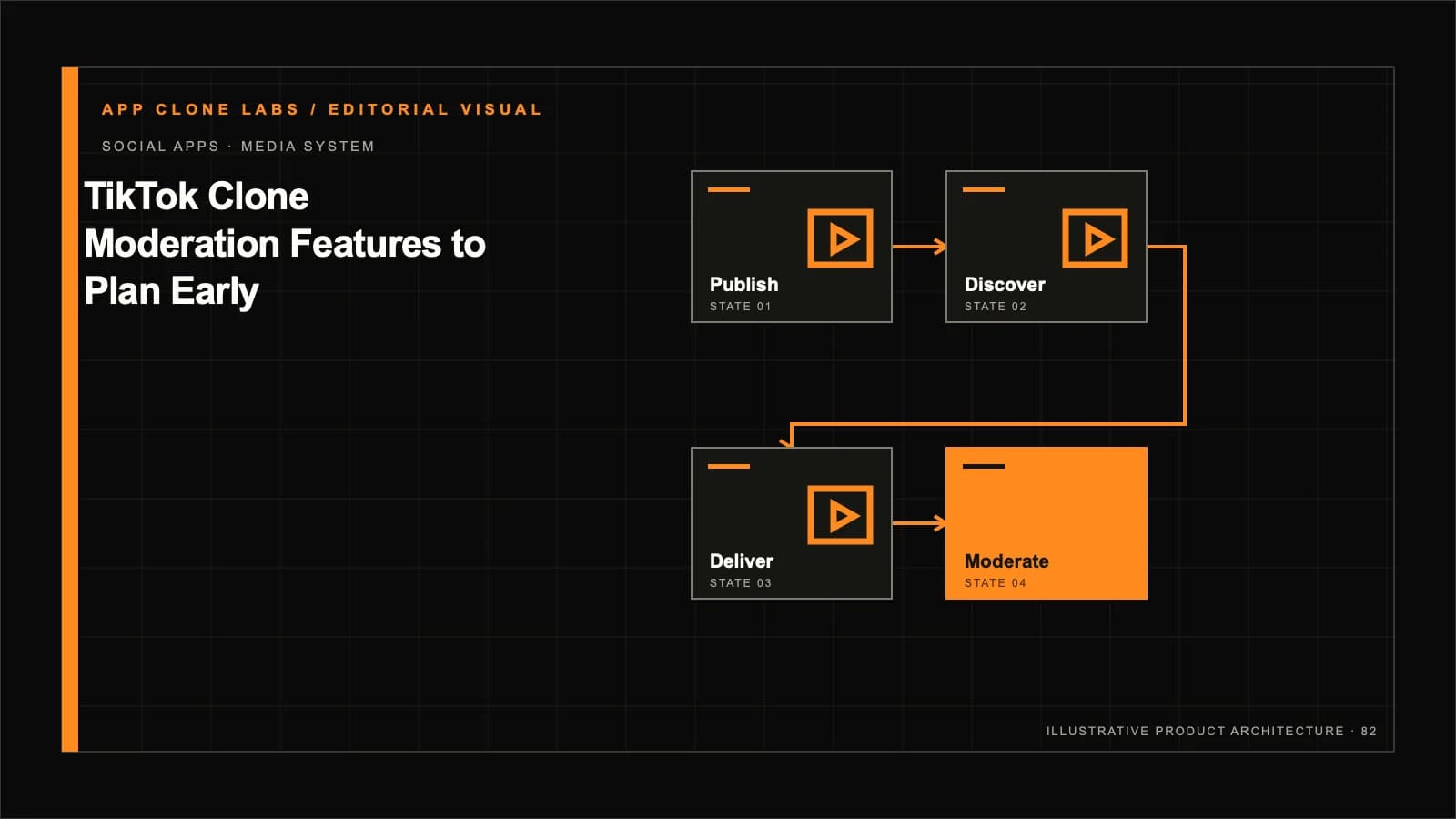
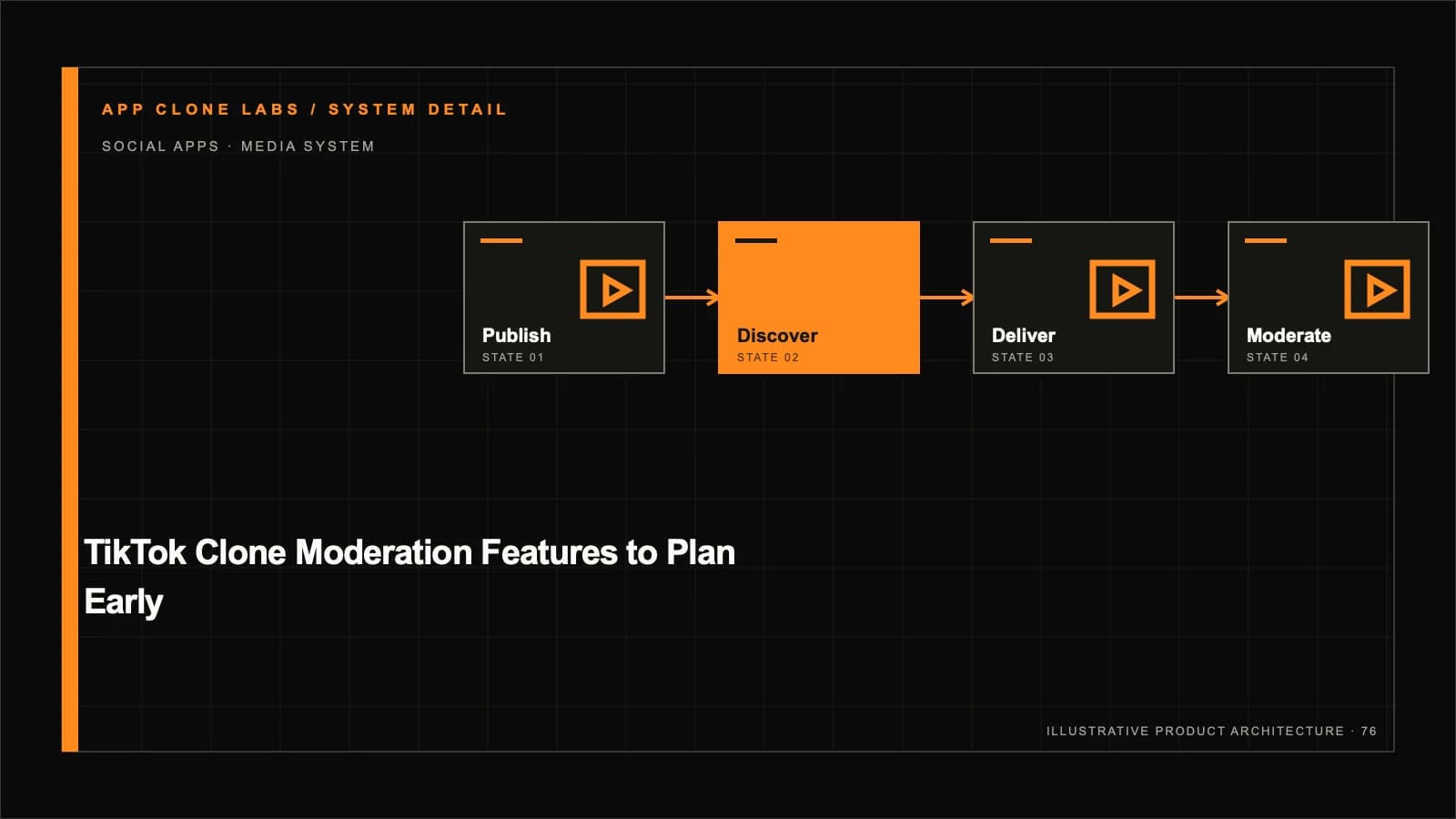
A short video can be uploaded, recommended to thousands of users and copied before a manual queue opens the first report. Moderation therefore begins at product architecture, not with an admin page added after growth.
Detection is only one layer. The platform still needs a policy taxonomy, reach controls, case priority, proportionate enforcement, an appeal path and evidence that survives account or content changes.
This guide orders the safety capabilities that affect launch scope and data design.
Write a versioned policy taxonomy
Write a versioned policy taxonomy is a separate product and operating decision within a short-video social platform distributing user-generated content at algorithmic scale. It changes the promise made to users, the authority of each role, the evidence the platform retains and the recovery route when normal processing fails.
The failure mode is concrete: the team treats write a versioned policy taxonomy as a screen requirement while lifecycle, permissions, downstream consequences and exception ownership remain implicit. This is not solved by adding another screen or background job. The product has to define ownership, permitted transitions, and the evidence retained when the transition occurs.
For the first release, define the authoritative lifecycle, accountable owner, allowed transitions, user-visible result and exception route for write a versioned policy taxonomy before implementation. Write that decision as an enforceable server-side rule, not guidance that depends on a client, operator, or AI model remembering the intended boundary.
Implementation should include For write a versioned policy taxonomy, retain stable identifiers, explicit states, server-side authorization, version checks, event and processing timestamps, reason codes, correlation IDs, audit history and a bounded recovery command. Keep the public response smaller than the internal record: users need a clear outcome and recovery path, while authorized operators need correlation IDs, policy versions, timestamps, and the before-and-after state.
Validate it with For write a versioned policy taxonomy, test the successful journey followed by stale state, duplicate delivery, concurrent commands, revoked authority, dependency timeout, partial completion, operator correction and reconciliation. Test the ordinary path, then repeat under timeout, duplicate delivery, stale state, partial failure, revoked authority, and concurrent requests. A feature is not ready when only the demonstration succeeds.
- Owner: product owner
- Release evidence: versioned write a versioned policy taxonomy decision, acceptance criteria and recovery record
- Stop condition: write a versioned policy taxonomy cannot be explained or restored from durable evidence
Screen upload metadata and media
Screen upload metadata and media is a separate product and operating decision within a short-video social platform distributing user-generated content at algorithmic scale. It changes the promise made to users, the authority of each role, the evidence the platform retains and the recovery route when normal processing fails.
The failure mode is concrete: the team treats screen upload metadata and media as a screen requirement while lifecycle, permissions, downstream consequences and exception ownership remain implicit. This is not solved by adding another screen or background job. The product has to define ownership, permitted transitions, and the evidence retained when the transition occurs.
For the first release, define the authoritative lifecycle, accountable owner, allowed transitions, user-visible result and exception route for screen upload metadata and media before implementation. Write that decision as an enforceable server-side rule, not guidance that depends on a client, operator, or AI model remembering the intended boundary.
Implementation should include For screen upload metadata and media, retain stable identifiers, explicit states, server-side authorization, version checks, event and processing timestamps, reason codes, correlation IDs, audit history and a bounded recovery command. Keep the public response smaller than the internal record: users need a clear outcome and recovery path, while authorized operators need correlation IDs, policy versions, timestamps, and the before-and-after state.
Validate it with For screen upload metadata and media, test the successful journey followed by stale state, duplicate delivery, concurrent commands, revoked authority, dependency timeout, partial completion, operator correction and reconciliation. Test the ordinary path, then repeat under timeout, duplicate delivery, stale state, partial failure, revoked authority, and concurrent requests. A feature is not ready when only the demonstration succeeds.
- Owner: engineering owner
- Release evidence: versioned screen upload metadata and media decision, acceptance criteria and recovery record
- Stop condition: screen upload metadata and media cannot be explained or restored from durable evidence
Control distribution eligibility
Control distribution eligibility is a separate product and operating decision within a short-video social platform distributing user-generated content at algorithmic scale. It changes the promise made to users, the authority of each role, the evidence the platform retains and the recovery route when normal processing fails.
The failure mode is concrete: the team treats control distribution eligibility as a screen requirement while lifecycle, permissions, downstream consequences and exception ownership remain implicit. This is not solved by adding another screen or background job. The product has to define ownership, permitted transitions, and the evidence retained when the transition occurs.
For the first release, define the authoritative lifecycle, accountable owner, allowed transitions, user-visible result and exception route for control distribution eligibility before implementation. Write that decision as an enforceable server-side rule, not guidance that depends on a client, operator, or AI model remembering the intended boundary.
Implementation should include For control distribution eligibility, retain stable identifiers, explicit states, server-side authorization, version checks, event and processing timestamps, reason codes, correlation IDs, audit history and a bounded recovery command. Keep the public response smaller than the internal record: users need a clear outcome and recovery path, while authorized operators need correlation IDs, policy versions, timestamps, and the before-and-after state.
Validate it with For control distribution eligibility, test the successful journey followed by stale state, duplicate delivery, concurrent commands, revoked authority, dependency timeout, partial completion, operator correction and reconciliation. Test the ordinary path, then repeat under timeout, duplicate delivery, stale state, partial failure, revoked authority, and concurrent requests. A feature is not ready when only the demonstration succeeds.
- Owner: operations owner
- Release evidence: versioned control distribution eligibility decision, acceptance criteria and recovery record
- Stop condition: control distribution eligibility cannot be explained or restored from durable evidence
Add user reporting surfaces
Add user reporting surfaces is a separate product and operating decision within a short-video social platform distributing user-generated content at algorithmic scale. It changes the promise made to users, the authority of each role, the evidence the platform retains and the recovery route when normal processing fails.
The failure mode is concrete: the team treats add user reporting surfaces as a screen requirement while lifecycle, permissions, downstream consequences and exception ownership remain implicit. This is not solved by adding another screen or background job. The product has to define ownership, permitted transitions, and the evidence retained when the transition occurs.
For the first release, define the authoritative lifecycle, accountable owner, allowed transitions, user-visible result and exception route for add user reporting surfaces before implementation. Write that decision as an enforceable server-side rule, not guidance that depends on a client, operator, or AI model remembering the intended boundary.
Implementation should include For add user reporting surfaces, retain stable identifiers, explicit states, server-side authorization, version checks, event and processing timestamps, reason codes, correlation IDs, audit history and a bounded recovery command. Keep the public response smaller than the internal record: users need a clear outcome and recovery path, while authorized operators need correlation IDs, policy versions, timestamps, and the before-and-after state.
Validate it with For add user reporting surfaces, test the successful journey followed by stale state, duplicate delivery, concurrent commands, revoked authority, dependency timeout, partial completion, operator correction and reconciliation. Test the ordinary path, then repeat under timeout, duplicate delivery, stale state, partial failure, revoked authority, and concurrent requests. A feature is not ready when only the demonstration succeeds.
- Owner: product owner
- Release evidence: versioned add user reporting surfaces decision, acceptance criteria and recovery record
- Stop condition: add user reporting surfaces cannot be explained or restored from durable evidence
Checkpoint 4: reconcile the product promise with the recorded state. Support, finance, security, and delivery teams should be able to reach the same conclusion from the same identifiers without reconstructing events from chat messages or screenshots.
Prioritize credible harm
Prioritize credible harm is a separate product and operating decision within a short-video social platform distributing user-generated content at algorithmic scale. It changes the promise made to users, the authority of each role, the evidence the platform retains and the recovery route when normal processing fails.
The failure mode is concrete: the team treats prioritize credible harm as a screen requirement while lifecycle, permissions, downstream consequences and exception ownership remain implicit. This is not solved by adding another screen or background job. The product has to define ownership, permitted transitions, and the evidence retained when the transition occurs.
For the first release, define the authoritative lifecycle, accountable owner, allowed transitions, user-visible result and exception route for prioritize credible harm before implementation. Write that decision as an enforceable server-side rule, not guidance that depends on a client, operator, or AI model remembering the intended boundary.
Implementation should include For prioritize credible harm, retain stable identifiers, explicit states, server-side authorization, version checks, event and processing timestamps, reason codes, correlation IDs, audit history and a bounded recovery command. Keep the public response smaller than the internal record: users need a clear outcome and recovery path, while authorized operators need correlation IDs, policy versions, timestamps, and the before-and-after state.
Validate it with For prioritize credible harm, test the successful journey followed by stale state, duplicate delivery, concurrent commands, revoked authority, dependency timeout, partial completion, operator correction and reconciliation. Test the ordinary path, then repeat under timeout, duplicate delivery, stale state, partial failure, revoked authority, and concurrent requests. A feature is not ready when only the demonstration succeeds.
- Owner: engineering owner
- Release evidence: versioned prioritize credible harm decision, acceptance criteria and recovery record
- Stop condition: prioritize credible harm cannot be explained or restored from durable evidence
Preserve moderation evidence
Preserve moderation evidence is a separate product and operating decision within a short-video social platform distributing user-generated content at algorithmic scale. It changes the promise made to users, the authority of each role, the evidence the platform retains and the recovery route when normal processing fails.
The failure mode is concrete: the team treats preserve moderation evidence as a screen requirement while lifecycle, permissions, downstream consequences and exception ownership remain implicit. This is not solved by adding another screen or background job. The product has to define ownership, permitted transitions, and the evidence retained when the transition occurs.
For the first release, define the authoritative lifecycle, accountable owner, allowed transitions, user-visible result and exception route for preserve moderation evidence before implementation. Write that decision as an enforceable server-side rule, not guidance that depends on a client, operator, or AI model remembering the intended boundary.
Implementation should include For preserve moderation evidence, retain stable identifiers, explicit states, server-side authorization, version checks, event and processing timestamps, reason codes, correlation IDs, audit history and a bounded recovery command. Keep the public response smaller than the internal record: users need a clear outcome and recovery path, while authorized operators need correlation IDs, policy versions, timestamps, and the before-and-after state.
Validate it with For preserve moderation evidence, test the successful journey followed by stale state, duplicate delivery, concurrent commands, revoked authority, dependency timeout, partial completion, operator correction and reconciliation. Test the ordinary path, then repeat under timeout, duplicate delivery, stale state, partial failure, revoked authority, and concurrent requests. A feature is not ready when only the demonstration succeeds.
- Owner: operations owner
- Release evidence: versioned preserve moderation evidence decision, acceptance criteria and recovery record
- Stop condition: preserve moderation evidence cannot be explained or restored from durable evidence
Design reviewer queues
Design reviewer queues is a separate product and operating decision within a short-video social platform distributing user-generated content at algorithmic scale. It changes the promise made to users, the authority of each role, the evidence the platform retains and the recovery route when normal processing fails.
The failure mode is concrete: the team treats design reviewer queues as a screen requirement while lifecycle, permissions, downstream consequences and exception ownership remain implicit. This is not solved by adding another screen or background job. The product has to define ownership, permitted transitions, and the evidence retained when the transition occurs.
For the first release, define the authoritative lifecycle, accountable owner, allowed transitions, user-visible result and exception route for design reviewer queues before implementation. Write that decision as an enforceable server-side rule, not guidance that depends on a client, operator, or AI model remembering the intended boundary.
Implementation should include For design reviewer queues, retain stable identifiers, explicit states, server-side authorization, version checks, event and processing timestamps, reason codes, correlation IDs, audit history and a bounded recovery command. Keep the public response smaller than the internal record: users need a clear outcome and recovery path, while authorized operators need correlation IDs, policy versions, timestamps, and the before-and-after state.
Validate it with For design reviewer queues, test the successful journey followed by stale state, duplicate delivery, concurrent commands, revoked authority, dependency timeout, partial completion, operator correction and reconciliation. Test the ordinary path, then repeat under timeout, duplicate delivery, stale state, partial failure, revoked authority, and concurrent requests. A feature is not ready when only the demonstration succeeds.
- Owner: product owner
- Release evidence: versioned design reviewer queues decision, acceptance criteria and recovery record
- Stop condition: design reviewer queues cannot be explained or restored from durable evidence
Handle live content urgency
Handle live content urgency is a separate product and operating decision within a short-video social platform distributing user-generated content at algorithmic scale. It changes the promise made to users, the authority of each role, the evidence the platform retains and the recovery route when normal processing fails.
The failure mode is concrete: the team treats handle live content urgency as a screen requirement while lifecycle, permissions, downstream consequences and exception ownership remain implicit. This is not solved by adding another screen or background job. The product has to define ownership, permitted transitions, and the evidence retained when the transition occurs.
For the first release, define the authoritative lifecycle, accountable owner, allowed transitions, user-visible result and exception route for handle live content urgency before implementation. Write that decision as an enforceable server-side rule, not guidance that depends on a client, operator, or AI model remembering the intended boundary.
Implementation should include For handle live content urgency, retain stable identifiers, explicit states, server-side authorization, version checks, event and processing timestamps, reason codes, correlation IDs, audit history and a bounded recovery command. Keep the public response smaller than the internal record: users need a clear outcome and recovery path, while authorized operators need correlation IDs, policy versions, timestamps, and the before-and-after state.
Validate it with For handle live content urgency, test the successful journey followed by stale state, duplicate delivery, concurrent commands, revoked authority, dependency timeout, partial completion, operator correction and reconciliation. Test the ordinary path, then repeat under timeout, duplicate delivery, stale state, partial failure, revoked authority, and concurrent requests. A feature is not ready when only the demonstration succeeds.
- Owner: engineering owner
- Release evidence: versioned handle live content urgency decision, acceptance criteria and recovery record
- Stop condition: handle live content urgency cannot be explained or restored from durable evidence
Checkpoint 8: reconcile the product promise with the recorded state. Support, finance, security, and delivery teams should be able to reach the same conclusion from the same identifiers without reconstructing events from chat messages or screenshots.
Protect younger users
Protect younger users is a separate product and operating decision within a short-video social platform distributing user-generated content at algorithmic scale. It changes the promise made to users, the authority of each role, the evidence the platform retains and the recovery route when normal processing fails.
The failure mode is concrete: the team treats protect younger users as a screen requirement while lifecycle, permissions, downstream consequences and exception ownership remain implicit. This is not solved by adding another screen or background job. The product has to define ownership, permitted transitions, and the evidence retained when the transition occurs.
For the first release, define the authoritative lifecycle, accountable owner, allowed transitions, user-visible result and exception route for protect younger users before implementation. Write that decision as an enforceable server-side rule, not guidance that depends on a client, operator, or AI model remembering the intended boundary.
Implementation should include For protect younger users, retain stable identifiers, explicit states, server-side authorization, version checks, event and processing timestamps, reason codes, correlation IDs, audit history and a bounded recovery command. Keep the public response smaller than the internal record: users need a clear outcome and recovery path, while authorized operators need correlation IDs, policy versions, timestamps, and the before-and-after state.
Validate it with For protect younger users, test the successful journey followed by stale state, duplicate delivery, concurrent commands, revoked authority, dependency timeout, partial completion, operator correction and reconciliation. Test the ordinary path, then repeat under timeout, duplicate delivery, stale state, partial failure, revoked authority, and concurrent requests. A feature is not ready when only the demonstration succeeds.
- Owner: operations owner
- Release evidence: versioned protect younger users decision, acceptance criteria and recovery record
- Stop condition: protect younger users cannot be explained or restored from durable evidence
Manage comments and messages
Manage comments and messages is a separate product and operating decision within a short-video social platform distributing user-generated content at algorithmic scale. It changes the promise made to users, the authority of each role, the evidence the platform retains and the recovery route when normal processing fails.
The failure mode is concrete: the team treats manage comments and messages as a screen requirement while lifecycle, permissions, downstream consequences and exception ownership remain implicit. This is not solved by adding another screen or background job. The product has to define ownership, permitted transitions, and the evidence retained when the transition occurs.
For the first release, define the authoritative lifecycle, accountable owner, allowed transitions, user-visible result and exception route for manage comments and messages before implementation. Write that decision as an enforceable server-side rule, not guidance that depends on a client, operator, or AI model remembering the intended boundary.
Implementation should include For manage comments and messages, retain stable identifiers, explicit states, server-side authorization, version checks, event and processing timestamps, reason codes, correlation IDs, audit history and a bounded recovery command. Keep the public response smaller than the internal record: users need a clear outcome and recovery path, while authorized operators need correlation IDs, policy versions, timestamps, and the before-and-after state.
Validate it with For manage comments and messages, test the successful journey followed by stale state, duplicate delivery, concurrent commands, revoked authority, dependency timeout, partial completion, operator correction and reconciliation. Test the ordinary path, then repeat under timeout, duplicate delivery, stale state, partial failure, revoked authority, and concurrent requests. A feature is not ready when only the demonstration succeeds.
- Owner: product owner
- Release evidence: versioned manage comments and messages decision, acceptance criteria and recovery record
- Stop condition: manage comments and messages cannot be explained or restored from durable evidence
Apply account-level enforcement
Apply account-level enforcement is a separate product and operating decision within a short-video social platform distributing user-generated content at algorithmic scale. It changes the promise made to users, the authority of each role, the evidence the platform retains and the recovery route when normal processing fails.
The failure mode is concrete: the team treats apply account-level enforcement as a screen requirement while lifecycle, permissions, downstream consequences and exception ownership remain implicit. This is not solved by adding another screen or background job. The product has to define ownership, permitted transitions, and the evidence retained when the transition occurs.
For the first release, define the authoritative lifecycle, accountable owner, allowed transitions, user-visible result and exception route for apply account-level enforcement before implementation. Write that decision as an enforceable server-side rule, not guidance that depends on a client, operator, or AI model remembering the intended boundary.
Implementation should include For apply account-level enforcement, retain stable identifiers, explicit states, server-side authorization, version checks, event and processing timestamps, reason codes, correlation IDs, audit history and a bounded recovery command. Keep the public response smaller than the internal record: users need a clear outcome and recovery path, while authorized operators need correlation IDs, policy versions, timestamps, and the before-and-after state.
Validate it with For apply account-level enforcement, test the successful journey followed by stale state, duplicate delivery, concurrent commands, revoked authority, dependency timeout, partial completion, operator correction and reconciliation. Test the ordinary path, then repeat under timeout, duplicate delivery, stale state, partial failure, revoked authority, and concurrent requests. A feature is not ready when only the demonstration succeeds.
- Owner: engineering owner
- Release evidence: versioned apply account-level enforcement decision, acceptance criteria and recovery record
- Stop condition: apply account-level enforcement cannot be explained or restored from durable evidence
Coordinate monetization holds
Coordinate monetization holds is a separate product and operating decision within a short-video social platform distributing user-generated content at algorithmic scale. It changes the promise made to users, the authority of each role, the evidence the platform retains and the recovery route when normal processing fails.
The failure mode is concrete: the team treats coordinate monetization holds as a screen requirement while lifecycle, permissions, downstream consequences and exception ownership remain implicit. This is not solved by adding another screen or background job. The product has to define ownership, permitted transitions, and the evidence retained when the transition occurs.
For the first release, define the authoritative lifecycle, accountable owner, allowed transitions, user-visible result and exception route for coordinate monetization holds before implementation. Write that decision as an enforceable server-side rule, not guidance that depends on a client, operator, or AI model remembering the intended boundary.
Implementation should include For coordinate monetization holds, retain stable identifiers, explicit states, server-side authorization, version checks, event and processing timestamps, reason codes, correlation IDs, audit history and a bounded recovery command. Keep the public response smaller than the internal record: users need a clear outcome and recovery path, while authorized operators need correlation IDs, policy versions, timestamps, and the before-and-after state.
Validate it with For coordinate monetization holds, test the successful journey followed by stale state, duplicate delivery, concurrent commands, revoked authority, dependency timeout, partial completion, operator correction and reconciliation. Test the ordinary path, then repeat under timeout, duplicate delivery, stale state, partial failure, revoked authority, and concurrent requests. A feature is not ready when only the demonstration succeeds.
- Owner: operations owner
- Release evidence: versioned coordinate monetization holds decision, acceptance criteria and recovery record
- Stop condition: coordinate monetization holds cannot be explained or restored from durable evidence
Checkpoint 12: reconcile the product promise with the recorded state. Support, finance, security, and delivery teams should be able to reach the same conclusion from the same identifiers without reconstructing events from chat messages or screenshots.
Process copyright claims
Process copyright claims is a separate product and operating decision within a short-video social platform distributing user-generated content at algorithmic scale. It changes the promise made to users, the authority of each role, the evidence the platform retains and the recovery route when normal processing fails.
The failure mode is concrete: the team treats process copyright claims as a screen requirement while lifecycle, permissions, downstream consequences and exception ownership remain implicit. This is not solved by adding another screen or background job. The product has to define ownership, permitted transitions, and the evidence retained when the transition occurs.
For the first release, define the authoritative lifecycle, accountable owner, allowed transitions, user-visible result and exception route for process copyright claims before implementation. Write that decision as an enforceable server-side rule, not guidance that depends on a client, operator, or AI model remembering the intended boundary.
Implementation should include For process copyright claims, retain stable identifiers, explicit states, server-side authorization, version checks, event and processing timestamps, reason codes, correlation IDs, audit history and a bounded recovery command. Keep the public response smaller than the internal record: users need a clear outcome and recovery path, while authorized operators need correlation IDs, policy versions, timestamps, and the before-and-after state.
Validate it with For process copyright claims, test the successful journey followed by stale state, duplicate delivery, concurrent commands, revoked authority, dependency timeout, partial completion, operator correction and reconciliation. Test the ordinary path, then repeat under timeout, duplicate delivery, stale state, partial failure, revoked authority, and concurrent requests. A feature is not ready when only the demonstration succeeds.
- Owner: product owner
- Release evidence: versioned process copyright claims decision, acceptance criteria and recovery record
- Stop condition: process copyright claims cannot be explained or restored from durable evidence
Operate independent appeals
Operate independent appeals is a separate product and operating decision within a short-video social platform distributing user-generated content at algorithmic scale. It changes the promise made to users, the authority of each role, the evidence the platform retains and the recovery route when normal processing fails.
The failure mode is concrete: the team treats operate independent appeals as a screen requirement while lifecycle, permissions, downstream consequences and exception ownership remain implicit. This is not solved by adding another screen or background job. The product has to define ownership, permitted transitions, and the evidence retained when the transition occurs.
For the first release, define the authoritative lifecycle, accountable owner, allowed transitions, user-visible result and exception route for operate independent appeals before implementation. Write that decision as an enforceable server-side rule, not guidance that depends on a client, operator, or AI model remembering the intended boundary.
Implementation should include For operate independent appeals, retain stable identifiers, explicit states, server-side authorization, version checks, event and processing timestamps, reason codes, correlation IDs, audit history and a bounded recovery command. Keep the public response smaller than the internal record: users need a clear outcome and recovery path, while authorized operators need correlation IDs, policy versions, timestamps, and the before-and-after state.
Validate it with For operate independent appeals, test the successful journey followed by stale state, duplicate delivery, concurrent commands, revoked authority, dependency timeout, partial completion, operator correction and reconciliation. Test the ordinary path, then repeat under timeout, duplicate delivery, stale state, partial failure, revoked authority, and concurrent requests. A feature is not ready when only the demonstration succeeds.
- Owner: engineering owner
- Release evidence: versioned operate independent appeals decision, acceptance criteria and recovery record
- Stop condition: operate independent appeals cannot be explained or restored from durable evidence
Publish safety measurements
Publish safety measurements is a separate product and operating decision within a short-video social platform distributing user-generated content at algorithmic scale. It changes the promise made to users, the authority of each role, the evidence the platform retains and the recovery route when normal processing fails.
The failure mode is concrete: the team treats publish safety measurements as a screen requirement while lifecycle, permissions, downstream consequences and exception ownership remain implicit. This is not solved by adding another screen or background job. The product has to define ownership, permitted transitions, and the evidence retained when the transition occurs.
For the first release, define the authoritative lifecycle, accountable owner, allowed transitions, user-visible result and exception route for publish safety measurements before implementation. Write that decision as an enforceable server-side rule, not guidance that depends on a client, operator, or AI model remembering the intended boundary.
Implementation should include For publish safety measurements, retain stable identifiers, explicit states, server-side authorization, version checks, event and processing timestamps, reason codes, correlation IDs, audit history and a bounded recovery command. Keep the public response smaller than the internal record: users need a clear outcome and recovery path, while authorized operators need correlation IDs, policy versions, timestamps, and the before-and-after state.
Validate it with For publish safety measurements, test the successful journey followed by stale state, duplicate delivery, concurrent commands, revoked authority, dependency timeout, partial completion, operator correction and reconciliation. Test the ordinary path, then repeat under timeout, duplicate delivery, stale state, partial failure, revoked authority, and concurrent requests. A feature is not ready when only the demonstration succeeds.
- Owner: operations owner
- Release evidence: versioned publish safety measurements decision, acceptance criteria and recovery record
- Stop condition: publish safety measurements cannot be explained or restored from durable evidence
Implementation references
Use Google Play policy center and record the version applied during release review.
Validate against Apple App Review Guidelines and record the version applied during release review.
Review NIST AI Risk Management Framework and record the version applied during release review.
Compare with OWASP API Security Top 10 and record the version applied during release review.
Continue with TikTok Clone Blueprint when converting this operating model into delivery scope.
Frequently asked questions
Should every upload wait for review?
No. Apply risk-based screening and distribution controls appropriate to the product.
What should reports capture?
Content, reason, context, reporter safety needs and durable identifiers.
How should live content differ?
Use faster monitoring, intervention and escalation because harm can spread immediately.
What happens to creator earnings during review?
Use an explicit, proportionate hold policy with notification and appeal.
Can AI make final decisions?
Only within narrow, evaluated boundaries; consequential cases need accountable review.
How should youth safety be designed?
With conservative defaults, age-aware features, contact restrictions and escalation.
What does an appeal require?
Original evidence, policy version, enforcement reason and an independent decision path.
Which metrics matter?
Harm prevalence, response time, wrongful enforcement, appeal reversal and recurrence.
Turn the plan into release evidence
A credible release joins the customer promise to durable state, scoped authority and an owned recovery route. Product, engineering, operations, security and support should reach the same conclusion from the same identifiers.
Keep the first scope narrow enough to rehearse under failure. Expand only after permissions, data, financial consequences and customer remedies stay consistent through retries, dependency outages and human mistakes.
- 01
- 02
- 03
- 04
- 05
- 06
Reviewed by the App Clone Labs product strategy team
This guide is written for founders and operators planning clone-inspired platforms, SaaS products, marketplaces, and mobile apps. It is reviewed against App Clone Labs delivery patterns, product scoping standards, and current implementation realities before being published.
Review the editorial team structureRelated product paths
Continue with the services, solutions, guides, and articles that connect this topic to a real software build.