Editorial dossier / SaaS Development
Multi-Tenant SaaS MVP Scope: Isolation, Billing, Roles and Launch Controls
A practical multi-tenant SaaS MVP scope covering tenant isolation, memberships, roles, subscriptions, entitlements, background jobs, support and data lifecycle.
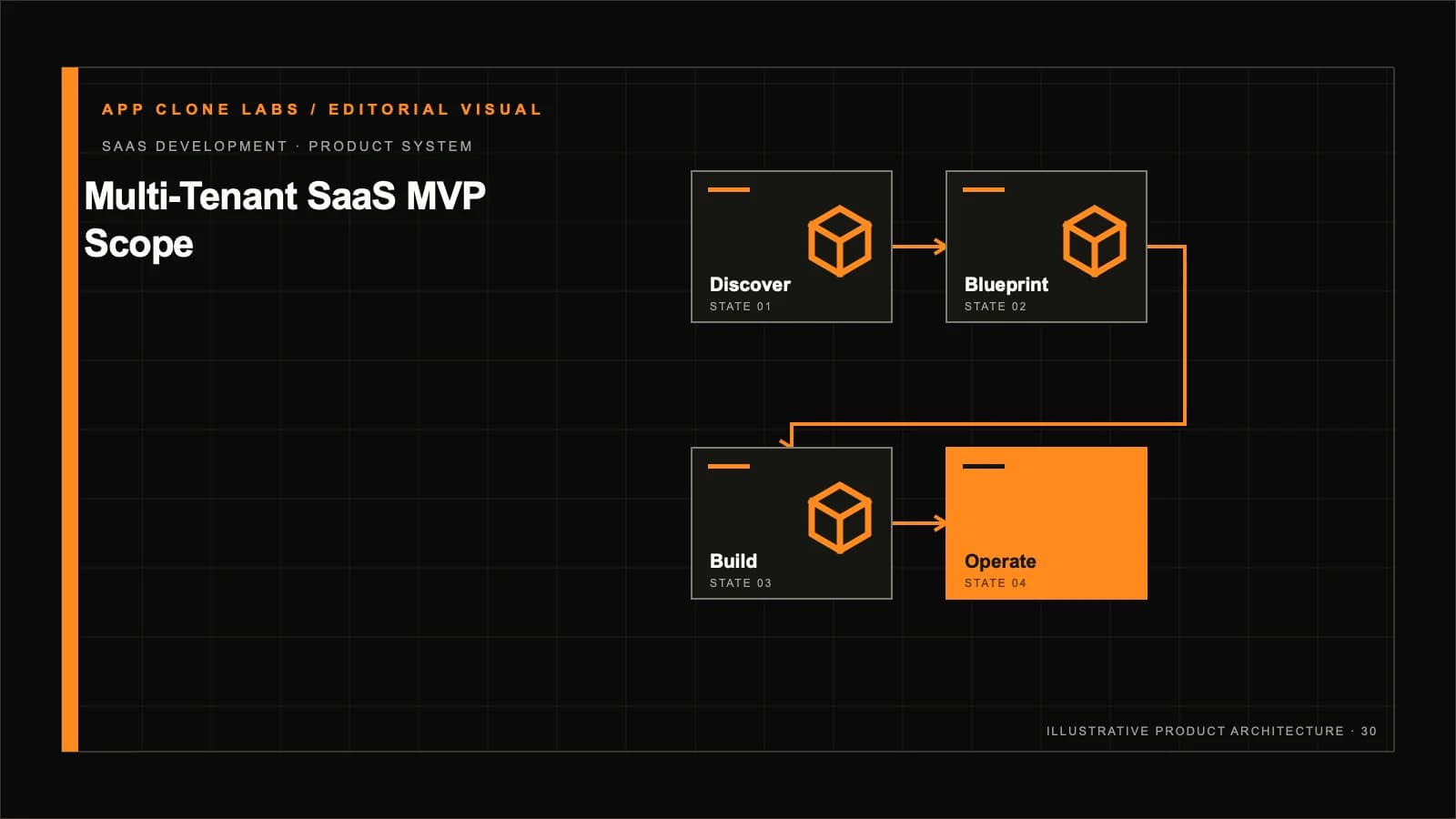
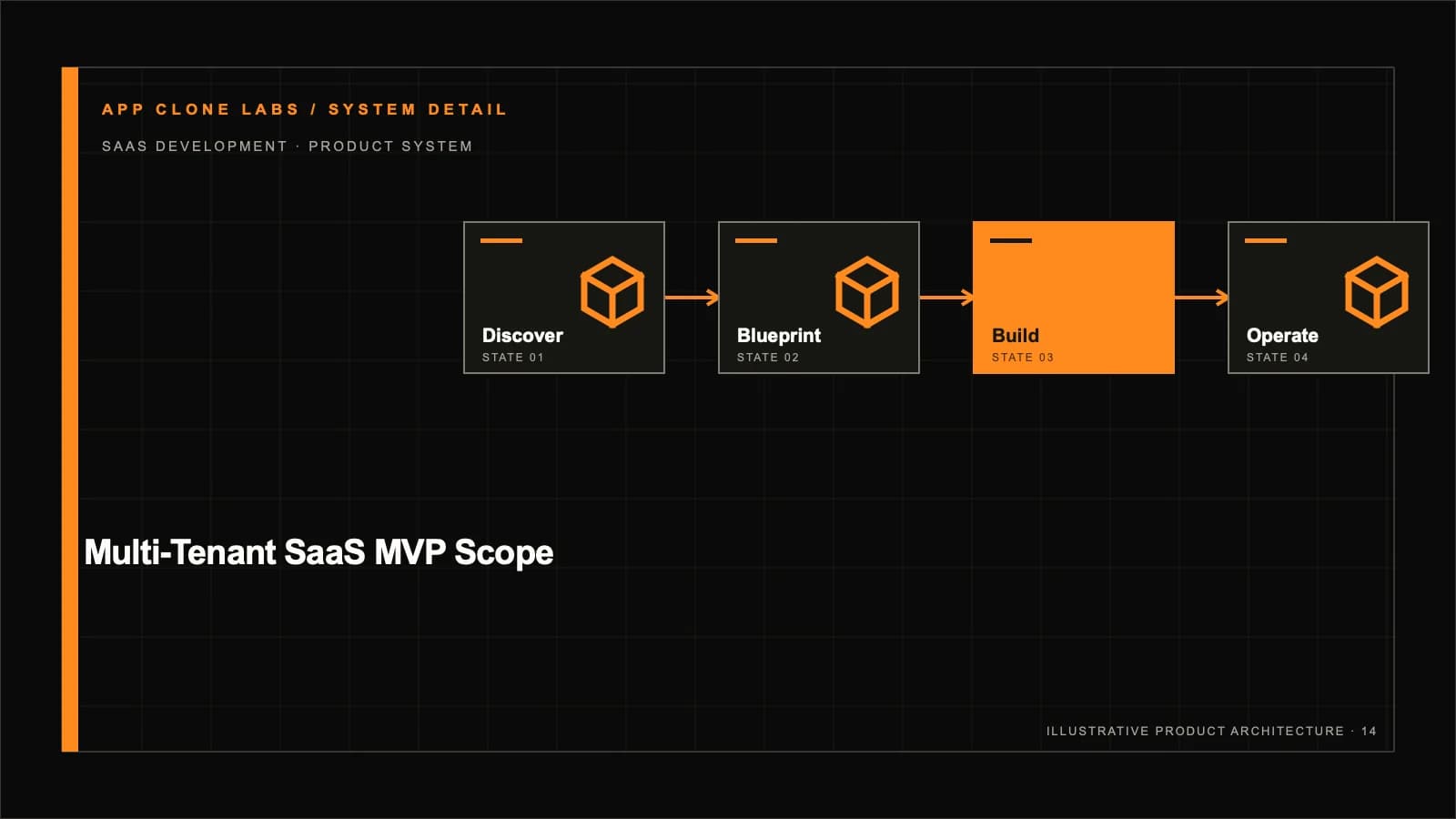
A multi-tenant SaaS MVP is not a normal web application with an organization_id column added at the end. Every sign-in, query, file, background job, export, webhook, cache entry and support action must answer the same question: which tenant owns this operation, and why is the current actor allowed to perform it?
The smallest credible release therefore needs more than registration and a dashboard. It needs a complete commercial loop: create an organization, invite a colleague, choose a plan, receive an entitlement, perform the core job, observe usage, obtain support, change or cancel billing, and retain an auditable history. Features outside that loop can wait; tenant isolation cannot.
This guide scopes that foundation without pretending every SaaS product has the same architecture. It identifies decisions, failure cases, acceptance evidence and explicit deferrals so a founder can launch a narrow product without creating a security and billing rewrite immediately afterward.
Define the tenant and the customer contract
A tenant may represent a company, workspace, franchise, school, property or client account. That boundary determines ownership, billing and administration.
The failure mode is concrete: users and data are attached to an ambiguous workspace concept that changes meaning across screens. This is not solved by adding another screen or background job. The product has to define ownership, permitted transitions, and the evidence retained when the transition occurs.
For the first release, write one tenant definition, ownership rule, lifecycle and relationship to legal customer and subscription. Write that decision as an enforceable server-side rule, not guidance that depends on a client, operator, or AI model remembering the intended boundary.
Implementation should include tenant identifier, display name, status, owner, billing customer reference, creation source and immutable audit timestamps. Keep the public response smaller than the internal record: users need a clear outcome and recovery path, while authorized operators need correlation IDs, policy versions, timestamps, and the before-and-after state.
Validate it with single-tenant user, user in two tenants, suspended tenant, renamed tenant and deleted invitation. Test the ordinary path, then repeat under timeout, duplicate delivery, stale state, partial failure, revoked authority, and concurrent requests. A feature is not ready when only the demonstration succeeds.
- Owner: product lead
- Release evidence: tenant-domain decision record
- Stop condition: two teams use tenant to mean different things
Choose an isolation model deliberately
Shared tables, separate schemas and separate databases offer different cost, isolation and operational tradeoffs.
The failure mode is concrete: the team promises dedicated isolation while operating one undifferentiated shared data path. This is not solved by adding another screen or background job. The product has to define ownership, permitted transitions, and the evidence retained when the transition occurs.
For the first release, select the first-release model from regulatory, customer, scale, restore and engineering constraints, and document a migration path. Write that decision as an enforceable server-side rule, not guidance that depends on a client, operator, or AI model remembering the intended boundary.
Implementation should include tenant key on every owned record, database constraints, scoped repository layer, backup design and isolation tests. Keep the public response smaller than the internal record: users need a clear outcome and recovery path, while authorized operators need correlation IDs, policy versions, timestamps, and the before-and-after state.
Validate it with cross-tenant reads, writes, joins, exports, search, cache and asynchronous work. Test the ordinary path, then repeat under timeout, duplicate delivery, stale state, partial failure, revoked authority, and concurrent requests. A feature is not ready when only the demonstration succeeds.
- Owner: architecture owner
- Release evidence: approved isolation threat model
- Stop condition: a query can execute without resolved tenant context
Resolve tenant context on the server
URLs and client state help navigation but are not trustworthy authorization inputs.
The failure mode is concrete: changing a workspace ID in a request exposes another customer. This is not solved by adding another screen or background job. The product has to define ownership, permitted transitions, and the evidence retained when the transition occurs.
For the first release, derive tenant context from authenticated membership and verify any route identifier against it before business logic. Write that decision as an enforceable server-side rule, not guidance that depends on a client, operator, or AI model remembering the intended boundary.
Implementation should include central context resolver, deny-by-default middleware, membership status, selected-tenant session and structured denial logs. Keep the public response smaller than the internal record: users need a clear outcome and recovery path, while authorized operators need correlation IDs, policy versions, timestamps, and the before-and-after state.
Validate it with tampered ID, stale membership, switched browser tab, revoked user and administrator impersonation. Test the ordinary path, then repeat under timeout, duplicate delivery, stale state, partial failure, revoked authority, and concurrent requests. A feature is not ready when only the demonstration succeeds.
- Owner: security lead
- Release evidence: negative authorization suite
- Stop condition: a controller trusts tenant_id supplied by the client
Model membership separately from identity
One person may belong to several organizations with different roles. Login identity and tenant permission are related but not identical.
The failure mode is concrete: a global role makes someone an administrator everywhere or deleting one membership deletes their account. This is not solved by adding another screen or background job. The product has to define ownership, permitted transitions, and the evidence retained when the transition occurs.
For the first release, store users globally where appropriate and connect them to tenants through explicit, stateful memberships. Write that decision as an enforceable server-side rule, not guidance that depends on a client, operator, or AI model remembering the intended boundary.
Implementation should include role, invitation provenance, joined time, status, last activity, revocation and uniqueness rules. Keep the public response smaller than the internal record: users need a clear outcome and recovery path, while authorized operators need correlation IDs, policy versions, timestamps, and the before-and-after state.
Validate it with duplicate invite, same email across tenants, role change, removal, reinvite and ownership transfer. Test the ordinary path, then repeat under timeout, duplicate delivery, stale state, partial failure, revoked authority, and concurrent requests. A feature is not ready when only the demonstration succeeds.
- Owner: identity engineer
- Release evidence: membership lifecycle tests
- Stop condition: role resolution bypasses active membership
Checkpoint 4: reconcile the product promise with the recorded state. Support, finance, security, and delivery teams should be able to reach the same conclusion from the same identifiers without reconstructing events from chat messages or screenshots.
Design invitations as security-sensitive state
Invitations grant future access and are routinely forwarded, reused or left active too long.
The failure mode is concrete: a permanent token lets an unintended recipient join months later. This is not solved by adding another screen or background job. The product has to define ownership, permitted transitions, and the evidence retained when the transition occurs.
For the first release, issue single-use, expiring invitations bound to tenant, intended email and offered role. Write that decision as an enforceable server-side rule, not guidance that depends on a client, operator, or AI model remembering the intended boundary.
Implementation should include hashed token, expiry, acceptance transaction, resend invalidation, rate limit and audit event. Keep the public response smaller than the internal record: users need a clear outcome and recovery path, while authorized operators need correlation IDs, policy versions, timestamps, and the before-and-after state.
Validate it with used token, wrong email, expired link, concurrent acceptance and inviter losing permission. Test the ordinary path, then repeat under timeout, duplicate delivery, stale state, partial failure, revoked authority, and concurrent requests. A feature is not ready when only the demonstration succeeds.
- Owner: backend lead
- Release evidence: invite abuse test report
- Stop condition: an accepted or revoked token works again
Keep the first role model small and explicit
Owner, admin, member and billing roles may be enough if their capabilities are defined. Role names alone are not policy.
The failure mode is concrete: every admin can export data or alter billing without the business intending it. This is not solved by adding another screen or background job. The product has to define ownership, permitted transitions, and the evidence retained when the transition occurs.
For the first release, create a capability matrix for tenant settings, members, core records, exports, billing and audit access. Write that decision as an enforceable server-side rule, not guidance that depends on a client, operator, or AI model remembering the intended boundary.
Implementation should include server-side policy checks, object ownership where required, default denial and policy version in audit records. Keep the public response smaller than the internal record: users need a clear outcome and recovery path, while authorized operators need correlation IDs, policy versions, timestamps, and the before-and-after state.
Validate it with every role against every sensitive action, including direct API calls. Test the ordinary path, then repeat under timeout, duplicate delivery, stale state, partial failure, revoked authority, and concurrent requests. A feature is not ready when only the demonstration succeeds.
- Owner: product security owner
- Release evidence: capability matrix mapped to automated tests
- Stop condition: the UI is the only permission enforcement
Use database protection as defence in depth
Application scoping is necessary, but shared-table mistakes are high impact. PostgreSQL row security can add a boundary when designed and operated correctly.
The failure mode is concrete: one missing filter leaks rows, while background jobs or privileged database roles silently bypass assumptions. This is not solved by adding another screen or background job. The product has to define ownership, permitted transitions, and the evidence retained when the transition occurs.
For the first release, evaluate row-level security for tenant-owned tables and document owner, bypass and connection-context behavior. Write that decision as an enforceable server-side rule, not guidance that depends on a client, operator, or AI model remembering the intended boundary.
Implementation should include forced policies where suitable, transaction-local tenant context, restricted application role, migration tests and operational access procedure. Keep the public response smaller than the internal record: users need a clear outcome and recovery path, while authorized operators need correlation IDs, policy versions, timestamps, and the before-and-after state.
Validate it with ordinary role, table owner behavior, worker connection reuse, missing context and maintenance jobs. Test the ordinary path, then repeat under timeout, duplicate delivery, stale state, partial failure, revoked authority, and concurrent requests. A feature is not ready when only the demonstration succeeds.
- Owner: database owner
- Release evidence: RLS behavior matrix
- Stop condition: the team assumes a policy protects roles that actually bypass it
Separate plans, prices and entitlements
A plan is marketing packaging; a provider price is billing configuration; an entitlement is what the product permits.
The failure mode is concrete: code checks a price ID scattered through controllers and cannot support grandfathered or custom customers. This is not solved by adding another screen or background job. The product has to define ownership, permitted transitions, and the evidence retained when the transition occurs.
For the first release, maintain an internal product catalog mapping subscription state to versioned entitlements. Write that decision as an enforceable server-side rule, not guidance that depends on a client, operator, or AI model remembering the intended boundary.
Implementation should include plan version, provider IDs, currency, interval, limits, feature keys, effective dates and override authority. Keep the public response smaller than the internal record: users need a clear outcome and recovery path, while authorized operators need correlation IDs, policy versions, timestamps, and the before-and-after state.
Validate it with upgrade, downgrade, trial, coupon, old price, custom contract and billing-provider outage. Test the ordinary path, then repeat under timeout, duplicate delivery, stale state, partial failure, revoked authority, and concurrent requests. A feature is not ready when only the demonstration succeeds.
- Owner: monetization owner
- Release evidence: catalog-to-feature acceptance tests
- Stop condition: a payment object directly controls unrelated application behavior
Checkpoint 8: reconcile the product promise with the recorded state. Support, finance, security, and delivery teams should be able to reach the same conclusion from the same identifiers without reconstructing events from chat messages or screenshots.
Treat billing events as asynchronous
Checkout return pages do not prove the durable subscription state. Renewals, failures, disputes and cancellations arrive later.
The failure mode is concrete: the browser declares a tenant paid or repeated webhooks apply the same change twice. This is not solved by adding another screen or background job. The product has to define ownership, permitted transitions, and the evidence retained when the transition occurs.
For the first release, verify provider webhooks, store event IDs and process entitlement transitions idempotently. Write that decision as an enforceable server-side rule, not guidance that depends on a client, operator, or AI model remembering the intended boundary.
Implementation should include signature verification, event allow-list, ordering policy, replay tool, dead-letter queue and reconciliation job. Keep the public response smaller than the internal record: users need a clear outcome and recovery path, while authorized operators need correlation IDs, policy versions, timestamps, and the before-and-after state.
Validate it with duplicate, delayed, reordered and missing events plus checkout abandonment. Test the ordinary path, then repeat under timeout, duplicate delivery, stale state, partial failure, revoked authority, and concurrent requests. A feature is not ready when only the demonstration succeeds.
- Owner: billing engineer
- Release evidence: provider-event transition log
- Stop condition: one replay grants or removes access twice
Specify lifecycle and grace decisions
Trialing, active, past due, paused, cancelled and scheduled cancellation must map to understandable product behavior.
The failure mode is concrete: a failed payment immediately destroys access or an expired account keeps premium capability forever. This is not solved by adding another screen or background job. The product has to define ownership, permitted transitions, and the evidence retained when the transition occurs.
For the first release, define a lifecycle table with access, communication, recovery and data-retention behavior for each state. Write that decision as an enforceable server-side rule, not guidance that depends on a client, operator, or AI model remembering the intended boundary.
Implementation should include grace window, read-only mode, retry messaging, owner notification, export option and reactivation path. Keep the public response smaller than the internal record: users need a clear outcome and recovery path, while authorized operators need correlation IDs, policy versions, timestamps, and the before-and-after state.
Validate it with payment failure, recovery, end-of-period cancel, immediate cancel and disputed charge. Test the ordinary path, then repeat under timeout, duplicate delivery, stale state, partial failure, revoked authority, and concurrent requests. A feature is not ready when only the demonstration succeeds.
- Owner: customer operations
- Release evidence: subscription-state playbook
- Stop condition: support cannot explain what a customer can do in each state
Bound the core workflow and its data
The MVP earns value through one repeatable job, not through settings screens.
The failure mode is concrete: the platform has polished administration but cannot complete and recover its primary customer outcome. This is not solved by adding another screen or background job. The product has to define ownership, permitted transitions, and the evidence retained when the transition occurs.
For the first release, name the trigger, responsible role, state transitions, completion evidence, exception path and measurable result for one workflow. Write that decision as an enforceable server-side rule, not guidance that depends on a client, operator, or AI model remembering the intended boundary.
Implementation should include validated inputs, optimistic concurrency, reason codes, audit events, notifications and operator recovery. Keep the public response smaller than the internal record: users need a clear outcome and recovery path, while authorized operators need correlation IDs, policy versions, timestamps, and the before-and-after state.
Validate it with happy path, invalid transition, duplicate submission, timeout and concurrent edit. Test the ordinary path, then repeat under timeout, duplicate delivery, stale state, partial failure, revoked authority, and concurrent requests. A feature is not ready when only the demonstration succeeds.
- Owner: workflow owner
- Release evidence: one end-to-end customer acceptance journey
- Stop condition: completion depends on manual database correction
Make background work tenant-aware
Emails, imports, reports and integrations often execute after the request context disappears.
The failure mode is concrete: a queued job reads the wrong tenant, writes an unscoped cache key or sends another company’s attachment. This is not solved by adding another screen or background job. The product has to define ownership, permitted transitions, and the evidence retained when the transition occurs.
For the first release, put tenant and actor references in the job envelope and re-authorize sensitive work at execution time. Write that decision as an enforceable server-side rule, not guidance that depends on a client, operator, or AI model remembering the intended boundary.
Implementation should include tenant-scoped storage paths, cache keys, idempotency keys, trace attributes, retry policy and dead-letter inspection. Keep the public response smaller than the internal record: users need a clear outcome and recovery path, while authorized operators need correlation IDs, policy versions, timestamps, and the before-and-after state.
Validate it with delayed role revocation, retry after deployment, two tenants with same record ID and poisoned message. Test the ordinary path, then repeat under timeout, duplicate delivery, stale state, partial failure, revoked authority, and concurrent requests. A feature is not ready when only the demonstration succeeds.
- Owner: platform lead
- Release evidence: worker isolation tests
- Stop condition: a worker infers tenant from a globally ambiguous identifier
Checkpoint 12: reconcile the product promise with the recorded state. Support, finance, security, and delivery teams should be able to reach the same conclusion from the same identifiers without reconstructing events from chat messages or screenshots.
Scope files, search and exports too
Tenant leaks frequently appear outside primary database queries. Object storage, search indexes, logs and exports need the same boundary.
The failure mode is concrete: a predictable file key or search filter exposes another customer’s content. This is not solved by adding another screen or background job. The product has to define ownership, permitted transitions, and the evidence retained when the transition occurs.
For the first release, include tenant ownership in every secondary store and authorize downloads through the application or short-lived signed access. Write that decision as an enforceable server-side rule, not guidance that depends on a client, operator, or AI model remembering the intended boundary.
Implementation should include namespaced object keys, metadata, search filters, export manifest, expiry, encryption and deletion propagation. Keep the public response smaller than the internal record: users need a clear outcome and recovery path, while authorized operators need correlation IDs, policy versions, timestamps, and the before-and-after state.
Validate it with guessed URL, reused signed link, cross-tenant search, cancelled export and account deletion. Test the ordinary path, then repeat under timeout, duplicate delivery, stale state, partial failure, revoked authority, and concurrent requests. A feature is not ready when only the demonstration succeeds.
- Owner: data protection owner
- Release evidence: secondary-store inventory and tests
- Stop condition: any store lacks a tenant ownership field or enforcement rule
Give support constrained operational tools
Support must diagnose memberships, billing and workflow failures without gaining invisible superuser power.
The failure mode is concrete: staff impersonate users or alter records with no durable reason and approval trail. This is not solved by adding another screen or background job. The product has to define ownership, permitted transitions, and the evidence retained when the transition occurs.
For the first release, build read-first tenant diagnostics and narrowly scoped actions with reason, permission and immutable audit. Write that decision as an enforceable server-side rule, not guidance that depends on a client, operator, or AI model remembering the intended boundary.
Implementation should include case reference, before-and-after state, actor, approval for high-risk action, redaction and customer notification policy. Keep the public response smaller than the internal record: users need a clear outcome and recovery path, while authorized operators need correlation IDs, policy versions, timestamps, and the before-and-after state.
Validate it with unauthorized staff, expired elevation, concurrent action and audit export. Test the ordinary path, then repeat under timeout, duplicate delivery, stale state, partial failure, revoked authority, and concurrent requests. A feature is not ready when only the demonstration succeeds.
- Owner: support manager
- Release evidence: support recovery drill
- Stop condition: routine support requires production database access
Define deletion, export and restore before launch
Customer data lifecycle affects product promises and architecture. A backup that can only restore the whole database may not satisfy tenant-level recovery expectations.
The failure mode is concrete: sales promises instant tenant restore or deletion without an implementable process. This is not solved by adding another screen or background job. The product has to define ownership, permitted transitions, and the evidence retained when the transition occurs.
For the first release, document retention, soft-delete, purge, legal-hold, export and restore capabilities accurately for the first release. Write that decision as an enforceable server-side rule, not guidance that depends on a client, operator, or AI model remembering the intended boundary.
Implementation should include deletion queue, dependency map, storage and search propagation, backup retention, restore granularity and verification. Keep the public response smaller than the internal record: users need a clear outcome and recovery path, while authorized operators need correlation IDs, policy versions, timestamps, and the before-and-after state.
Validate it with cancel deletion, expired retention, partial failure, tenant export and recovery exercise. Test the ordinary path, then repeat under timeout, duplicate delivery, stale state, partial failure, revoked authority, and concurrent requests. A feature is not ready when only the demonstration succeeds.
- Owner: governance owner
- Release evidence: tested lifecycle runbook
- Stop condition: public promises exceed the demonstrated restore or deletion capability
Create launch gates and explicit deferrals
Analytics builders, white labeling, SSO, custom domains and dozens of integrations can overwhelm the foundation.
The failure mode is concrete: scope grows while isolation, billing recovery and support remain untested. This is not solved by adding another screen or background job. The product has to define ownership, permitted transitions, and the evidence retained when the transition occurs.
For the first release, defer features unless they are required to complete or sell the first commercial loop, and attach a measurable trigger for reconsideration. Write that decision as an enforceable server-side rule, not guidance that depends on a client, operator, or AI model remembering the intended boundary.
Implementation should include must-have evidence, excluded backlog, change budget, acceptance owner, rollback plan and post-launch review date. Keep the public response smaller than the internal record: users need a clear outcome and recovery path, while authorized operators need correlation IDs, policy versions, timestamps, and the before-and-after state.
Validate it with full tenant journey, security negative cases, billing replay, backup restore and support simulation. Test the ordinary path, then repeat under timeout, duplicate delivery, stale state, partial failure, revoked authority, and concurrent requests. A feature is not ready when only the demonstration succeeds.
- Owner: delivery lead
- Release evidence: signed release readiness record
- Stop condition: any critical isolation or entitlement invariant is unproven
Checkpoint 16: reconcile the product promise with the recorded state. Support, finance, security, and delivery teams should be able to reach the same conclusion from the same identifiers without reconstructing events from chat messages or screenshots.
Implementation references
Evaluate tenancy options with the Microsoft multitenant architecture guide while documenting product-specific constraints.
If PostgreSQL policies are used, verify exact behavior in the row security documentation including roles that can bypass policies.
Base server-side checks on OWASP authorization guidance and test denied access, not only allowed access.
Model renewals and failures using Stripe subscription webhook guidance or the equivalent documentation for the selected provider.
Connect the scope to SaaS development when converting the decision record into delivery work.
Frequently asked questions
What is the minimum multi-tenant SaaS MVP?
One organization lifecycle, secure membership and invitations, a small role model, one complete core workflow, a subscription-to-entitlement flow, support tooling, audit history and tested tenant isolation.
Should every tenant have a separate database?
Not automatically. Choose shared tables, schemas or databases from risk, customer commitments, scale, restore needs and operating capability. Whatever you choose must be explicit and tested.
Is adding tenant_id to tables enough?
No. Requests, joins, jobs, caches, files, search, exports and support actions all need resolved tenant context and authorization. Database controls can add defence in depth.
How many roles should an MVP have?
Use the smallest set that represents real responsibility, commonly owner, admin, member and perhaps billing. Define capabilities per action instead of relying on labels.
Should billing status equal product access?
Not directly. Map verified subscription state through an internal, versioned entitlement catalog so trials, grace, grandfathering and custom contracts remain manageable.
Can the checkout success page activate a tenant?
Use it for experience, but authoritative access should follow verified, idempotently processed provider events and reconciliation.
What should be deferred?
Defer features such as SSO, custom domains, complex analytics and broad integrations unless a validated first customer requires them. Never defer isolation, authorization or recoverability.
What proves the MVP is ready?
A full commercial journey plus negative tenant-access tests, billing replay, background-job isolation, customer-data lifecycle checks, support recovery and a demonstrated backup restore.
Launch one trustworthy tenant journey
The best SaaS MVP is not the one with the fewest screens. It is the smallest version in which a paying organization can complete its job without weakening another organization’s privacy, losing access incorrectly, or depending on engineers for ordinary support.
Treat every deferred feature as a conscious business decision and every isolation or entitlement rule as a testable invariant. That combination keeps scope narrow while preserving the foundation needed for the second customer, the hundredth tenant and the first difficult billing incident.
- 01
- 02
- 03
- 04
- 05
- 06
Reviewed by the App Clone Labs product strategy team
This guide is written for founders and operators planning clone-inspired platforms, SaaS products, marketplaces, and mobile apps. It is reviewed against App Clone Labs delivery patterns, product scoping standards, and current implementation realities before being published.
Review the editorial team structureRelated product paths
Continue with the services, solutions, guides, and articles that connect this topic to a real software build.
Services, solutions, and guides
Read next