Editorial dossier / AI Engineering
Where AI Belongs in Marketplace Apps: Use Cases, Boundaries and Evaluation
Evaluate marketplace AI across search, recommendations, moderation, fraud review, support, extraction and operations with measurable boundaries.
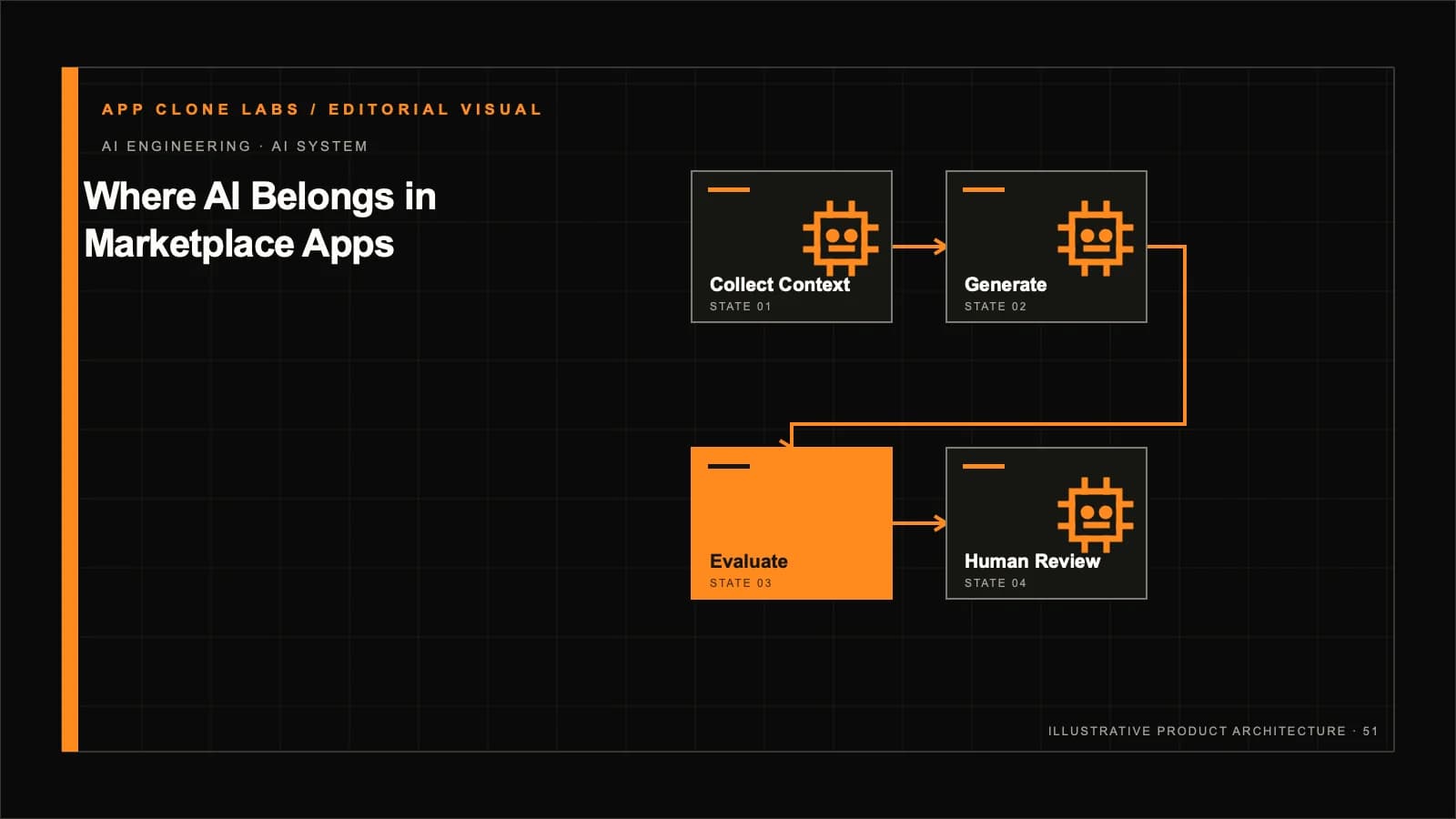
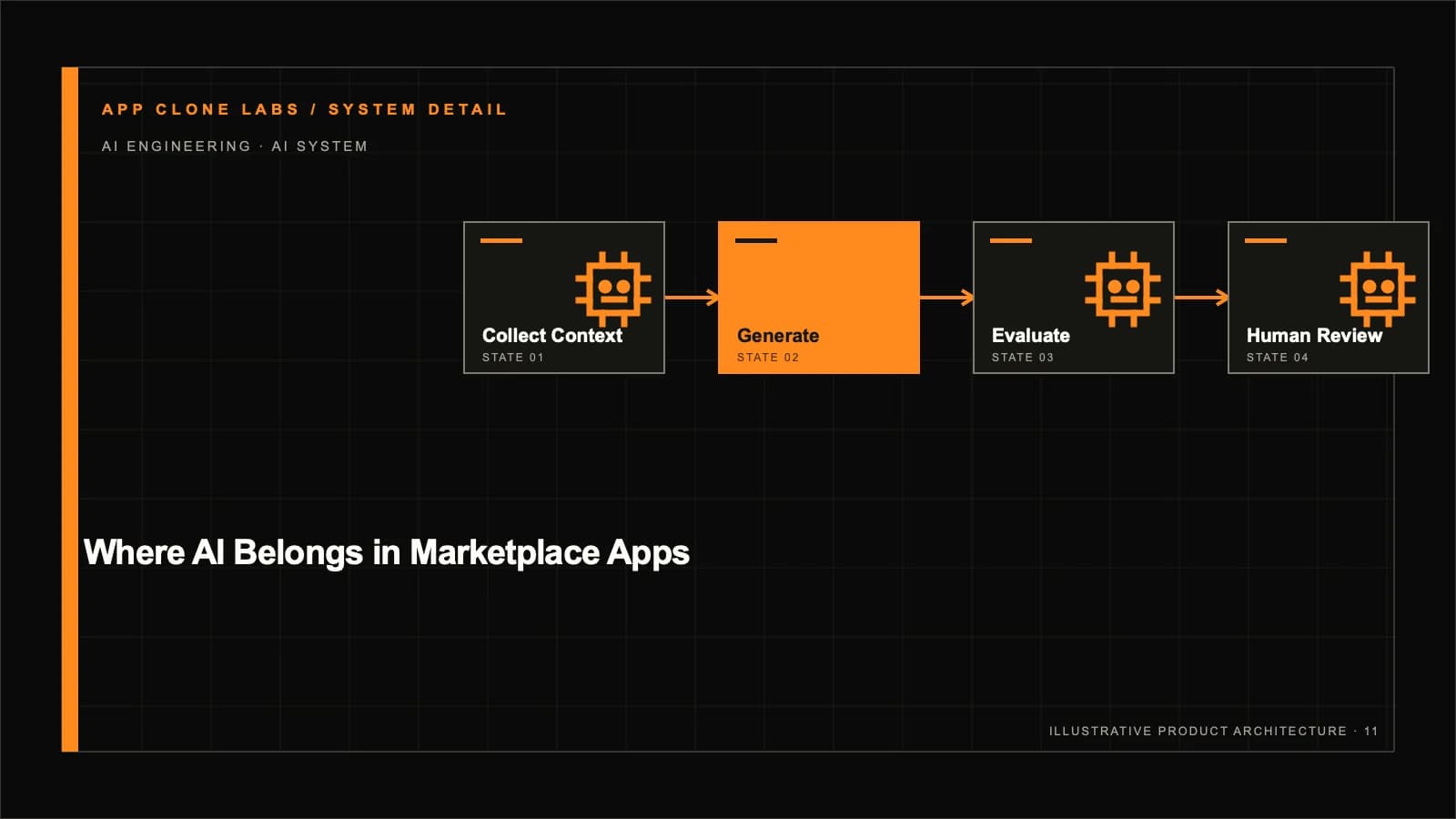
AI belongs in a marketplace only where it improves a defined decision without erasing accountability. A model that raises conversion while leaking private listings, blocking legitimate providers or inventing refund policy has not improved the product.
The best early uses often assist narrow operational work: classify a case, rank eligible inventory, extract a document or draft a response from approved evidence.
This guide compares use cases by data readiness, failure cost and review design.
Define the marketplace decision
Define the marketplace decision is an independent operating decision inside a multi-party marketplace using AI inside search, trust, support and operations. It affects the public promise, the authority of each participant, the evidence retained by the platform and the recovery path when ordinary processing fails.
The failure mode is concrete: the team implements define the marketplace decision as a screen-level feature, leaving permissions, downstream state, financial effects and support behavior inconsistent. This is not solved by adding another screen or background job. The product has to define ownership, permitted transitions, and the evidence retained when the transition occurs.
For the first release, write the authoritative lifecycle, responsible role, permitted transitions and user-visible outcome for define the marketplace decision before adding interface breadth. Write that decision as an enforceable server-side rule, not guidance that depends on a client, operator, or AI model remembering the intended boundary.
Implementation should include For define the marketplace decision, retain stable identifiers, explicit states, server-side authorization, version checks, occurrence and processing times, reason codes, correlation identifiers, audit history and an owned exception route. Keep the public response smaller than the internal record: users need a clear outcome and recovery path, while authorized operators need correlation IDs, policy versions, timestamps, and the before-and-after state.
Validate it with For define the marketplace decision, run the successful journey followed by duplicate delivery, stale state, concurrent commands, revoked authority, dependency timeout, partial failure, operator correction and later reconciliation. Test the ordinary path, then repeat under timeout, duplicate delivery, stale state, partial failure, revoked authority, and concurrent requests. A feature is not ready when only the demonstration succeeds.
- Owner: product owner
- Release evidence: versioned define the marketplace decision decision record and acceptance results
- Stop condition: define the marketplace decision cannot be explained, bounded or recovered from durable evidence
Assess data readiness
Assess data readiness is an independent operating decision inside a multi-party marketplace using AI inside search, trust, support and operations. It affects the public promise, the authority of each participant, the evidence retained by the platform and the recovery path when ordinary processing fails.
The failure mode is concrete: the team implements assess data readiness as a screen-level feature, leaving permissions, downstream state, financial effects and support behavior inconsistent. This is not solved by adding another screen or background job. The product has to define ownership, permitted transitions, and the evidence retained when the transition occurs.
For the first release, write the authoritative lifecycle, responsible role, permitted transitions and user-visible outcome for assess data readiness before adding interface breadth. Write that decision as an enforceable server-side rule, not guidance that depends on a client, operator, or AI model remembering the intended boundary.
Implementation should include For assess data readiness, retain stable identifiers, explicit states, server-side authorization, version checks, occurrence and processing times, reason codes, correlation identifiers, audit history and an owned exception route. Keep the public response smaller than the internal record: users need a clear outcome and recovery path, while authorized operators need correlation IDs, policy versions, timestamps, and the before-and-after state.
Validate it with For assess data readiness, run the successful journey followed by duplicate delivery, stale state, concurrent commands, revoked authority, dependency timeout, partial failure, operator correction and later reconciliation. Test the ordinary path, then repeat under timeout, duplicate delivery, stale state, partial failure, revoked authority, and concurrent requests. A feature is not ready when only the demonstration succeeds.
- Owner: product owner
- Release evidence: versioned assess data readiness decision record and acceptance results
- Stop condition: assess data readiness cannot be explained, bounded or recovered from durable evidence
Build search assistance
Build search assistance is an independent operating decision inside a multi-party marketplace using AI inside search, trust, support and operations. It affects the public promise, the authority of each participant, the evidence retained by the platform and the recovery path when ordinary processing fails.
The failure mode is concrete: the team implements build search assistance as a screen-level feature, leaving permissions, downstream state, financial effects and support behavior inconsistent. This is not solved by adding another screen or background job. The product has to define ownership, permitted transitions, and the evidence retained when the transition occurs.
For the first release, write the authoritative lifecycle, responsible role, permitted transitions and user-visible outcome for build search assistance before adding interface breadth. Write that decision as an enforceable server-side rule, not guidance that depends on a client, operator, or AI model remembering the intended boundary.
Implementation should include For build search assistance, retain stable identifiers, explicit states, server-side authorization, version checks, occurrence and processing times, reason codes, correlation identifiers, audit history and an owned exception route. Keep the public response smaller than the internal record: users need a clear outcome and recovery path, while authorized operators need correlation IDs, policy versions, timestamps, and the before-and-after state.
Validate it with For build search assistance, run the successful journey followed by duplicate delivery, stale state, concurrent commands, revoked authority, dependency timeout, partial failure, operator correction and later reconciliation. Test the ordinary path, then repeat under timeout, duplicate delivery, stale state, partial failure, revoked authority, and concurrent requests. A feature is not ready when only the demonstration succeeds.
- Owner: product owner
- Release evidence: versioned build search assistance decision record and acceptance results
- Stop condition: build search assistance cannot be explained, bounded or recovered from durable evidence
Plan recommendation systems
Plan recommendation systems is an independent operating decision inside a multi-party marketplace using AI inside search, trust, support and operations. It affects the public promise, the authority of each participant, the evidence retained by the platform and the recovery path when ordinary processing fails.
The failure mode is concrete: the team implements plan recommendation systems as a screen-level feature, leaving permissions, downstream state, financial effects and support behavior inconsistent. This is not solved by adding another screen or background job. The product has to define ownership, permitted transitions, and the evidence retained when the transition occurs.
For the first release, write the authoritative lifecycle, responsible role, permitted transitions and user-visible outcome for plan recommendation systems before adding interface breadth. Write that decision as an enforceable server-side rule, not guidance that depends on a client, operator, or AI model remembering the intended boundary.
Implementation should include For plan recommendation systems, retain stable identifiers, explicit states, server-side authorization, version checks, occurrence and processing times, reason codes, correlation identifiers, audit history and an owned exception route. Keep the public response smaller than the internal record: users need a clear outcome and recovery path, while authorized operators need correlation IDs, policy versions, timestamps, and the before-and-after state.
Validate it with For plan recommendation systems, run the successful journey followed by duplicate delivery, stale state, concurrent commands, revoked authority, dependency timeout, partial failure, operator correction and later reconciliation. Test the ordinary path, then repeat under timeout, duplicate delivery, stale state, partial failure, revoked authority, and concurrent requests. A feature is not ready when only the demonstration succeeds.
- Owner: product owner
- Release evidence: versioned plan recommendation systems decision record and acceptance results
- Stop condition: plan recommendation systems cannot be explained, bounded or recovered from durable evidence
Checkpoint 4: reconcile the product promise with the recorded state. Support, finance, security, and delivery teams should be able to reach the same conclusion from the same identifiers without reconstructing events from chat messages or screenshots.
Classify listings and documents
Classify listings and documents is an independent operating decision inside a multi-party marketplace using AI inside search, trust, support and operations. It affects the public promise, the authority of each participant, the evidence retained by the platform and the recovery path when ordinary processing fails.
The failure mode is concrete: the team implements classify listings and documents as a screen-level feature, leaving permissions, downstream state, financial effects and support behavior inconsistent. This is not solved by adding another screen or background job. The product has to define ownership, permitted transitions, and the evidence retained when the transition occurs.
For the first release, write the authoritative lifecycle, responsible role, permitted transitions and user-visible outcome for classify listings and documents before adding interface breadth. Write that decision as an enforceable server-side rule, not guidance that depends on a client, operator, or AI model remembering the intended boundary.
Implementation should include For classify listings and documents, retain stable identifiers, explicit states, server-side authorization, version checks, occurrence and processing times, reason codes, correlation identifiers, audit history and an owned exception route. Keep the public response smaller than the internal record: users need a clear outcome and recovery path, while authorized operators need correlation IDs, policy versions, timestamps, and the before-and-after state.
Validate it with For classify listings and documents, run the successful journey followed by duplicate delivery, stale state, concurrent commands, revoked authority, dependency timeout, partial failure, operator correction and later reconciliation. Test the ordinary path, then repeat under timeout, duplicate delivery, stale state, partial failure, revoked authority, and concurrent requests. A feature is not ready when only the demonstration succeeds.
- Owner: product owner
- Release evidence: versioned classify listings and documents decision record and acceptance results
- Stop condition: classify listings and documents cannot be explained, bounded or recovered from durable evidence
Assist content moderation
Assist content moderation is an independent operating decision inside a multi-party marketplace using AI inside search, trust, support and operations. It affects the public promise, the authority of each participant, the evidence retained by the platform and the recovery path when ordinary processing fails.
The failure mode is concrete: the team implements assist content moderation as a screen-level feature, leaving permissions, downstream state, financial effects and support behavior inconsistent. This is not solved by adding another screen or background job. The product has to define ownership, permitted transitions, and the evidence retained when the transition occurs.
For the first release, write the authoritative lifecycle, responsible role, permitted transitions and user-visible outcome for assist content moderation before adding interface breadth. Write that decision as an enforceable server-side rule, not guidance that depends on a client, operator, or AI model remembering the intended boundary.
Implementation should include For assist content moderation, retain stable identifiers, explicit states, server-side authorization, version checks, occurrence and processing times, reason codes, correlation identifiers, audit history and an owned exception route. Keep the public response smaller than the internal record: users need a clear outcome and recovery path, while authorized operators need correlation IDs, policy versions, timestamps, and the before-and-after state.
Validate it with For assist content moderation, run the successful journey followed by duplicate delivery, stale state, concurrent commands, revoked authority, dependency timeout, partial failure, operator correction and later reconciliation. Test the ordinary path, then repeat under timeout, duplicate delivery, stale state, partial failure, revoked authority, and concurrent requests. A feature is not ready when only the demonstration succeeds.
- Owner: product owner
- Release evidence: versioned assist content moderation decision record and acceptance results
- Stop condition: assist content moderation cannot be explained, bounded or recovered from durable evidence
Support fraud review
Support fraud review is an independent operating decision inside a multi-party marketplace using AI inside search, trust, support and operations. It affects the public promise, the authority of each participant, the evidence retained by the platform and the recovery path when ordinary processing fails.
The failure mode is concrete: the team implements support fraud review as a screen-level feature, leaving permissions, downstream state, financial effects and support behavior inconsistent. This is not solved by adding another screen or background job. The product has to define ownership, permitted transitions, and the evidence retained when the transition occurs.
For the first release, write the authoritative lifecycle, responsible role, permitted transitions and user-visible outcome for support fraud review before adding interface breadth. Write that decision as an enforceable server-side rule, not guidance that depends on a client, operator, or AI model remembering the intended boundary.
Implementation should include For support fraud review, retain stable identifiers, explicit states, server-side authorization, version checks, occurrence and processing times, reason codes, correlation identifiers, audit history and an owned exception route. Keep the public response smaller than the internal record: users need a clear outcome and recovery path, while authorized operators need correlation IDs, policy versions, timestamps, and the before-and-after state.
Validate it with For support fraud review, run the successful journey followed by duplicate delivery, stale state, concurrent commands, revoked authority, dependency timeout, partial failure, operator correction and later reconciliation. Test the ordinary path, then repeat under timeout, duplicate delivery, stale state, partial failure, revoked authority, and concurrent requests. A feature is not ready when only the demonstration succeeds.
- Owner: product owner
- Release evidence: versioned support fraud review decision record and acceptance results
- Stop condition: support fraud review cannot be explained, bounded or recovered from durable evidence
Draft evidence-linked support answers
Draft evidence-linked support answers is an independent operating decision inside a multi-party marketplace using AI inside search, trust, support and operations. It affects the public promise, the authority of each participant, the evidence retained by the platform and the recovery path when ordinary processing fails.
The failure mode is concrete: the team implements draft evidence-linked support answers as a screen-level feature, leaving permissions, downstream state, financial effects and support behavior inconsistent. This is not solved by adding another screen or background job. The product has to define ownership, permitted transitions, and the evidence retained when the transition occurs.
For the first release, write the authoritative lifecycle, responsible role, permitted transitions and user-visible outcome for draft evidence-linked support answers before adding interface breadth. Write that decision as an enforceable server-side rule, not guidance that depends on a client, operator, or AI model remembering the intended boundary.
Implementation should include For draft evidence-linked support answers, retain stable identifiers, explicit states, server-side authorization, version checks, occurrence and processing times, reason codes, correlation identifiers, audit history and an owned exception route. Keep the public response smaller than the internal record: users need a clear outcome and recovery path, while authorized operators need correlation IDs, policy versions, timestamps, and the before-and-after state.
Validate it with For draft evidence-linked support answers, run the successful journey followed by duplicate delivery, stale state, concurrent commands, revoked authority, dependency timeout, partial failure, operator correction and later reconciliation. Test the ordinary path, then repeat under timeout, duplicate delivery, stale state, partial failure, revoked authority, and concurrent requests. A feature is not ready when only the demonstration succeeds.
- Owner: product owner
- Release evidence: versioned draft evidence-linked support answers decision record and acceptance results
- Stop condition: draft evidence-linked support answers cannot be explained, bounded or recovered from durable evidence
Checkpoint 8: reconcile the product promise with the recorded state. Support, finance, security, and delivery teams should be able to reach the same conclusion from the same identifiers without reconstructing events from chat messages or screenshots.
Route operational exceptions
Route operational exceptions is an independent operating decision inside a multi-party marketplace using AI inside search, trust, support and operations. It affects the public promise, the authority of each participant, the evidence retained by the platform and the recovery path when ordinary processing fails.
The failure mode is concrete: the team implements route operational exceptions as a screen-level feature, leaving permissions, downstream state, financial effects and support behavior inconsistent. This is not solved by adding another screen or background job. The product has to define ownership, permitted transitions, and the evidence retained when the transition occurs.
For the first release, write the authoritative lifecycle, responsible role, permitted transitions and user-visible outcome for route operational exceptions before adding interface breadth. Write that decision as an enforceable server-side rule, not guidance that depends on a client, operator, or AI model remembering the intended boundary.
Implementation should include For route operational exceptions, retain stable identifiers, explicit states, server-side authorization, version checks, occurrence and processing times, reason codes, correlation identifiers, audit history and an owned exception route. Keep the public response smaller than the internal record: users need a clear outcome and recovery path, while authorized operators need correlation IDs, policy versions, timestamps, and the before-and-after state.
Validate it with For route operational exceptions, run the successful journey followed by duplicate delivery, stale state, concurrent commands, revoked authority, dependency timeout, partial failure, operator correction and later reconciliation. Test the ordinary path, then repeat under timeout, duplicate delivery, stale state, partial failure, revoked authority, and concurrent requests. A feature is not ready when only the demonstration succeeds.
- Owner: product owner
- Release evidence: versioned route operational exceptions decision record and acceptance results
- Stop condition: route operational exceptions cannot be explained, bounded or recovered from durable evidence
Forecast supply and demand
Forecast supply and demand is an independent operating decision inside a multi-party marketplace using AI inside search, trust, support and operations. It affects the public promise, the authority of each participant, the evidence retained by the platform and the recovery path when ordinary processing fails.
The failure mode is concrete: the team implements forecast supply and demand as a screen-level feature, leaving permissions, downstream state, financial effects and support behavior inconsistent. This is not solved by adding another screen or background job. The product has to define ownership, permitted transitions, and the evidence retained when the transition occurs.
For the first release, write the authoritative lifecycle, responsible role, permitted transitions and user-visible outcome for forecast supply and demand before adding interface breadth. Write that decision as an enforceable server-side rule, not guidance that depends on a client, operator, or AI model remembering the intended boundary.
Implementation should include For forecast supply and demand, retain stable identifiers, explicit states, server-side authorization, version checks, occurrence and processing times, reason codes, correlation identifiers, audit history and an owned exception route. Keep the public response smaller than the internal record: users need a clear outcome and recovery path, while authorized operators need correlation IDs, policy versions, timestamps, and the before-and-after state.
Validate it with For forecast supply and demand, run the successful journey followed by duplicate delivery, stale state, concurrent commands, revoked authority, dependency timeout, partial failure, operator correction and later reconciliation. Test the ordinary path, then repeat under timeout, duplicate delivery, stale state, partial failure, revoked authority, and concurrent requests. A feature is not ready when only the demonstration succeeds.
- Owner: product owner
- Release evidence: versioned forecast supply and demand decision record and acceptance results
- Stop condition: forecast supply and demand cannot be explained, bounded or recovered from durable evidence
Protect tenant and participant data
Protect tenant and participant data is an independent operating decision inside a multi-party marketplace using AI inside search, trust, support and operations. It affects the public promise, the authority of each participant, the evidence retained by the platform and the recovery path when ordinary processing fails.
The failure mode is concrete: the team implements protect tenant and participant data as a screen-level feature, leaving permissions, downstream state, financial effects and support behavior inconsistent. This is not solved by adding another screen or background job. The product has to define ownership, permitted transitions, and the evidence retained when the transition occurs.
For the first release, write the authoritative lifecycle, responsible role, permitted transitions and user-visible outcome for protect tenant and participant data before adding interface breadth. Write that decision as an enforceable server-side rule, not guidance that depends on a client, operator, or AI model remembering the intended boundary.
Implementation should include For protect tenant and participant data, retain stable identifiers, explicit states, server-side authorization, version checks, occurrence and processing times, reason codes, correlation identifiers, audit history and an owned exception route. Keep the public response smaller than the internal record: users need a clear outcome and recovery path, while authorized operators need correlation IDs, policy versions, timestamps, and the before-and-after state.
Validate it with For protect tenant and participant data, run the successful journey followed by duplicate delivery, stale state, concurrent commands, revoked authority, dependency timeout, partial failure, operator correction and later reconciliation. Test the ordinary path, then repeat under timeout, duplicate delivery, stale state, partial failure, revoked authority, and concurrent requests. A feature is not ready when only the demonstration succeeds.
- Owner: product owner
- Release evidence: versioned protect tenant and participant data decision record and acceptance results
- Stop condition: protect tenant and participant data cannot be explained, bounded or recovered from durable evidence
Keep consequential actions human-controlled
Keep consequential actions human-controlled is an independent operating decision inside a multi-party marketplace using AI inside search, trust, support and operations. It affects the public promise, the authority of each participant, the evidence retained by the platform and the recovery path when ordinary processing fails.
The failure mode is concrete: the team implements keep consequential actions human-controlled as a screen-level feature, leaving permissions, downstream state, financial effects and support behavior inconsistent. This is not solved by adding another screen or background job. The product has to define ownership, permitted transitions, and the evidence retained when the transition occurs.
For the first release, write the authoritative lifecycle, responsible role, permitted transitions and user-visible outcome for keep consequential actions human-controlled before adding interface breadth. Write that decision as an enforceable server-side rule, not guidance that depends on a client, operator, or AI model remembering the intended boundary.
Implementation should include For keep consequential actions human-controlled, retain stable identifiers, explicit states, server-side authorization, version checks, occurrence and processing times, reason codes, correlation identifiers, audit history and an owned exception route. Keep the public response smaller than the internal record: users need a clear outcome and recovery path, while authorized operators need correlation IDs, policy versions, timestamps, and the before-and-after state.
Validate it with For keep consequential actions human-controlled, run the successful journey followed by duplicate delivery, stale state, concurrent commands, revoked authority, dependency timeout, partial failure, operator correction and later reconciliation. Test the ordinary path, then repeat under timeout, duplicate delivery, stale state, partial failure, revoked authority, and concurrent requests. A feature is not ready when only the demonstration succeeds.
- Owner: product owner
- Release evidence: versioned keep consequential actions human-controlled decision record and acceptance results
- Stop condition: keep consequential actions human-controlled cannot be explained, bounded or recovered from durable evidence
Checkpoint 12: reconcile the product promise with the recorded state. Support, finance, security, and delivery teams should be able to reach the same conclusion from the same identifiers without reconstructing events from chat messages or screenshots.
Build representative evaluations
Build representative evaluations is an independent operating decision inside a multi-party marketplace using AI inside search, trust, support and operations. It affects the public promise, the authority of each participant, the evidence retained by the platform and the recovery path when ordinary processing fails.
The failure mode is concrete: the team implements build representative evaluations as a screen-level feature, leaving permissions, downstream state, financial effects and support behavior inconsistent. This is not solved by adding another screen or background job. The product has to define ownership, permitted transitions, and the evidence retained when the transition occurs.
For the first release, write the authoritative lifecycle, responsible role, permitted transitions and user-visible outcome for build representative evaluations before adding interface breadth. Write that decision as an enforceable server-side rule, not guidance that depends on a client, operator, or AI model remembering the intended boundary.
Implementation should include For build representative evaluations, retain stable identifiers, explicit states, server-side authorization, version checks, occurrence and processing times, reason codes, correlation identifiers, audit history and an owned exception route. Keep the public response smaller than the internal record: users need a clear outcome and recovery path, while authorized operators need correlation IDs, policy versions, timestamps, and the before-and-after state.
Validate it with For build representative evaluations, run the successful journey followed by duplicate delivery, stale state, concurrent commands, revoked authority, dependency timeout, partial failure, operator correction and later reconciliation. Test the ordinary path, then repeat under timeout, duplicate delivery, stale state, partial failure, revoked authority, and concurrent requests. A feature is not ready when only the demonstration succeeds.
- Owner: product owner
- Release evidence: versioned build representative evaluations decision record and acceptance results
- Stop condition: build representative evaluations cannot be explained, bounded or recovered from durable evidence
Monitor drift and false positives
Monitor drift and false positives is an independent operating decision inside a multi-party marketplace using AI inside search, trust, support and operations. It affects the public promise, the authority of each participant, the evidence retained by the platform and the recovery path when ordinary processing fails.
The failure mode is concrete: the team implements monitor drift and false positives as a screen-level feature, leaving permissions, downstream state, financial effects and support behavior inconsistent. This is not solved by adding another screen or background job. The product has to define ownership, permitted transitions, and the evidence retained when the transition occurs.
For the first release, write the authoritative lifecycle, responsible role, permitted transitions and user-visible outcome for monitor drift and false positives before adding interface breadth. Write that decision as an enforceable server-side rule, not guidance that depends on a client, operator, or AI model remembering the intended boundary.
Implementation should include For monitor drift and false positives, retain stable identifiers, explicit states, server-side authorization, version checks, occurrence and processing times, reason codes, correlation identifiers, audit history and an owned exception route. Keep the public response smaller than the internal record: users need a clear outcome and recovery path, while authorized operators need correlation IDs, policy versions, timestamps, and the before-and-after state.
Validate it with For monitor drift and false positives, run the successful journey followed by duplicate delivery, stale state, concurrent commands, revoked authority, dependency timeout, partial failure, operator correction and later reconciliation. Test the ordinary path, then repeat under timeout, duplicate delivery, stale state, partial failure, revoked authority, and concurrent requests. A feature is not ready when only the demonstration succeeds.
- Owner: product owner
- Release evidence: versioned monitor drift and false positives decision record and acceptance results
- Stop condition: monitor drift and false positives cannot be explained, bounded or recovered from durable evidence
Version and roll back AI components
Version and roll back AI components is an independent operating decision inside a multi-party marketplace using AI inside search, trust, support and operations. It affects the public promise, the authority of each participant, the evidence retained by the platform and the recovery path when ordinary processing fails.
The failure mode is concrete: the team implements version and roll back ai components as a screen-level feature, leaving permissions, downstream state, financial effects and support behavior inconsistent. This is not solved by adding another screen or background job. The product has to define ownership, permitted transitions, and the evidence retained when the transition occurs.
For the first release, write the authoritative lifecycle, responsible role, permitted transitions and user-visible outcome for version and roll back ai components before adding interface breadth. Write that decision as an enforceable server-side rule, not guidance that depends on a client, operator, or AI model remembering the intended boundary.
Implementation should include For version and roll back ai components, retain stable identifiers, explicit states, server-side authorization, version checks, occurrence and processing times, reason codes, correlation identifiers, audit history and an owned exception route. Keep the public response smaller than the internal record: users need a clear outcome and recovery path, while authorized operators need correlation IDs, policy versions, timestamps, and the before-and-after state.
Validate it with For version and roll back ai components, run the successful journey followed by duplicate delivery, stale state, concurrent commands, revoked authority, dependency timeout, partial failure, operator correction and later reconciliation. Test the ordinary path, then repeat under timeout, duplicate delivery, stale state, partial failure, revoked authority, and concurrent requests. A feature is not ready when only the demonstration succeeds.
- Owner: product owner
- Release evidence: versioned version and roll back ai components decision record and acceptance results
- Stop condition: version and roll back ai components cannot be explained, bounded or recovered from durable evidence
Implementation references
Use NIST AI Risk Management Framework and record the version used for release.
Validate against NIST Generative AI Profile and record the version used for release.
Review OWASP LLM Top 10 and record the version used for release.
Compare with Google Rules of ML and record the version used for release.
Continue with AI Development when converting this guide into scope.
Frequently asked questions
Where should marketplace AI start?
A narrow repetitive decision with good data, clear review and recoverable errors.
Should AI set prices automatically?
Only with explicit authority, guardrails, evidence and rollback appropriate to the market.
Can AI moderate content alone?
Use it for signals and triage; consequential decisions need governed review.
How do recommendations stay safe?
Filter permissions and eligibility before ranking, then apply measured guardrails.
What makes support answers trustworthy?
Authorized sources, citations, freshness and abstention.
How are false positives managed?
Measure them by cohort, provide review and preserve appeals.
What should be monitored?
Quality, drift, latency, cost, complaints, overrides and access denials.
How should model updates ship?
Version components, run regression evaluations and keep rollback.
Turn the plan into release evidence
A credible release connects its promise to durable state, scoped authority and recoverable operations. The team should explain ordinary journeys and important exceptions from the same evidence.
Keep the first scope narrow enough to rehearse. Expand only after permissions, data, money and support outcomes remain consistent under retries, failures and human mistakes.
- 01
- 02
- 03
- 04
- 05
- 06
Reviewed by the App Clone Labs product strategy team
This guide is written for founders and operators planning clone-inspired platforms, SaaS products, marketplaces, and mobile apps. It is reviewed against App Clone Labs delivery patterns, product scoping standards, and current implementation realities before being published.
Review the editorial team structureRelated product paths
Continue with the services, solutions, guides, and articles that connect this topic to a real software build.
Services, solutions, and guides
Read next