Regulated wealth-platform blueprint

Groww-style Multi-Asset Investment Platform

Plan an original multi-asset investment platform spanning authorised products, onboarding, recurring instructions, portfolio records, provider integrations, operations, and customer protection.

Reviewed · App Clone Labs Editorial Team

See product screens and demo access

Custom workflows

Brand-safe product strategy

Admin and operations tooling

Review suitability, order states and portfolio reporting before planning an investing product.

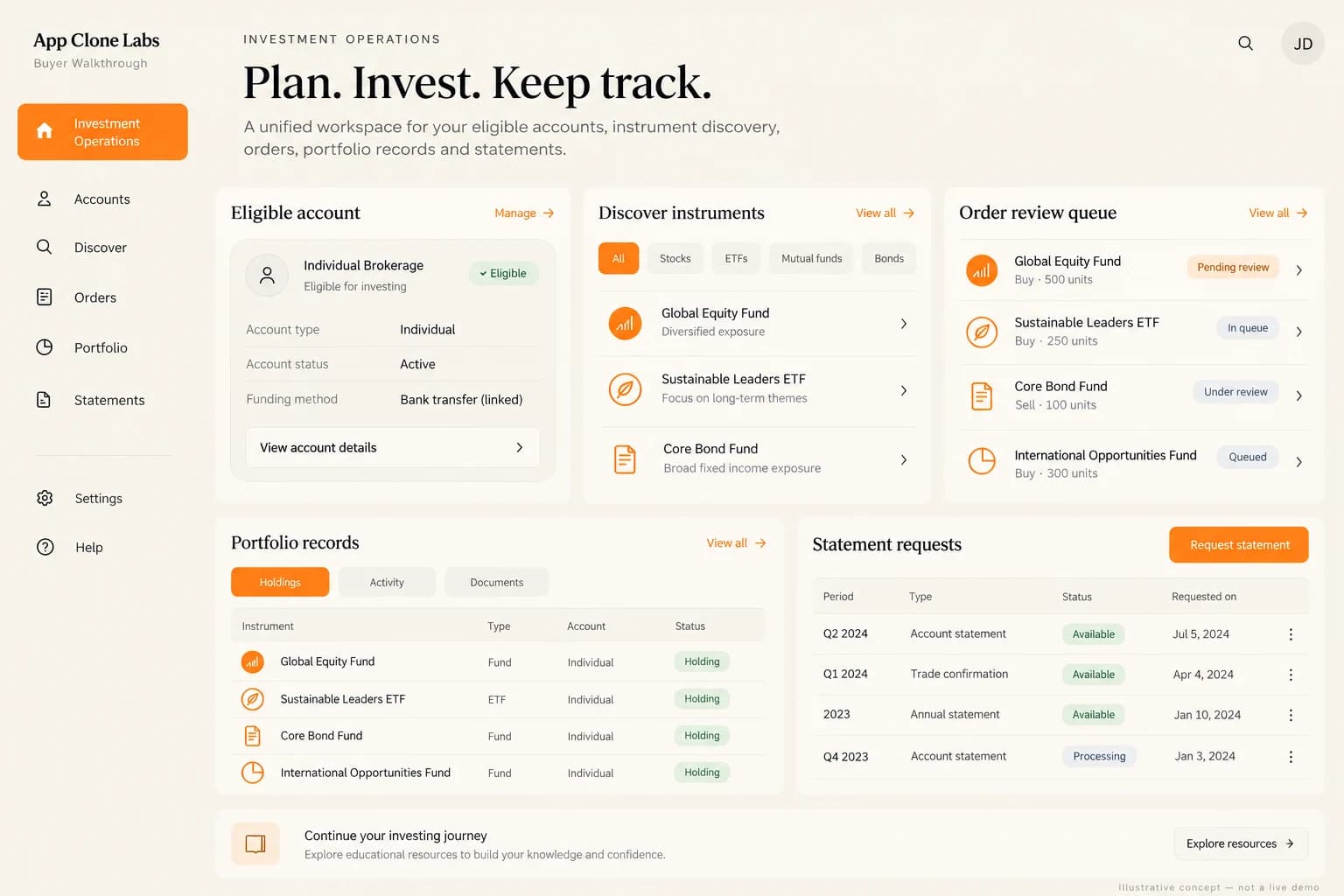
Use this original investment-operations concept to scope instruments, orders and statements. It is not Groww UI or proof of brokerage access, market data, returns, suitability, custody or financial advice.

Illustrative investment operations workspace with account, portfolio and statement controls

Illustrative investment operations workspace with account, portfolio and statement controls

Original investment-operations concept. Accounts, instruments and statuses are illustrative and do not establish live prices, execution, custody, returns or regulatory authorization.

What to check in the walkthrough

  • Suitability: Which identity, risk, jurisdiction and disclosure checks occur before an instrument is shown?
  • Order lifecycle: How are quote, submission, rejection, execution, settlement and reversal states recorded?
  • Portfolio trust: How are balances, fees, statements, tax records and audit events reconciled without promising returns?
Open full-size reference

Solution reference register

01 / Reference and IP

Groww is referenced only to describe a familiar multi-asset investment-product category. App Clone Labs is independent and is not affiliated with, sponsored by, or endorsed by Groww. No proprietary source code, design, content, data, or protected brand assets are offered.

02 / Artifact status

Boards, diagrams, screens and workflow descriptions on this page are illustrative planning artifacts, not evidence of a deployed client product.

03 / Regulatory caveat

Software does not provide or confer brokerage, advisory, distribution, exchange, custody, banking, or other financial-services authorisation. · Do not present educational content, filters, calculators, goals, or projections as personalised investment advice. · Each asset class, provider, jurisdiction, disclosure, customer-protection control, and data licence requires qualified review before activation. · Do not claim guaranteed returns, assured approval, suitability, capital protection, execution quality, compliance, or launch readiness.

04 / Rights and handover

The signed agreement defines rights in original client-specific deliverables, reusable materials, open-source software, third-party services, provider data, and protected brand assets. Regulatory permissions and market-data rights remain with their authorised owners.

Multi-asset investment operations

Design a governed wealth experience around authorised products, providers, and truthful customer records.

A Groww-style product is best understood as a multi-asset investment and wealth-operations platform, not as a screen-by-screen copy of a named application. It brings discovery, eligibility, account opening, portfolio records, recurring investment instructions, documents, education, and support into one governed customer experience. The software does not make its operator a broker, investment adviser, distributor, exchange member, custodian, or other regulated provider. Those roles, permissions, disclosures, and customer protections must be established with qualified advisers and the relevant authorities in every intended market.

This blueprint is for licensed institutions and authorised financial-service operators assessing an original investment experience under their own brand, contracts, providers, and controls. It is planning material rather than investment advice, a recommendation to offer any instrument, or a claim of regulatory readiness. Product scope must follow the operator’s actual permissions. No asset class, order type, return, approval, market access, or launch outcome is implied by this page.

Separate wealth breadth from trading execution

The defining question is whether the product helps a customer organise a broad investment relationship or optimises the mechanics of frequent trade execution. A wealth-led experience may combine eligible funds, listed securities, fixed-income products, recurring plans, goals, portfolio views, tax documents, and learning material through authorised providers. A trading-led experience concentrates on market data, order entry, routing, risk checks, execution status, positions, and professional tools. Combining both without a clear operating boundary can make suitability, fees, custody, support, and responsibility difficult to explain.

App Clone Labs treats this concept as distinct from the Zerodha-style self-directed brokerage blueprint. The Groww-style boundary is portfolio breadth, guided discovery without personalised advice, recurring instruction management, consolidated records, and understandable servicing. The Zerodha-style boundary is execution depth. An operator can ultimately support both, but the product model should identify which regulated entity owns each journey and which evidence a customer receives before expanding the catalogue.

Start with the authorised product catalogue

An investment catalogue is not an ordinary ecommerce catalogue. Each product needs a source, issuer or manufacturer, provider relationship, jurisdiction, currency, eligibility rules, dealing calendar, risk classification, fee and tax disclosures, minimums, documents, pricing or valuation source, and lifecycle status. Publication should follow an approved review process. A product that becomes suspended, matured, closed, restricted, or unsupported needs controlled treatment in discovery and in existing customer portfolios.

Different instruments also create different workflows. A fund instruction may involve cut-off times, units, net asset value, recurring mandates, settlement delay, rejection, and cancellation rules. A listed security may require venue access, quotes, pre-trade checks, order states, executions, and contract records. A fixed-income product may have denomination, maturity, coupon, liquidity, and issuer-risk considerations. These should not be forced into one generic “buy” object merely because the interface presents a unified search field.

Identity, eligibility, and account opening are product lifecycles

Customer onboarding should distinguish identity evidence, contact verification, tax status, residency, financial-service agreements, risk or appropriateness inputs where applicable, bank-account ownership, nominee or beneficiary records where supported, and provider-specific account states. The operator must decide what it is authorised to collect and who performs each review. Third-party identity results are evidence inputs, not automatic permission to activate every product.

Applications can be incomplete, duplicated, expired, returned for correction, escalated, approved for one product and not another, or closed after activation. Customers need truthful status and a safe route to correct information. Operations teams need review queues, reason codes, document controls, maker-checker approval where required, audit context, and escalation. Sensitive identity and financial data should be minimised, protected, retained, and disclosed according to the applicable legal, contractual, and provider requirements.

Keep orders, cash, holdings, and valuations separate

A credible investment system does not treat the number shown in a portfolio card as the source of truth. Customer instructions, provider orders, executions or allotments, cash movements, fees, taxes, units or positions, corporate actions, and valuations are separate records with different provenance. A portfolio view is derived from those records. It should display valuation time, currency assumptions, pending activity, and limitations so a customer does not mistake an indicative view for immediately realisable value.

The system needs correlation identifiers across every handoff. When a customer submits an instruction, the platform should be able to show whether it was received, validated, transmitted, accepted, partially completed, rejected, cancelled, settled, or awaiting reconciliation. Repeated taps, network timeouts, delayed provider callbacks, and manual corrections must not create duplicate financial consequences. Idempotency, durable state transitions, reconciliation, and exception ownership are foundational product requirements.

Recurring investments require mandate and calendar controls

A recurring investment plan is not merely a scheduled button press. It involves customer consent, funding authority, amount and frequency, eligible dates, holidays, cut-off rules, retries, insufficient funds, provider submission, modification, pause, cancellation, and a record of each attempt. The product should distinguish a plan from the individual instructions it generates. Changing a plan should not rewrite the history of instructions already submitted or settled.

Customer communication must follow actual state. An upcoming reminder is not confirmation that money was collected. A debit request is not proof an investment was allotted. A failed attempt should explain the next available action without promising a price or return. Operators need queues for rejected mandates, stale instructions, unmatched provider records, and customer disputes. These controls matter more than celebratory animations because they determine whether the recurring experience remains trustworthy.

Goals can organise information without becoming hidden advice

Goals can help customers label time horizons, contributions, and progress, but the software must not present an arbitrary target allocation, risk score, or projected return as a suitable personal recommendation unless the responsible authorised advisory process supports it. Educational explanations, neutral filters, calculators, and customer-selected preferences should be clearly distinguished from regulated advice or research. Methodology, assumptions, uncertainty, fees, inflation, tax treatment, and data freshness should be visible where they affect an output.

If the product includes recommendations, model portfolios, nudges, or automated rebalancing, the operator needs a separate decision covering advisory authority, customer information, suitability, conflicts, oversight, model governance, disclosures, consent, execution, monitoring, and review. A software vendor can implement an agreed control model; it cannot supply the operator’s licence or make a legal suitability determination on the operator’s behalf.

Design a consolidated portfolio without concealing custody

Customers may see holdings from several providers in one interface. The product should identify which institution executes, safeguards, administers, or records each asset and where the customer can obtain the authoritative statement. Imported or aggregated data needs consent, refresh status, matching rules, and a correction route. The platform should not imply custody merely because it displays a balance, or imply ownership merely because an instruction is pending.

Corporate actions, distributions, fees, taxes, splits, maturities, transfers, and corrections affect portfolio history. The operating model should decide which events are received from providers, calculated locally, confirmed manually, or shown only after reconciliation. Performance calculations need a documented method and complete cash-flow data; otherwise the interface should use narrower language. Any benchmark comparison must state the benchmark, period, currency, treatment of fees, and source.

Provider integrations define what the product can truthfully promise

Market data, product reference data, identity verification, bank mandates, payment rails, brokers, distributors, custodians, transfer agents, exchanges, depositories, tax services, and communication systems may all sit outside the application. Each integration needs an account owner, approved use, data licence, environment, authentication, timeout handling, retry and duplicate policy, callback verification, monitoring, reconciliation, and support contact. Demonstration data must be labelled and kept separate from production evidence.

The customer journey should degrade safely when a provider is unavailable. The application must not invent a quote, hide stale data, or declare a financial instruction complete because a request was sent. It should preserve the instruction identifier, communicate the known state, prevent unsafe repetition, and give operators an investigation path. Contract changes, provider maintenance, credential expiry, and API version changes need named ownership after launch.
Operations and compliance are first-class surfaces

A multi-asset platform needs more than a customer application. Depending on the authorised model, operations may require onboarding review, product publication, document management, mandate exceptions, order and settlement reconciliation, cash breaks, restricted-account handling, complaints, communication history, provider health, access review, and regulatory or management reporting. Permissions should follow responsibility and segregation of duties, with sensitive actions attributable to an authorised operator.

Surveillance, sanctions screening, fraud controls, complaint handling, recordkeeping, best-execution or order-handling review, and customer-asset protections vary by service and jurisdiction. They should be mapped to the regulated entity and qualified reviewer responsible for them. A generic compliance badge or checklist is not evidence that the operating model is approved. The release should state which controls are implemented, configured, externally provided, manually operated, untested, or excluded.

Build disclosures into the decision journey

Fees, taxes, product risk, liquidity, lock-ins, cancellation, market hours, valuation basis, conflicts, provider identity, and complaint routes should appear where a customer makes the related decision—not only in a footer. The wording must match the commercial and regulatory documents approved for the product. Consent records should capture the document version, time, customer, context, and action where required, without using interface friction as a substitute for comprehension.

Marketing and lifecycle messages require the same discipline. The product should not imply guaranteed returns, assured approval, capital protection, or suitability unless the authorised product and approved disclosure support the statement. Performance examples require substantiation and balanced limitations. Personalisation should respect consent and should not turn sensitive financial behaviour into manipulative pressure. High-consequence decisions need an accessible route to human support.

Security and resilience follow financial consequences

The security model should cover account recovery, session and device management, multifactor authentication where appropriate, server-side authorisation, privileged operations, secrets, provider credentials, sensitive-data storage, encryption choices, logs, software dependencies, abuse controls, monitoring, incident response, and customer communication. Security verification should be proportionate to the threat model and independently reviewed when required. No page can promise that a future deployment is universally secure.

Resilience planning should identify the journeys whose interruption creates customer or financial harm. Recovery objectives, backup and restore evidence, provider fallbacks, queue recovery, reconciliation, and manual continuity should follow those journeys. A mobile or web interface may remain available while a provider cannot accept instructions; accurate degraded-state communication is therefore as important as infrastructure uptime.

How to scope a defensible first release

The safest first release is usually narrower than a “complete investing super app.” It may serve one eligible customer segment, one jurisdiction, one responsible regulated entity, a limited product family, one funding method, and a defined servicing team. It should complete account opening, discovery, required disclosure, an authorised instruction, status, holdings or records, documents, support, and operator reconciliation. Every included product must have real provider and policy readiness.

Additional asset classes should be added as separate operating capabilities, not labels added to navigation. Each expansion may change eligibility, market data, order behavior, settlement, custody, fees, tax records, disclosures, complaints, and support. The roadmap should sequence these dependencies and define the evidence required before activation. This protects customers and prevents catalogue breadth from concealing unfinished control work.

Evidence required before a controlled launch

  • The operator, provider, and legal responsibilities for each customer journey and asset class are documented and approved by the appropriate owners.
  • Critical onboarding, consent, instruction, recurring-plan, cancellation, settlement, document, complaint, and reconciliation scenarios pass in the named environment.
  • Market and portfolio data show their source and freshness, while demonstration, delayed, indicative, and authoritative records remain distinguishable.
  • Permissions, privileged actions, audit evidence, incident paths, provider failures, repeated requests, and recovery procedures are exercised with accountable operators.
  • Store, web, privacy, security, accessibility, support, handover, and release documentation accurately describe the shipped product and its limitations.

Handover and long-term ownership

The signed agreement should identify applicable source code, infrastructure, database and integration documentation, tests, design files, vendor accounts, credentials, data licences, reusable components, third-party software, support, and transition responsibilities. Regulated-provider contracts, market-data rights, customer agreements, policies, and approvals remain the operator’s responsibility unless a separate agreement explicitly says otherwise.

This reference uses the Groww name only to describe a familiar product category. App Clone Labs is independent and does not claim affiliation, endorsement, access to proprietary code, or permission to use protected branding, content, data, or interface assets. The delivered product must use original design, content, implementation, workflows, and commercial identity. Its readiness depends on the buyer’s jurisdiction, authorisations, providers, review, testing, and operating capacity.

01 / PRODUCT DISTINCTION

Breadth and servicing—not trading-terminal depth.

Separate multi-asset wealth operations from execution-led brokerage so customers and operators understand who owns every outcome.

Catalogue

01

Authorised investment products

Model eligibility, disclosure, data, order behavior, settlement, custody, documents, and lifecycle per asset class.

Records

02

Portfolio and recurring instructions

Keep plans, orders, cash, holdings, valuations, and authoritative provider records distinct.

Comparison

03

Execution-led brokerage

Review the adjacent trading-first architecture and avoid search-intent or product-boundary overlap.

Open register

Deployable Product Architecture

01 / PRODUCT DISTINCTION / system register

Revision EPlanning surface

Product delivery loop

Breadth and servicing—not trading-terminal depth.

A focused release proves one complete workflow

Product delivery loop: Breadth and servicing—not trading-terminal depth.A focused release proves one complete workflow. Scope the customer action and the operator response as one system.
01

Authorised investment products

02

Portfolio and recurring instructions

03

Execution-led brokerage

Control note

Scope the customer action and the operator response as one system.

Illustrative architecture register; validate against the accepted scope.

02 / CONTROL PLANE

What makes the platform operable.

Connect customer decisions to review queues, reconciliation, provider health, complaints, access control, and release evidence.

Integration and failure governance

Name authority, licences, state, retries, reconciliation, data freshness, and support for each dependency.

Non-advice and YMYL boundaries

Keep education, filters, goals, recommendations, and regulated advice accurately separated.

Original mobile and web product

Build accessible customer journeys and operator controls under original branding.

Buyer and compliance questions

Questions to resolve before building a multi-asset investment platform.

01Is a Groww-style platform the same as a trading terminal?

No. This blueprint prioritises multi-asset discovery, recurring investments, goals, consolidated portfolio records, documents, and servicing. A trading-first product prioritises market data, order routing, execution controls, and active-trader tools.

02Does the software include a broker, adviser, exchange, or custodian licence?

No. Software does not confer regulatory authorisation. The operator must establish every regulated role, provider relationship, disclosure, customer protection, and approval required in each intended market.

03Can the platform recommend investments?

Only within an operating model reviewed and authorised for advice or recommendations. Neutral education and customer-selected filters should remain distinct from personalised advice, model portfolios, nudges, or automated rebalancing.

04How should multiple asset classes be added?

Treat each asset class as a separate operating capability with its own eligibility, data, order or instruction states, settlement, custody, fees, taxes, documents, disclosures, complaints, and support evidence.

05What is a credible first-release boundary?

One authorised operator, jurisdiction, customer segment, limited product family, funding route, and complete journey from onboarding through instruction, status, records, support, and reconciliation.

06Can portfolio values be treated as authoritative balances?

Not automatically. The interface should state the source, valuation time, currency assumptions, pending activity, and limitations, and identify where the customer obtains the authoritative provider statement.

07What happens when a provider API is unavailable?

Preserve the instruction identifier and last known state, prevent unsafe duplication, label stale or unavailable data, provide customer guidance, and route the exception to an accountable operations queue.

08Is App Clone Labs affiliated with Groww?

No. The name is used only as a descriptive category reference. Any delivered product requires original branding, design, content, implementation, workflows, and commercial identity.

Primary sources

References behind this page

Dated official documentation, standards, and research that support the factual claims on this page.

  1. 01
    SEBI Investor Website

    Official Indian investor information and investor-protection resources; applicable obligations require current professional review.

  2. 02
    SEBI Legal Framework

    Official access to Indian securities laws, regulations, circulars, and orders; determine the current instruments and rules that apply.

  3. 03
    SEC Regulation Best Interest

    Official United States material on broker-dealer standards and related disclosure; relevant only where that regime applies.

  4. 04
    FINRA Know Your Customer Rule 2090

    Primary rule text concerning essential customer facts for FINRA members in the United States.

  5. 05
    OWASP Application Security Verification Standard

    A structured technical reference for defining proportionate application-security verification requirements.

Citation readiness

How to interpret this page

Published by App Clone Labs Editorial Team · Updated

Commercial claims
Scope, cost, and timeline claims are planning guidance and require validation in a current proposal.
Evidence status
Diagrams, boards, examples, and estimates are illustrative planning artifacts unless explicitly identified with a source and measured evidence status.

Planning only

Map the authorised investment operation before defining features.

Bring the intended market, licences, provider model, customer segment, asset classes, and servicing responsibilities for a controlled feasibility review.

Commercial rights, repositories, environments, documentation, acceptance and handover remain contract-defined.

Plan the authorised platform

Independent from Groww

App Clone Labs is an independent software development studio. We are not affiliated with, connected to, sponsored by, or endorsed by Groww.

Why this name appears

Groww is referenced descriptively to identify familiar product mechanics and common search terminology. “Clone” describes a planning reference, not a replica.

Original delivery

Any product delivered by App Clone Labs is independently designed and developed for the accepted scope. It does not contain proprietary code, branding, copy, interface assets, or confidential material from Groww.

Trademark ownership

Groww and associated names, logos, and marks remain the property of their respective owners. Their use identifies a reference category and does not imply authorization or endorsement.