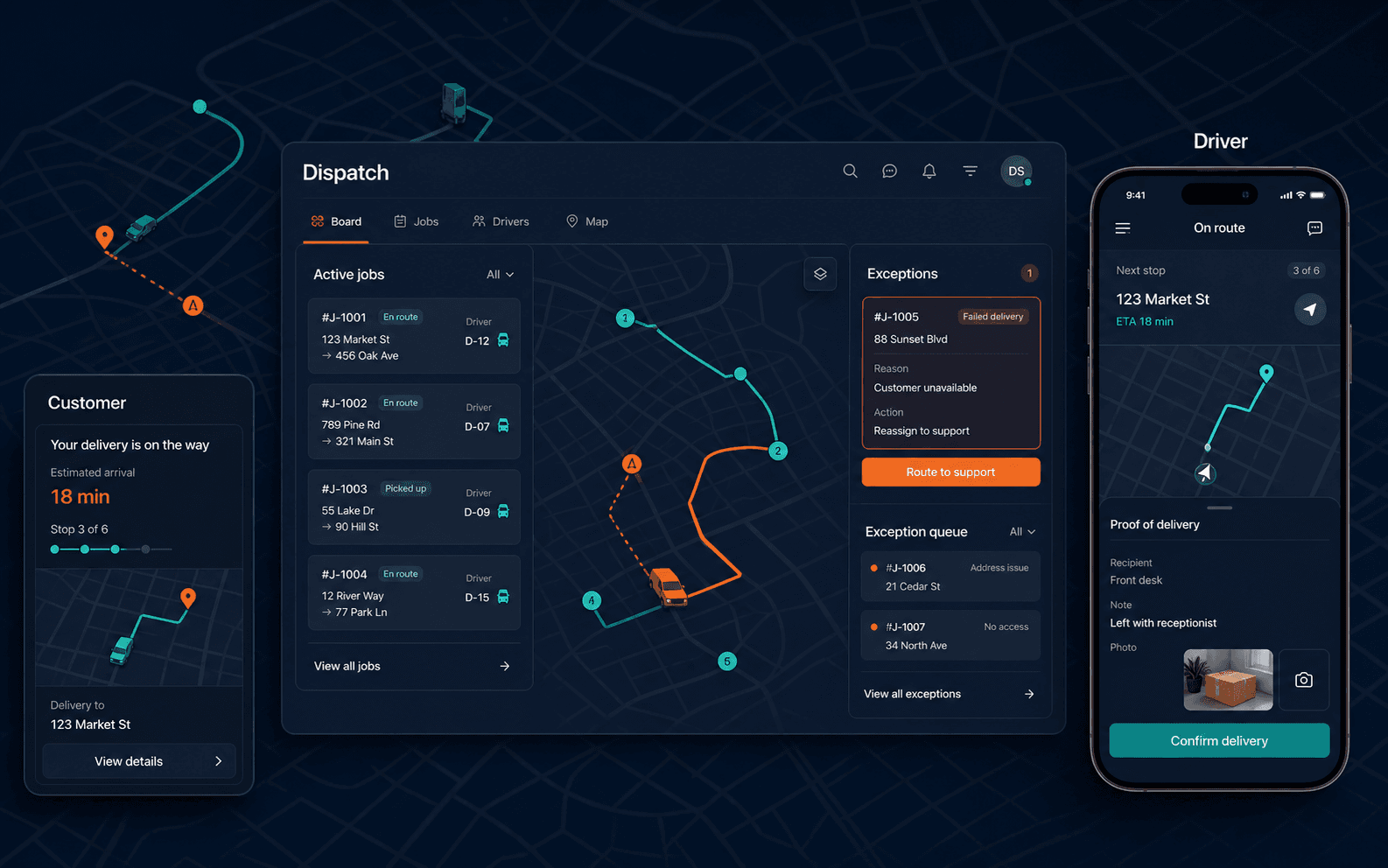
Logistics and mobility

Lyft-style Ride Marketplace — Custom-Built for Your Market

Two-sided ride-hailing marketplace with driver dispatch. Planned for mobility operators building local rider and driver networks with role-specific workflows, operator controls, integrations, and a handover boundary defined for the selected market.

See product screens and demo access

Custom workflows

Brand-safe product strategy

Admin and operations tooling

Reference walkthrough by arrangement

Review eligible vehicle matching and cancellation handling for a local ride marketplace.

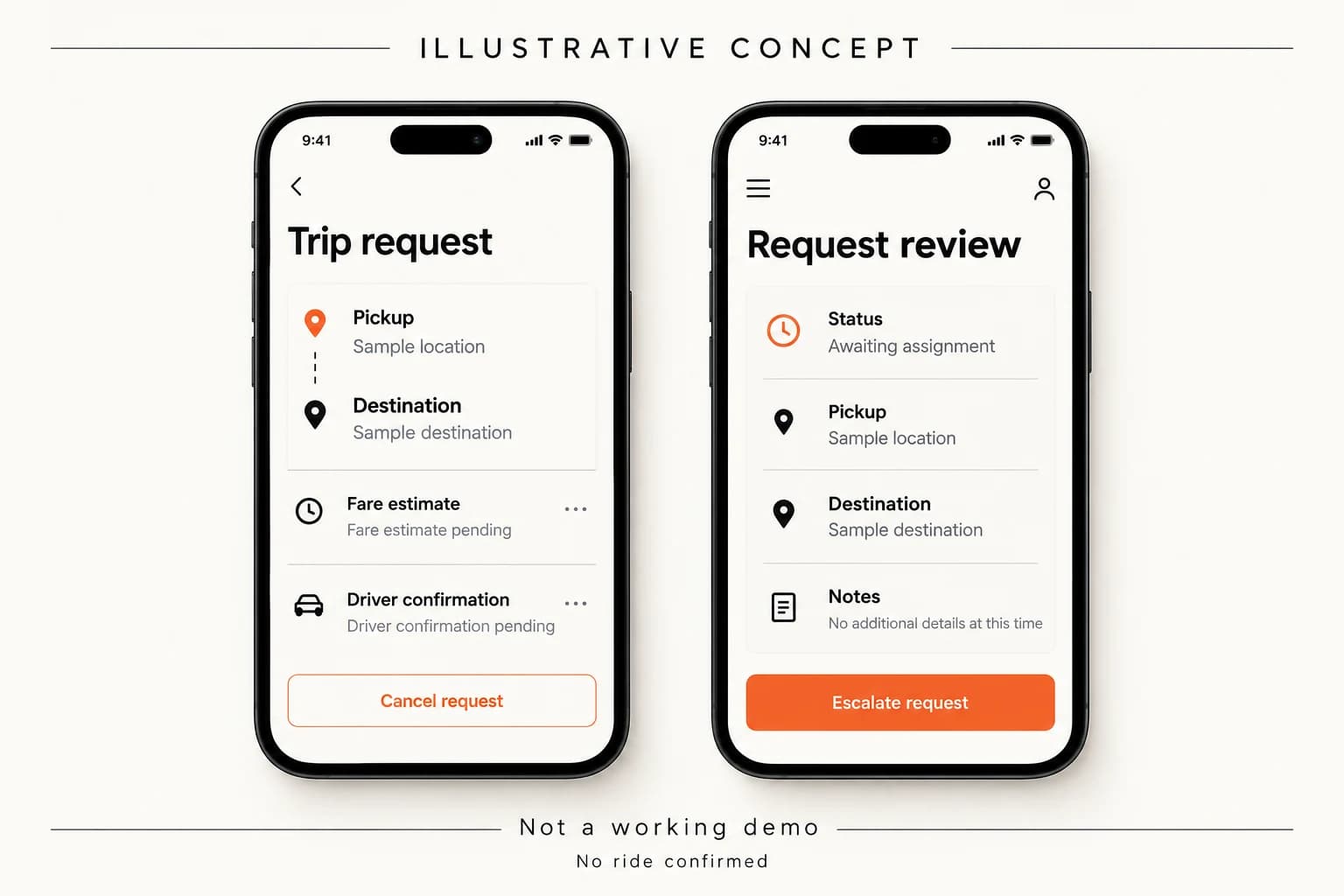
Use this original ride-request concept to discuss a Lyft-style Ride Marketplace for your service area. The sample route awaits an estimate and a confirmed driver. Ask for a scoped working demo that connects rider requirements, driver and vehicle eligibility, matching decisions and dispatcher intervention under the proposed operating rules.

Local ride-matching concept awaiting an estimate and confirmed driver

Local ride-matching concept awaiting an estimate and confirmed driver

Original App Clone Labs ride-request concept at 1536×1024, showing sample pickup and destination, a pending estimate, pending driver confirmation and dispatcher escalation. It is illustrative artwork, not Lyft UI or a live fleet view. The image does not establish accessible vehicle supply, driver eligibility, matching performance, safety or transport compliance; those need evidence for the agreed service area.

What to check in the walkthrough

  • Accessible fleet scope: Which rider requirements and vehicle capabilities will the proposed service support, and how is available supply verified? Ask the demo to request an agreed accessible vehicle option when no eligible vehicle is available, then show the rider explanation and dispatcher escalation without silently substituting a different vehicle.
  • Driver eligibility and matching: Which driver approval, vehicle category, service-area and availability checks gate an assignment? Ask to suspend a driver or expire a vehicle approval while a request is pending, inspect the matching decision and attempt manual assignment; identify who owns eligibility records and when they are checked again.
  • Cancellation ownership: How do rider cancellation, driver cancellation, no-show and rematching affect the booking, proposed fee and notifications? Ask to cancel while driver acceptance is arriving, then inspect the authoritative outcome, fee reason and review history so operations can resolve a disputed cancellation without retaining two assignments.
Open full-size reference

Solution reference register

01 / Reference and IP

This page references third-party product names only to describe familiar product models and planning references. App Clone Labs is not affiliated with or endorsed by those brands. Build decisions require independent legal, regulatory, and operational review for your market.

02 / Artifact status

Boards, diagrams, screens and workflow descriptions on this page are illustrative planning artifacts, not evidence of a deployed client product.

03 / Regulatory caveat

Qualified transport concept · Driver, vehicle, fare, and operating rules vary by market · Insurance and accessibility review required

04 / Rights and handover

Source access, licensing, repositories, environments, documentation, acceptance and handover are defined by the signed contract and accepted scope.

Scope

Operating model defined

Roles, workflows, dependencies, exclusions, and assumptions are made reviewable.

Evidence: illustrative

System

Applications connected

Experience, operations, services, data, integrations, and release controls are planned together.

Evidence: illustrative

Handover

Rights stated in writing

Access, assignment, licensing, dependencies, documentation, and support follow the signed agreement.

Evidence: illustrative

Artifact register

Product screens and planning references.

Reference screens illustrate workflows, not a contracted feature list. Sample prices, data, and responses are demonstration content; confirm the current scope during a walkthrough.

Lyft-style Ride Marketplace connected product workflow planning visual
Connected customer, operations, and data workflowEvidence: illustrativeOpen full-size reference
Lyft-style Ride Marketplace product engineering ecosystem visual
Product engineering ecosystem and handover boundaryEvidence: illustrativeOpen full-size reference
Lyft-style Ride Marketplace operations and dispatch planning visual
Operations, dispatch, and exception handlingEvidence: illustrativeOpen full-size reference

The car has arrived, but the rider is waiting at a different entrance

A rider requests collection outside a railway station. The driver reaches the taxi lane, the rider waits at the accessible entrance and both screens say the other person is nearby. The arrival countdown starts, a cancellation follows and a no-show charge becomes a support dispute. A moving map did not solve the pickup. The product needed an agreed meeting point, clear readiness messages and evidence that described what actually happened.

A Lyft-style ride marketplace connects riders and approved drivers through independently branded booking, pickup, journey and support software. It does not include Lyft’s drivers, proprietary code, operating permissions or safety organization. For a buyer, the useful decision is whether the operator can deliver the promised ride experience in a defined area, including awkward pickups and disputed outcomes. The interface should make those responsibilities visible rather than conceal them behind a familiar booking pattern.

Define the pickup agreement before the driver starts navigating

A street address and a usable meeting point are not always the same thing. Capture the rider’s chosen entrance, permissible stopping location and concise instructions separately from device GPS position. Show uncertainty instead of treating every location fix as precise. If a venue has restricted access, explain the meeting point before confirmation. Drivers should receive instructions that are useful while parked, not a paragraph they must read while moving.

Changing the meeting point creates a new version that both participants must receive. A driver following an older instruction should not acquire a no-show entitlement because the rider accepted a different entrance. Record who changed the location, whether it was acknowledged and how it affected arrival expectations. Keep sensitive access notes out of public profiles. Test a rider moving between entrances with a weak connection, then inspect the same pickup version on the operations screen.

Treat scheduling as a service commitment, not a calendar decoration

The official Lyft scheduled-rides guidance distinguishes booking ahead from local driver availability and describes a conditional airport-related credit program. Those are that operator’s terms, not benefits included with this software. A buyer must define their own assignment policy and funded remedies rather than copy a promise into a booking screen.

Show scheduled request, driver assigned, driver approaching and pickup confirmed as distinct states. State when the rider should expect confirmation and what happens if a driver withdraws. A stored pickup time alone does not prove that a vehicle is reserved. Define reminders, time-zone handling, payment authorization and cancellation rules explicitly. If the business sells a guaranteed reservation, its staffing, substitute capacity and customer remedy must support that different obligation; a scheduling feature cannot establish them.

Give rider readiness its own signal at the meeting point

Arrival should trigger useful instructions, not simply a countdown. Let the rider confirm they have reached the agreed location and identify the assigned car without broadcasting personal details. Explain whether a driver is waiting, circling because stopping is prohibited or approaching a nearby entrance. These conditions have different consequences. Keep notification delivery separate from acknowledgement so a failed message is not mistaken for evidence that the rider ignored it.

Provide a text-based contact alternative and a way to correct the meeting point without abandoning the trip. Avoid relying solely on color, a map pin or an audible notification. An operations agent should see the last acknowledged instruction and whether contact was attempted, not assume that physical proximity means the participants met. Rehearse a rider who cannot hear a call and a driver who cannot safely stop at the original pin. Recovery belongs inside the journey, not only in support training.

Publish accommodation choices only where the service can deliver them

The Lyft Canada accessibility guidance separates wheelchair-accessible vehicles, assisted rides and communication features, and notes that wheelchair rides are not available in every market. It is a useful example of distinguishing service types. Its Canadian policies are not a universal legal specification or proof that an independent operator has equivalent vehicles or assistance capacity.

Maintain capability and availability separately: a suitable vehicle may exist but be unavailable for the requested time or area. Explain assistance boundaries and obtain qualified local review of accessibility and anti-discrimination responsibilities. Do not present a service animal as an ordinary paid pet upgrade. Collect only the information needed to arrange the ride and protect it from unrelated staff. A failed accommodation requires a meaningful reporting path, not a misleading generic reason that erases the problem.

Verify the vehicle before arrival becomes a started trip

The rider needs a readable driver identity and assigned vehicle record at pickup. Later changes to a driver profile must not overwrite the vehicle associated with a disputed journey. Define what happens if another car arrives, the passenger is not the intended rider or a third party booked on someone’s behalf. Starting the meter should require the agreed confirmation, not a location event that happens while a car passes the station.

Driver eligibility, insurance and operating authority remain responsibilities requiring appropriate verification and review. A profile badge or identity provider result does not establish every permission to transport passengers. Protect verification documents and restrict staff access to relevant duties. When a mismatch is reported, preserve evidence and route it to an accountable team. The product should offer a clear stop-and-report option without suggesting that continuing an uncertain pickup is necessary to avoid a fee.

Make no-show decisions reviewable from the disclosed pickup terms

A missed pickup can be caused by rider absence, an inaccessible meeting point, a late driver or conflicting instructions. Define applicable waiting and cancellation rules before the booking is accepted. Keep scheduled and immediate requests distinguishable. The evidence record should include the agreed location, arrival event, relevant uncertainty, contact attempts and acknowledged changes. Avoid treating one driver tap as conclusive proof that the rider failed to appear.

An authorized reviewer needs both participants’ accounts and a way to correct an erroneous fee without destroying the original decision. Duplicate cancellation events must not create duplicate charges. Separate payment reversal from an accommodation complaint or a safety investigation; a refund does not automatically resolve either. Review disputed no-shows with sample timelines before release. The buyer should be able to explain the decision from the record without guessing what happened from two moving dots.

Explain the receipt when the completed route differs from the quote

A changed destination, permitted waiting charge or toll can make the receipt differ from the initial estimate. Disclose the pricing basis and amendment process before the trip. Record the rider’s authorized changes and applicable terms rather than editing the original quote. Show fare, platform charges, taxes, tolls and optional tips as intelligible components. Do not label a variable estimate as a fixed price unless the operating agreement actually supports that promise.

Trip completion and successful collection are different events. A delayed payment callback must remain unresolved until reconciled, not invite a second charge merely because the first screen timed out. Staff adjustments need an actor, reason and financial consequence; driver proceeds should reconcile with the same trip record. Demonstrate an extra stop, disputed toll and uncertain payment result. Buyers need to inspect the resulting receipt and correction history, not only the passenger checkout animation.

Keep safety reporting separate from ratings and fare complaints

A safety concern needs a clearly identified channel even when the ride was cancelled or never started. Do not bury it inside a low-star rating form. State who reviews reports, what support is available and when participants should contact local emergency services. Software can surface information and route an incident; it does not replace responders or guarantee protection. Another platform’s emergency partnership is not included without a separately established arrangement.

Limit access to incident evidence and avoid publishing allegations in ordinary driver feedback. Preserve relevant trip context without exposing a rider’s entire travel history. Define escalation, acknowledgement and appropriate account restrictions with qualified operational reviewers. A financial agent issuing a credit should not silently close an incident. Test a report made after cancellation and verify that the affected participant can still submit relevant information without reopening the booking or confronting the other party.

Handle airport arrivals differently from trips to an airport

A passenger landing at a terminal may not be ready when the aircraft touches down. Baggage collection, immigration and the permitted pickup zone affect readiness. A trip to the airport has a different origin and deadline. Keep the two directions explicit in scheduling rules and customer communications. Access to flight data does not itself provide airport operating permissions, a parking entitlement or authority to use a restricted pickup lane.

Scope airport-specific work only after the operator confirms access rules and support coverage. Define who may adjust a pickup after flight changes and how the driver receives the update. Avoid charging for a waiting period whose starting event the rider was never shown. Group travel, luggage and assistance requirements can change vehicle suitability. A controlled example should include a delayed arrival and changed terminal so the buyer can judge whether the proposed workflow is usable.

Choose the operating boundary before adding more mobility categories

Start with a service area and ride category the operator can supervise. Set responsibilities for driver approval, vehicle checks, support, disputes and payment reconciliation. Review local transport, fare, insurance, privacy and accessibility requirements with appropriate specialists. Product engineering does not grant operating authority. Expansion into different vehicles, courier work or intercity transport changes the operating model and should not be treated as another filter on the same booking form.

Compare an inDrive-style negotiated-fare marketplace if participant price proposals are central to your business. This page instead emphasizes pickup readiness, scheduled-service commitments and post-trip accountability. Choose that interaction deliberately: negotiation introduces offer selection and agreement rules that are not solved by ordinary dispatch. The reference name helps explain a category; it is not a reason to adopt every feature the reference business offers.

Ask the walkthrough to prove a difficult pickup and its resolution

Illustrative screenshots describe proposed interfaces, not a live driver network or guaranteed demo access. Request a controlled walkthrough using sample riders, drivers and sandbox payments. Move the pickup point after assignment, suppress an arrival notification and reconnect both devices. Check that the latest instruction survives and that a no-show decision cannot ignore the change. Inspect the operations record alongside the rider and driver screens.

Buyer acceptance should also cover an unavailable accommodation category, vehicle mismatch, scheduled driver withdrawal, receipt correction and a report after cancellation. Verify readable mobile instructions, keyboard access and permission boundaries. The proposal should distinguish configured components, new engineering, third-party access and operator obligations. These checks make scope review concrete without claiming another brand’s approvals, response times or commercial results. Delivery milestones should follow the agreed operating scope rather than an unsupported universal launch date.

Bring a pickup policy and a disputed-ride example to a ride-marketplace scope discussion. Agree ownership, dependencies, support responsibilities and handover access in the applicable contract.

Use the delivery process to set review checkpoints for pickup recovery, accommodation communication, payment reconciliation and incident training.

Product flow

Role-workflow flow diagram.

A visual map of how each role interacts with each workflow stage, with operator controls and integration boundaries.

Deployable Product Architecture

Lyft-style Ride Marketplace

ESTABLISH THE RID…BRING RIDER AND D…SEPARATE TRIP CLO…Find the correct …Meet the rider wi…Resolve missed pi…INTEGRATIONS: Maps, geocoding and messaging with safe meeting-point guidance, pickup vers…OPERATOR CONTROLS: Keep arrival, rider readiness and boarding distinct · Describe actual servi…
Illustrative validation artifact — role-workflow flow diagram; final surfaces, boundaries, and integration topology are confirmed during discovery.

User roles

Lyft-style Ride Marketplace roles and workflows.

Clone-inspired platforms usually need several coordinated interfaces, not just a customer app.

Rider

01

Find the correct pickup and understand the commitment

Choose a supported ride, confirm the meeting point and distinguish a scheduled request from driver assignment. Review the quote, accommodation information and cancellation terms before booking.

Driver

02

Meet the rider without confusing arrival with boarding

Receive a current pickup instruction, confirm the assigned vehicle and record arrival, contact attempts and trip start separately. Escalate unsafe or inaccessible pickup conditions.

Mobility operations

03

Resolve missed pickups and disputed ride outcomes

Inspect booking versions, readiness messages, no-show evidence and fare adjustments. Keep incident handling, accessibility complaints and financial decisions in accountable queues.

Workflow

Lyft-style Ride Marketplace workflow stages.

Each workflow stage is mapped to a role, screen, API, notification, admin control, and measurable launch outcome.

Request

01

Establish the ride and meeting-point expectations

Check operating area, ride category, pickup location and supported accommodations. Present scheduled status and disclosed price components without implying guaranteed vehicle availability.

Meet

02

Bring rider and driver to the same safe location

Synchronize pickup instructions and arrival notices. Confirm rider readiness, vehicle identity and any agreed meeting-point change before allowing the journey to start.

Complete and review

03

Separate trip closure from payment and incident closure

Issue an itemized receipt, reconcile the payment result and route disagreements. Preserve evidence needed to review a missed pickup or safety report without exposing unnecessary location history.

Deployable Product Architecture

Workflow / system register

Revision EPlanning surface

Live operations

Lyft-style Ride Marketplace workflow stages.

Every request becomes an observable job

Live operations: Lyft-style Ride Marketplace workflow stages.Every request becomes an observable job. Exceptions and support need the same visibility as the happy path.
01

Establish the ride and meeting-point expectations

02

Bring rider and driver to the same safe location

03

Separate trip closure from payment and incident closure

Control note

Exceptions and support need the same visibility as the happy path.

Illustrative architecture register; validate against the accepted scope.

Operator controls

Lyft-style Ride Marketplace admin and operator controls.

The control center is scoped as a first-class product surface, not an afterthought.

Pickup state

01

Keep arrival, rider readiness and boarding distinct

Use server-recorded transitions and the latest meeting-point version. A driver tap or location estimate alone must not prove the rider boarded or justify an automatic no-show charge.

Accommodation scope

02

Describe actual service availability without hiding obligations

Maintain reviewed vehicle capabilities, geographic coverage and assistance boundaries. Protect accommodation details and give complaints an accountable route rather than a generic cancellation reason.

Review evidence

03

Resolve fares and incidents without rewriting history

Restrict access to contact attempts, disclosed terms and trip events. Require reasons for manual adjustments and preserve the original receipt alongside any correction.

Monetization

Lyft-style Ride Marketplace monetization models.

We model monetization early so payments, admin controls, and reporting support the business.

Disclose passenger charges and driver proceeds

Define platform fees, taxes, toll treatment and permitted adjustments. Keep fare collection, tips and driver settlement separately reconcilable.

Apply employer controls without exposing personal travel

Scope eligible travellers, spending limits and invoice access. A business administrator needs agreed financial records, not unrestricted rider location history.

Fund any benefit before presenting its promise

Specify membership discounts or service credits with eligibility, exclusions and settlement rules. Do not imply that payment for a plan guarantees supply or overrides accessibility duties.

Integrations

Lyft-style Ride Marketplace integration surface.

External systems that determine launch readiness, data flow, and operational continuity.

Integration

01

Integration 1

Maps, geocoding and messaging with safe meeting-point guidance, pickup versions, uncertainty handling and minimum necessary location retention

Integration

02

Integration 2

Driver and vehicle verification services with capability records, permissioned document access, expiry handling and operator-reviewed transport eligibility

Integration

03

Integration 3

Payment, receipt and support systems with trip identifiers, itemized adjustments, duplicate-event protection and separate incident escalation

Scope drivers

Lyft-style Ride Marketplace scope drivers.

The variables that most influence build effort, cost, and launch readiness.

Pickup environment

01

Choose the places the operator can actually serve

Review street access, event restrictions, airport permissions and meeting-point guidance. Scheduled travel requires supply planning and exception support beyond a calendar selector.

Service commitments

02

Write the distinction between a request and a reservation

Define assignment timing, reminders, driver withdrawal and rider notifications. Any arrival promise needs explicit conditions and an operator-backed remedy.

Accessibility and review

03

Match interfaces to real operating responsibilities

Agree supported vehicles, assistance policies, communication alternatives and complaint ownership with qualified local reviewers. Category labels cannot substitute for available service.

Deployable Product Architecture

Scope drivers / system register

Revision DPlanning surface

Live operations

Lyft-style Ride Marketplace scope drivers.

Every request becomes an observable job

Live operations: Lyft-style Ride Marketplace scope drivers.Every request becomes an observable job. Exceptions and support need the same visibility as the happy path.
01

Choose the places the operator can actually serve

02

Write the distinction between a request and a reservation

03

Match interfaces to real operating responsibilities

Control note

Exceptions and support need the same visibility as the happy path.

Illustrative architecture register; validate against the accepted scope.

V1 scope

Lyft-style Ride Marketplace V1 foundation.

Launch the smallest complete operating loop first, then scale the product with confidence.

Local rider journeys

01

Prove request, pickup and trip closure together

Support one reviewed vehicle category and service area with visible terms, meeting-point confirmation and durable trip status across reconnecting devices.

Pickup recovery

02

Show what happens when participants cannot meet

Provide contact attempts, a changed pickup point, disputed arrival and no-show review. Keep safety and accommodation concerns distinguishable from ordinary cancellations.

Receipts and accountability

03

Trace each adjustment to an actual decision

Connect trip events to payment attempts and an itemized receipt. Rehearse unresolved charges, restricted support access and incident escalation with controlled data.

Later phases

Lyft-style Ride Marketplace post-launch expansion.

Capabilities that should usually wait until real usage proves the core loop.

Scheduled and airport travel

01

Add commitments after supply and permissions are established

Introduce scheduling, flight information and airport pickup instructions only with reviewed assignment rules, reminders and fallback arrangements.

Additional service categories

02

Validate accommodation capacity before publishing availability

Extend vehicle capabilities and assistance options with appropriate training, coverage checks and complaint handling. Do not use another operator’s coverage map as your own.

Business and membership programs

03

Separate billing convenience from ride guarantees

Add permissioned business invoices and funded benefits after ordinary fares reconcile. Evaluate service exceptions before promising priority or punctuality.

Deployable Product Architecture

Later phases / system register

Revision APlanning surface

Live operations

Lyft-style Ride Marketplace post-launch expansion.

Every request becomes an observable job

Live operations: Lyft-style Ride Marketplace post-launch expansion.Every request becomes an observable job. Exceptions and support need the same visibility as the happy path.
01

Add commitments after supply and permissions are established

02

Validate accommodation capacity before publishing availability

03

Separate billing convenience from ride guarantees

Control note

Exceptions and support need the same visibility as the happy path.

Illustrative architecture register; validate against the accepted scope.

Regulatory review

Lyft-style Ride Marketplace regulatory and compliance flags.

Each flag must be reviewed by qualified counsel for your target market before build or launch.

Flag 1

Qualified transport concept

Flag 2

Driver, vehicle, fare, and operating rules vary by market

Flag 3

Insurance and accessibility review required

Reference walkthrough

Request a Lyft-style Ride Marketplace reference walkthrough.

Ask us to confirm which reference surfaces are currently available for this product model. Rather than publishing shared demo credentials, we schedule a private guided walkthrough for qualified buyers.

Reference surface

01

Rider: Find the correct pickup and understand the commitment

Request a role-specific demonstration and confirm which capabilities are currently available. Review the proposed responsibility: Choose a supported ride, confirm the meeting point and distinguish a scheduled request from driver assignment. Review the quote, accommodation information and cancellation terms before booking.

Reference surface

02

Driver: Meet the rider without confusing arrival with boarding

Request a role-specific demonstration and confirm which capabilities are currently available. Review the proposed responsibility: Receive a current pickup instruction, confirm the assigned vehicle and record arrival, contact attempts and trip start separately. Escalate unsafe or inaccessible pickup conditions.

Reference surface

03

Mobility operations: Resolve missed pickups and disputed ride outcomes

Request a role-specific demonstration and confirm which capabilities are currently available. Review the proposed responsibility: Inspect booking versions, readiness messages, no-show evidence and fare adjustments. Keep incident handling, accessibility complaints and financial decisions in accountable queues.

Next step

04

Book a walkthrough

Request a live, private walkthrough of the reference implementation. We will confirm scope and discuss configured deployment versus custom build for your market.

Open register

Deployable Product Architecture

Reference walkthrough / system register

Revision BPlanning surface

Live operations

Request a Lyft-style Ride Marketplace reference walkthrough.

Every request becomes an observable job

Live operations: Request a Lyft-style Ride Marketplace reference walkthrough.Every request becomes an observable job. Exceptions and support need the same visibility as the happy path.
01

Rider: Find the correct pickup and understand the commitment

02

Driver: Meet the rider without confusing arrival with boarding

03

Mobility operations: Resolve missed pickups and disputed ride outcomes

04

Book a walkthrough

Control note

Exceptions and support need the same visibility as the happy path.

Illustrative architecture register; validate against the accepted scope.

Process

A traceable path from decision to acceptance.

  1. 01

    Model teardown

    We map the reference business model, user roles, monetization path, regulatory needs, and launch constraints.

    Artifact: Product teardown, risk map, role matrix

  2. 02

    Market-fit blueprint

    We reshape the model around your market, operations, pricing, workflows, and first release priorities.

    Artifact: Feature scope, flows, technical plan

  3. 03

    Design and build

    Product, design, engineering, QA, and cloud delivery move in weekly demo cycles with visible progress.

    Artifact: Working releases, QA notes, sprint demos

  4. 04

    Launch and operate

    We support production release, monitoring, handoff, roadmap decisions, and post-launch improvement.

    Artifact: Launch checklist, docs, growth backlog

FAQ

Questions to resolve before the build.

01Does the Lyft-style solution include Lyft drivers or brand access?

No. It is independently branded software inspired by a ride-marketplace model. Lyft’s network, proprietary code, operating permissions, emergency partnerships and brand rights are not included.

02Does scheduling a ride guarantee that a driver is reserved?

Not by itself. Distinguish a stored request, driver assignment and confirmed pickup. Any guaranteed reservation needs an operator-backed capacity policy, explicit conditions and a defined remedy.

03How should pickup locations change after assignment?

Create a new meeting-point version and communicate it to both participants. Preserve acknowledgement and prior instructions so arrival expectations and any no-show review use the correct agreement.

04Is a driver arrival tap enough to charge a no-show fee?

It should not be treated as conclusive evidence. Review disclosed terms, the agreed location, contact attempts, relevant uncertainty and acknowledged changes, with an authorized correction path.

05Can wheelchair-accessible or assisted rides be offered everywhere?

Only publish categories supported by actual vehicle capability, availability and reviewed operating arrangements. Explain geographic and assistance boundaries without implying that a category label fulfills local obligations.

06Can the interface rely on calls and map pins for pickup?

Provide readable instructions and appropriate text-based communication alternatives. Distinguish rider readiness from notification delivery, GPS proximity and driver arrival, and test accessibility with real assistive tools.

07What happens if the arriving vehicle does not match the booking?

Provide a clear stop-and-report route, preserve the assigned vehicle record and send the mismatch to an accountable queue. Do not silently change historical vehicle details or pressure the rider to continue.

08How are changes between the quote and receipt explained?

Disclose the pricing basis and permitted adjustments before booking. Preserve approved amendments and itemized charges, and record authorized corrections without overwriting the original quote or receipt.

09Does a refund close a safety or accessibility report?

No. Financial resolution and incident or accommodation review are separate responsibilities. Keep reporting available for cancelled and unstarted rides, protect evidence and assign appropriate escalation.

10Are airport pickups the same as rides to an airport?

No. Terminal access, arrival readiness, flight changes and permitted meeting points affect airport collection. Define the direction and review permissions, waiting rules and communications separately.

11Does development establish transport compliance or safe travel?

No. Operating authority, driver checks, insurance, fare rules, accessibility and incident arrangements require appropriate local review. Software cannot replace emergency responders or guarantee a safe journey.

12What should the buyer inspect before approving the scope?

Rehearse changed pickup points, missing notifications, disputed no-shows, unavailable accommodations, vehicle mismatch, schedule withdrawal and uncertain payments. Inspect mobile access, operator records and incident permissions with controlled sample data.

Primary sources

References behind this page

Dated official documentation, standards, and research that support the factual claims on this page.

  1. 01
  2. 02

Citation readiness

How to interpret this page

Published by App Clone Labs Editorial Team

Commercial claims
Scope, cost, and timeline claims are planning guidance and require validation in a current proposal.
Evidence status
Diagrams, boards, examples, and estimates are illustrative planning artifacts unless explicitly identified with a source and measured evidence status.

Next decision

Turn the brief into an accepted product scope.

Define outcomes, constraints, evidence, rights and handover before delivery begins.

Commercial rights, repositories, environments, documentation, acceptance and handover remain contract-defined.

Scope Lyft-style Ride Marketplace

Independent from Lyft

App Clone Labs is an independent software development studio. We are not affiliated with, connected to, sponsored by, or endorsed by Lyft.

Why this name appears

Lyft is referenced descriptively to identify familiar product mechanics and common search terminology. “Clone” describes a planning reference, not a replica.

Original delivery

Any product delivered by App Clone Labs is independently designed and developed for the accepted scope. It does not contain proprietary code, branding, copy, interface assets, or confidential material from Lyft.

Trademark ownership

Lyft and associated names, logos, and marks remain the property of their respective owners. Their use identifies a reference category and does not imply authorization or endorsement.