
01Structure
Series-season-episode hierarchy
Choose the hierarchy from the expected library and preserve identity when names, order, or media change.
Catalog-led episodic streaming blueprint
Plan an original short-drama platform around series, seasons, episodes, rights, territories, localization, publishing, entitlements, playback, and analytics.
See product screens and demo accessBlueprint content only; final catalog, architecture, providers, rights interpretation, and acceptance criteria require discovery.
No affiliation with or endorsement by MoboReels is claimed.
No audience, revenue, completion, content-performance, approval, compliance, capacity, or delivery-time result is guaranteed.
01 / CONTENT GRAPH
Stable catalog identity protects publishing, viewer progress, entitlements, localization, analytics, and later corrections.
Choose the hierarchy from the expected library and preserve identity when names, order, or media change.
Record permissions at the relevant content and language level, then recheck them at playback.
Validate metadata and media, expose blocking issues, preview availability, and audit publication.
Deployable Product Architecture
01 / CONTENT GRAPH / system register
Content platform
Keep series, seasons, episodes, assets, and rights connected.
Publishing is only the start of the system
Series-season-episode hierarchy
Territories and release windows
Ingest and publishing states
Control note
Entitlements, discovery, delivery quality, and governance work together.
02 / ACCESS MODEL
Coin unlocks, memberships, and rewarded advertising need distinct, traceable entitlement records.
Protect purchases across duplicate events, repricing, reordering, refunds, and catalog changes.
Define included content, renewal, cancellation, expiry, and rights-window interaction.
Grant access only from eligible completion events and provide a recovery path when inventory fails.
03 / SHORT-DRAMA CLUSTER
These adjacent pages cover different buyer decisions and should exchange descriptive internal links without duplicating their copy.
Prioritize multi-market distribution, localization coverage, and territory-aware releases.
Open registerPrioritize swipe-led discovery, episode progression, and chapter-entitlement UX.
Open registerPrioritize rewarded acquisition, referral controls, campaign attribution, and feed experimentation.
Open registerConnect catalog planning to product design, mobile delivery, QA, cloud, and handover.
Open registerReview the wider industry operating model for episodic mobile media.
Open registerDeployable Product Architecture
03 / SHORT-DRAMA CLUSTER / system register
Engineering decision path
Choose the page that matches the operating constraint.
Good product work turns assumptions into evidence
DramaBox-style short drama
ReelShort-style vertical series
ShortMax-style acquisition system
Short Drama App Development
Control note
Each stage should leave a decision, artifact, or test the next stage can use.
Use this short-drama discovery reference to plan a structured series, season and episode catalogue. Bring one sample series to a guided demo and ask to follow episode order, resumed viewing, unlocks and localized releases. Confirm which journeys are currently demonstrable and which require development.
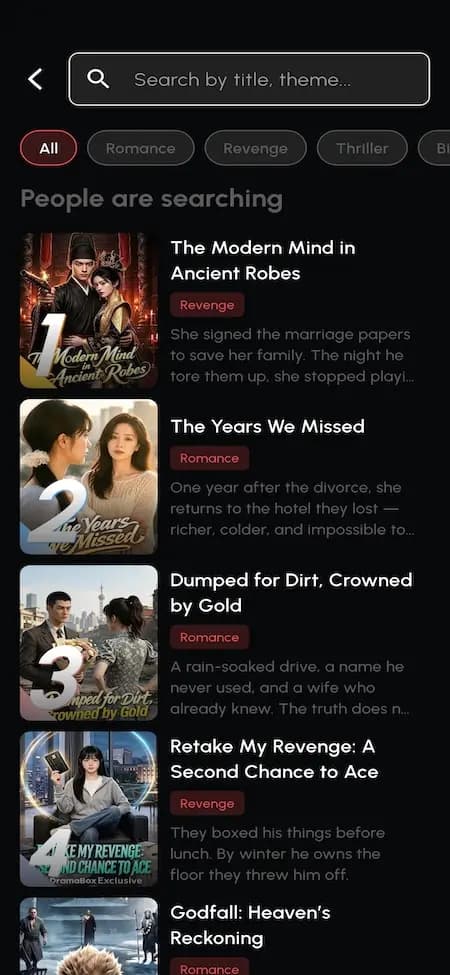
Illustrative series-discovery reference, not official MoboReels UI or evidence of affiliation. Titles and artwork are demonstration content; no content library or distribution rights are included. This screen shows search and genre filters, not playback, unlocks or publishing controls.
What to check in the walkthrough
A MoboReels-style product is a catalog-led short-drama platform for operating serialized, mobile-first fiction across titles, seasons, episodes, languages, territories, release windows, viewing entitlements, and performance reporting. The reference name describes a recognizable buyer category. The delivered system requires original branding, interface design, workflows, content, data structures, and implementation for the rights and publishing model of the client.
This blueprint is for studios, publishers, licensors, distributors, and media operators whose primary constraint is running a growing drama library accurately. The player is one surface. The harder operating work includes receiving title data and masters, validating episode order, recording rights, preparing captions and dubbing, scheduling releases, enforcing territory and entitlement rules, correcting catalog errors without breaking viewer progress, and producing reports a content owner can reconcile.
A short-drama library should not be modeled as an unstructured folder of video files. The catalog needs stable identities for franchises or collections where relevant, series, seasons, episodes, trailers, language versions, artwork, contributors, classifications, and rights records. Each object should have a lifecycle and an owner. Viewer navigation, search, recommendations, entitlements, localization, publishing, analytics, and support all depend on those identities remaining consistent.
The correct hierarchy depends on the acquired content. Some compact stories may contain one season, while licensed franchises can add seasons, alternate cuts, bonus episodes, or territory-specific versions. Removing the season layer may simplify an early catalog but can create duplicate titles and ambiguous episode numbering later. Including it without a real need can burden operators. Discovery should examine the expected library, licensor deliveries, reporting obligations, and roadmap before fixing the content graph.
The series record can govern the canonical title, synopsis, genres, themes, contributor credits, content rating, key artwork, discoverability, original language, status, and relationships to seasons and promotions. It should distinguish editorial metadata from contractual rights and transactional configuration. An editor may change a synopsis without receiving permission to change a licensed territory or paid-access rule.
A season can preserve its own number, subtitle, release strategy, artwork, rights window, language availability, and episode order. Operators need rules for an unnumbered special, a replacement season, or a title that is delivered differently across markets. The data model should avoid using display text as identity so renaming or localization does not strand watch history, entitlements, or analytics.
An episode may include a durable identifier, sequence, title, synopsis, duration, source master, poster or thumbnail, preview status, release window, rating, caption and audio tracks, entitlement policy, and publication state. Reordering should update display sequence without silently changing purchased access or analytical identity. Replacing a media file should create a reviewable version and preserve the reason, actor, and prior state.
Content may arrive through spreadsheets, metadata feeds, cloud storage, transfer links, post-production systems, or manual entry. The ingest design should map source identifiers, required fields, accepted formats, validation rules, duplicate behavior, ownership, and error reporting. A bulk import needs preview and correction rather than failing halfway with no record of what changed. Operators should be able to retry safely without creating duplicate seasons, episodes, or language tracks.
Media processing can include validation, malware checks where relevant, checksum or identity capture, transcoding, thumbnails, captions, audio alignment, packaging, encryption, and delivery to storage or a content-delivery network. Each job needs a status, diagnostics, retry policy, and link to the catalog object. A published episode should not point to a processing job that has silently failed, and a replacement should not become visible before its required tracks and rights checks pass.
A rights record should name the content object, licensor or rights owner, agreement reference, permitted territories, start and end times, languages, platforms, business models, promotional use, download or offline rights, and any reporting obligations relevant to the agreement. The exact fields follow legal review. Storing a contract file is not enough if the playback and publishing systems cannot interpret the restrictions that govern availability.
Rights can apply at series, season, episode, audio, subtitle, artwork, trailer, or promotional-clip level. An inherited rule may simplify common cases, but operators need to see when a child item overrides it. Conflicting windows should be surfaced before publication. Expiry should affect new playback authorization, discovery, active promotions, scheduled notifications, and support context according to the approved policy—not merely remove a poster from one screen.
Territory filtering in a catalog interface is useful but not sufficient. Playback authorization should recheck the viewer’s eligibility, the content object, territory, release window, account state, entitlement, device or concurrency rules where applicable, and the current takedown state. Signed playback access should be short-lived and scoped to the authorized asset. The exact location and anti-circumvention approach require technical and legal review because network location is imperfect.
A viewer needs a truthful response when an episode is upcoming, expired, unavailable in the region, removed, age-restricted, not included in the current plan, or temporarily unavailable. Support operators need the same decision and the rule behind it. Generic playback errors turn legitimate rights enforcement into customer confusion and make it harder to distinguish an authorization decision from a media failure.
Localization includes more than translating the series title. The system may need localized titles, descriptions, artwork, content warnings, promotional copy, captions, subtitles, dubbed audio, episode names, search aliases, and store material. Each asset needs language and locale metadata, version, review status, relationship to its source, and applicable territory. Machine assistance can accelerate preparation but should not silently publish unreviewed dialogue, safety labels, or contractual credits.
Language tags should be stored consistently so the player, APIs, search, analytics, and external feeds describe the same track. The interface needs fallback rules when a requested locale lacks metadata, captions, or audio. Right-to-left layout, line breaking, font coverage, caption positioning, reading speed, audio synchronization, and text expansion need testing on representative devices. A language being present in a dropdown does not prove the experience is usable.
Operators may need upload, format validation, timing review, speaker or sound information where appropriate, language tagging, version comparison, approval, replacement, and takedown. The player should expose available tracks accurately and preserve the user’s preference where suitable. Caption quality affects accessibility and comprehension, while contractual or regulatory requirements vary by market and content. The target standard must be agreed and reviewed for the launch territories.
Dubbed audio needs its own rights, contributors, source relationship, loudness and synchronization review, approval state, and delivery asset. A replacement audio track should not change the identity of the episode or erase historical reporting. The operator console should reveal missing, failed, pending, or rejected language assets before a localized campaign sends viewers to an incomplete title.
A publishing workflow can move content through received, incomplete, processing, editorial review, rights review, localization review, scheduled, published, paused, expired, and withdrawn states. The roles allowed to change each state should be explicit. High-impact actions—publishing a full season, changing a rights window, replacing a master, or withdrawing a licensed title—may require a reason, preview, or second approval depending on the organization.
Scheduling should use an agreed time zone and show the effective viewer time in each market. A scheduled release should validate media readiness, required text and artwork, rights, classifications, language assets, entitlement configuration, and destination rails before it becomes eligible. Campaigns and notifications should reference the same release state so a delayed episode does not produce a broken launch message.
Editors need preview modes for market, language, device, account or entitlement, and future time where appropriate. Preview should not create a public bypass. The console should show why an item is blocked and the accountable team. A publication audit record should connect the version, actor, timestamp, checks, and resulting availability.
Catalog quality checks can cover missing required metadata, duplicate identifiers, broken relationships, invalid sequence, absent masters, failed media jobs, unsupported files, missing required captions, artwork dimensions, rights conflicts, unavailable entitlement products, inconsistent ratings, and scheduled items that cannot publish. Checks should be classified as blocking or advisory for the selected market rather than treating every warning as equivalent.
Viewer-facing QA should test home rails, search, title pages, season and episode navigation, continuation, language selection, entitlement prompts, restored purchases, playback authorization, captions, casting or connected devices if included, errors, and support routes. Operator QA should test imports, corrections, reordering, versioning, window changes, localization, bulk actions, publication, withdrawal, and reports. The test matrix should use representative catalog shapes, not only one perfectly complete title.
A short-drama platform may offer free episodes, per-episode or per-series access through purchased credits, membership access, rewarded advertising, or a combination. These are different grants. The entitlement service should record what was granted, to whom, for which content scope, by which commercial event, under which rule version, and whether access expires. A displayed balance or membership badge should not be the sole authorization for playback.
Virtual credits need clear purchase terms, package identity, currency, promotional versus purchased balance treatment, consumption record, reversal policy, and transaction history. Auto-unlock should require informed user choice and a visible off switch. Episode reordering or repricing must not make a prior purchase point to different content. Current app-store and consumer rules should be reviewed for every distribution channel and territory.
Membership entitlement should define included titles or windows, renewal state, billing recovery, cancellation effect, grace periods, and access after expiry. A title can move into or out of membership only through a controlled rule that preserves historical records. Marketing must not imply a catalog remains permanently available when rights windows can change.
Advertising eligibility, consent, frequency, age suitability, measurement, and regional availability need explicit rules. A rewarded view should grant access only after a verified completion event and should handle duplicate or delayed callbacks safely. The product needs a recovery path when inventory is unavailable so the viewer is not trapped at an episode boundary. Revenue reporting should distinguish estimates from reconciled provider records.
Continue-watching data should reference stable series and episode identities, position, completion, version, and time. Reordering, replacement, localization, or withdrawal needs a defined effect on progress. The system should decide whether progress synchronizes across devices, how conflicting updates are resolved, and how long history remains. A viewer returning after a rights change needs a clear outcome rather than a silent jump to unrelated content.
Episode release cadence can create upcoming states and notifications, but scheduled content should not be treated as playable. Deep links, saved items, recommendations, and campaigns should resolve safely when a title is unpublished or restricted. Operators may need to map a withdrawn item to a notice or approved alternative without rewriting historical analytics.
Events should preserve stable identifiers for series, season, episode, asset or language version, territory, entitlement type, and release configuration where appropriate. Playback starts, qualified views, progress, completion, errors, unlock attempts, granted access, ad outcomes, search, rail impressions, and support events need shared definitions. Client-side events alone should not be treated as authoritative purchases or rights-compliant plays.
Content teams may need performance by series, season, episode, language, territory, release cohort, acquisition source, and entitlement path. Rights owners may require statements based on contract definitions, not product-dashboard shorthand. Finance needs reconciled commercial events; editors need discovery and completion evidence; operations need processing and playback failures. Each report should disclose its source, delay, filters, and treatment of retries, refunds, test traffic, and removed content.
Analytics should not encourage unsupported claims about success. A high completion rate can reflect episode duration or audience selection, and revenue concentration can reflect promotion rather than intrinsic title quality. Decision reviews should connect quantitative signals with catalog changes, campaigns, support cases, and rights context before commissioning or licensing conclusions are made.
This MoboReels-style blueprint is catalog-operations first: the series-season-episode graph, rights and territory windows, ingest, localization, publishing QA, and content-owner reporting are the central buyer intent. The existing DramaBox-style page is better for teams prioritizing multi-market distribution and language-market operations. The ReelShort-style page is better for a swipe-led vertical-series experience and chapter-entitlement journey. Those pages should link across the cluster without repeating the same body copy.
A ShortMax-style brief is more naturally led by growth operations such as rewards, referrals, campaigns, retention experiments, and their abuse controls. A TikTok-style product is a creator and social-feed system, not a licensed serialized-drama catalog. A Netflix-style service is usually membership-led long-form OTT with a broader device and entitlement model. Naming these boundaries helps buyers choose a system based on operating work rather than superficial vertical-video resemblance.
The applicable agreement should distinguish client-specific application and service code, reusable components, third-party software, media and metadata supplied by the client, licensed fonts or artwork, streaming and storage services, payment and advertising providers, and localization vendors. Repository, cloud, domain, app-store, analytics, billing, media-delivery, and support ownership should be explicit, including who can rotate credentials and release a catalog or code change.
A practical handover includes the content graph, import mappings, rights and entitlement rules, media pipeline, localization workflow, publishing states, environments, deployment and rollback, scheduled jobs, monitoring, report definitions, operating guides, and unresolved risks. App Clone Labs is independent from MoboReels and its owners. No affiliation, endorsement, copied interface, proprietary source, content catalog, or reported result is claimed; the page is an original planning blueprint rather than a promise of approval, audience, revenue, capacity, compliance, or delivery timing.
Buyer questions
MoboReels Clone app development means building a custom clone-inspired custom software platform inspired by proven product mechanics, with original branding, workflows, code, admin tools, integrations, and launch support for your market.
MoboReels Clone is best suited for moboreels clone founders, SMBs, agencies, funded startups, and enterprise teams that want a market-ready product without depending on a generic clone script. It works well when you want a proven product category but need original execution, local market fit, and operational ownership.
A clone-inspired product is acceptable when it uses the business model as inspiration but does not copy protected branding, proprietary UI, private data, content, trademarks, or unique assets. App Clone Labs builds original products around familiar mechanics.
The schedule follows the agreed roles, release boundary, integration depth, content readiness, review cadence, testing requirements, and third-party approvals. Multi-role and enterprise builds require broader validation and delivery plans.
V1 should include the smallest complete operating loop for customers, providers, operators, support teams, business admins, and growth teams: onboarding, core workflow, transaction or request state, notifications, admin visibility, support, and analytics.
Advanced personalization, complex loyalty, deep automation, multi-region rules, uncommon integrations, and enterprise analytics should usually wait until real usage proves the core loop.
The applicable agreement defines repository access, bespoke-code assignment or licensing, reusable framework rights, third-party dependencies, deployment context, documentation, and the handover boundary.
Yes. We adapt language, currency, payment methods, compliance needs, business rules, roles, workflows, content, and growth mechanics for your specific market.
Yes. Serious clone-inspired platforms need admin controls for users, transactions, payments, reports, support, moderation, content, settings, and operational exceptions.
The stack depends on scope, but common choices include Next.js web app, React Native or Flutter apps, Node.js APIs, PostgreSQL, Redis queues, cloud hosting, analytics, payment gateways, and role-based admin tooling.
Cost depends on apps required, number of roles, workflow depth, integrations, admin complexity, QA, cloud setup, and launch support. We estimate after mapping the MVP scope and full-build roadmap.
Yes. AI can support search, recommendations, moderation, support copilots, fraud review, document intake, analytics, and workflow automation where it creates real operational value.
We can support post-launch monitoring, bug fixes, analytics review, feature iteration, cloud improvements, app-store updates, and roadmap planning after the MVP goes live.
Solution reference register
01 / Reference and IP
App Clone Labs is independent from MoboReels and its owners. “MoboReels-style” is used only to describe familiar catalog-led short-drama mechanics and buyer intent. The proposed product uses original branding, design, workflows, content, data structures, and implementation.
02 / Regulatory caveat
Confirm chain of title, media, music, artwork, contributor, subtitle, dubbing, promotional-use, territory, platform, and release-window rights. · Review age ratings, minor safety, privacy, accessibility, captioning, audiovisual, advertising, and consumer rules in each launch market. · Confirm app-store and payment treatment of virtual credits, subscriptions, rewarded advertising, refunds, expiry, and digital-content access. · Define location limitations, takedown, legal hold, rights expiry, evidence retention, and content-owner reporting obligations.
03 / Rights and handover
The signed agreement defines client-specific deliverables, repository and deployment access, assignment or licensing, reusable components, third-party services, open-source software, content and localization rights, documentation, credentials, and support. MoboReels and all third-party names and marks remain the property of their respective owners.
Primary sources
Dated official documentation, standards, and research that support the factual claims on this page.
Official documentation for adaptive live and on-demand media delivery using HTTP Live Streaming.
The W3C specification for timed text tracks including captions and subtitles used with web media.
The W3C specification enabling scripted media stream construction for adaptive playback experiences.
The IETF standard for identifying languages consistently across metadata and software systems.
Official App Store review requirements including digital content, payments, subscriptions, privacy, and application behavior.
Official Android guidance for selling digital products and subscriptions through Google Play.
How to read this page
Scope, cost and timeline figures are planning guidance until confirmed in a written proposal. Diagrams and screens are illustrations, not client deliverables, and source-code rights and handover follow the signed agreement. See the delivery process and the full disclaimer.
Next decision
Bring the sample catalog, rights and territory rules, language plan, release cadence, access model, and reporting obligations.
Commercial rights, repositories, environments, documentation, acceptance and handover remain contract-defined.
App Clone Labs is not affiliated with, sponsored by, or endorsed by MoboReels. The name identifies a familiar product category; every delivered product is independently designed and built, and the mark remains its owner's property. Read the full legal notice.
