Healthcare and pharmacy

PharmEasy-style Pharmacy Marketplace — Custom-Built for Your Market

Multi-pharmacy medicine ordering and diagnostic booking marketplace. Planned for health-commerce operators aggregating licensed pharmacies and laboratories with role-specific workflows, operator controls, integrations, and a handover boundary defined for the selected market.

See product screens and demo access

Custom workflows

Brand-safe product strategy

Admin and operations tooling

Reference walkthrough by arrangement

Review item eligibility, prescription responsibilities and substitution approval.

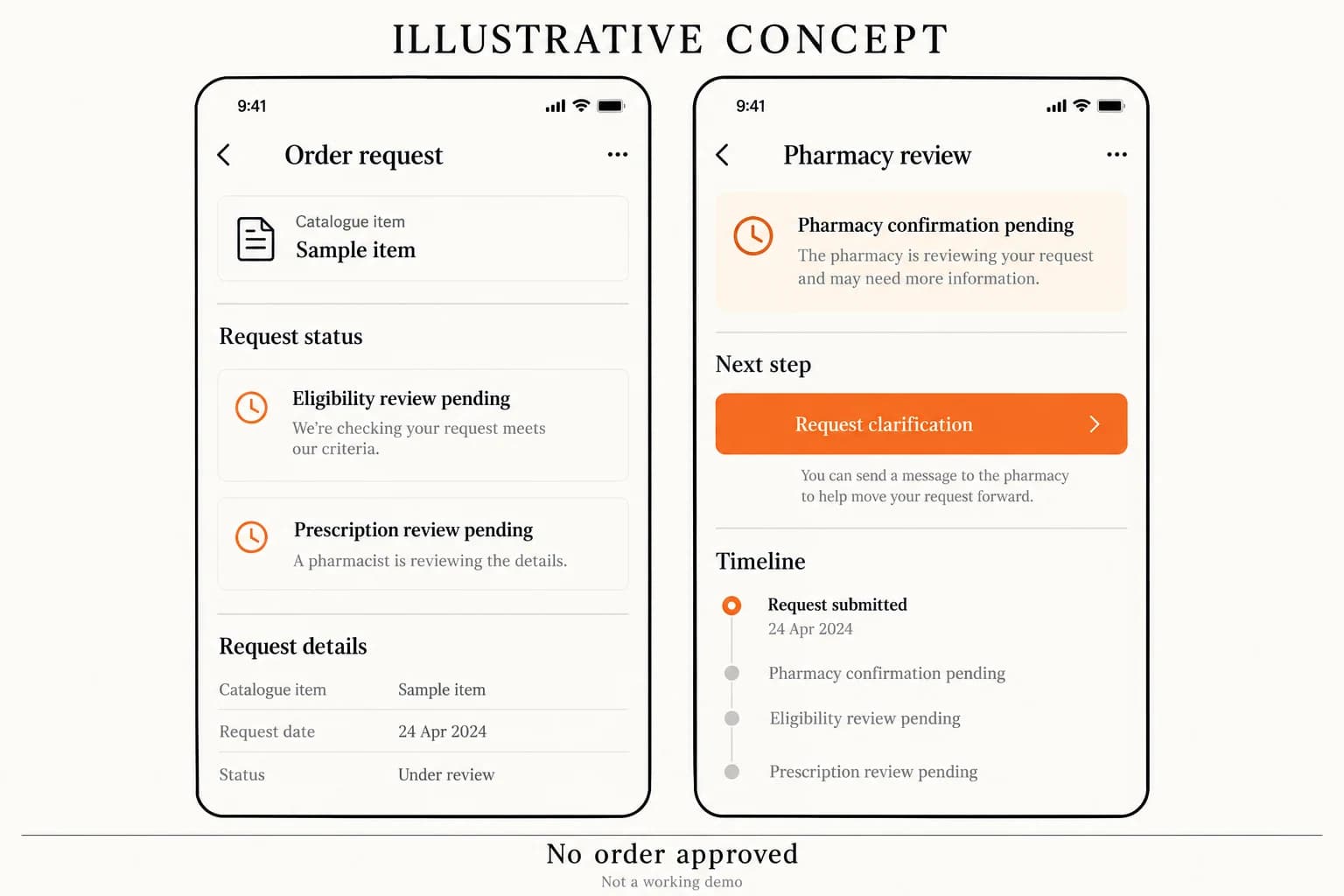
Use this original pharmacy-order concept to scope a PharmEasy-style marketplace. A sample catalogue item awaits eligibility checks, prescription review and pharmacy confirmation; the order is not approved. Ask to demonstrate the proposed workflow with simulated records and identify the qualified pharmacy parties responsible for decisions before agreeing the order scope.

Pharmacy-order concept with eligibility, prescription review and pharmacy confirmation pending

Pharmacy-order concept with eligibility, prescription review and pharmacy confirmation pending

Original App Clone Labs pharmacy-order concept at 1536×1024. A sample catalogue item has eligibility and prescription review pending, pharmacy confirmation pending and an order not approved. No actual medicine, dosage or advice is shown. This is not an official PharmEasy interface, an approved prescription or evidence of pharmacy licensing, stock, dispensing, delivery, legal compliance or affiliation. Qualified pharmacy responsibilities must be established separately for the proposed scope.

What to check in the walkthrough

  • Eligibility boundary: Which catalogue items and service areas can the proposed marketplace accept, and who sets and maintains those rules? Ask to demonstrate a simulated item that needs a prescription, an unsupported delivery area and an incomplete customer record, showing why each remains pending or is rejected and who may resolve the hold before pharmacy confirmation.
  • Prescription and reviewer roles: Which qualified pharmacy party reviews the submitted prescription and authorizes fulfilment, and what may customer support access or change? Ask to demonstrate restricted reviewer access, a clarification request and an attempted approval by an unauthorized role using simulated records. Inspect the decision reason, access history and customer status; software status alone cannot establish professional qualification or permission to dispense.
  • Out-of-stock substitution: Who may propose an alternative item, what qualified review does it need and whose authorization is required before the order changes? Ask to demonstrate an unavailable sample item, a proposed substitution and a customer declining it. Inspect the retained original request, review and consent records, revised price and cancellation option, ensuring a stock event cannot silently replace an approved item.
Open full-size reference

Solution reference register

01 / Reference and IP

This page references third-party product names only to describe familiar product models and planning references. App Clone Labs is not affiliated with or endorsed by those brands. Build decisions require independent legal, regulatory, and operational review for your market.

02 / Artifact status

Boards, diagrams, screens and workflow descriptions on this page are illustrative planning artifacts, not evidence of a deployed client product.

03 / Regulatory caveat

Qualified pharmacy and healthcare concept · Prescription, laboratory, and pharmacy rules vary by market · Clinical decisions remain with licensed professionals

04 / Rights and handover

Source access, licensing, repositories, environments, documentation, acceptance and handover are defined by the signed contract and accepted scope.

Scope

Operating model defined

Roles, workflows, dependencies, exclusions, and assumptions are made reviewable.

Evidence: illustrative

System

Applications connected

Experience, operations, services, data, integrations, and release controls are planned together.

Evidence: illustrative

Handover

Rights stated in writing

Access, assignment, licensing, dependencies, documentation, and support follow the signed agreement.

Evidence: illustrative

Artifact register

Product screens and planning references.

Reference screens illustrate workflows, not a contracted feature list. Sample prices, data, and responses are demonstration content; confirm the current scope during a walkthrough.

PharmEasy-style Pharmacy Marketplace connected product workflow planning visual
Connected customer, operations, and data workflowEvidence: illustrativeOpen full-size reference
PharmEasy-style Pharmacy Marketplace product engineering ecosystem visual
Product engineering ecosystem and handover boundaryEvidence: illustrativeOpen full-size reference

One account can book a test and request medicine; the providers still make separate decisions

A daughter orders medicine for her father and books a home blood collection through the same account. The selected pharmacy cannot supply one item, while the laboratory confirms the appointment. A single “order progressing” label hides two different commitments and may expose the father’s report to the wrong person. The marketplace needs a patient identity, an authorized requester and a named professional provider for each service before a convenient combined experience becomes a reliable operation.

A PharmEasy-style product aggregates pharmacy ordering and diagnostic booking across participating providers. The proposed scope is independently branded software, not access to PharmEasy suppliers, laboratories, proprietary systems or clinical teams. Unlike a single-premises pharmacy storefront, aggregation must manage provider selection and reassignment without transferring clinical authority to a ranking algorithm. This page addresses software procurement and operating controls, not medical advice, legal advice or a guarantee of treatment outcomes.

Show which provider is responsible before the patient commits

The official PharmEasy marketplace terms describe third-party pharmacy and laboratory services and distinguish prescription verification from stock availability. That separation informs the workflow discussion here. The reference company’s contractual exclusions and Indian service terms are not a template for your own obligations; obtain qualified review for the intended operating model and market.

Display the responsible pharmacy or laboratory, its relevant service scope and the contracting information the patient needs. Provider onboarding should capture evidence with a review owner and renewal process. A profile badge must say what was checked rather than imply universal certification. If eligibility expires, block new assignments within the affected scope and route existing work for review. Removing the listing is not enough when accepted requests remain with that provider.

Prescription review is not inventory allocation

An inventory feed can indicate available packs without authorizing dispensing to a particular patient. Track the prescription request, the accountable review decision and stock confirmation separately. Preserve who reviewed which document version, what remains unresolved and whether the pharmacy accepted supply. A checkout payment or an uploaded image must not become automatic clinical approval. Support may request clearer information through the agreed process but should not approve a prescription themselves.

Treat strength, form, quantity and pack configuration as consequential product attributes, not interchangeable search synonyms. If stock changes during review, show the affected item and route the next decision to the responsible professional. Do not let a cheaper ranking result silently replace a requested medicine. Any permitted alternative needs the required professional authorization and patient agreement. The software must preserve that decision trail rather than present similarity of names as sufficient authority.

Reassignment must preserve the patient’s knowledge and permissions

The first pharmacy declines and the marketplace finds another with apparent stock. Before reassignment, establish whether the second provider may receive the prescription and what the patient must be told. Preserve the original refusal and avoid implying that one pharmacy’s review binds another. Revalidate availability, charges, service coverage and the required approval. A new provider should receive only the information needed for a legitimate request, not the patient’s entire account history.

Keep one current assignment while retaining restricted historical evidence. Late acceptance from the first pharmacy must not create two supplies. A provider change can also alter invoices, delivery arrangements and payment handling, so explain the consequence before commitment where required. Compare a premises-led alternative through the Netmeds-style pharmacy fulfillment model when the business primarily needs controlled dispatch from a defined pharmacy operation rather than cross-provider assignment. The right boundary depends on the actual licensed operating arrangement.

A diagnostic appointment is not a specimen accepted by the lab

The official PharmEasy diagnostic service overview describes booking, collection and laboratory processing as distinct parts of the service. Its reference timings, coverage and promotional claims do not establish your partners’ capabilities. Define your own supported tests, collection areas, preparation communications and report expectations with each participating laboratory.

A confirmed appointment means a collection resource or facility slot is reserved under the agreed rule. It does not mean a usable specimen has arrived or testing has begun. The patient should see scheduled, collected, received, assessed and processing states where the laboratory can substantiate them. Avoid inventing detailed progress when the partner only sends a final report. An honest unavailable status is more useful than a decorative progress bar that advances without evidence.

Bind the specimen to the right patient and booking

Collection staff need a reviewed identity and labelling procedure that connects the patient, requested test and specimen identifier. Record custody events the partner can provide and expose discrepancies to an accountable laboratory queue. A barcode scan confirms a specific recorded event; it does not independently prove specimen suitability or analytical accuracy. Keep collector, booking and laboratory references recoverable when devices reconnect or labels need professional investigation.

Specimen rejection needs a reason and an agreed recollection path, not a generic failed delivery message. Distinguish patient absence, collection failure, transport exception and laboratory rejection because their next actions differ. Preserve the first attempt and any new collection identifier. The software should communicate provider-approved instructions and scheduling options, not determine medical suitability itself. Demonstrate a specimen received under the wrong booking and confirm that processing does not proceed silently.

Preparation messages must come from an accountable clinical source

Different tests and patients may require different preparation. Store the issuing provider, applicable test and instruction version instead of generating universal fasting or medication advice. Ask the provider how changed instructions should be communicated to an already booked patient. If the person reports that preparation was not followed, route the question to the appropriate professional; the coordinator should not decide whether the test can safely proceed.

Keep location directions, appointment reminders and billing messages separate from clinical instructions. Translation and accessibility review matter when a patient relies on the message to prepare. Do not infer that a package advertised for a condition is appropriate for everyone with similar symptoms. Recommendation engines and promotional placement must not masquerade as a clinician’s request. This platform is not an emergency service; urgent-care communication needs reviewed local arrangements and clear limits.

Release a report without turning the marketplace into its author

The laboratory should remain the identifiable issuer of its report. Capture the report identifier, authorized release state and version, and verify the patient association before making it available. A successful file upload is not proof that the document is approved for release. Distinguish a processing estimate from a lab-issued result. Do not replace a delayed result with a generated explanation that appears to contain findings the laboratory has not supplied.

A corrected report must remain distinguishable from the earlier version with an appropriate notice and access history. Decide who can withdraw an erroneous release, notify permitted recipients and investigate previous access. Support agents may resolve a broken download link without editing the clinical content. Any interpretation or automated summary needs a separately reviewed clinical scope; a reference range or green badge cannot establish that a person is healthy. Direct clinical questions to qualified professionals.

Payment does not grant access to another person’s results

A family member can fund a service without necessarily having authority to read the patient’s prescription or report. Model the patient, payer, requester and representative separately. Establish appropriate identity and authority checks, consent records and revocation procedures for the launch market. The same account may manage several people, but one profile’s permissions must not spill into another’s records. Notification previews should avoid exposing diagnoses, test names or sensitive attachments unnecessarily.

Restrict provider access to assigned services and staff access to legitimate duties. A courier does not need the full prescription to locate a delivery address, and a billing user does not need analytical results to reconcile a charge. Control exports, attachment links and retention as well as the visible screen. Test account sharing, a revoked representative and a removed provider. Access should stop where required without erasing evidence that must lawfully remain available for review.

Settle each service even when the combined experience diverges

A pharmacy request may be declined while the diagnostic collection completes. Keep separate service references, charge components and payment outcomes so one failure does not cancel the other indiscriminately. Explain provider prices, permitted platform fees, discounts and invoice responsibilities before commitment. Reconcile authorization, capture and refund events against the relevant service. A combined checkout can simplify payment presentation without collapsing the underlying professional and financial obligations.

Define partial cancellation, failed collection and recollection charges under the applicable agreement and reviewed consumer terms. Do not copy a reference platform’s wallet promotion or punctuality guarantee. Duplicate callbacks must recover existing actions rather than issue repeated refunds or charges. Uncertain provider results need a reconciliation queue with an owner. A buyer should inspect a statement showing one completed lab service and one refused medicine request, including how funded discounts and provider proceeds were adjusted.

Expand the network only when operational evidence supports it

More pharmacy and laboratory logos do not prove connected inventory, available appointments or valid integration rights. Document which partners supply current stock, accountable review, collection events and report updates. Define manual fallback limits and prevent an unavailable connection from implying live capacity. Provider onboarding needs operating checks as well as credentials; administrators must know who responds to a refusal, specimen discrepancy or incorrect report release.

Choose the first market and service catalogue around providers the operator can supervise. Advertising, data handling, pharmacy authority, laboratory scope and clinical responsibilities need appropriate jurisdiction-specific review. Paid discovery cannot certify suitability or accreditation. Track unresolved routing and reconciliation issues before adding refill subscriptions, broader test packages or automated interpretation. A useful launch has fewer unsupported assumptions, not a larger catalogue with no dependable owner for the next patient question.

Validate professional boundaries with synthetic patient journeys

Illustrative screens explain pharmacy selection, appointment booking and report access; they do not demonstrate licensed operation or a connected provider network. Request a controlled walkthrough with synthetic records and sandbox services. Decline a prescription request, change providers, remove stock after review, reject a specimen and release a corrected report. Inspect what the patient sees, which professional must act and what the coordinator cannot approve. Buyer acceptance should include these boundaries explicitly.

Review mobile readability, accessible instructions, permission failures and service-specific financial recovery alongside the attractive catalogue. Require a proposal distinguishing new engineering, configured components, third-party rights and operator obligations. Source ownership, provider contracts, administrative access, retention and handover guidance belong in the applicable agreements. Accept the product only when each demonstrated event has an accountable owner and the evidence needed for recovery; a polished health dashboard cannot replace that operational clarity.

Bring your provider model and an assignment exception to a pharmacy and diagnostics scope discussion before deciding how the two service journeys should connect.

Use the delivery process to establish checkpoints for provider approval, patient permissions, laboratory events and financial rehearsal.

Product flow

Role-workflow flow diagram.

A visual map of how each role interacts with each workflow stage, with operator controls and integration boundaries.

Deployable Product Architecture

PharmEasy-style Pharmacy Marketplace

IDENTIFY THE PATI…CONFIRM AUTHORITY…CLOSE EACH SERVIC…Choose a service …Make the professi…Route exceptions …INTEGRATIONS: Pharmacy inventory and prescription-review systems with provider-specific a…OPERATOR CONTROLS: Check the scope behind the listing · Constrain disclosure to a legitimate a…
Illustrative validation artifact — role-workflow flow diagram; final surfaces, boundaries, and integration topology are confirmed during discovery.

User roles

PharmEasy-style Pharmacy Marketplace roles and workflows.

Clone-inspired platforms usually need several coordinated interfaces, not just a customer app.

Patient or authorized representative

01

Choose a service without losing provider accountability

Submit an appropriate medicine request or diagnostic booking, identify the patient and review the responsible provider. Grant only the access required for the chosen service and track each request separately.

Licensed pharmacy or laboratory

02

Make the professional decision within its own authority

Review the prescription or test request, confirm eligible capacity and record an accountable decision. Pharmacy acceptance, specimen assessment and report release belong to the appropriately qualified provider.

Marketplace coordinator

03

Route exceptions without acting as the clinician

Resolve assignment, scheduling and payment uncertainty. Inspect permitted status information while escalating prescription questions, sample problems and report corrections to authorized professionals.

Workflow

PharmEasy-style Pharmacy Marketplace workflow stages.

Each workflow stage is mapped to a role, screen, API, notification, admin control, and measurable launch outcome.

Request and permission

01

Identify the patient and intended service

Separate medicine and diagnostic requests, collect necessary information and record representative authority. Explain provider access and avoid distributing sensitive records to unrelated vendors.

Provider commitment

02

Confirm authority, review and availability

Route to an eligible pharmacy or laboratory. Keep prescription review separate from stock allocation and a diagnostic slot separate from specimen acceptance.

Supply and results

03

Close each service against its own evidence

Track pharmacy fulfillment and diagnostic collection independently. Preserve lab-issued report versions, financial adjustments and unresolved professional-review tasks without combining them into one completed flag.

Deployable Product Architecture

Workflow / system register

Revision BPlanning surface

Marketplace loop

PharmEasy-style Pharmacy Marketplace workflow stages.

Demand and supply meet through governed transactions

Marketplace loop: PharmEasy-style Pharmacy Marketplace workflow stages.Demand and supply meet through governed transactions. Trust, payments, support, and operator controls close the commercial loop.
01

Identify the patient and intended service

02

Confirm authority, review and availability

03

Close each service against its own evidence

Control note

Trust, payments, support, and operator controls close the commercial loop.

Illustrative architecture register; validate against the accepted scope.

Operator controls

PharmEasy-style Pharmacy Marketplace admin and operator controls.

The control center is scoped as a first-class product surface, not an afterthought.

Provider eligibility

01

Check the scope behind the listing

Record relevant licence or accreditation evidence, scope and review dates. A paid provider profile or location match does not establish authority to dispense a medicine or perform a test.

Health-data access

02

Constrain disclosure to a legitimate assignment

Separate patient identity, representative permissions and service-specific access. Restrict prescriptions, reports, exports and notification previews; retain a traceable access history.

Clinical boundaries

03

Prevent operational shortcuts from becoming treatment decisions

Keep medicine alternatives, test preparation, specimen acceptance and report correction within the agreed professional workflow. Escalate uncertainty rather than allowing support to rewrite clinical records.

Monetization

PharmEasy-style Pharmacy Marketplace monetization models.

We model monetization early so payments, admin controls, and reporting support the business.

Explain charges by service and provider

Disclose permitted platform charges, provider prices, taxes and adjustment rules. Reconcile a failed medicine request separately from a completed diagnostic service.

Price coordination without selling clinical authority

Offer scheduling or reporting tools under explicit agreements. Subscription status must not imply a valid licence, accreditation, clinical endorsement or guaranteed patient volume.

Keep paid placement distinct from care suitability

Label sponsorship and review applicable health advertising restrictions. Do not rank medicines or test packages as clinically necessary because a supplier funded visibility.

Integrations

PharmEasy-style Pharmacy Marketplace integration surface.

External systems that determine launch readiness, data flow, and operational continuity.

Integration

01

Integration 1

Pharmacy inventory and prescription-review systems with provider-specific access, stock freshness, accountable approval and reassignment rules

Integration

02

Integration 2

Laboratory scheduling and information systems with patient identity checks, collection identifiers, specimen status, report versions and authorized release

Integration

03

Integration 3

Payment, messaging and support services with service-level reconciliation, sensitive-data restrictions, representative permissions and traceable exception ownership

Scope drivers

PharmEasy-style Pharmacy Marketplace scope drivers.

The variables that most influence build effort, cost, and launch readiness.

Operating model

01

Define the platform and provider responsibilities

Agree jurisdictions, eligible services and contracting parties with qualified reviewers. Software delivery does not confer pharmacy, laboratory or clinical operating authority.

Provider connectivity

02

Learn which events each partner can confirm

Inventory APIs, manual review desks, inventory feeds and lab interfaces. Show uncertainty where a partner cannot provide a reliable acceptance or results event.

Patient permissions

03

Design for delegated access before onboarding families

Specify consent, identity, guardian or representative checks, retention and revocation. Separate paying for a service from authority to inspect the patient’s records.

Deployable Product Architecture

Scope drivers / system register

Revision CPlanning surface

Marketplace loop

PharmEasy-style Pharmacy Marketplace scope drivers.

Demand and supply meet through governed transactions

Marketplace loop: PharmEasy-style Pharmacy Marketplace scope drivers.Demand and supply meet through governed transactions. Trust, payments, support, and operator controls close the commercial loop.
01

Define the platform and provider responsibilities

02

Learn which events each partner can confirm

03

Design for delegated access before onboarding families

Control note

Trust, payments, support, and operator controls close the commercial loop.

Illustrative architecture register; validate against the accepted scope.

V1 scope

PharmEasy-style Pharmacy Marketplace V1 foundation.

Launch the smallest complete operating loop first, then scale the product with confidence.

Bounded provider network

01

Prove accountable routing in one reviewed market

Start with agreed pharmacies and laboratories, a defined service catalogue and explicit eligibility evidence. Keep reassignment visible and subject to professional review.

Two service journeys

02

Operate medicine and diagnostics independently

Support pharmacy review and stock confirmation alongside diagnostic scheduling, specimen tracking and report availability. Present separate statuses and support owners.

Permissioned closeout

03

Rehearse failures without exposing health records

Test representative access, provider refusal, recollection, corrected reports and service-specific payment recovery using synthetic records and sandbox integrations.

Later phases

PharmEasy-style Pharmacy Marketplace post-launch expansion.

Capabilities that should usually wait until real usage proves the core loop.

More provider interfaces

01

Expand from verified connection capabilities

Add pharmacies, lab systems and regions only after access rights, operating scope and exception recovery are reviewed. Do not infer readiness from a partner logo.

Refill coordination

02

Keep reminders separate from dispensing approval

Add permissioned reminders and request preparation without assuming continuing prescription validity or automatic supply. A professional decision may still be required.

Longitudinal records

03

Govern report history before offering trends

Support authorized access to lab-issued versions with provenance and retention controls. Interpretation or clinical decision support needs separate qualified review, not an unexamined AI summary.

Deployable Product Architecture

Later phases / system register

Revision BPlanning surface

Marketplace loop

PharmEasy-style Pharmacy Marketplace post-launch expansion.

Demand and supply meet through governed transactions

Marketplace loop: PharmEasy-style Pharmacy Marketplace post-launch expansion.Demand and supply meet through governed transactions. Trust, payments, support, and operator controls close the commercial loop.
01

Expand from verified connection capabilities

02

Keep reminders separate from dispensing approval

03

Govern report history before offering trends

Control note

Trust, payments, support, and operator controls close the commercial loop.

Illustrative architecture register; validate against the accepted scope.

Regulatory review

PharmEasy-style Pharmacy Marketplace regulatory and compliance flags.

Each flag must be reviewed by qualified counsel for your target market before build or launch.

Flag 1

Qualified pharmacy and healthcare concept

Flag 2

Prescription, laboratory, and pharmacy rules vary by market

Flag 3

Clinical decisions remain with licensed professionals

Reference walkthrough

Request a PharmEasy-style Pharmacy Marketplace reference walkthrough.

Ask us to confirm which reference surfaces are currently available for this product model. Rather than publishing shared demo credentials, we schedule a private guided walkthrough for qualified buyers.

Reference surface

01

Patient or authorized representative: Choose a service without losing provider accountability

Request a role-specific demonstration and confirm which capabilities are currently available. Review the proposed responsibility: Submit an appropriate medicine request or diagnostic booking, identify the patient and review the responsible provider. Grant only the access required for the chosen service and track each request separately.

Reference surface

02

Licensed pharmacy or laboratory: Make the professional decision within its own authority

Request a role-specific demonstration and confirm which capabilities are currently available. Review the proposed responsibility: Review the prescription or test request, confirm eligible capacity and record an accountable decision. Pharmacy acceptance, specimen assessment and report release belong to the appropriately qualified provider.

Reference surface

03

Marketplace coordinator: Route exceptions without acting as the clinician

Request a role-specific demonstration and confirm which capabilities are currently available. Review the proposed responsibility: Resolve assignment, scheduling and payment uncertainty. Inspect permitted status information while escalating prescription questions, sample problems and report corrections to authorized professionals.

Next step

04

Book a walkthrough

Request a live, private walkthrough of the reference implementation. We will confirm scope and discuss configured deployment versus custom build for your market.

Open register

Deployable Product Architecture

Reference walkthrough / system register

Revision EPlanning surface

Marketplace loop

Request a PharmEasy-style Pharmacy Marketplace reference walkthrough.

Demand and supply meet through governed transactions

Marketplace loop: Request a PharmEasy-style Pharmacy Marketplace reference walkthrough.Demand and supply meet through governed transactions. Trust, payments, support, and operator controls close the commercial loop.
01

Patient or authorized representative: Choose a service without losing provider accountability

02

Licensed pharmacy or laboratory: Make the professional decision within its own authority

03

Marketplace coordinator: Route exceptions without acting as the clinician

04

Book a walkthrough

Control note

Trust, payments, support, and operator controls close the commercial loop.

Illustrative architecture register; validate against the accepted scope.

Process

A traceable path from decision to acceptance.

  1. 01

    Model teardown

    We map the reference business model, user roles, monetization path, regulatory needs, and launch constraints.

    Artifact: Product teardown, risk map, role matrix

  2. 02

    Market-fit blueprint

    We reshape the model around your market, operations, pricing, workflows, and first release priorities.

    Artifact: Feature scope, flows, technical plan

  3. 03

    Design and build

    Product, design, engineering, QA, and cloud delivery move in weekly demo cycles with visible progress.

    Artifact: Working releases, QA notes, sprint demos

  4. 04

    Launch and operate

    We support production release, monitoring, handoff, roadmap decisions, and post-launch improvement.

    Artifact: Launch checklist, docs, growth backlog

FAQ

Questions to resolve before the build.

01Does this include PharmEasy pharmacies, laboratories or clinical staff?

No. This is independently branded software for a proposed provider aggregation model. Another company’s suppliers, laboratories, proprietary systems, clinical teams and operating authority are not included.

02Does uploading a prescription approve medicine supply?

No. Prescription review, stock confirmation and pharmacy acceptance are separate steps. The appropriately authorized professional makes the dispensing decision under the reviewed operating model.

03Can the system replace an unavailable medicine automatically?

A similar name or available pack does not authorize substitution. Any permitted alternative must follow the required professional review and patient agreement with a preserved decision trail.

04What changes when an order moves to another pharmacy?

Recheck provider eligibility, required review, availability, charges and information-sharing permissions. Preserve the earlier decision and prevent a late response from creating duplicate supply.

05Is a confirmed lab appointment the same as testing in progress?

No. A booked slot, collected specimen, laboratory receipt, suitability assessment and processing are distinct events. Display only statuses the participating provider can substantiate.

06How should rejected specimens be handled?

Record the laboratory’s accountable decision and the agreed next action. Keep failed collection, transport exceptions and lab rejection separate, and preserve any recollection identifier without making clinical decisions in support.

07Who supplies test preparation instructions?

The accountable clinical provider supplies instructions for the relevant test and patient context. Store the version and route uncertainty to a qualified professional instead of generating universal preparation advice.

08Can marketplace staff change a laboratory report?

They should not rewrite clinical content. Preserve the issuing laboratory, release authorization and report versions. Corrections and withdrawn releases require an appropriate laboratory-led workflow.

09Can the person paying always see the patient’s reports?

No. Payment and record-access authority are different. Model the patient, payer, requester and representative separately with appropriate checks, consent and revocation rules.

10What happens if medicine is declined but the diagnostic service completes?

Track separate service and payment references. Resolve the declined request independently while retaining the completed lab service, applicable invoice and permitted charge adjustments.

11Does the software provide medical advice or guarantee regulatory approval?

No. This is a software procurement scope, not medical or legal advice. Provider authority, clinical responsibilities, operating permissions and data obligations need qualified review for the proposed market.

12What should a buyer validate in the demonstration?

Use synthetic records to test provider refusal, reassignment, unavailable stock, rejected specimens, corrected reports, revoked representative access and partial payment recovery. Inspect the professional owner and permission boundary at every step.

Primary sources

References behind this page

Dated official documentation, standards, and research that support the factual claims on this page.

  1. 01
  2. 02

Citation readiness

How to interpret this page

Published by App Clone Labs Editorial Team

Commercial claims
Scope, cost, and timeline claims are planning guidance and require validation in a current proposal.
Evidence status
Diagrams, boards, examples, and estimates are illustrative planning artifacts unless explicitly identified with a source and measured evidence status.

Next decision

Turn the brief into an accepted product scope.

Define outcomes, constraints, evidence, rights and handover before delivery begins.

Commercial rights, repositories, environments, documentation, acceptance and handover remain contract-defined.

Scope PharmEasy-style Pharmacy Marketplace

Independent from PharmEasy

App Clone Labs is an independent software development studio. We are not affiliated with, connected to, sponsored by, or endorsed by PharmEasy.

Why this name appears

PharmEasy is referenced descriptively to identify familiar product mechanics and common search terminology. “Clone” describes a planning reference, not a replica.

Original delivery

Any product delivered by App Clone Labs is independently designed and developed for the accepted scope. It does not contain proprietary code, branding, copy, interface assets, or confidential material from PharmEasy.

Trademark ownership

PharmEasy and associated names, logos, and marks remain the property of their respective owners. Their use identifies a reference category and does not imply authorization or endorsement.
