Healthcare and pharmacy

Practo-style Care Discovery — Custom-Built for Your Market

Provider directory, appointment booking, and practice software platform. Planned for clinics and digital health operators improving patient access with role-specific workflows, operator controls, integrations, and a handover boundary defined for the selected market.

See product screens and demo access

Custom workflows

Brand-safe product strategy

Admin and operations tooling

Reference walkthrough by arrangement

Review appointment requests, provider confirmation and rescheduling before selecting a booking platform.

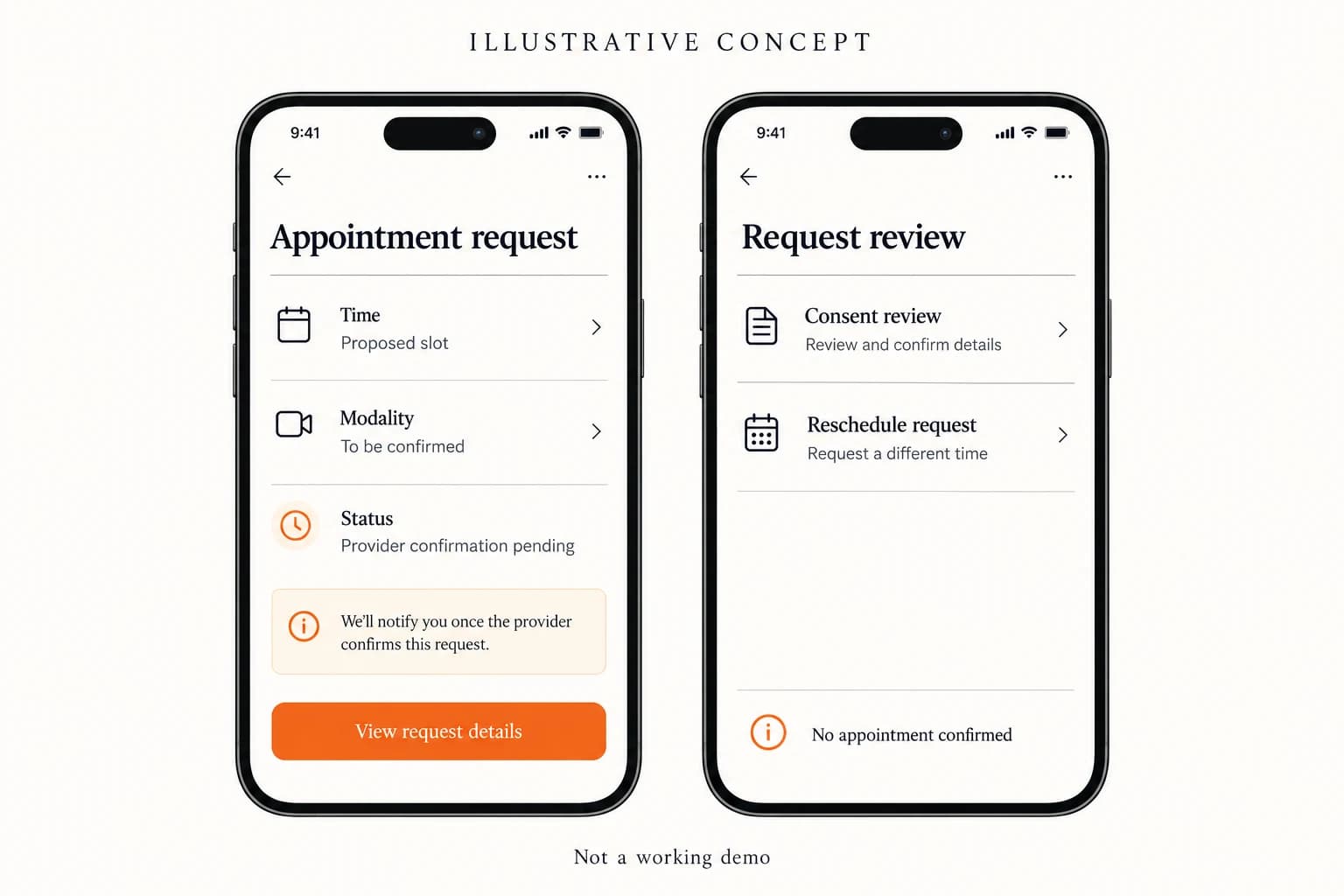
Use this original appointment-request concept to scope a Practo-style booking marketplace. A sample request proposes a modality and time while provider confirmation remains pending. Ask for a working demo that distinguishes a submitted request from a confirmed appointment and follows changes across customer, provider and booking-operations roles.

Appointment-request concept with proposed modality, time and provider confirmation pending

Appointment-request concept with proposed modality, time and provider confirmation pending

Original App Clone Labs appointment-request concept at 1536×1024. A sample modality and proposed time illustrate a request awaiting provider confirmation. No names, diagnosis or personal health information are shown. This is concept artwork, not an official Practo interface, a confirmed appointment, a clinical workflow or evidence of provider credentials, availability or regulatory compliance.

What to check in the walkthrough

  • Booking confirmation: Can the scoped working demo follow a submitted appointment request through provider acceptance, rejection or expiry? Ask to repeat a submission after a lost acknowledgement and inspect the authoritative booking identifier, slot reservation and customer notification; identify the event that makes the appointment confirmed.
  • Rescheduling: What happens when a customer proposes another time while provider confirmation is pending or after an appointment is confirmed? Ask to demonstrate competing requests for the same slot, provider approval, any applicable cancellation or payment rule and the final status of both the old and replacement times.
  • Role boundaries: Which actions can the customer, provider, booking operator and administrator perform on an appointment? Ask to demonstrate access restrictions, an operator-assisted change and its history using synthetic records, then identify how provider credential checks and clinical responsibilities would be handled separately from booking operations.
Open full-size reference

Solution reference register

01 / Reference and IP

This page references third-party product names only to describe familiar product models and planning references. App Clone Labs is not affiliated with or endorsed by those brands. Build decisions require independent legal, regulatory, and operational review for your market.

02 / Artifact status

Boards, diagrams, screens and workflow descriptions on this page are illustrative planning artifacts, not evidence of a deployed client product.

03 / Regulatory caveat

Qualified healthcare concept · Provider advertising and telehealth rules vary by market · Health-data consent and access controls required

04 / Rights and handover

Source access, licensing, repositories, environments, documentation, acceptance and handover are defined by the signed contract and accepted scope.

Scope

Operating model defined

Roles, workflows, dependencies, exclusions, and assumptions are made reviewable.

Evidence: illustrative

System

Applications connected

Experience, operations, services, data, integrations, and release controls are planned together.

Evidence: illustrative

Handover

Rights stated in writing

Access, assignment, licensing, dependencies, documentation, and support follow the signed agreement.

Evidence: illustrative

Artifact register

Product screens and planning references.

Reference screens illustrate workflows, not a contracted feature list. Sample prices, data, and responses are demonstration content; confirm the current scope during a walkthrough.

Practo-style Care Discovery connected product workflow planning visual
Connected customer, operations, and data workflowEvidence: illustrativeOpen full-size reference
Practo-style Care Discovery product engineering ecosystem visual
Product engineering ecosystem and handover boundaryEvidence: illustrativeOpen full-size reference

The patient has a confirmation, but the clinic calendar has no appointment

A patient books a specialist for Tuesday afternoon while the receptionist reserves that time by phone. The website sends a confirmation, the clinician is assigned to another branch and the patient arrives with a message the clinic cannot honor. The discovery interface worked; the appointment agreement did not. A useful care-access platform needs a clinic-owned availability decision, a durable booking record and a person responsible for resolving conflicting information.

A Practo-style platform combines clinician discovery, clinic appointments and selected practice administration in independently branded software. It does not include Practo’s provider network, proprietary records, credentials, integrations or brand rights. The buyer must decide what information the operator can verify, who controls each calendar and how patients learn about changes. Software can coordinate access to care, but neither a booking confirmation nor an attractive provider profile guarantees diagnosis, treatment or a particular health outcome.

Verify profile facts without turning a badge into a clinical recommendation

Separate a clinician’s identity, registration information, stated specialty and current clinic association. Record the evidence source, reviewer and date for each verification scope. A credential checked at onboarding can later expire or change. Provide a correction process and pause unsupported claims where appropriate. Do not let a provider edit a reviewed qualification into a different specialty without review, or imply that payment for visibility establishes professional competence.

Profiles should show where the clinician practices, which services the clinic actually offers and any important consultation-mode boundaries. Patient feedback needs moderation and privacy rules; a popular rating is not proof of clinical suitability. Make sponsored placement recognizable and explain relevant search filters. Buyers should inspect a changed registration status and a disputed profile correction, not only a directory populated with sample names. Use fabricated sample identities only when clearly marked as demonstration data.

Give each clinic one authoritative view of available time

The official Practo online-appointment terms describe responsibilities around honoring appointments, maintaining availability and communicating changes. They illustrate that booking reliability depends on participating practices, not merely a calendar widget. An independent operator needs its own reviewed commitments and cannot adopt another service’s commercial terms as a development deliverable.

Map online requests, telephone bookings, walk-ins, clinician breaks and branch transfers to the agreed scheduling authority. Define whether the source supports immediate confirmation or staff approval. Temporary holds need expiry and a conflict response when two patients select the same opening. If a practice system disconnects, label availability uncertainty rather than keep selling stale slots. Recheck the slot when confirmation occurs and preserve the result so support can explain why a request was accepted or declined.

Separate a booking request from consultation acceptance

The Practo API program terms describe provider-confirmed physical appointments, consent obligations and restricted integration rights. This is a reference for operational boundaries, not evidence that this solution has API access. Public documentation does not permit copying a provider database or bypassing an integration agreement.

Requested, awaiting clinic response, confirmed, cancelled and attended are different administrative states. None establishes that a clinician has assessed the patient or agreed to a particular intervention. Make confirmation timing visible and explain what happens when no response arrives. Do not display a successful payment as proof that the clinic accepted a slot. The patient needs a clear next action and an identifiable support owner rather than an indefinite spinner or a reassuring message unsupported by the practice.

Reschedule with acknowledgement rather than overwrite the appointment

A clinician’s absence can affect a whole afternoon, not just one booking. Show the proposed replacement time, location and clinician explicitly. Ask the patient to accept the change where the operating policy requires it, and retain the original appointment. A reminder for the old slot must not arrive after a new confirmation. Keep message delivery, patient acknowledgement and staff action separately visible so nobody assumes an unread notification established agreement.

Define alternatives for patients who cannot accept the new time, including cancellation and any applicable payment handling. A different clinician is not an interchangeable substitution merely because the specialty label matches. Avoid exposing other patients while staff manage a blocked session. Rehearse a branch change, a failed notification and a reschedule during poor connectivity. Both the practice calendar and patient screen should recover the same current appointment without deleting the earlier commitment history.

Let a representative book without inheriting the patient’s records

The account holder, person attending, payer and authorized representative may be different people. Capture the patient identity and relevant authority without assuming a shared telephone number proves consent. Family booking should not automatically reveal past visits, prescriptions or clinical messages. Agree appropriate handling for minors, guardians and changing representative authority with qualified reviewers for the target market. Administrative convenience must not erase a patient’s independent privacy interests.

Give representatives narrowly scoped permissions and a way to revoke access where applicable. A person permitted to reschedule an appointment may not be entitled to download a consultation record. Show who receives reminders and keep message previews discreet. Test a representative removed after booking and a patient updating their contact method. Support must resolve the appointment without emailing sensitive information to an outdated address or treating a payment receipt as authority to see clinical documents.

Design arrival and no-show review around the clinic’s actual workflow

A confirmed time may still involve check-in, queueing and clinic delays. Explain arrival instructions and distinguish scheduled time from an unconditional promise of immediate consultation. Reception staff should record administrative arrival without making a clinical triage decision. A patient waiting in the clinic must not be marked absent because they did not tap an app button. Attendance evidence should reflect the practice’s reviewed process and allow appropriate correction.

Disclose cancellation and no-show terms before booking, including who decides exceptions. Record clinic delays, appointment changes and contact attempts where relevant to a disputed fee. Duplicate events must not issue repeated charges. Keep an administrative dispute separate from a complaint about care. A refund cannot establish that the consultation occurred or resolve a clinical concern. Demonstrate a patient arriving during an outage so the buyer can see how receptionist evidence repairs the digital record.

Keep appointment data outside unrestricted clinical-record access

A booking assistant usually needs a name, time, clinic and limited communication details; they do not automatically need the patient’s full medical history. Decide whether the first release needs clinical documents at all. If records are included, define professional ownership, permitted access, retention and export responsibilities before implementation. Separate consent for appointment administration from optional communications and other purposes rather than hide every permission inside one checkbox.

Restrict document links, exports and staff accounts, and record access relevant to investigation. Removing a representative should update their document access as well as the visible account label. Notifications and analytics should avoid unnecessary health details. Test a receptionist attempting to open a clinical attachment and a support export containing sensitive fields. These are scope acceptance checks, not a claim that the software is certified or universally compliant; appropriate organizational and jurisdictional review remains necessary.

Present consultation fees without implying a treatment package

State what a displayed amount covers, who collects it and whether it is an estimate or a confirmed administrative charge. A consultation fee does not automatically cover tests, procedures, follow-ups or treatment. Changes need clear communication and an agreed resolution path rather than an unexplained difference at reception. Keep platform fees distinct from professional charges and review whether the proposed commercial arrangement is permitted in the operating market.

Payment authorization, appointment confirmation and attendance must remain separate facts. If a patient pays the clinic after an uncertain online charge, reconcile the first attempt before collecting again. Define refunds, receipts and authorized corrections with a traceable reason. Do not copy another platform’s charges or claim insurance eligibility from a successful booking. A controlled demonstration should include a cancelled unconfirmed slot and a duplicated payment callback, with the patient and clinic viewing consistent outcomes.

Treat a referral as a consented handoff, not an accepted next appointment

A clinician may recommend another professional, but the receiving practice still controls its availability and acceptance. Any referral module needs a clear sender, intended recipient, permission basis and acknowledgement state. Sending a document must not mark the patient as booked or imply the recipient reviewed it. Limit the information transferred and avoid distributing records to several clinics merely to find the earliest opening.

Separate referral administration from clinical recommendations and follow-up obligations. An unanswered referral needs an accountable queue, not an invented completion status. Make receiving-practice access revocable where applicable and keep the original information identifiable when a correction is sent. The buyer should establish whether referrals belong in the first release or require a later professional workflow. Expanding booking into care coordination without assigning ownership creates a larger risk than leaving a feature out deliberately.

Choose clinic access or remote consultation as distinct scopes

A directory with appointment slots is not a telemedicine service. Adding chat, video, prescribing or clinical messaging changes professional responsibilities, eligibility and record handling. Do not place an unrestricted symptom form in discovery and imply that marketplace staff will assess it. Establish reviewed urgent-care messaging and escalation boundaries without presenting this software as an emergency service or giving medical instructions through administrative support.

Compare a Lybrate-style consultation platform when asynchronous professional interaction is central to the intended service. This page focuses on discovery, practice-owned calendars and appointment accountability. Select the workflow based on participating clinicians and operator responsibilities rather than combining all health features into one launch. Appropriate specialists should review professional, advertising, consent and data obligations before the service is opened to patients.

Use the walkthrough to prove calendar recovery and private access

Illustrative screens explain proposed patient and practice surfaces; they do not establish a live clinician network or access to another company’s systems. Request a controlled walkthrough using clearly identified sample providers and sandbox payments. Book the same slot through online and desk channels, disconnect the schedule source and cancel a clinician session. Inspect confirmation, reminders, staff permissions and the resulting patient record together.

Buyer acceptance should include a declined reschedule, representative revocation, disputed no-show, fee correction and an unanswered referral if that module is in scope. Check accessible search, readable mobile instructions and protection of notification content. Require a proposal that distinguishes configured software, new engineering, licensed integrations and clinic duties. Clinical outcomes, professional approvals and provider participation cannot be guaranteed by development milestones. The deliverable should make administrative commitments traceable without pretending to make clinical decisions.

Bring one clinic calendar and a conflicting-booking example to a care-discovery scope discussion. Agree ownership, integration permissions, professional boundaries and handover responsibilities in the applicable contract.

Use the delivery process to schedule clinic workflow review, permission tests, booking recovery and staff acceptance before release.

Product flow

Role-workflow flow diagram.

A visual map of how each role interacts with each workflow stage, with operator controls and integration boundaries.

Deployable Product Architecture

Practo-style Care Discovery

COMPARE ACCURATE …RESERVE TIME THRO…PRESERVE THE APPO…Find a provider a…Own the calendar …Maintain director…INTEGRATIONS: Clinic-owned scheduling and practice systems with authorized access, calend…OPERATOR CONTROLS: Prevent double booking across desk and online channels · Keep patient, paye…
Illustrative validation artifact — role-workflow flow diagram; final surfaces, boundaries, and integration topology are confirmed during discovery.

User roles

Practo-style Care Discovery roles and workflows.

Clone-inspired platforms usually need several coordinated interfaces, not just a customer app.

Patient or authorized representative

01

Find a provider and understand appointment status

Review sourced credentials, clinic location, fees and available times. Request an appointment for the correct patient and distinguish clinic confirmation from clinical assessment.

Clinic scheduling team

02

Own the calendar and communicate changes

Confirm available slots against the practice schedule, manage clinician absences and reschedule with patient acknowledgement. Keep administrative notes separate from clinical records.

Platform operations

03

Maintain directory integrity and booking accountability

Review profile corrections, calendar conflicts, consent and disputed charges. Route clinical questions to the appropriate professional rather than answering them as marketplace support.

Workflow

Practo-style Care Discovery workflow stages.

Each workflow stage is mapped to a role, screen, API, notification, admin control, and measurable launch outcome.

Discover

01

Compare accurate practice information

Show clinician credentials with their verification scope, clinic-specific services and disclosed visibility placement. Avoid implying a recommendation guarantees a suitable clinical outcome.

Request and confirm

02

Reserve time through the clinic-controlled calendar

Recheck the current slot, identify the patient and obtain required administrative permissions. Present requested, confirmed, changed and cancelled appointments distinctly.

Attend and follow up

03

Preserve the appointment record without inventing care decisions

Record administrative attendance, reconcile agreed charges and deliver permissioned reminders. Clinical acceptance, referrals and records remain subject to professional responsibilities and reviewed access rules.

Deployable Product Architecture

Workflow / system register

Revision APlanning surface

Care workflow

Practo-style Care Discovery workflow stages.

Access and accountability travel with the record

Care workflow: Practo-style Care Discovery workflow stages.Access and accountability travel with the record. Role boundaries, consent, and traceability shape every interaction.
01

Compare accurate practice information

02

Reserve time through the clinic-controlled calendar

03

Preserve the appointment record without inventing care decisions

Control note

Role boundaries, consent, and traceability shape every interaction.

Illustrative architecture register; validate against the accepted scope.

Operator controls

Practo-style Care Discovery admin and operator controls.

The control center is scoped as a first-class product surface, not an afterthought.

Calendar integrity

01

Prevent double booking across desk and online channels

Use one authoritative availability policy with temporary holds, expiry and conflict recovery. Preserve changes and notify affected patients instead of silently replacing their appointment.

Identity and consent

02

Keep patient, payer and representative roles separate

Record the basis and scope of representative access and verify identity appropriately. Booking for a family member must not automatically reveal their records or authorize future communications.

Clinical boundary

03

Separate administrative support from professional judgement

Route medical questions and urgent-care needs through reviewed pathways. A confirmed slot, profile badge or paid placement does not establish clinical suitability, diagnosis or guaranteed treatment.

Monetization

Practo-style Care Discovery monetization models.

We model monetization early so payments, admin controls, and reporting support the business.

Charge for administrative tools under clear terms

Scope calendar management, staff permissions and reporting subscriptions. A practice plan must not imply professional endorsement or preferential clinical suitability.

Disclose who pays for appointment facilitation

Review permitted fee arrangements for the market, show charges before confirmation and define cancellation or non-confirmation treatment. Keep professional fees distinguishable from platform fees.

Label promoted discovery separately from credentials

Explain paid placement and maintain factual profile review. Advertising spend cannot become a verification badge, an outcome claim or an undisclosed recommendation.

Integrations

Practo-style Care Discovery integration surface.

External systems that determine launch readiness, data flow, and operational continuity.

Integration

01

Integration 1

Clinic-owned scheduling and practice systems with authorized access, calendar conflict checks, service-specific duration and traceable appointment changes

Integration

02

Integration 2

Identity, credential review and messaging services with purpose-limited consent, safe reminder content and separate patient and representative permissions

Integration

03

Integration 3

Payment and permissioned record systems with itemized fees, reconciliation, reviewed retention and access logs that exclude clinical content from ordinary support views

Scope drivers

Practo-style Care Discovery scope drivers.

The variables that most influence build effort, cost, and launch readiness.

Practice participation

01

Confirm authority to publish and book for each clinic

Agree profile approval, calendar ownership, credential review and correction duties. Multiple locations require distinct availability and service details.

Booking policy

02

Define what the patient is actually reserving

Specify appointment duration, confirmation timing, consultation modality, arrival instructions and rescheduling rules. A request cannot be sold as an accepted clinical encounter.

Information boundary

03

Decide whether clinical records belong in this release

Start with minimum administrative data where possible. Medical records, referrals and teleconsultation introduce professional, privacy and integration responsibilities requiring separate review.

Deployable Product Architecture

Scope drivers / system register

Revision FPlanning surface

Care workflow

Practo-style Care Discovery scope drivers.

Access and accountability travel with the record

Care workflow: Practo-style Care Discovery scope drivers.Access and accountability travel with the record. Role boundaries, consent, and traceability shape every interaction.
01

Confirm authority to publish and book for each clinic

02

Define what the patient is actually reserving

03

Decide whether clinical records belong in this release

Control note

Role boundaries, consent, and traceability shape every interaction.

Illustrative architecture register; validate against the accepted scope.

V1 scope

Practo-style Care Discovery V1 foundation.

Launch the smallest complete operating loop first, then scale the product with confidence.

Verified discovery

01

Publish useful profiles with correction ownership

Support reviewed providers, clinic locations, services, fees and accessible search. Distinguish verified facts from patient feedback and advertising.

Clinic-confirmed appointments

02

Prove slot integrity and patient communication

Connect requests to the authoritative schedule, preserve confirmation and allow acknowledged changes. Rehearse conflicting bookings and clinician absence.

Administrative accountability

03

Resolve attendance and charges without exposing records

Provide staff roles, safe reminders, attendance disputes and payment reconciliation. Keep representative permissions and clinical questions out of unrestricted support access.

Later phases

Practo-style Care Discovery post-launch expansion.

Capabilities that should usually wait until real usage proves the core loop.

Practice operations

01

Extend beyond booking after permissions are established

Add clinical documentation or practice workflows only with professional ownership, appropriate access controls and reviewed integration rights.

Referral coordination

02

Track a permitted handoff rather than promise acceptance

Introduce consented referral records, receiving-practice acknowledgement and follow-up responsibilities. A sent referral is not an accepted appointment or a treatment outcome.

Consented engagement

03

Separate care administration from promotion

Add reminders and communications with purpose-specific permissions, preference controls and clinic review. Do not convert appointment history into an unrestricted marketing audience.

Deployable Product Architecture

Later phases / system register

Revision EPlanning surface

Care workflow

Practo-style Care Discovery post-launch expansion.

Access and accountability travel with the record

Care workflow: Practo-style Care Discovery post-launch expansion.Access and accountability travel with the record. Role boundaries, consent, and traceability shape every interaction.
01

Extend beyond booking after permissions are established

02

Track a permitted handoff rather than promise acceptance

03

Separate care administration from promotion

Control note

Role boundaries, consent, and traceability shape every interaction.

Illustrative architecture register; validate against the accepted scope.

Regulatory review

Practo-style Care Discovery regulatory and compliance flags.

Each flag must be reviewed by qualified counsel for your target market before build or launch.

Flag 1

Qualified healthcare concept

Flag 2

Provider advertising and telehealth rules vary by market

Flag 3

Health-data consent and access controls required

Reference walkthrough

Request a Practo-style Care Discovery reference walkthrough.

Ask us to confirm which reference surfaces are currently available for this product model. Rather than publishing shared demo credentials, we schedule a private guided walkthrough for qualified buyers.

Reference surface

01

Patient or authorized representative: Find a provider and understand appointment status

Request a role-specific demonstration and confirm which capabilities are currently available. Review the proposed responsibility: Review sourced credentials, clinic location, fees and available times. Request an appointment for the correct patient and distinguish clinic confirmation from clinical assessment.

Reference surface

02

Clinic scheduling team: Own the calendar and communicate changes

Request a role-specific demonstration and confirm which capabilities are currently available. Review the proposed responsibility: Confirm available slots against the practice schedule, manage clinician absences and reschedule with patient acknowledgement. Keep administrative notes separate from clinical records.

Reference surface

03

Platform operations: Maintain directory integrity and booking accountability

Request a role-specific demonstration and confirm which capabilities are currently available. Review the proposed responsibility: Review profile corrections, calendar conflicts, consent and disputed charges. Route clinical questions to the appropriate professional rather than answering them as marketplace support.

Next step

04

Book a walkthrough

Request a live, private walkthrough of the reference implementation. We will confirm scope and discuss configured deployment versus custom build for your market.

Open register

Deployable Product Architecture

Reference walkthrough / system register

Revision DPlanning surface

Care workflow

Request a Practo-style Care Discovery reference walkthrough.

Access and accountability travel with the record

Care workflow: Request a Practo-style Care Discovery reference walkthrough.Access and accountability travel with the record. Role boundaries, consent, and traceability shape every interaction.
01

Patient or authorized representative: Find a provider and understand appointment status

02

Clinic scheduling team: Own the calendar and communicate changes

03

Platform operations: Maintain directory integrity and booking accountability

04

Book a walkthrough

Control note

Role boundaries, consent, and traceability shape every interaction.

Illustrative architecture register; validate against the accepted scope.

Process

A traceable path from decision to acceptance.

  1. 01

    Model teardown

    We map the reference business model, user roles, monetization path, regulatory needs, and launch constraints.

    Artifact: Product teardown, risk map, role matrix

  2. 02

    Market-fit blueprint

    We reshape the model around your market, operations, pricing, workflows, and first release priorities.

    Artifact: Feature scope, flows, technical plan

  3. 03

    Design and build

    Product, design, engineering, QA, and cloud delivery move in weekly demo cycles with visible progress.

    Artifact: Working releases, QA notes, sprint demos

  4. 04

    Launch and operate

    We support production release, monitoring, handoff, roadmap decisions, and post-launch improvement.

    Artifact: Launch checklist, docs, growth backlog

FAQ

Questions to resolve before the build.

01Does this include Practo’s clinicians, records or integrations?

No. This is independently branded care-discovery and appointment software. Provider participation, data permissions, proprietary records and licensed integration access must be established separately.

02Does an available slot mean the clinician accepted the consultation?

Not automatically. Recheck the authoritative clinic calendar and distinguish requested, awaiting response and confirmed appointments. Administrative confirmation does not establish clinical assessment, treatment acceptance or an outcome.

03How are telephone and online bookings kept consistent?

Agree one scheduling authority and connect each booking channel to it. Use expiring holds, confirmation checks and conflict recovery; disconnected availability must not continue to appear certain.

04Can a clinician’s qualifications be changed without review?

Reviewed facts should have evidence, scope and correction ownership. Material credential or clinic-association changes need appropriate review. A paid plan or high rating must not be presented as professional verification.

05How should an absent clinician’s appointments be rescheduled?

Preserve the original appointment and present the new time, location and clinician clearly. Record required patient acknowledgement and synchronize reminders; do not silently substitute another professional.

06Does booking for a family member permit access to their records?

No automatic entitlement is implied. Distinguish account holder, patient, payer and authorized representative, and establish the scope of authority with appropriate review. Booking and record-download permissions should be separate.

07How are clinic delays and disputed no-shows handled?

Use the practice’s reviewed attendance process and consider relevant arrival, delay and notification evidence. Provide authorized corrections and prevent duplicate fees. Administrative refunds do not resolve complaints about clinical care.

08Do reception and support staff need full clinical records?

Usually appointment administration can use narrower information. Decide access by role and purpose, protect attachments and exports, and review retention and professional responsibilities before adding clinical-record features.

09Does a consultation fee include tests or treatment?

Only if expressly included in the reviewed service terms. Explain what the displayed fee covers, distinguish platform and professional charges, and define corrections and reconciliation for uncertain payments.

10Does a sent referral mean the next appointment is booked?

No. Track permission, intended recipient and acknowledgement separately. The receiving practice controls availability and acceptance; sending records does not establish review, treatment or a confirmed visit.

11Can remote consultation be added as a basic booking feature?

It needs separate scope and professional review. Clinical chat, video, prescribing and medical records introduce responsibilities not established by a directory or calendar. This software is not an emergency-care service.

12What should a buyer validate in the demonstration?

Test conflicting bookings, schedule disconnection, clinician absence, declined changes, representative revocation, attendance disputes and uncertain payments. Inspect patient and clinic screens alongside permissioned operations records using controlled data.

Primary sources

References behind this page

Dated official documentation, standards, and research that support the factual claims on this page.

  1. 01
  2. 02

Citation readiness

How to interpret this page

Published by App Clone Labs Editorial Team

Commercial claims
Scope, cost, and timeline claims are planning guidance and require validation in a current proposal.
Evidence status
Diagrams, boards, examples, and estimates are illustrative planning artifacts unless explicitly identified with a source and measured evidence status.

Next decision

Turn the brief into an accepted product scope.

Define outcomes, constraints, evidence, rights and handover before delivery begins.

Commercial rights, repositories, environments, documentation, acceptance and handover remain contract-defined.

Scope Practo-style Care Discovery

Independent from Practo

App Clone Labs is an independent software development studio. We are not affiliated with, connected to, sponsored by, or endorsed by Practo.

Why this name appears

Practo is referenced descriptively to identify familiar product mechanics and common search terminology. “Clone” describes a planning reference, not a replica.

Original delivery

Any product delivered by App Clone Labs is independently designed and developed for the accepted scope. It does not contain proprietary code, branding, copy, interface assets, or confidential material from Practo.

Trademark ownership

Practo and associated names, logos, and marks remain the property of their respective owners. Their use identifies a reference category and does not imply authorization or endorsement.
