
01Review regional availability
Check eligible offers against live coverage
Select approved currency, payment method, trade limits and active merchants. Show unavailable coverage instead of presenting stale offers as executable liquidity.
Digital-asset exchange
Peer digital-asset marketplace with escrow workflow and localized settlement operations. Planned for authorized operators coordinating verified users within selected regional payment networks with role-specific workflows, operator controls, integrations, and a handover boundary defined for the selected market.
See product screens and demo accessCustom workflows
Brand-safe product strategy
Admin and operations tooling
Reference walkthrough by arrangement
Workflow
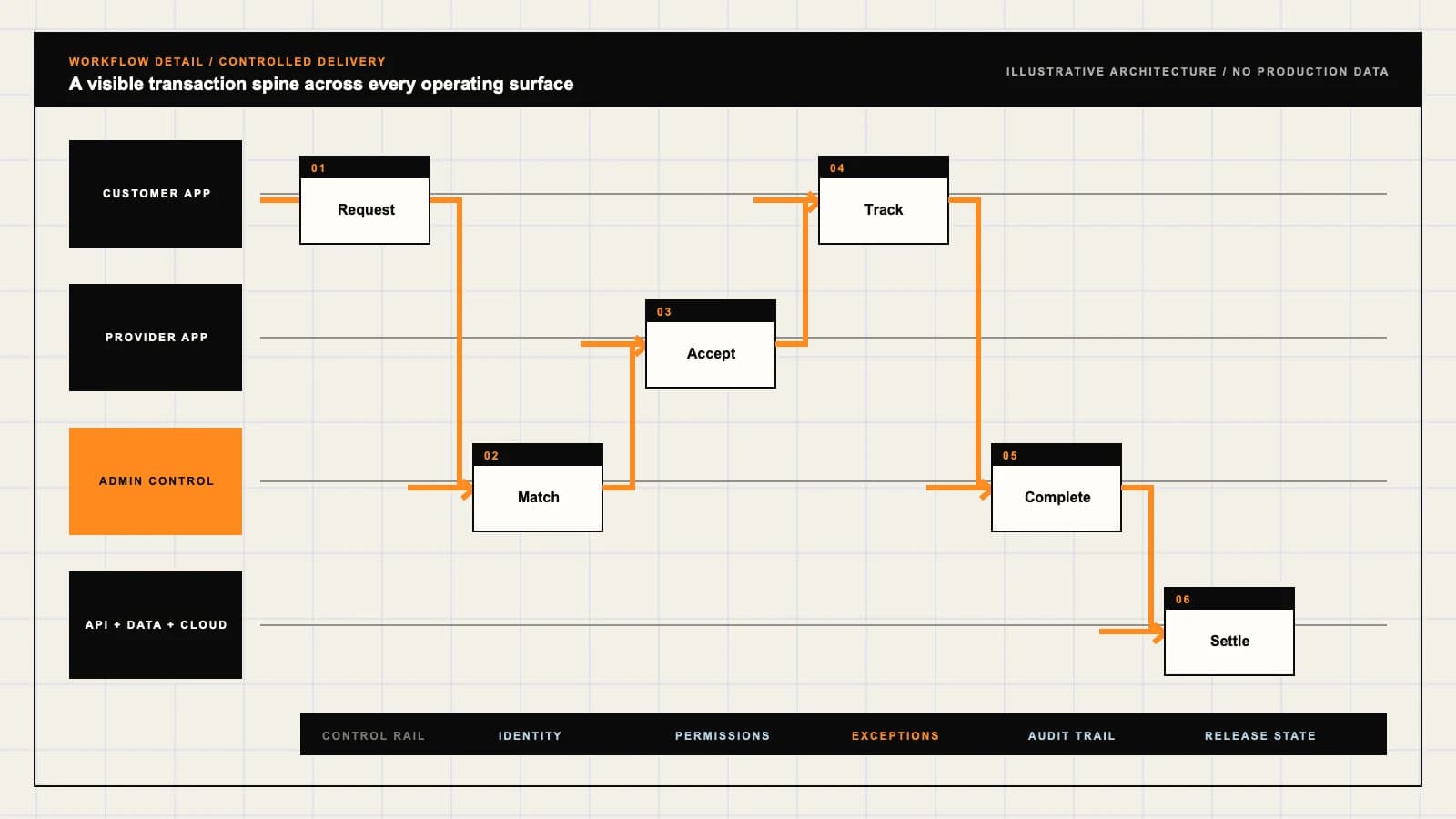
Each workflow stage is mapped to a role, screen, API, notification, admin control, and measurable launch outcome.
Select approved currency, payment method, trade limits and active merchants. Show unavailable coverage instead of presenting stale offers as executable liquidity.
Preserve the quote, fees, beneficiary and payment deadline. Request payment only after the selected custody arrangement confirms the required reservation.
Distinguish payment reported, receipt verified and disputed states. Route late transfers, mismatches and appeals to the responsible team with explicit custody instructions.
Deployable Product Architecture
Workflow / system register
Product delivery loop
A focused release proves one complete workflow
Check eligible offers against live coverage
Bind terms to a confirmed asset reservation
Reconcile fiat evidence before asset release
Control note
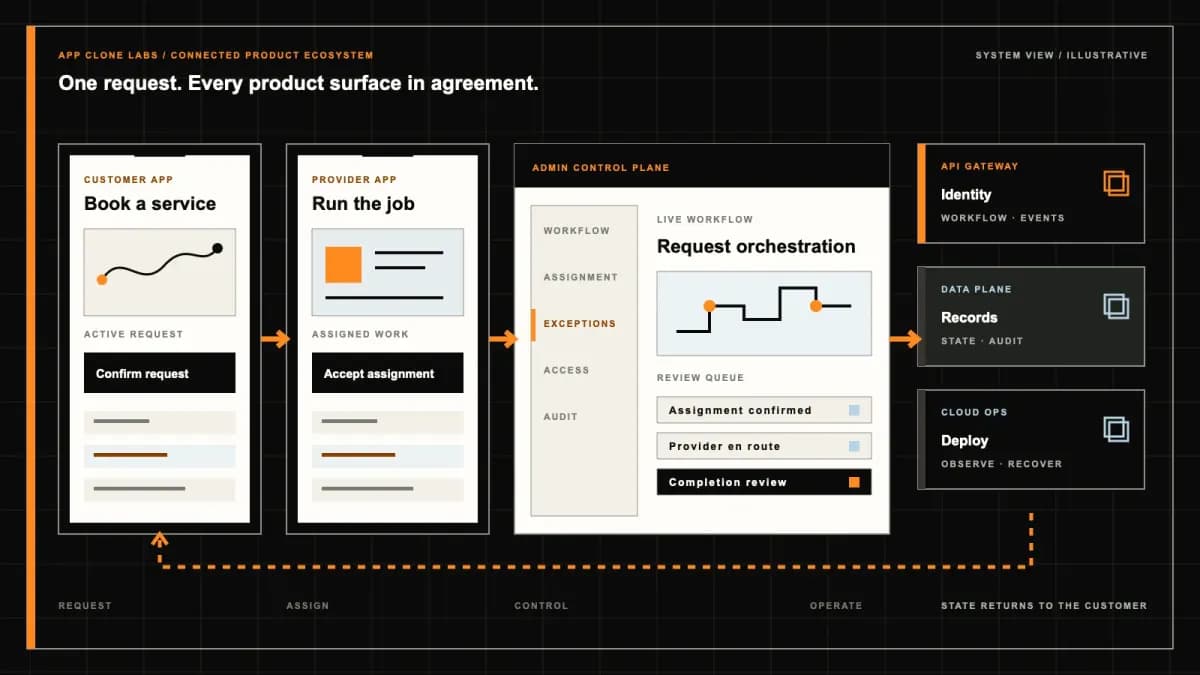
Scope the customer action and the operator response as one system.
Operator controls
The control center is scoped as a first-class product surface, not an afterthought.
Record permitted users, beneficiary checks, transfer limits and evidence requirements. A supported currency label does not authorize every payment method or territory.
Validate fresh capacity and current terms on acceptance. Prevent an expired quote or duplicate request from creating overlapping reservations or unsupported settlement promises.
Protect payment documents, preserve decision history and restrict escrow actions. Screenshots and timer expiry cannot independently establish receipt or entitlement to release.
Integrations
External systems that determine launch readiness, data flow, and operational continuity.
Authorized regional identity, sanctions, fraud and beneficiary-name review services with explicit eligibility decisions and restricted evidence access
Selected custody and escrow services with reservation acknowledgments, independently controlled release permissions and reconciled asset records
Permitted local payment evidence, merchant availability, notification and case-management systems with regional ownership and accountable appeal routing
Scope drivers
The variables that most influence build effort, cost, and launch readiness.
Choose permitted currencies, payment methods, users and counterparties. Each expansion needs evidence handling, settlement limits and staffed exception ownership.
Define working hours, inventory commitments and stale-offer removal. Software cannot supply merchants, bank access or dependable fiat settlement merely by displaying offers.
Scope late transfers, changed beneficiaries, mismatched names and contested decisions. Match support languages and custody review capacity to the selected regional operation.
Deployable Product Architecture
Scope drivers / system register
Product delivery loop
A focused release proves one complete workflow
Count reviewed arrangements rather than country flags
Establish real participation for each offer market
Budget for unresolved payment evidence
Control note
Scope the customer action and the operator response as one system.
V1 scope
Launch the smallest complete operating loop first, then scale the product with confidence.
Use fictional merchants, selected methods and explicit eligibility. Show an unsupported rail and a permitted market with no merchant coverage.
Provide offer freshness, capacity checks, fees, reservation confirmation and separate deadlines. Test two buyers competing for the same inventory and a quote expiring during acceptance.
Support protected evidence, payment-name checks, regional case assignment and authorized release. Rehearse late payment, duplicate confirmation and an appeal with new evidence.
Later phases
Capabilities that should usually wait until real usage proves the core loop.
Add currencies and methods only with provider permission, beneficiary controls, staffed language coverage and tested delayed-payment handling.
Add schedules and capacity signals after measuring actual participation. Forecasts must remain distinguishable from executable quotes and guaranteed merchant presence.
Add permitted evidence interfaces and reviewer routing after proving access boundaries, custody coordination and consistent decisions across selected regional markets.
Deployable Product Architecture
Later phases / system register
Product delivery loop
A focused release proves one complete workflow
Expand after reviewed settlement evidence
Improve coverage using observed commitments
Extend attributable support and reconciliation
Control note
Scope the customer action and the operator response as one system.
Regulatory review
Each flag must be reviewed by qualified counsel for your target market before build or launch.
Reference walkthrough
Ask us to confirm which reference surfaces are currently available for this product model. Rather than publishing shared demo credentials, we schedule a private guided walkthrough for qualified buyers.
Request a role-specific demonstration and confirm which capabilities are currently available. Review the proposed responsibility: Inspect merchant availability, accepted terms and payment instructions. Report a transfer separately from confirming that the recipient received the agreed amount.
Request a role-specific demonstration and confirm which capabilities are currently available. Review the proposed responsibility: Publish bounded offers, manage working hours and verify receipt through the approved method. A merchant badge cannot replace current capacity or payment evidence.
Request a role-specific demonstration and confirm which capabilities are currently available. Review the proposed responsibility: Route language and payment-method cases, retain evidence and coordinate authorized escrow actions. Separate investigation access from permission to move customer assets.
Request a live, private walkthrough of the reference implementation. We will confirm scope and discuss configured deployment versus custom build for your market.
Open registerDeployable Product Architecture
Reference walkthrough / system register
Product delivery loop
A focused release proves one complete workflow
Eligible regional buyers and sellers: Choose a supported currency and payment rail
Approved regional merchants: Maintain available inventory and settlement coverage
Regional support and custody reviewers: Own exceptions through an attributable decision
Book a walkthrough
Control note
Scope the customer action and the operator response as one system.
User roles
Clone-inspired platforms usually need several coordinated interfaces, not just a customer app.
Inspect merchant availability, accepted terms and payment instructions. Report a transfer separately from confirming that the recipient received the agreed amount.
Publish bounded offers, manage working hours and verify receipt through the approved method. A merchant badge cannot replace current capacity or payment evidence.
Route language and payment-method cases, retain evidence and coordinate authorized escrow actions. Separate investigation access from permission to move customer assets.
Use this original payment-dispute concept to scope a Remitano-style peer exchange with localized offers. The buyer reports payment sent with a sample receipt, while the seller reports no matching receipt; evidence awaits review and release is disabled. Ask to connect accepted offer terms, currency responsibilities and reconciliation records in the proposed demo, with the operator and provider responsibilities documented for each market.
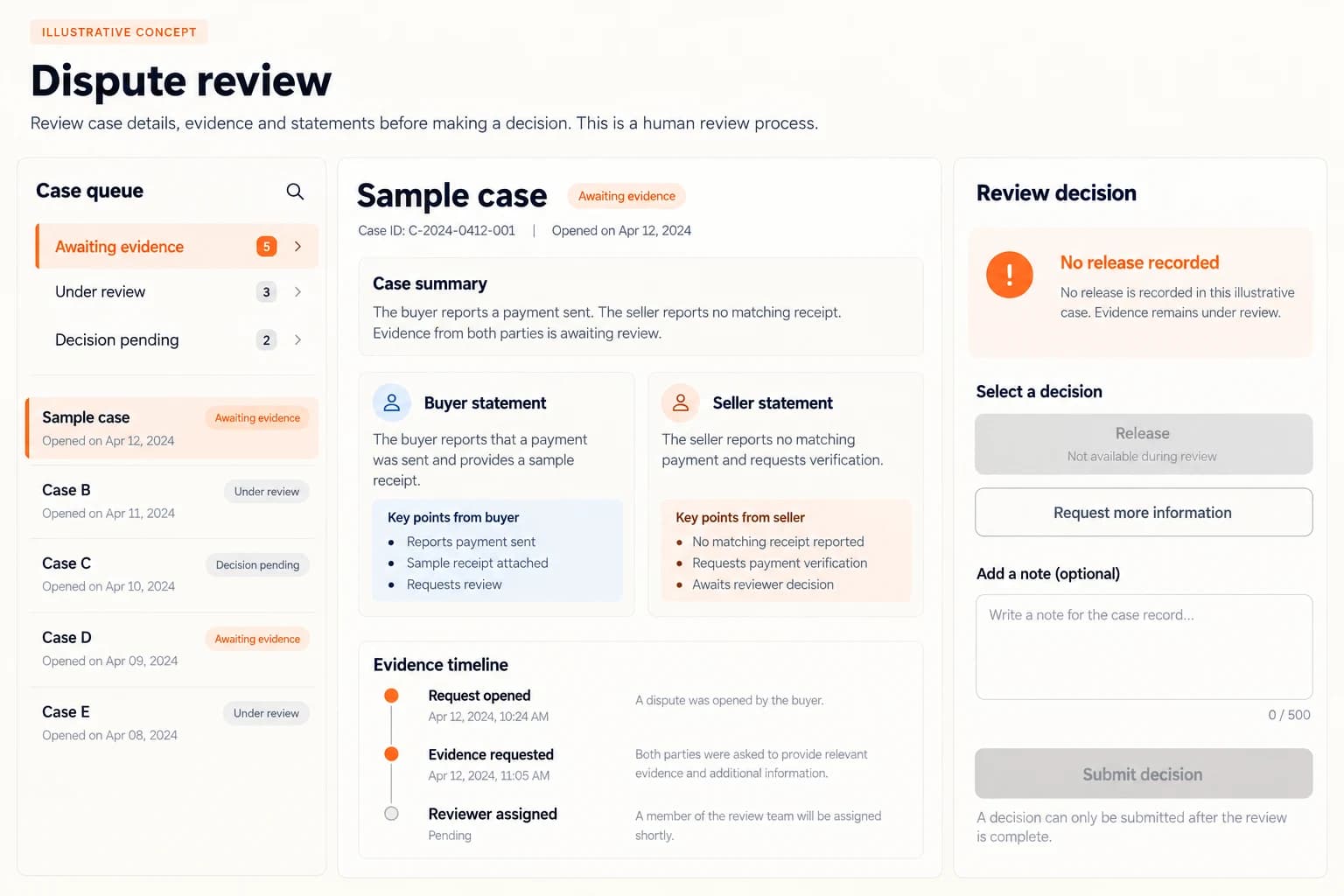
Original App Clone Labs payment-dispute concept at 1536×1024. This illustrates conflicting payment reports awaiting review, with release disabled and no release recorded. It is not the Remitano UI, an actual payment or custody screen, a working escrow demonstration or proof of settlement, asset release or operator authorization. App Clone Labs is not affiliated with or endorsed by Remitano.
Product flow
A visual map of how each role interacts with each workflow stage, with operator controls and integration boundaries.
Deployable Product Architecture
Remitano-style Escrowed Peer Exchange
Monetization
We model monetization early so payments, admin controls, and reporting support the business.
Define fee currency, rounding and cancellation treatment with reconciled records. Merchant participation and a displayed quote do not guarantee execution or returns.
Offer permitted inventory, reporting and availability tools. Paid status cannot bypass eligibility, settlement restrictions, evidence review or dispute accountability.
Describe supported languages, hours and escalation handling without promising universal resolution times. Commercial support access does not confer custody authority or payment-provider permission.
Artifact register
Reference screens illustrate workflows, not a contracted feature list. Sample prices, data, and responses are demonstration content; confirm the current scope during a walkthrough.
A fictional buyer, Mira, accepts an offer from Cedar Merchant for a fictional digital asset called UNIT. The offer uses local currency and one approved bank-transfer method. Cedar has enough asset inventory, but its receiving account becomes unavailable after Mira opens the payment screen. A Remitano-style regional P2P exchange needs an answer for that trade before adding another currency selector. The accepted terms, asset reservation and payment instructions must remain traceable while support establishes what actually happened.
Remitano’s official security project overview describes its P2P escrow product as connecting cryptocurrency buyers and sellers. That is the narrow reference used here. App Clone Labs scopes independently branded software; this does not imply Remitano affiliation, merchant access, bank partnerships or permission to operate. No trading returns are guaranteed. Establish actual custody, lawful regional activity and participating counterparties separately from the software demonstration.
Choose the intended users, asset, currency and specific settlement method before estimating the release. A currency can be supported in one permitted arrangement while another bank, wallet or transfer type remains excluded. Record provider permissions, transfer limits, beneficiary requirements and the evidence available to investigate receipt. Have qualified advisers determine the obligations of the actual operation; a localized interface cannot settle licensing, remittance, custody or reporting questions.
Create an admission record for each payment rail and an owner who can suspend it. Rehearse a permitted currency paired with an unsupported transfer method, then a reviewed method whose provider relationship changes. The offer search and acceptance decision should enforce the same restriction. Avoid country flags that imply universal access. When a method stops accepting new trades, existing payment obligations still need a visible resolution path and a team authorized to handle them. Record the effective restriction time so support can distinguish a previously accepted instruction from a new attempt. Test customers reopening an older payment screen after suspension, including a transfer already sent under the earlier instructions. The customer view and reviewer record should explain the same remaining obligation.
Define who supplies each offer, what inventory supports it and when the merchant can verify receipt. Regional merchant liquidity depends on willing counterparties and their actual capacity. A seeded list of attractive prices establishes neither. Show relevant merchant availability, minimum and maximum amounts, selected method and last confirmed offer state. Treat an empty market honestly instead of inserting synthetic counterparties into the production customer journey.
Give operations a way to withdraw stale offers and investigate concentrated dependence on one merchant. Test Cedar going offline while another merchant remains available, and two buyers attempting the last eligible amount simultaneously. Capacity must be checked at acceptance, not inferred from a page opened earlier. Merchant programs require documented duties and review. Paid placement should not disguise unavailable inventory, override restrictions or imply that the platform guarantees a merchant’s solvency or future willingness to settle.
Distinguish an indicative offer from a quote the customer can accept. Present asset quantity, fiat amount, service charges, receiving party, payment method and relevant deadlines together. Explain how rounding affects the amount actually sent. Validate the quote and merchant capacity when acceptance reaches the server, then retain the exact terms governing the resulting trade. A refreshed price elsewhere must not rewrite the agreement already accepted.
Rehearse a quote expiring during acceptance, a changed fee schedule and a customer retry after a lost response. One accepted instruction should produce one trade and one reservation. Return the existing result when the first attempt succeeded. If the quote was never accepted, obtain fresh consent to new terms. Keep quote expiry distinct from the later payment window; otherwise a customer can see a ticking clock without knowing which decision it controls.
Reserve the required asset through the selected custody arrangement and wait for an authoritative acknowledgment before requesting payment. A reservation requested is different from a reservation confirmed. Track the asset, quantity, trade identifier and custody reference consistently. Keep available inventory distinct from amounts already committed to other trades, and reconcile reservations after interrupted responses rather than assuming the missing message means nothing happened.
Test custody confirming a reservation after the interface reports a timeout, followed by a repeated acceptance request. The buyer should receive one coherent trade status and current instructions. Separate merchant administration, support investigation and custody release permissions. An escrow label does not establish segregation, recovery rights or universal protection against external payment disputes. Describe the supported arrangement accurately and identify who can investigate when its state remains uncertain or its service is temporarily unavailable.
A buyer marking payment sent reports an action; it does not prove receipt by the intended beneficiary. Distinguish submitted evidence, merchant receipt review and confirmed settlement. Preserve the agreed currency, amount and transfer reference. Where a permitted provider supplies evidence, verify its scope and authenticity before using it. A connection that reports initiation cannot silently become confirmation that funds are available and final.
Rehearse Mira uploading a receipt while Cedar sees a pending bank entry, an underpayment and two transfers carrying the same reference. State what additional evidence the reviewer requires and who owns the next action. The product should not instruct either party to repeat payment merely because confirmation is delayed. Account for provider fees and permitted amount differences under reviewed rules. Any later asset release needs its own attributable authorization connected to the evidence accepted for that trade.
Bind displayed beneficiary details to the accepted trade and protect changes with appropriate review. An unverified replacement account sent through chat should not become authoritative payment instructions. Establish how the selected rail handles payer names, joint accounts and other permitted exceptions. A name mismatch is evidence requiring investigation under the operator’s policy, not an automatic finding of fraud or an instruction to transfer again.
Test Cedar requesting a different receiving account after acceptance and a receipt showing a payer name that differs from Mira’s reviewed profile. Preserve the original instruction, changed request and reviewer decision. Route potential account takeover separately from an ordinary spelling discrepancy. Limit exposure of bank and identity documents to legitimate reviewers. Collect only the information needed for the actual decision, with reviewed retention and access rules rather than publishing sensitive evidence in shared merchant notes.
Specify what the payment deadline permits when no payment was reported, when a buyer reported payment and when external evidence remains uncertain. Timer expiry alone cannot establish that fiat never moved. Avoid releasing an asset reservation back into available inventory while a supported payment investigation is still pending. Show the next action and responsible owner instead of describing every timed-out trade as fully resolved.
Rehearse a bank transfer initiated before the deadline but reported afterward, a delayed notification and a dispute request arriving as cancellation begins. Serialize consequential decisions and reconcile the custody result before enabling a conflicting action. Retain a late-payment case after the offer disappears. If the operator supports repayment or another remedy, define its authorization and external dependencies explicitly. Do not promise automatic reversal of a bank transfer, guaranteed recovery or a universal settlement time.
The official Remitano buyer dispute guide describes payment evidence, a stated dispute reason and customer-support review. It also explains that released escrow funds limit further intervention. These are reference boundaries, not a borrowed resolution guarantee or proof that an independent operator can reverse completed transfers.
Assign cases by supported language, payment method and relevant operating hours. Link the offer version, accepted quote, reservation, payment references and protected attachments to one case. Give each party a clear request for missing evidence and preserve communications during handoff. Test a reviewer shift change and conflicting statements about receipt. An automated summary can assist triage, but the responsible reviewer must inspect material evidence and record why the authorized outcome follows from the selected policy.
Define how a customer challenges a decision, which new evidence can be considered and who reviews a potential conflict of interest. Distinguish an appeal request received from an accepted reconsideration or a completed remedy. Preserve the original decision and subsequent reasoning. A second review should not overwrite the history or instruct custody to move the same reserved amount twice.
Rehearse an appeal with a later bank confirmation after the first reviewer recorded insufficient evidence. Show what remains possible under the actual custody and payment arrangements, especially after asset release. Keep unresolved external claims visible without presenting the platform as able to retrieve funds it no longer controls. Merchant suspension, account investigation and customer compensation are separate decisions with different permissions. Establish any available remedy through the operator’s approved policy and actual capabilities before exposing it as a customer promise.
Compare the Paxful-style peer marketplace when approved payment categories and a broader peer offer model define the procurement decision. This brief instead prioritizes local merchant coverage, currency and rail admission, fiat receipt uncertainty and regional support ownership. Those commitments should determine the first release.
Use the configurable crypto exchange core to examine shared ledger and custody boundaries. Agree trade-fee treatment, merchant tools and staffed support separately; a commercial plan cannot waive payment restrictions. Expand only after the first market demonstrates reconciled reservations, current offers and accountable exceptions. Adding currencies without willing merchants and reviewed settlement access increases interface breadth while leaving the operating requirement unmet.
Use illustrative screens with a synthetic sandbox containing Mira, Cedar Merchant and UNIT. Buyer acceptance should show unavailable merchant coverage, reject an unsupported rail and race two acceptances against limited inventory. Expire a quote, delay reservation confirmation and submit duplicate payment evidence. Introduce a changed beneficiary, late fiat transfer and appeal with new evidence. Follow each event across customer, merchant, regional support and custody views, preserving the decision and responsible owner.
Bring one regional market and its hardest settlement exception to a P2P scope discussion to establish payment evidence, merchant commitments and support coverage.
Use the delivery process to agree provider permissions, source-code terms and acceptance records. A synthetic demo proves selected behavior, not real merchant liquidity, bank access or operating authorization.
FAQ
It centers regional merchant availability, reviewed currency and payment rails, accepted quotes, uncertain fiat receipt and staffed dispute ownership rather than a generic exchange feature list.
No. Establish independent branding, lawful operating permissions, real merchant participation, bank access and custody arrangements separately. Synthetic offers do not provide executable liquidity.
No. Review each currency and payment rail arrangement separately, including provider permissions, eligible users, beneficiary checks, limits and the evidence available for settlement investigation.
Show that coverage is unavailable and prevent unsupported acceptance. Stale offers and seeded demonstration counterparties must not be presented as real inventory ready to settle.
Retain asset quantity, fiat amount, fees, payment method, beneficiary details and deadlines. Validate capacity at acceptance and require fresh consent when an unaccepted quote expires.
Only after the selected custody arrangement confirms the required reservation. A delayed acknowledgment needs reconciliation before retries create a second trade or conflicting inventory commitment.
No. Separate the buyer report, submitted evidence and verified receipt. An initiation message or screenshot cannot independently establish that the agreed beneficiary received available funds.
Preserve the accepted instructions and require reviewed authority for a change. A replacement account shared in chat must not silently become the official receiving destination.
No. Consider reported payment, uncertain evidence and late arrival before consequential cancellation or release. A clock reaching zero does not prove that fiat never moved.
Provide the accepted terms, reservation references, payment evidence and protected communications, with language and method routing. Record the decision owner and reasons for the authorized outcome.
No. Define reconsideration ownership and supported remedies under actual custody and payment arrangements. Preserve new evidence without promising retrieval of funds outside the operator’s control.
Use fictional trades to verify coverage gaps, quote expiry, reservation delays, name mismatches, late transfers and appeals, with reconciled records and accountable regional support handoffs.
Solution reference register
01 / Reference and IP
This page references third-party product names only to describe familiar product models and planning references. App Clone Labs is not affiliated with or endorsed by those brands. Build decisions require independent legal, regulatory, and operational review for your market.
02 / Regulatory caveat
Confirm licensing and market-specific authorization before enabling regulated activity · Define whether assets or funds are held by the operator, a qualified custodian, or not held at all · Apply security review, strong authentication, encryption, audit logging, recovery, and incident response · Present educational product information only and prohibit personalized financial, legal, tax, or wagering advice · Apply customer verification, sanctions screening, blockchain monitoring, asset-listing review, and travel-rule processes where required · Review cross-border exchange, remittance, money-transmission, tax, and reporting obligations by corridor
Primary sources
Dated official documentation, standards, and research that support the factual claims on this page.
How to read this page
Scope, cost and timeline figures are planning guidance until confirmed in a written proposal. Diagrams and screens are illustrations, not client deliverables, and source-code rights and handover follow the signed agreement. See the delivery process and the full disclaimer.
Next decision
Define outcomes, constraints, evidence, rights and handover before delivery begins.
Commercial rights, repositories, environments, documentation, acceptance and handover remain contract-defined.
App Clone Labs is not affiliated with, sponsored by, or endorsed by Remitano. The name identifies a familiar product category; every delivered product is independently designed and built, and the mark remains its owner's property. Read the full legal notice.
