
01Configure and admit
Validate a bounded market contract
Version market settings, account permissions and precision before enabling order admission. Reject incompatible configurations and preserve rules governing accepted orders.
Digital-asset exchange
Configurable digital-asset exchange core: order matching, ledgers, wallet orchestration and compliance queues for authorized trading venues.
See product screens and demo accessCustom workflows
Brand-safe product strategy
Admin and operations tooling
Reference walkthrough by arrangement
Workflow
Each workflow stage is mapped to a role, screen, API, notification, admin control, and measurable launch outcome.
Version market settings, account permissions and precision before enabling order admission. Reject incompatible configurations and preserve rules governing accepted orders.
Reserve the required assets once, apply declared matching rules and record partial fills. Resolve cancellation races from authoritative event order rather than client timestamps.
Apply idempotent ledger effects, coordinate screened custody instructions and reconcile provider evidence. Replay from known checkpoints while affected capabilities remain controlled.
Deployable Product Architecture
Workflow / system register
Product delivery loop
A focused release proves one complete workflow
Validate a bounded market contract
Produce traceable execution events
Reconcile internal and external outcomes
Control note
Scope the customer action and the operator response as one system.
Operator controls
The control center is scoped as a first-class product surface, not an afterthought.
Define identity, sequence, schema version and replay behavior for orders, fills and postings. A transport acknowledgment does not establish an accounting outcome.
Use exact financial quantities, balanced postings and controlled rounding. Release only the unexecuted reservation and investigate discrepancies before reopening dependent activity.
Separate market publication, ledger adjustments, deployment and signing privileges. Keep auditable approval evidence and rehearse recovery without assuming provider availability.
Integrations
External systems that determine launch readiness, data flow, and operational continuity.
Selected matching and market-data interfaces with versioned event contracts, admission rules, sequence recovery and independently established liquidity arrangements
Authorized custody adapters with signing separation, screened instruction approval, external outcome confirmation and network-specific reconciliation
Ledger, screening and operational case systems with exact quantities, idempotent postings, restricted evidence access and tested deployment recovery
Scope drivers
The variables that most influence build effort, cost, and launch readiness.
Choose assets, increments, order types, fee policies and pause transitions. Wider configuration increases validation and migration obligations.
Bound order bursts, fills, reservations and reconciliation events. Demonstrate capacity and recovery against the chosen workload instead of promising unlimited throughput.
Confirm provider contracts, signing boundaries, backup retention and reopening decisions before production asset handling.
Deployable Product Architecture
Scope drivers / system register
Product delivery loop
A focused release proves one complete workflow
Count rules as well as pairs
Measure the actual workload
Establish authority and recovery ownership
Control note
Scope the customer action and the operator response as one system.
V1 scope
Launch the smallest complete operating loop first, then scale the product with confidence.
Use synthetic assets to test precision rejection, admission, partial fills and a cancel race under a declared ordering policy.
Inspect reservations, fees and balanced ledger postings. Replay duplicate events and interrupt a worker between execution capture and accounting.
Demonstrate an uncertain custody instruction, a reconciliation break and recovery from an agreed checkpoint with restricted operational approval.
Later phases
Capabilities that should usually wait until real usage proves the core loop.
Add assets and order behaviors after testing precision, existing-order compatibility and revised operating permissions.
Add authorized adapters only after defining ownership, external identifiers, reconciliation and uncertain-transfer recovery for each relationship.
Treat leverage, derivatives and other products as distinct permission and accounting decisions rather than flags on an existing spot market.
Deployable Product Architecture
Later phases / system register
Product delivery loop
A focused release proves one complete workflow
Expand after validating migration
Preserve authority across provider changes
Review a separate risk and operating model
Control note
Scope the customer action and the operator response as one system.
Regulatory review
Each flag must be reviewed by qualified counsel for your target market before build or launch.
Reference walkthrough
Ask us to confirm which reference surfaces are currently available for this product model. Rather than publishing shared demo credentials, we schedule a private guided walkthrough for qualified buyers.
Request a role-specific demonstration and confirm which capabilities are currently available. Review the proposed responsibility: Define admitted assets, precision, order types and pause behavior within established operating permissions. Configuration access does not grant custody signing or accounting adjustment authority.
Request a role-specific demonstration and confirm which capabilities are currently available. Review the proposed responsibility: Inspect event identities, balanced postings and unresolved discrepancies. Correct records through attributable adjustments rather than editing executions or aggregate balances.
Request a role-specific demonstration and confirm which capabilities are currently available. Review the proposed responsibility: Control deployment, replay and provider adapters with separate approvals. Confirm external outcomes before retrying uncertain transfers and reopening affected activity.
Request a live, private walkthrough of the reference implementation. We will confirm scope and discuss configured deployment versus custom build for your market.
Open registerDeployable Product Architecture
Reference walkthrough / system register
Product delivery loop
A focused release proves one complete workflow
Venue configuration team: Publish versioned market rules
Ledger and reconciliation operators: Trace reservations and execution postings
Infrastructure and custody teams: Recover services without repeating asset movements
Book a walkthrough
Control note
Scope the customer action and the operator response as one system.
User roles
Clone-inspired platforms usually need several coordinated interfaces, not just a customer app.
Define admitted assets, precision, order types and pause behavior within established operating permissions. Configuration access does not grant custody signing or accounting adjustment authority.
Inspect event identities, balanced postings and unresolved discrepancies. Correct records through attributable adjustments rather than editing executions or aggregate balances.
Control deployment, replay and provider adapters with separate approvals. Confirm external outcomes before retrying uncertain transfers and reopening affected activity.
Use this original withdrawal-review concept to scope the boundary between an exchange ledger, wallet orchestration and a custody provider. Ask to trace a proposed withdrawal from the customer instruction through review, provider acknowledgement and reconciliation, identifying the responsible operator and the evidence required at each step.
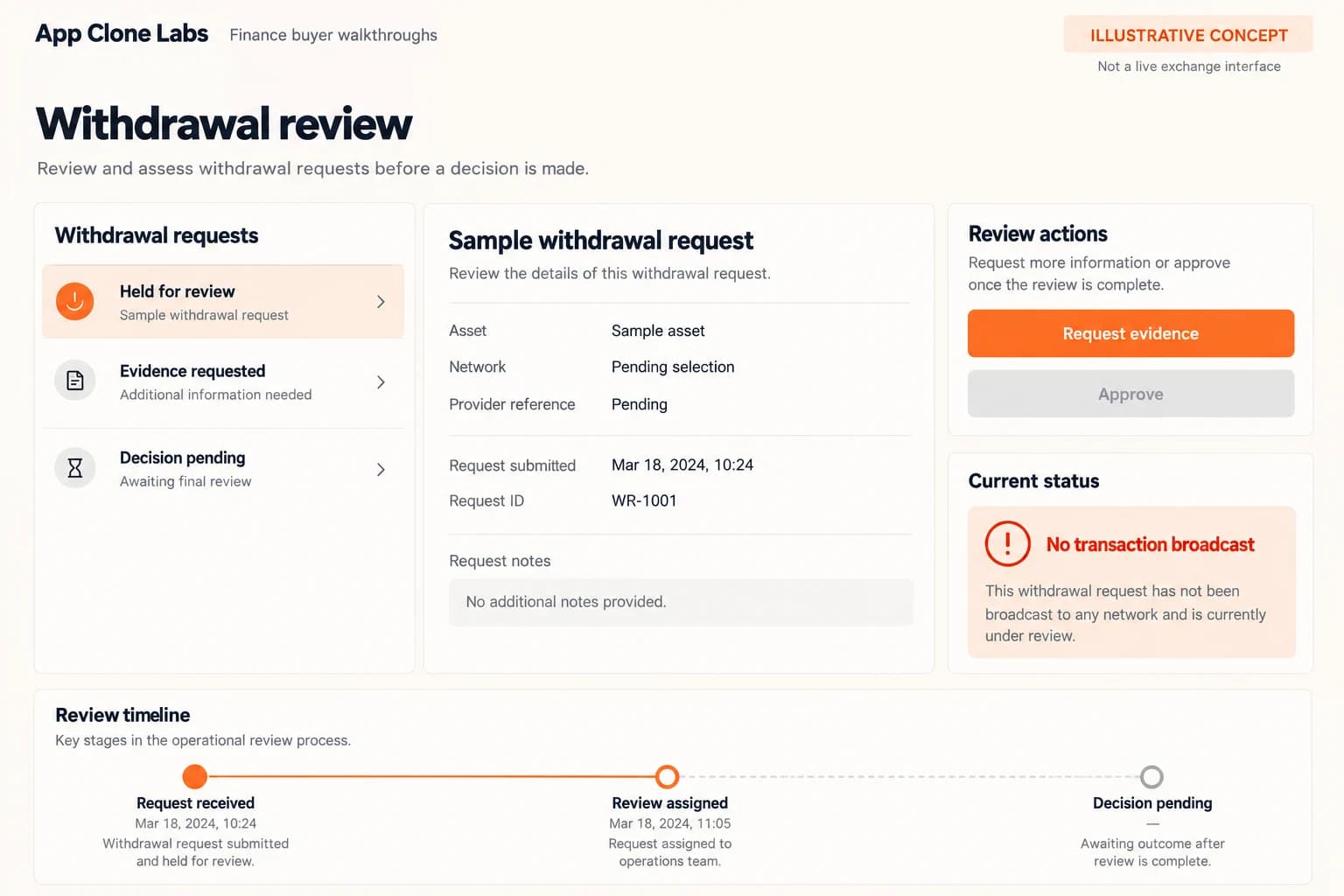
Original App Clone Labs withdrawal-review concept at 1536×1024. The sample withdrawal is held for manual review, the provider response is pending and no broadcast is recorded. This illustrative artwork does not demonstrate actual custody, transaction execution, provider connectivity or authorization to handle assets.
Product flow
A visual map of how each role interacts with each workflow stage, with operator controls and integration boundaries.
Deployable Product Architecture
Configurable Digital-asset Exchange Core
Monetization
We model monetization early so payments, admin controls, and reporting support the business.
Specify environments, source-code terms, supported interfaces and maintenance. A software license confers neither exchange authorization nor custody permissions.
Define reconciliation, case review and reporting capabilities with named owners. Module access does not certify compliance or replace qualified operational assessment.
Price supported provider connections and recovery commitments separately from liquidity, custody contracts or customer trading returns.
Artifact register
Reference screens illustrate workflows, not a contracted feature list. Sample prices, data, and responses are demonstration content; confirm the current scope during a walkthrough.
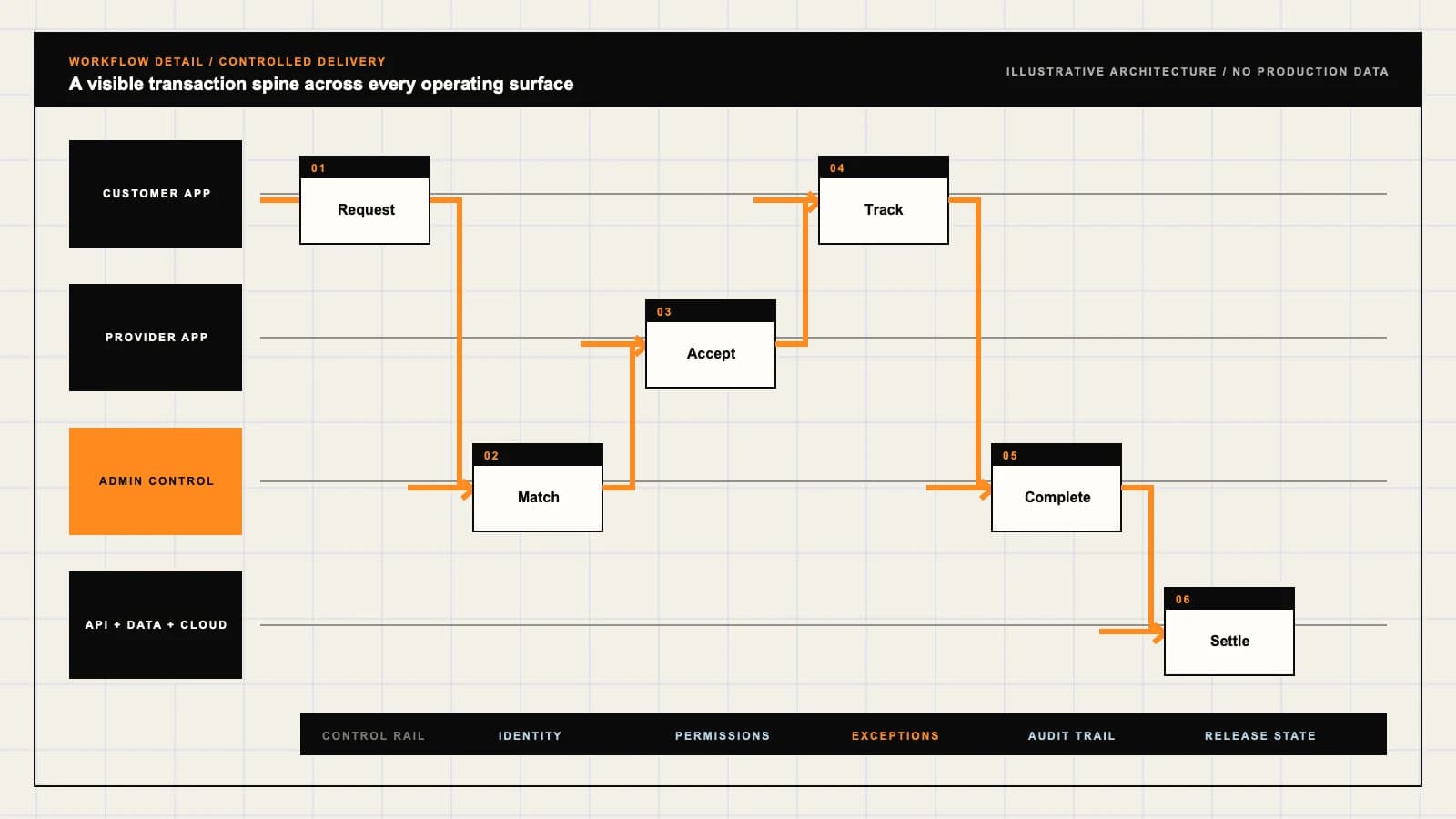
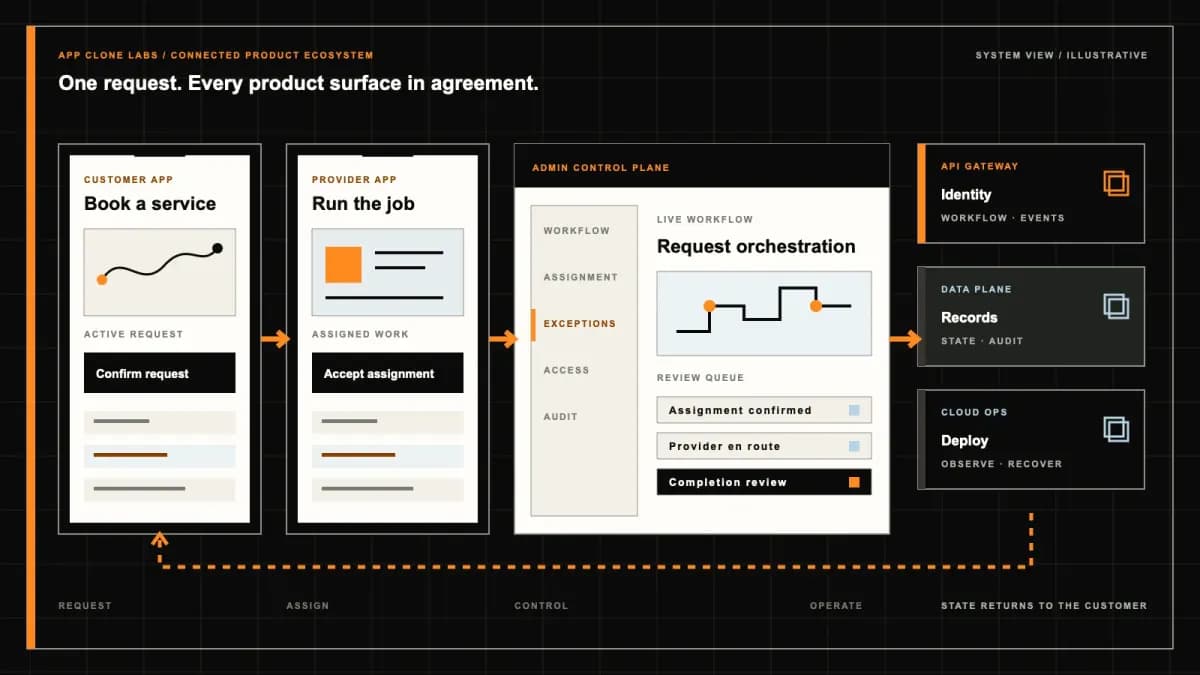
A matching worker emits a partial fill, a cancellation arrives, and the ledger consumer restarts before acknowledging its posting. After recovery, the venue must identify what executed, what remains reserved and which event was already applied. A configurable crypto exchange script is useful only when those answers survive interruption. The acceptance artifact should connect order admission, matching, reservations and accounting across one traceable sequence rather than demonstrate an animated order book.
App Clone Labs scopes exchange infrastructure for an independently operated venue. Software delivery does not grant exchange authorization, custody permissions, liquidity relationships or guaranteed returns. Establish those arrangements for the intended assets, customers and jurisdictions separately. The first release should make a bounded spot configuration and its recovery behavior inspectable. Screens explain operational state; the durable records behind them determine whether the core can account for its commitments after a failure.
Define each market through admitted assets, base and quote units, increments, supported order types, fee policy and permitted account categories. A pair name alone does not specify valid behavior. Validate configuration before publication and give it a version that travels with accepted orders. Separate a proposed change from an effective change so different services cannot silently enforce different settings during deployment.
Specify how pausing, disabling or revising a market affects open orders and reservations. A precision reduction can make an existing remainder incompatible with new rules; decide the supported transition before applying it. Rehearse an operator changing a minimum quantity while orders are queued and a deployment reading an obsolete configuration. Preserve historical rules for investigation. Publishing a market must not automatically enable deposits on every network associated with its asset or confer permission to serve another customer category.
Orders, reservations, fills, cancellations and ledger postings need distinct identities and explicit relationships. Specify schema versions, sequence meaning and the authoritative owner of each transition. Define how a consumer recognizes a duplicate, detects a gap and recovers missing evidence. A message delivered successfully is not proof that every downstream economic effect completed. Transport delivery guarantees do not replace application accounting rules.
Use a documented ordering boundary suited to the matching model. Do not assume timestamps from separate machines establish an unambiguous sequence for competing requests. Rehearse messages arriving late, a consumer seeing an unknown schema version and a replay beginning before its last checkpoint. Unsupported events should enter a visible recovery path rather than disappear into a success count. Operators need correlation references sufficient to trace the affected commitment while ordinary application logs avoid unnecessary private account information.
The official Coinbase Exchange matching engine documentation describes price-time priority, self-trade prevention and an order lifecycle. These are concrete examples of behavior an exchange must specify. They do not supply this independent core with Coinbase infrastructure, market access or the same operating rules.
Choose the supported matching policy and order types explicitly. Define resting and incoming order behavior, partial execution, expiration and self-trade prevention under the venue’s reviewed contract. Measure capacity only after correct behavior is established under representative contention. An order-per-second figure without durability, accounting and recovery conditions cannot establish usable capacity. Rehearse two equal-price orders, a self-crossing account and a market pause during matching. The outcome should be reproducible from accepted events and the governing rules, with unexplained discrepancies blocking affected activity until reviewed.
Define financial units and exact decimal representation for every asset, price, quantity and fee. A user interface may format values for readability, but the admission boundary must validate the underlying quantity against configured increments. Reject unsupported precision with a useful explanation instead of silently changing the requested trade. Document rounding direction and the destination of any rounding difference where the approved accounting policy requires it.
Apply consistent rules across matching, fees, custody adapters and statements. A provider supporting fewer decimal places than the ledger creates an integration decision, not permission to discard a remainder. Test the smallest supported unit, a maximum bounded quantity and a fee charged in another asset. Reconcile values before and after serialization and replay. Configuration changes should preserve the meaning of historical amounts rather than reinterpret old entries using a newly selected decimal scale.
Reserve the necessary assets before admitting a commitment under the selected architecture. Distinguish available, reserved and completed amounts with attributable transitions. Two simultaneous requests must not both spend the same available funds. Define how admission failure releases a reservation and how an uncertain matching outcome keeps the relevant amount restricted until the original result can be established.
For partial fills, consume only the amount required by confirmed executions and their applicable charges. Release only the supported remainder after cancellation or expiry becomes authoritative. Rehearse a cancel race in which the last fill is sequenced before cancellation and another in which cancellation wins. The client request time cannot reverse a valid earlier execution. Compare the matching result and reservation ledger after replay so a cancelled display state cannot hide funds still reserved or assets already spent.
Give each economic event a stable posting identity and the balanced entries required by the chosen accounting model. Retrying delivery must produce the same economic effect once. Account for asset movements, reservations and fees separately enough to trace them without inferring holdings from order history or market-data candles. An aggregate balance is a projection; the underlying ledger entries need attributable causes.
Specify the boundary between captured executions and completed postings. Test a worker stopping after a posting commits but before its acknowledgment reaches the sender. Replay should recognize the original posting rather than debit the account again. If an adjustment is required, preserve the original entries and add an approved correction with a reason and reference. Separate adjustment privileges from deployment access. Balanced accounting supports reconciliation; it does not establish solvency, asset protection or the lawfulness of the venue’s offering.
A custody adapter translates an authorized instruction and reports provider evidence. It should not create signing authority merely because a transfer request exists. Establish who screens, approves, signs and investigates each supported movement under the actual custody arrangement. Keep secrets and signing material outside ordinary support access and market configuration. Define account and network identifiers carefully enough to prevent a valid instruction reaching the wrong environment.
Separate requested transfer, provider acceptance, broadcast and the confirmation required by the operator policy. An uncertain external response requires investigation before another movement is issued. Rehearse a timeout after provider acceptance, a duplicated callback and a destination changed during approval. Track the original reference across retry and reconciliation. Contracted provider access, custody responsibility, supported networks and recovery capability require independent establishment; an adapter demonstration with synthetic funds cannot guarantee customer assets are secured in production.
Compare matching executions, reservations, ledger postings and custody evidence at explicitly defined checkpoints. Report the affected asset, accounts, event references and unresolved amount with an assigned owner. A single venue total can conceal offsetting mistakes or missing individual credits. Reconciliation should reveal whether a mismatch originated in event delivery, accounting, provider reporting or an authorized adjustment rather than immediately rewriting balances to make totals agree.
Define which breaks suspend admission, withdrawals or another affected capability. Recovery requires evidence that the discrepancy is understood and the applicable records agree. Test a missing fill event, a duplicate fee and an external transfer reported after an internal recovery. Keep corrections and reopening decisions attributable. Reporting a reconciliation success is useful only when the underlying comparisons and remaining exceptions are inspectable. It is not a guarantee of liquidity, custody protection or regulatory compliance.
The official PostgreSQL continuous archiving documentation explains recovery using a base backup and archived write-ahead logs, including the need for an uninterrupted log sequence. This is a database recovery reference, not evidence that restoring a database restores an entire exchange or reverses external transfers.
Define recovery checkpoints for matching, accounting and custody coordination together. Reconcile messages and external outcomes newer than a restored database before reopening dependent services. Prevent two active deployments from independently processing the same authority during failover. Rehearse a missing archive segment, a schema migration interrupted during rollout and a transfer completed outside the restored checkpoint. Record recovery time and outstanding uncertainty under the tested workload. Backup existence alone cannot demonstrate recoverability; acceptance needs a restore and an explained reconciliation result.
Compare the Binance-style spot exchange journey when customer-facing market discovery, account servicing and venue operations drive the brief. This configurable core focuses on the contracts connecting matching, ledgering, adapters and recovery. Reusing the underlying services should not erase the distinct decisions each customer product needs.
Review the Coinbase-style retail brokerage scope when a quoted purchase experience better describes the intended service. Brokerage quotes and exchange order admission have different commitments. Do not assume this engine includes advisory services, brokerage permissions or a ready customer acquisition model.
Price source-code rights, permitted deployments, adapter maintenance and operational coverage explicitly. Add markets or providers after their precision, migration and recovery rules have been validated. Optional derivatives require separately established authority and accounting behavior.
Use a sandbox with fictional accounts, synthetic assets and non-monetary balances. Reject invalid precision, reserve funds, partly fill an order and introduce a cancellation race. Stop the posting worker, replay the fill and confirm one economic effect. Then interrupt a custody response and restore an agreed checkpoint. Buyer acceptance should connect the resulting order state, remaining reservation, ledger entries and unresolved provider evidence across operator views.
Bring one market contract and custody boundary to an exchange infrastructure scope discussion to establish acceptance evidence, provider permissions and responsible recovery owners. The demonstration does not establish live liquidity or operating authorization.
Use the delivery process to agree deployment access, security assessment, reconciliation evidence and handover responsibilities. Production asset handling depends on independently established authority and verified controls alongside the software commitments demonstrated.
FAQ
It connects market configuration, order admission, matching, reservations, ledger postings, custody adapters and operational recovery under an explicitly bounded infrastructure contract.
No. Operating authority, custody permissions, liquidity relationships and applicable assessment must be established separately for the actual offering.
Accepted orders need the rules that governed them. Precision changes, pauses and supported order types require explicit transitions rather than silent reinterpretation of existing commitments.
Define stable identity, relationships, schema version, sequence meaning, authoritative ownership, duplicate recognition and recovery behavior for missing or unsupported events.
No. The official documentation is a technical reference. Specify and validate the independent venue’s matching policy, order lifecycle and self-trade behavior.
Reject invalid quantities at admission and define exact representation and rounding across matching, fees, adapters and accounting. Do not silently change the trade.
Use the authoritative event sequence to establish the result. Preserve completed executions and release only the supported unexecuted reservation.
A stable economic event produces its ledger effect once even when delivery repeats. Preserve original entries and use approved adjustments for corrections.
No. Custody authority, signing responsibility, supported networks and provider contracts require separate establishment. Investigate uncertain transfers before retrying asset movement.
Not by itself. Reconcile matching, accounting, messages and external commitments beyond the restored checkpoint before enabling dependent activity.
No. Establish liquidity arrangements independently. Software licensing, synthetic markets and capacity demonstrations do not guarantee trading returns or financial protection.
Use synthetic accounts to inspect precision rejection, reservations, partial fills, cancellation races, duplicate replay, single ledger effects, uncertain custody instructions and checkpoint recovery with reconciliation.
Solution reference register
01 / Regulatory caveat
Confirm licensing and market-specific authorization before enabling regulated activity · Define whether assets or funds are held by the operator, a qualified custodian, or not held at all · Apply security review, strong authentication, encryption, audit logging, recovery, and incident response · Present educational product information only and prohibit personalized financial, legal, tax, or wagering advice · Apply customer verification, sanctions screening, blockchain monitoring, asset-listing review, and travel-rule processes where required · Independent security assessment and financial-ledger reconciliation are required before handling customer assets
Primary sources
Dated official documentation, standards, and research that support the factual claims on this page.
How to read this page
Scope, cost and timeline figures are planning guidance until confirmed in a written proposal. Diagrams and screens are illustrations, not client deliverables, and source-code rights and handover follow the signed agreement. See the delivery process and the full disclaimer.
Next decision
Define outcomes, constraints, evidence, rights and handover before delivery begins.
Commercial rights, repositories, environments, documentation, acceptance and handover remain contract-defined.
