
01Establish eligibility and funding
Check the actual intended transaction
Confirm customer and asset permissions, supported funding methods and applicable holds. A successful identity check or displayed balance alone does not authorize a purchase.
Digital-asset exchange
Retail digital-asset brokerage with simple conversion, custody access, and learning content. Planned for authorized brokers offering selected digital assets to eligible retail customers with role-specific workflows, operator controls, integrations, and a handover boundary defined for the selected market.
See product screens and demo accessCustom workflows
Brand-safe product strategy
Admin and operations tooling
Reference walkthrough by arrangement
Workflow
Each workflow stage is mapped to a role, screen, API, notification, admin control, and measurable launch outcome.
Confirm customer and asset permissions, supported funding methods and applicable holds. A successful identity check or displayed balance alone does not authorize a purchase.
Show price, spread, fees, quantity and expiry. Recover uncertain submissions by stable identity before inviting another purchase or presenting a fresh quote.
Track completed purchases or sales separately from settled funding and withdrawal availability. Preserve transfer approvals, external outcomes and correction evidence.
Deployable Product Architecture
Workflow / system register
Marketplace loop
Demand and supply meet through governed transactions
Check the actual intended transaction
Make the retail commitment explicit
Reconcile execution, cash and custody
Control note
Trust, payments, support, and operator controls close the commercial loop.
Operator controls
The control center is scoped as a first-class product surface, not an afterthought.
Enforce expiry, approved assets and funding permissions at confirmation. Changes to price or quantity require the reviewed customer acceptance flow rather than silent substitution.
Restrict destination changes, approval and signing roles. Investigate uncertain transfers before retrying and explain holds without promising immediate availability.
Link executions, fees and funding entries with replay protection. Escalate differences between customer liabilities, banking records and custody evidence.
Integrations
External systems that determine launch readiness, data flow, and operational continuity.
Authorized quote and liquidity services with asset coverage, expiry, executable terms and recoverable order identities
Permitted banking and payment services with funding status, holds, returns and reconciled settlement evidence
Approved custody, identity, transfer-screening and support systems with restricted approvals, external confirmation and exception ownership
Scope drivers
The variables that most influence build effort, cost, and launch readiness.
Define buy, sell and transfer availability separately with customer eligibility. A discovery page must not imply every displayed asset can be purchased or withdrawn.
Choose supported payment methods, settlement policies and custody relationships. Document signing authority, recovery responsibilities and restrictions before handling customer assets.
Measure quote validity, supplier availability and exception capacity. More jurisdictions or providers require reviewed permissions and reconciled outcomes.
Deployable Product Architecture
Scope drivers / system register
Marketplace loop
Demand and supply meet through governed transactions
Review each offered asset and network
Establish who owes and controls each balance
Bound commitments the team can resolve
Control note
Trust, payments, support, and operator controls close the commercial loop.
V1 scope
Launch the smallest complete operating loop first, then scale the product with confidence.
Use reviewed assets, transparent spread and fees, explicit quote expiry and confirmation. Rehearse a failed quote and expired confirmation with no accidental charge.
Track pending funding, confirmed transactions and settled balances with receipts. Test an uncertain purchase and duplicate callback without generating another order.
Include destination review, restricted signing and reconciliation. Rehearse a withdrawal hold, uncertain broadcast and bank return with named support ownership.
Later phases
Capabilities that should usually wait until real usage proves the core loop.
Add quote, funding and custody support only after validating the new asset and network. Preserve clear restrictions where buying and transferring have different availability.
Add permitted payment methods with reviewed holds, disputes and reconciliation. A faster checkout does not establish faster final settlement.
Assess key responsibility, recovery and transfer disclosures independently. Do not describe hosted account recovery as recovery of a customer-controlled private key.
Deployable Product Architecture
Later phases / system register
Marketplace loop
Demand and supply meet through governed transactions
Expand reviewed retail coverage
Validate settlement before extending convenience
Treat control changes as a separate product
Control note
Trust, payments, support, and operator controls close the commercial loop.
Regulatory review
Each flag must be reviewed by qualified counsel for your target market before build or launch.
Reference walkthrough
Ask us to confirm which reference surfaces are currently available for this product model. Rather than publishing shared demo credentials, we schedule a private guided walkthrough for qualified buyers.
Request a role-specific demonstration and confirm which capabilities are currently available. Review the proposed responsibility: Inspect asset quantity, spread, fees and quote expiry before confirming. Distinguish portfolio value from funds available to trade, withdraw or transfer.
Request a role-specific demonstration and confirm which capabilities are currently available. Review the proposed responsibility: Manage approved asset quotes, liquidity relationships and settlement exceptions. Restrict custody approvals and signing independently of routine purchase support.
Request a role-specific demonstration and confirm which capabilities are currently available. Review the proposed responsibility: Review eligibility, disputed funding and transfer controls using relevant evidence. Assign owners for uncertain purchases without changing financial records to close a ticket.
Request a live, private walkthrough of the reference implementation. We will confirm scope and discuss configured deployment versus custom build for your market.
Open registerDeployable Product Architecture
Reference walkthrough / system register
Marketplace loop
Demand and supply meet through governed transactions
Eligible retail customer: Review a quoted purchase or sale
Brokerage and treasury operations: Resolve execution and funding separately
Risk and customer support: Explain restrictions through accountable cases
Book a walkthrough
Control note
Trust, payments, support, and operator controls close the commercial loop.
User roles
Clone-inspired platforms usually need several coordinated interfaces, not just a customer app.
Inspect asset quantity, spread, fees and quote expiry before confirming. Distinguish portfolio value from funds available to trade, withdraw or transfer.
Manage approved asset quotes, liquidity relationships and settlement exceptions. Restrict custody approvals and signing independently of routine purchase support.
Review eligibility, disputed funding and transfer controls using relevant evidence. Assign owners for uncertain purchases without changing financial records to close a ticket.
Use this original withdrawal-review concept to evaluate a Coinbase-style customer experience. Ask for a working demo that explains the customer request, the provider responsible for custody and submission, and the receipt used to reconcile the outcome. Confirm how a manual review hold is communicated, who may approve it and which steps are simulated before agreeing a connected service scope.
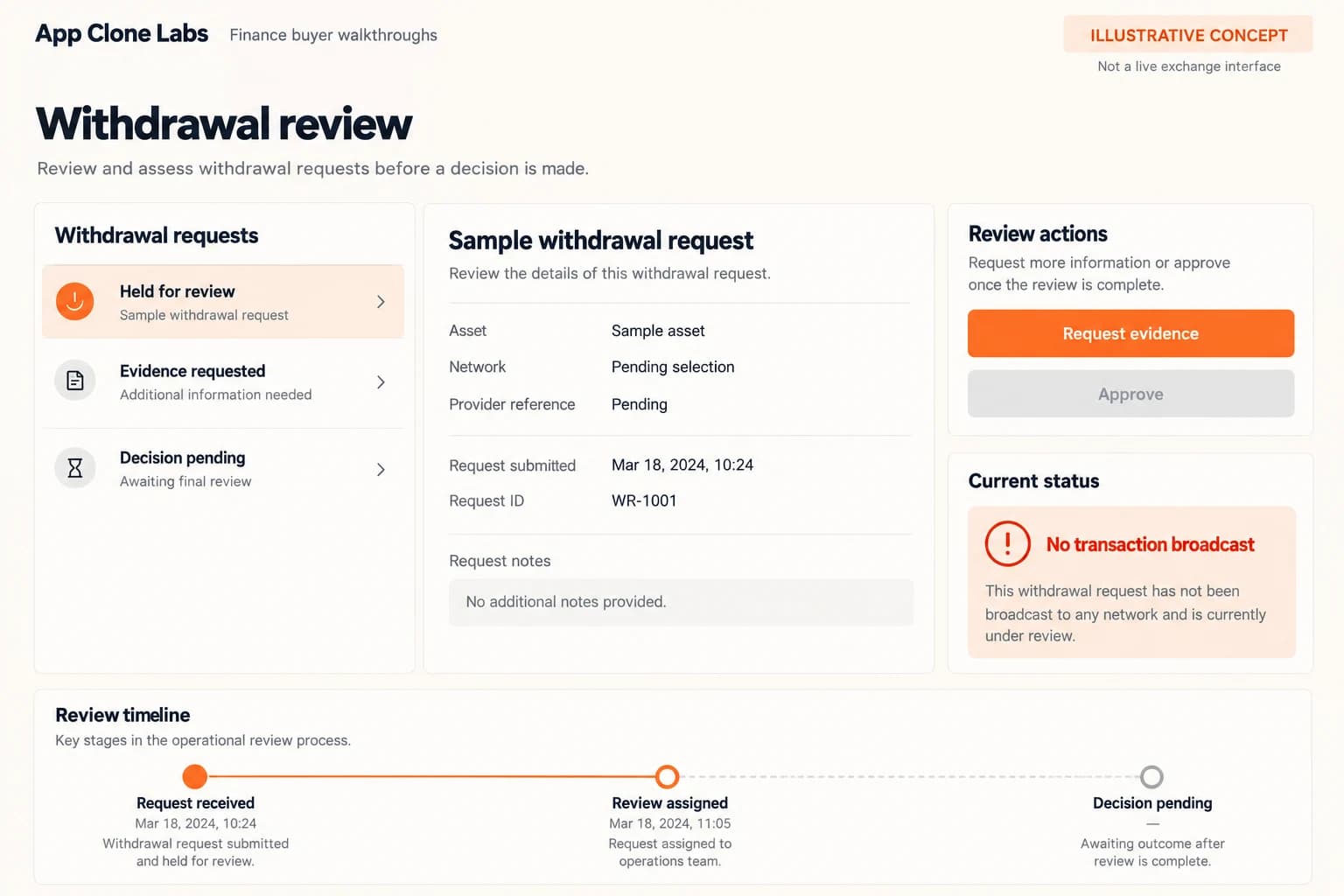
Original App Clone Labs withdrawal-review planning concept at 1536×1024. A sample request on review hold, a pending provider reference and a manual approval boundary illustrate a proposed workflow; no transaction has been broadcast. This is not an official Coinbase interface or an endorsement or affiliation claim. It provides no evidence of a functioning exchange, custody, transfer execution, authorization or tested security controls.
Product flow
A visual map of how each role interacts with each workflow stage, with operator controls and integration boundaries.
Deployable Product Architecture
Coinbase-style Retail Asset Brokerage
Monetization
We model monetization early so payments, admin controls, and reporting support the business.
Show fees and total consideration before confirmation and retain them in receipts. Revenue depends on permitted services, not promised customer returns.
Define how the quoted conversion rate and any spread are shown. Establish liquidity and execution agreements independently without implying access to Coinbase pricing.
Specify included account tools, statements and support commitments. Paid plans do not bypass eligibility, custody restrictions or withdrawal review.
Artifact register
Reference screens illustrate workflows, not a contracted feature list. Sample prices, data, and responses are demonstration content; confirm the current scope during a walkthrough.
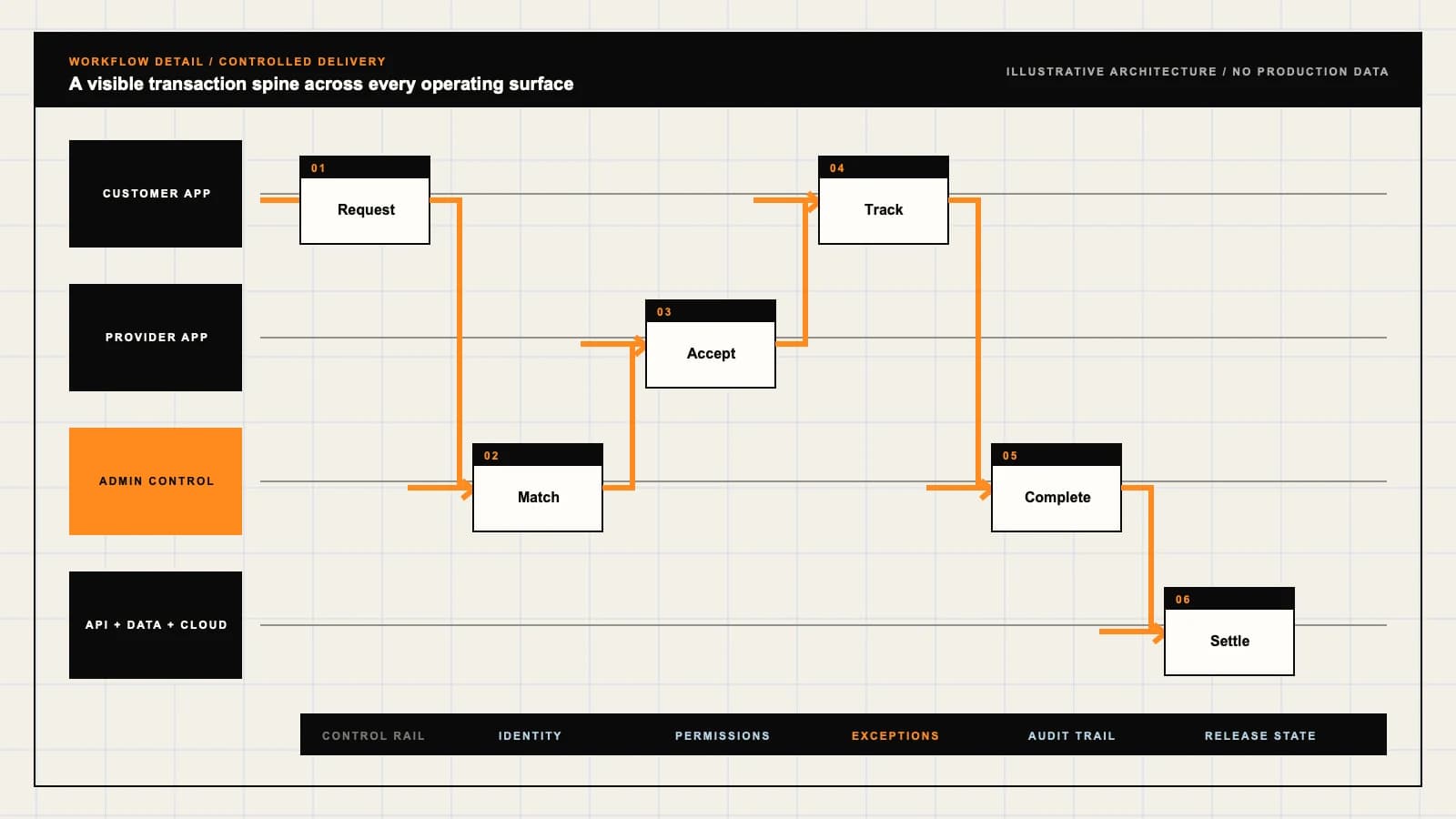
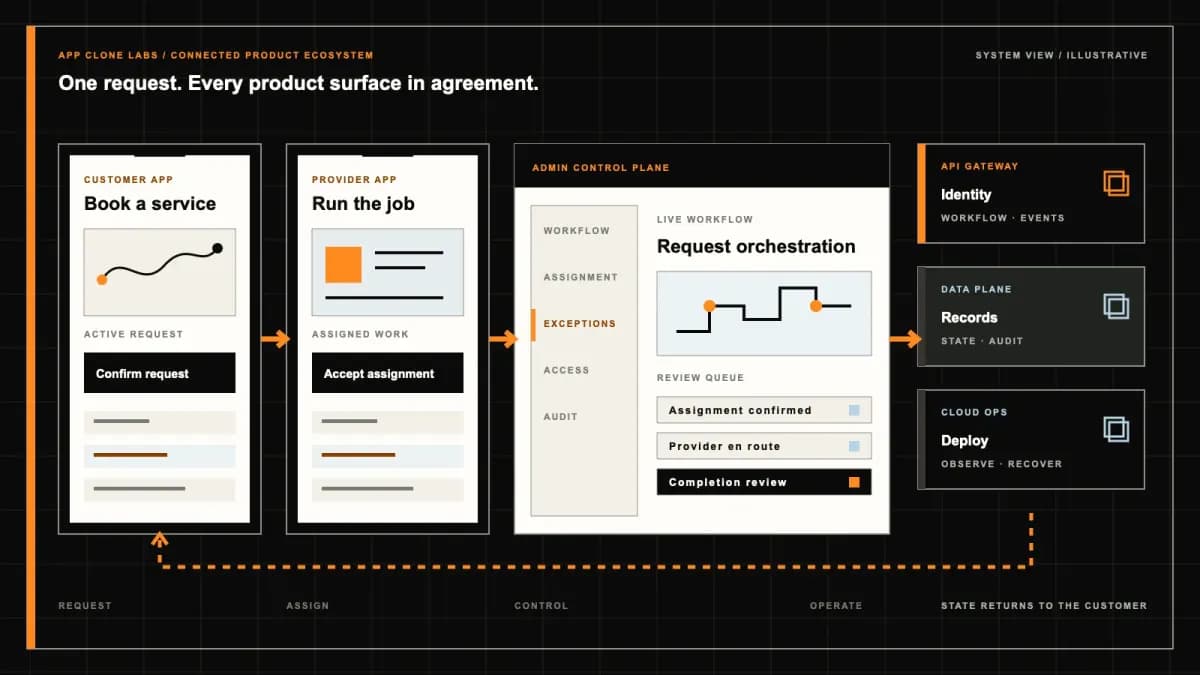
A fictional customer reviews a purchase quote, waits until it expires and presses confirm while a funding callback is delayed. The portfolio must not show an invented purchase, and support must not ask the customer to pay again before investigating the original request. A Coinbase-style retail brokerage brief begins with that commitment: the asset quantity, cash consideration, fees, expiry and accepted instruction must remain explainable across customer and operator views.
App Clone Labs scopes independently branded software for selected retail buy and sell journeys, portfolio records and protected transfers. This does not imply Coinbase affiliation, provider access, liquidity or authorization to operate. No investment returns are guaranteed. Establish brokerage permissions, customer eligibility, execution arrangements and custody responsibilities for the actual offering before any release handles customer money or digital assets. A familiar purchase screen is not evidence of those arrangements.
Choose the intended jurisdictions, eligible customers and reviewed asset list before enabling purchases. Identity verification is one input to eligibility, not permission to offer every asset or service. Define supported account types, funding methods and transaction restrictions. Asset discovery can explain a product without presenting an active purchase button where trading is unavailable. Show pending and refused states with a support route that does not invite customers to bypass checks.
Version eligibility decisions and recheck relevant permissions when a transaction is confirmed. A customer who viewed an asset yesterday may face a changed restriction today. Rehearse an unsupported jurisdiction, an account awaiting review and an asset suspended during checkout. Operations needs attributable reasons and appropriate evidence access. Restrict identity documents separately from ordinary purchase support, and avoid exposing sensitive detection details in customer-facing explanations. One approved transaction does not authorize future activity indefinitely.
Coinbase’s official pricing and fees disclosures explain that simple buy and sell quotes include a spread and that customers can review fees in a transaction preview. The page notes regional variation. This supports a disclosure reference, not a fee schedule or execution promise for an independent brokerage.
Specify the quoted asset quantity, cash amount, currency, spread treatment and applicable service charges in plain language. Show the total the customer pays or receives before confirmation and preserve those terms in transaction history. Do not bury material costs behind a headline asset price. Define exact decimal handling and rounding for small purchases, fees charged in another asset and supported currencies. Rehearse a purchase near the minimum amount and a quote whose fees leave insufficient funding. Disclose the resulting refusal before creating a financial commitment.
Give each quote an identity and an explicit validity boundary under the selected provider contract. Distinguish an indicative estimate from an executable quote. A countdown can help customers understand timing, but the confirmation service must validate expiry itself. Do not rely on the device clock or a cached browser state. When a quote expires, explain the result and present any replacement terms for a fresh decision.
Recheck eligibility, funding and asset status alongside quote validity. A supplier timeout must not become an approved purchase simply because the customer pressed confirm. Test a failed quote, a slow confirmation, a changed price and a device reconnecting with an expired preview. Preserve which quote was accepted and the provider response. If execution terms can change under the reviewed model, disclose that behavior explicitly rather than silently delivering a different quantity while retaining the original total on the receipt.
Document the supported banking and payment arrangements, including authorization, capture, settlement and return behavior. A payment provider acknowledging a request does not necessarily establish settled funds. Decide which transactions can proceed against pending funding under the operator’s assessed policy. Show the resulting restrictions clearly and avoid suggesting that a completed checkout guarantees immediate external transfer availability. Each enabled funding method needs its own reviewed exception path.
Link funding events to the customer instruction using stable references. Duplicate callbacks must not create two deposits or two purchases. Rehearse insufficient funds, a delayed confirmation and a bank return after assets appear in the portfolio. Establish who investigates and which activity may pause while records are reconciled. Customer messages should explain the known state and next action without predicting a completion time the provider has not confirmed. Refund decisions and confirmed bank outcomes also need separate records.
A lost response can leave a purchase submitted but not yet known to the customer interface. Preserve the original instruction identity and recover its outcome from the authoritative execution service. Do not interpret a timeout as either successful execution or a definite failure. A new purchase button should not create a second economic commitment while the first remains unresolved. Provide a transaction reference and an accountable support path.
Separate submitted, accepted, executed, failed and unresolved states with documented transitions. Test an execution confirmation arriving after the browser closes and a retry carrying the same instruction identity. Record the actual accepted quote, execution quantity and charges once, then reconcile downstream ledger entries. Support should locate the original instruction without asking for a second payment. If the provider cannot establish an outcome, retain the unresolved state and apply the reviewed restriction or investigation procedure instead of inventing success for the portfolio screen.
A retail sale needs its own quote, disclosed fees and confirmed execution. The customer should understand the quantity sold and resulting cash consideration before proceeding. A portfolio valuation is a changing estimate, not an executable sale price or a guaranteed cash-out amount. Distinguish sale proceeds from settled cash and separately available withdrawal funds. Explain any restrictions using the reviewed funding and account policy.
Keep sale execution and the bank withdrawal as separate instructions with separate outcomes. Rehearse a successful sale followed by a rejected withdrawal destination, a pending settlement and a returned payout. Do not reverse the completed asset sale merely to make a failed cash transfer look simple. Show what remains in the account and which action needs review. Use attributable adjustments for genuine corrections, preserving the original instruction and provider evidence. Customer history should remain useful after an operator resolves the exception.
Coinbase’s available balance guidance explains that cash deposits can be held and may not be immediately available to send or cash out. It illustrates why account value and transfer availability need distinct explanations. The independent product must establish its own reviewed availability policy rather than inherit Coinbase hold periods.
Show owned assets, estimated value, pending transactions and available amounts with clear units and timestamps. A price movement must not silently release a funding restriction. Define which balances can support buying, selling or external transfers and explain the reason for any difference. Rehearse stale valuation data, a hold lifting while a withdrawal is being reviewed and an asset whose sell access differs from transfer access. Accessible labels and readable receipts matter more than an animated total that obscures unresolved activity.
Establish who holds assets, who owes the customer a balance and who controls signing. Hosted custody and customer-controlled keys create different responsibilities and recovery limits. Explain the selected arrangement before customers transfer assets into the service. An account password reset should not be described as recovery of an independently controlled private key. Custody contracts, incident handling and customer disclosures require assessment beyond the interface.
Separate support access, destination administration, transfer review and signing authority. Define restricted operational records and departure procedures for staff with sensitive privileges. Rehearse a revoked signing permission and a deposit on an unsupported network. An address displayed in a prototype does not establish safe production custody or guaranteed asset recovery. Provide an investigation route for unsupported transfers without promising reversibility. Collect only necessary evidence and keep sensitive account or address information out of public URLs and ordinary notification previews.
Treat withdrawal requests, approved instructions, broadcasts and confirmed transfers as different states. Validate the selected destination, asset, network and available balance under the reviewed operator policy. Apply required screening and approval boundaries independently of the customer’s subscription or purchase history. Changing a destination after approval must trigger the appropriate recheck. Explain network and service charges before the customer commits to the transfer.
Investigate an uncertain broadcast before authorizing another asset movement. Rehearse a provider timeout after submission, conflicting status messages and a network interruption. Record the original transfer reference, reviewers and external evidence with restricted access. Support should explain the next action without promising that a pending transaction can always be cancelled. If balance availability changes during review, revalidate the instruction before signing. Release conditions must remain attributable rather than depending on an undocumented manual override by whichever staff member is available.
Compare customer liabilities, execution records, bank funding and custody evidence on documented boundaries. Every purchase, sale, fee and transfer should have an explainable ledger effect with replay protection. Correct errors through attributable adjustments rather than editing an earlier receipt. Rehearse a duplicate fee, missing funding entry and custody mismatch, identifying the owner and any activity restriction before the difference spreads.
Compare the Binance-style multi-market exchange when customers need order-book entry and matching states. This retail brief focuses on quoted buy and sell commitments, even where an execution provider uses a venue behind the scenes.
Review the configurable exchange core for ledger and custody responsibilities beneath the customer journey. Infrastructure reuse does not supply liquidity, approvals or reconciled production records. Keep unsupported products disabled until their operating arrangements and acceptance evidence exist.
Illustrative screens and synthetic balances demonstrate proposed behavior, not live execution capacity or regulatory approval. Request a sandbox with fictional customers and labeled test assets. Fail a quote, expire another, interrupt a purchase response and replay a funding callback. Then sell an asset, hold withdrawal availability and introduce a custody difference. Buyer acceptance should show the customer, brokerage, treasury and support views agreeing on what happened and who owns each unresolved state.
Bring selected assets and the funding model to a retail brokerage scope discussion to agree refusal conditions and evidence before enabled production activity. Unresolved permissions, missing provider agreements or unreliable financial records should block handover.
Use the delivery process to establish source-code terms, custody responsibility, deployment access and staffed incident ownership. Accept the failure cases alongside a successful purchase so the commitment remains useful when a provider or network stops responding.
FAQ
Independently branded retail quoted purchases and sales, eligibility, funding, portfolio records, custody access and protected transfers for selected assets.
No. Establish independent branding, provider agreements, liquidity and operating permissions for the actual offering. Documentation does not confer authorization or guarantee returns.
The initial journey is retail quote, buy and sell confirmation. Execution arrangements are separately established, including any venue used behind the scenes.
Show asset quantity, cash consideration, currency, applicable spread and fees, validity and execution terms. Preserve the accepted terms in transaction history.
Validate expiry at confirmation and explain refusal. Any replacement quote needs a fresh decision under the reviewed acceptance model rather than silent price substitution.
No. Distinguish authorization, capture, settlement and returns. Establish which activities may proceed against pending funding and disclose resulting restrictions.
Look up the original instruction by stable identity before retrying. Keep unresolved states visible and do not create another purchase or charge while the first outcome is unknown.
No. Sale execution, settled proceeds and a bank withdrawal are separate commitments. A failed payout does not erase the completed sale.
Valuation, pending activity and funds available for buying or transferring can differ. Show clear units, timestamps and restriction reasons under the independent operator policy.
Separate customer requests, destination changes, review and signing. Document the custody model and recovery limits before accepting customer assets.
Investigate the original external outcome before creating another movement. Retain transfer evidence, approval records and named support ownership.
Use synthetic accounts to test failed and expired quotes, uncertain purchases, duplicate funding, restricted withdrawals and reconciliation differences alongside a successful buy and sell.
Solution reference register
01 / Reference and IP
This page references third-party product names only to describe familiar product models and planning references. App Clone Labs is not affiliated with or endorsed by those brands. Build decisions require independent legal, regulatory, and operational review for your market.
02 / Regulatory caveat
Confirm licensing and market-specific authorization before enabling regulated activity · Define whether assets or funds are held by the operator, a qualified custodian, or not held at all · Apply security review, strong authentication, encryption, audit logging, recovery, and incident response · Present educational product information only and prohibit personalized financial, legal, tax, or wagering advice · Apply customer verification, sanctions screening, blockchain monitoring, asset-listing review, and travel-rule processes where required · Distinguish brokerage quotes from exchange order books and disclose custody and execution arrangements
Primary sources
Dated official documentation, standards, and research that support the factual claims on this page.
How to read this page
Scope, cost and timeline figures are planning guidance until confirmed in a written proposal. Diagrams and screens are illustrations, not client deliverables, and source-code rights and handover follow the signed agreement. See the delivery process and the full disclaimer.
Next decision
Define outcomes, constraints, evidence, rights and handover before delivery begins.
Commercial rights, repositories, environments, documentation, acceptance and handover remain contract-defined.
App Clone Labs is not affiliated with, sponsored by, or endorsed by Coinbase. The name identifies a familiar product category; every delivered product is independently designed and built, and the mark remains its owner's property. Read the full legal notice.
