Travel and leisure

Travel Booking Platform — Custom-Built for Your Market

Supplier-connected booking platform for stays, transport, and activities. Planned for travel startups and agencies assembling focused booking journeys with role-specific workflows, operator controls, integrations, and a handover boundary defined for the selected market.

See product screens and demo access

Custom workflows

Brand-safe product strategy

Admin and operations tooling

Reference walkthrough by arrangement

Trace a hotel reservation from search to servicing.

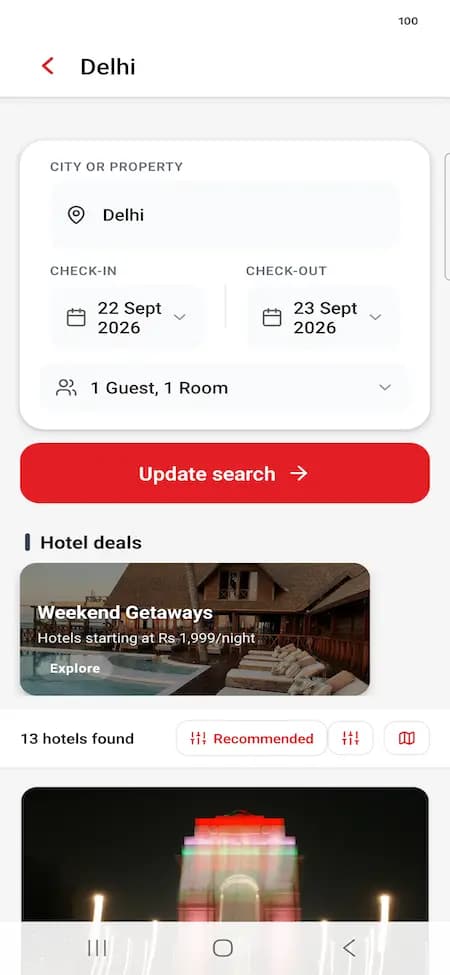
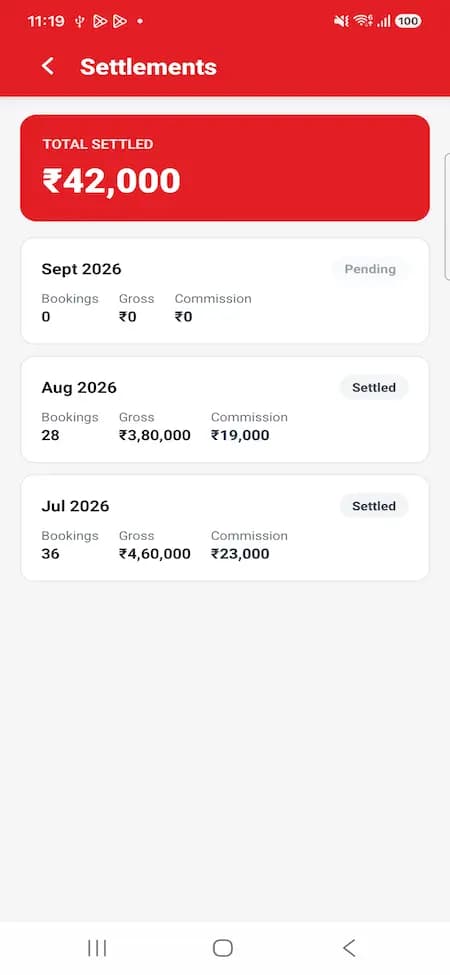
For a supplier-connected travel platform, start with the accommodation journey shown here: define which supplier handles the reservation, what the traveller accepts and who services a change. Use the settlement reference to discuss agency reporting. Transport, activity and connected-package journeys need their own demo; these images do not establish those interfaces or supplier access.

Hotel search reference showing Delhi, check-in and check-out dates, one guest and one room, a hotel promotion and result controls

Hotel search reference showing Delhi, check-in and check-out dates, one guest and one room, a hotel promotion and result controls

Accommodation-search reference with sample dates, hotel count and promotional pricing. The visible search and result controls do not establish live inventory, supplier contracts, final room terms or a confirmed reservation.

What to check in the walkthrough

  • Can the demo identify the supplier behind one room offer, show its last availability check and revalidate the total, taxes and cancellation terms before reservation?
  • Can we follow a hotel booking that is still awaiting supplier confirmation, see the supplier reference when it arrives and distinguish the platform itinerary number from the confirmed reservation?
  • If a traveller later adds an activity or transfer, can the proposed itinerary keep each component’s supplier, confirmation and change rules separate, and which of those journeys can be demonstrated today?
Open full-size reference
Travel agent settlement reference showing a total settled amount and monthly bookings, gross amounts, commissions and settlement statuses

Travel agent settlement reference showing a total settled amount and monthly bookings, gross amounts, commissions and settlement statuses

Agency settlement-summary reference with demonstration amounts and monthly statuses. This is not evidence of revenue, commission entitlement, money transferred or reconciliation; those records and calculations require a walkthrough.

What to check in the walkthrough

  • Can we open a monthly statement and trace a hotel commission to its supplier reservation, eligible booking event and the commission terms that applied when it was sold?
  • If a supplier accepts a date change or cancellation, can we follow the revised reservation and refund through the agency statement, including any service fee or commission adjustment?
  • Can the demo show who handles a supplier dispute, what evidence is needed before marking an agency amount settled and how staff reconcile that status against the actual payment record?
Open full-size reference

Solution reference register

01 / Reference and IP

This page references third-party product names only to describe familiar product models and planning references. App Clone Labs is not affiliated with or endorsed by those brands. Build decisions require independent legal, regulatory, and operational review for your market.

02 / Artifact status

Boards, diagrams, screens and workflow descriptions on this page are illustrative planning artifacts, not evidence of a deployed client product.

03 / Regulatory caveat

Qualified travel concept · Travel seller, package, refund, and accessibility rules vary by market · Visa and entry decisions remain with relevant authorities

04 / Rights and handover

Source access, licensing, repositories, environments, documentation, acceptance and handover are defined by the signed contract and accepted scope.

Scope

Operating model defined

Roles, workflows, dependencies, exclusions, and assumptions are made reviewable.

Evidence: illustrative

System

Applications connected

Experience, operations, services, data, integrations, and release controls are planned together.

Evidence: illustrative

Handover

Rights stated in writing

Access, assignment, licensing, dependencies, documentation, and support follow the signed agreement.

Evidence: illustrative

Artifact register

Product screens and planning references.

Reference screens illustrate workflows, not a contracted feature list. Sample prices, data, and responses are demonstration content; confirm the current scope during a walkthrough.

Travel Booking Platform connected product workflow planning visual
Connected customer, operations, and data workflowEvidence: illustrativeOpen full-size reference
Travel Booking Platform product engineering ecosystem visual
Product engineering ecosystem and handover boundaryEvidence: illustrativeOpen full-size reference

A hotel-only launch needs a complete reservation loop

A traveler reserves a room for two adults and a child, but the confirmation omits the child allocation. A polished search screen has not solved the operating problem: the agency must locate the accepted offer, establish what the supplier confirmed and resolve the discrepancy before arrival. Start a travel booking platform brief with that complete loop.

This is a brand-neutral development scope for supplier-connected accommodation, transport and activity journeys. A hotel-only first release can be the right boundary when its supply and support paths are ready. Including more product tabs is useful only when each product can be confirmed, serviced and reconciled under an agreed operating model.

Separate referral traffic from reservations you must service

The Booking.com accommodation tutorial distinguishes a redirect journey from booking inside the application, with approval and a partner agreement required for the latter. This illustrates a real scope boundary; the documentation does not provide your business with a supplier relationship or a working integration.

Choose whether travelers leave to complete a purchase or your team owns the booking journey. Name the contracting seller, payment collector and after-sale contact. For referrals, avoid showing your own confirmation without the agreed evidence. For direct booking, the brief needs reservation retrieval, exception handling and an accountable service desk.

Approve inventory access before designing a universal catalogue

Bring the intended supplier agreement, permitted products and markets, credential readiness and production acceptance requirements. Identify the connection that can confirm each offer. Supplier logos, sandbox listings and photographs demonstrate presentation choices; they cannot prove bookable inventory or permission to sell it.

Distinguish property descriptions from current room availability. Decide how provider identifiers map to your records, who corrects duplicate properties and when outdated descriptive content is refreshed. When a supplier is unavailable, show the actual limitation and a recovery route instead of continuing checkout against a stale catalogue.

Use dates and occupancy to select a room product

A property can be listed while the required room is unavailable. Search needs the stay dates, room count, adult allocation and any child ages required by the supplier. Room capacity, meal inclusion and bed information belong to the selected offer; a generic hotel card must not imply that every guest arrangement can be accommodated.

Show mandatory charges, optional additions and accessibility information with their source and limits. A request for an accessible room or a cot needs a defined supplier response and follow-up path. Collect the information required to book and fulfil the stay, rather than building a general traveler-document store without an agreed purpose.

Preview the current offer before asking for commitment

The Demand API order-creation guide describes a preview followed by creation and explicitly separates preview from a confirmed reservation. It requires a fresh preview after an expired token or a material selection change. Apply the documented sequence of the chosen approved provider; another supplier can have a different contract.

Keep the selected dates, room products, guest allocation and accepted terms together. If a refreshed price or policy differs, present the change and ask the traveler to accept it. Preserve the offer version used for submission. Do not quietly exchange a refundable rate for a non-refundable one or a different room because the first option expired.

Show who collects each charge and when

A room can require payment now, a deposit, or an amount collected at the property under the selected supplier model. Explain the collector, currency, timing, agency fee and later charges before commitment. If the interface displays an estimated currency conversion, distinguish it from the amount actually charged.

Define what happens when payment is authorised but the reservation is unresolved, and when the supplier confirms but payment needs investigation. Finance needs comparable reservation, charge, adjustment and refund references. Reviewed provider arrangements determine the money flow; software screens should reflect those arrangements rather than imply control over supplier or bank processing.

Treat confirmation and fulfilment as separate milestones

A reservation can be submitted, confirmed, rejected or unresolved. After confirmation, arrival instructions, permitted amendments and check-in problems remain part of fulfilment. Preserve supplier references and tell the traveler what is confirmed and what needs action. An email receipt or card notification alone is insufficient evidence of a booked room.

For an unknown outcome after a timeout, use the provider’s retrieval or recovery process before submitting again. Set an owner and escalation path for the unresolved record. Test a confirmed booking with failed notification delivery separately: staff should resend or provide access to the existing confirmation without reserving a second room.
Plan the arrival exception before a traveler reaches reception

A traveler arrives and the property cannot locate the reservation. The operations view needs the accepted dates and guest allocation, supplier reference, relevant contact and prior communication. Agree who contacts the provider, what evidence can be shared and who may approve a replacement or adjustment. A chat widget alone cannot decide these responsibilities.

Show check-in times and arrival instructions from the approved source, and distinguish confirmed arrangements from special requests awaiting an answer. Support coverage and out-of-hours escalation are explicit scope inputs. Visa and entry decisions remain with the relevant authorities; itinerary software must not imply that a reservation establishes permission to travel.

Carry cancellation through to the actual refund outcome

Store the cancellation terms the traveler accepted, including the relevant deadline and time basis. A cancellation request, supplier acceptance and refund settlement are different events. Explain the permitted action and reviewed charge before submission, then retain the supplier response and any unresolved exception.

A refund queue needs requested, approved, submitted, failed and reconciled states under the agreed financial process. Identify the collector responsible for returning the money and give staff an escalation record. Avoid a universal refund deadline: provider processing and supplier rules must be reviewed for the selected flow.

Add another travel product only with a partial-trip policy

If a stay is confirmed while an airport transfer fails, the trip is incomplete even though one reservation is usable. Define whether the traveler keeps the stay, chooses a different transfer or requests a permitted cancellation. Record those decisions and their financial consequences; there is no assumed free reversal of a successful component.

Compare the white-label travel portal brief when branded agency and partner workspaces are the main requirement. For any multi-product build, review independent supplier servicing paths and the market-specific implications of combining products before committing to one checkout.

Ask the demo to prove an exception can be resolved

Request a walkthrough that follows the same reservation from traveler selection to the operations queue and finance review. Confirm current demo availability, which connections use sandbox responses and which visuals are illustrative. An attractive itinerary is not evidence of live inventory, production credentials or a completed refund.

Acceptance should include wrong guest allocation, an expired offer, a changed cancellation policy, an unknown booking outcome, failed confirmation delivery and an arrival escalation. Inspect whether staff can find the existing reservation before retrying and whether another traveler’s record is inaccessible. For additional products, include one component failure and the approved recovery choice.

Bring supplier evidence and a bounded release brief

Bring a sample room offer, redacted reservation response, cancellation scenario, payment responsibilities and named support owners. Specify the launch market, currencies, supplier connections and customer surfaces. Distinguish configuration, new engineering, external integrations and exclusions so an estimate describes a complete operating release.

Use a travel booking scope discussion to review these inputs and the acceptance evidence. Delivery and handover depend on usable provider access, operating decisions and the agreed contract, including source rights, third-party licences, deployment access and support.

Review the delivery process to agree discovery, implementation and acceptance checkpoints before expanding into transport, activities or combined packages.

Product flow

Role-workflow flow diagram.

A visual map of how each role interacts with each workflow stage, with operator controls and integration boundaries.

Deployable Product Architecture

Travel Booking Platform

MATCH DATES AND G…REFRESH THE OFFER…CARRY CONFIRMATIO…Choose an offer w…Resolve inventory…Own exceptions an…INTEGRATIONS: Approved accommodation supplier connections for property content, live room…OPERATOR CONTROLS: Only approved connections belong in scope · Evidence determines the next ac…
Illustrative validation artifact — role-workflow flow diagram; final surfaces, boundaries, and integration topology are confirmed during discovery.

User roles

Travel Booking Platform roles and workflows.

Clone-inspired platforms usually need several coordinated interfaces, not just a customer app.

Traveler

01

Choose an offer with usable terms

Compare room occupancy, included services, payment timing and cancellation rules. Follow the actual reservation status and access a support route when confirmation is unresolved.

Supplier liaison

02

Resolve inventory and reservation questions

Maintain approved supplier mappings, investigate missing confirmations and record provider responses. Forward special requests without presenting them as guaranteed fulfilment.

Booking operator

03

Own exceptions and financial review

Assign pending bookings, reconcile charges and refunds, and review permitted changes. Restrict financial approvals and traveler records by staff responsibility.

Workflow

Travel Booking Platform workflow stages.

Each workflow stage is mapped to a role, screen, API, notification, admin control, and measurable launch outcome.

Select

01

Match dates and guests to bookable products

Request relevant availability, identify the supplier and display room rules and charges. Preserve the selection rather than treating a property listing as a room reservation.

Commit

02

Refresh the offer and submit once

Review the current price and terms, collect required guest details and obtain acceptance. Follow provider recovery guidance if the reservation request has an unknown outcome.

Fulfil

03

Carry confirmation through the stay

Provide supplier references, arrival information and status. Track permitted cancellation, check-in exceptions and refund reconciliation with a named operations owner.

Deployable Product Architecture

Workflow / system register

Revision DPlanning surface

Marketplace loop

Travel Booking Platform workflow stages.

Demand and supply meet through governed transactions

Marketplace loop: Travel Booking Platform workflow stages.Demand and supply meet through governed transactions. Trust, payments, support, and operator controls close the commercial loop.
01

Match dates and guests to bookable products

02

Refresh the offer and submit once

03

Carry confirmation through the stay

Control note

Trust, payments, support, and operator controls close the commercial loop.

Illustrative architecture register; validate against the accepted scope.

Operator controls

Travel Booking Platform admin and operator controls.

The control center is scoped as a first-class product surface, not an afterthought.

Inventory readiness

01

Only approved connections belong in scope

Record supplier agreements, supported products and credentials separately from sample data. Define who reviews discontinued offers, stale content and production readiness.

Status integrity

02

Evidence determines the next action

Keep quoted, submitted, confirmed, rejected and unresolved reservation states distinct. A charge or delivered message cannot replace supplier confirmation.

Access and decisions

03

Staff authority has a boundary

Limit traveler details and financial exports to the relevant role. Record cancellation approvals, manual adjustments and reasons; exclude sensitive payment data from support logs.

Monetization

Travel Booking Platform monetization models.

We model monetization early so payments, admin controls, and reporting support the business.

Recognise the contracted entitlement

Compare qualifying bookings and cancellations with supplier statements. The booking total and expected commission are separate records, subject to the reviewed agreement.

Explain what the agency charges

Disclose agency fees before purchase, including currency and cancellation treatment. Identify whether the agency, property or another provider collects each amount.

Keep paid visibility legible

Label sponsored placements and preserve current availability and comparison details. Selling a placement does not establish that its advertised room can be reserved.

Integrations

Travel Booking Platform integration surface.

External systems that determine launch readiness, data flow, and operational continuity.

Integration

01

Integration 1

Approved accommodation supplier connections for property content, live room availability, offer preview, reservation retrieval and permitted cancellation

Integration

02

Integration 2

Payment and finance connections scoped to the actual collector, charge timing, supplier statements and reconciliation of unresolved refunds

Integration

03

Integration 3

Traveler messaging and support tooling with supplier references, delivery tracking, restricted personal data and an escalation owner

Scope drivers

Travel Booking Platform scope drivers.

The variables that most influence build effort, cost, and launch readiness.

Product boundary

01

Hotel-only and multi-product are different briefs

Adding transport or activities introduces distinct traveler fields, confirmation evidence and servicing dependencies. Name launch products before specifying a combined itinerary.

Connection readiness

02

Approval and documentation precede estimates

Review provider permissions, API versions, sandbox coverage, available markets and recovery procedures. A public API page is a planning reference, not a supplied commercial connection.

Fulfilment ownership

03

Service after purchase shapes the build

Define who handles a missing room, delayed confirmation, arrival problem and refund query. Support hours, escalation authority and collector responsibilities influence the console and notifications.

Deployable Product Architecture

Scope drivers / system register

Revision EPlanning surface

Marketplace loop

Travel Booking Platform scope drivers.

Demand and supply meet through governed transactions

Marketplace loop: Travel Booking Platform scope drivers.Demand and supply meet through governed transactions. Trust, payments, support, and operator controls close the commercial loop.
01

Hotel-only and multi-product are different briefs

02

Approval and documentation precede estimates

03

Service after purchase shapes the build

Control note

Trust, payments, support, and operator controls close the commercial loop.

Illustrative architecture register; validate against the accepted scope.

V1 scope

Travel Booking Platform V1 foundation.

Launch the smallest complete operating loop first, then scale the product with confidence.

Accommodation booking

01

Finish one selected supplier journey

Include relevant search, room selection, current terms, accepted checkout and retrievable supplier confirmation. Provide a truthful pending state when immediate confirmation is unavailable.

Exception desk

02

Make unfinished work visible

Assign unknown reservation outcomes, undelivered messages and arrival escalations. Show the supplier reference, last action and next permitted step without encouraging duplicate booking.

Servicing record

03

Connect cancellation to money review

Retain accepted policies and supplier responses. Track cancellation requests and refund outcomes independently and provide a reviewed export for reconciliation.

Later phases

Travel Booking Platform post-launch expansion.

Capabilities that should usually wait until real usage proves the core loop.

Transport and activities

01

Extend only with servicing evidence

Add a product after confirming provider access, fulfillment status and correction or cancellation paths. Establish how it relates to an existing accommodation reservation.

Combined itineraries

02

Agree partial failure decisions first

Define traveler choices, staff authority and financial consequences when one component fails. Review the selling model and any package obligations for the intended market.

Traveler self-service

03

Automate approved decisions

Expose only supplier-supported changes after manual servicing paths are understood. Preserve eligibility checks, exceptions and escalation rather than implying every reservation is editable.

Deployable Product Architecture

Later phases / system register

Revision DPlanning surface

Marketplace loop

Travel Booking Platform post-launch expansion.

Demand and supply meet through governed transactions

Marketplace loop: Travel Booking Platform post-launch expansion.Demand and supply meet through governed transactions. Trust, payments, support, and operator controls close the commercial loop.
01

Extend only with servicing evidence

02

Agree partial failure decisions first

03

Automate approved decisions

Control note

Trust, payments, support, and operator controls close the commercial loop.

Illustrative architecture register; validate against the accepted scope.

Regulatory review

Travel Booking Platform regulatory and compliance flags.

Each flag must be reviewed by qualified counsel for your target market before build or launch.

Flag 1

Qualified travel concept

Flag 2

Travel seller, package, refund, and accessibility rules vary by market

Flag 3

Visa and entry decisions remain with relevant authorities

Reference walkthrough

Request a Travel Booking Platform reference walkthrough.

Ask us to confirm which reference surfaces are currently available for this product model. Rather than publishing shared demo credentials, we schedule a private guided walkthrough for qualified buyers.

Reference surface

01

Traveler: Choose an offer with usable terms

Request a role-specific demonstration and confirm which capabilities are currently available. Review the proposed responsibility: Compare room occupancy, included services, payment timing and cancellation rules. Follow the actual reservation status and access a support route when confirmation is unresolved.

Reference surface

02

Supplier liaison: Resolve inventory and reservation questions

Request a role-specific demonstration and confirm which capabilities are currently available. Review the proposed responsibility: Maintain approved supplier mappings, investigate missing confirmations and record provider responses. Forward special requests without presenting them as guaranteed fulfilment.

Reference surface

03

Booking operator: Own exceptions and financial review

Request a role-specific demonstration and confirm which capabilities are currently available. Review the proposed responsibility: Assign pending bookings, reconcile charges and refunds, and review permitted changes. Restrict financial approvals and traveler records by staff responsibility.

Next step

04

Book a walkthrough

Request a live, private walkthrough of the reference implementation. We will confirm scope and discuss configured deployment versus custom build for your market.

Open register

Deployable Product Architecture

Reference walkthrough / system register

Revision CPlanning surface

Marketplace loop

Request a Travel Booking Platform reference walkthrough.

Demand and supply meet through governed transactions

Marketplace loop: Request a Travel Booking Platform reference walkthrough.Demand and supply meet through governed transactions. Trust, payments, support, and operator controls close the commercial loop.
01

Traveler: Choose an offer with usable terms

02

Supplier liaison: Resolve inventory and reservation questions

03

Booking operator: Own exceptions and financial review

04

Book a walkthrough

Control note

Trust, payments, support, and operator controls close the commercial loop.

Illustrative architecture register; validate against the accepted scope.

Process

A traceable path from decision to acceptance.

  1. 01

    Model teardown

    We map the reference business model, user roles, monetization path, regulatory needs, and launch constraints.

    Artifact: Product teardown, risk map, role matrix

  2. 02

    Market-fit blueprint

    We reshape the model around your market, operations, pricing, workflows, and first release priorities.

    Artifact: Feature scope, flows, technical plan

  3. 03

    Design and build

    Product, design, engineering, QA, and cloud delivery move in weekly demo cycles with visible progress.

    Artifact: Working releases, QA notes, sprint demos

  4. 04

    Launch and operate

    We support production release, monitoring, handoff, roadmap decisions, and post-launch improvement.

    Artifact: Launch checklist, docs, growth backlog

FAQ

Questions to resolve before the build.

01Is hotel-only a sensible first release for a travel booking platform?

Yes, when the selected accommodation connection and servicing paths are ready. Scope a complete search, current-offer review, reservation, exception and reconciliation journey before adding transport or activities.

02How does a referral journey differ from booking in our application?

A referral sends the traveler to another booking surface. Booking within your application requires the approved supplier process and defined ownership of confirmation, support and financial exceptions. Agree that boundary before estimating the build.

03Do supplier names or public API documents mean inventory is included?

No. Agreements, credentials, permitted products and production approval require confirmation with each supplier. Documentation and sandbox examples can inform scope without establishing permission to sell inventory.

04Why do room selection and guest allocation need separate review?

A listed property does not establish availability for the requested room and occupants. Preserve dates, room products, adult allocation and required child ages through quote review and supplier submission.

05What happens if the selected rate or cancellation policy changes?

Refresh through the approved provider flow, present the changed price or terms and obtain acceptance before submitting. Keep the accepted offer version so staff can investigate later questions.

06Can the property collect payment instead of our agency?

That depends on the selected commercial and supplier model. Disclose the actual collector, amount, currency and timing, including agency fees and amounts due later, then scope reconciliation to those responsibilities.

07What should staff do when a reservation request times out?

Treat the outcome as unresolved and follow the supplier retrieval or recovery procedure before retrying. Assign an owner and preserve request evidence because the first request may already have created a reservation.

08Does confirmation mean the stay has been fulfilled?

No. Confirmation establishes the reservation under the agreed evidence rules; arrival instructions, check-in exceptions and permitted servicing remain separate operating milestones.

09How should a missing reservation at check-in be handled?

Give staff the accepted booking details, supplier reference, provider contact and prior communication. Agree escalation coverage and who may approve a replacement or adjustment before promising an arrival support service.

10Does supplier cancellation complete the traveler’s refund?

No. Track cancellation acceptance, refund eligibility, provider submission and reconciliation separately. Identify the payment collector responsible for returning funds and route unresolved amounts to that owner.

11What evidence should a travel booking demo show?

Inspect a single reservation across traveler, operations and finance views, including stale offers, unknown submission outcomes and failed notification delivery. Confirm sandbox versus working integrations, current demo availability and restricted access to other travelers’ records.

12What must be agreed before adding transport or activities?

Confirm each product’s supplier access, required traveler data, confirmation and servicing rules. Define partial-trip recovery, financial consequences and qualified review of the selling model and applicable package obligations.

Primary sources

References behind this page

Dated official documentation, standards, and research that support the factual claims on this page.

  1. 01
  2. 02

Citation readiness

How to interpret this page

Published by App Clone Labs Editorial Team

Commercial claims
Scope, cost, and timeline claims are planning guidance and require validation in a current proposal.
Evidence status
Diagrams, boards, examples, and estimates are illustrative planning artifacts unless explicitly identified with a source and measured evidence status.

Next decision

Turn the brief into an accepted product scope.

Define outcomes, constraints, evidence, rights and handover before delivery begins.

Commercial rights, repositories, environments, documentation, acceptance and handover remain contract-defined.

Scope Travel Booking Platform

