Social media

Twitter-style Real-time Public Network — Custom-Built for Your Market

Short-post public network with follows, trends, media, and live conversation. Planned for media communities organizing rapid public updates and interest graphs with role-specific workflows, operator controls, integrations, and a handover boundary defined for the selected market.

See product screens and demo access

Custom workflows

Brand-safe product strategy

Admin and operations tooling

Reference walkthrough by arrangement

Review short-form publishing, reports and visibility rules before selecting a public conversation build.

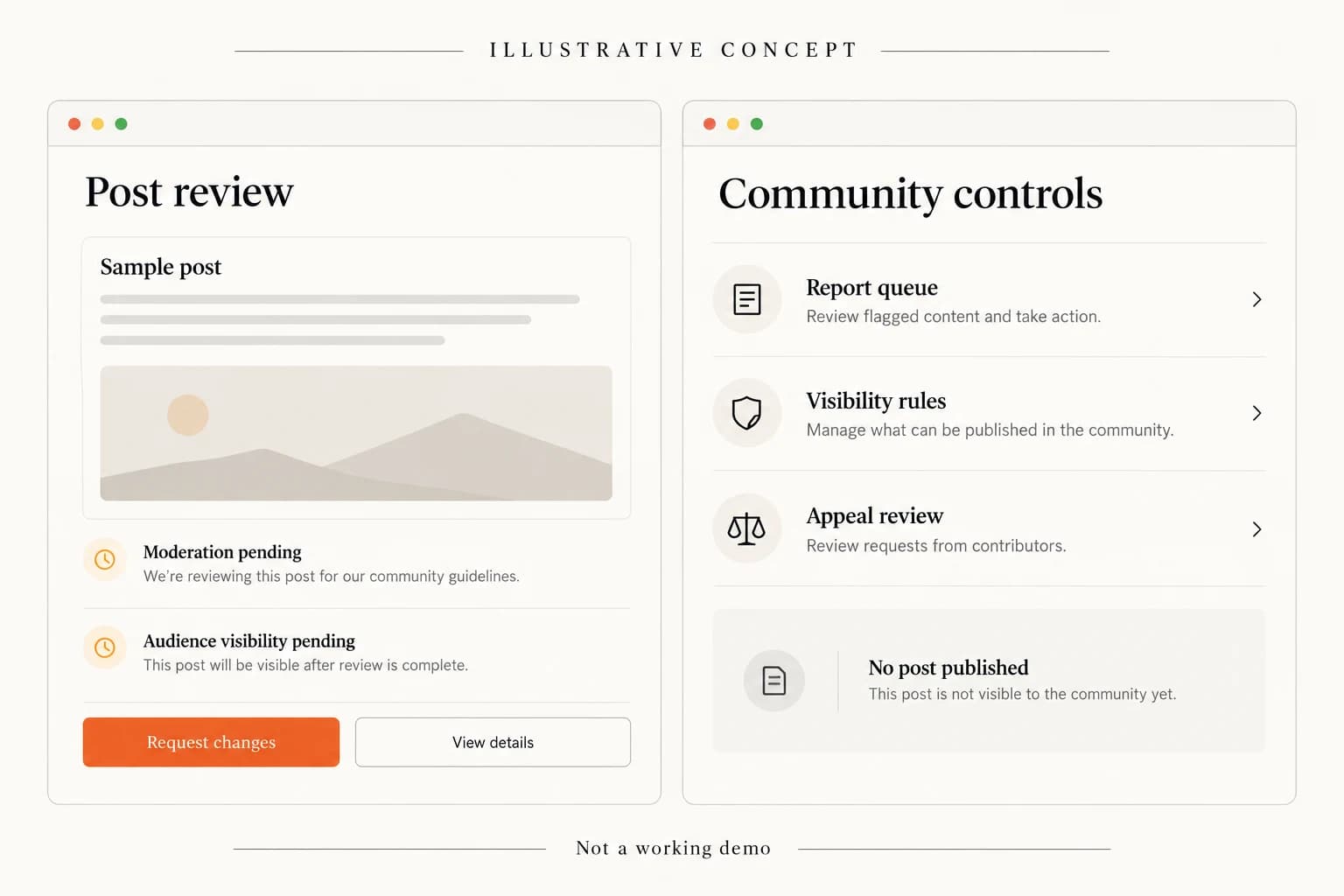
Use this generic community review concept to discuss moderation and publication workflows. It is not X/Twitter UI or evidence of reach, ranking, public posts or platform affiliation.

Community post review with moderation and audience visibility pending

Community post review with moderation and audience visibility pending

Original App Clone Labs community publishing concept at 1536×1024. This illustrative artwork shows sample review states and is not an official twitter interface, a live deployment or proof of supply, reach, moderation, payments, identity, safety or platform affiliation.

What to check in the walkthrough

  • Publication gate: Which checks must pass before a post is visible to a selected audience?
  • Report resolution: How are reports, reviewer actions, appeals and operator overrides recorded?
  • Withdrawal scope: When content is withdrawn, which feed, search, notification and shared-link surfaces must update?
Open full-size reference

Solution reference register

01 / Reference and IP

This page references third-party product names only to describe familiar product models and planning references. App Clone Labs is not affiliated with or endorsed by those brands. Build decisions require independent legal, regulatory, and operational review for your market.

02 / Artifact status

Boards, diagrams, screens and workflow descriptions on this page are illustrative planning artifacts, not evidence of a deployed client product.

03 / Regulatory caveat

Provide moderation, appeals, crisis escalation, and transparency workflows · Support copyright, trademark, privacy, and content-takedown requests · Apply age assurance, parental experiences, and minor-safety controls · Define public-interest, crisis, and manipulated-media response policies

04 / Rights and handover

Source access, licensing, repositories, environments, documentation, acceptance and handover are defined by the signed contract and accepted scope.

Scope

Operating model defined

Roles, workflows, dependencies, exclusions, and assumptions are made reviewable.

Evidence: illustrative

System

Applications connected

Experience, operations, services, data, integrations, and release controls are planned together.

Evidence: illustrative

Handover

Rights stated in writing

Access, assignment, licensing, dependencies, documentation, and support follow the signed agreement.

Evidence: illustrative

Artifact register

Product screens and planning references.

Reference screens illustrate workflows, not a contracted feature list. Sample prices, data, and responses are demonstration content; confirm the current scope during a walkthrough.

Twitter-style Real-time Public Network connected product workflow planning visual
Connected customer, operations, and data workflowEvidence: illustrativeOpen full-size reference
Twitter-style Real-time Public Network product engineering ecosystem visual
Product engineering ecosystem and handover boundaryEvidence: illustrativeOpen full-size reference

A breaking update needs a distribution and correction trail

A local reporter posts that a bridge has reopened. Readers repost it, a topic feed picks it up and phone notifications begin leaving the queue. Minutes later, the reporter corrects the location. The product needs to show which version readers are seeing, what happened to reposts and which notifications can still be changed. A fast composer covers only the first part of a public update’s life.

A Twitter-style build is an independently branded short-post network for follows, rapid updates, public discovery and safety operations. Twitter is the historical product reference; the referenced service is now X. The brief does not include either brand’s proprietary software, accounts, licensed social graph or live API access. Define one community and its publishing responsibilities before specifying scale claims. Distribution, correction and abuse handling must be reviewable alongside the posting experience.

Keep the first release focused on public short updates

Name the first audience: for example, readers following local publishers and public service updates. Decide whether account handles, public profiles and a follow graph meet that need. Identity review should prevent deceptive impersonation without requiring every member to publish a legal name. Define who owns organization accounts, how staff access is revoked and what the product says about any verification label.

Compare the X-style broader conversation network for live rooms, larger media and creator commercial expansion. The Twitter reference here concentrates on rapid short-post distribution. Existing Threads-style conversation and Reddit-style topic communities make different choices about account linkage, replies and delegated moderation. Do not infer an external user base from a familiar interface. Start with synthetic demonstration accounts and a documented plan for onboarding an independently operated community.

A post has an identity, audience and publication state

Define supported text length, media limits, link handling and audience choices as product rules rather than assumed vendor parity. Validate submissions at the boundary and reject unsupported content clearly. Give each committed post a stable identifier and retain the author, publication time and current revision. Distinguish an optimistic screen update from a successful stored publication, especially after a mobile connection drops.

A repeated request should not silently create another copy of the same update. Keep a deliberate second post distinct from a transport retry and show unresolved submission outcomes for recovery. Media needs accessible alternatives, upload validation and an explicit processing state. A failed attachment should not disappear behind a published label that implies the intended image is available. Agree how drafts, rejected content and abandoned uploads are retained, and restrict access to material that was never published.

Chronological and selected feeds need different explanations

A chronological following feed needs a defined ordering rule, stable pagination and treatment of delayed posts. Decide whether ordering uses publication time or another event time, and how reposts enter that stream. Avoid inserting a late event in a way that silently changes what a reader already saw. Show freshness and a way to refresh when distribution falls behind during a busy public event.

A selected feed needs visible reasons for inclusion, such as followed sources, topic interest or editorial selection. Define how muted terms, blocked accounts, restricted audiences and moderation decisions affect eligibility before ranking. Explain the distinction between selection and a chronological view without claiming that either proves a post is accurate. Measure feed lag and missing eligible content against a stated workload. An impressive scrolling demo with seeded posts does not establish sustained distribution capacity or useful recommendations for real readers.

Reposts and quotes must preserve source and audience context

A repost should identify both the original author and the account distributing it. A quote adds a separate author’s commentary while retaining a reference to the source. Define which audiences may access each object, including restricted posts and a quote whose source later becomes unavailable. A new wrapper must not expand access to source media that the quoting account cannot legitimately expose.

The X repost FAQ distinguishes undoing a repost from deleting the original and describes protected-post restrictions. Use that distinction to agree the independent network’s own behavior. Test source removal, audience changes and blocked relationships from several reader accounts. Preserve meaningful unavailable states rather than implying the source author wrote the quotation. External screenshots or copied text may outlive a source post; product controls should not claim the ability to retract material outside the operated system.

Replies and notifications should respect current access

Define who can reply, how a participant changes reply permissions and what happens to existing replies. Keep conversation context accessible without turning mentions into an unrestricted harassment channel. Readers need understandable notification choices for follows, mentions, replies and repost activity. Group repeated activity sensibly, with visible unread state and an explicit distinction between an in-product event and a provider-delivered push notification.

Recheck current visibility and applicable blocks before building notification content or dispatching a delayed message. Use stable event identifiers to prevent queue retries from creating duplicate alerts. A notification already delivered to a device may not be retractable; expose that boundary in deletion and correction behavior. Test expired device tokens, missed delivery and a removed post behind an old deep link. A tap should resolve to the current permitted state rather than resurrect stale content from a notification payload.

Before adding a trending panel, define its topic grouping, observation window, eligible population and geographic or language scope. Separate repeated posts from independent participation and decide how reposts contribute. A topic’s prominence is evidence of activity under these rules, not a verdict about public importance or truth. Show the selection context and keep sponsored topics labelled separately from organic discovery.

The X authenticity policy describes coordinated inauthentic activity, including artificial amplification of topics and engagement. Treat that as a reference for a reviewable integrity problem, not a ready-made detection system. Establish limits and operator review for suspicious bursts, while preserving legitimate coordinated discussion. Record the evidence behind exclusion and allow appropriate review. In a small first release, curated topics with disclosed selection can be more accountable than a trend score whose data population and manipulation exposure remain undefined.

Spam and impersonation need evidence beyond a score

Set limits for posting, following, replies and recovery attempts with responses that explain temporary restrictions. Review suspicious account creation, repeated links and coordinated activity as signals for investigation. A new account or popular message is not by itself evidence of abuse. Distinguish parody, commentary and organization representation using an agreed policy, and provide a clear route to report deceptive impersonation.

Give integrity operators a restricted case view with relevant events, source reports and the policy under review. Keep sensitive account signals out of public profiles and routine publisher exports. Automated filters need a bounded effect and a review path for false positives. Define crisis and manipulated-media escalation ownership before launching a breaking-news community. Staff availability and language coverage limit response capacity; a detector integration does not establish continuous human review or justify promising that harmful material will never reach readers.

Reports and appeals must expose the decision and its effect

A report should identify the target post or account, allegation and relevant context without encouraging unnecessary collection of personal data. Accept duplicate reports without interpreting raw volume as proof. Show receipt, review and outcome states according to the agreed disclosure policy, and protect reporters from unnecessary exposure. Name which team owns urgent cases and how unresolved reports are handed over.

Record the policy reason, reviewer and effect of a removal, reach restriction or account action. Let the affected member request an appeal with relevant context and show its status. Reversing a decision needs deliberate propagation to feeds, search and eligible notifications; it must not silently create new alerts for old activity. Keep the review evidence and member-facing explanation within their respective access boundaries. Confirm retention and operator audit access so later investigations can explain a decision without keeping unrelated personal records indefinitely.

Blocks, edits and deletion must reach controlled copies

Define what blocking changes for replies, mentions, feeds and authenticated access. Public material may still be observable through other routes, so avoid presenting a block as universal secrecy. Check direct links, search results and media access against the actual audience policy. A removed follow edge should not leave a previously restricted post readable merely because the reader still has its identifier.

If editing is supported, identify the current revision and how readers can inspect correction context. Decide whether existing quotes reflect the new source or retain a clearly marked earlier revision. Propagate deletion and restrictions to controlled indexes, caches and queues, with an operator able to inspect failed or delayed work. Retain only the review evidence justified by the agreed policy. External search caches, screenshots and independently copied posts need an honest limitation; deleting the operated record cannot guarantee removal of every copy.

Revenue and reach reports need separate meanings

Advertising requires labelled placements, audience choices, advertiser review and reporting that separates paid delivery from organic distribution. Subscription benefits should be explicit, including renewal and cancellation behavior. A paid badge or tool allowance must not imply reliable reporting, identity verification or immunity from enforcement. Organization posting and permitted data exports can be separately scoped without promising rights to another service’s accounts or content.

Report active participants, eligible feed deliveries, notification outcomes, restriction propagation and moderation backlog for stated windows. Define whether impressions count visible presentations, requests or unique readers, and identify synthetic activity. A topic appearing in a trend list does not establish independent popularity; a view count does not prove agreement. Measure recovery and integrity work beside growth. Publisher analytics and external APIs need confirmed permissions and data-use rights before they can be represented as connected capabilities in a buyer demonstration.

Bring a synthetic breaking story and test its correction

Buyer acceptance should connect publication, follows, chronological and selected feeds, reposts, quotes and notifications using synthetic members. Change the source audience, correct the update and delete it while delivery is delayed. Check blocked readers, stale search results, duplicate submissions and a reported impersonation. Inspect the case reason, appeal outcome and propagation evidence. Clearly identify illustrative artwork, seeded activity and sandbox providers; none proves live API access or a licensed external social graph.

Bring your audience policy, sample updates and safety escalation owner to a real-time public network scope discussion. Agree configured capabilities, custom work, distribution limits and source rights in the contract.

Review the delivery process for checkpoints covering audience rules, correction testing, report review and operator handover. Accept a bounded release using inspectable evidence, with support ownership and exclusions documented before launch.

Product flow

Role-workflow flow diagram.

A visual map of how each role interacts with each workflow stage, with operator controls and integration boundaries.

Deployable Product Architecture

Twitter-style Real-time Public Network

COMMIT THE POST W…EXPLAIN HOW THE U…HANDLE CORRECTION…Follow sources an…Distribute update…Review abuse and …INTEGRATIONS: Feed, search, trend and notification infrastructure with stable event ident…OPERATOR CONTROLS: Check visibility when content is accessed · Keep manipulation signals separ…
Illustrative validation artifact — role-workflow flow diagram; final surfaces, boundaries, and integration topology are confirmed during discovery.

User roles

Twitter-style Real-time Public Network roles and workflows.

Clone-inspired platforms usually need several coordinated interfaces, not just a customer app.

Member and reader

01

Follow sources and control public interaction

Publish short updates, inspect chronological or selected feeds and manage replies, reposts and notifications. Access blocking, reporting and account recovery without requiring a public identity disclosure.

Journalist and publisher

02

Distribute updates with visible context

Maintain an accountable profile, publish corrections and track versions of public posts. Use scoped organization access and inspect reach without treating impressions or trending status as proof of accuracy.

Integrity operator

03

Review abuse and distribution exceptions

Investigate spam, impersonation and coordinated manipulation with restricted evidence access. Apply reasoned actions, receive appeals and reconcile removals across feeds, search and pending notifications.

Workflow

Twitter-style Real-time Public Network workflow stages.

Each workflow stage is mapped to a role, screen, API, notification, admin control, and measurable launch outcome.

Publish an update

01

Commit the post with its audience and revision

Validate text, media and account permissions, then retain a stable post identifier. Show pending, published or rejected outcomes and distinguish repeated submission from a deliberate new update.

Distribute and discover

02

Explain how the update reached a reader

Apply current visibility, follow relationships and feed rules to eligible posts. Keep repost and quote attribution, search indexing and notification decisions traceable during bursts or delayed delivery.

Respond and reconcile

03

Handle corrections, reports and withdrawals

Apply blocks, edits, deletion and moderation decisions across controlled distribution surfaces. Preserve review evidence with restricted retention and expose failed propagation or appeal outcomes to responsible operators.

Deployable Product Architecture

Workflow / system register

Revision EPlanning surface

Product delivery loop

Twitter-style Real-time Public Network workflow stages.

A focused release proves one complete workflow

Product delivery loop: Twitter-style Real-time Public Network workflow stages.A focused release proves one complete workflow. Scope the customer action and the operator response as one system.
01

Commit the post with its audience and revision

02

Explain how the update reached a reader

03

Handle corrections, reports and withdrawals

Control note

Scope the customer action and the operator response as one system.

Illustrative architecture register; validate against the accepted scope.

Operator controls

Twitter-style Real-time Public Network admin and operator controls.

The control center is scoped as a first-class product surface, not an afterthought.

Audience enforcement

01

Check visibility when content is accessed

Apply public or restricted audience rules to posts, media, reposts and search. Explain what blocking changes inside the product and the limits of controlling publicly shared copies.

Integrity review

02

Keep manipulation signals separate from verdicts

Limit abusive posting and account actions, investigate coordinated activity and preserve reasons for restrictions. Provide reporting and appeals with scoped evidence access and accountable operator decisions.

Distribution recovery

03

Prevent stale content from being presented as current

Track revisions and removals across feeds, search and notification queues. Retain propagation evidence, reconcile delayed actions and state where provider delivery or external copies limit withdrawal.

Monetization

Twitter-style Real-time Public Network monetization models.

We model monetization early so payments, admin controls, and reporting support the business.

Label sponsored distribution and protect audience choices

Define placement eligibility, targeting permissions, frequency controls and advertiser review. Keep paid impressions separate from organic trends and enforce the same reporting and safety boundaries.

Price specific benefits without promising reach

State included tools, renewal and cancellation terms. Explain the meaning of account labels; payment must not imply verified identity, reliable reporting or exemption from integrity enforcement.

Offer bounded organization and data access

Scope team permissions, posting workflows and permitted exports with allowance and retention terms. Third-party social graphs, live API access and data redistribution rights require separate confirmed arrangements.

Integrations

Twitter-style Real-time Public Network integration surface.

External systems that determine launch readiness, data flow, and operational continuity.

Integration

01

Integration 1

Feed, search, trend and notification infrastructure with stable event identifiers, current audience checks and accountable reconciliation of delayed distribution

Integration

02

Integration 2

Text and media review, spam detection and abuse case systems with restricted evidence access, reviewable signals and explicit escalation ownership

Integration

03

Integration 3

Account recovery, analytics and advertising services with scoped permissions, consent choices, retention limits and separately confirmed rights for any external network API

Scope drivers

Twitter-style Real-time Public Network scope drivers.

The variables that most influence build effort, cost, and launch readiness.

Distribution model

01

Choose feed modes and audience boundaries

Define chronological ordering, selected-feed reasons, follow semantics, reposts and quote visibility. Bound freshness expectations, peak activity and recovery when indexing or fan-out falls behind.

Integrity operations

02

Staff reports, appeals and trend review

Agree policies for impersonation, coordinated abuse, manipulated media and crisis escalation. Set evidence permissions, review ownership and propagation expectations for restrictions and reversals.

Publication lifecycle

03

Define edits, deletion and notification effects

Specify revision history, pending delivery, controlled search copies and external-copy limitations. Decide which organization tools and licensed data access belong in the first release.

Deployable Product Architecture

Scope drivers / system register

Revision FPlanning surface

Product delivery loop

Twitter-style Real-time Public Network scope drivers.

A focused release proves one complete workflow

Product delivery loop: Twitter-style Real-time Public Network scope drivers.A focused release proves one complete workflow. Scope the customer action and the operator response as one system.
01

Choose feed modes and audience boundaries

02

Staff reports, appeals and trend review

03

Define edits, deletion and notification effects

Control note

Scope the customer action and the operator response as one system.

Illustrative architecture register; validate against the accepted scope.

V1 scope

Twitter-style Real-time Public Network V1 foundation.

Launch the smallest complete operating loop first, then scale the product with confidence.

Public short-post workspace

01

Publish and inspect accountable updates

Include profiles, follows, short posts, accessible media, replies, reposts and explicit audience rules. Preserve post identifiers, publication state and bounded correction behavior.

Feed and discovery controls

02

Read a defined stream with inspectable ordering

Provide a chronological mode and clearly identified selected-feed behavior, search and notification preferences. Keep stale events, blocked accounts and removed posts within the agreed visibility boundaries.

Safety and operations desk

03

Investigate and recover distribution failures

Include reports, case decisions, appeals, blocks and removal propagation evidence. Demonstrate spam limits and operator recovery using synthetic accounts without claiming a functioning external social graph.

Later phases

Twitter-style Real-time Public Network post-launch expansion.

Capabilities that should usually wait until real usage proves the core loop.

Reviewed trends

01

Add discovery after manipulation controls are ready

Introduce topic aggregation with time windows, population rules and human review for suspicious amplification. Publish interpretation limits and keep paid placement separate from organic selection.

Lists and publisher workflows

02

Extend source curation and organization access

Add curated lists and team posting once visibility, attribution, credential scope and correction ownership are defined. Keep public audience expectations clear when several people manage an account.

Live and commercial formats

03

Extend beyond the bounded short-post network

Evaluate live rooms, larger media and creator memberships after safety staffing, rights and commercial recovery are agreed. Each format adds operating responsibilities rather than merely another composer button.

Deployable Product Architecture

Later phases / system register

Revision EPlanning surface

Product delivery loop

Twitter-style Real-time Public Network post-launch expansion.

A focused release proves one complete workflow

Product delivery loop: Twitter-style Real-time Public Network post-launch expansion.A focused release proves one complete workflow. Scope the customer action and the operator response as one system.
01

Add discovery after manipulation controls are ready

02

Extend source curation and organization access

03

Extend beyond the bounded short-post network

Control note

Scope the customer action and the operator response as one system.

Illustrative architecture register; validate against the accepted scope.

Regulatory review

Twitter-style Real-time Public Network regulatory and compliance flags.

Each flag must be reviewed by qualified counsel for your target market before build or launch.

Flag 1

Provide moderation, appeals, crisis escalation, and transparency workflows

Flag 2

Support copyright, trademark, privacy, and content-takedown requests

Flag 3

Apply age assurance, parental experiences, and minor-safety controls

Flag 4

Define public-interest, crisis, and manipulated-media response policies

Reference walkthrough

Request a Twitter-style Real-time Public Network reference walkthrough.

Ask us to confirm which reference surfaces are currently available for this product model. Rather than publishing shared demo credentials, we schedule a private guided walkthrough for qualified buyers.

Reference surface

01

Member and reader: Follow sources and control public interaction

Request a role-specific demonstration and confirm which capabilities are currently available. Review the proposed responsibility: Publish short updates, inspect chronological or selected feeds and manage replies, reposts and notifications. Access blocking, reporting and account recovery without requiring a public identity disclosure.

Reference surface

02

Journalist and publisher: Distribute updates with visible context

Request a role-specific demonstration and confirm which capabilities are currently available. Review the proposed responsibility: Maintain an accountable profile, publish corrections and track versions of public posts. Use scoped organization access and inspect reach without treating impressions or trending status as proof of accuracy.

Reference surface

03

Integrity operator: Review abuse and distribution exceptions

Request a role-specific demonstration and confirm which capabilities are currently available. Review the proposed responsibility: Investigate spam, impersonation and coordinated manipulation with restricted evidence access. Apply reasoned actions, receive appeals and reconcile removals across feeds, search and pending notifications.

Next step

04

Book a walkthrough

Request a live, private walkthrough of the reference implementation. We will confirm scope and discuss configured deployment versus custom build for your market.

Open register

Deployable Product Architecture

Reference walkthrough / system register

Revision DPlanning surface

Product delivery loop

Request a Twitter-style Real-time Public Network reference walkthrough.

A focused release proves one complete workflow

Product delivery loop: Request a Twitter-style Real-time Public Network reference walkthrough.A focused release proves one complete workflow. Scope the customer action and the operator response as one system.
01

Member and reader: Follow sources and control public interaction

02

Journalist and publisher: Distribute updates with visible context

03

Integrity operator: Review abuse and distribution exceptions

04

Book a walkthrough

Control note

Scope the customer action and the operator response as one system.

Illustrative architecture register; validate against the accepted scope.

Process

A traceable path from decision to acceptance.

  1. 01

    Model teardown

    We map the reference business model, user roles, monetization path, regulatory needs, and launch constraints.

    Artifact: Product teardown, risk map, role matrix

  2. 02

    Market-fit blueprint

    We reshape the model around your market, operations, pricing, workflows, and first release priorities.

    Artifact: Feature scope, flows, technical plan

  3. 03

    Design and build

    Product, design, engineering, QA, and cloud delivery move in weekly demo cycles with visible progress.

    Artifact: Working releases, QA notes, sprint demos

  4. 04

    Launch and operate

    We support production release, monitoring, handoff, roadmap decisions, and post-launch improvement.

    Artifact: Launch checklist, docs, growth backlog

FAQ

Questions to resolve before the build.

01Why does this page use Twitter when the service is now X?

Twitter is the historical reference for a real-time short-post public network. The referenced service is now X. This is an independently branded build; neither brand’s software, accounts, affiliation, licensed social graph nor live API access is included.

02How does this differ from an X-style broader conversation network?

This brief centers on short updates, follows, feeds, reposts, discovery and safety operations. Larger media, live rooms and creator commercial features belong to a broader conversation scope. Threads-style identity-linked replies and Reddit-style delegated communities have distinct operating models.

03What should happen after an uncertain post submission?

Keep the submission outcome inspectable and use stable identifiers to reconcile it. A repeated transport request should not create another copy, while a deliberate new post remains separate. Distinguish locally displayed content from successful stored publication.

04How should chronological and selected feeds be explained?

Define ordering, pagination and delayed-event handling for the chronological feed. Identify inclusion reasons and eligibility rules for a selected feed. Apply blocks and audience restrictions before presentation, and demonstrate freshness against an agreed workload.

05Can a quote make a restricted post public?

The agreed audience rules should prevent a quote wrapper from exposing restricted source content. Preserve author attribution and an unavailable state when the source is removed or inaccessible. External screenshots and copied text remain outside operated withdrawal controls.

06Can deletion retract every notification?

No. Recheck visibility before controllable dispatch and resolve old links to current permitted state. A push notification already delivered to a device may not be retractable. Test delayed messages, invalid tokens and source removal with provider limits identified.

07Does a trending topic prove broad public interest?

No. Explain the eligible population, time window, topic grouping and contribution rules. Review suspected artificial amplification and label sponsored placement. A topic score describes activity under those rules, not accuracy, independent popularity or public importance.

08How should spam and impersonation controls avoid false positives?

Treat account and activity signals as review inputs with bounded automated effects. Define limits, evidence access, parody and representation rules, and an accountable review path. A new account or successful post alone is not proof of abuse.

09What should reporting and appeals make visible?

Record receipt, review and outcome states under the disclosure policy. Preserve the policy reason and effect of an action, then let affected members appeal. Reversals need deliberate distribution reconciliation, with sensitive reviewer and reporter evidence restricted.

10Do blocks and deletion remove all public copies?

No. Apply the agreed rules across controlled feeds, direct access, indexes, media and pending notifications, and inspect failed propagation. Screenshots, external caches and independently copied posts may remain beyond the operator’s control.

11Can paid accounts receive guaranteed reach or trusted status?

No. Specify the purchased benefits and meaning of any label. Keep paid and organic distribution distinct, and apply safety controls consistently. Payment does not establish reliable reporting, verified identity, audience agreement or exemption from enforcement.

12What should a buyer acceptance walkthrough prove?

Use synthetic members to publish, follow, repost, quote, correct and remove an update. Exercise audience changes, delayed delivery, blocks, stale search, reports and appeals. Inspect recovery evidence and distinguish illustrative or sandbox surfaces from live integrations and licensed external data.

Primary sources

References behind this page

Dated official documentation, standards, and research that support the factual claims on this page.

  1. 01
  2. 02

Citation readiness

How to interpret this page

Published by App Clone Labs Editorial Team

Commercial claims
Scope, cost, and timeline claims are planning guidance and require validation in a current proposal.
Evidence status
Diagrams, boards, examples, and estimates are illustrative planning artifacts unless explicitly identified with a source and measured evidence status.

Next decision

Turn the brief into an accepted product scope.

Define outcomes, constraints, evidence, rights and handover before delivery begins.

Commercial rights, repositories, environments, documentation, acceptance and handover remain contract-defined.

Scope Twitter-style Real-time Public Network

Independent from Twitter

App Clone Labs is an independent software development studio. We are not affiliated with, connected to, sponsored by, or endorsed by Twitter.

Why this name appears

Twitter is referenced descriptively to identify familiar product mechanics and common search terminology. “Clone” describes a planning reference, not a replica.

Original delivery

Any product delivered by App Clone Labs is independently designed and developed for the accepted scope. It does not contain proprietary code, branding, copy, interface assets, or confidential material from Twitter.

Trademark ownership

Twitter and associated names, logos, and marks remain the property of their respective owners. Their use identifies a reference category and does not imply authorization or endorsement.
