On-demand services

On-demand Service Marketplace — Custom-Built for Your Market

Configurable request, matching, booking, and fulfillment marketplace. Planned for founders adapting on-demand operations to a defined service vertical with role-specific workflows, operator controls, integrations, and a handover boundary defined for the selected market.

See product screens and demo access

Custom workflows

Brand-safe product strategy

Admin and operations tooling

Reference walkthrough by arrangement

Review a service-specific request, assignment and fulfilment workflow.

Use this proposed On-demand Service Marketplace workflow to define one service category before expanding. Bring its eligibility rules, capacity limits and completion checklist, then ask to demonstrate the customer, provider and operator journeys for that category within the agreed scope.

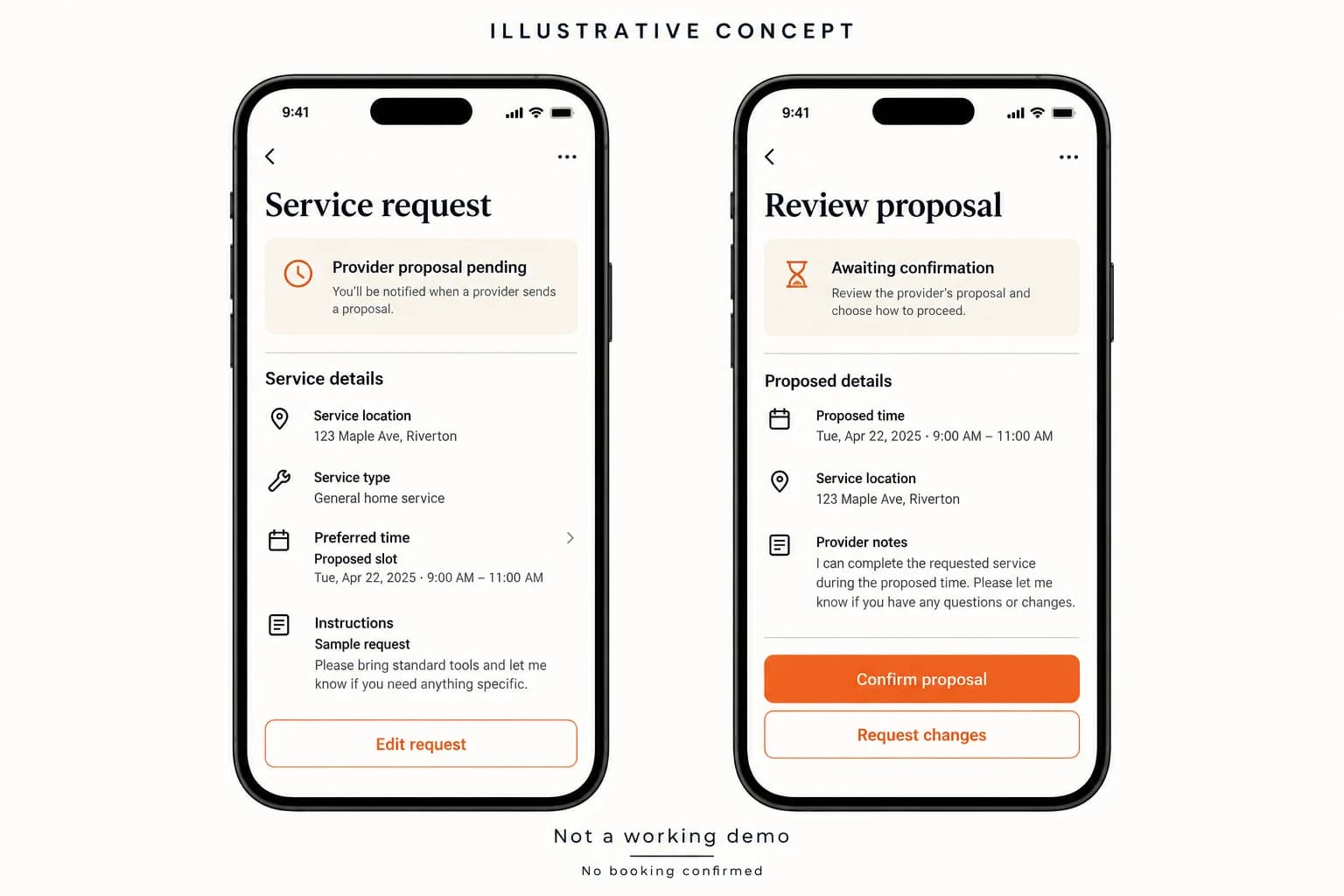
Proposed on-demand service request with preferred time, instructions and pending provider proposal

Proposed on-demand service request with preferred time, instructions and pending provider proposal

Original concept artwork showing a proposed local-service request, preferred time, instructions, pending provider proposal and request-change control. Sample details illustrate review before acceptance; no booking is confirmed. This is not brand UI or evidence of current provider availability, payment or verification.

What to check in the walkthrough

  • What does fulfilment mean for your chosen category? Ask to demonstrate its required request fields, eligibility, equipment or duration constraints and completion evidence using a representative service, rather than assuming a ride-booking flow fits.
  • What may each role view and change? Ask to demonstrate customer edits, provider acceptance and operator reassignment, with denied access to unrelated requests and an audit trail for overrides or sensitive instructions.
  • How does the request recover when fulfilment fails? Ask to demonstrate no eligible capacity, expired proposals, changed requirements, provider no-show and partial completion, including support ownership and the agreed cancellation or refund policy.
Open full-size reference

Solution reference register

01 / Reference and IP

This page references third-party product names only to describe familiar product models and planning references. App Clone Labs is not affiliated with or endorsed by those brands. Build decisions require independent legal, regulatory, and operational review for your market.

02 / Artifact status

Boards, diagrams, screens and workflow descriptions on this page are illustrative planning artifacts, not evidence of a deployed client product.

03 / Regulatory caveat

Licensing, labor, safety, and consumer rules depend on the chosen category · Regulated categories require separate qualification

04 / Rights and handover

Source access, licensing, repositories, environments, documentation, acceptance and handover are defined by the signed contract and accepted scope.

Scope

Operating model defined

Roles, workflows, dependencies, exclusions, and assumptions are made reviewable.

Evidence: illustrative

System

Applications connected

Experience, operations, services, data, integrations, and release controls are planned together.

Evidence: illustrative

Handover

Rights stated in writing

Access, assignment, licensing, dependencies, documentation, and support follow the signed agreement.

Evidence: illustrative

Artifact register

Product screens and planning references.

Reference screens illustrate workflows, not a contracted feature list. Sample prices, data, and responses are demonstration content; confirm the current scope during a walkthrough.

On-demand Service Marketplace connected product workflow planning visual
Connected customer, operations, and data workflowEvidence: illustrativeOpen full-size reference
On-demand Service Marketplace product engineering ecosystem visual
Product engineering ecosystem and handover boundaryEvidence: illustrativeOpen full-size reference

Choose one service promise before building an Uber-for-X marketplace

A customer asks for a technician now, receives three quotations and assumes someone is already travelling. Each provider thinks they have only received a lead. The app has collected a location and displayed nearby profiles, but nobody owns the appointment. An on-demand marketplace fails at this boundary when familiar screens hide an undefined operating promise.

An Uber-for-X concept adapts request, matching and fulfillment patterns to a specific service category. It is not one universal application that safely handles every kind of work. The useful purchase is an independently branded system with a defined customer commitment, eligible provider model and accountable exception handling. It does not include Uber’s network, proprietary implementation or operating permissions. Start with the job the customer expects to receive, then decide which parts the platform actually controls.

Decide between introductions, scheduled bookings and immediate dispatch

An introduction connects a customer with potential providers; a scheduled booking reserves a service commitment; immediate dispatch allocates eligible capacity against a near-term request. Those are different products even if they share search, chat and maps. State which promise appears on the primary action and what event makes it binding. A provider responding to a lead should not accidentally become responsible for a confirmed appointment.

If the service requires inspection or negotiation, an estimate-and-acceptance flow may be more honest than a fixed checkout price. If it is standardized, define the included task and exclusions before promising instant confirmation. Mixed models need visibly different states and terms. Test a customer moving from an inquiry to a booking: the agreed scope, provider availability and payment authority must be established at that transition rather than inherited from an earlier conversation.

Write the category boundary as an intake decision, not a disclaimer

A useful request form asks questions that affect whether the work can be supplied. Cleaning may require property size and access; equipment servicing may require a device type and known symptoms. Unknown answers should remain unknown instead of being forced into false certainty. Define tasks the operation excludes and show that boundary before collecting a commitment that support will later have to unwind.

Separate the desired result from a diagnosis or technical instruction. Photos can improve preparation but do not establish the underlying condition of equipment or a property. Review category-specific licensing, labor, safety and consumer requirements with qualified advisers. Regulated categories require their own qualification rather than a universal provider badge. Rehearse an out-of-scope request, an inaccessible location and an ambiguous brief so the customer receives an understandable next step instead of an unexplained rejection.

Provider eligibility must precede proximity in matching

The closest provider may lack the required equipment, credential or authority for the request. Apply category and service-area eligibility before presenting travel estimates as a reason to assign them. Identify whether the provider is an individual, a business or a named worker within a team. An account-holder check does not automatically describe the person arriving at the customer’s location.

Store the subject, source and review date behind each eligibility decision, with expiry and appeal handling where appropriate. Avoid exposing sensitive underlying reports in customer screens. Define who can pause a category permission and what happens to already confirmed jobs. A provider should not continue receiving work simply because their calendar remains open after a relevant credential expires. Keep reassignment and customer communication linked to the affected commitment without announcing unreviewed allegations publicly.

Capacity includes travel, task duration and required resources

The official Google Maps route optimization overview describes objectives and constraints including work hours, time windows and capacity. It is a useful integration reference, not proof that a particular service network can fulfill a request or that a third-party connection is already included.

A provider available at noon is not necessarily available for a long job across the city. Model preparation, expected duration, travel and any shared equipment that constrains acceptance. Record assumptions behind arrival estimates and explain when an estimate is stale. Rehearse overlapping reservations and a late-running appointment. The system should protect an existing commitment or obtain an explicit revised arrangement, not silently squeeze another customer into capacity that does not exist.

An operator override also needs a reason and a visible consequence. If dispatch moves a worker from one booking to another, show the displaced commitment and required customer communication before saving the change. Keep manual allocation available when location estimates or automated recommendations fail, but apply the same hard eligibility checks. A dispatcher should not bypass missing qualifications merely because demand is high. Review the queue from the perspective of a shift handover: the next operator must distinguish unassigned requests, held slots, accepted work and exceptions awaiting a participant response without reconstructing the day from chat messages.

Make every offer refer to a current request and price version

A customer adds extra work while a provider accepts the original request. Without versioned offers, both parties can receive confirmation while agreeing to different tasks. Preserve the request, price basis, exclusions and appointment terms that the offer covered. Material changes should trigger a new approval or clear reconfirmation rather than editing the agreement retrospectively.

Distinguish an estimate, a fixed quotation and time-based charging. State how travel, materials and additional work are treated under the chosen model. Expire offers deliberately and show whether a slot is held during acceptance. Duplicate taps or a reconnecting phone should recover the same accepted booking rather than create a second job. Test stale offers, simultaneous edits and withdrawal so the operator can explain exactly what each participant accepted and which commitments were released.

Use service states that explain who must act next

Requested, offered, accepted, travelling, arrived and completed can be useful states, but their definitions must fit the category. Arrived should not authorize work outside the accepted scope; provider completion should not automatically settle a customer complaint. Each transition needs an actor, relevant evidence and a rule for a lost connection or conflicting update.

Separate work progress from commercial and incident status. A job can be physically finished while payment remains uncertain, or cancelled while a safety report still requires review. Give operations a timeline of the accepted scope, changes and participant actions. Rehearse a worker reporting completion offline after a reassignment. Reject or review incompatible updates without erasing the evidence, and keep notifications aligned with the authoritative booking instead of whichever device last sent a message.

Treat payment authority and settlement as separate responsibilities

The official Stripe marketplace guide describes a particular configuration with responsibilities for payments, disputes and refunds. The selected payment model, supported market and commercial agreement need their own review; the reference is not a promise of processor approval or universal availability.

Define which event authorizes a charge and which event makes a provider amount eligible for settlement. Keep commissions, materials, cancellation adjustments and refunds understandable in the job ledger. An unknown provider callback must remain reconcilable rather than prompting another charge. Rehearse duplicate notifications and a customer disputing additional work. A payment reversal should preserve the service record, and successful collection must not automatically close an unresolved quality or incident case.

Design cancellation and no-provider outcomes before adding automation

A request can fail because no eligible provider exists, a reserved worker declines or the customer cannot grant access. These outcomes need different explanations and potentially different commercial treatment. Specify when a request expires, whether another provider may be offered and how a customer declines a changed appointment. Never label reassignment as confirmed until the new provider has accepted the relevant terms.

Make any cancellation charge depend on the disclosed policy and recorded facts, with an appropriate review route. Do not infer fault solely from a location dot or an unanswered notification. Operations should see who attempted contact and which commitment was active. Test a provider cancellation after travel begins, a customer withdrawing before acceptance and a request that never matched. Release capacity and reconcile payment authority without losing the timeline needed to resolve a later complaint.

Keep incident handling distinct from ordinary service dissatisfaction

Late arrival, unfinished work, property damage and alleged unsafe conduct should not share one generic refund form. Define review ownership, escalation and appropriate evidence access for each. Tell participants what the operator can investigate and what requires external professional or emergency assistance. The software should not present a support chat as a replacement for urgent local services.

Restrict exact addresses, entry instructions and private photos to people with a legitimate need. Revoke live access after reassignment or role removal while preserving authorized dispute evidence under the reviewed retention policy. A refunded amount must not silently close a serious incident. Inspect how the console separates provider response, customer communication and financial adjustment, including the permissions of an assistant who can reschedule a visit but cannot approve extra work or view sensitive reports.

Expand categories only when their operating differences are understood

Compare the Thumbtack-style project marketplace when a job needs discussion, site visits and negotiated scope rather than immediate dispatch. The right starting model follows the buying decision, not the desire to reuse every screen unchanged.

Adjacent categories may share identities, messaging and notifications while requiring different qualifications, pricing and evidence. Document those differences before exposing a new category in navigation. Avoid a launch promise that one generic app supports every trade, wellness treatment and transport service. Evaluate the first category using relevant inquiries, accepted commitments, explained exceptions and support workload. Those observations guide expansion; they do not guarantee demand, revenue or customer retention. New geography also needs separate operational and regulatory review.

Accept the system by rehearsing a changed job, not watching a map

Illustrative screens communicate intended design, not a functioning provider network or an approved integration. Request a sandbox walkthrough with fictional customers and providers. Change the task after an offer, remove eligibility, exhaust capacity and disconnect a worker during fulfillment. Buyer acceptance should show who owns each unresolved state across customer, provider and operations views.

Review a duplicate charge notification, rejected extra work and a cancellation after reassignment. Confirm that original terms, scoped access and reconciliation records remain recoverable. Agree source ownership, third-party licenses, deployment access, integration rights and support duties in the contract. The purchase decision becomes clearer when the operator can explain one complete service promise and its exceptions rather than count the number of category tiles on a demonstration homepage.

Bring one category brief and a realistic exception to an on-demand marketplace scope discussion so the operating model can be bounded before implementation.

Use the delivery process to agree request, eligibility, booking and reconciliation acceptance checkpoints before public launch.

Product flow

Role-workflow flow diagram.

A visual map of how each role interacts with each workflow stage, with operator controls and integration boundaries.

Deployable Product Architecture

On-demand Service Marketplace

COLLECT FACTS THA…RESERVE CAPACITY …KEEP WORK EVIDENC…Request a defined…Accept work withi…Own the commitmen…INTEGRATIONS: Scheduling and location services with service duration, travel assumptions,…OPERATOR CONTROLS: Reject requests the operation cannot responsibly fulfill · Treat availabili…
Illustrative validation artifact — role-workflow flow diagram; final surfaces, boundaries, and integration topology are confirmed during discovery.

User roles

On-demand Service Marketplace roles and workflows.

Clone-inspired platforms usually need several coordinated interfaces, not just a customer app.

Service customer

01

Request a defined outcome rather than an ambiguous task

Describe the category-specific need, location and timing. Understand whether the response is an introduction, an estimate or a confirmed appointment before accepting a charge.

Eligible provider

02

Accept work within skills, authority and capacity

Review requirements, travel and equipment needs. Accept the current job version, disclose scope limits and record changes without assuming every nearby request is suitable.

Service operator

03

Own the commitment and the exception queue

Maintain category eligibility, capacity and dispatch policies. Assign accountable owners to missed appointments, disputed scope, uncertain payments and safety reports.

Workflow

On-demand Service Marketplace workflow stages.

Each workflow stage is mapped to a role, screen, API, notification, admin control, and measurable launch outcome.

Qualify the request

01

Collect facts that change service suitability

Use a bounded category brief and service area. Separate preferred timing from a reserved slot and an indicative amount from an agreed quote.

Match and confirm

02

Reserve capacity against the accepted scope

Apply eligibility and availability before proximity. Confirm the provider, current scope and disclosed terms without double-booking a shared resource.

Perform and resolve

03

Keep work evidence and financial outcome distinct

Record arrival, approved changes and completion evidence. Route cancellation, rework and charge review through explicit responsibilities rather than one generic failed status.

Deployable Product Architecture

Workflow / system register

Revision DPlanning surface

Marketplace loop

On-demand Service Marketplace workflow stages.

Demand and supply meet through governed transactions

Marketplace loop: On-demand Service Marketplace workflow stages.Demand and supply meet through governed transactions. Trust, payments, support, and operator controls close the commercial loop.
01

Collect facts that change service suitability

02

Reserve capacity against the accepted scope

03

Keep work evidence and financial outcome distinct

Control note

Trust, payments, support, and operator controls close the commercial loop.

Illustrative architecture register; validate against the accepted scope.

Operator controls

On-demand Service Marketplace admin and operator controls.

The control center is scoped as a first-class product surface, not an afterthought.

Category boundaries

01

Reject requests the operation cannot responsibly fulfill

Define included tasks, exclusions, qualifications and escalation. A category icon must not imply permission to perform regulated or hazardous work.

Capacity integrity

02

Treat availability as a reservable resource

Account for service duration, travel, tools and existing commitments. Expire offers and release reservations with a recoverable explanation when a request changes.

Participant privacy

03

Share locations and job records by legitimate role

Limit precise addresses, entry instructions and supporting photos. Revoke live access after reassignment while retaining restricted evidence under the reviewed policy.

Monetization

On-demand Service Marketplace monetization models.

We model monetization early so payments, admin controls, and reporting support the business.

Tie the platform fee to a disclosed transaction event

Define the basis for fees, cancellation adjustments and provider settlement. A booking charge is not proof of successful service or permission to retain every disputed amount.

Sell operational tools without selling eligibility

Scope calendar, team and reporting benefits with transparent billing. Subscription status cannot replace qualifications or override a suspended service permission.

Distinguish visibility from a completed job

Label paid placement and explain any lead charge. Providers need spending controls and review rules without promises that promotion guarantees customers.

Integrations

On-demand Service Marketplace integration surface.

External systems that determine launch readiness, data flow, and operational continuity.

Integration

01

Integration 1

Scheduling and location services with service duration, travel assumptions, capacity reservations and clear behavior when estimates become unavailable

Integration

02

Integration 2

Identity and credential systems with authorized access, category-specific review, subject matching, expiry handling and restricted evidence

Integration

03

Integration 3

Payment and messaging services with job-version references, participant permissions, callback reconciliation and accountable dispute routing

Scope drivers

On-demand Service Marketplace scope drivers.

The variables that most influence build effort, cost, and launch readiness.

Operating promise

01

Choose introduction, scheduled booking or immediate dispatch

These models differ in pricing certainty, capacity ownership and support. Select a primary transaction rather than blending incompatible expectations in the first release.

Provider model

02

Define who supplies and supervises the work

Independent professionals, operator employees and partner businesses need different onboarding, assignment and permission boundaries. Review the applicable employment and commercial arrangements.

Service risk

03

Match evidence and eligibility to the chosen category

Determine qualifications, insurance, access constraints and incident escalation with appropriate specialists. Generic registration does not establish authority for every task.

Deployable Product Architecture

Scope drivers / system register

Revision APlanning surface

Marketplace loop

On-demand Service Marketplace scope drivers.

Demand and supply meet through governed transactions

Marketplace loop: On-demand Service Marketplace scope drivers.Demand and supply meet through governed transactions. Trust, payments, support, and operator controls close the commercial loop.
01

Choose introduction, scheduled booking or immediate dispatch

02

Define who supplies and supervises the work

03

Match evidence and eligibility to the chosen category

Control note

Trust, payments, support, and operator controls close the commercial loop.

Illustrative architecture register; validate against the accepted scope.

V1 scope

On-demand Service Marketplace V1 foundation.

Launch the smallest complete operating loop first, then scale the product with confidence.

One bounded service

01

Prove a coherent request-to-resolution journey

Launch a defined category and zone with meaningful intake, eligible providers and a supportable promise. Avoid an unrestricted directory presented as instant fulfillment.

Explicit commitments

02

Make quote acceptance and capacity reservation observable

Preserve request versions, offer expiry and confirmed appointments. Explain what happens when the provider declines, a customer changes the task or a calendar conflicts.

Exception rehearsal

03

Validate the operator console beyond successful jobs

Test no available provider, delayed arrival, changed scope, disputed completion and uncertain payment. Each exception needs an owner and recoverable customer communication.

Later phases

On-demand Service Marketplace post-launch expansion.

Capabilities that should usually wait until real usage proves the core loop.

Adjacent categories

01

Add new operating rules before expanding the catalog

Review intake, qualifications, pricing and evidence for each service. Shared accounts and notifications do not make operational responsibilities interchangeable.

Automated allocation

02

Optimize only after hard constraints are reliable

Evaluate travel and workload against eligibility, appointment windows and manual overrides. Keep a visible fallback when recommendations cannot produce a feasible assignment.

Teams and repeat plans

03

Extend permissions and scheduling deliberately

Support named workers, recurring authority and current availability. A prior completed job is not blanket consent for property access or future charges.

Deployable Product Architecture

Later phases / system register

Revision FPlanning surface

Marketplace loop

On-demand Service Marketplace post-launch expansion.

Demand and supply meet through governed transactions

Marketplace loop: On-demand Service Marketplace post-launch expansion.Demand and supply meet through governed transactions. Trust, payments, support, and operator controls close the commercial loop.
01

Add new operating rules before expanding the catalog

02

Optimize only after hard constraints are reliable

03

Extend permissions and scheduling deliberately

Control note

Trust, payments, support, and operator controls close the commercial loop.

Illustrative architecture register; validate against the accepted scope.

Regulatory review

On-demand Service Marketplace regulatory and compliance flags.

Each flag must be reviewed by qualified counsel for your target market before build or launch.

Flag 1

Licensing, labor, safety, and consumer rules depend on the chosen category

Flag 2

Regulated categories require separate qualification

Reference walkthrough

Request a On-demand Service Marketplace reference walkthrough.

Ask us to confirm which reference surfaces are currently available for this product model. Rather than publishing shared demo credentials, we schedule a private guided walkthrough for qualified buyers.

Reference surface

01

Service customer: Request a defined outcome rather than an ambiguous task

Request a role-specific demonstration and confirm which capabilities are currently available. Review the proposed responsibility: Describe the category-specific need, location and timing. Understand whether the response is an introduction, an estimate or a confirmed appointment before accepting a charge.

Reference surface

02

Eligible provider: Accept work within skills, authority and capacity

Request a role-specific demonstration and confirm which capabilities are currently available. Review the proposed responsibility: Review requirements, travel and equipment needs. Accept the current job version, disclose scope limits and record changes without assuming every nearby request is suitable.

Reference surface

03

Service operator: Own the commitment and the exception queue

Request a role-specific demonstration and confirm which capabilities are currently available. Review the proposed responsibility: Maintain category eligibility, capacity and dispatch policies. Assign accountable owners to missed appointments, disputed scope, uncertain payments and safety reports.

Next step

04

Book a walkthrough

Request a live, private walkthrough of the reference implementation. We will confirm scope and discuss configured deployment versus custom build for your market.

Open register

Deployable Product Architecture

Reference walkthrough / system register

Revision APlanning surface

Marketplace loop

Request a On-demand Service Marketplace reference walkthrough.

Demand and supply meet through governed transactions

Marketplace loop: Request a On-demand Service Marketplace reference walkthrough.Demand and supply meet through governed transactions. Trust, payments, support, and operator controls close the commercial loop.
01

Service customer: Request a defined outcome rather than an ambiguous task

02

Eligible provider: Accept work within skills, authority and capacity

03

Service operator: Own the commitment and the exception queue

04

Book a walkthrough

Control note

Trust, payments, support, and operator controls close the commercial loop.

Illustrative architecture register; validate against the accepted scope.

Process

A traceable path from decision to acceptance.

  1. 01

    Model teardown

    We map the reference business model, user roles, monetization path, regulatory needs, and launch constraints.

    Artifact: Product teardown, risk map, role matrix

  2. 02

    Market-fit blueprint

    We reshape the model around your market, operations, pricing, workflows, and first release priorities.

    Artifact: Feature scope, flows, technical plan

  3. 03

    Design and build

    Product, design, engineering, QA, and cloud delivery move in weekly demo cycles with visible progress.

    Artifact: Working releases, QA notes, sprint demos

  4. 04

    Launch and operate

    We support production release, monitoring, handoff, roadmap decisions, and post-launch improvement.

    Artifact: Launch checklist, docs, growth backlog

FAQ

Questions to resolve before the build.

01Is Uber-for-X one application for every service category?

No. It is an adaptable marketplace pattern. Each category needs its own intake, eligibility, pricing, evidence and operating boundaries before it can responsibly be offered.

02Does this include Uber’s provider network or implementation?

No. It is independently branded software, not access to Uber’s proprietary systems, network, protected assets or permissions.

03Should the first release sell leads or confirm bookings?

Choose the commitment the operator can support. Introductions, scheduled bookings and immediate dispatch need visibly different acceptance, capacity and support rules.

04Can the nearest provider always receive the request?

No. Category eligibility, equipment, authority and available capacity should be checked before proximity informs allocation.

05What if the customer cannot describe the exact problem?

Preserve uncertainty and use a suitable assessment or estimate flow. Do not force a diagnosis or promise fixed work that the brief cannot establish.

06How should an edited request affect an existing offer?

Preserve the earlier version and require appropriate reconfirmation of material changes. Acceptance must refer to identifiable scope, pricing and appointment terms.

07Does provider completion automatically trigger settlement?

Not necessarily. Work status, customer review, charge authority and provider settlement are separate states governed by the selected commercial and payment arrangements.

08What happens when no eligible provider is available?

Explain expiry, alternative offers and any payment-authority release. Do not present a pending search or an unaccepted reassignment as a confirmed booking.

09Can providers charge for unexpected extra work?

Use a documented change proposal and appropriate approval under the agreed policy. Preserve the original scope instead of silently rewriting a final invoice.

10Does a refund resolve an incident automatically?

No. Financial adjustment and incident review need separate ownership. Serious reports must retain appropriate evidence and escalation even after a payment is returned.

11Can categories and regions be expanded later?

Yes, after reviewing their distinct qualifications, operational capacity, consumer terms and regulatory context. Shared software components do not establish universal service eligibility.

12What should the buyer validate in a demo?

Inspect changed requests, expired eligibility, unavailable capacity, reconnecting devices, duplicate payment events and unresolved complaints using fictional data. Confirm permissions and accountable operator queues.

Primary sources

References behind this page

Dated official documentation, standards, and research that support the factual claims on this page.

  1. 01
  2. 02

Citation readiness

How to interpret this page

Published by App Clone Labs Editorial Team

Commercial claims
Scope, cost, and timeline claims are planning guidance and require validation in a current proposal.
Evidence status
Diagrams, boards, examples, and estimates are illustrative planning artifacts unless explicitly identified with a source and measured evidence status.

Next decision

Turn the brief into an accepted product scope.

Define outcomes, constraints, evidence, rights and handover before delivery begins.

Commercial rights, repositories, environments, documentation, acceptance and handover remain contract-defined.

Scope On-demand Service Marketplace

Independent from Uber

App Clone Labs is an independent software development studio. We are not affiliated with, connected to, sponsored by, or endorsed by Uber.

Why this name appears

Uber is referenced descriptively to identify familiar product mechanics and common search terminology. “Clone” describes a planning reference, not a replica.

Original delivery

Any product delivered by App Clone Labs is independently designed and developed for the accepted scope. It does not contain proprietary code, branding, copy, interface assets, or confidential material from Uber.

Trademark ownership

Uber and associated names, logos, and marks remain the property of their respective owners. Their use identifies a reference category and does not imply authorization or endorsement.
