
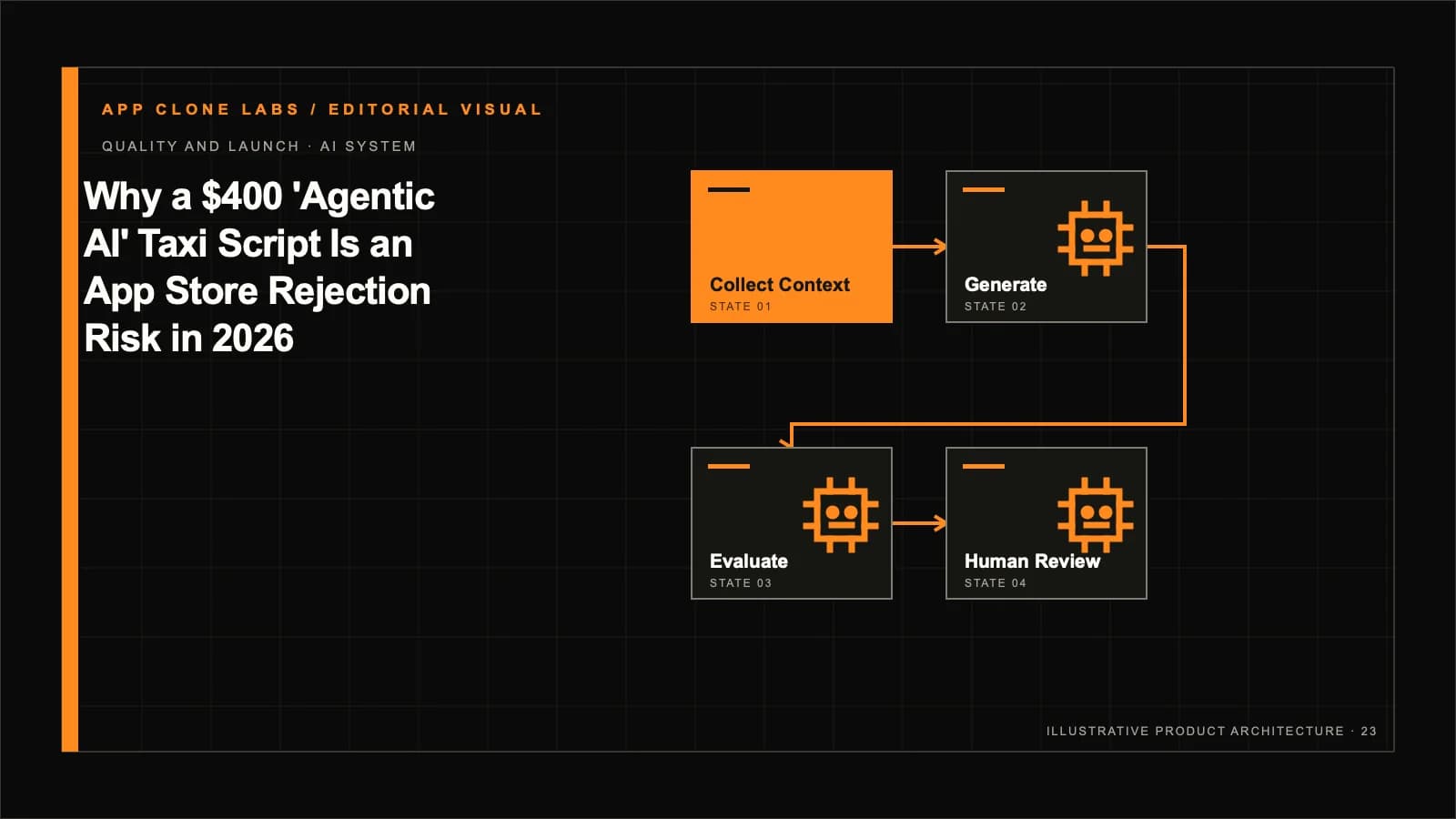
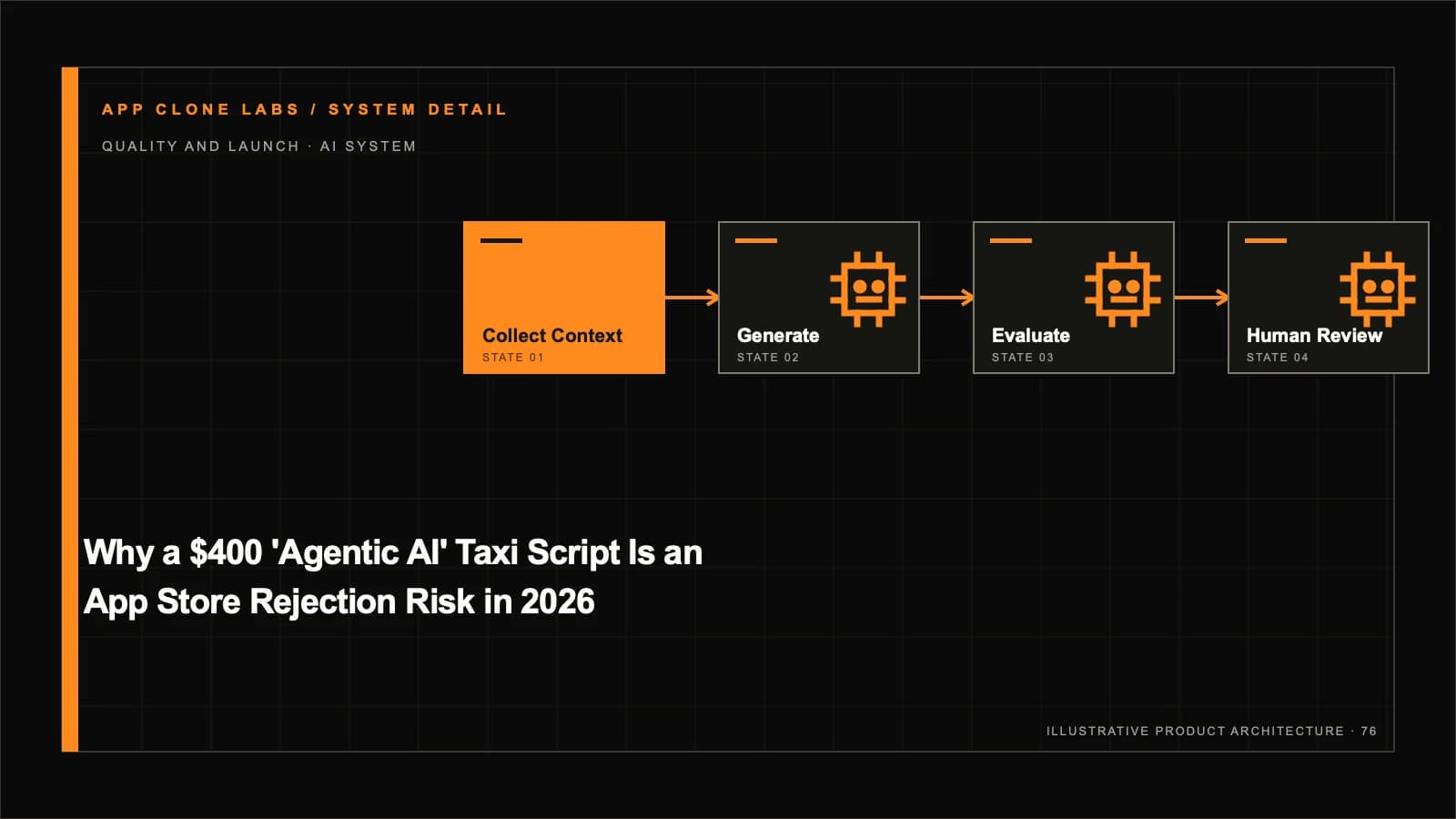
A low purchase price does not reveal whether a taxi script can pass review, protect location history or recover when two drivers accept the same request. The risk sits in the code, dependencies, policy disclosures and operating gaps that a screenshot cannot show.
Adding “AI” to the product name creates another evidence burden. The team must explain what the model does, which data it uses, how errors are measured and whether a human can recover consequential outcomes.
This guide is a pre-purchase and pre-submission audit, not a claim that low-cost software is automatically unsafe.
Verify lawful source ownership
Verify lawful source ownership is a distinct decision within a ride-booking product whose store approval and production safety depend on identity, dispatch, location, payments and explainable automation. It changes the promise made to the recipient or user, the authority of each role, the evidence retained and the recovery path when normal processing fails.
The failure mode is concrete: the team treats verify lawful source ownership as a checklist label while provenance, consequence, ownership and recovery remain implicit. This is not solved by adding another screen or background job. The product has to define ownership, permitted transitions, and the evidence retained when the transition occurs.
For the first release, define the accountable owner, permitted action, evidence standard, visible outcome and exception route for verify lawful source ownership before execution. Write that decision as an enforceable server-side rule, not guidance that depends on a client, operator, or AI model remembering the intended boundary.
Implementation should include For verify lawful source ownership, retain stable identifiers, explicit states, current authorization, versioned decisions, event and processing timestamps, reason codes, correlation records, audit history and a bounded corrective action. Keep the public response smaller than the internal record: users need a clear outcome and recovery path, while authorized operators need correlation IDs, policy versions, timestamps, and the before-and-after state.
Validate it with For verify lawful source ownership, validate the ordinary outcome followed by stale evidence, duplicate action, concurrent change, revoked authority, dependency failure, partial completion, correction and reconciliation. Test the ordinary path, then repeat under timeout, duplicate delivery, stale state, partial failure, revoked authority, and concurrent requests. A feature is not ready when only the demonstration succeeds.
- Owner: product owner
- Release evidence: versioned verify lawful source ownership decision, source and acceptance record
- Stop condition: verify lawful source ownership cannot be explained or corrected from durable evidence
Inventory mobile and backend dependencies
Inventory mobile and backend dependencies is a distinct decision within a ride-booking product whose store approval and production safety depend on identity, dispatch, location, payments and explainable automation. It changes the promise made to the recipient or user, the authority of each role, the evidence retained and the recovery path when normal processing fails.
The failure mode is concrete: the team treats inventory mobile and backend dependencies as a checklist label while provenance, consequence, ownership and recovery remain implicit.
For the first release, define the accountable owner, permitted action, evidence standard, visible outcome and exception route for inventory mobile and backend dependencies before execution.
Implementation should include For inventory mobile and backend dependencies, retain stable identifiers, explicit states, current authorization, versioned decisions, event and processing timestamps, reason codes, correlation records, audit history and a bounded corrective action.
Validate it with For inventory mobile and backend dependencies, validate the ordinary outcome followed by stale evidence, duplicate action, concurrent change, revoked authority, dependency failure, partial completion, correction and reconciliation.
- Owner: delivery owner
- Release evidence: versioned inventory mobile and backend dependencies decision, source and acceptance record
- Stop condition: inventory mobile and backend dependencies cannot be explained or corrected from durable evidence
Rebuild signing and package identity
Rebuild signing and package identity is a distinct decision within a ride-booking product whose store approval and production safety depend on identity, dispatch, location, payments and explainable automation. It changes the promise made to the recipient or user, the authority of each role, the evidence retained and the recovery path when normal processing fails.
The failure mode is concrete: the team treats rebuild signing and package identity as a checklist label while provenance, consequence, ownership and recovery remain implicit.
For the first release, define the accountable owner, permitted action, evidence standard, visible outcome and exception route for rebuild signing and package identity before execution.
Implementation should include For rebuild signing and package identity, retain stable identifiers, explicit states, current authorization, versioned decisions, event and processing timestamps, reason codes, correlation records, audit history and a bounded corrective action.
Validate it with For rebuild signing and package identity, validate the ordinary outcome followed by stale evidence, duplicate action, concurrent change, revoked authority, dependency failure, partial completion, correction and reconciliation.
- Owner: operations owner
- Release evidence: versioned rebuild signing and package identity decision, source and acceptance record
- Stop condition: rebuild signing and package identity cannot be explained or corrected from durable evidence
Audit account creation and deletion
Audit account creation and deletion is a distinct decision within a ride-booking product whose store approval and production safety depend on identity, dispatch, location, payments and explainable automation. It changes the promise made to the recipient or user, the authority of each role, the evidence retained and the recovery path when normal processing fails.
The failure mode is concrete: the team treats audit account creation and deletion as a checklist label while provenance, consequence, ownership and recovery remain implicit.
For the first release, define the accountable owner, permitted action, evidence standard, visible outcome and exception route for audit account creation and deletion before execution.
Implementation should include For audit account creation and deletion, retain stable identifiers, explicit states, current authorization, versioned decisions, event and processing timestamps, reason codes, correlation records, audit history and a bounded corrective action.
Validate it with For audit account creation and deletion, validate the ordinary outcome followed by stale evidence, duplicate action, concurrent change, revoked authority, dependency failure, partial completion, correction and reconciliation.
- Owner: product owner
- Release evidence: versioned audit account creation and deletion decision, source and acceptance record
- Stop condition: audit account creation and deletion cannot be explained or corrected from durable evidence
Checkpoint 4: reconcile the product promise with the recorded state. Support, finance, security, and delivery teams should be able to reach the same conclusion from the same identifiers without reconstructing events from chat messages or screenshots.
Map location collection and retention
Map location collection and retention is a distinct decision within a ride-booking product whose store approval and production safety depend on identity, dispatch, location, payments and explainable automation. It changes the promise made to the recipient or user, the authority of each role, the evidence retained and the recovery path when normal processing fails.
The failure mode is concrete: the team treats map location collection and retention as a checklist label while provenance, consequence, ownership and recovery remain implicit.
For the first release, define the accountable owner, permitted action, evidence standard, visible outcome and exception route for map location collection and retention before execution.
Implementation should include For map location collection and retention, retain stable identifiers, explicit states, current authorization, versioned decisions, event and processing timestamps, reason codes, correlation records, audit history and a bounded corrective action.
Validate it with For map location collection and retention, validate the ordinary outcome followed by stale evidence, duplicate action, concurrent change, revoked authority, dependency failure, partial completion, correction and reconciliation.
- Owner: delivery owner
- Release evidence: versioned map location collection and retention decision, source and acceptance record
- Stop condition: map location collection and retention cannot be explained or corrected from durable evidence
Review permission timing and purpose
Review permission timing and purpose is a distinct decision within a ride-booking product whose store approval and production safety depend on identity, dispatch, location, payments and explainable automation. It changes the promise made to the recipient or user, the authority of each role, the evidence retained and the recovery path when normal processing fails.
The failure mode is concrete: the team treats review permission timing and purpose as a checklist label while provenance, consequence, ownership and recovery remain implicit.
For the first release, define the accountable owner, permitted action, evidence standard, visible outcome and exception route for review permission timing and purpose before execution.
Implementation should include For review permission timing and purpose, retain stable identifiers, explicit states, current authorization, versioned decisions, event and processing timestamps, reason codes, correlation records, audit history and a bounded corrective action.
Validate it with For review permission timing and purpose, validate the ordinary outcome followed by stale evidence, duplicate action, concurrent change, revoked authority, dependency failure, partial completion, correction and reconciliation.
- Owner: operations owner
- Release evidence: versioned review permission timing and purpose decision, source and acceptance record
- Stop condition: review permission timing and purpose cannot be explained or corrected from durable evidence
Test dispatch concurrency
Test dispatch concurrency is a distinct decision within a ride-booking product whose store approval and production safety depend on identity, dispatch, location, payments and explainable automation. It changes the promise made to the recipient or user, the authority of each role, the evidence retained and the recovery path when normal processing fails.
The failure mode is concrete: the team treats test dispatch concurrency as a checklist label while provenance, consequence, ownership and recovery remain implicit.
For the first release, define the accountable owner, permitted action, evidence standard, visible outcome and exception route for test dispatch concurrency before execution.
Implementation should include For test dispatch concurrency, retain stable identifiers, explicit states, current authorization, versioned decisions, event and processing timestamps, reason codes, correlation records, audit history and a bounded corrective action.
Validate it with For test dispatch concurrency, validate the ordinary outcome followed by stale evidence, duplicate action, concurrent change, revoked authority, dependency failure, partial completion, correction and reconciliation.
- Owner: product owner
- Release evidence: versioned test dispatch concurrency decision, source and acceptance record
- Stop condition: test dispatch concurrency cannot be explained or corrected from durable evidence
Validate fare and payment integrity
Validate fare and payment integrity is a distinct decision within a ride-booking product whose store approval and production safety depend on identity, dispatch, location, payments and explainable automation. It changes the promise made to the recipient or user, the authority of each role, the evidence retained and the recovery path when normal processing fails.
The failure mode is concrete: the team treats validate fare and payment integrity as a checklist label while provenance, consequence, ownership and recovery remain implicit.
For the first release, define the accountable owner, permitted action, evidence standard, visible outcome and exception route for validate fare and payment integrity before execution.
Implementation should include For validate fare and payment integrity, retain stable identifiers, explicit states, current authorization, versioned decisions, event and processing timestamps, reason codes, correlation records, audit history and a bounded corrective action.
Validate it with For validate fare and payment integrity, validate the ordinary outcome followed by stale evidence, duplicate action, concurrent change, revoked authority, dependency failure, partial completion, correction and reconciliation.
- Owner: delivery owner
- Release evidence: versioned validate fare and payment integrity decision, source and acceptance record
- Stop condition: validate fare and payment integrity cannot be explained or corrected from durable evidence
Checkpoint 8: reconcile the product promise with the recorded state. Support, finance, security, and delivery teams should be able to reach the same conclusion from the same identifiers without reconstructing events from chat messages or screenshots.
Inspect driver and rider authorization
Inspect driver and rider authorization is a distinct decision within a ride-booking product whose store approval and production safety depend on identity, dispatch, location, payments and explainable automation. It changes the promise made to the recipient or user, the authority of each role, the evidence retained and the recovery path when normal processing fails.
The failure mode is concrete: the team treats inspect driver and rider authorization as a checklist label while provenance, consequence, ownership and recovery remain implicit.
For the first release, define the accountable owner, permitted action, evidence standard, visible outcome and exception route for inspect driver and rider authorization before execution.
Implementation should include For inspect driver and rider authorization, retain stable identifiers, explicit states, current authorization, versioned decisions, event and processing timestamps, reason codes, correlation records, audit history and a bounded corrective action.
Validate it with For inspect driver and rider authorization, validate the ordinary outcome followed by stale evidence, duplicate action, concurrent change, revoked authority, dependency failure, partial completion, correction and reconciliation.
- Owner: operations owner
- Release evidence: versioned inspect driver and rider authorization decision, source and acceptance record
- Stop condition: inspect driver and rider authorization cannot be explained or corrected from durable evidence
Evaluate the claimed AI use case
Evaluate the claimed AI use case is a distinct decision within a ride-booking product whose store approval and production safety depend on identity, dispatch, location, payments and explainable automation. It changes the promise made to the recipient or user, the authority of each role, the evidence retained and the recovery path when normal processing fails.
The failure mode is concrete: the team treats evaluate the claimed ai use case as a checklist label while provenance, consequence, ownership and recovery remain implicit.
For the first release, define the accountable owner, permitted action, evidence standard, visible outcome and exception route for evaluate the claimed ai use case before execution.
Implementation should include For evaluate the claimed ai use case, retain stable identifiers, explicit states, current authorization, versioned decisions, event and processing timestamps, reason codes, correlation records, audit history and a bounded corrective action.
Validate it with For evaluate the claimed ai use case, validate the ordinary outcome followed by stale evidence, duplicate action, concurrent change, revoked authority, dependency failure, partial completion, correction and reconciliation.
- Owner: product owner
- Release evidence: versioned evaluate the claimed ai use case decision, source and acceptance record
- Stop condition: evaluate the claimed ai use case cannot be explained or corrected from durable evidence
Test model error and fallback
Test model error and fallback is a distinct decision within a ride-booking product whose store approval and production safety depend on identity, dispatch, location, payments and explainable automation. It changes the promise made to the recipient or user, the authority of each role, the evidence retained and the recovery path when normal processing fails.
The failure mode is concrete: the team treats test model error and fallback as a checklist label while provenance, consequence, ownership and recovery remain implicit.
For the first release, define the accountable owner, permitted action, evidence standard, visible outcome and exception route for test model error and fallback before execution.
Implementation should include For test model error and fallback, retain stable identifiers, explicit states, current authorization, versioned decisions, event and processing timestamps, reason codes, correlation records, audit history and a bounded corrective action.
Validate it with For test model error and fallback, validate the ordinary outcome followed by stale evidence, duplicate action, concurrent change, revoked authority, dependency failure, partial completion, correction and reconciliation.
- Owner: delivery owner
- Release evidence: versioned test model error and fallback decision, source and acceptance record
- Stop condition: test model error and fallback cannot be explained or corrected from durable evidence
Match privacy disclosures to runtime
Match privacy disclosures to runtime is a distinct decision within a ride-booking product whose store approval and production safety depend on identity, dispatch, location, payments and explainable automation. It changes the promise made to the recipient or user, the authority of each role, the evidence retained and the recovery path when normal processing fails.
The failure mode is concrete: the team treats match privacy disclosures to runtime as a checklist label while provenance, consequence, ownership and recovery remain implicit.
For the first release, define the accountable owner, permitted action, evidence standard, visible outcome and exception route for match privacy disclosures to runtime before execution.
Implementation should include For match privacy disclosures to runtime, retain stable identifiers, explicit states, current authorization, versioned decisions, event and processing timestamps, reason codes, correlation records, audit history and a bounded corrective action.
Validate it with For match privacy disclosures to runtime, validate the ordinary outcome followed by stale evidence, duplicate action, concurrent change, revoked authority, dependency failure, partial completion, correction and reconciliation.
- Owner: operations owner
- Release evidence: versioned match privacy disclosures to runtime decision, source and acceptance record
- Stop condition: match privacy disclosures to runtime cannot be explained or corrected from durable evidence
Checkpoint 12: reconcile the product promise with the recorded state. Support, finance, security, and delivery teams should be able to reach the same conclusion from the same identifiers without reconstructing events from chat messages or screenshots.
Prepare reviewer access and notes
Prepare reviewer access and notes is a distinct decision within a ride-booking product whose store approval and production safety depend on identity, dispatch, location, payments and explainable automation. It changes the promise made to the recipient or user, the authority of each role, the evidence retained and the recovery path when normal processing fails.
The failure mode is concrete: the team treats prepare reviewer access and notes as a checklist label while provenance, consequence, ownership and recovery remain implicit.
For the first release, define the accountable owner, permitted action, evidence standard, visible outcome and exception route for prepare reviewer access and notes before execution.
Implementation should include For prepare reviewer access and notes, retain stable identifiers, explicit states, current authorization, versioned decisions, event and processing timestamps, reason codes, correlation records, audit history and a bounded corrective action.
Validate it with For prepare reviewer access and notes, validate the ordinary outcome followed by stale evidence, duplicate action, concurrent change, revoked authority, dependency failure, partial completion, correction and reconciliation.
- Owner: product owner
- Release evidence: versioned prepare reviewer access and notes decision, source and acceptance record
- Stop condition: prepare reviewer access and notes cannot be explained or corrected from durable evidence
Build admin safety and recovery
Build admin safety and recovery is a distinct decision within a ride-booking product whose store approval and production safety depend on identity, dispatch, location, payments and explainable automation. It changes the promise made to the recipient or user, the authority of each role, the evidence retained and the recovery path when normal processing fails.
The failure mode is concrete: the team treats build admin safety and recovery as a checklist label while provenance, consequence, ownership and recovery remain implicit.
For the first release, define the accountable owner, permitted action, evidence standard, visible outcome and exception route for build admin safety and recovery before execution.
Implementation should include For build admin safety and recovery, retain stable identifiers, explicit states, current authorization, versioned decisions, event and processing timestamps, reason codes, correlation records, audit history and a bounded corrective action.
Validate it with For build admin safety and recovery, validate the ordinary outcome followed by stale evidence, duplicate action, concurrent change, revoked authority, dependency failure, partial completion, correction and reconciliation.
- Owner: delivery owner
- Release evidence: versioned build admin safety and recovery decision, source and acceptance record
- Stop condition: build admin safety and recovery cannot be explained or corrected from durable evidence
Calculate remediation versus rebuild cost
Calculate remediation versus rebuild cost is a distinct decision within a ride-booking product whose store approval and production safety depend on identity, dispatch, location, payments and explainable automation. It changes the promise made to the recipient or user, the authority of each role, the evidence retained and the recovery path when normal processing fails.
The failure mode is concrete: the team treats calculate remediation versus rebuild cost as a checklist label while provenance, consequence, ownership and recovery remain implicit.
For the first release, define the accountable owner, permitted action, evidence standard, visible outcome and exception route for calculate remediation versus rebuild cost before execution.
Implementation should include For calculate remediation versus rebuild cost, retain stable identifiers, explicit states, current authorization, versioned decisions, event and processing timestamps, reason codes, correlation records, audit history and a bounded corrective action.
Validate it with For calculate remediation versus rebuild cost, validate the ordinary outcome followed by stale evidence, duplicate action, concurrent change, revoked authority, dependency failure, partial completion, correction and reconciliation.
- Owner: operations owner
- Release evidence: versioned calculate remediation versus rebuild cost decision, source and acceptance record
- Stop condition: calculate remediation versus rebuild cost cannot be explained or corrected from durable evidence
Implementation references
Use Apple App Review Guidelines and record the version or jurisdiction used during review.
Validate against Google Play policy center and record the version or jurisdiction used during review.
Review OWASP API Security Top 10 and record the version or jurisdiction used during review.
Compare with OWASP Authorization Cheat Sheet and record the version or jurisdiction used during review.
Apply NIST Cybersecurity Framework 2.0 and record the version or jurisdiction used during review.
Continue with Uber-Style Build Guide when converting this guide into an owned plan.
Frequently asked questions
Does a low script price guarantee rejection?
No. Rejection risk depends on actual behavior, disclosures, quality, rights and policy compliance.
What should be verified before purchase?
Source ownership, dependency licenses, build reproducibility, backend access, documentation and data handling.
Can an AI label itself cause rejection?
The label is not the issue; misleading claims, unsafe behavior or undisclosed data use can create risk.
Which taxi workflow is most important to test?
The complete request, assignment, trip, payment and support lifecycle under retries and concurrency.
What location evidence is required?
Purpose, permission, collection timing, accuracy, retention, access and deletion should align.
Can store metadata be copied from another app?
No. Listings, screenshots, branding and claims should accurately describe the owned product.
When is remediation uneconomic?
When unclear ownership, obsolete dependencies and unsafe architecture cost more to verify than a controlled rebuild.
What should launch approval require?
Passing journeys, accurate disclosures, store-ready evidence and owned recovery procedures.
Turn the plan into accountable evidence
A credible decision connects the stated promise to current evidence, scoped authority and an owned correction route. Product, delivery, operations, security and commercial teams should reach the same conclusion from the same records.
Keep the first action narrow enough to review. Expand only after data, permissions, customer consequences and remedies remain consistent through retries, external failures and human mistakes.
- 01
- 02
- 03
- 04
- 05
- 06
Reviewed by the App Clone Labs product strategy team
This guide is written for founders and operators planning clone-inspired platforms, SaaS products, marketplaces, and mobile apps. It is reviewed against App Clone Labs delivery patterns, product scoping standards, and current implementation realities before being published.
Review the editorial team structureRelated product paths
Continue with the services, solutions, guides, and articles that connect this topic to a real software build.