Editorial dossier / Fintech Apps
Fintech App Security and QA Checklist: Identity, Money and Recovery
Validate fintech applications across identity, authorization, transaction integrity, ledgers, secrets, APIs, devices, fraud controls, audit evidence and incident recovery.
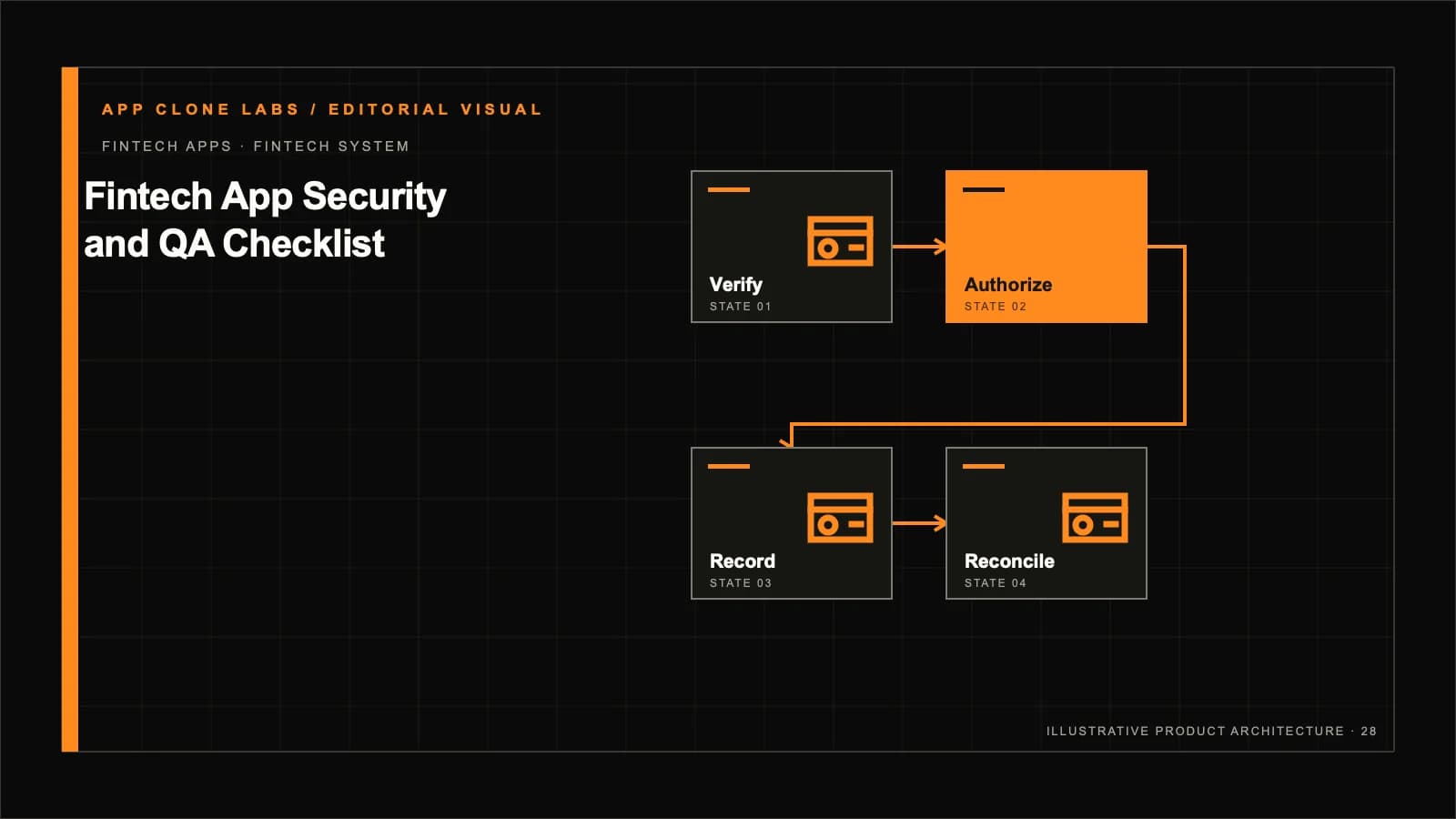
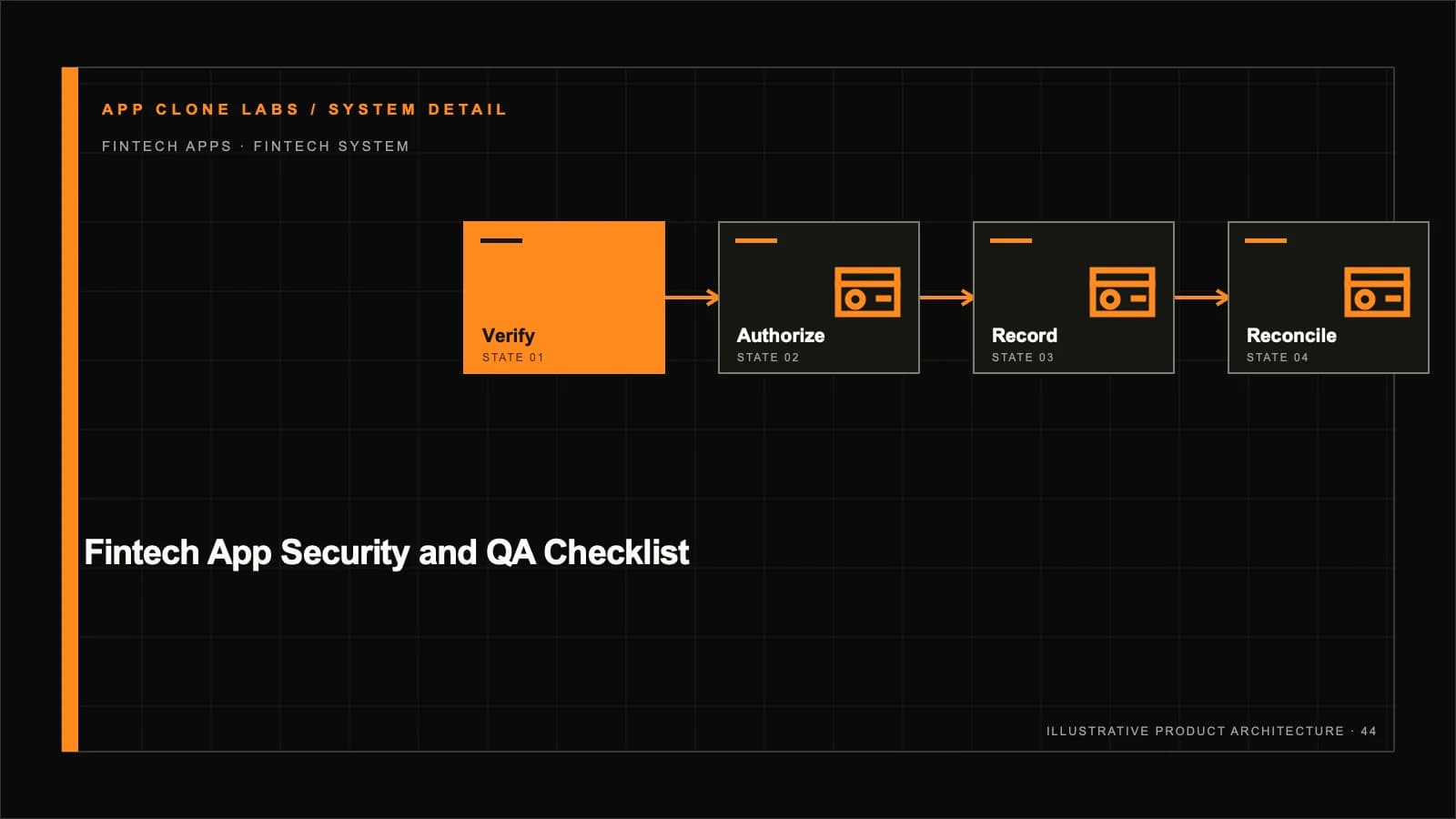
A fintech application can pass a penetration test and still post the same transfer twice. It can encrypt data and still let a support operator approve their own balance adjustment. It can verify identity at signup and never respond when that evidence expires.
Security and quality converge around integrity: the right actor must perform an allowed action once, against current state, with a result that can be reconciled and recovered. Vulnerability scanning covers only part of that promise.
This checklist treats identity, money movement, administration and resilience as one control system.
Map assets and trust boundaries
Money, identity evidence, credentials, keys and audit records need explicit ownership.
The failure mode is concrete: security testing starts from endpoints without a system model. This is not solved by adding another screen or background job. The product has to define ownership, permitted transitions, and the evidence retained when the transition occurs.
For the first release, document data flows and trust transitions. Write that decision as an enforceable server-side rule, not guidance that depends on a client, operator, or AI model remembering the intended boundary.
Implementation should include asset, owner, source, destination, sensitivity, authority, encryption and retention. Keep the public response smaller than the internal record: users need a clear outcome and recovery path, while authorized operators need correlation IDs, policy versions, timestamps, and the before-and-after state.
Validate it with one customer transfer end to end. Test the ordinary path, then repeat under timeout, duplicate delivery, stale state, partial failure, revoked authority, and concurrent requests. A feature is not ready when only the demonstration succeeds.
- Owner: security architect
- Release evidence: Map assets and trust boundaries acceptance record
- Stop condition: map assets and trust boundaries cannot be explained or recovered
Verify identity lifecycle
Enrollment, recovery, device change and closure carry different risks.
The failure mode is concrete: signup verification is the only tested identity event. This is not solved by adding another screen or background job. The product has to define ownership, permitted transitions, and the evidence retained when the transition occurs.
For the first release, test every identity transition and evidence expiry. Write that decision as an enforceable server-side rule, not guidance that depends on a client, operator, or AI model remembering the intended boundary.
Implementation should include subject, authenticator, assurance, recovery factor, device, status and audit. Keep the public response smaller than the internal record: users need a clear outcome and recovery path, while authorized operators need correlation IDs, policy versions, timestamps, and the before-and-after state.
Validate it with lost device and compromised email. Test the ordinary path, then repeat under timeout, duplicate delivery, stale state, partial failure, revoked authority, and concurrent requests. A feature is not ready when only the demonstration succeeds.
- Owner: identity security lead
- Release evidence: Verify identity lifecycle acceptance record
- Stop condition: verify identity lifecycle cannot be explained or recovered
Enforce object authorization
Valid users must not access other customers or organizations.
The failure mode is concrete: predictable identifiers return unauthorized data. This is not solved by adding another screen or background job. The product has to define ownership, permitted transitions, and the evidence retained when the transition occurs.
For the first release, authorize every object and field server-side. Write that decision as an enforceable server-side rule, not guidance that depends on a client, operator, or AI model remembering the intended boundary.
Implementation should include actor, tenant, capability, object owner, requested field, policy and denial. Keep the public response smaller than the internal record: users need a clear outcome and recovery path, while authorized operators need correlation IDs, policy versions, timestamps, and the before-and-after state.
Validate it with cross-account ID and list endpoint. Test the ordinary path, then repeat under timeout, duplicate delivery, stale state, partial failure, revoked authority, and concurrent requests. A feature is not ready when only the demonstration succeeds.
- Owner: API security owner
- Release evidence: Enforce object authorization acceptance record
- Stop condition: enforce object authorization cannot be explained or recovered
Protect transaction authorization
Authentication alone should not authorize consequential intent.
The failure mode is concrete: a stolen session can create arbitrary transfers. This is not solved by adding another screen or background job. The product has to define ownership, permitted transitions, and the evidence retained when the transition occurs.
For the first release, bind confirmation to amount, destination and transaction context. Write that decision as an enforceable server-side rule, not guidance that depends on a client, operator, or AI model remembering the intended boundary.
Implementation should include intent ID, source, destination, amount, currency, challenge, expiry and signed result. Keep the public response smaller than the internal record: users need a clear outcome and recovery path, while authorized operators need correlation IDs, policy versions, timestamps, and the before-and-after state.
Validate it with changed beneficiary after confirmation. Test the ordinary path, then repeat under timeout, duplicate delivery, stale state, partial failure, revoked authority, and concurrent requests. A feature is not ready when only the demonstration succeeds.
- Owner: payments security
- Release evidence: Protect transaction authorization acceptance record
- Stop condition: protect transaction authorization cannot be explained or recovered
Checkpoint 4: reconcile the product promise with the recorded state. Support, finance, security, and delivery teams should be able to reach the same conclusion from the same identifiers without reconstructing events from chat messages or screenshots.
Prove idempotent money movement
Timeouts cause legitimate retries.
The failure mode is concrete: duplicate requests create duplicate economic effects. This is not solved by adding another screen or background job. The product has to define ownership, permitted transitions, and the evidence retained when the transition occurs.
For the first release, store scoped keys and immutable outcomes. Write that decision as an enforceable server-side rule, not guidance that depends on a client, operator, or AI model remembering the intended boundary.
Implementation should include key, request hash, actor, first result, expiry and mismatch response. Keep the public response smaller than the internal record: users need a clear outcome and recovery path, while authorized operators need correlation IDs, policy versions, timestamps, and the before-and-after state.
Validate it with retry before and after timeout. Test the ordinary path, then repeat under timeout, duplicate delivery, stale state, partial failure, revoked authority, and concurrent requests. A feature is not ready when only the demonstration succeeds.
- Owner: transaction engineer
- Release evidence: Prove idempotent money movement acceptance record
- Stop condition: prove idempotent money movement cannot be explained or recovered
Validate ledger invariants
Every movement should remain balanced and traceable.
The failure mode is concrete: tests check displayed balance only. This is not solved by adding another screen or background job. The product has to define ownership, permitted transitions, and the evidence retained when the transition occurs.
For the first release, assert balanced entries and permitted account behavior. Write that decision as an enforceable server-side rule, not guidance that depends on a client, operator, or AI model remembering the intended boundary.
Implementation should include transaction, debits, credits, currency, account type, posting state and source. Keep the public response smaller than the internal record: users need a clear outcome and recovery path, while authorized operators need correlation IDs, policy versions, timestamps, and the before-and-after state.
Validate it with concurrent transfers and reversal. Test the ordinary path, then repeat under timeout, duplicate delivery, stale state, partial failure, revoked authority, and concurrent requests. A feature is not ready when only the demonstration succeeds.
- Owner: ledger QA
- Release evidence: Validate ledger invariants acceptance record
- Stop condition: validate ledger invariants cannot be explained or recovered
Secure secrets and cryptographic keys
Keys require controlled generation, access and rotation.
The failure mode is concrete: long-lived secrets appear in repositories or shared files. This is not solved by adding another screen or background job. The product has to define ownership, permitted transitions, and the evidence retained when the transition occurs.
For the first release, inventory secrets and use managed stores with least privilege. Write that decision as an enforceable server-side rule, not guidance that depends on a client, operator, or AI model remembering the intended boundary.
Implementation should include secret owner, environment, purpose, storage, rotation, consumers and emergency revocation. Keep the public response smaller than the internal record: users need a clear outcome and recovery path, while authorized operators need correlation IDs, policy versions, timestamps, and the before-and-after state.
Validate it with leaked key and rotation failure. Test the ordinary path, then repeat under timeout, duplicate delivery, stale state, partial failure, revoked authority, and concurrent requests. A feature is not ready when only the demonstration succeeds.
- Owner: platform security
- Release evidence: Secure secrets and cryptographic keys acceptance record
- Stop condition: secure secrets and cryptographic keys cannot be explained or recovered
Test session and device controls
Sessions persist across password, role and risk changes.
The failure mode is concrete: logout affects only the visible device. This is not solved by adding another screen or background job. The product has to define ownership, permitted transitions, and the evidence retained when the transition occurs.
For the first release, support revocation, bounded lifetime and device visibility. Write that decision as an enforceable server-side rule, not guidance that depends on a client, operator, or AI model remembering the intended boundary.
Implementation should include session ID, device, issued time, assurance, expiry, last use, revocation and risk. Keep the public response smaller than the internal record: users need a clear outcome and recovery path, while authorized operators need correlation IDs, policy versions, timestamps, and the before-and-after state.
Validate it with stolen refresh token and role removal. Test the ordinary path, then repeat under timeout, duplicate delivery, stale state, partial failure, revoked authority, and concurrent requests. A feature is not ready when only the demonstration succeeds.
- Owner: authentication owner
- Release evidence: Test session and device controls acceptance record
- Stop condition: test session and device controls cannot be explained or recovered
Checkpoint 8: reconcile the product promise with the recorded state. Support, finance, security, and delivery teams should be able to reach the same conclusion from the same identifiers without reconstructing events from chat messages or screenshots.
Harden API behavior
Rate, input and business-sequence abuse can bypass normal UI.
The failure mode is concrete: testing stops at schema validation. This is not solved by adding another screen or background job. The product has to define ownership, permitted transitions, and the evidence retained when the transition occurs.
For the first release, exercise authorization, resource limits and workflow abuse. Write that decision as an enforceable server-side rule, not guidance that depends on a client, operator, or AI model remembering the intended boundary.
Implementation should include endpoint, actor, object, input bounds, rate policy, idempotency, error and audit. Keep the public response smaller than the internal record: users need a clear outcome and recovery path, while authorized operators need correlation IDs, policy versions, timestamps, and the before-and-after state.
Validate it with enumeration and expensive query. Test the ordinary path, then repeat under timeout, duplicate delivery, stale state, partial failure, revoked authority, and concurrent requests. A feature is not ready when only the demonstration succeeds.
- Owner: API QA
- Release evidence: Harden API behavior acceptance record
- Stop condition: harden api behavior cannot be explained or recovered
Secure mobile storage and transport
Devices can be lost, rooted or observed.
The failure mode is concrete: tokens and sensitive data persist in ordinary storage. This is not solved by adding another screen or background job. The product has to define ownership, permitted transitions, and the evidence retained when the transition occurs.
For the first release, minimize local data and use platform-protected storage. Write that decision as an enforceable server-side rule, not guidance that depends on a client, operator, or AI model remembering the intended boundary.
Implementation should include data item, necessity, storage class, expiry, screenshot policy, transport and deletion. Keep the public response smaller than the internal record: users need a clear outcome and recovery path, while authorized operators need correlation IDs, policy versions, timestamps, and the before-and-after state.
Validate it with backup restore and rooted device. Test the ordinary path, then repeat under timeout, duplicate delivery, stale state, partial failure, revoked authority, and concurrent requests. A feature is not ready when only the demonstration succeeds.
- Owner: mobile security
- Release evidence: Secure mobile storage and transport acceptance record
- Stop condition: secure mobile storage and transport cannot be explained or recovered
Bound fraud automation
Rules and models should produce reviewable signals.
The failure mode is concrete: an opaque score silently blocks customers. This is not solved by adding another screen or background job. The product has to define ownership, permitted transitions, and the evidence retained when the transition occurs.
For the first release, version signals, thresholds and human escalation. Write that decision as an enforceable server-side rule, not guidance that depends on a client, operator, or AI model remembering the intended boundary.
Implementation should include signal, model or rule, features, score, threshold, action, reviewer and appeal. Keep the public response smaller than the internal record: users need a clear outcome and recovery path, while authorized operators need correlation IDs, policy versions, timestamps, and the before-and-after state.
Validate it with false positive and model drift. Test the ordinary path, then repeat under timeout, duplicate delivery, stale state, partial failure, revoked authority, and concurrent requests. A feature is not ready when only the demonstration succeeds.
- Owner: fraud systems owner
- Release evidence: Bound fraud automation acceptance record
- Stop condition: bound fraud automation cannot be explained or recovered
Protect administrative power
Operators can expose data or alter financial outcomes.
The failure mode is concrete: one admin role grants every action. This is not solved by adding another screen or background job. The product has to define ownership, permitted transitions, and the evidence retained when the transition occurs.
For the first release, use capabilities, stronger confirmation and separation of duties. Write that decision as an enforceable server-side rule, not guidance that depends on a client, operator, or AI model remembering the intended boundary.
Implementation should include role, scope, action, reason, approver, before-and-after, expiry and log. Keep the public response smaller than the internal record: users need a clear outcome and recovery path, while authorized operators need correlation IDs, policy versions, timestamps, and the before-and-after state.
Validate it with self-approved adjustment. Test the ordinary path, then repeat under timeout, duplicate delivery, stale state, partial failure, revoked authority, and concurrent requests. A feature is not ready when only the demonstration succeeds.
- Owner: control owner
- Release evidence: Protect administrative power acceptance record
- Stop condition: protect administrative power cannot be explained or recovered
Checkpoint 12: reconcile the product promise with the recorded state. Support, finance, security, and delivery teams should be able to reach the same conclusion from the same identifiers without reconstructing events from chat messages or screenshots.
Make audit evidence trustworthy
Investigation needs complete, correlated and protected history.
The failure mode is concrete: logs omit failed attempts or can be changed by operators. This is not solved by adding another screen or background job. The product has to define ownership, permitted transitions, and the evidence retained when the transition occurs.
For the first release, centralize security events with access controls and retention. Write that decision as an enforceable server-side rule, not guidance that depends on a client, operator, or AI model remembering the intended boundary.
Implementation should include actor, session, target, action, result, time, correlation, source and integrity control. Keep the public response smaller than the internal record: users need a clear outcome and recovery path, while authorized operators need correlation IDs, policy versions, timestamps, and the before-and-after state.
Validate it with denied action and log-service outage. Test the ordinary path, then repeat under timeout, duplicate delivery, stale state, partial failure, revoked authority, and concurrent requests. A feature is not ready when only the demonstration succeeds.
- Owner: security operations
- Release evidence: Make audit evidence trustworthy acceptance record
- Stop condition: make audit evidence trustworthy cannot be explained or recovered
Test dependency failure
Identity, banking and notification providers can be slow or inconsistent.
The failure mode is concrete: external success is assumed. This is not solved by adding another screen or background job. The product has to define ownership, permitted transitions, and the evidence retained when the transition occurs.
For the first release, inject failures and reconcile later outcomes. Write that decision as an enforceable server-side rule, not guidance that depends on a client, operator, or AI model remembering the intended boundary.
Implementation should include dependency, timeout, retry, circuit, queued work, user state, callback and mismatch queue. Keep the public response smaller than the internal record: users need a clear outcome and recovery path, while authorized operators need correlation IDs, policy versions, timestamps, and the before-and-after state.
Validate it with delayed settlement and provider outage. Test the ordinary path, then repeat under timeout, duplicate delivery, stale state, partial failure, revoked authority, and concurrent requests. A feature is not ready when only the demonstration succeeds.
- Owner: resilience QA
- Release evidence: Test dependency failure acceptance record
- Stop condition: test dependency failure cannot be explained or recovered
Rehearse incidents and recovery
Detection without practiced response leaves customer harm unresolved.
The failure mode is concrete: the incident plan is a static document. This is not solved by adding another screen or background job. The product has to define ownership, permitted transitions, and the evidence retained when the transition occurs.
For the first release, exercise credential theft, financial anomaly and data exposure. Write that decision as an enforceable server-side rule, not guidance that depends on a client, operator, or AI model remembering the intended boundary.
Implementation should include scenario, roles, containment, evidence, customer communication, regulator decision, recovery and learning. Keep the public response smaller than the internal record: users need a clear outcome and recovery path, while authorized operators need correlation IDs, policy versions, timestamps, and the before-and-after state.
Validate it with compromised operator and duplicated transfer. Test the ordinary path, then repeat under timeout, duplicate delivery, stale state, partial failure, revoked authority, and concurrent requests. A feature is not ready when only the demonstration succeeds.
- Owner: incident commander
- Release evidence: Rehearse incidents and recovery acceptance record
- Stop condition: rehearse incidents and recovery cannot be explained or recovered
Implementation references
Use OWASP API Security Top 10 and record the version applied to this release.
Validate implementation against OWASP Authorization Cheat Sheet and record the version applied to this release.
Review NIST Cybersecurity Framework 2.0 and record the version applied to this release.
Compare with OWASP ASVS and record the version applied to this release.
Continue with Fintech Industry when translating this guide into delivery scope.
Frequently asked questions
Is a penetration test enough for a fintech app?
No. It does not replace transaction-integrity, ledger, concurrency, operational and recovery testing.
What is transaction authorization?
Confirming the specific consequential intent—such as destination and amount—not merely that a session is authenticated.
Why test idempotency?
Network retries must not create duplicate financial effects.
What ledger checks matter?
Balanced debits and credits, currency consistency, account rules, immutable history and reconciled reversals.
How should admin access be controlled?
With scoped capabilities, reasoned actions, stronger confirmation, separation of duties and audit.
What should mobile testing cover?
Protected local storage, session revocation, transport, device loss, screenshot exposure and degraded connectivity.
How should fraud models be governed?
Version signals and thresholds, measure false positives, retain rationale and support review or appeal.
What incidents should be rehearsed?
Credential theft, duplicated money movement, compromised operators, provider outage and sensitive-data exposure.
Turn the plan into release evidence
A credible release connects the public promise to durable state, scoped authority and recoverable operations. Ordinary journeys and important exceptions should be explainable from the same evidence.
Keep the initial scope narrow enough to rehearse end to end. Expand only after permissions, financial consequences, data integrity and support outcomes remain consistent under retries, failures and human mistakes.
- 01
- 02
- 03
- 04
- 05
- 06
Reviewed by the App Clone Labs product strategy team
This guide is written for founders and operators planning clone-inspired platforms, SaaS products, marketplaces, and mobile apps. It is reviewed against App Clone Labs delivery patterns, product scoping standards, and current implementation realities before being published.
Review the editorial team structureRelated product paths
Continue with the services, solutions, guides, and articles that connect this topic to a real software build.
Services, solutions, and guides
Read next