Editorial dossier / Education Apps
Cohort-Based Learning Platform MVP: Scope, Workflows and Launch Controls
A complete cohort learning MVP plan covering enrolment, schedules, live sessions, assignments, feedback, community, progress, accessibility and learner support.
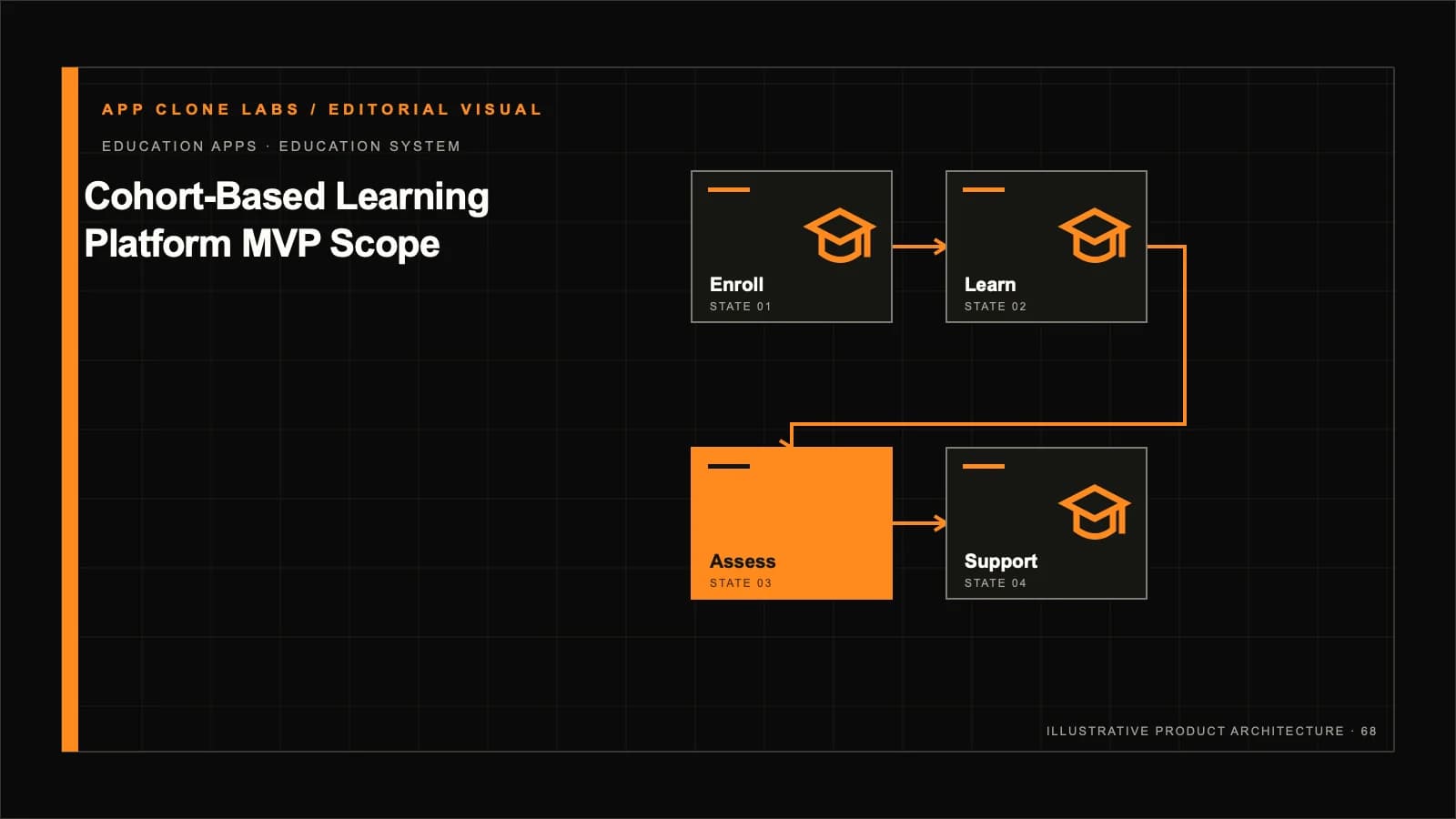
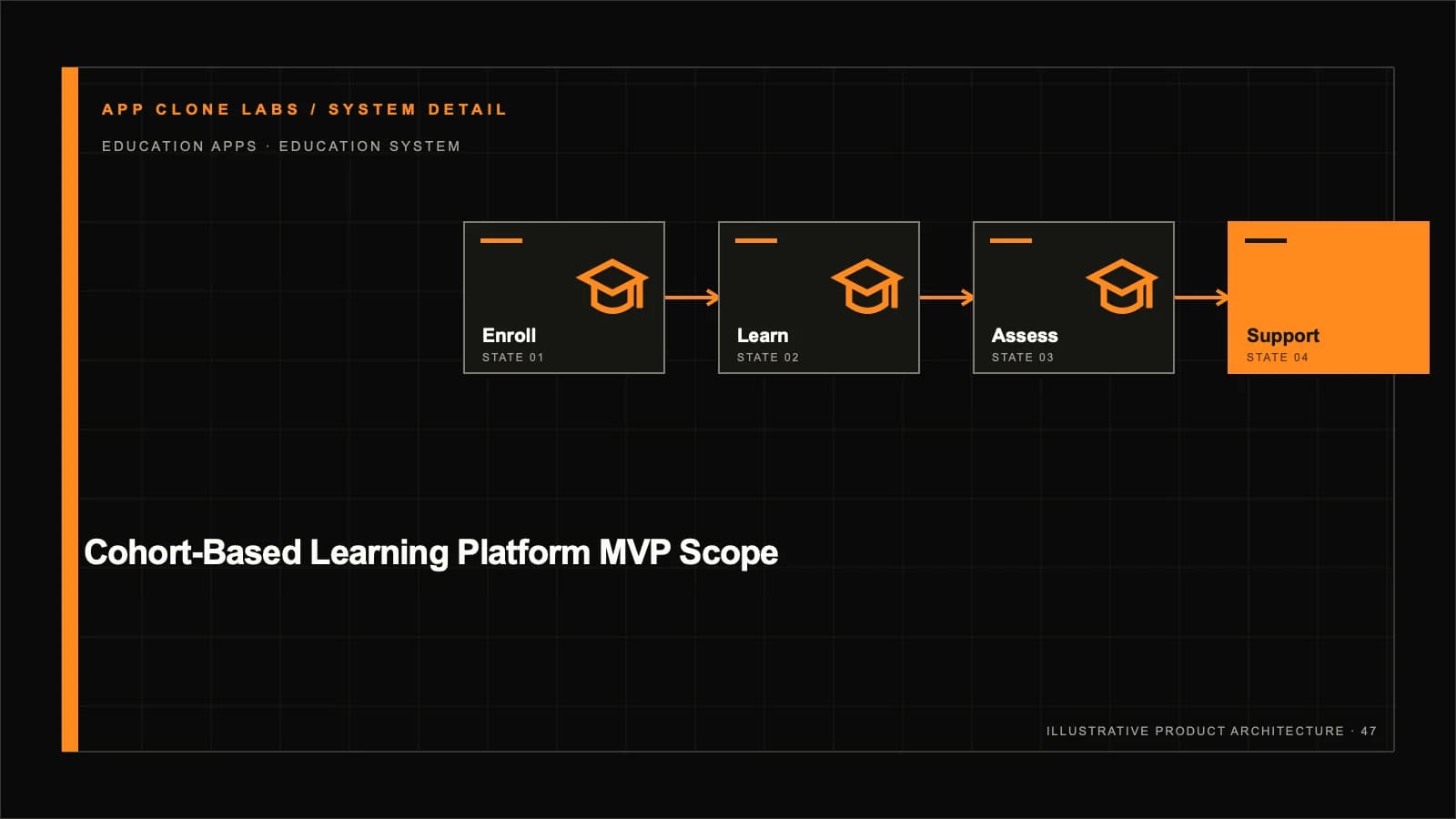
A cohort does not fail because it lacks a colourful dashboard. It fails when a learner joins the wrong intake, misses a rescheduled session, submits against an outdated brief, cannot get feedback, or completes the work while the platform still reports them as behind.
The MVP must therefore protect one time-bound learning journey: discover the programme, enrol in the correct cohort, receive a localized schedule, attend or recover a live session, complete an assignment, receive feedback, participate safely, and leave with an explainable result.
This guide scopes that loop as an operational system rather than a list of classroom features.
Define the cohort contract
State start, end, cadence, capacity, outcomes, attendance and completion promises.
The failure mode is concrete: marketing and delivery describe different programmes. This is not solved by adding another screen or background job. The product has to define ownership, permitted transitions, and the evidence retained when the transition occurs.
For the first release, version one learner-facing cohort specification. Write that decision as an enforceable server-side rule, not guidance that depends on a client, operator, or AI model remembering the intended boundary.
Implementation should include timezone, session plan, instructor, prerequisites, capacity, policies and outcomes. Keep the public response smaller than the internal record: users need a clear outcome and recovery path, while authorized operators need correlation IDs, policy versions, timestamps, and the before-and-after state.
Validate it with late enrolment, reschedule, cancellation and transfer. Test the ordinary path, then repeat under timeout, duplicate delivery, stale state, partial failure, revoked authority, and concurrent requests. A feature is not ready when only the demonstration succeeds.
- Owner: programme lead
- Release evidence: approved cohort brief
- Stop condition: support cannot explain the purchased experience
Separate course from cohort
Reusable curriculum and a scheduled delivery instance change independently.
The failure mode is concrete: editing a course rewrites active cohort history. This is not solved by adding another screen or background job. The product has to define ownership, permitted transitions, and the evidence retained when the transition occurs.
For the first release, let cohorts reference a versioned course. Write that decision as an enforceable server-side rule, not guidance that depends on a client, operator, or AI model remembering the intended boundary.
Implementation should include course version, cohort dates, facilitators, overrides and learner migration. Keep the public response smaller than the internal record: users need a clear outcome and recovery path, while authorized operators need correlation IDs, policy versions, timestamps, and the before-and-after state.
Validate it with new course version and active learners. Test the ordinary path, then repeat under timeout, duplicate delivery, stale state, partial failure, revoked authority, and concurrent requests. A feature is not ready when only the demonstration succeeds.
- Owner: product architect
- Release evidence: version tests
- Stop condition: historical activity changes after editing
Model enrolment as a lifecycle
Interest, payment, invitation, active participation, withdrawal and completion differ.
The failure mode is concrete: one enrolled boolean hides operational state. This is not solved by adding another screen or background job. The product has to define ownership, permitted transitions, and the evidence retained when the transition occurs.
For the first release, use explicit permitted transitions and reason codes. Write that decision as an enforceable server-side rule, not guidance that depends on a client, operator, or AI model remembering the intended boundary.
Implementation should include cohort, learner, source, status, entitlement, timestamps and actor. Keep the public response smaller than the internal record: users need a clear outcome and recovery path, while authorized operators need correlation IDs, policy versions, timestamps, and the before-and-after state.
Validate it with duplicate enrolment, refund, transfer and removal. Test the ordinary path, then repeat under timeout, duplicate delivery, stale state, partial failure, revoked authority, and concurrent requests. A feature is not ready when only the demonstration succeeds.
- Owner: enrolment owner
- Release evidence: transition matrix
- Stop condition: two active seats exist for one purchase
Make capacity enforceable
Capacity affects facilitation and economics.
The failure mode is concrete: two checkout requests oversell the final seat. This is not solved by adding another screen or background job. The product has to define ownership, permitted transitions, and the evidence retained when the transition occurs.
For the first release, reserve and confirm seats transactionally with expiry. Write that decision as an enforceable server-side rule, not guidance that depends on a client, operator, or AI model remembering the intended boundary.
Implementation should include capacity, held seats, waitlist, payment attempt and release job. Keep the public response smaller than the internal record: users need a clear outcome and recovery path, while authorized operators need correlation IDs, policy versions, timestamps, and the before-and-after state.
Validate it with concurrent final seat and abandoned payment. Test the ordinary path, then repeat under timeout, duplicate delivery, stale state, partial failure, revoked authority, and concurrent requests. A feature is not ready when only the demonstration succeeds.
- Owner: commerce engineer
- Release evidence: capacity invariant
- Stop condition: confirmed enrolments exceed limit
Checkpoint 4: reconcile the product promise with the recorded state. Support, finance, security, and delivery teams should be able to reach the same conclusion from the same identifiers without reconstructing events from chat messages or screenshots.
Normalize schedules and timezones
A single session has one canonical instant but many local displays.
The failure mode is concrete: stored local times shift during daylight-saving changes. This is not solved by adding another screen or background job. The product has to define ownership, permitted transitions, and the evidence retained when the transition occurs.
For the first release, store an instant plus source timezone and display per learner. Write that decision as an enforceable server-side rule, not guidance that depends on a client, operator, or AI model remembering the intended boundary.
Implementation should include start, end, zone, recurrence, change version and notification. Keep the public response smaller than the internal record: users need a clear outcome and recovery path, while authorized operators need correlation IDs, policy versions, timestamps, and the before-and-after state.
Validate it with DST boundary, traveller and instructor reschedule. Test the ordinary path, then repeat under timeout, duplicate delivery, stale state, partial failure, revoked authority, and concurrent requests. A feature is not ready when only the demonstration succeeds.
- Owner: calendar owner
- Release evidence: timezone test matrix
- Stop condition: two clients show different instants
Integrate live sessions safely
Meeting providers are delivery dependencies, not the course data model.
The failure mode is concrete: public reusable links leak into search or old cohorts. This is not solved by adding another screen or background job. The product has to define ownership, permitted transitions, and the evidence retained when the transition occurs.
For the first release, create scoped sessions through an adapter and authorize access from active enrolment. Write that decision as an enforceable server-side rule, not guidance that depends on a client, operator, or AI model remembering the intended boundary.
Implementation should include provider ID, join policy, host, recording consent, status and fallback. Keep the public response smaller than the internal record: users need a clear outcome and recovery path, while authorized operators need correlation IDs, policy versions, timestamps, and the before-and-after state.
Validate it with expired token, provider outage and removed learner. Test the ordinary path, then repeat under timeout, duplicate delivery, stale state, partial failure, revoked authority, and concurrent requests. A feature is not ready when only the demonstration succeeds.
- Owner: integration lead
- Release evidence: session access tests
- Stop condition: a forwarded link bypasses enrolment
Plan recordings and recovery
Absence recovery may include recording, notes, alternative task or instructor review.
The failure mode is concrete: recording is assumed available without consent or processing state. This is not solved by adding another screen or background job. The product has to define ownership, permitted transitions, and the evidence retained when the transition occurs.
For the first release, publish an explicit recovery policy per session. Write that decision as an enforceable server-side rule, not guidance that depends on a client, operator, or AI model remembering the intended boundary.
Implementation should include consent, upload state, captions, expiry, entitlement and alternative. Keep the public response smaller than the internal record: users need a clear outcome and recovery path, while authorized operators need correlation IDs, policy versions, timestamps, and the before-and-after state.
Validate it with failed recording, missing caption and withdrawal. Test the ordinary path, then repeat under timeout, duplicate delivery, stale state, partial failure, revoked authority, and concurrent requests. A feature is not ready when only the demonstration succeeds.
- Owner: learning operations
- Release evidence: recovery checklist
- Stop condition: a missed session has no defined route
Version assignments and rubrics
Learner work must remain tied to the instructions and criteria used.
The failure mode is concrete: editing the brief changes historical grading context. This is not solved by adding another screen or background job. The product has to define ownership, permitted transitions, and the evidence retained when the transition occurs.
For the first release, snapshot assignment and rubric versions for each submission. Write that decision as an enforceable server-side rule, not guidance that depends on a client, operator, or AI model remembering the intended boundary.
Implementation should include due date, version, attempt, files, rubric, grader and feedback release. Keep the public response smaller than the internal record: users need a clear outcome and recovery path, while authorized operators need correlation IDs, policy versions, timestamps, and the before-and-after state.
Validate it with late work, resubmission and rubric correction. Test the ordinary path, then repeat under timeout, duplicate delivery, stale state, partial failure, revoked authority, and concurrent requests. A feature is not ready when only the demonstration succeeds.
- Owner: assessment lead
- Release evidence: reproducible grade
- Stop condition: a result cannot be reconstructed
Checkpoint 8: reconcile the product promise with the recorded state. Support, finance, security, and delivery teams should be able to reach the same conclusion from the same identifiers without reconstructing events from chat messages or screenshots.
Build feedback as a workflow
Feedback moves through requested, assigned, drafted, released and acknowledged states.
The failure mode is concrete: comments live in chat and disappear from the learning record. This is not solved by adding another screen or background job. The product has to define ownership, permitted transitions, and the evidence retained when the transition occurs.
For the first release, store structured, permissioned feedback with service expectations. Write that decision as an enforceable server-side rule, not guidance that depends on a client, operator, or AI model remembering the intended boundary.
Implementation should include reviewer, rubric item, private note, release, revision request and timestamp. Keep the public response smaller than the internal record: users need a clear outcome and recovery path, while authorized operators need correlation IDs, policy versions, timestamps, and the before-and-after state.
Validate it with reviewer replacement and withdrawn learner. Test the ordinary path, then repeat under timeout, duplicate delivery, stale state, partial failure, revoked authority, and concurrent requests. A feature is not ready when only the demonstration succeeds.
- Owner: instruction lead
- Release evidence: feedback timeline
- Stop condition: learners receive unaudited conflicting feedback
Design community boundaries
Cohort discussion needs membership, moderation and an end-of-cohort policy.
The failure mode is concrete: former learners retain private group access. This is not solved by adding another screen or background job. The product has to define ownership, permitted transitions, and the evidence retained when the transition occurs.
For the first release, derive community access from active cohort state and publish conduct rules. Write that decision as an enforceable server-side rule, not guidance that depends on a client, operator, or AI model remembering the intended boundary.
Implementation should include channels, roles, block, report, moderator action, archive and export policy. Keep the public response smaller than the internal record: users need a clear outcome and recovery path, while authorized operators need correlation IDs, policy versions, timestamps, and the before-and-after state.
Validate it with removal, abuse report and cohort close. Test the ordinary path, then repeat under timeout, duplicate delivery, stale state, partial failure, revoked authority, and concurrent requests. A feature is not ready when only the demonstration succeeds.
- Owner: community lead
- Release evidence: moderation drill
- Stop condition: membership revocation does not affect chat
Measure learning rather than attendance alone
Presence is useful but not proof of mastery.
The failure mode is concrete: dashboard calls join duration educational success. This is not solved by adding another screen or background job. The product has to define ownership, permitted transitions, and the evidence retained when the transition occurs.
For the first release, keep attendance, activity, completion and mastery separate. Write that decision as an enforceable server-side rule, not guidance that depends on a client, operator, or AI model remembering the intended boundary.
Implementation should include event definitions, denominators, course version, consent and correction. Keep the public response smaller than the internal record: users need a clear outcome and recovery path, while authorized operators need correlation IDs, policy versions, timestamps, and the before-and-after state.
Validate it with reconnect, repeat viewing and manual override. Test the ordinary path, then repeat under timeout, duplicate delivery, stale state, partial failure, revoked authority, and concurrent requests. A feature is not ready when only the demonstration succeeds.
- Owner: analytics owner
- Release evidence: metric dictionary
- Stop condition: one score mixes incompatible evidence
Give instructors an exception queue
Late work, absence, access problems and at-risk learners need owned decisions.
The failure mode is concrete: exceptions hide in email. This is not solved by adding another screen or background job. The product has to define ownership, permitted transitions, and the evidence retained when the transition occurs.
For the first release, create a prioritized queue with bounded actions and audit. Write that decision as an enforceable server-side rule, not guidance that depends on a client, operator, or AI model remembering the intended boundary.
Implementation should include reason, learner, cohort, evidence, owner, due time, action and note. Keep the public response smaller than the internal record: users need a clear outcome and recovery path, while authorized operators need correlation IDs, policy versions, timestamps, and the before-and-after state.
Validate it with duplicate case and instructor absence. Test the ordinary path, then repeat under timeout, duplicate delivery, stale state, partial failure, revoked authority, and concurrent requests. A feature is not ready when only the demonstration succeeds.
- Owner: operations manager
- Release evidence: exception-resolution drill
- Stop condition: an urgent learner has no accountable owner
Checkpoint 12: reconcile the product promise with the recorded state. Support, finance, security, and delivery teams should be able to reach the same conclusion from the same identifiers without reconstructing events from chat messages or screenshots.
Make accessibility a launch gate
Live, recorded and assignment experiences require usable alternatives.
The failure mode is concrete: accessibility is postponed until after enrolment. This is not solved by adding another screen or background job. The product has to define ownership, permitted transitions, and the evidence retained when the transition occurs.
For the first release, review keyboard access, captions, transcripts, documents, contrast and accommodations. Write that decision as an enforceable server-side rule, not guidance that depends on a client, operator, or AI model remembering the intended boundary.
Implementation should include status, blocker, exception owner and learner communication. Keep the public response smaller than the internal record: users need a clear outcome and recovery path, while authorized operators need correlation IDs, policy versions, timestamps, and the before-and-after state.
Validate it with screen reader, zoom, keyboard and caption delay. Test the ordinary path, then repeat under timeout, duplicate delivery, stale state, partial failure, revoked authority, and concurrent requests. A feature is not ready when only the demonstration succeeds.
- Owner: accessibility owner
- Release evidence: WCAG-oriented evidence
- Stop condition: essential content lacks an accessible route
Scope learner support
Support must see enrolment, entitlement, schedule, attendance, submissions and communications.
The failure mode is concrete: staff repair progress in the database. This is not solved by adding another screen or background job. The product has to define ownership, permitted transitions, and the evidence retained when the transition occurs.
For the first release, provide a read-first timeline and reasoned actions. Write that decision as an enforceable server-side rule, not guidance that depends on a client, operator, or AI model remembering the intended boundary.
Implementation should include resend, transfer, deadline extension, access restoration and immutable audit. Keep the public response smaller than the internal record: users need a clear outcome and recovery path, while authorized operators need correlation IDs, policy versions, timestamps, and the before-and-after state.
Validate it with wrong cohort, repeated action and unauthorized staff. Test the ordinary path, then repeat under timeout, duplicate delivery, stale state, partial failure, revoked authority, and concurrent requests. A feature is not ready when only the demonstration succeeds.
- Owner: support lead
- Release evidence: support simulation
- Stop condition: routine recovery needs database access
Set release and rollback gates
The programme starts on a fixed date, making late defects expensive.
The failure mode is concrete: launch depends on a demo rather than operational rehearsal. This is not solved by adding another screen or background job. The product has to define ownership, permitted transitions, and the evidence retained when the transition occurs.
For the first release, rehearse the first week and define fallbacks for every external dependency. Write that decision as an enforceable server-side rule, not guidance that depends on a client, operator, or AI model remembering the intended boundary.
Implementation should include seeded cohort, communications, meeting fallback, support rota, monitoring and rollback. Keep the public response smaller than the internal record: users need a clear outcome and recovery path, while authorized operators need correlation IDs, policy versions, timestamps, and the before-and-after state.
Validate it with provider outage, bad schedule import and payment delay. Test the ordinary path, then repeat under timeout, duplicate delivery, stale state, partial failure, revoked authority, and concurrent requests. A feature is not ready when only the demonstration succeeds.
- Owner: delivery lead
- Release evidence: first-week rehearsal
- Stop condition: the first live session has no fallback
Implementation references
Use 1EdTech OneRoster and record the version applied to this release.
Validate decisions against 1EdTech Learning Tools Interoperability and record the version applied to this release.
Review 1EdTech Caliper Analytics and record the version applied to this release.
Compare with W3C Web Content Accessibility Guidelines 2.2 and record the version applied to this release.
Continue with Education and EdTech when translating this guide into delivery scope.
Frequently asked questions
What is the smallest credible cohort-learning MVP?
One course version, cohort enrolment, localized schedule, live-session access and recovery, assignments, feedback, community controls, progress evidence and learner support.
Should courses and cohorts be the same record?
No. A course is reusable curriculum; a cohort is a scheduled delivery instance tied to a course version.
How should timezones be handled?
Store canonical instants with the source timezone, then render in the learner’s chosen timezone and test daylight-saving boundaries.
What happens when a session is missed?
Use a declared recovery policy: recording with captions, notes, an alternative activity or instructor review.
How should cohort capacity work?
Reserve seats during checkout with expiry, confirm after verified payment and use a waitlist or controlled transfer path.
What proves learning progress?
Keep attendance, activity completion, assessment evidence and mastery distinct, with documented denominators and version context.
Which accessibility checks are essential?
Keyboard access, screen-reader structure, zoom, contrast, captions or transcripts, accessible documents and a process for accommodations.
What should be tested before launch?
Rehearse enrolment through the first week, including timezones, payment delay, provider outage, rescheduling, accessibility, support and rollback.
Turn the design into operating evidence
The release is credible when ordinary users can complete the promised journey and operators can explain and recover every important exception from durable state. A polished demonstration is not a substitute for those properties.
Keep the scope narrow, the language accurate and the acceptance evidence visible. That creates a better foundation for expansion than features whose permissions, financial consequences or quality thresholds remain implicit.
- 01
- 02
- 03
- 04
- 05
- 06
Reviewed by the App Clone Labs product strategy team
This guide is written for founders and operators planning clone-inspired platforms, SaaS products, marketplaces, and mobile apps. It is reviewed against App Clone Labs delivery patterns, product scoping standards, and current implementation realities before being published.
Review the editorial team structureRelated product paths
Continue with the services, solutions, guides, and articles that connect this topic to a real software build.
Services, solutions, and guides
Read next