Editorial dossier / Media and Entertainment
OTT Streaming Tech Stack: Playback, Entitlements and Operations
Plan an OTT stack across content workflows, encoding, storage, CDN delivery, playback, entitlements, DRM, profiles, discovery, analytics and reliability.
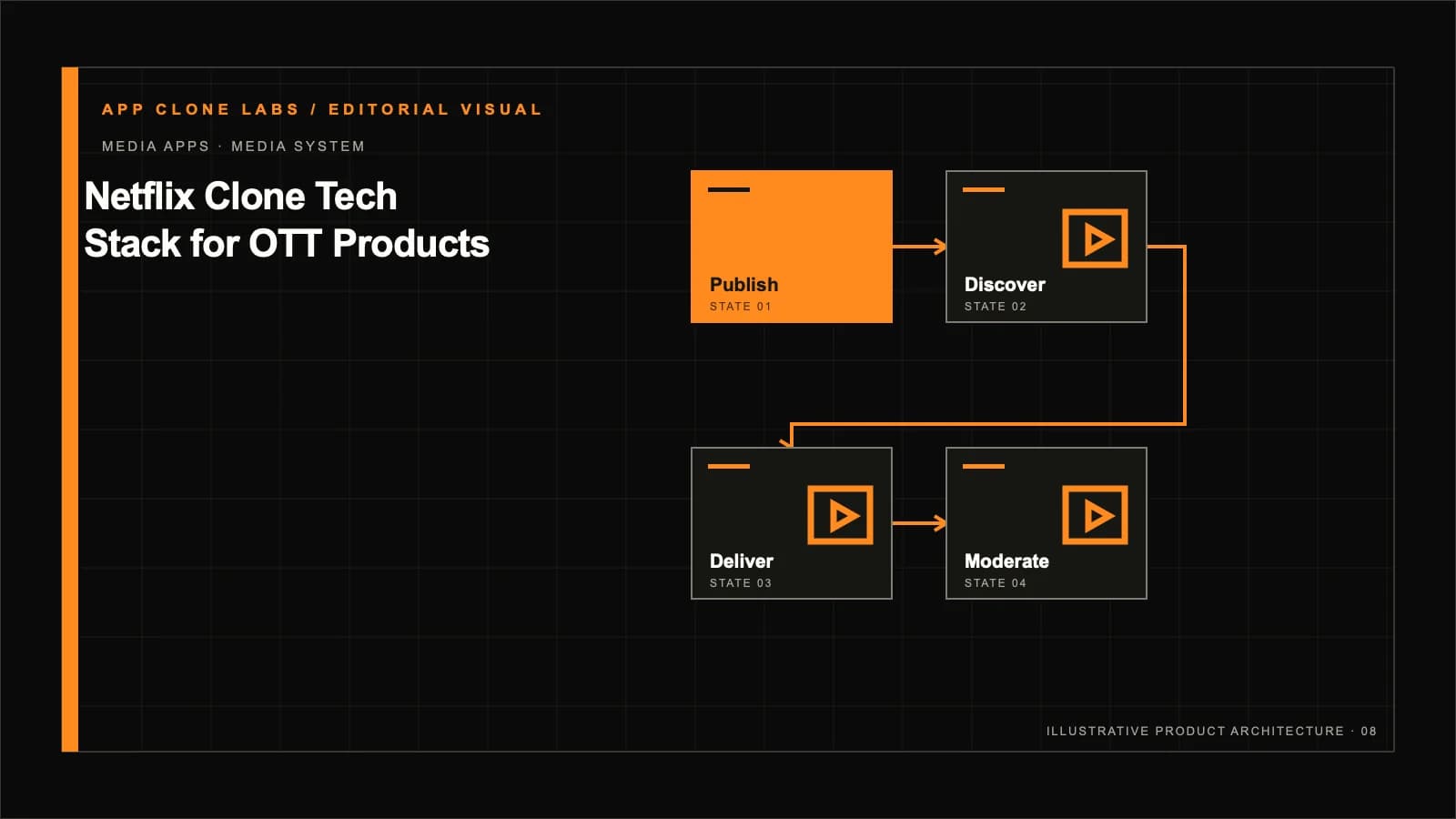
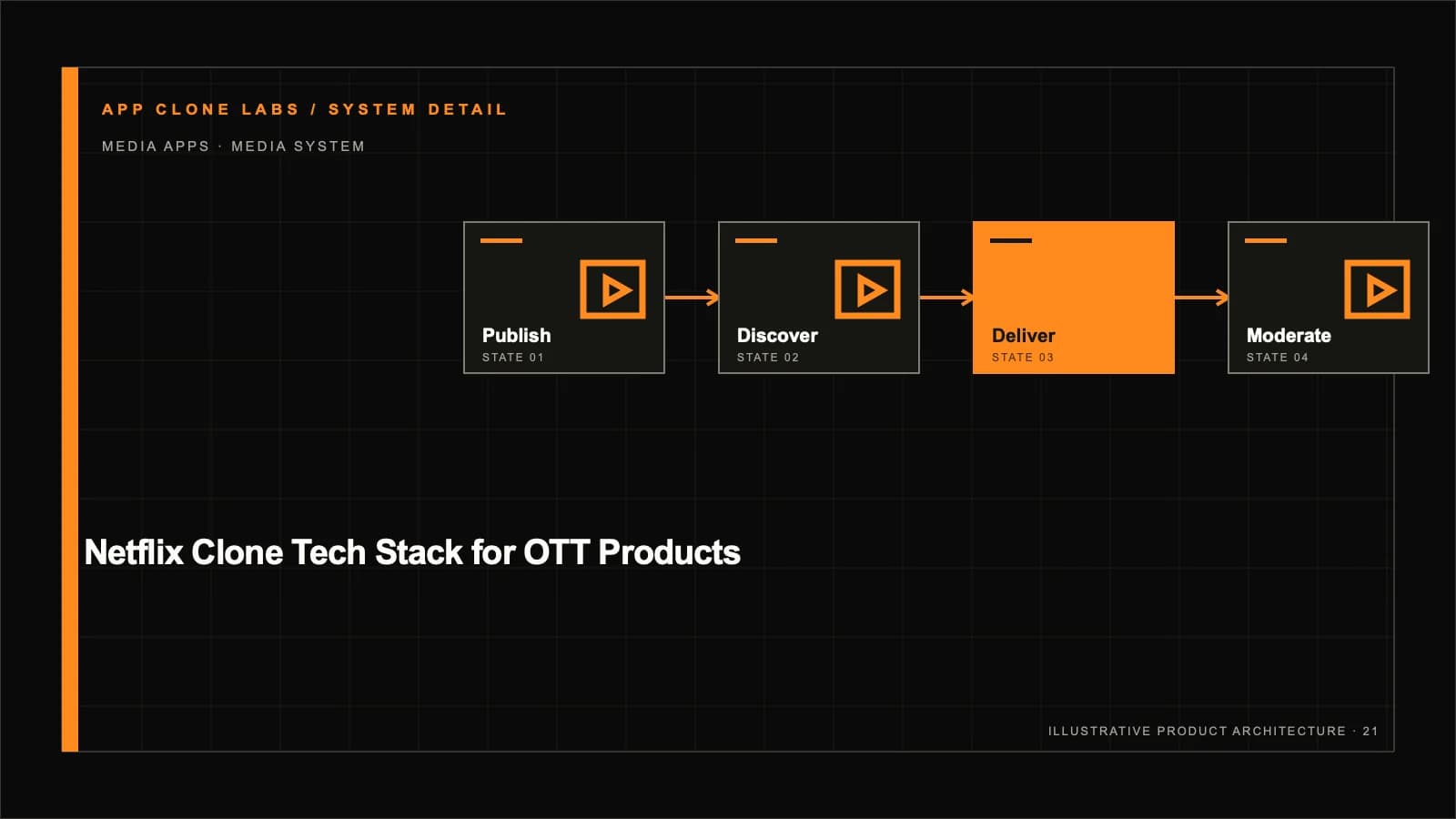
A streaming application is not a catalog connected to a video player. The product has to transform source media into device-compatible renditions, authorize playback under a current entitlement and observe quality without exposing sensitive viewing data.
The stack should be chosen from audience, rights, devices, latency, catalogue scale and operating capability. Copying a famous platform’s component list creates cost without recreating its constraints.
This guide maps the path from content ingestion to reliable playback and customer support.
Define audience and device coverage
Define audience and device coverage is a distinct product and operating decision inside a subscription video platform delivering protected media across devices and regions. It determines what the platform may promise, which role has authority, what evidence survives a dispute and how the team recovers when normal processing fails.
The failure mode is concrete: the team treats define audience and device coverage as interface scope while state, permissions, downstream consequences and operator recovery remain implicit This is not solved by adding another screen or background job. The product has to define ownership, permitted transitions, and the evidence retained when the transition occurs.
For the first release, define the authoritative lifecycle, accountable owner, allowed transitions, user-visible outcome and exception route for define audience and device coverage before implementation Write that decision as an enforceable server-side rule, not guidance that depends on a client, operator, or AI model remembering the intended boundary.
Implementation should include For define audience and device coverage, retain stable identifiers, explicit states, server-side authorization, version checks, event and processing timestamps, reason codes, correlation IDs, audit history and a bounded recovery action. Keep the public response smaller than the internal record: users need a clear outcome and recovery path, while authorized operators need correlation IDs, policy versions, timestamps, and the before-and-after state.
Validate it with For define audience and device coverage, test the successful journey followed by stale state, duplicate delivery, concurrent commands, revoked authority, dependency timeout, partial completion, operator correction and reconciliation. Test the ordinary path, then repeat under timeout, duplicate delivery, stale state, partial failure, revoked authority, and concurrent requests. A feature is not ready when only the demonstration succeeds.
- Owner: product owner
- Release evidence: versioned define audience and device coverage decision, acceptance criteria and recovery record
- Stop condition: define audience and device coverage cannot be explained or restored from durable evidence
Model titles seasons and assets
Model titles seasons and assets is a distinct product and operating decision inside a subscription video platform delivering protected media across devices and regions. It determines what the platform may promise, which role has authority, what evidence survives a dispute and how the team recovers when normal processing fails.
The failure mode is concrete: the team treats model titles seasons and assets as interface scope while state, permissions, downstream consequences and operator recovery remain implicit This is not solved by adding another screen or background job. The product has to define ownership, permitted transitions, and the evidence retained when the transition occurs.
For the first release, define the authoritative lifecycle, accountable owner, allowed transitions, user-visible outcome and exception route for model titles seasons and assets before implementation Write that decision as an enforceable server-side rule, not guidance that depends on a client, operator, or AI model remembering the intended boundary.
Implementation should include For model titles seasons and assets, retain stable identifiers, explicit states, server-side authorization, version checks, event and processing timestamps, reason codes, correlation IDs, audit history and a bounded recovery action. Keep the public response smaller than the internal record: users need a clear outcome and recovery path, while authorized operators need correlation IDs, policy versions, timestamps, and the before-and-after state.
Validate it with For model titles seasons and assets, test the successful journey followed by stale state, duplicate delivery, concurrent commands, revoked authority, dependency timeout, partial completion, operator correction and reconciliation. Test the ordinary path, then repeat under timeout, duplicate delivery, stale state, partial failure, revoked authority, and concurrent requests. A feature is not ready when only the demonstration succeeds.
- Owner: engineering owner
- Release evidence: versioned model titles seasons and assets decision, acceptance criteria and recovery record
- Stop condition: model titles seasons and assets cannot be explained or restored from durable evidence
Ingest source media reliably
Ingest source media reliably is a distinct product and operating decision inside a subscription video platform delivering protected media across devices and regions. It determines what the platform may promise, which role has authority, what evidence survives a dispute and how the team recovers when normal processing fails.
The failure mode is concrete: the team treats ingest source media reliably as interface scope while state, permissions, downstream consequences and operator recovery remain implicit This is not solved by adding another screen or background job. The product has to define ownership, permitted transitions, and the evidence retained when the transition occurs.
For the first release, define the authoritative lifecycle, accountable owner, allowed transitions, user-visible outcome and exception route for ingest source media reliably before implementation Write that decision as an enforceable server-side rule, not guidance that depends on a client, operator, or AI model remembering the intended boundary.
Implementation should include For ingest source media reliably, retain stable identifiers, explicit states, server-side authorization, version checks, event and processing timestamps, reason codes, correlation IDs, audit history and a bounded recovery action. Keep the public response smaller than the internal record: users need a clear outcome and recovery path, while authorized operators need correlation IDs, policy versions, timestamps, and the before-and-after state.
Validate it with For ingest source media reliably, test the successful journey followed by stale state, duplicate delivery, concurrent commands, revoked authority, dependency timeout, partial completion, operator correction and reconciliation. Test the ordinary path, then repeat under timeout, duplicate delivery, stale state, partial failure, revoked authority, and concurrent requests. A feature is not ready when only the demonstration succeeds.
- Owner: operations owner
- Release evidence: versioned ingest source media reliably decision, acceptance criteria and recovery record
- Stop condition: ingest source media reliably cannot be explained or restored from durable evidence
Create encoding ladders
Create encoding ladders is a distinct product and operating decision inside a subscription video platform delivering protected media across devices and regions. It determines what the platform may promise, which role has authority, what evidence survives a dispute and how the team recovers when normal processing fails.
The failure mode is concrete: the team treats create encoding ladders as interface scope while state, permissions, downstream consequences and operator recovery remain implicit This is not solved by adding another screen or background job. The product has to define ownership, permitted transitions, and the evidence retained when the transition occurs.
For the first release, define the authoritative lifecycle, accountable owner, allowed transitions, user-visible outcome and exception route for create encoding ladders before implementation Write that decision as an enforceable server-side rule, not guidance that depends on a client, operator, or AI model remembering the intended boundary.
Implementation should include For create encoding ladders, retain stable identifiers, explicit states, server-side authorization, version checks, event and processing timestamps, reason codes, correlation IDs, audit history and a bounded recovery action. Keep the public response smaller than the internal record: users need a clear outcome and recovery path, while authorized operators need correlation IDs, policy versions, timestamps, and the before-and-after state.
Validate it with For create encoding ladders, test the successful journey followed by stale state, duplicate delivery, concurrent commands, revoked authority, dependency timeout, partial completion, operator correction and reconciliation. Test the ordinary path, then repeat under timeout, duplicate delivery, stale state, partial failure, revoked authority, and concurrent requests. A feature is not ready when only the demonstration succeeds.
- Owner: product owner
- Release evidence: versioned create encoding ladders decision, acceptance criteria and recovery record
- Stop condition: create encoding ladders cannot be explained or restored from durable evidence
Checkpoint 4: reconcile the product promise with the recorded state. Support, finance, security, and delivery teams should be able to reach the same conclusion from the same identifiers without reconstructing events from chat messages or screenshots.
Package adaptive streaming formats
Package adaptive streaming formats is a distinct product and operating decision inside a subscription video platform delivering protected media across devices and regions. It determines what the platform may promise, which role has authority, what evidence survives a dispute and how the team recovers when normal processing fails.
The failure mode is concrete: the team treats package adaptive streaming formats as interface scope while state, permissions, downstream consequences and operator recovery remain implicit This is not solved by adding another screen or background job. The product has to define ownership, permitted transitions, and the evidence retained when the transition occurs.
For the first release, define the authoritative lifecycle, accountable owner, allowed transitions, user-visible outcome and exception route for package adaptive streaming formats before implementation Write that decision as an enforceable server-side rule, not guidance that depends on a client, operator, or AI model remembering the intended boundary.
Implementation should include For package adaptive streaming formats, retain stable identifiers, explicit states, server-side authorization, version checks, event and processing timestamps, reason codes, correlation IDs, audit history and a bounded recovery action. Keep the public response smaller than the internal record: users need a clear outcome and recovery path, while authorized operators need correlation IDs, policy versions, timestamps, and the before-and-after state.
Validate it with For package adaptive streaming formats, test the successful journey followed by stale state, duplicate delivery, concurrent commands, revoked authority, dependency timeout, partial completion, operator correction and reconciliation. Test the ordinary path, then repeat under timeout, duplicate delivery, stale state, partial failure, revoked authority, and concurrent requests. A feature is not ready when only the demonstration succeeds.
- Owner: engineering owner
- Release evidence: versioned package adaptive streaming formats decision, acceptance criteria and recovery record
- Stop condition: package adaptive streaming formats cannot be explained or restored from durable evidence
Store originals and renditions
Store originals and renditions is a distinct product and operating decision inside a subscription video platform delivering protected media across devices and regions. It determines what the platform may promise, which role has authority, what evidence survives a dispute and how the team recovers when normal processing fails.
The failure mode is concrete: the team treats store originals and renditions as interface scope while state, permissions, downstream consequences and operator recovery remain implicit This is not solved by adding another screen or background job. The product has to define ownership, permitted transitions, and the evidence retained when the transition occurs.
For the first release, define the authoritative lifecycle, accountable owner, allowed transitions, user-visible outcome and exception route for store originals and renditions before implementation Write that decision as an enforceable server-side rule, not guidance that depends on a client, operator, or AI model remembering the intended boundary.
Implementation should include For store originals and renditions, retain stable identifiers, explicit states, server-side authorization, version checks, event and processing timestamps, reason codes, correlation IDs, audit history and a bounded recovery action. Keep the public response smaller than the internal record: users need a clear outcome and recovery path, while authorized operators need correlation IDs, policy versions, timestamps, and the before-and-after state.
Validate it with For store originals and renditions, test the successful journey followed by stale state, duplicate delivery, concurrent commands, revoked authority, dependency timeout, partial completion, operator correction and reconciliation. Test the ordinary path, then repeat under timeout, duplicate delivery, stale state, partial failure, revoked authority, and concurrent requests. A feature is not ready when only the demonstration succeeds.
- Owner: operations owner
- Release evidence: versioned store originals and renditions decision, acceptance criteria and recovery record
- Stop condition: store originals and renditions cannot be explained or restored from durable evidence
Distribute through a CDN
Distribute through a CDN is a distinct product and operating decision inside a subscription video platform delivering protected media across devices and regions. It determines what the platform may promise, which role has authority, what evidence survives a dispute and how the team recovers when normal processing fails.
The failure mode is concrete: the team treats distribute through a cdn as interface scope while state, permissions, downstream consequences and operator recovery remain implicit This is not solved by adding another screen or background job. The product has to define ownership, permitted transitions, and the evidence retained when the transition occurs.
For the first release, define the authoritative lifecycle, accountable owner, allowed transitions, user-visible outcome and exception route for distribute through a cdn before implementation Write that decision as an enforceable server-side rule, not guidance that depends on a client, operator, or AI model remembering the intended boundary.
Implementation should include For distribute through a cdn, retain stable identifiers, explicit states, server-side authorization, version checks, event and processing timestamps, reason codes, correlation IDs, audit history and a bounded recovery action. Keep the public response smaller than the internal record: users need a clear outcome and recovery path, while authorized operators need correlation IDs, policy versions, timestamps, and the before-and-after state.
Validate it with For distribute through a cdn, test the successful journey followed by stale state, duplicate delivery, concurrent commands, revoked authority, dependency timeout, partial completion, operator correction and reconciliation. Test the ordinary path, then repeat under timeout, duplicate delivery, stale state, partial failure, revoked authority, and concurrent requests. A feature is not ready when only the demonstration succeeds.
- Owner: product owner
- Release evidence: versioned distribute through a cdn decision, acceptance criteria and recovery record
- Stop condition: distribute through a cdn cannot be explained or restored from durable evidence
Authorize playback sessions
Authorize playback sessions is a distinct product and operating decision inside a subscription video platform delivering protected media across devices and regions. It determines what the platform may promise, which role has authority, what evidence survives a dispute and how the team recovers when normal processing fails.
The failure mode is concrete: the team treats authorize playback sessions as interface scope while state, permissions, downstream consequences and operator recovery remain implicit This is not solved by adding another screen or background job. The product has to define ownership, permitted transitions, and the evidence retained when the transition occurs.
For the first release, define the authoritative lifecycle, accountable owner, allowed transitions, user-visible outcome and exception route for authorize playback sessions before implementation Write that decision as an enforceable server-side rule, not guidance that depends on a client, operator, or AI model remembering the intended boundary.
Implementation should include For authorize playback sessions, retain stable identifiers, explicit states, server-side authorization, version checks, event and processing timestamps, reason codes, correlation IDs, audit history and a bounded recovery action. Keep the public response smaller than the internal record: users need a clear outcome and recovery path, while authorized operators need correlation IDs, policy versions, timestamps, and the before-and-after state.
Validate it with For authorize playback sessions, test the successful journey followed by stale state, duplicate delivery, concurrent commands, revoked authority, dependency timeout, partial completion, operator correction and reconciliation. Test the ordinary path, then repeat under timeout, duplicate delivery, stale state, partial failure, revoked authority, and concurrent requests. A feature is not ready when only the demonstration succeeds.
- Owner: engineering owner
- Release evidence: versioned authorize playback sessions decision, acceptance criteria and recovery record
- Stop condition: authorize playback sessions cannot be explained or restored from durable evidence
Checkpoint 8: reconcile the product promise with the recorded state. Support, finance, security, and delivery teams should be able to reach the same conclusion from the same identifiers without reconstructing events from chat messages or screenshots.
Apply DRM and rights policy
Apply DRM and rights policy is a distinct product and operating decision inside a subscription video platform delivering protected media across devices and regions. It determines what the platform may promise, which role has authority, what evidence survives a dispute and how the team recovers when normal processing fails.
The failure mode is concrete: the team treats apply drm and rights policy as interface scope while state, permissions, downstream consequences and operator recovery remain implicit This is not solved by adding another screen or background job. The product has to define ownership, permitted transitions, and the evidence retained when the transition occurs.
For the first release, define the authoritative lifecycle, accountable owner, allowed transitions, user-visible outcome and exception route for apply drm and rights policy before implementation Write that decision as an enforceable server-side rule, not guidance that depends on a client, operator, or AI model remembering the intended boundary.
Implementation should include For apply drm and rights policy, retain stable identifiers, explicit states, server-side authorization, version checks, event and processing timestamps, reason codes, correlation IDs, audit history and a bounded recovery action. Keep the public response smaller than the internal record: users need a clear outcome and recovery path, while authorized operators need correlation IDs, policy versions, timestamps, and the before-and-after state.
Validate it with For apply drm and rights policy, test the successful journey followed by stale state, duplicate delivery, concurrent commands, revoked authority, dependency timeout, partial completion, operator correction and reconciliation. Test the ordinary path, then repeat under timeout, duplicate delivery, stale state, partial failure, revoked authority, and concurrent requests. A feature is not ready when only the demonstration succeeds.
- Owner: operations owner
- Release evidence: versioned apply drm and rights policy decision, acceptance criteria and recovery record
- Stop condition: apply drm and rights policy cannot be explained or restored from durable evidence
Build resilient video clients
Build resilient video clients is a distinct product and operating decision inside a subscription video platform delivering protected media across devices and regions. It determines what the platform may promise, which role has authority, what evidence survives a dispute and how the team recovers when normal processing fails.
The failure mode is concrete: the team treats build resilient video clients as interface scope while state, permissions, downstream consequences and operator recovery remain implicit This is not solved by adding another screen or background job. The product has to define ownership, permitted transitions, and the evidence retained when the transition occurs.
For the first release, define the authoritative lifecycle, accountable owner, allowed transitions, user-visible outcome and exception route for build resilient video clients before implementation Write that decision as an enforceable server-side rule, not guidance that depends on a client, operator, or AI model remembering the intended boundary.
Implementation should include For build resilient video clients, retain stable identifiers, explicit states, server-side authorization, version checks, event and processing timestamps, reason codes, correlation IDs, audit history and a bounded recovery action. Keep the public response smaller than the internal record: users need a clear outcome and recovery path, while authorized operators need correlation IDs, policy versions, timestamps, and the before-and-after state.
Validate it with For build resilient video clients, test the successful journey followed by stale state, duplicate delivery, concurrent commands, revoked authority, dependency timeout, partial completion, operator correction and reconciliation. Test the ordinary path, then repeat under timeout, duplicate delivery, stale state, partial failure, revoked authority, and concurrent requests. A feature is not ready when only the demonstration succeeds.
- Owner: product owner
- Release evidence: versioned build resilient video clients decision, acceptance criteria and recovery record
- Stop condition: build resilient video clients cannot be explained or restored from durable evidence
Manage profiles and devices
Manage profiles and devices is a distinct product and operating decision inside a subscription video platform delivering protected media across devices and regions. It determines what the platform may promise, which role has authority, what evidence survives a dispute and how the team recovers when normal processing fails.
The failure mode is concrete: the team treats manage profiles and devices as interface scope while state, permissions, downstream consequences and operator recovery remain implicit This is not solved by adding another screen or background job. The product has to define ownership, permitted transitions, and the evidence retained when the transition occurs.
For the first release, define the authoritative lifecycle, accountable owner, allowed transitions, user-visible outcome and exception route for manage profiles and devices before implementation Write that decision as an enforceable server-side rule, not guidance that depends on a client, operator, or AI model remembering the intended boundary.
Implementation should include For manage profiles and devices, retain stable identifiers, explicit states, server-side authorization, version checks, event and processing timestamps, reason codes, correlation IDs, audit history and a bounded recovery action. Keep the public response smaller than the internal record: users need a clear outcome and recovery path, while authorized operators need correlation IDs, policy versions, timestamps, and the before-and-after state.
Validate it with For manage profiles and devices, test the successful journey followed by stale state, duplicate delivery, concurrent commands, revoked authority, dependency timeout, partial completion, operator correction and reconciliation. Test the ordinary path, then repeat under timeout, duplicate delivery, stale state, partial failure, revoked authority, and concurrent requests. A feature is not ready when only the demonstration succeeds.
- Owner: engineering owner
- Release evidence: versioned manage profiles and devices decision, acceptance criteria and recovery record
- Stop condition: manage profiles and devices cannot be explained or restored from durable evidence
Design search and discovery
Design search and discovery is a distinct product and operating decision inside a subscription video platform delivering protected media across devices and regions. It determines what the platform may promise, which role has authority, what evidence survives a dispute and how the team recovers when normal processing fails.
The failure mode is concrete: the team treats design search and discovery as interface scope while state, permissions, downstream consequences and operator recovery remain implicit This is not solved by adding another screen or background job. The product has to define ownership, permitted transitions, and the evidence retained when the transition occurs.
For the first release, define the authoritative lifecycle, accountable owner, allowed transitions, user-visible outcome and exception route for design search and discovery before implementation Write that decision as an enforceable server-side rule, not guidance that depends on a client, operator, or AI model remembering the intended boundary.
Implementation should include For design search and discovery, retain stable identifiers, explicit states, server-side authorization, version checks, event and processing timestamps, reason codes, correlation IDs, audit history and a bounded recovery action. Keep the public response smaller than the internal record: users need a clear outcome and recovery path, while authorized operators need correlation IDs, policy versions, timestamps, and the before-and-after state.
Validate it with For design search and discovery, test the successful journey followed by stale state, duplicate delivery, concurrent commands, revoked authority, dependency timeout, partial completion, operator correction and reconciliation. Test the ordinary path, then repeat under timeout, duplicate delivery, stale state, partial failure, revoked authority, and concurrent requests. A feature is not ready when only the demonstration succeeds.
- Owner: operations owner
- Release evidence: versioned design search and discovery decision, acceptance criteria and recovery record
- Stop condition: design search and discovery cannot be explained or restored from durable evidence
Checkpoint 12: reconcile the product promise with the recorded state. Support, finance, security, and delivery teams should be able to reach the same conclusion from the same identifiers without reconstructing events from chat messages or screenshots.
Capture quality-of-experience signals
Capture quality-of-experience signals is a distinct product and operating decision inside a subscription video platform delivering protected media across devices and regions. It determines what the platform may promise, which role has authority, what evidence survives a dispute and how the team recovers when normal processing fails.
The failure mode is concrete: the team treats capture quality-of-experience signals as interface scope while state, permissions, downstream consequences and operator recovery remain implicit This is not solved by adding another screen or background job. The product has to define ownership, permitted transitions, and the evidence retained when the transition occurs.
For the first release, define the authoritative lifecycle, accountable owner, allowed transitions, user-visible outcome and exception route for capture quality-of-experience signals before implementation Write that decision as an enforceable server-side rule, not guidance that depends on a client, operator, or AI model remembering the intended boundary.
Implementation should include For capture quality-of-experience signals, retain stable identifiers, explicit states, server-side authorization, version checks, event and processing timestamps, reason codes, correlation IDs, audit history and a bounded recovery action. Keep the public response smaller than the internal record: users need a clear outcome and recovery path, while authorized operators need correlation IDs, policy versions, timestamps, and the before-and-after state.
Validate it with For capture quality-of-experience signals, test the successful journey followed by stale state, duplicate delivery, concurrent commands, revoked authority, dependency timeout, partial completion, operator correction and reconciliation. Test the ordinary path, then repeat under timeout, duplicate delivery, stale state, partial failure, revoked authority, and concurrent requests. A feature is not ready when only the demonstration succeeds.
- Owner: product owner
- Release evidence: versioned capture quality-of-experience signals decision, acceptance criteria and recovery record
- Stop condition: capture quality-of-experience signals cannot be explained or restored from durable evidence
Operate content publishing
Operate content publishing is a distinct product and operating decision inside a subscription video platform delivering protected media across devices and regions. It determines what the platform may promise, which role has authority, what evidence survives a dispute and how the team recovers when normal processing fails.
The failure mode is concrete: the team treats operate content publishing as interface scope while state, permissions, downstream consequences and operator recovery remain implicit This is not solved by adding another screen or background job. The product has to define ownership, permitted transitions, and the evidence retained when the transition occurs.
For the first release, define the authoritative lifecycle, accountable owner, allowed transitions, user-visible outcome and exception route for operate content publishing before implementation Write that decision as an enforceable server-side rule, not guidance that depends on a client, operator, or AI model remembering the intended boundary.
Implementation should include For operate content publishing, retain stable identifiers, explicit states, server-side authorization, version checks, event and processing timestamps, reason codes, correlation IDs, audit history and a bounded recovery action. Keep the public response smaller than the internal record: users need a clear outcome and recovery path, while authorized operators need correlation IDs, policy versions, timestamps, and the before-and-after state.
Validate it with For operate content publishing, test the successful journey followed by stale state, duplicate delivery, concurrent commands, revoked authority, dependency timeout, partial completion, operator correction and reconciliation. Test the ordinary path, then repeat under timeout, duplicate delivery, stale state, partial failure, revoked authority, and concurrent requests. A feature is not ready when only the demonstration succeeds.
- Owner: engineering owner
- Release evidence: versioned operate content publishing decision, acceptance criteria and recovery record
- Stop condition: operate content publishing cannot be explained or restored from durable evidence
Control cost and regional expansion
Control cost and regional expansion is a distinct product and operating decision inside a subscription video platform delivering protected media across devices and regions. It determines what the platform may promise, which role has authority, what evidence survives a dispute and how the team recovers when normal processing fails.
The failure mode is concrete: the team treats control cost and regional expansion as interface scope while state, permissions, downstream consequences and operator recovery remain implicit This is not solved by adding another screen or background job. The product has to define ownership, permitted transitions, and the evidence retained when the transition occurs.
For the first release, define the authoritative lifecycle, accountable owner, allowed transitions, user-visible outcome and exception route for control cost and regional expansion before implementation Write that decision as an enforceable server-side rule, not guidance that depends on a client, operator, or AI model remembering the intended boundary.
Implementation should include For control cost and regional expansion, retain stable identifiers, explicit states, server-side authorization, version checks, event and processing timestamps, reason codes, correlation IDs, audit history and a bounded recovery action. Keep the public response smaller than the internal record: users need a clear outcome and recovery path, while authorized operators need correlation IDs, policy versions, timestamps, and the before-and-after state.
Validate it with For control cost and regional expansion, test the successful journey followed by stale state, duplicate delivery, concurrent commands, revoked authority, dependency timeout, partial completion, operator correction and reconciliation. Test the ordinary path, then repeat under timeout, duplicate delivery, stale state, partial failure, revoked authority, and concurrent requests. A feature is not ready when only the demonstration succeeds.
- Owner: operations owner
- Release evidence: versioned control cost and regional expansion decision, acceptance criteria and recovery record
- Stop condition: control cost and regional expansion cannot be explained or restored from durable evidence
Implementation references
Use Apple HTTP Live Streaming and record the version applied during release review.
Validate against DASH Industry Forum guidelines and record the version applied during release review.
Review W3C Encrypted Media Extensions and record the version applied during release review.
Compare with W3C WCAG 2.2 and record the version applied during release review.
Continue with Netflix Clone Blueprint when converting the operating model into delivery scope.
Frequently asked questions
Which streaming format should an OTT app use?
Choose HLS, DASH or both based on target devices, DRM and distribution requirements.
What is an encoding ladder?
A set of resolutions and bitrates used for adaptive playback under changing conditions.
Is a CDN enough for secure playback?
No. Playback also needs entitlement checks, signed delivery and appropriate content protection.
What should playback analytics measure?
Startup time, rebuffering, failures, bitrate changes, exits and device context.
How should profiles affect access?
Profiles personalize experience, while account entitlement and policy remain authoritative.
Should source files be served directly?
No. Preserve masters separately and deliver packaged renditions through controlled distribution.
How is accessibility handled?
Plan captions, audio description, controls, focus and readable interfaces in the media workflow.
What should be load tested?
Playback authorization, manifests, spikes, analytics ingestion and origin fallback.
Turn the architecture into release evidence
A credible release joins the customer promise to durable state, scoped authority and an owned recovery path. Product, engineering, security, operations and support should reach the same conclusion from the same identifiers.
Keep the first scope narrow enough to rehearse under failure. Expand only after permissions, data, financial consequences and customer remedies remain consistent through retries, dependency outages and human mistakes.
- 01
- 02
- 03
- 04
- 05
- 06
Reviewed by the App Clone Labs product strategy team
This guide is written for founders and operators planning clone-inspired platforms, SaaS products, marketplaces, and mobile apps. It is reviewed against App Clone Labs delivery patterns, product scoping standards, and current implementation realities before being published.
Review the editorial team structureRelated product paths
Continue with the services, solutions, guides, and articles that connect this topic to a real software build.
Services, solutions, and guides
Related articles
Read next