Editorial dossier / Quality Engineering
On-Demand App QA Checklist Before Launch: Journeys, Failures and Evidence
Test an on-demand app across account access, availability, pricing, booking, dispatch, tracking, payments, cancellations, notifications and operations.
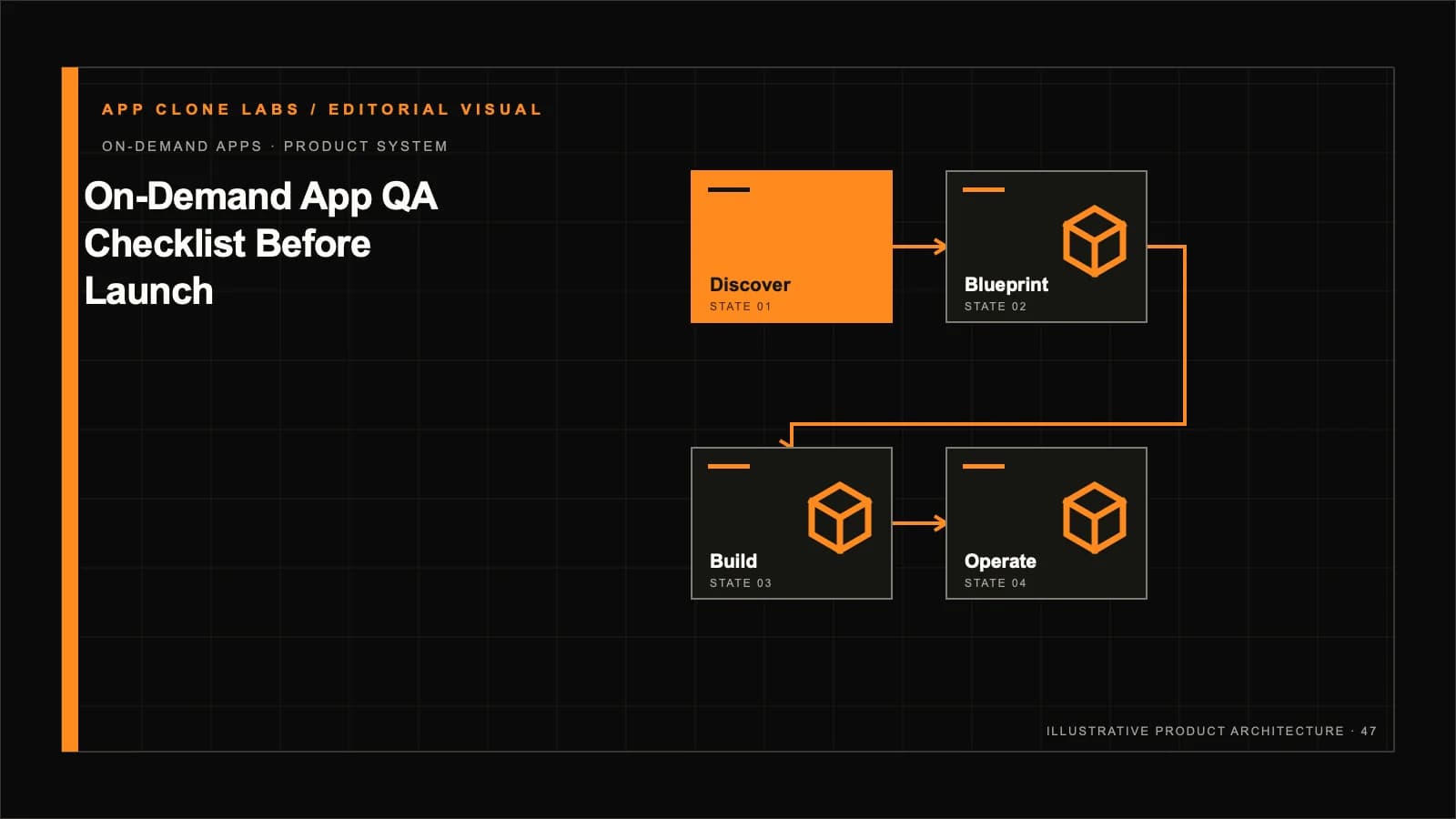
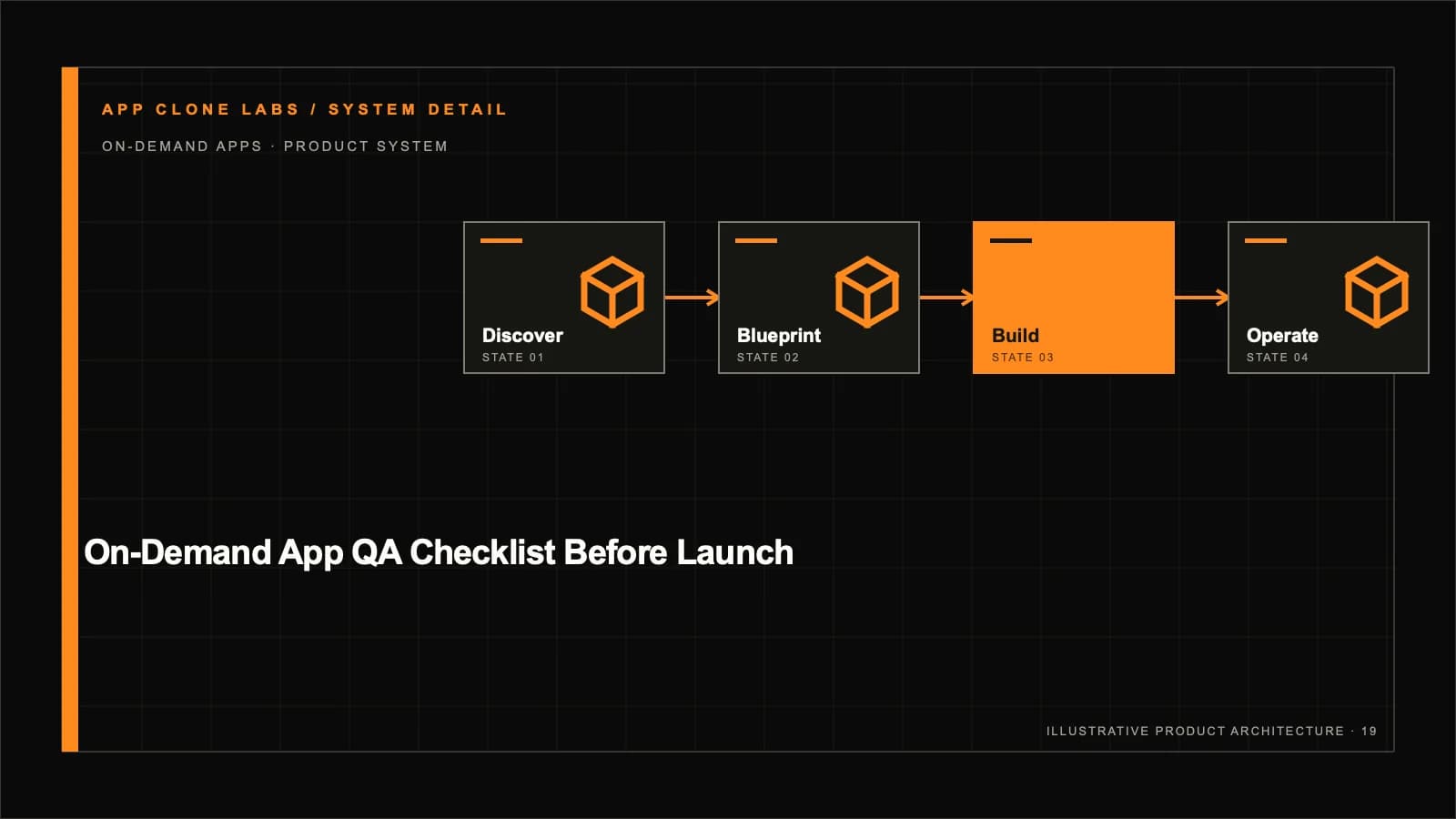
An on-demand booking can look successful on the customer phone while the provider never receives it, the payment remains authorized and the admin timeline contains no recoverable explanation.
Testing screens independently misses the system’s defining risk: one commercial journey crosses several roles, devices, services and external providers under uncertain timing.
This checklist validates the journey as durable state, then deliberately breaks networks, callbacks, permissions and concurrency to prove recovery.
Define launch acceptance evidence
Define launch acceptance evidence is a distinct product and operating decision inside an on-demand marketplace coordinating customers, providers, operators, money and location. It determines what the platform may promise, which role has authority, what evidence survives a dispute and how the team recovers when normal processing fails.
The failure mode is concrete: the team treats define launch acceptance evidence as interface scope while state, permissions, downstream consequences and operator recovery remain implicit This is not solved by adding another screen or background job. The product has to define ownership, permitted transitions, and the evidence retained when the transition occurs.
For the first release, define the authoritative lifecycle, accountable owner, allowed transitions, user-visible outcome and exception route for define launch acceptance evidence before implementation Write that decision as an enforceable server-side rule, not guidance that depends on a client, operator, or AI model remembering the intended boundary.
Implementation should include For define launch acceptance evidence, retain stable identifiers, explicit states, server-side authorization, version checks, event and processing timestamps, reason codes, correlation IDs, audit history and a bounded recovery action. Keep the public response smaller than the internal record: users need a clear outcome and recovery path, while authorized operators need correlation IDs, policy versions, timestamps, and the before-and-after state.
Validate it with For define launch acceptance evidence, test the successful journey followed by stale state, duplicate delivery, concurrent commands, revoked authority, dependency timeout, partial completion, operator correction and reconciliation. Test the ordinary path, then repeat under timeout, duplicate delivery, stale state, partial failure, revoked authority, and concurrent requests. A feature is not ready when only the demonstration succeeds.
- Owner: product owner
- Release evidence: versioned define launch acceptance evidence decision, acceptance criteria and recovery record
- Stop condition: define launch acceptance evidence cannot be explained or restored from durable evidence
Test account and session boundaries
Test account and session boundaries is a distinct product and operating decision inside an on-demand marketplace coordinating customers, providers, operators, money and location. It determines what the platform may promise, which role has authority, what evidence survives a dispute and how the team recovers when normal processing fails.
The failure mode is concrete: the team treats test account and session boundaries as interface scope while state, permissions, downstream consequences and operator recovery remain implicit This is not solved by adding another screen or background job. The product has to define ownership, permitted transitions, and the evidence retained when the transition occurs.
For the first release, define the authoritative lifecycle, accountable owner, allowed transitions, user-visible outcome and exception route for test account and session boundaries before implementation Write that decision as an enforceable server-side rule, not guidance that depends on a client, operator, or AI model remembering the intended boundary.
Implementation should include For test account and session boundaries, retain stable identifiers, explicit states, server-side authorization, version checks, event and processing timestamps, reason codes, correlation IDs, audit history and a bounded recovery action. Keep the public response smaller than the internal record: users need a clear outcome and recovery path, while authorized operators need correlation IDs, policy versions, timestamps, and the before-and-after state.
Validate it with For test account and session boundaries, test the successful journey followed by stale state, duplicate delivery, concurrent commands, revoked authority, dependency timeout, partial completion, operator correction and reconciliation. Test the ordinary path, then repeat under timeout, duplicate delivery, stale state, partial failure, revoked authority, and concurrent requests. A feature is not ready when only the demonstration succeeds.
- Owner: engineering owner
- Release evidence: versioned test account and session boundaries decision, acceptance criteria and recovery record
- Stop condition: test account and session boundaries cannot be explained or restored from durable evidence
Verify role authorization
Verify role authorization is a distinct product and operating decision inside an on-demand marketplace coordinating customers, providers, operators, money and location. It determines what the platform may promise, which role has authority, what evidence survives a dispute and how the team recovers when normal processing fails.
The failure mode is concrete: the team treats verify role authorization as interface scope while state, permissions, downstream consequences and operator recovery remain implicit This is not solved by adding another screen or background job. The product has to define ownership, permitted transitions, and the evidence retained when the transition occurs.
For the first release, define the authoritative lifecycle, accountable owner, allowed transitions, user-visible outcome and exception route for verify role authorization before implementation Write that decision as an enforceable server-side rule, not guidance that depends on a client, operator, or AI model remembering the intended boundary.
Implementation should include For verify role authorization, retain stable identifiers, explicit states, server-side authorization, version checks, event and processing timestamps, reason codes, correlation IDs, audit history and a bounded recovery action. Keep the public response smaller than the internal record: users need a clear outcome and recovery path, while authorized operators need correlation IDs, policy versions, timestamps, and the before-and-after state.
Validate it with For verify role authorization, test the successful journey followed by stale state, duplicate delivery, concurrent commands, revoked authority, dependency timeout, partial completion, operator correction and reconciliation. Test the ordinary path, then repeat under timeout, duplicate delivery, stale state, partial failure, revoked authority, and concurrent requests. A feature is not ready when only the demonstration succeeds.
- Owner: operations owner
- Release evidence: versioned verify role authorization decision, acceptance criteria and recovery record
- Stop condition: verify role authorization cannot be explained or restored from durable evidence
Test service-area eligibility
Test service-area eligibility is a distinct product and operating decision inside an on-demand marketplace coordinating customers, providers, operators, money and location. It determines what the platform may promise, which role has authority, what evidence survives a dispute and how the team recovers when normal processing fails.
The failure mode is concrete: the team treats test service-area eligibility as interface scope while state, permissions, downstream consequences and operator recovery remain implicit This is not solved by adding another screen or background job. The product has to define ownership, permitted transitions, and the evidence retained when the transition occurs.
For the first release, define the authoritative lifecycle, accountable owner, allowed transitions, user-visible outcome and exception route for test service-area eligibility before implementation Write that decision as an enforceable server-side rule, not guidance that depends on a client, operator, or AI model remembering the intended boundary.
Implementation should include For test service-area eligibility, retain stable identifiers, explicit states, server-side authorization, version checks, event and processing timestamps, reason codes, correlation IDs, audit history and a bounded recovery action. Keep the public response smaller than the internal record: users need a clear outcome and recovery path, while authorized operators need correlation IDs, policy versions, timestamps, and the before-and-after state.
Validate it with For test service-area eligibility, test the successful journey followed by stale state, duplicate delivery, concurrent commands, revoked authority, dependency timeout, partial completion, operator correction and reconciliation. Test the ordinary path, then repeat under timeout, duplicate delivery, stale state, partial failure, revoked authority, and concurrent requests. A feature is not ready when only the demonstration succeeds.
- Owner: product owner
- Release evidence: versioned test service-area eligibility decision, acceptance criteria and recovery record
- Stop condition: test service-area eligibility cannot be explained or restored from durable evidence
Checkpoint 4: reconcile the product promise with the recorded state. Support, finance, security, and delivery teams should be able to reach the same conclusion from the same identifiers without reconstructing events from chat messages or screenshots.
Validate availability and capacity
Validate availability and capacity is a distinct product and operating decision inside an on-demand marketplace coordinating customers, providers, operators, money and location. It determines what the platform may promise, which role has authority, what evidence survives a dispute and how the team recovers when normal processing fails.
The failure mode is concrete: the team treats validate availability and capacity as interface scope while state, permissions, downstream consequences and operator recovery remain implicit This is not solved by adding another screen or background job. The product has to define ownership, permitted transitions, and the evidence retained when the transition occurs.
For the first release, define the authoritative lifecycle, accountable owner, allowed transitions, user-visible outcome and exception route for validate availability and capacity before implementation Write that decision as an enforceable server-side rule, not guidance that depends on a client, operator, or AI model remembering the intended boundary.
Implementation should include For validate availability and capacity, retain stable identifiers, explicit states, server-side authorization, version checks, event and processing timestamps, reason codes, correlation IDs, audit history and a bounded recovery action. Keep the public response smaller than the internal record: users need a clear outcome and recovery path, while authorized operators need correlation IDs, policy versions, timestamps, and the before-and-after state.
Validate it with For validate availability and capacity, test the successful journey followed by stale state, duplicate delivery, concurrent commands, revoked authority, dependency timeout, partial completion, operator correction and reconciliation. Test the ordinary path, then repeat under timeout, duplicate delivery, stale state, partial failure, revoked authority, and concurrent requests. A feature is not ready when only the demonstration succeeds.
- Owner: engineering owner
- Release evidence: versioned validate availability and capacity decision, acceptance criteria and recovery record
- Stop condition: validate availability and capacity cannot be explained or restored from durable evidence
Verify quotes and expiry
Verify quotes and expiry is a distinct product and operating decision inside an on-demand marketplace coordinating customers, providers, operators, money and location. It determines what the platform may promise, which role has authority, what evidence survives a dispute and how the team recovers when normal processing fails.
The failure mode is concrete: the team treats verify quotes and expiry as interface scope while state, permissions, downstream consequences and operator recovery remain implicit This is not solved by adding another screen or background job. The product has to define ownership, permitted transitions, and the evidence retained when the transition occurs.
For the first release, define the authoritative lifecycle, accountable owner, allowed transitions, user-visible outcome and exception route for verify quotes and expiry before implementation Write that decision as an enforceable server-side rule, not guidance that depends on a client, operator, or AI model remembering the intended boundary.
Implementation should include For verify quotes and expiry, retain stable identifiers, explicit states, server-side authorization, version checks, event and processing timestamps, reason codes, correlation IDs, audit history and a bounded recovery action. Keep the public response smaller than the internal record: users need a clear outcome and recovery path, while authorized operators need correlation IDs, policy versions, timestamps, and the before-and-after state.
Validate it with For verify quotes and expiry, test the successful journey followed by stale state, duplicate delivery, concurrent commands, revoked authority, dependency timeout, partial completion, operator correction and reconciliation. Test the ordinary path, then repeat under timeout, duplicate delivery, stale state, partial failure, revoked authority, and concurrent requests. A feature is not ready when only the demonstration succeeds.
- Owner: operations owner
- Release evidence: versioned verify quotes and expiry decision, acceptance criteria and recovery record
- Stop condition: verify quotes and expiry cannot be explained or restored from durable evidence
Create bookings idempotently
Create bookings idempotently is a distinct product and operating decision inside an on-demand marketplace coordinating customers, providers, operators, money and location. It determines what the platform may promise, which role has authority, what evidence survives a dispute and how the team recovers when normal processing fails.
The failure mode is concrete: the team treats create bookings idempotently as interface scope while state, permissions, downstream consequences and operator recovery remain implicit This is not solved by adding another screen or background job. The product has to define ownership, permitted transitions, and the evidence retained when the transition occurs.
For the first release, define the authoritative lifecycle, accountable owner, allowed transitions, user-visible outcome and exception route for create bookings idempotently before implementation Write that decision as an enforceable server-side rule, not guidance that depends on a client, operator, or AI model remembering the intended boundary.
Implementation should include For create bookings idempotently, retain stable identifiers, explicit states, server-side authorization, version checks, event and processing timestamps, reason codes, correlation IDs, audit history and a bounded recovery action. Keep the public response smaller than the internal record: users need a clear outcome and recovery path, while authorized operators need correlation IDs, policy versions, timestamps, and the before-and-after state.
Validate it with For create bookings idempotently, test the successful journey followed by stale state, duplicate delivery, concurrent commands, revoked authority, dependency timeout, partial completion, operator correction and reconciliation. Test the ordinary path, then repeat under timeout, duplicate delivery, stale state, partial failure, revoked authority, and concurrent requests. A feature is not ready when only the demonstration succeeds.
- Owner: product owner
- Release evidence: versioned create bookings idempotently decision, acceptance criteria and recovery record
- Stop condition: create bookings idempotently cannot be explained or restored from durable evidence
Test provider assignment races
Test provider assignment races is a distinct product and operating decision inside an on-demand marketplace coordinating customers, providers, operators, money and location. It determines what the platform may promise, which role has authority, what evidence survives a dispute and how the team recovers when normal processing fails.
The failure mode is concrete: the team treats test provider assignment races as interface scope while state, permissions, downstream consequences and operator recovery remain implicit This is not solved by adding another screen or background job. The product has to define ownership, permitted transitions, and the evidence retained when the transition occurs.
For the first release, define the authoritative lifecycle, accountable owner, allowed transitions, user-visible outcome and exception route for test provider assignment races before implementation Write that decision as an enforceable server-side rule, not guidance that depends on a client, operator, or AI model remembering the intended boundary.
Implementation should include For test provider assignment races, retain stable identifiers, explicit states, server-side authorization, version checks, event and processing timestamps, reason codes, correlation IDs, audit history and a bounded recovery action. Keep the public response smaller than the internal record: users need a clear outcome and recovery path, while authorized operators need correlation IDs, policy versions, timestamps, and the before-and-after state.
Validate it with For test provider assignment races, test the successful journey followed by stale state, duplicate delivery, concurrent commands, revoked authority, dependency timeout, partial completion, operator correction and reconciliation. Test the ordinary path, then repeat under timeout, duplicate delivery, stale state, partial failure, revoked authority, and concurrent requests. A feature is not ready when only the demonstration succeeds.
- Owner: engineering owner
- Release evidence: versioned test provider assignment races decision, acceptance criteria and recovery record
- Stop condition: test provider assignment races cannot be explained or restored from durable evidence
Checkpoint 8: reconcile the product promise with the recorded state. Support, finance, security, and delivery teams should be able to reach the same conclusion from the same identifiers without reconstructing events from chat messages or screenshots.
Validate tracking freshness
Validate tracking freshness is a distinct product and operating decision inside an on-demand marketplace coordinating customers, providers, operators, money and location. It determines what the platform may promise, which role has authority, what evidence survives a dispute and how the team recovers when normal processing fails.
The failure mode is concrete: the team treats validate tracking freshness as interface scope while state, permissions, downstream consequences and operator recovery remain implicit This is not solved by adding another screen or background job. The product has to define ownership, permitted transitions, and the evidence retained when the transition occurs.
For the first release, define the authoritative lifecycle, accountable owner, allowed transitions, user-visible outcome and exception route for validate tracking freshness before implementation Write that decision as an enforceable server-side rule, not guidance that depends on a client, operator, or AI model remembering the intended boundary.
Implementation should include For validate tracking freshness, retain stable identifiers, explicit states, server-side authorization, version checks, event and processing timestamps, reason codes, correlation IDs, audit history and a bounded recovery action. Keep the public response smaller than the internal record: users need a clear outcome and recovery path, while authorized operators need correlation IDs, policy versions, timestamps, and the before-and-after state.
Validate it with For validate tracking freshness, test the successful journey followed by stale state, duplicate delivery, concurrent commands, revoked authority, dependency timeout, partial completion, operator correction and reconciliation. Test the ordinary path, then repeat under timeout, duplicate delivery, stale state, partial failure, revoked authority, and concurrent requests. A feature is not ready when only the demonstration succeeds.
- Owner: operations owner
- Release evidence: versioned validate tracking freshness decision, acceptance criteria and recovery record
- Stop condition: validate tracking freshness cannot be explained or restored from durable evidence
Test customer-provider communication
Test customer-provider communication is a distinct product and operating decision inside an on-demand marketplace coordinating customers, providers, operators, money and location. It determines what the platform may promise, which role has authority, what evidence survives a dispute and how the team recovers when normal processing fails.
The failure mode is concrete: the team treats test customer-provider communication as interface scope while state, permissions, downstream consequences and operator recovery remain implicit This is not solved by adding another screen or background job. The product has to define ownership, permitted transitions, and the evidence retained when the transition occurs.
For the first release, define the authoritative lifecycle, accountable owner, allowed transitions, user-visible outcome and exception route for test customer-provider communication before implementation Write that decision as an enforceable server-side rule, not guidance that depends on a client, operator, or AI model remembering the intended boundary.
Implementation should include For test customer-provider communication, retain stable identifiers, explicit states, server-side authorization, version checks, event and processing timestamps, reason codes, correlation IDs, audit history and a bounded recovery action. Keep the public response smaller than the internal record: users need a clear outcome and recovery path, while authorized operators need correlation IDs, policy versions, timestamps, and the before-and-after state.
Validate it with For test customer-provider communication, test the successful journey followed by stale state, duplicate delivery, concurrent commands, revoked authority, dependency timeout, partial completion, operator correction and reconciliation. Test the ordinary path, then repeat under timeout, duplicate delivery, stale state, partial failure, revoked authority, and concurrent requests. A feature is not ready when only the demonstration succeeds.
- Owner: product owner
- Release evidence: versioned test customer-provider communication decision, acceptance criteria and recovery record
- Stop condition: test customer-provider communication cannot be explained or restored from durable evidence
Verify payment state transitions
Verify payment state transitions is a distinct product and operating decision inside an on-demand marketplace coordinating customers, providers, operators, money and location. It determines what the platform may promise, which role has authority, what evidence survives a dispute and how the team recovers when normal processing fails.
The failure mode is concrete: the team treats verify payment state transitions as interface scope while state, permissions, downstream consequences and operator recovery remain implicit This is not solved by adding another screen or background job. The product has to define ownership, permitted transitions, and the evidence retained when the transition occurs.
For the first release, define the authoritative lifecycle, accountable owner, allowed transitions, user-visible outcome and exception route for verify payment state transitions before implementation Write that decision as an enforceable server-side rule, not guidance that depends on a client, operator, or AI model remembering the intended boundary.
Implementation should include For verify payment state transitions, retain stable identifiers, explicit states, server-side authorization, version checks, event and processing timestamps, reason codes, correlation IDs, audit history and a bounded recovery action. Keep the public response smaller than the internal record: users need a clear outcome and recovery path, while authorized operators need correlation IDs, policy versions, timestamps, and the before-and-after state.
Validate it with For verify payment state transitions, test the successful journey followed by stale state, duplicate delivery, concurrent commands, revoked authority, dependency timeout, partial completion, operator correction and reconciliation. Test the ordinary path, then repeat under timeout, duplicate delivery, stale state, partial failure, revoked authority, and concurrent requests. A feature is not ready when only the demonstration succeeds.
- Owner: engineering owner
- Release evidence: versioned verify payment state transitions decision, acceptance criteria and recovery record
- Stop condition: verify payment state transitions cannot be explained or restored from durable evidence
Exercise cancellation policy
Exercise cancellation policy is a distinct product and operating decision inside an on-demand marketplace coordinating customers, providers, operators, money and location. It determines what the platform may promise, which role has authority, what evidence survives a dispute and how the team recovers when normal processing fails.
The failure mode is concrete: the team treats exercise cancellation policy as interface scope while state, permissions, downstream consequences and operator recovery remain implicit This is not solved by adding another screen or background job. The product has to define ownership, permitted transitions, and the evidence retained when the transition occurs.
For the first release, define the authoritative lifecycle, accountable owner, allowed transitions, user-visible outcome and exception route for exercise cancellation policy before implementation Write that decision as an enforceable server-side rule, not guidance that depends on a client, operator, or AI model remembering the intended boundary.
Implementation should include For exercise cancellation policy, retain stable identifiers, explicit states, server-side authorization, version checks, event and processing timestamps, reason codes, correlation IDs, audit history and a bounded recovery action. Keep the public response smaller than the internal record: users need a clear outcome and recovery path, while authorized operators need correlation IDs, policy versions, timestamps, and the before-and-after state.
Validate it with For exercise cancellation policy, test the successful journey followed by stale state, duplicate delivery, concurrent commands, revoked authority, dependency timeout, partial completion, operator correction and reconciliation. Test the ordinary path, then repeat under timeout, duplicate delivery, stale state, partial failure, revoked authority, and concurrent requests. A feature is not ready when only the demonstration succeeds.
- Owner: operations owner
- Release evidence: versioned exercise cancellation policy decision, acceptance criteria and recovery record
- Stop condition: exercise cancellation policy cannot be explained or restored from durable evidence
Checkpoint 12: reconcile the product promise with the recorded state. Support, finance, security, and delivery teams should be able to reach the same conclusion from the same identifiers without reconstructing events from chat messages or screenshots.
Test refunds and provider earnings
Test refunds and provider earnings is a distinct product and operating decision inside an on-demand marketplace coordinating customers, providers, operators, money and location. It determines what the platform may promise, which role has authority, what evidence survives a dispute and how the team recovers when normal processing fails.
The failure mode is concrete: the team treats test refunds and provider earnings as interface scope while state, permissions, downstream consequences and operator recovery remain implicit This is not solved by adding another screen or background job. The product has to define ownership, permitted transitions, and the evidence retained when the transition occurs.
For the first release, define the authoritative lifecycle, accountable owner, allowed transitions, user-visible outcome and exception route for test refunds and provider earnings before implementation Write that decision as an enforceable server-side rule, not guidance that depends on a client, operator, or AI model remembering the intended boundary.
Implementation should include For test refunds and provider earnings, retain stable identifiers, explicit states, server-side authorization, version checks, event and processing timestamps, reason codes, correlation IDs, audit history and a bounded recovery action. Keep the public response smaller than the internal record: users need a clear outcome and recovery path, while authorized operators need correlation IDs, policy versions, timestamps, and the before-and-after state.
Validate it with For test refunds and provider earnings, test the successful journey followed by stale state, duplicate delivery, concurrent commands, revoked authority, dependency timeout, partial completion, operator correction and reconciliation. Test the ordinary path, then repeat under timeout, duplicate delivery, stale state, partial failure, revoked authority, and concurrent requests. A feature is not ready when only the demonstration succeeds.
- Owner: product owner
- Release evidence: versioned test refunds and provider earnings decision, acceptance criteria and recovery record
- Stop condition: test refunds and provider earnings cannot be explained or restored from durable evidence
Validate notifications and deep links
Validate notifications and deep links is a distinct product and operating decision inside an on-demand marketplace coordinating customers, providers, operators, money and location. It determines what the platform may promise, which role has authority, what evidence survives a dispute and how the team recovers when normal processing fails.
The failure mode is concrete: the team treats validate notifications and deep links as interface scope while state, permissions, downstream consequences and operator recovery remain implicit This is not solved by adding another screen or background job. The product has to define ownership, permitted transitions, and the evidence retained when the transition occurs.
For the first release, define the authoritative lifecycle, accountable owner, allowed transitions, user-visible outcome and exception route for validate notifications and deep links before implementation Write that decision as an enforceable server-side rule, not guidance that depends on a client, operator, or AI model remembering the intended boundary.
Implementation should include For validate notifications and deep links, retain stable identifiers, explicit states, server-side authorization, version checks, event and processing timestamps, reason codes, correlation IDs, audit history and a bounded recovery action. Keep the public response smaller than the internal record: users need a clear outcome and recovery path, while authorized operators need correlation IDs, policy versions, timestamps, and the before-and-after state.
Validate it with For validate notifications and deep links, test the successful journey followed by stale state, duplicate delivery, concurrent commands, revoked authority, dependency timeout, partial completion, operator correction and reconciliation. Test the ordinary path, then repeat under timeout, duplicate delivery, stale state, partial failure, revoked authority, and concurrent requests. A feature is not ready when only the demonstration succeeds.
- Owner: engineering owner
- Release evidence: versioned validate notifications and deep links decision, acceptance criteria and recovery record
- Stop condition: validate notifications and deep links cannot be explained or restored from durable evidence
Rehearse operator recovery
Rehearse operator recovery is a distinct product and operating decision inside an on-demand marketplace coordinating customers, providers, operators, money and location. It determines what the platform may promise, which role has authority, what evidence survives a dispute and how the team recovers when normal processing fails.
The failure mode is concrete: the team treats rehearse operator recovery as interface scope while state, permissions, downstream consequences and operator recovery remain implicit This is not solved by adding another screen or background job. The product has to define ownership, permitted transitions, and the evidence retained when the transition occurs.
For the first release, define the authoritative lifecycle, accountable owner, allowed transitions, user-visible outcome and exception route for rehearse operator recovery before implementation Write that decision as an enforceable server-side rule, not guidance that depends on a client, operator, or AI model remembering the intended boundary.
Implementation should include For rehearse operator recovery, retain stable identifiers, explicit states, server-side authorization, version checks, event and processing timestamps, reason codes, correlation IDs, audit history and a bounded recovery action. Keep the public response smaller than the internal record: users need a clear outcome and recovery path, while authorized operators need correlation IDs, policy versions, timestamps, and the before-and-after state.
Validate it with For rehearse operator recovery, test the successful journey followed by stale state, duplicate delivery, concurrent commands, revoked authority, dependency timeout, partial completion, operator correction and reconciliation. Test the ordinary path, then repeat under timeout, duplicate delivery, stale state, partial failure, revoked authority, and concurrent requests. A feature is not ready when only the demonstration succeeds.
- Owner: operations owner
- Release evidence: versioned rehearse operator recovery decision, acceptance criteria and recovery record
- Stop condition: rehearse operator recovery cannot be explained or restored from durable evidence
Implementation references
Use OWASP API Security Top 10 and record the version applied during release review.
Validate against OWASP Authorization Cheat Sheet and record the version applied during release review.
Review W3C WCAG 2.2 and record the version applied during release review.
Compare with Apple App Review Guidelines and record the version applied during release review.
Continue with QA Testing when converting the operating model into delivery scope.
Frequently asked questions
What should be tested first?
The highest-consequence journey from eligibility through fulfilment, payment and support.
Why are retries important?
Mobile networks and providers deliver duplicates and timeouts; commands must remain safe.
How is dispatch concurrency tested?
Have several providers accept the same work and verify only one durable assignment wins.
What payment cases are essential?
Success, decline, timeout, duplicate callback, cancellation, partial refund and dispute.
How should GPS be tested?
With stale, inaccurate, missing, denied and background-limited location.
What belongs in operator testing?
Search, chronology, correction, refund, reassignment, restriction and audit.
Which devices should be covered?
Representative operating systems, screen sizes, memory classes and network conditions from actual audience data.
When is the app ready?
When critical journeys and recovery paths pass with evidence and accepted residual risk.
Turn the architecture into release evidence
A credible release joins the customer promise to durable state, scoped authority and an owned recovery path. Product, engineering, security, operations and support should reach the same conclusion from the same identifiers.
Keep the first scope narrow enough to rehearse under failure. Expand only after permissions, data, financial consequences and customer remedies remain consistent through retries, dependency outages and human mistakes.
- 01
- 02
- 03
- 04
- 05
- 06
Reviewed by the App Clone Labs product strategy team
This guide is written for founders and operators planning clone-inspired platforms, SaaS products, marketplaces, and mobile apps. It is reviewed against App Clone Labs delivery patterns, product scoping standards, and current implementation realities before being published.
Review the editorial team structureRelated product paths
Continue with the services, solutions, guides, and articles that connect this topic to a real software build.
Services, solutions, and guides
Read next