Editorial dossier / Quality and Launch
Performance Testing for Marketplace and SaaS Apps: Workloads, Limits and Recovery
Plan performance testing across service objectives, workload models, data scale, concurrency, bottlenecks, dependencies, endurance, failure and capacity.
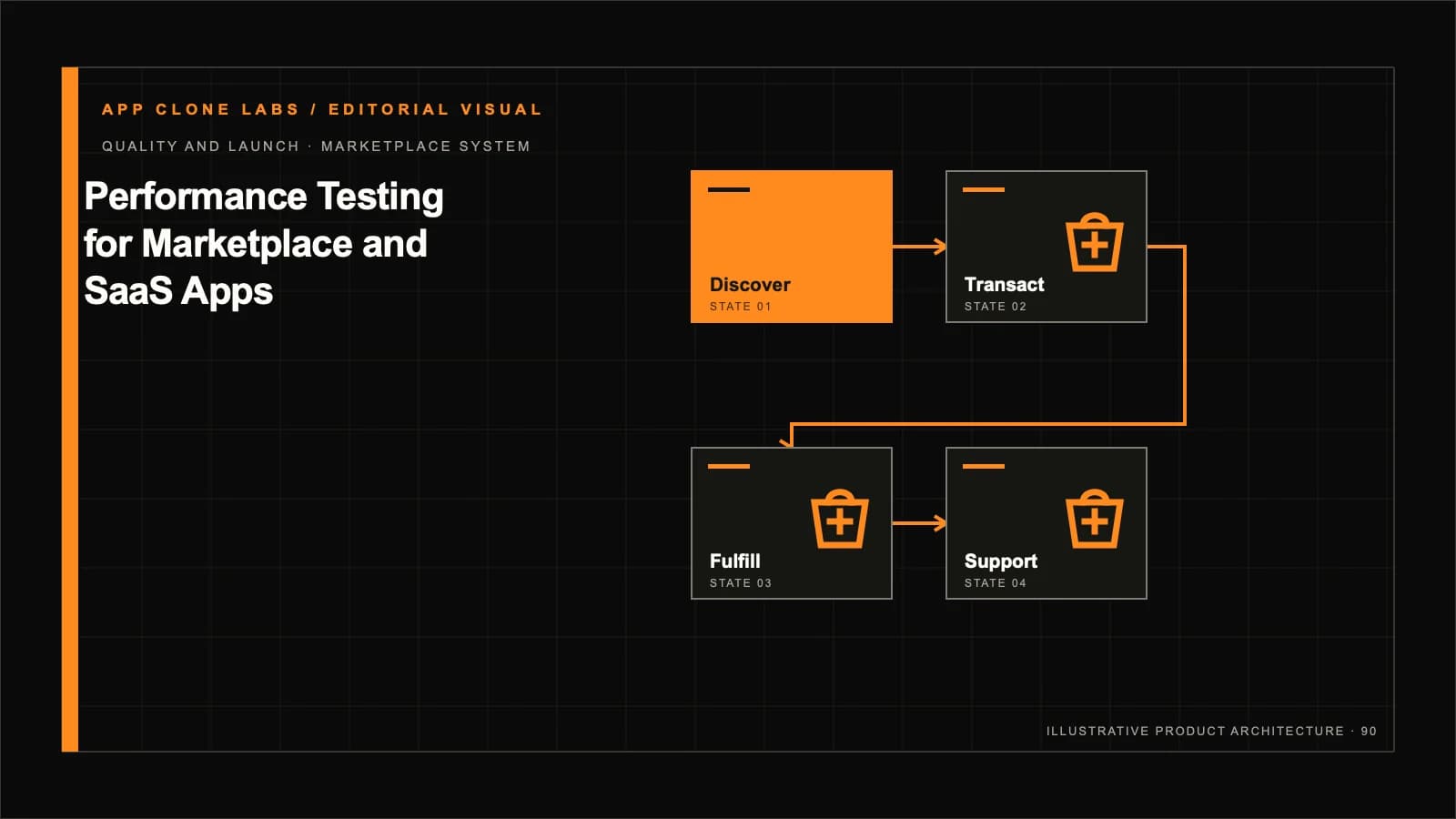
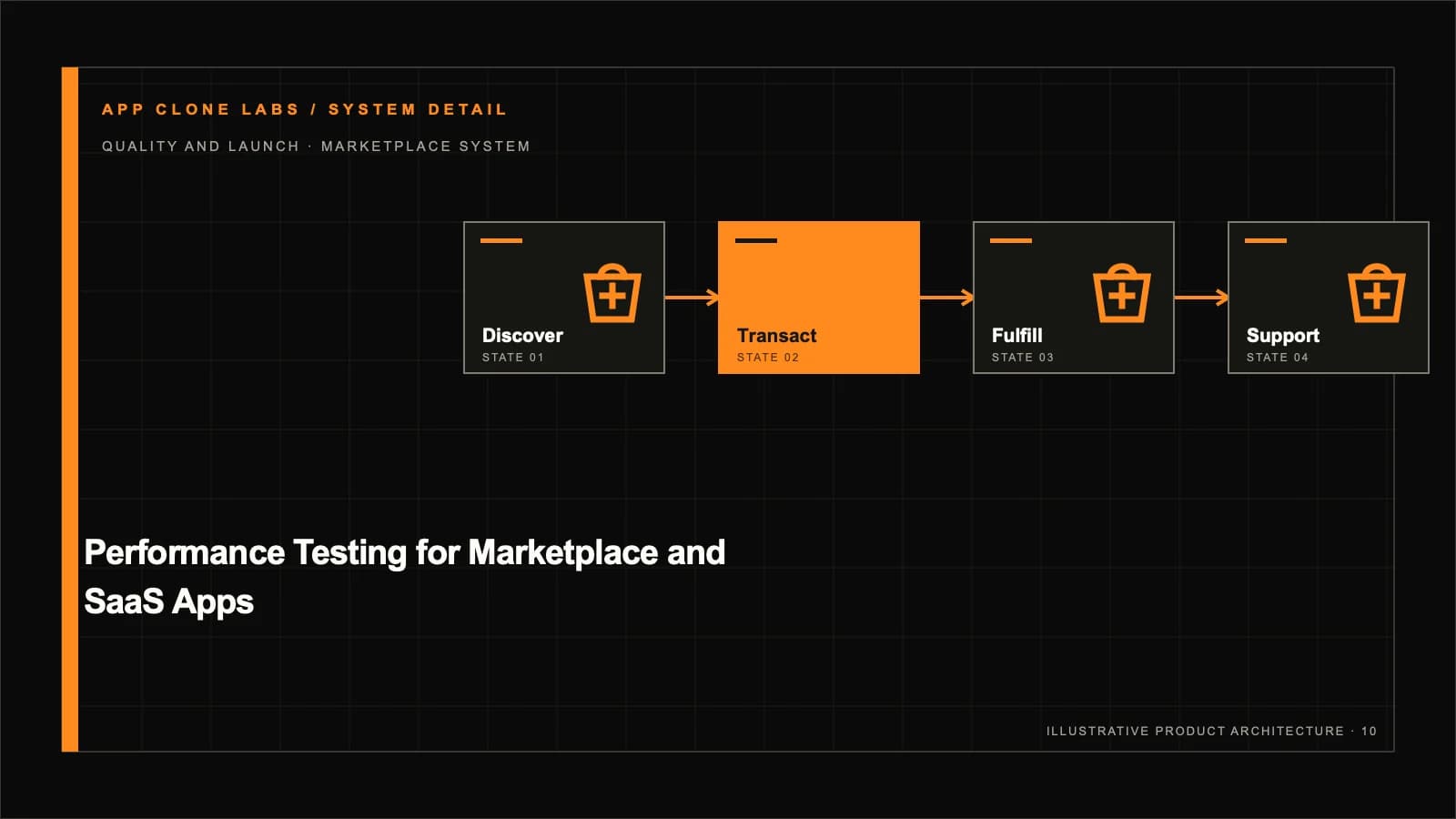
A test that sends ten thousand identical requests to one endpoint does not prove a marketplace can survive a Friday-night surge. Real load mixes browsing, writes, payments, queues, searches, dashboards and retries against realistic data.
The objective is not the largest request count. It is evidence that critical customer obligations remain within agreed limits, failures stay bounded and recovery works before capacity is exhausted.
This guide creates a reproducible workload and turns bottlenecks into release decisions.
Define customer-facing objectives
Define customer-facing objectives is a separate product and operating decision within a marketplace or SaaS product serving concurrent journeys across APIs, databases, queues and external providers. It changes the promise made to users, the authority of each role, the evidence the platform retains and the recovery route when normal processing fails.
The failure mode is concrete: the team treats define customer-facing objectives as a screen requirement while lifecycle, permissions, downstream consequences and exception ownership remain implicit. This is not solved by adding another screen or background job. The product has to define ownership, permitted transitions, and the evidence retained when the transition occurs.
For the first release, define the authoritative lifecycle, accountable owner, allowed transitions, user-visible result and exception route for define customer-facing objectives before implementation. Write that decision as an enforceable server-side rule, not guidance that depends on a client, operator, or AI model remembering the intended boundary.
Implementation should include For define customer-facing objectives, retain stable identifiers, explicit states, server-side authorization, version checks, event and processing timestamps, reason codes, correlation IDs, audit history and a bounded recovery command. Keep the public response smaller than the internal record: users need a clear outcome and recovery path, while authorized operators need correlation IDs, policy versions, timestamps, and the before-and-after state.
Validate it with For define customer-facing objectives, test the successful journey followed by stale state, duplicate delivery, concurrent commands, revoked authority, dependency timeout, partial completion, operator correction and reconciliation. Test the ordinary path, then repeat under timeout, duplicate delivery, stale state, partial failure, revoked authority, and concurrent requests. A feature is not ready when only the demonstration succeeds.
- Owner: product owner
- Release evidence: versioned define customer-facing objectives decision, acceptance criteria and recovery record
- Stop condition: define customer-facing objectives cannot be explained or restored from durable evidence
Select critical journeys
Select critical journeys is a separate product and operating decision within a marketplace or SaaS product serving concurrent journeys across APIs, databases, queues and external providers. It changes the promise made to users, the authority of each role, the evidence the platform retains and the recovery route when normal processing fails.
The failure mode is concrete: the team treats select critical journeys as a screen requirement while lifecycle, permissions, downstream consequences and exception ownership remain implicit. This is not solved by adding another screen or background job. The product has to define ownership, permitted transitions, and the evidence retained when the transition occurs.
For the first release, define the authoritative lifecycle, accountable owner, allowed transitions, user-visible result and exception route for select critical journeys before implementation. Write that decision as an enforceable server-side rule, not guidance that depends on a client, operator, or AI model remembering the intended boundary.
Implementation should include For select critical journeys, retain stable identifiers, explicit states, server-side authorization, version checks, event and processing timestamps, reason codes, correlation IDs, audit history and a bounded recovery command. Keep the public response smaller than the internal record: users need a clear outcome and recovery path, while authorized operators need correlation IDs, policy versions, timestamps, and the before-and-after state.
Validate it with For select critical journeys, test the successful journey followed by stale state, duplicate delivery, concurrent commands, revoked authority, dependency timeout, partial completion, operator correction and reconciliation. Test the ordinary path, then repeat under timeout, duplicate delivery, stale state, partial failure, revoked authority, and concurrent requests. A feature is not ready when only the demonstration succeeds.
- Owner: engineering owner
- Release evidence: versioned select critical journeys decision, acceptance criteria and recovery record
- Stop condition: select critical journeys cannot be explained or restored from durable evidence
Build a realistic workload mix
Build a realistic workload mix is a separate product and operating decision within a marketplace or SaaS product serving concurrent journeys across APIs, databases, queues and external providers. It changes the promise made to users, the authority of each role, the evidence the platform retains and the recovery route when normal processing fails.
The failure mode is concrete: the team treats build a realistic workload mix as a screen requirement while lifecycle, permissions, downstream consequences and exception ownership remain implicit. This is not solved by adding another screen or background job. The product has to define ownership, permitted transitions, and the evidence retained when the transition occurs.
For the first release, define the authoritative lifecycle, accountable owner, allowed transitions, user-visible result and exception route for build a realistic workload mix before implementation. Write that decision as an enforceable server-side rule, not guidance that depends on a client, operator, or AI model remembering the intended boundary.
Implementation should include For build a realistic workload mix, retain stable identifiers, explicit states, server-side authorization, version checks, event and processing timestamps, reason codes, correlation IDs, audit history and a bounded recovery command. Keep the public response smaller than the internal record: users need a clear outcome and recovery path, while authorized operators need correlation IDs, policy versions, timestamps, and the before-and-after state.
Validate it with For build a realistic workload mix, test the successful journey followed by stale state, duplicate delivery, concurrent commands, revoked authority, dependency timeout, partial completion, operator correction and reconciliation. Test the ordinary path, then repeat under timeout, duplicate delivery, stale state, partial failure, revoked authority, and concurrent requests. A feature is not ready when only the demonstration succeeds.
- Owner: operations owner
- Release evidence: versioned build a realistic workload mix decision, acceptance criteria and recovery record
- Stop condition: build a realistic workload mix cannot be explained or restored from durable evidence
Model arrival patterns
Model arrival patterns is a separate product and operating decision within a marketplace or SaaS product serving concurrent journeys across APIs, databases, queues and external providers. It changes the promise made to users, the authority of each role, the evidence the platform retains and the recovery route when normal processing fails.
The failure mode is concrete: the team treats model arrival patterns as a screen requirement while lifecycle, permissions, downstream consequences and exception ownership remain implicit. This is not solved by adding another screen or background job. The product has to define ownership, permitted transitions, and the evidence retained when the transition occurs.
For the first release, define the authoritative lifecycle, accountable owner, allowed transitions, user-visible result and exception route for model arrival patterns before implementation. Write that decision as an enforceable server-side rule, not guidance that depends on a client, operator, or AI model remembering the intended boundary.
Implementation should include For model arrival patterns, retain stable identifiers, explicit states, server-side authorization, version checks, event and processing timestamps, reason codes, correlation IDs, audit history and a bounded recovery command. Keep the public response smaller than the internal record: users need a clear outcome and recovery path, while authorized operators need correlation IDs, policy versions, timestamps, and the before-and-after state.
Validate it with For model arrival patterns, test the successful journey followed by stale state, duplicate delivery, concurrent commands, revoked authority, dependency timeout, partial completion, operator correction and reconciliation. Test the ordinary path, then repeat under timeout, duplicate delivery, stale state, partial failure, revoked authority, and concurrent requests. A feature is not ready when only the demonstration succeeds.
- Owner: product owner
- Release evidence: versioned model arrival patterns decision, acceptance criteria and recovery record
- Stop condition: model arrival patterns cannot be explained or restored from durable evidence
Checkpoint 4: reconcile the product promise with the recorded state. Support, finance, security, and delivery teams should be able to reach the same conclusion from the same identifiers without reconstructing events from chat messages or screenshots.
Create production-shaped data
Create production-shaped data is a separate product and operating decision within a marketplace or SaaS product serving concurrent journeys across APIs, databases, queues and external providers. It changes the promise made to users, the authority of each role, the evidence the platform retains and the recovery route when normal processing fails.
The failure mode is concrete: the team treats create production-shaped data as a screen requirement while lifecycle, permissions, downstream consequences and exception ownership remain implicit. This is not solved by adding another screen or background job. The product has to define ownership, permitted transitions, and the evidence retained when the transition occurs.
For the first release, define the authoritative lifecycle, accountable owner, allowed transitions, user-visible result and exception route for create production-shaped data before implementation. Write that decision as an enforceable server-side rule, not guidance that depends on a client, operator, or AI model remembering the intended boundary.
Implementation should include For create production-shaped data, retain stable identifiers, explicit states, server-side authorization, version checks, event and processing timestamps, reason codes, correlation IDs, audit history and a bounded recovery command. Keep the public response smaller than the internal record: users need a clear outcome and recovery path, while authorized operators need correlation IDs, policy versions, timestamps, and the before-and-after state.
Validate it with For create production-shaped data, test the successful journey followed by stale state, duplicate delivery, concurrent commands, revoked authority, dependency timeout, partial completion, operator correction and reconciliation. Test the ordinary path, then repeat under timeout, duplicate delivery, stale state, partial failure, revoked authority, and concurrent requests. A feature is not ready when only the demonstration succeeds.
- Owner: engineering owner
- Release evidence: versioned create production-shaped data decision, acceptance criteria and recovery record
- Stop condition: create production-shaped data cannot be explained or restored from durable evidence
Warm caches deliberately
Warm caches deliberately is a separate product and operating decision within a marketplace or SaaS product serving concurrent journeys across APIs, databases, queues and external providers. It changes the promise made to users, the authority of each role, the evidence the platform retains and the recovery route when normal processing fails.
The failure mode is concrete: the team treats warm caches deliberately as a screen requirement while lifecycle, permissions, downstream consequences and exception ownership remain implicit. This is not solved by adding another screen or background job. The product has to define ownership, permitted transitions, and the evidence retained when the transition occurs.
For the first release, define the authoritative lifecycle, accountable owner, allowed transitions, user-visible result and exception route for warm caches deliberately before implementation. Write that decision as an enforceable server-side rule, not guidance that depends on a client, operator, or AI model remembering the intended boundary.
Implementation should include For warm caches deliberately, retain stable identifiers, explicit states, server-side authorization, version checks, event and processing timestamps, reason codes, correlation IDs, audit history and a bounded recovery command. Keep the public response smaller than the internal record: users need a clear outcome and recovery path, while authorized operators need correlation IDs, policy versions, timestamps, and the before-and-after state.
Validate it with For warm caches deliberately, test the successful journey followed by stale state, duplicate delivery, concurrent commands, revoked authority, dependency timeout, partial completion, operator correction and reconciliation. Test the ordinary path, then repeat under timeout, duplicate delivery, stale state, partial failure, revoked authority, and concurrent requests. A feature is not ready when only the demonstration succeeds.
- Owner: operations owner
- Release evidence: versioned warm caches deliberately decision, acceptance criteria and recovery record
- Stop condition: warm caches deliberately cannot be explained or restored from durable evidence
Measure end-to-end latency
Measure end-to-end latency is a separate product and operating decision within a marketplace or SaaS product serving concurrent journeys across APIs, databases, queues and external providers. It changes the promise made to users, the authority of each role, the evidence the platform retains and the recovery route when normal processing fails.
The failure mode is concrete: the team treats measure end-to-end latency as a screen requirement while lifecycle, permissions, downstream consequences and exception ownership remain implicit. This is not solved by adding another screen or background job. The product has to define ownership, permitted transitions, and the evidence retained when the transition occurs.
For the first release, define the authoritative lifecycle, accountable owner, allowed transitions, user-visible result and exception route for measure end-to-end latency before implementation. Write that decision as an enforceable server-side rule, not guidance that depends on a client, operator, or AI model remembering the intended boundary.
Implementation should include For measure end-to-end latency, retain stable identifiers, explicit states, server-side authorization, version checks, event and processing timestamps, reason codes, correlation IDs, audit history and a bounded recovery command. Keep the public response smaller than the internal record: users need a clear outcome and recovery path, while authorized operators need correlation IDs, policy versions, timestamps, and the before-and-after state.
Validate it with For measure end-to-end latency, test the successful journey followed by stale state, duplicate delivery, concurrent commands, revoked authority, dependency timeout, partial completion, operator correction and reconciliation. Test the ordinary path, then repeat under timeout, duplicate delivery, stale state, partial failure, revoked authority, and concurrent requests. A feature is not ready when only the demonstration succeeds.
- Owner: product owner
- Release evidence: versioned measure end-to-end latency decision, acceptance criteria and recovery record
- Stop condition: measure end-to-end latency cannot be explained or restored from durable evidence
Track errors by consequence
Track errors by consequence is a separate product and operating decision within a marketplace or SaaS product serving concurrent journeys across APIs, databases, queues and external providers. It changes the promise made to users, the authority of each role, the evidence the platform retains and the recovery route when normal processing fails.
The failure mode is concrete: the team treats track errors by consequence as a screen requirement while lifecycle, permissions, downstream consequences and exception ownership remain implicit. This is not solved by adding another screen or background job. The product has to define ownership, permitted transitions, and the evidence retained when the transition occurs.
For the first release, define the authoritative lifecycle, accountable owner, allowed transitions, user-visible result and exception route for track errors by consequence before implementation. Write that decision as an enforceable server-side rule, not guidance that depends on a client, operator, or AI model remembering the intended boundary.
Implementation should include For track errors by consequence, retain stable identifiers, explicit states, server-side authorization, version checks, event and processing timestamps, reason codes, correlation IDs, audit history and a bounded recovery command. Keep the public response smaller than the internal record: users need a clear outcome and recovery path, while authorized operators need correlation IDs, policy versions, timestamps, and the before-and-after state.
Validate it with For track errors by consequence, test the successful journey followed by stale state, duplicate delivery, concurrent commands, revoked authority, dependency timeout, partial completion, operator correction and reconciliation. Test the ordinary path, then repeat under timeout, duplicate delivery, stale state, partial failure, revoked authority, and concurrent requests. A feature is not ready when only the demonstration succeeds.
- Owner: engineering owner
- Release evidence: versioned track errors by consequence decision, acceptance criteria and recovery record
- Stop condition: track errors by consequence cannot be explained or restored from durable evidence
Checkpoint 8: reconcile the product promise with the recorded state. Support, finance, security, and delivery teams should be able to reach the same conclusion from the same identifiers without reconstructing events from chat messages or screenshots.
Observe database contention
Observe database contention is a separate product and operating decision within a marketplace or SaaS product serving concurrent journeys across APIs, databases, queues and external providers. It changes the promise made to users, the authority of each role, the evidence the platform retains and the recovery route when normal processing fails.
The failure mode is concrete: the team treats observe database contention as a screen requirement while lifecycle, permissions, downstream consequences and exception ownership remain implicit. This is not solved by adding another screen or background job. The product has to define ownership, permitted transitions, and the evidence retained when the transition occurs.
For the first release, define the authoritative lifecycle, accountable owner, allowed transitions, user-visible result and exception route for observe database contention before implementation. Write that decision as an enforceable server-side rule, not guidance that depends on a client, operator, or AI model remembering the intended boundary.
Implementation should include For observe database contention, retain stable identifiers, explicit states, server-side authorization, version checks, event and processing timestamps, reason codes, correlation IDs, audit history and a bounded recovery command. Keep the public response smaller than the internal record: users need a clear outcome and recovery path, while authorized operators need correlation IDs, policy versions, timestamps, and the before-and-after state.
Validate it with For observe database contention, test the successful journey followed by stale state, duplicate delivery, concurrent commands, revoked authority, dependency timeout, partial completion, operator correction and reconciliation. Test the ordinary path, then repeat under timeout, duplicate delivery, stale state, partial failure, revoked authority, and concurrent requests. A feature is not ready when only the demonstration succeeds.
- Owner: operations owner
- Release evidence: versioned observe database contention decision, acceptance criteria and recovery record
- Stop condition: observe database contention cannot be explained or restored from durable evidence
Test queues and background work
Test queues and background work is a separate product and operating decision within a marketplace or SaaS product serving concurrent journeys across APIs, databases, queues and external providers. It changes the promise made to users, the authority of each role, the evidence the platform retains and the recovery route when normal processing fails.
The failure mode is concrete: the team treats test queues and background work as a screen requirement while lifecycle, permissions, downstream consequences and exception ownership remain implicit. This is not solved by adding another screen or background job. The product has to define ownership, permitted transitions, and the evidence retained when the transition occurs.
For the first release, define the authoritative lifecycle, accountable owner, allowed transitions, user-visible result and exception route for test queues and background work before implementation. Write that decision as an enforceable server-side rule, not guidance that depends on a client, operator, or AI model remembering the intended boundary.
Implementation should include For test queues and background work, retain stable identifiers, explicit states, server-side authorization, version checks, event and processing timestamps, reason codes, correlation IDs, audit history and a bounded recovery command. Keep the public response smaller than the internal record: users need a clear outcome and recovery path, while authorized operators need correlation IDs, policy versions, timestamps, and the before-and-after state.
Validate it with For test queues and background work, test the successful journey followed by stale state, duplicate delivery, concurrent commands, revoked authority, dependency timeout, partial completion, operator correction and reconciliation. Test the ordinary path, then repeat under timeout, duplicate delivery, stale state, partial failure, revoked authority, and concurrent requests. A feature is not ready when only the demonstration succeeds.
- Owner: product owner
- Release evidence: versioned test queues and background work decision, acceptance criteria and recovery record
- Stop condition: test queues and background work cannot be explained or restored from durable evidence
Control external dependencies
Control external dependencies is a separate product and operating decision within a marketplace or SaaS product serving concurrent journeys across APIs, databases, queues and external providers. It changes the promise made to users, the authority of each role, the evidence the platform retains and the recovery route when normal processing fails.
The failure mode is concrete: the team treats control external dependencies as a screen requirement while lifecycle, permissions, downstream consequences and exception ownership remain implicit. This is not solved by adding another screen or background job. The product has to define ownership, permitted transitions, and the evidence retained when the transition occurs.
For the first release, define the authoritative lifecycle, accountable owner, allowed transitions, user-visible result and exception route for control external dependencies before implementation. Write that decision as an enforceable server-side rule, not guidance that depends on a client, operator, or AI model remembering the intended boundary.
Implementation should include For control external dependencies, retain stable identifiers, explicit states, server-side authorization, version checks, event and processing timestamps, reason codes, correlation IDs, audit history and a bounded recovery command. Keep the public response smaller than the internal record: users need a clear outcome and recovery path, while authorized operators need correlation IDs, policy versions, timestamps, and the before-and-after state.
Validate it with For control external dependencies, test the successful journey followed by stale state, duplicate delivery, concurrent commands, revoked authority, dependency timeout, partial completion, operator correction and reconciliation. Test the ordinary path, then repeat under timeout, duplicate delivery, stale state, partial failure, revoked authority, and concurrent requests. A feature is not ready when only the demonstration succeeds.
- Owner: engineering owner
- Release evidence: versioned control external dependencies decision, acceptance criteria and recovery record
- Stop condition: control external dependencies cannot be explained or restored from durable evidence
Run spike and stress tests
Run spike and stress tests is a separate product and operating decision within a marketplace or SaaS product serving concurrent journeys across APIs, databases, queues and external providers. It changes the promise made to users, the authority of each role, the evidence the platform retains and the recovery route when normal processing fails.
The failure mode is concrete: the team treats run spike and stress tests as a screen requirement while lifecycle, permissions, downstream consequences and exception ownership remain implicit. This is not solved by adding another screen or background job. The product has to define ownership, permitted transitions, and the evidence retained when the transition occurs.
For the first release, define the authoritative lifecycle, accountable owner, allowed transitions, user-visible result and exception route for run spike and stress tests before implementation. Write that decision as an enforceable server-side rule, not guidance that depends on a client, operator, or AI model remembering the intended boundary.
Implementation should include For run spike and stress tests, retain stable identifiers, explicit states, server-side authorization, version checks, event and processing timestamps, reason codes, correlation IDs, audit history and a bounded recovery command. Keep the public response smaller than the internal record: users need a clear outcome and recovery path, while authorized operators need correlation IDs, policy versions, timestamps, and the before-and-after state.
Validate it with For run spike and stress tests, test the successful journey followed by stale state, duplicate delivery, concurrent commands, revoked authority, dependency timeout, partial completion, operator correction and reconciliation. Test the ordinary path, then repeat under timeout, duplicate delivery, stale state, partial failure, revoked authority, and concurrent requests. A feature is not ready when only the demonstration succeeds.
- Owner: operations owner
- Release evidence: versioned run spike and stress tests decision, acceptance criteria and recovery record
- Stop condition: run spike and stress tests cannot be explained or restored from durable evidence
Checkpoint 12: reconcile the product promise with the recorded state. Support, finance, security, and delivery teams should be able to reach the same conclusion from the same identifiers without reconstructing events from chat messages or screenshots.
Run endurance tests
Run endurance tests is a separate product and operating decision within a marketplace or SaaS product serving concurrent journeys across APIs, databases, queues and external providers. It changes the promise made to users, the authority of each role, the evidence the platform retains and the recovery route when normal processing fails.
The failure mode is concrete: the team treats run endurance tests as a screen requirement while lifecycle, permissions, downstream consequences and exception ownership remain implicit. This is not solved by adding another screen or background job. The product has to define ownership, permitted transitions, and the evidence retained when the transition occurs.
For the first release, define the authoritative lifecycle, accountable owner, allowed transitions, user-visible result and exception route for run endurance tests before implementation. Write that decision as an enforceable server-side rule, not guidance that depends on a client, operator, or AI model remembering the intended boundary.
Implementation should include For run endurance tests, retain stable identifiers, explicit states, server-side authorization, version checks, event and processing timestamps, reason codes, correlation IDs, audit history and a bounded recovery command. Keep the public response smaller than the internal record: users need a clear outcome and recovery path, while authorized operators need correlation IDs, policy versions, timestamps, and the before-and-after state.
Validate it with For run endurance tests, test the successful journey followed by stale state, duplicate delivery, concurrent commands, revoked authority, dependency timeout, partial completion, operator correction and reconciliation. Test the ordinary path, then repeat under timeout, duplicate delivery, stale state, partial failure, revoked authority, and concurrent requests. A feature is not ready when only the demonstration succeeds.
- Owner: product owner
- Release evidence: versioned run endurance tests decision, acceptance criteria and recovery record
- Stop condition: run endurance tests cannot be explained or restored from durable evidence
Exercise degraded operation
Exercise degraded operation is a separate product and operating decision within a marketplace or SaaS product serving concurrent journeys across APIs, databases, queues and external providers. It changes the promise made to users, the authority of each role, the evidence the platform retains and the recovery route when normal processing fails.
The failure mode is concrete: the team treats exercise degraded operation as a screen requirement while lifecycle, permissions, downstream consequences and exception ownership remain implicit. This is not solved by adding another screen or background job. The product has to define ownership, permitted transitions, and the evidence retained when the transition occurs.
For the first release, define the authoritative lifecycle, accountable owner, allowed transitions, user-visible result and exception route for exercise degraded operation before implementation. Write that decision as an enforceable server-side rule, not guidance that depends on a client, operator, or AI model remembering the intended boundary.
Implementation should include For exercise degraded operation, retain stable identifiers, explicit states, server-side authorization, version checks, event and processing timestamps, reason codes, correlation IDs, audit history and a bounded recovery command. Keep the public response smaller than the internal record: users need a clear outcome and recovery path, while authorized operators need correlation IDs, policy versions, timestamps, and the before-and-after state.
Validate it with For exercise degraded operation, test the successful journey followed by stale state, duplicate delivery, concurrent commands, revoked authority, dependency timeout, partial completion, operator correction and reconciliation. Test the ordinary path, then repeat under timeout, duplicate delivery, stale state, partial failure, revoked authority, and concurrent requests. A feature is not ready when only the demonstration succeeds.
- Owner: engineering owner
- Release evidence: versioned exercise degraded operation decision, acceptance criteria and recovery record
- Stop condition: exercise degraded operation cannot be explained or restored from durable evidence
Translate results into capacity
Translate results into capacity is a separate product and operating decision within a marketplace or SaaS product serving concurrent journeys across APIs, databases, queues and external providers. It changes the promise made to users, the authority of each role, the evidence the platform retains and the recovery route when normal processing fails.
The failure mode is concrete: the team treats translate results into capacity as a screen requirement while lifecycle, permissions, downstream consequences and exception ownership remain implicit. This is not solved by adding another screen or background job. The product has to define ownership, permitted transitions, and the evidence retained when the transition occurs.
For the first release, define the authoritative lifecycle, accountable owner, allowed transitions, user-visible result and exception route for translate results into capacity before implementation. Write that decision as an enforceable server-side rule, not guidance that depends on a client, operator, or AI model remembering the intended boundary.
Implementation should include For translate results into capacity, retain stable identifiers, explicit states, server-side authorization, version checks, event and processing timestamps, reason codes, correlation IDs, audit history and a bounded recovery command. Keep the public response smaller than the internal record: users need a clear outcome and recovery path, while authorized operators need correlation IDs, policy versions, timestamps, and the before-and-after state.
Validate it with For translate results into capacity, test the successful journey followed by stale state, duplicate delivery, concurrent commands, revoked authority, dependency timeout, partial completion, operator correction and reconciliation. Test the ordinary path, then repeat under timeout, duplicate delivery, stale state, partial failure, revoked authority, and concurrent requests. A feature is not ready when only the demonstration succeeds.
- Owner: operations owner
- Release evidence: versioned translate results into capacity decision, acceptance criteria and recovery record
- Stop condition: translate results into capacity cannot be explained or restored from durable evidence
Implementation references
Use Google SRE Workbook and record the version applied during release review.
Validate against Google SRE service level objectives and record the version applied during release review.
Review k6 documentation and record the version applied during release review.
Compare with OWASP API Security Top 10 and record the version applied during release review.
Continue with QA Testing when converting this operating model into delivery scope.
Frequently asked questions
What is the difference between load and stress testing?
Load tests expected demand; stress tests find behavior beyond planned capacity.
How much test data is required?
Enough to reproduce production query shapes, indexes, partitions and access patterns.
Should averages be used?
Tail latency and error distribution reveal harm hidden by averages.
How are third-party services tested?
Use controlled doubles for load plus bounded validation of real-provider limits and failure behavior.
What is an endurance test?
A sustained run that reveals leaks, backlog growth and degradation over time.
What should fail first?
Designed limits should shed optional work while protecting critical journeys.
How often should tests run?
Baseline in delivery automation and repeat full capacity tests after material architecture or traffic changes.
What evidence belongs in the result?
Version, environment, data, workload, telemetry, limits, bottlenecks and accepted capacity.
Turn the plan into release evidence
A credible release joins the customer promise to durable state, scoped authority and an owned recovery route. Product, engineering, operations, security and support should reach the same conclusion from the same identifiers.
Keep the first scope narrow enough to rehearse under failure. Expand only after permissions, data, financial consequences and customer remedies stay consistent through retries, dependency outages and human mistakes.
- 01
- 02
- 03
- 04
- 05
- 06
Reviewed by the App Clone Labs product strategy team
This guide is written for founders and operators planning clone-inspired platforms, SaaS products, marketplaces, and mobile apps. It is reviewed against App Clone Labs delivery patterns, product scoping standards, and current implementation realities before being published.
Review the editorial team structureRelated product paths
Continue with the services, solutions, guides, and articles that connect this topic to a real software build.
Services, solutions, and guides
Read next