
01Identify and service
Establish the account and permitted action
Validate authority, product state and restrictions before accepting a request. Keep customer identity separate from permission to perform a particular transaction.
Banking and financial operations
Configurable banking operations software for onboarding, account servicing, transfers and ledger posting, run with an authorized banking partner.
See product screens and demo accessCustom workflows
Brand-safe product strategy
Admin and operations tooling
Reference walkthrough by arrangement
Workflow
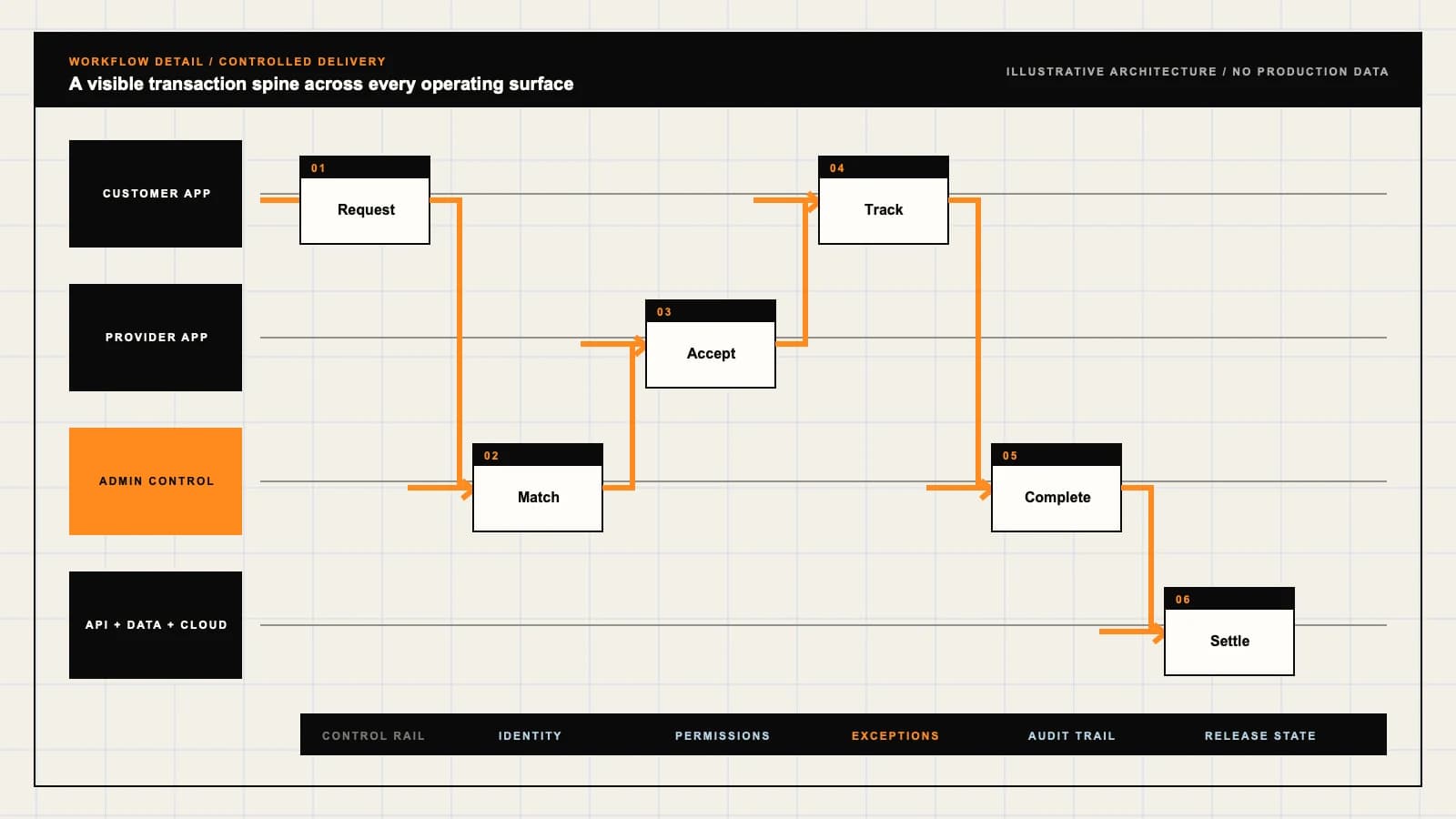
Each workflow stage is mapped to a role, screen, API, notification, admin control, and measurable launch outcome.
Validate authority, product state and restrictions before accepting a request. Keep customer identity separate from permission to perform a particular transaction.
Bind approval to instruction details and post balanced entries under a stable reference. A timeout requires investigation before another instruction can create a duplicate.
Compare provider evidence with internal events, assign exceptions and retain controlled period-close records. Corrections must refer to the original transaction.
Deployable Product Architecture
Workflow / system register
Product delivery loop
A focused release proves one complete workflow
Establish the account and permitted action
Apply maker-checker and ledger controls
Explain differences before signing off
Control note
Scope the customer action and the operator response as one system.
Operator controls
The control center is scoped as a first-class product surface, not an afterthought.
Specify the authoritative ledger, journal rules and reversal policy. Do not overwrite an earlier posting to make the current balance look correct.
Apply institution-scoped permissions, independent checking and restricted exports. Record permission changes and deny attempts outside the operator’s assigned scope.
Preserve pending outcomes, reconciliation breaks and close blockers with responsible owners. Recovery must demonstrate complete records rather than merely restore a login screen.
Integrations
External systems that determine launch readiness, data flow, and operational continuity.
Institution-authorized core or double-entry ledger interfaces with explicit authority, posting references, reversals and reconciliation exports
Identity, sanctions and transaction-monitoring systems with restricted case access, accountable review and documented unavailable-service behavior
Approved payment rails, statement delivery and reporting interfaces with event deduplication, settlement evidence and period-close controls
Scope drivers
The variables that most influence build effort, cost, and launch readiness.
Define chart of accounts, currencies, value dates and posting ownership. A servicing layer and a replacement core require different evidence and migration work.
Establish legal entities, account states, maker-checker limits and staffed exception queues. A generic administrator role cannot represent every financial responsibility.
Identify source records, retention decisions, provider dependencies and recovery acceptance. Rehearse missing events before accepting a larger product footprint.
Deployable Product Architecture
Scope drivers / system register
Product delivery loop
A focused release proves one complete workflow
Choose the authoritative ledger first
Map products and approval responsibilities
Agree migration and continuity evidence
Control note
Scope the customer action and the operator response as one system.
V1 scope
Launch the smallest complete operating loop first, then scale the product with confidence.
Include authorized onboarding, account views, statements and restricted servicing cases. Test closure or restriction while a request remains pending.
Include maker-checker, stable references and documented reversal handling. Test duplicate events, changed instructions and uncertain provider responses.
Provide matched and unmatched records, exception evidence and close approval. Demonstrate late events and restoration before accepting operational handover.
Later phases
Capabilities that should usually wait until real usage proves the core loop.
Add currencies or products after their posting, servicing and reporting rules are established. Avoid treating an extra menu item as a complete product launch.
Introduce explainable rules with exception sampling and controlled changes. Ambiguous records should remain reviewable rather than disappear into forced matches.
Add entities, integrations and support windows after permissions and recovery have been rehearsed. Provider readiness is separate from software configuration.
Deployable Product Architecture
Later phases / system register
Product delivery loop
A focused release proves one complete workflow
Expand accounting rules deliberately
Automate proven matching rules
Extend only with accountable staffing
Control note
Scope the customer action and the operator response as one system.
Regulatory review
Each flag must be reviewed by qualified counsel for your target market before build or launch.
Reference walkthrough
Ask us to confirm which reference surfaces are currently available for this product model. Rather than publishing shared demo credentials, we schedule a private guided walkthrough for qualified buyers.
Request a role-specific demonstration and confirm which capabilities are currently available. Review the proposed responsibility: View explained account states, statements and transfer outcomes. A submitted instruction remains distinct from authorization, posting and external settlement.
Request a role-specific demonstration and confirm which capabilities are currently available. Review the proposed responsibility: Use separate permissions for adjustments, account restrictions and financial instructions. Approval applies to the exact reviewed version and cannot be inherited after editing.
Request a role-specific demonstration and confirm which capabilities are currently available. Review the proposed responsibility: Investigate unmatched items, authorize supported corrections and preserve closing evidence. Assign unresolved exceptions rather than hiding them behind a balanced dashboard.
Request a live, private walkthrough of the reference implementation. We will confirm scope and discuss configured deployment versus custom build for your market.
Open registerDeployable Product Architecture
Reference walkthrough / system register
Product delivery loop
A focused release proves one complete workflow
Account holder: Inspect balances and request permitted servicing
Servicing maker and independent checker: Prepare and approve bounded changes
Finance and operations owner: Reconcile records and control period close
Book a walkthrough
Control note
Scope the customer action and the operator response as one system.
User roles
Clone-inspired platforms usually need several coordinated interfaces, not just a customer app.
View explained account states, statements and transfer outcomes. A submitted instruction remains distinct from authorization, posting and external settlement.
Use separate permissions for adjustments, account restrictions and financial instructions. Approval applies to the exact reviewed version and cannot be inherited after editing.
Investigate unmatched items, authorize supported corrections and preserve closing evidence. Assign unresolved exceptions rather than hiding them behind a balanced dashboard.
Use this generic finance operations planning illustration to discuss the configurable banking spine behind customer servicing. Ask to connect the sample review case to a scoped banking demo covering instruction validation, ledger posting and authoritative provider events. Demonstrate institution, vendor and jurisdiction responsibilities separately from the software workflow.
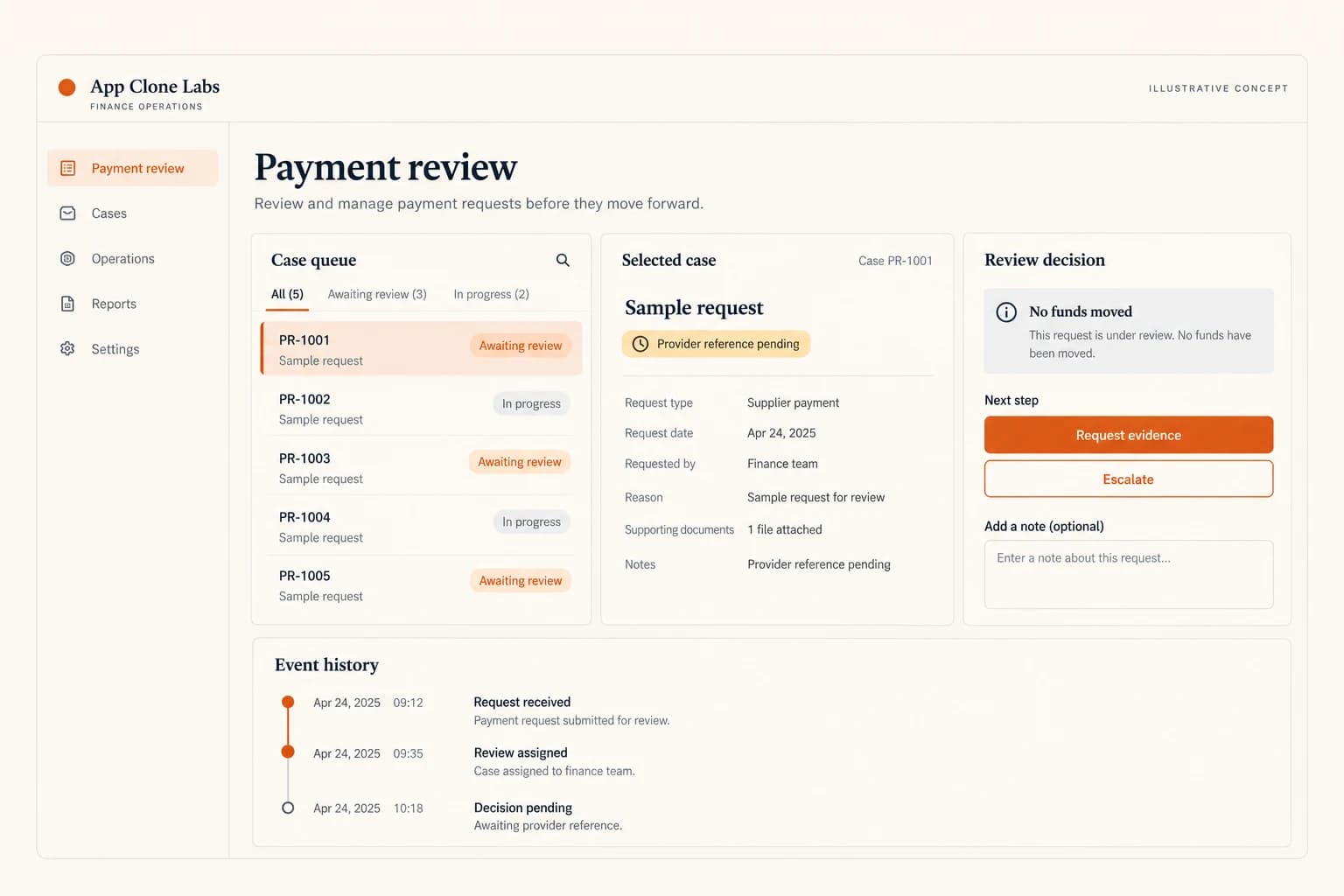
Original App Clone Labs generic finance operations planning illustration at 1536×1024. A sample supplier-payment request, pending provider reference and case event history illustrate review planning with no funds moved. This is not a retail account or card interface and does not demonstrate account opening, custody or actual transfers. Connect it to a scoped banking demo; institution, vendor and jurisdiction responsibilities require separate evidence.
Product flow
A visual map of how each role interacts with each workflow stage, with operator controls and integration boundaries.
Deployable Product Architecture
Configurable Banking Operations Platform
Monetization
We model monetization early so payments, admin controls, and reporting support the business.
Define supported entities, products, operator roles and environments. Licensing software does not confer authorization to issue accounts or move customer money.
Agree supported statements, restrictions, case handling and approval paths. Additional modules need their own data, accounting and acceptance decisions.
Price migration rehearsal, approved connectors and operational training against deliverables. External provider agreements and institutional approvals remain separate commitments.
Artifact register
Reference screens illustrate workflows, not a contracted feature list. Sample prices, data, and responses are demonstration content; confirm the current scope during a walkthrough.
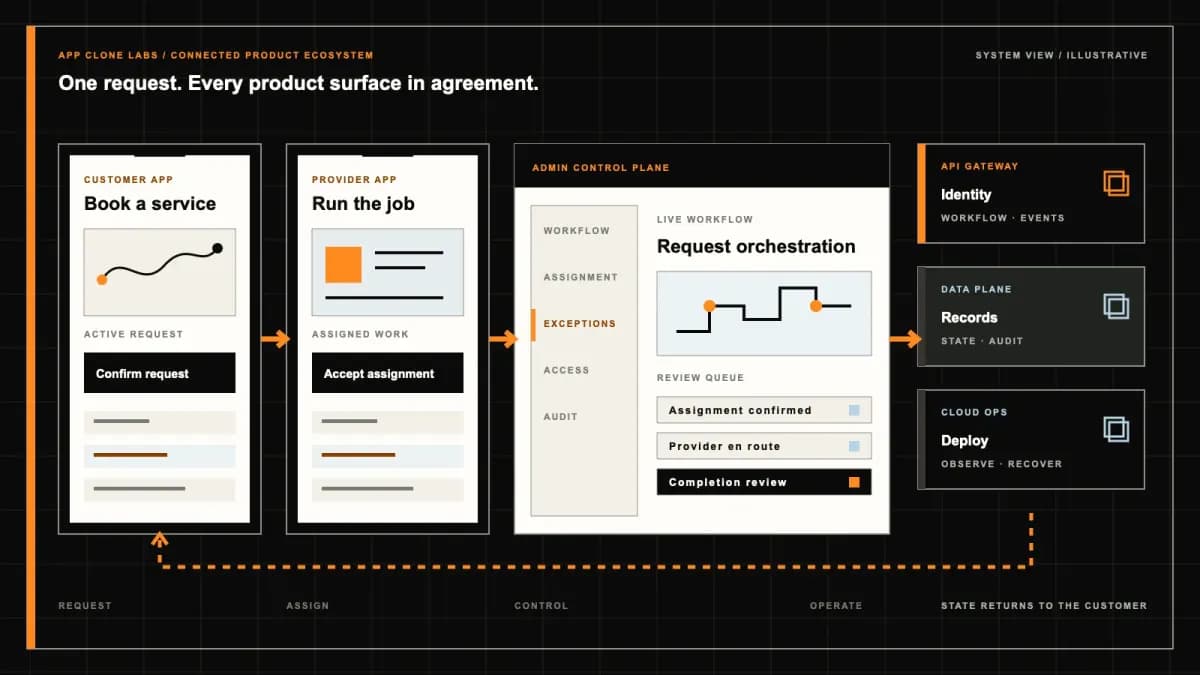
A servicing agent prepares an account adjustment, a checker approves it and the payment interface times out. The customer sees a pending instruction while finance has no settlement confirmation. A configurable banking operations platform must preserve that uncertainty. It should show who requested the change, which version was approved, whether entries were posted and what evidence is still missing. Changing the screen to successful cannot settle the instruction or repair an accounting difference.
This banking script brief is for authorized institutions defining account servicing and controlled ledger operations. App Clone Labs scopes independently branded software around agreed institutional responsibilities. It is not a bank license, certified core banking system or evidence of regulatory approval. Account issuance, custody and money movement remain with appropriately authorized institutions. The buyer must establish the applicable operating permissions and accounting ownership before a production release can be accepted.
Compare the embedded banking program hub when the primary challenge is coordinating sponsor institutions, processors and program managers. This page instead centers the operational record: account state, authorized changes, ledger posting, reconciliation and close. Both may connect to providers, but the buyer should identify which system owns each decision rather than purchasing two overlapping dashboards that disagree about whether an instruction completed.
Use the neobank customer experience brief when the initial priority is a branded customer channel. A mobile balance view still depends on authoritative records and a staffed servicing process. For this operations platform, select one institution, a bounded account product and an explicit funds-flow diagram. Document the interfaces that already exist and the missing operator decisions before selecting more modules or promising broader financial coverage.
An identity match does not authorize every account action. Establish who may open, restrict, amend or close an account and which evidence supports the requested change. Show pending review, active, restricted and closed states using the institution’s agreed model. A restriction may permit statement access while blocking outgoing instructions; the interface must explain that distinction without inviting support to remove a control simply to clear a queue.
Bind servicing cases to the customer, account and product version involved. Validate account identifiers at the boundary and avoid disclosing another customer’s record through search or error messages. Rehearse a closure request with unsettled transfers, a change submitted against a restricted account and two agents updating the same case. The operator should see the conflict and the next permitted action, with an attributable decision preserved for subsequent review.
Decide whether this layer submits events to an existing ledger or owns an agreed ledger component. Document the chart of accounts, currencies, precision, value dates and transaction references with the institution’s accounting owners. Displayed, available and settled balances can describe different facts. Their labels and calculations must follow the chosen product rules rather than assume every externally reported balance can be copied directly into the customer’s available amount.
Require balanced double-entry postings under the selected accounting model and retain the relationship between a business instruction and its journal entries. Correct an error through an authorized reversal or adjustment that references its origin; do not edit historical entries silently. Rehearse an unsupported currency, an out-of-balance posting and a correction after statement generation. Finance should reconstruct what happened from evidence without needing a developer to explain an undocumented database change.
A checker needs the amount, destination, account, reason and relevant supporting evidence before approval. Define which actions require independent review and the limits associated with each role. Editing the destination after approval should invalidate that approval rather than retain a green badge on a different instruction. Operators need readable differences between versions and an explicit rejection route so a failed request does not stay ambiguously ready for processing.
The NIST separation-of-duty definition describes dividing responsibilities and recognizes controls enforced when access occurs. It supports the narrow design rationale for independent checking, not a claim that this software is NIST certified. Rehearse the maker attempting self-approval, a checker losing authority before execution and an administrator changing a limit. The event record should identify both the effective permission and the instruction version actually processed.
Treat instruction acceptance, internal authorization, ledger posting, external submission and settlement as separate events. Assign a stable reference and define retry behavior with the connected provider. A network timeout can leave the external outcome unknown, so retrying with a new reference may create a second transfer. Show an investigation state and the evidence needed to resolve it; do not ask the customer to keep submitting until the page changes.
Validate duplicate and out-of-order provider events against the same instruction. A repeated confirmation should not post another debit, and a late failure should not blindly overwrite a verified settlement. Rehearse the provider accepting a request while the local response is lost, followed by an event arriving after a manual review starts. Operators should recover the recorded instruction and reconcile its actual outcome before initiating a supported correction or further movement.
Agree which internal events, provider statements and settlement records are compared, including their identifiers and reporting cutoffs. An internal posting and an external debit may arrive in different reporting windows. Matching needs explained rules and evidence, with ambiguous items kept separate from confirmed matches. A total that balances can still conceal an incorrect customer allocation, so acceptance should examine individual relationships as well as aggregate amounts.
Give every reconciliation break a reason, age, responsible owner and next action. Separate investigation from permission to post an adjustment. Rehearse a missing provider file, an unexpected fee, duplicate statement lines and an internal entry without an external counterpart. Show how the operator supplies evidence and how finance approves a resolution. Retain the prior unmatched state so an auditor can understand the decision instead of seeing only a tidy final report.
Define the institution’s business date, timezone, close prerequisites and treatment of unresolved items. A period-close action should expose blocking differences, permitted exceptions and the responsible approver. Establish whether late events belong to a subsequent period or require an approved reopening under the accounting policy. A scheduled job running at midnight is not enough to demonstrate that statements and finance extracts share a consistent accounting boundary.
Preserve close snapshots, approval evidence and the version of each supporting extract. Rehearse a transfer confirmed after cutoff, an unresolved suspense item and a corrected statement after close. If reopening is supported, record its reason and authorization rather than unlocking the period for every operator. The buyer should compare the final statement, journal and reconciliation report and explain any difference before accepting the configured closing process.
Scope operator access by institution, entity, product and task where those boundaries apply. Separate servicing, checking, finance review and permission administration. Read access and export access also need deliberate decisions because a support task rarely requires every account record. Record grants and revocations with their effective time, and check current authority when an action executes rather than relying only on the permission present when a screen opened.
Rehearse an operator moving teams, a revoked checker with an open browser and an attempted export from another entity. Restricted records must remain protected in search, downloads, notifications and support tooling. Provide accessible keyboard navigation and clear confirmation language for consequential actions. Authentication and an audit log are useful components, but neither proves that the chosen permissions represent the institution’s actual separation of responsibilities or retention requirements.
A manual queue should explain what failed, which evidence exists and what the operator may do next. Avoid a universal force-success button. Document allowed case transitions, escalation ownership and supported adjustments, with independent approval where required. Record customer communications separately from financial correction so an agent cannot close an accounting problem simply by sending a reassuring message. Set realistic response commitments using the institution’s staffed operating model.
The Basel Committee’s operational resilience principles address dependency mapping, continuity testing and incident management for banks. This is context for rehearsing disruption, not a compliance endorsement. Test an unavailable ledger interface, delayed provider evidence and restoration from a backup. Recovery acceptance should demonstrate complete event histories, assigned unresolved cases and reconciled outcomes, including actions accepted during the disruption. Record what remains uncertain after service returns.
Inventory the source accounts, balances, transaction histories, permissions and open cases before planning a migration. Agree extraction dates, mapping rules and which records remain accessible in the legacy system. Rehearse with controlled data and compare counts, amounts and individual samples against the approved source. A successful import status does not prove that each account retained its restrictions or that pending transfers can still be investigated.
Define cutover responsibility, rollback conditions and the reconciliation evidence needed before operators resume work. Keep production credentials and customer data out of illustrative demonstrations. Acceptance should include an incomplete source record, a duplicate account identifier and an unresolved case carried into the new workspace. Source-code delivery, hosting access and integration ownership must be explicit commercial commitments; a catalog screenshot does not establish those rights or a ready operating environment.
Request a sandbox buyer walkthrough using fictional accounts and synthetic transactions. Have a maker prepare an adjustment, change it after review, seek new checker approval and encounter an uncertain transfer outcome. Then import mismatched provider evidence, resolve an approved correction and attempt period close with an unresolved exception. Buyer acceptance should show the customer view, operator permissions, journal, case history and closing report agreeing on what is known and what remains pending.
Bring one account product and a failed transaction example to an operations scope discussion so the brief can identify accounting authority, approval limits and staffed exception handling.
Use the delivery process to agree integration access, migration evidence, recovery rehearsal and handover. Illustrative screens describe intended behavior; they are not evidence of a licensed institution, certified core, completed deployment or approved production funds flow.
FAQ
A configurable operations layer for authorized institutions: account servicing, controlled transfers, ledger events, reconciliation and period close. The exact accounting authority and provider responsibilities must be agreed before implementation.
No. Software delivery does not provide banking authorization, core certification or regulatory approval. Account issuance and money movement remain with appropriately authorized institutions and their established operating arrangements.
The embedded banking program hub centers sponsor, processor and program coordination. This brief centers controlled operational records, including account states, approved postings, reconciliation breaks and close evidence.
Yes, when access and responsibilities are established. Decide whether the platform submits instructions to the existing authoritative ledger or owns a bounded ledger component; document posting and reconciliation ownership explicitly.
Approval must apply to the exact reviewed version. Changes to consequential details should require renewed review under the institution’s policy, with readable differences and an attributable approval record.
Preserve the instruction reference and show the outcome as uncertain. Investigate provider evidence before retrying or correcting; a lost response does not prove that the provider rejected the original instruction.
Use authorized reversals or adjustments under the agreed accounting model, referencing the original entries. Preserve historical evidence rather than silently editing a posting to produce the desired current balance.
Show confirmed matches, unmatched records and ambiguous candidates with evidence, responsible owners and next actions. Aggregate balance agreement alone does not establish correct allocation to each customer or instruction.
Agree cutoff rules, blocking differences, exception approval and late-event treatment. Compare close snapshots, journals, statements and extracts, and preserve authorization for any supported reopening or subsequent correction.
Only within explicitly assigned permissions and supported case transitions. Separate investigation, customer communication and financial adjustment, applying independent checking where required instead of offering an unrestricted force-success action.
Compare account identifiers, balances, restrictions, histories, permissions and open cases against approved source records. Rehearse duplicates, incomplete records, rollback conditions and pending transfers before operational handover.
Use fictional records to demonstrate changed approvals, duplicate events, uncertain transfers, mismatched reconciliation, restricted exports and blocked period close. Inspect attributable evidence across customer, servicing, checker and finance views.
Solution reference register
01 / Regulatory caveat
Confirm licensing and market-specific authorization before enabling regulated activity · Define whether assets or funds are held by the operator, a qualified custodian, or not held at all · Apply security review, strong authentication, encryption, audit logging, recovery, and incident response · Present educational product information only and prohibit personalized financial, legal, tax, or wagering advice · Apply identity, sanctions, transaction monitoring, complaint, and suspicious-activity procedures · Keep regulated account issuance and money movement with appropriately authorized institutions
Primary sources
Dated official documentation, standards, and research that support the factual claims on this page.
How to read this page
Scope, cost and timeline figures are planning guidance until confirmed in a written proposal. Diagrams and screens are illustrations, not client deliverables, and source-code rights and handover follow the signed agreement. See the delivery process and the full disclaimer.
Next decision
Define outcomes, constraints, evidence, rights and handover before delivery begins.
Commercial rights, repositories, environments, documentation, acceptance and handover remain contract-defined.
