
01Apply and receive a decision
Separate application from issued account
Show required evidence, pending review, rejection and provider-confirmed approval. Enable only the account and card capabilities actually established for that customer.
Banking and financial operations
Mobile-first account experience layered over authorized banking and payment providers. Planned for licensed institutions and approved programs offering digital account servicing with role-specific workflows, operator controls, integrations, and a handover boundary defined for the selected market.
See product screens and demo accessCustom workflows
Brand-safe product strategy
Admin and operations tooling
Reference walkthrough by arrangement
Workflow
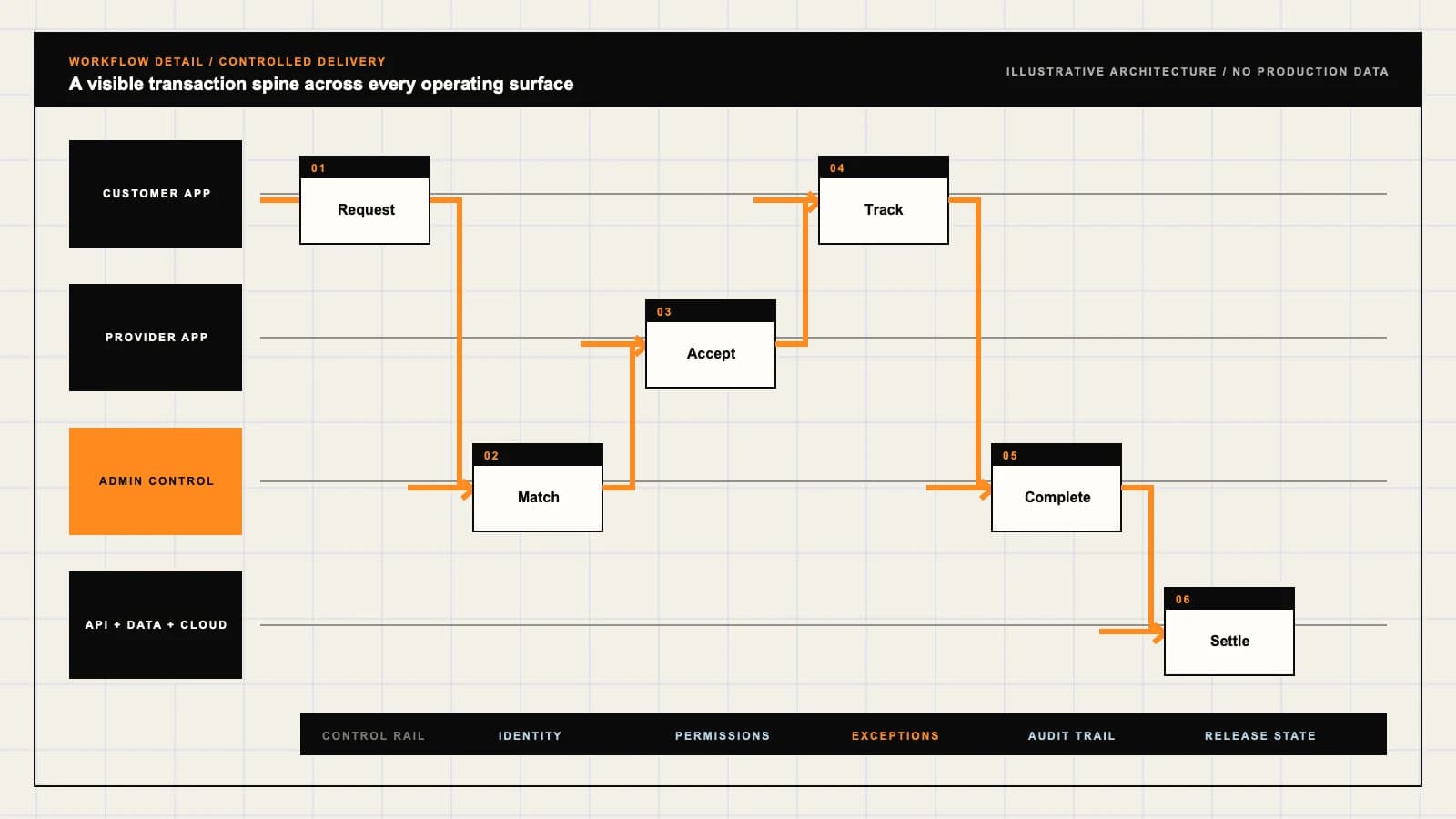
Each workflow stage is mapped to a role, screen, API, notification, admin control, and measurable launch outcome.
Show required evidence, pending review, rejection and provider-confirmed approval. Enable only the account and card capabilities actually established for that customer.
Label available, ledger and pending amounts. Show card-control requests and transfer terms before confirmation, then recover uncertain outcomes using the original reference.
Explain confirmed transfers, returned funds and statement corrections. Maintain an accessible dispute route with named ownership and actual provider evidence.
Deployable Product Architecture
Workflow / system register
Product delivery loop
A focused release proves one complete workflow
Separate application from issued account
Make consequential actions understandable
Keep receipts statements and cases connected
Control note
Scope the customer action and the operator response as one system.
Operator controls
The control center is scoped as a first-class product surface, not an afterthought.
Recheck permitted capabilities under the selected institution rules. Interface delivery does not provide a bank license, deposit insurance or regulatory certification.
Confirm provider card status and explain pending authorizations. Freezing a card must not be presented as reversing earlier purchases or cancelling all future settlement.
Restrict document access, account recovery and adjustment authority. Preserve original records and attributable remedies rather than editing history to close a case.
Integrations
External systems that determine launch readiness, data flow, and operational continuity.
Authorized institution account and balance services with application decisions, capability status, pending amounts and reconciliation references
Permitted card and transfer providers with confirmed control state, authorization and capture events, recoverable instructions and return evidence
Identity, statement and customer-support systems with restricted case access, versioned corrections, accessible delivery and attributable dispute ownership
Scope drivers
The variables that most influence build effort, cost, and launch readiness.
Define the operating entity, approved account products, customer regions and exact disclosures before enabling an application journey.
Confirm freeze behavior, card issuance, payment rails and supported destinations. Wider coverage adds distinct status, failure and support decisions.
Scope accessible assistance, lost-device recovery, statement corrections and disputes with actual institution escalation and reconciliation ownership.
Deployable Product Architecture
Scope drivers / system register
Product delivery loop
A focused release proves one complete workflow
Choose an established provider relationship
Validate each exposed action
Staff the states customers cannot resolve alone
Control note
Scope the customer action and the operator response as one system.
V1 scope
Launch the smallest complete operating loop first, then scale the product with confidence.
Use fictional customers to test pending and rejected applications, provider approval, ledger balances, available funds and pending card holds.
Rehearse a freeze awaiting acknowledgment, later capture of an earlier authorization and an uncertain transfer recovered by its original reference.
Provide accessible statements and owned support cases. Test a returned transfer, corrected statement, disputed purchase and restricted recovery action.
Later phases
Capabilities that should usually wait until real usage proves the core loop.
Add savings or business experiences after establishing institution approval, disclosures, permissions and service ownership for each product.
Add permitted capabilities after testing provider-specific limits, confirmation behavior, returns and customer support under outage conditions.
Add reviewed categorization and customer-controlled goals without implying that a budgeting label moves funds or establishes a separate protected account.
Deployable Product Architecture
Later phases / system register
Product delivery loop
A focused release proves one complete workflow
Extend customer eligibility deliberately
Expand after proving exception coverage
Build on explained transaction history
Control note
Scope the customer action and the operator response as one system.
Regulatory review
Each flag must be reviewed by qualified counsel for your target market before build or launch.
Reference walkthrough
Ask us to confirm which reference surfaces are currently available for this product model. Rather than publishing shared demo credentials, we schedule a private guided walkthrough for qualified buyers.
Request a role-specific demonstration and confirm which capabilities are currently available. Review the proposed responsibility: Complete the required application, inspect confirmed balances and control supported cards. Follow transfer receipts, statements and disputes without treating registration as account approval.
Request a role-specific demonstration and confirm which capabilities are currently available. Review the proposed responsibility: Locate relevant provider references and maintain case ownership. Restrict identity evidence and financial adjustments independently of ordinary servicing access.
Request a role-specific demonstration and confirm which capabilities are currently available. Review the proposed responsibility: Review eligibility, card exceptions, reconciliation differences and permitted disclosures. Establish the actual account provider and responsibilities before enabling customer activity.
Request a live, private walkthrough of the reference implementation. We will confirm scope and discuss configured deployment versus custom build for your market.
Open registerDeployable Product Architecture
Reference walkthrough / system register
Product delivery loop
A focused release proves one complete workflow
Applicant and account customer: Understand approval and available services
Customer support and dispute reviewers: Resolve the reported account problem
Institution and program operations: Confirm provider status and customer remedies
Book a walkthrough
Control note
Scope the customer action and the operator response as one system.
User roles
Clone-inspired platforms usually need several coordinated interfaces, not just a customer app.
Complete the required application, inspect confirmed balances and control supported cards. Follow transfer receipts, statements and disputes without treating registration as account approval.
Locate relevant provider references and maintain case ownership. Restrict identity evidence and financial adjustments independently of ordinary servicing access.
Review eligibility, card exceptions, reconciliation differences and permitted disclosures. Establish the actual account provider and responsibilities before enabling customer activity.
Use this generic finance operations planning illustration to discuss the operations layer behind a proposed neobank experience. Ask to connect the sample supplier-payment case to a scoped banking demo with separate customer account views and restricted operator workflows. Account and card availability, institution and vendor authority, and responsibilities in the intended jurisdiction need separate demonstration.
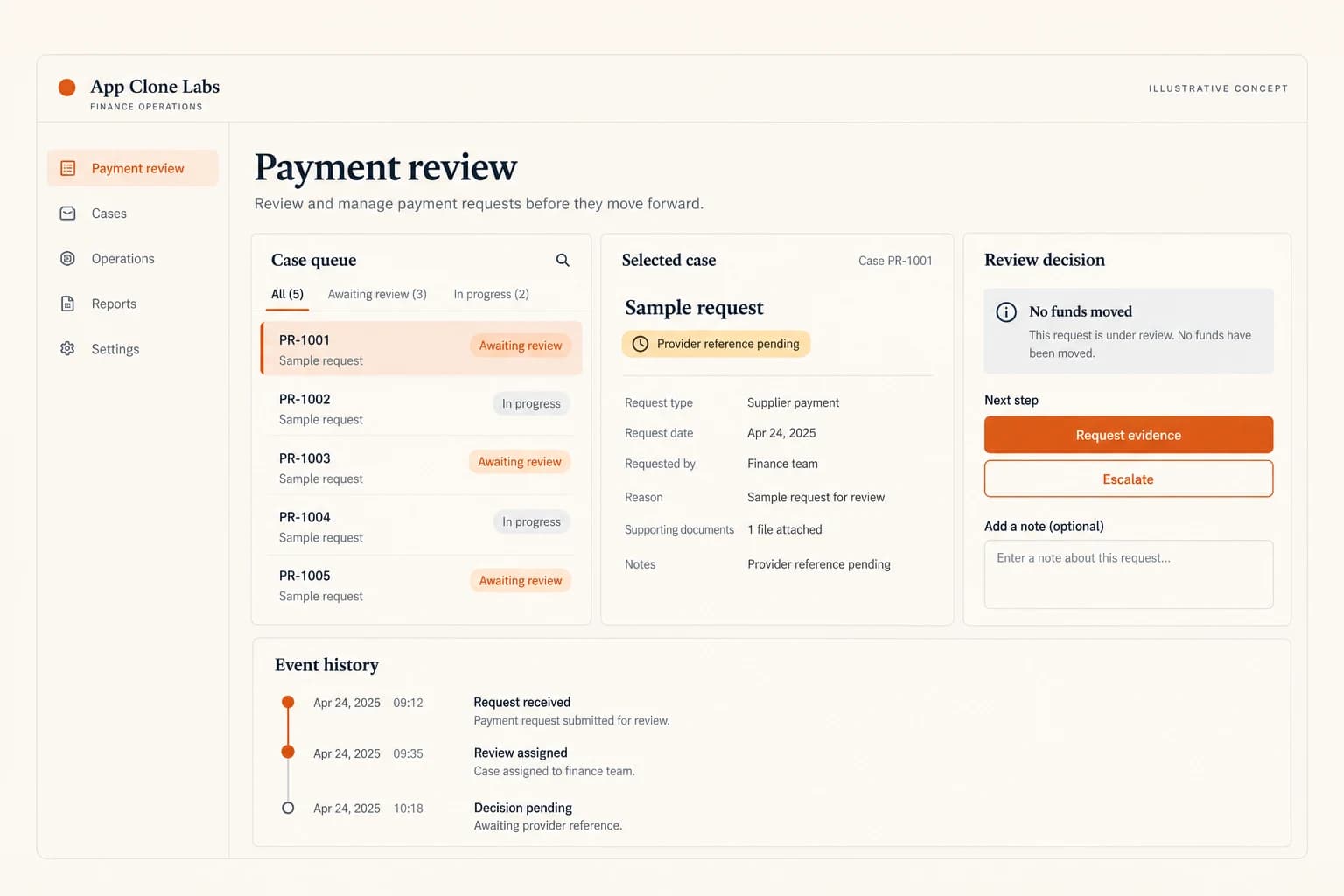
Original App Clone Labs generic finance operations planning illustration at 1536×1024. A sample supplier-payment request, pending provider reference and case event history depict review planning with no funds moved. This is not a neobank customer account or card screen and does not demonstrate account opening, custody or actual transfers. Connect it to a scoped banking demo and demonstrate institution, vendor and jurisdiction responsibilities separately.
Product flow
A visual map of how each role interacts with each workflow stage, with operator controls and integration boundaries.
Deployable Product Architecture
Digital Banking Front-end Platform
Monetization
We model monetization early so payments, admin controls, and reporting support the business.
State included tools, service charges and cancellation terms under the provider-approved schedule. Plan upgrades cannot bypass account restrictions or guarantee protection.
Specify environments, customer journeys and staffed service coverage. Banking permissions and provider agreements require independent establishment.
Describe participation only where agreed with the actual institution and processor. A card screen does not establish issuing access, earnings or guaranteed transaction revenue.
Artifact register
Reference screens illustrate workflows, not a contracted feature list. Sample prices, data, and responses are demonstration content; confirm the current scope during a walkthrough.
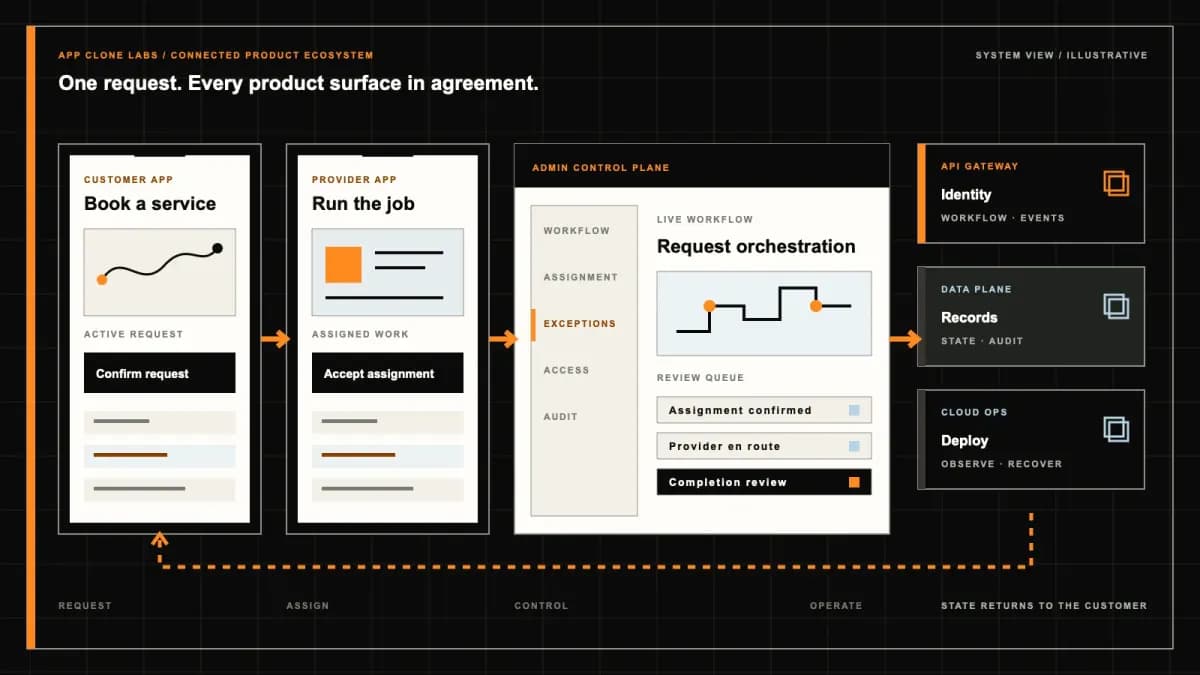
A customer opens the app, sees money in the account and freezes a misplaced card. A pending purchase later settles while an outgoing transfer remains under review. Those outcomes can be consistent, but the interface needs to explain them. A neobank-style digital banking frontend starts with provider-confirmed account capabilities, understandable balances and useful next actions. A polished home screen cannot resolve uncertainty about whether the customer has an approved account or money available for a particular instruction.
App Clone Labs scopes the customer experience over separately established banking and payment relationships. Software delivery does not provide a bank license, deposit insurance, partner availability or guaranteed regulatory compliance. Identify the actual account provider, relevant protection status, fees and service responsibilities through approved disclosures. The product should communicate the established arrangement clearly rather than imply that independent branding changes who holds funds or owes the customer a remedy.
Separate registration, saved application, submitted evidence, pending review, rejection and provider-confirmed account approval. Tell the applicant what remains required without presenting an account number or card promise before the provider establishes it. An identity document received is not an eligibility decision. Explain unsupported regions and account types with an appropriate support route rather than inviting the person to change details to bypass a restriction.
Version the relevant application terms and preserve decisions when evidence changes. A corrected address or expired document may require another review under the institution policy. Rehearse missing evidence, a rejected applicant returning later and an approval response arriving while the customer is offline. Customer and support views should agree on the current status. Sensitive screening evidence belongs in restricted review tools, while the mobile journey needs a useful explanation of the next permitted step.
Show the amount available for the selected action alongside the posted ledger balance and pending activity. A card authorization or incoming transfer can affect what the customer can spend without representing a completed transaction. Use the provider’s established balance definitions, currencies and source times. Avoid calculating apparent availability from a cached transaction list when the authoritative service reports a restriction or unresolved amount.
Explain the reason for a difference with readable transaction details and a staffed route for questions. Rehearse a hold being released, an incoming payment not yet available and a balance refresh failing after a customer returns to the app. A budgeting category or savings goal should not imply funds moved into a separate account unless that capability actually exists. Show stale information honestly instead of leaving an enabled payment button beside an outdated available amount.
The official Stripe Issuing transaction documentation distinguishes authorization holds from capture transactions and explains that card status controls apply to authorization rather than blocking capture of an approved authorization. This is a specific provider reference for explaining separate states, not an integration commitment or universal promise about every card program.
The customer history should identify pending purchases, posted transactions, released holds and refunds under the actual processor model. Link related evidence where available without inventing a match when provider records are ambiguous. Do not display a pending and posted entry as two completed charges merely because separate notifications arrived. Rehearse a partial capture, a changed final amount and a refund arriving without an original authorization reference. Support needs the provider evidence and a clear explanation; customers need the current amount and next action.
Separate the customer’s freeze request from the provider-confirmed result. Show pending or failed control changes clearly, including what to do when a misplaced card requires urgent assistance. A local toggle changing color does not establish that the issuing provider applied the restriction. Recheck card identity and authority when the action reaches the provider, particularly when a customer has several cards or switches accounts.
Describe the supported effect and limits of freezing under the selected card arrangement. It should not promise to undo earlier purchases, cancel every settlement or replace reporting an unauthorized transaction. Rehearse a freeze timeout, an acknowledgment after the app closes and capture of an earlier authorization after freezing. Unfreezing requires its own confirmed outcome. A support agent should not reactivate a card simply to clear a case when the customer has not authorized that action through the established recovery process.
Before submission, show the destination, amount, currency, fees and applicable timing information. Validate beneficiary details and the customer’s permitted account capabilities using the actual provider rules. Confirmation must refer to the instruction the customer reviewed. If material details change, obtain the required new decision rather than silently redirecting a payment or modifying its amount. Keep the important information readable with keyboard and screen-reader support.
Give the instruction a stable reference and distinguish submitted, accepted, completed, failed and unresolved states. A receipt for submission should not say the recipient was paid. Rehearse a provider accepting the instruction before a connection drops and a customer pressing submit twice. Recover the original outcome before another payment can be created. Explain cancellation only where supported by the actual state and rail; the interface must not promise that a pending transfer remains reversible.
A transfer may be returned after an earlier accepted or completed status. Preserve the original instruction and connect the return, reason where appropriate, fees and confirmed credit evidence. The customer needs to see what happened to the money and whether any action remains required. Do not simply remove the payment from history or turn a return notification into an assumption that funds are already available again.
Receipts should distinguish the original amount, relevant dates and actual outcome without exposing unnecessary account details. Rehearse a rejected beneficiary, delayed return and duplicate provider notification. Reconcile the credited amount before suggesting a replacement transfer. Support should identify the responsible institution or operational queue and explain known next steps without inventing completion dates. Accessible downloadable receipts and a clear in-app history help customers discuss the issue without relying on a transient notification or screenshot.
Provide statements for the supported period and account with readable dates, currencies, transaction references and the applicable provider identity. Match the records to the established statement source. A downloadable file generated from an incomplete cached history can look official while omitting a correction or delayed transaction. Explain when a period remains unavailable and how the customer can obtain assistance rather than generating a misleading empty statement.
A correction should preserve the original document and identify the revised version and reason under the institution policy. Avoid silently replacing the file while support continues discussing an earlier copy. Rehearse a corrected transaction after statement generation and a customer requesting a prior closed-account statement. Restrict document access appropriately and use accessible text instead of an image-only statement. Retention and delivery rules must follow the actual account relationship, including the treatment of records during suspension or closure.
The CFPB guidance on unauthorized electronic transactions explains reporting suspected unauthorized activity to the bank or credit union and describes protections in its US legal context. This is a jurisdiction-specific reference for accessible reporting and investigation, not a universal deadline, refund promise or guarantee that the independent program falls within that regime.
Let customers report an unfamiliar purchase or transfer from the relevant record and receive a case reference. Capture necessary information without requiring repeated uploads of unrelated personal documents. Distinguish a dispute, investigation, provisional adjustment where applicable and confirmed outcome. Keep the original transaction visible while review proceeds. Rehearse an unauthorized purchase reported after a card freeze, additional evidence arriving later and a reviewer finding an accounting discrepancy. Commercial support targets must not suppress a valid complaint or erase its evidence.
A lost device, unreadable statement or failed authentication can prevent the customer from reaching the very control they need. Provide an approved assistance route outside the normal signed-in journey, with identity and recovery checks appropriate to the actual institution. Support should explain card and account restrictions without asking customers to reveal passwords, security codes or complete identity documents through an ordinary chat thread.
Test readable status messages, keyboard navigation, screen-reader labels and alternatives when a preferred channel is unavailable. Do not rely only on color to distinguish pending and completed transfers. Separate support access, account recovery, card reactivation and financial adjustment permissions. Rehearse an agent without recovery authority, a customer using assistive technology and an outage affecting notifications. An answered chat does not establish that the provider resolved the financial issue; keep the case owner and current evidence visible until the outcome is confirmed.
Compare the configurable banking operations platform when ledger events, transfer approvals and institution operations drive the brief. This neobank-style scope concentrates on how customers apply, understand their money, control supported cards and receive help. Shared components should retain the actual provider’s authoritative account and transaction definitions.
Review the embedded banking program hub when sponsor oversight, processor responsibilities and program management need definition. A customer frontend does not establish those institutional relationships or substitute for their review.
Price the exposed capabilities, permitted account plans and staffed support commitments explicitly. Additional savings or business experiences require separate approval, disclosures and exception coverage. Branding and convenient navigation cannot grant new account permissions, insure deposits or make an unavailable provider relationship operational.
Request a sandbox using fictional customers, accounts and non-monetary balances. Inspect a pending and rejected application, then a provider-approved account with a card hold. Freeze the card while its acknowledgment is delayed and capture an earlier authorization. Submit a transfer with an uncertain response, return another payment and correct a statement. Buyer acceptance should show customer and support views agreeing on balances, references, unresolved cases and permitted next actions.
Bring one account relationship to a digital banking experience scope discussion to agree customer disclosures, provider permissions and owned support remedies.
Use the delivery process to establish source-code terms, deployment access, reconciliation evidence and accessibility acceptance. Illustrative results demonstrate the proposed interface; they do not establish a live bank, insured account or approved provider integration.
FAQ
A customer-facing account application, balance, card-control, transfer, statement and support experience over independently established authorized banking and payment relationships.
No. Identify the actual account provider, protection status and responsibilities through approved disclosures. Software delivery does not establish banking authority, insurance or regulatory compliance.
No. Keep evidence submission, provider review, rejection and confirmed account approval distinct. Enable only the capabilities actually established for that customer.
Posted records, pending activity and funds available for a particular action can differ. Use the provider definitions and explain restrictions with clear amounts and source times.
No. Explain the actual processor states for holds, capture, release and refunds. Related notifications must not become duplicate completed charges in customer history.
No. Show the provider-confirmed control state and its limits. Earlier authorizations may still settle under the actual arrangement, and reporting unfamiliar activity remains a separate action.
No. Distinguish submission, acceptance, completion and unresolved outcomes. Recover an uncertain instruction by its original reference before allowing a duplicate payment.
Preserve the original instruction and connect the confirmed return, fees and credit evidence. A return notice alone does not prove that funds are already available again.
Preserve appropriate version evidence and identify the revised document under the institution policy. Customers and support should be able to explain which record changed and why.
No. The cited guidance has a US legal context. Establish applicable reporting, investigation and remedy obligations for the actual institution, customer and transaction.
Readable status messages, accessible documents, approved lost-device assistance and restricted recovery authority. A support response should identify the case owner and confirmed evidence.
Use synthetic accounts to test application decisions, pending balances, delayed freeze confirmation, later capture, uncertain transfers, returns, statement corrections and owned disputes across customer and support views.
Solution reference register
01 / Regulatory caveat
Confirm licensing and market-specific authorization before enabling regulated activity · Define whether assets or funds are held by the operator, a qualified custodian, or not held at all · Apply security review, strong authentication, encryption, audit logging, recovery, and incident response · Present educational product information only and prohibit personalized financial, legal, tax, or wagering advice · Apply identity, sanctions, transaction monitoring, complaint, and suspicious-activity procedures · Disclose the licensed institution, deposit protection status, fee terms, and program responsibilities
Primary sources
Dated official documentation, standards, and research that support the factual claims on this page.
How to read this page
Scope, cost and timeline figures are planning guidance until confirmed in a written proposal. Diagrams and screens are illustrations, not client deliverables, and source-code rights and handover follow the signed agreement. See the delivery process and the full disclaimer.
Next decision
Define outcomes, constraints, evidence, rights and handover before delivery begins.
Commercial rights, repositories, environments, documentation, acceptance and handover remain contract-defined.
