
01Host
Eligibility and broadcast controls
Review host access, room capabilities, co-hosts, policy state, and interruption behavior.
Live-video social entertainment blueprint
Plan an original live-video platform across hosts, viewers, real-time rooms, virtual gifts, talent agencies, moderation, payouts, and operator control.
See product screens and demo accessBlueprint content only; final roles, policies, architecture, acceptance criteria, and provider choices require discovery.
No affiliation with or endorsement by Bigo Live is claimed.
No revenue, audience, safety, approval, compliance, capacity, or delivery-time result is guaranteed.
01 / LIVE SESSION
Design identity, room state, media, interaction, degraded behavior, and urgent operator controls as one system.
Review host access, room capabilities, co-hosts, policy state, and interruption behavior.
Make room eligibility, interaction, spending, blocking, reporting, and recovery understandable.
Give accountable staff real-time context, proportionate actions, evidence controls, and appeals.
Deployable Product Architecture
01 / LIVE SESSION / system register
Product delivery loop
The product is more than a video player.
A focused release proves one complete workflow
Eligibility and broadcast controls
Discovery and safe participation
Live safety and session authority
Control note
Scope the customer action and the operator response as one system.
02 / GIFT ECONOMY
Connect purchase, gifts, shares, holds, reversals, host earnings, agency statements, and payouts without treating balances as decoration.
Use stable identifiers, versioned economic rules, duplicate protection, and traceable corrections.
Model acceptance, permissions, terms, roster changes, statements, and disputes.
Restrict approvals, verify eligibility, record holds and failures, and reconcile provider events.
03 / CONNECTED CAPABILITIES
The solution depends on mobile experience, APIs, cloud operations, QA, and governed AI or moderation components.
Design device permissions, notifications, interruption, store submission, and release ownership.
Open registerCreate authenticated, observable boundaries for rooms, gifts, roles, moderation, and payments.
Open registerPlan media dependencies, deployment, monitoring, capacity, cost controls, and incident response.
Open registerVerify role, room, money, safety, device, network, and provider failure states before release.
Open registerCompare an audio-first room model when voice participation matters more than video broadcasting.
Open registerDeployable Product Architecture
03 / CONNECTED CAPABILITIES / system register
Product delivery loop
Use existing specialist services around the product.
A focused release proves one complete workflow
Mobile app development
API development
Cloud engineering
QA testing
Control note
Scope the customer action and the operator response as one system.
Use this viewer-discovery reference to plan an original live-video platform around your hosts, audience and operating team. Ask to review broadcasting, live moderation, agency permissions and gift accounting in a guided walkthrough; these workflows are not demonstrated by the directory. Confirm the current demo and supported scope before choosing the build. App Clone Labs is independent from Bigo Live and its owners; no affiliation or endorsement is claimed.
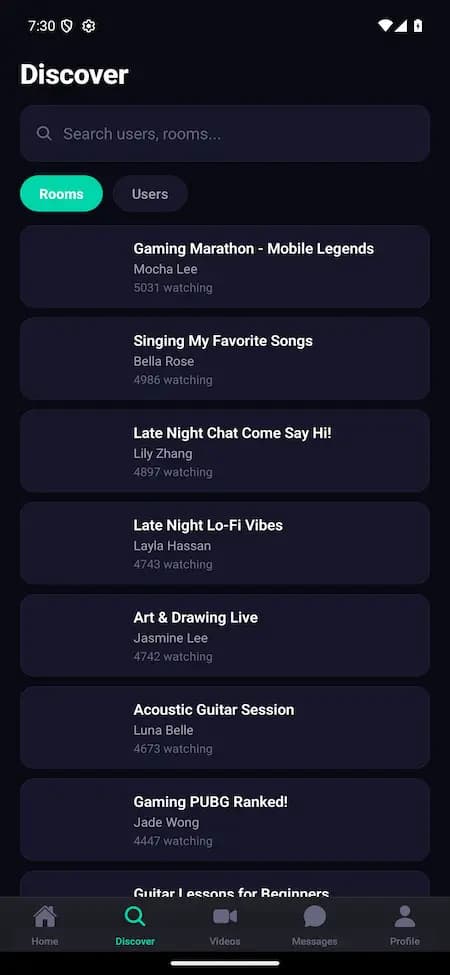
Illustrative viewer directory with sample room titles, creator names and watching counts. Counts do not establish an active audience or tested capacity. This is not the Bigo Live interface or a client deployment; host broadcasting, live moderation, agency management and gift settlement are not shown.
What to check in the walkthrough
A Bigo Live-style platform is a live-video social entertainment product in which hosts broadcast, audiences join and interact in real time, virtual gifts create an economic event, agencies may manage host supply, and operators govern safety, payments, payouts, and community health. The familiar product is a planning reference only. A credible delivery requires original branding, interface design, workflows, policies, data structures, and implementation for the intended market.
This blueprint is for teams evaluating a live creator business rather than a simple video player. The difficult work sits around the stream: host eligibility, room access, real-time roles, gift settlement, agency agreements, moderation coverage, evidence preservation, payout review, fraud response, app-store rules, infrastructure cost, and an operator console that can intervene while a broadcast is still active. Those responsibilities should be accepted before a feature list or technical stack is selected.
Live video creates immediacy, participation, and creator intimacy, but it also creates time-sensitive safety and infrastructure obligations. A recorded-video feed may be the better first product when content can be reviewed before publication, when the team cannot staff live escalation, or when the audience value comes from a catalog rather than synchronous interaction. An audio-room or webinar product may fit when presence matters but continuous creator entertainment does not. The product decision should follow the participant job and operating capacity.
The first commercial brief should define the audience, host supply model, territories, eligible content, age boundary, room formats, interaction model, and revenue path. It should explain why a viewer returns, why a host broadcasts, how an agency contributes, what the platform earns, and which events require an operator. If those incentives conflict, technology will not repair the business model. A launch scope should prove one coherent live loop before adding games, broad social feeds, or multiple currencies.
The viewer journey can include account creation, age-appropriate discovery, room entry, following, chat, reactions, gift purchase, gift sending, blocking, reporting, and transaction history. The interface must distinguish entertainment signals from monetary actions. Prices, balances, conversion rules, purchase confirmation, refund conditions, and spending controls should be understandable before a user commits value.
Hosts need eligibility review, profile and schedule tools, room configuration, stream controls, co-host or guest management, moderation assistance, earnings visibility, and an appeal route. Going live should not automatically grant every capability. Account status, age and identity checks, territory, policy history, payout readiness, device state, and operator restrictions may affect what a host can do.
An agency layer is a separate business relationship, not an administrative label. The platform may need invitations, host acceptance, contract dates, territory, targets, revenue-share terms, transfers between agencies, dispute handling, manager permissions, and statements that explain how an amount was calculated. The agreement and applicable employment, contractor, tax, and commercial rules require qualified review in each market.
Live moderators need room context and fast controls without unnecessary access to payments or private data. Finance reviewers need gifts, adjustments, holds, reserves, settlements, and payout evidence without broad content-administration rights. Administrators need policy configuration, role assignment, audit records, incident controls, and system health. Separating these roles limits accidental or abusive intervention and makes sensitive actions reviewable.
A room moves through scheduled, ready, live, paused, interrupted, ended, restricted, and archived states according to the selected product. Participants can join late, reconnect, change role, lose network access, or be removed. The service must decide which state is authoritative and how clients recover after a disconnect. Viewer counts, seat assignments, host presence, and moderation actions should not depend on one device’s local state.
Room formats should be selected for a defined use case. A solo broadcast, multi-guest panel, audio room, subscriber-only session, ticketed event, or competitive live format creates different access, media, interaction, payout, and moderation rules. Packaging many modes into V1 increases the state and test matrix. A stronger first release defines one or two room types, proves entry through closure, and documents how later formats extend the same session model.
The media architecture must account for publishing, relay, playback, chat or reactions, recording where permitted, and the control plane that authorizes each role. The selected managed provider or self-operated components depend on territories, supported clients, latency needs, recording policy, moderation design, accessibility, concurrency assumptions, and team capacity. Provider capability should be verified against current documentation and tested with the product’s own devices and networks.
A useful test plan includes poor uplink, changing networks, backgrounding, device interruption, expired credentials, delayed role changes, duplicate joins, missing media, provider errors, and regional unavailability. The interface should communicate connection state honestly and preserve safe recovery. A viewer should not be charged for an action whose outcome cannot be established, and a host should know whether the room is live, reconnecting, or closed.
Recording and replay are separate consent, rights, storage, and moderation decisions. The platform should define whether a session is recorded, who can start it, what participants are told, how long files remain, who can access them, and how takedown or legal-hold requirements are handled. A recording can support incident review, but indiscriminate retention can also increase privacy and security exposure.
A virtual gift can connect a purchased balance, a catalog item, a room event, a recipient earning, a platform share, an agency share, a hold, and a later payout. The animation is presentation; the ledger is the commercial record. Every value-changing event needs a durable identifier, currency and amount, source, recipient, applicable split version, timestamp, status, and reversal relationship. Repeated requests or delayed payment events must not create duplicate value.
The product should avoid suggesting that coins, points, gifts, earnings, and withdrawable money are interchangeable unless the terms and system make that true. Operators need configurable catalogs and economic rules, but changes should be versioned so historical statements remain explainable. Promotions, bonus balances, expiry, regional availability, refunds, chargebacks, fraud holds, and account sanctions can all affect what a viewer may spend and what a host may receive.
Payment-provider and app-store rules vary by transaction, content, device, and market. Digital goods may require platform billing on distributed mobile applications, while creator payouts require an eligible provider, identity and tax processes, and risk controls. The architecture should be selected after current policy and provider eligibility review. Engineering can implement agreed controls, but it cannot guarantee processor approval or redefine the parties’ legal obligations.
An earnings view should show the events contributing to gross gift value, the applicable platform and agency terms, adjustments, holds, reversals, and the amount eligible for payout. A single mutable balance without a traceable event history makes disputes and reconciliation difficult. Statements should use the business’s agreed definitions and distinguish pending, held, available, requested, processing, paid, failed, and reversed states where those apply.
Payout approval may require account eligibility, identity verification, minimum amounts, reserve rules, sanctions or fraud review, tax information, and evidence for unusual activity. Access to approve or alter money should be restricted and audited. Operators also need a process for failed transfers, changed bank details, duplicate requests, chargebacks after payout, agency disputes, and a host who loses eligibility while funds remain unsettled.
If agencies recruit and support hosts, the platform must represent that relationship explicitly. Invitation and acceptance, effective dates, territory, manager roles, host movement, probation, targets, benefits, deductions, termination, and dispute states may matter. Agency dashboards should show only the hosts and financial information they are permitted to manage. Platform administrators need oversight without allowing an agency to alter the underlying transaction record.
Targets and leaderboards can influence host behavior. They should be designed with clear calculation windows, eligible activity, correction rules, and anti-abuse controls. The product team should consider whether incentives encourage unsafe hours, manipulative viewer spending, coordinated gifting, or policy violations. A commercially useful host program needs quality and safety measures alongside volume, with the exact model reviewed for local worker and consumer implications.
Recorded-content moderation can often queue a decision; live harm may require action in seconds. The operating model should define report intake, risk priority, room visibility, evidence capture, warning, participant mute or removal, stream interruption, account restriction, escalation, and appeal. Automated signals can prioritize cases, but the authority and response for serious harm should be explicit. Coverage hours and escalation capacity are launch dependencies, not post-launch enhancements.
The rules should address sexual content, exploitation, violence, self-harm, hateful conduct, harassment, scams, dangerous activity, copyright, privacy, and the protection of minors according to the intended markets and qualified policy review. The product may also need keyword, image, audio, behavior, device, and payment-risk signals. No detection system is complete; users need accessible blocking and reporting, moderators need context, and policy owners need a way to correct an erroneous action.
Evidence handling requires restraint. A moderator may need a short authorized capture, chat context, user reports, and action history to resolve a case, but storing sensitive broadcasts indefinitely can compound harm. The plan should define collection authority, access, encryption, retention, export, deletion, and legal requests. Highly sensitive incidents require trained people and established external escalation routes appropriate to the jurisdiction.
Age eligibility affects discovery, messaging, gifting, live participation, advertising, data use, and parental experiences. A date-of-birth field alone may not satisfy the risk. The product team should assess age assurance, host identity, guardian involvement where applicable, age-separated experiences, default privacy, contact controls, spending restrictions, reporting, and high-risk feature availability. The appropriate controls depend on audience, territory, and current law and platform policy.
Launching globally by default can multiply incompatible requirements. It may be safer to begin with named territories, languages, payment methods, support hours, and content policies. Geographical controls must be enforced by the service rather than presentation alone, and their limitations should be understood. Counsel, trust-and-safety specialists, payment partners, and app-store owners should review the real product behavior before release.
Live discovery can rank rooms using language, topic, eligibility, safety state, recency, audience response, and editorial choices. The team should define which rooms can be recommended and why, how sponsored placement is disclosed, and how users change their experience. Optimizing only for viewing or gifting can reward sensational or unsafe conduct. Ranking quality should include safety, satisfaction, diversity, and complaint evidence appropriate to the product.
Competitive live formats and casual games can increase participation but also resemble wagering or manipulate spending if value, chance, and rewards are poorly defined. V1 should avoid adding mechanics whose legal and platform classification has not been reviewed. Scores should have a clear source and correction policy. If gifts influence a contest, users should understand the effect before purchase, and the product should prevent hosts or coordinated accounts from manufacturing deceptive activity.
Live-video cost depends on publish minutes, viewer minutes, resolution, geography, recording, transcoding, egress, messaging volume, storage, moderation, and provider pricing. Concurrency alone does not explain the bill. The commercial model should estimate a small number of representative room profiles and test them against current vendor terms. Limits, alerts, room controls, and regional configuration should keep unexpected use from becoming an uncontrolled infrastructure expense.
Performance acceptance should include join success, time to first usable media, rebuffering, reconnection, chat and gift propagation, moderation-action delay, API behavior, and operator visibility on representative devices and networks. Targets need to be agreed from the audience and architecture rather than invented for marketing. Load testing should protect real providers and accounts, use authorized environments, and preserve enough evidence to compare releases.
The operator console may include users, host applications, agencies, live rooms, reports, policy actions, appeals, gift catalogs, balances, earnings, payout review, promotions, permissions, configuration, and system health. Access should be scoped by job. High-consequence changes such as share rules, manual balance adjustments, payout approval, evidence export, and account reinstatement may require reasons, limits, or additional approval.
The console should connect an incident across identities, room state, reports, moderation actions, gift events, and payout consequences without exposing unrelated personal data. Search and filters need stable identifiers and timestamps. Exports should be permissioned and recorded. Configuration changes should be versioned where they affect money, access, or enforcement. Operational usability matters because a technically available control is ineffective if staff cannot find and use it during a live event.
A disciplined V1 may use one live-video room type, basic discovery, chat and reactions, a small gift catalog, a single transparent earnings model, host review, operator moderation, and a controlled payout workflow. Agency functionality belongs in V1 only when agencies are essential to host supply. Competitive formats, audio rooms, broad social feeds, games, several currencies, advanced recommendation, and international expansion should wait until the core live and financial records are trustworthy.
Deferral does not mean ignoring architecture. The team should document likely extension points and the decisions that would trigger the next module. Real usage may show that moderation tooling, host quality, payment recovery, or media reliability deserves investment before another engagement mechanic. The roadmap should respond to viewer, host, agency, support, finance, safety, and infrastructure evidence rather than copying another platform’s visible feature count.
The signed agreement should define the applicable client-specific source, reusable components, third-party SDKs and services, design assets, documentation, deployment material, tests, accounts, credentials, and support. Media providers, payment services, app stores, identity vendors, moderation services, and open-source components retain their own terms. The buyer should know which dependencies can be replaced and which capabilities stop if an external account is suspended or a policy changes.
App Clone Labs is independent from Bigo Live and its owners. The name is used only to describe a familiar market category and buyer search intent; no affiliation, endorsement, proprietary source code, interface, brand asset, private data, or operational result is claimed. The intended outcome is an original live-video platform the buyer can inspect and operate—not a guarantee of approval, safety, audience growth, creator earnings, revenue, infrastructure capacity, legal compliance, or uninterrupted third-party service.
Buyer questions
Bigo Live Clone app development means building a custom clone-inspired custom software platform inspired by proven product mechanics, with original branding, workflows, code, admin tools, integrations, and launch support for your market.
Bigo Live Clone is best suited for bigo live clone founders, SMBs, agencies, funded startups, and enterprise teams that want a market-ready product without depending on a generic clone script. It works well when you want a proven product category but need original execution, local market fit, and operational ownership.
A clone-inspired product is acceptable when it uses the business model as inspiration but does not copy protected branding, proprietary UI, private data, content, trademarks, or unique assets. App Clone Labs builds original products around familiar mechanics.
The schedule follows the agreed roles, release boundary, integration depth, content readiness, review cadence, testing requirements, and third-party approvals. Multi-role and enterprise builds require broader validation and delivery plans.
V1 should include the smallest complete operating loop for customers, providers, operators, support teams, business admins, and growth teams: onboarding, core workflow, transaction or request state, notifications, admin visibility, support, and analytics.
Advanced personalization, complex loyalty, deep automation, multi-region rules, uncommon integrations, and enterprise analytics should usually wait until real usage proves the core loop.
The applicable agreement defines repository access, bespoke-code assignment or licensing, reusable framework rights, third-party dependencies, deployment context, documentation, and the handover boundary.
Yes. We adapt language, currency, payment methods, compliance needs, business rules, roles, workflows, content, and growth mechanics for your specific market.
Yes. Serious clone-inspired platforms need admin controls for users, transactions, payments, reports, support, moderation, content, settings, and operational exceptions.
The stack depends on scope, but common choices include Next.js web app, React Native or Flutter apps, Node.js APIs, PostgreSQL, Redis queues, cloud hosting, analytics, payment gateways, and role-based admin tooling.
Cost depends on apps required, number of roles, workflow depth, integrations, admin complexity, QA, cloud setup, and launch support. We estimate after mapping the MVP scope and full-build roadmap.
Yes. AI can support search, recommendations, moderation, support copilots, fraud review, document intake, analytics, and workflow automation where it creates real operational value.
We can support post-launch monitoring, bug fixes, analytics review, feature iteration, cloud improvements, app-store updates, and roadmap planning after the MVP goes live.
Solution reference register
01 / Reference and IP
App Clone Labs is independent from Bigo Live and its owners. “Bigo Live-style” is used only to describe familiar live-streaming product mechanics and buyer intent. The proposed product uses original branding, design, workflows, content, data structures, and implementation.
02 / Regulatory caveat
Review live user-generated content, minor safety, age assurance, and urgent escalation duties in every launch market. · Confirm app-store treatment of digital gifts, virtual currency, competitive live formats, and external payment routes. · Confirm payment and payout provider eligibility, identity, tax, fraud, reserve, chargeback, and sanctions controls. · Review host and agency contracts, worker status, incentives, revenue shares, content rights, recording consent, and evidence retention.
03 / Rights and handover
The signed agreement defines client-specific deliverables, repository and deployment access, assignment or licensing, reusable components, third-party services, open-source software, media rights, documentation, credentials, and support. Third-party names and marks remain the property of their owners.
Primary sources
Dated official documentation, standards, and research that support the factual claims on this page.
Official review requirements including user-generated content, payments, privacy, safety, and account behavior for App Store distribution.
Official Google Play requirements for applications that host or distribute user-generated content.
The W3C specification for real-time audio, video, and data capabilities in web applications.
Official Apple documentation for adaptive live and on-demand media delivery using HTTP Live Streaming.
Primary documentation for connected-account onboarding, platform payments, balances, and payouts where the provider and market are eligible.
A requirements and verification reference for application security controls.
How to read this page
Scope, cost and timeline figures are planning guidance until confirmed in a written proposal. Diagrams and screens are illustrations, not client deliverables, and source-code rights and handover follow the signed agreement. See the delivery process and the full disclaimer.
Next decision
Bring the host model, territories, content boundary, room formats, gift economics, agency role, safety coverage, and payout constraints.
Commercial rights, repositories, environments, documentation, acceptance and handover remain contract-defined.
App Clone Labs is not affiliated with, sponsored by, or endorsed by Bigo Live. The name identifies a familiar product category; every delivered product is independently designed and built, and the mark remains its owner's property. Read the full legal notice.
