
01Review issuer and terms
Keep the offering unavailable until required gates hold
Collect diligence, classification and jurisdiction review with versioned disclosures. Record unresolved conditions and designated approval owners.
Token issuance and launch platforms
Token-offering application, due-diligence, subscription, and distribution administration. Planned for authorized offering operators coordinating legally reviewed token issuances with role-specific workflows, operator controls, integrations, and a handover boundary defined for the selected market.
See product screens and demo accessCustom workflows
Brand-safe product strategy
Admin and operations tooling
Reference walkthrough by arrangement
Workflow
Each workflow stage is mapped to a role, screen, API, notification, admin control, and measurable launch outcome.
Collect diligence, classification and jurisdiction review with versioned disclosures. Record unresolved conditions and designated approval owners.
Check purchaser permissions and document acceptance before processing supported funding. Correlate payment evidence without counting an unsigned pledge as settled proceeds.
Apply approved cap and deadline rules, reconcile contributions and authorize permitted release, distribution or refund. Preserve uncertain outcomes and accountable exception review.
Deployable Product Architecture
Workflow / system register
Product delivery loop
A focused release proves one complete workflow
Keep the offering unavailable until required gates hold
Distinguish commitments from confirmed contributions
Execute the documented outcome under custody controls
Control note
Scope the customer action and the operator response as one system.
Operator controls
The control center is scoped as a first-class product surface, not an afterthought.
Version issuer records, selling restrictions and document acceptance. A revised disclosure must trigger the established review rather than silently rewriting an existing subscription.
Restrict document access, subscriptions and promotional activity under the reviewed structure. Wallet connection or a paid membership does not establish purchaser eligibility.
Restrict fund-release instructions, reconcile custody records and retain confirmed delivery or refund references. Contract execution alone does not establish legal approval.
Integrations
External systems that determine launch readiness, data flow, and operational continuity.
Business verification, restricted diligence and legal-document services with approval evidence and versioned disclosure records
Authorized purchaser eligibility, sanctions, payment and qualified custody providers with separate subscription and contribution outcomes
Independently reviewed contracts, vesting, ownership records and reporting services with supported-network references and controlled release authority
Scope drivers
The variables that most influence build effort, cost, and launch readiness.
Define issuer location, purchaser categories, token classification and selling restrictions through qualified legal review. Each new market needs separately established requirements.
Choose accepted assets, soft cap, hard cap, deadlines and refund rules where applicable. Establish which reconciled contributions count toward each condition.
Scope token delivery, vesting claims, transfer restrictions and purchaser cases. Include failed closes, disputed contributions and retained records before adding offerings.
Deployable Product Architecture
Scope drivers / system register
Product delivery loop
A focused release proves one complete workflow
Establish the permitted operating envelope
Map commitments to controlled custody
Define what happens after acceptance
Control note
Scope the customer action and the operator response as one system.
V1 scope
Launch the smallest complete operating loop first, then scale the product with confidence.
Support issuer intake, diligence cases and restricted document versions. Test a rejected issuer and revised terms after a purchaser has accepted an earlier version.
Record permission checks, subscriptions and confirmed custody references. Test an ineligible purchaser, late funding and duplicate payment events.
Demonstrate cap evaluation and authorized outcomes on a test network. Rehearse failed soft cap, uncertain release and a claim before vesting begins.
Later phases
Capabilities that should usually wait until real usage proves the core loop.
Add formats only after documenting purchaser restrictions, disclosures, custody and closing obligations. Do not copy permissions from the first issuance.
Add supported ownership and restriction checks with accountable exception handling. A token being technically transferable does not establish permission to resell it.
Add approved reporting and notice workflows with restricted purchaser information. Keep distribution corrections and unresolved refunds visible across later reporting periods.
Deployable Product Architecture
Later phases / system register
Product delivery loop
A focused release proves one complete workflow
Expand after renewed legal and operational review
Extend the reviewed post-offering workflow
Improve evidence access after the first close
Control note
Scope the customer action and the operator response as one system.
Regulatory review
Each flag must be reviewed by qualified counsel for your target market before build or launch.
Reference walkthrough
Ask us to confirm which reference surfaces are currently available for this product model. Rather than publishing shared demo credentials, we schedule a private guided walkthrough for qualified buyers.
Request a role-specific demonstration and confirm which capabilities are currently available. Review the proposed responsibility: Provide entity information, proposed terms and supporting documents. Resolve diligence questions without treating an application receipt as permission to solicit purchasers.
Request a role-specific demonstration and confirm which capabilities are currently available. Review the proposed responsibility: Access permitted disclosures, complete eligibility checks and inspect accepted subscriptions, confirmed contributions and later delivery or refund records separately.
Request a role-specific demonstration and confirm which capabilities are currently available. Review the proposed responsibility: Maintain legal and disclosure approvals, purchaser restrictions and proceeds handling. Separate document publication, subscription acceptance and authority to release held funds.
Request a live, private walkthrough of the reference implementation. We will confirm scope and discuss configured deployment versus custom build for your market.
Open registerDeployable Product Architecture
Reference walkthrough / system register
Product delivery loop
A focused release proves one complete workflow
Issuer and authorized representative: Submit a reviewable offering record
Eligible purchaser: Review the applicable terms and subscription state
Offering reviewer and custody operator: Authorize bounded decisions with evidence
Book a walkthrough
Control note
Scope the customer action and the operator response as one system.
User roles
Clone-inspired platforms usually need several coordinated interfaces, not just a customer app.
Provide entity information, proposed terms and supporting documents. Resolve diligence questions without treating an application receipt as permission to solicit purchasers.
Access permitted disclosures, complete eligibility checks and inspect accepted subscriptions, confirmed contributions and later delivery or refund records separately.
Maintain legal and disclosure approvals, purchaser restrictions and proceeds handling. Separate document publication, subscription acceptance and authority to release held funds.
Use this original allocation concept to scope reviewed offerings and controlled distribution. It is not ICO Launchpad UI or proof of a token, sale, wallet, custody, classification or permission to operate.
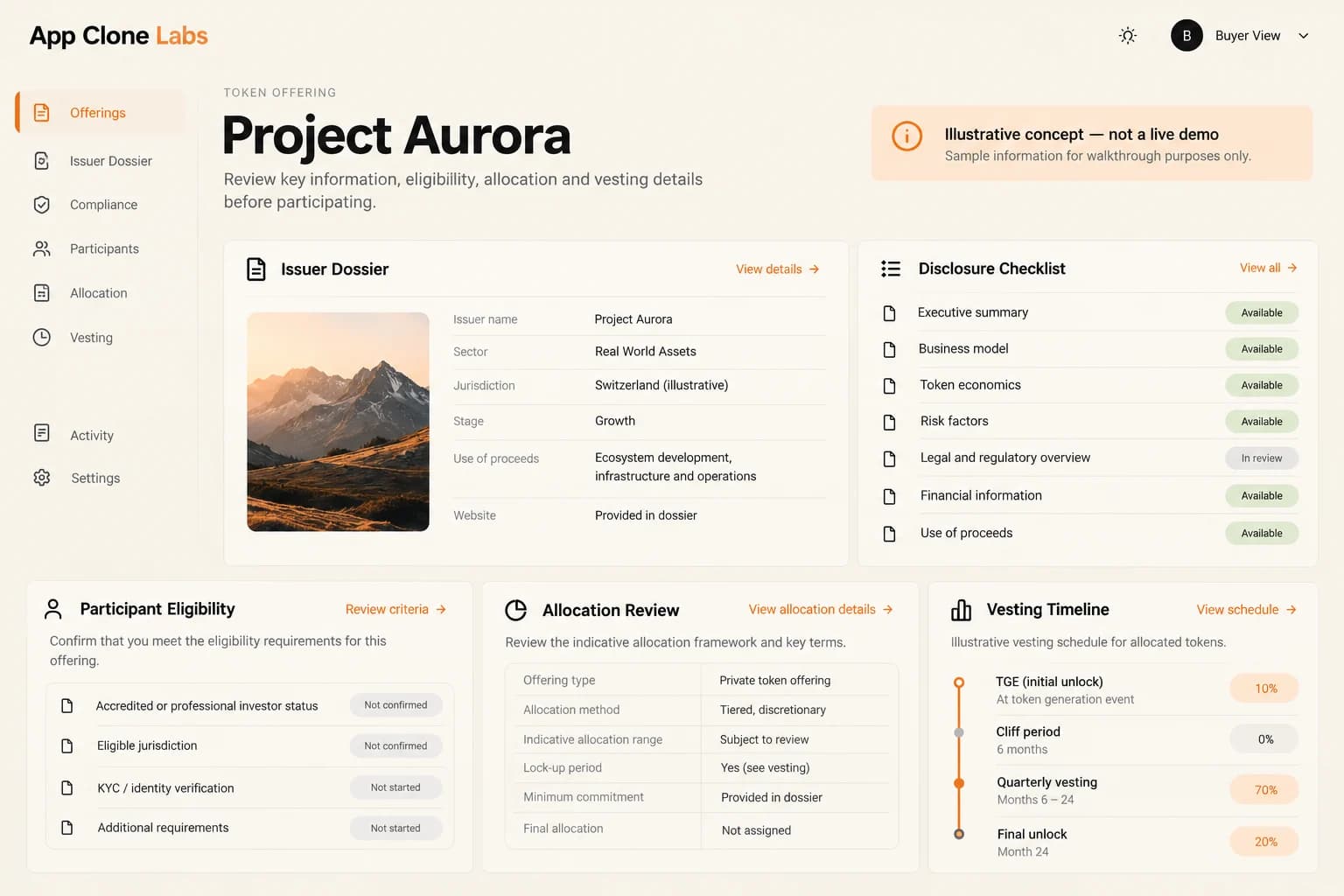
Original offering-review concept. Issuer information and decisions are illustrative and do not establish a token offering, compliance approval, smart contract or investor outcome.
Product flow
A visual map of how each role interacts with each workflow stage, with operator controls and integration boundaries.
Deployable Product Architecture
ICO Launchpad-style Offering Portal
Monetization
We model monetization early so payments, admin controls, and reporting support the business.
Specify included diligence support, document administration and reporting. A fee does not purchase approval, successful fundraising or permission to launch.
Establish who may charge each fee, when it is due and how cancellation affects it. Do not assume software operation permits compensation tied to securities transactions.
Define reporting, retention and support responsibilities under the selected arrangement. Recordkeeping software does not confer registration or certify an offering’s compliance.
Artifact register
Reference screens illustrate workflows, not a contracted feature list. Sample prices, data, and responses are demonstration content; confirm the current scope during a walkthrough.
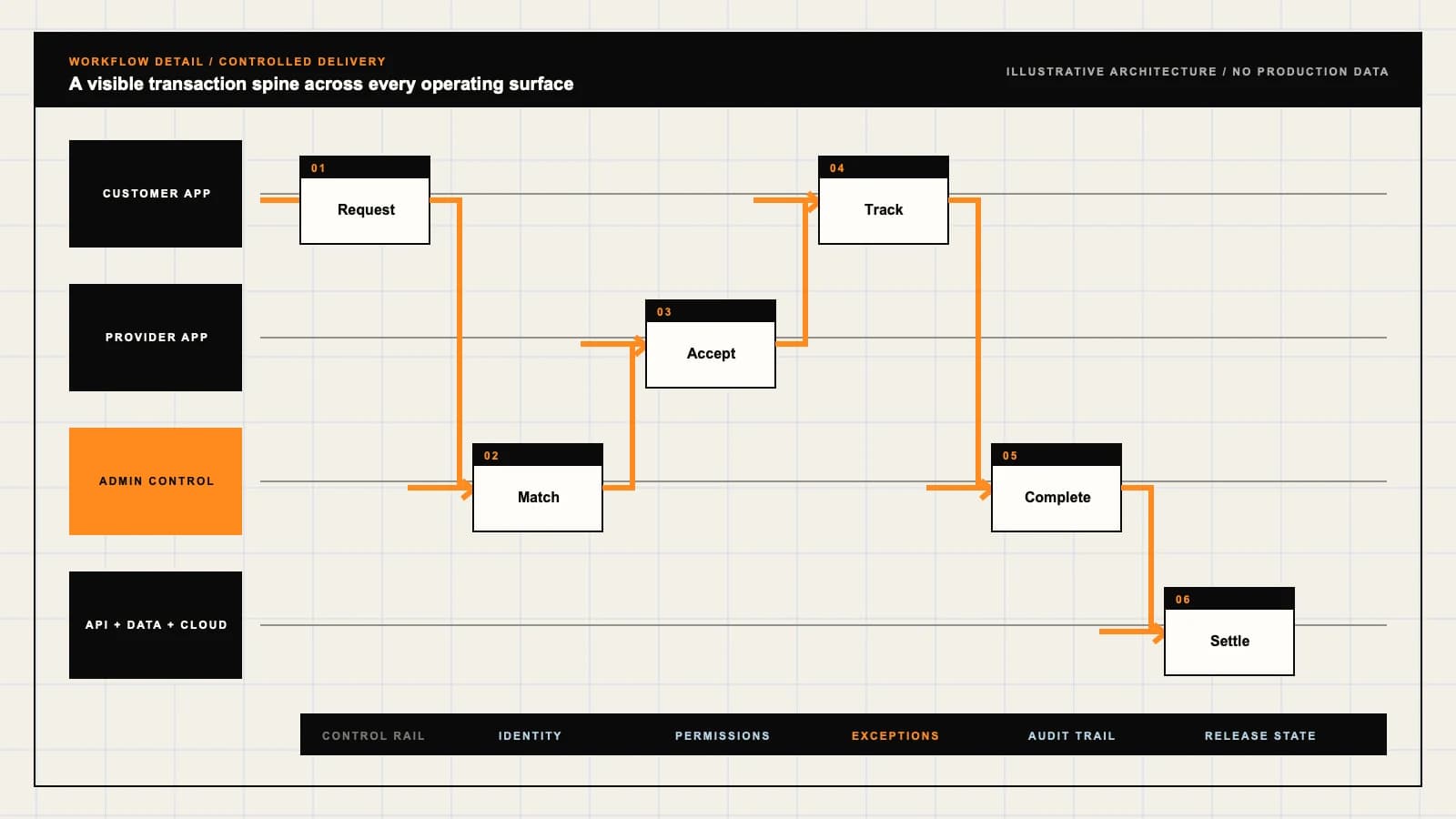
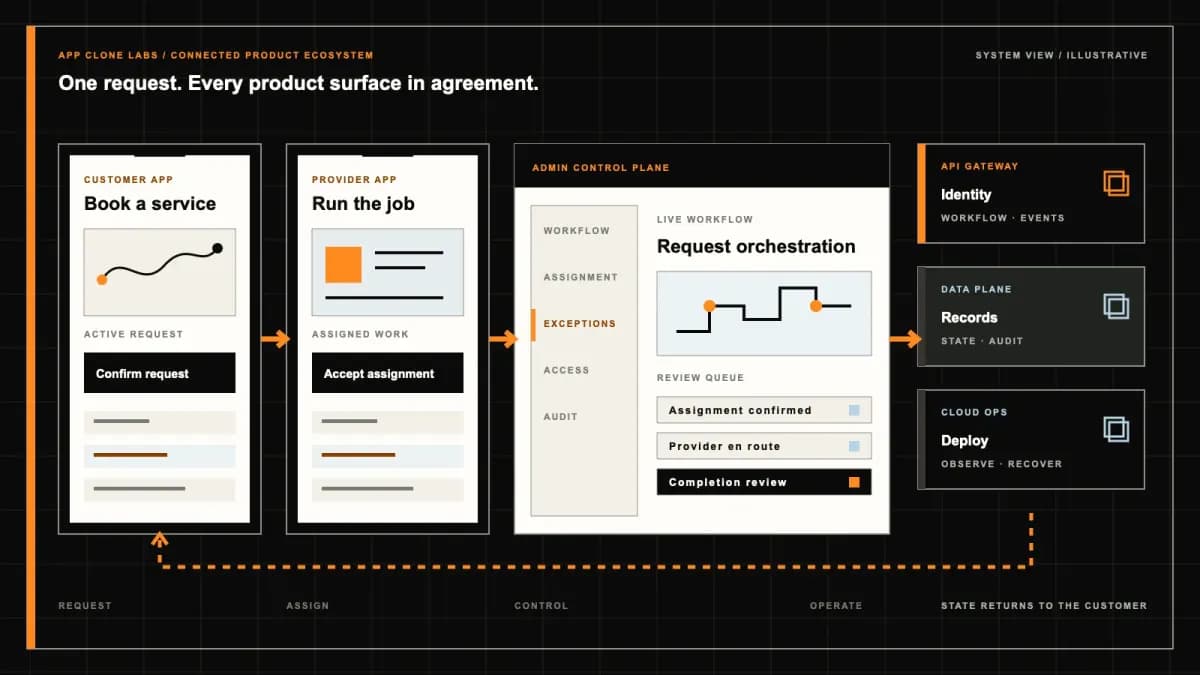
A purchaser accepts an offering document and submits a subscription, but the contribution remains unconfirmed when the closing deadline arrives. The issuer dashboard must not count that commitment as settled proceeds or release funds because a progress bar reached its target. An ICO launchpad-style offering portal coordinates issuer review, purchaser eligibility, documented subscriptions and controlled delivery. Each step needs evidence and an accountable decision owner, especially when the expected close does not occur.
App Clone Labs scopes administration software for separately authorized offering arrangements. Delivery does not establish legal approval, required registrations, available custody services or permission to launch a token offering. No returns, exchange listing, liquidity or fundraising success are guaranteed. The operator and qualified advisers must establish the permissible structure and selling activity for the intended issuer, purchasers and jurisdictions before real participation begins.
Collect the issuer’s entity information, authorized representatives, proposed token rights and intended use of proceeds in a restricted diligence case. Assign reviewers and record unresolved questions alongside the supporting evidence. An identity check establishes only the outcome of that check; it does not validate the commercial plan or authorize the sale. Keep an incomplete application distinguishable from a reviewed offering ready for the next permitted step.
Define who may approve publication, request amendments or reject the application. Marketing access should follow the established offering restrictions rather than become available automatically when an issuer pays an administration fee. Rehearse a representative losing authority during review and a material project change before publication. Preserve the earlier evidence and require the designated owners to resolve the change. A public listing must not appear merely because the technical configuration is complete.
The SEC’s official offering pathways resource explains that a business may not offer or sell securities in the United States unless the offering is registered or an exemption applies. This is a narrow U.S. securities reference, not a determination that a particular token has a specific classification or qualifies for an exemption.
Qualified legal review must establish classification, issuer permissions, purchaser categories and relevant marketing or transfer restrictions for the actual arrangement. The portal records the approved operating boundary; it does not decide legal status from a token name or automatically apply a foreign framework. Rehearse an offering open to one reviewed purchaser category but unavailable in another jurisdiction. Explain the access outcome without exposing confidential diligence. These product requirements are not legal advice or a substitute for the required professional assessment.
Maintain the approved offering documents, risk disclosures, token rights, fees and closing conditions as a versioned record. Let permitted purchasers inspect the applicable material before acceptance. Record which version they received and accepted, with an understandable date and offering identity. Publishing a replacement PDF must not silently rewrite the terms associated with an earlier subscription.
Define the review and notification route for changed disclosures. The authorized reviewers must decide whether subscriptions pause, require renewed acceptance or follow another permitted treatment. Rehearse a corrected deadline and an amended use-of-proceeds statement while funding remains pending. Preserve prior versions with restricted access and explain the next required purchaser action. Avoid presenting a document-room badge as a promise that the issuer’s claims have been independently proven or that the offering carries government endorsement.
Disclose permitted administration and participation charges with the same care as the subscription terms. Identify the charging entity, due date and treatment if the offering does not close. An issuer service agreement must not imply that paying for software buys a favorable diligence outcome. Review any proposed transaction-linked compensation with qualified advisers rather than assuming it is authorized because the portal can calculate it. Keep charges distinguishable from contributions held for the offering.
An address connecting successfully does not establish identity, eligibility or authority to act for an organization. Apply the purchaser checks required by the reviewed offering structure, including jurisdiction and any applicable category restrictions. Limit access to restricted material and subscriptions accordingly. Explain missing information and pending review without suggesting that a small contribution bypasses the rules.
Recheck relevant permissions at the required decision points rather than trusting an old browser state. Define how expiring evidence, changed purchaser information and denied eligibility affect a pending subscription. Rehearse a purchaser changing jurisdiction after viewing documents and a representative attempting to subscribe on behalf of a different entity. Keep sensitive supporting records restricted. A general access plan or priority membership must never become an undocumented substitute for the offering’s actual eligibility requirements.
Distinguish an expression of interest, a submitted subscription, accepted terms, a funding instruction and confirmed contribution. Define the point at which the issuer or authorized operator accepts a subscription under the documented arrangement. Show its relationship to payment evidence without claiming that a signed form means funds arrived. Preserve currency, asset, offering and purchaser references across each state.
Compare the tiered token allocation portal when participation tiers and allocation administration are the starting point. This offering portal emphasizes diligence, disclosure acceptance and subscription evidence rather than ranking access by tier. Test a partial contribution, a payment with no accepted subscription and a duplicated confirmation. Operations should assign an exception and reconcile the difference instead of changing the subscription amount until the totals look consistent.
Where applicable, define the minimum funding condition, maximum accepted amount and closing deadline in the reviewed terms. Specify which confirmed contributions count, how valuation is determined and how late or excess funds are handled. An optimistic total that includes unresolved payments must not trigger an issuer release. Use exact financial calculations and preserve the evidence behind the close decision.
Rehearse simultaneous contributions near the hard cap and a confirmation received after the deadline. Determine whether the result is accepted, rejected, held for review or refunded under the approved terms. Do not silently extend a deadline because the target was missed. If terms allow a change, follow the established disclosure and acceptance process. The purchaser view should show the actual outcome and next step, while the operator can inspect the records used to calculate it.
Map where contributions are held, who controls the relevant accounts or keys and what conditions permit movement. Describe an arrangement as escrow only when the actual custody terms support that description. A contract address on a page is not evidence of independent custody or protection. Restrict release instructions separately from issuer editing, customer support and document publication permissions.
Require the authorized release process to use reconciled funding and documented close conditions. Preserve approval, instruction and confirmed transfer evidence independently. Rehearse a release request while a contribution remains disputed and an uncertain transfer after a network interruption. Check the first outcome before retrying movement of assets. Software configuration must not provide an issuer with an undisclosed route around the agreed custody boundary, even when the dashboard indicates that the offering has reached its displayed target.
OpenZeppelin’s official vesting wallet reference describes releasing native assets and ERC-20 tokens to a beneficiary according to a schedule. It illustrates a technical vesting primitive, not a complete offering system, a reviewed deployment or legal permission for a token distribution. Contract selection and independent assessment remain separate work.
Specify allocation evidence, beneficiary identity, token contract, network, start time and schedule before enabling a claim. Distinguish allocated, funded, vested, claimable and confirmed delivery amounts. A countdown reaching zero does not prove the delivery contract contains sufficient assets. Test a claim before the start, a duplicated request and a late funding change. Review whether the selected contract behavior matches the disclosed schedule; a familiar library name cannot replace verification of the actual implementation and deployment.
A failed soft cap, rejected contribution or canceled offering needs the treatment established in its terms. Identify who authorizes the remedy and which assets, amounts and destinations it covers. Separate an approved refund from a submitted transfer and its confirmed outcome. Explain pending cases without promising immediate return when the provider or network has not confirmed delivery.
Rehearse a failed close with several contribution assets, an unavailable purchaser destination and a refund instruction interrupted after submission. Keep unresolved funds and exceptions visible. Any deductions or conversion treatment require the appropriate disclosure and authority rather than an operator inventing a convenient policy during support. Financial correction should preserve the original subscription, document version and eligibility evidence. Do not mark every purchaser refunded merely because one aggregate custody balance moved or the offering page was removed.
Define retention and access for issuer diligence, purchaser eligibility, accepted disclosures, custody events and distribution records. Make corrections attributable instead of overwriting the evidence behind a completed close. A customer-service team should see the records needed for its case without gaining broad access to confidential purchaser documents. Establish a handover route if the issuer changes representatives or a service provider becomes unavailable.
Use the reviewed self-service launch brief when issuer configuration is the main entry point. This portal organizes the offering record and purchaser lifecycle around explicit approval gates. Test a reporting correction after token delivery and a purchaser asking about transfer restrictions. Delivery does not establish permission to resell. Preserve applicable notices and an accountable support owner without implying that the operator guarantees future liquidity or a continuing market for the token.
An illustrative demo should use a fictional issuer, synthetic purchaser records and test-network assets. Buyer acceptance should reject an incomplete issuer, block an ineligible subscription and preserve a disclosure change. Submit a commitment without funding, reach a cap with confirmed test contributions and close another offering below its minimum. Inspect controlled release, an early vesting claim and an unresolved refund from issuer, purchaser and reviewer views.
Bring one reviewed offering structure to an offering portal scope discussion to agree eligibility gates, custody responsibilities, document versions and concrete failure cases.
Use the delivery process to establish source-code rights, provider permissions, contract assessment, deployment responsibility and release review. Acceptance should demonstrate restricted and uncertain outcomes alongside successful delivery; no walkthrough establishes legal approval, investment returns or launch permissions.
FAQ
It organizes issuer diligence, reviewed disclosures, purchaser eligibility, subscriptions, contribution evidence and controlled distribution or refunds around a separately established offering arrangement.
No. Classification, registrations or exemptions, selling permissions, disclosures and custody arrangements require separate qualified review for the actual issuer and jurisdictions.
No. It establishes only the outcome of the specified check. Publication and participation need the other review gates and designated approval owners.
It identifies the terms the purchaser received and accepted. Revisions need the established review and notification process rather than silently replacing earlier evidence.
No. Apply the jurisdiction, identity and category checks required by the reviewed structure. Recheck relevant permissions at the required subscription and funding decisions.
No. Keep submitted subscriptions, acceptance, funding instructions and confirmed contributions separate. Reconcile partial, duplicate and unmatched payments before using them in close calculations.
Apply the approved terms to reconciled contributions and documented deadlines. Define late and excess funding treatment and do not silently change conditions after participation begins.
No. Use escrow wording only when the actual custody arrangement supports it. Establish who controls funds and restrict release authority independently of ordinary portal administration.
No. Confirm beneficiary, network, contract funding, schedule and actual claim status. Allocated, vested, claimable and confirmed delivered amounts answer different questions.
Use the authorized remedy and confirmed transfer evidence. An approved instruction or aggregate custody movement does not prove each purchaser received the correct amount.
No. Offering administration and token delivery establish none of those outcomes. Post-delivery transfer permissions and service obligations require their own reviewed treatment.
Use fictional records and test-network assets for rejected issuers, ineligible purchasers, changed disclosures, unfunded commitments, cap boundaries, controlled release, early claims and unresolved refunds.
Solution reference register
01 / Reference and IP
This page references third-party product names only to describe familiar product models and planning references. App Clone Labs is not affiliated with or endorsed by those brands. Build decisions require independent legal, regulatory, and operational review for your market.
02 / Regulatory caveat
Confirm licensing and market-specific authorization before enabling regulated activity · Define whether assets or funds are held by the operator, a qualified custodian, or not held at all · Apply security review, strong authentication, encryption, audit logging, recovery, and incident response · Present educational product information only and prohibit personalized financial, legal, tax, or wagering advice · Obtain legal classification of each token and offering and enforce investor, marketing, sanctions, and distribution restrictions · No offering may proceed without qualified legal review, required registrations or exemptions, and approved disclosures
Primary sources
Dated official documentation, standards, and research that support the factual claims on this page.
How to read this page
Scope, cost and timeline figures are planning guidance until confirmed in a written proposal. Diagrams and screens are illustrations, not client deliverables, and source-code rights and handover follow the signed agreement. See the delivery process and the full disclaimer.
Next decision
Define outcomes, constraints, evidence, rights and handover before delivery begins.
Commercial rights, repositories, environments, documentation, acceptance and handover remain contract-defined.