
01Configure and review
Validate the sale before publication
Bind token, network, caps, timing, fee terms and distribution rules to the reviewed contract. Keep unresolved issuer or permission checks visibly pending.
Token issuance and launch platforms
Issuer-configured token sale administration with mandatory review and participant restrictions. Planned for authorized launch operators standardizing smaller token-offering workflows with role-specific workflows, operator controls, integrations, and a handover boundary defined for the selected market.
See product screens and demo accessCustom workflows
Brand-safe product strategy
Admin and operations tooling
Reference walkthrough by arrangement
Workflow
Each workflow stage is mapped to a role, screen, API, notification, admin control, and measurable launch outcome.
Bind token, network, caps, timing, fee terms and distribution rules to the reviewed contract. Keep unresolved issuer or permission checks visibly pending.
Validate wallet eligibility and remaining capacity at acceptance. Reconcile confirmed contributions independently of browser messages and delayed event indexing.
Follow the approved contract path for claims, liquidity actions or refunds. Preserve uncertain transactions and outstanding participant obligations for investigation.
Deployable Product Architecture
Workflow / system register
Product delivery loop
A focused release proves one complete workflow
Validate the sale before publication
Enforce the current participation rules
Resolve the recorded launch outcome
Control note
Scope the customer action and the operator response as one system.
Operator controls
The control center is scoped as a first-class product surface, not an afterthought.
Record token addresses, decimal precision, pool identity and mutable parameters. Prevent an issuer editing approved terms into a different launch without renewed approval.
Separate issuer editing, reviewer approval, publication, cancellation and treasury authority. Review delegated access, emergency permissions and administrative contract powers.
Track contributions, distributions, refunds and lock transactions against chain evidence. A contract review or liquidity lock cannot establish issuer legitimacy or lawful permission.
Integrations
External systems that determine launch readiness, data flow, and operational continuity.
Authorized issuer diligence, offering-document and participant eligibility systems with versioned decisions and restricted access
Reviewed deployment, wallet and chain observation services with explicit contract identity, supported assets and transaction reconciliation
Selected liquidity router, lock and vesting services with verified permissions, event evidence and staffed exception ownership
Scope drivers
The variables that most influence build effort, cost, and launch readiness.
Choose supported networks, funding assets, listing modes and contract templates. Each variant adds validation, transaction and failure-path obligations.
Define caps, close conditions, cancellation, refunds, liquidity allocation and vesting. Distinguish token inventory handling from return of contribution funds.
Identify approval owners, access reviews, monitoring and incident coverage. More simultaneous launches increase reconciliation and participant communication responsibilities.
Deployable Product Architecture
Scope drivers / system register
Product delivery loop
A focused release proves one complete workflow
Count the combinations requiring review
Specify every participant outcome
Budget for consequential decisions
Control note
Scope the customer action and the operator response as one system.
V1 scope
Launch the smallest complete operating loop first, then scale the product with confidence.
Use a fictional token and bounded network configuration with explicit caps, timing, fees and role permissions. Reject a changed deployment after approval.
Demonstrate eligibility checks, concurrent cap enforcement, delayed confirmations and failed-soft-cap refunds using synthetic wallets and transaction records.
Show selected listing instructions, lock references and claim schedules. Test failed finalization, early claims and a support case for an uncertain transaction.
Later phases
Capabilities that should usually wait until real usage proves the core loop.
Add fair launches or private sales only with their own permissions, funding rules, disclosure review and complete participant outcome tests.
Add chains, funding assets and routers after reviewing contract compatibility, exact-unit arithmetic, lock evidence and monitoring behavior for each combination.
Add scoped issuer-change signals and lock-expiry monitoring with clear escalation. Automated alerts assist investigation without certifying legitimacy or investment safety.
Deployable Product Architecture
Later phases / system register
Product delivery loop
A focused release proves one complete workflow
Expand after proving one lifecycle
Validate each deployment environment
Extend attributable operational review
Control note
Scope the customer action and the operator response as one system.
Regulatory review
Each flag must be reviewed by qualified counsel for your target market before build or launch.
Reference walkthrough
Ask us to confirm which reference surfaces are currently available for this product model. Rather than publishing shared demo credentials, we schedule a private guided walkthrough for qualified buyers.
Request a role-specific demonstration and confirm which capabilities are currently available. Review the proposed responsibility: Submit token identity, sale parameters, funding asset, liquidity instructions and vesting schedules. Configuration access cannot authorize publication or release proceeds.
Request a role-specific demonstration and confirm which capabilities are currently available. Review the proposed responsibility: Review issuer evidence, offering permissions, contract behavior and participant restrictions against a versioned configuration. Require renewed review after consequential changes.
Request a role-specific demonstration and confirm which capabilities are currently available. Review the proposed responsibility: Inspect approved terms, connect the intended wallet and track contributions, claims or refunds. Support investigates transaction evidence without requesting private keys.
Request a live, private walkthrough of the reference implementation. We will confirm scope and discuss configured deployment versus custom build for your market.
Open registerDeployable Product Architecture
Reference walkthrough / system register
Product delivery loop
A focused release proves one complete workflow
Issuer configuration team: Prepare a reviewable launch
Launch and contract reviewers: Approve the actual deployment
Eligible participants and support: Follow contributions to their outcome
Book a walkthrough
Control note
Scope the customer action and the operator response as one system.
User roles
Clone-inspired platforms usually need several coordinated interfaces, not just a customer app.
Submit token identity, sale parameters, funding asset, liquidity instructions and vesting schedules. Configuration access cannot authorize publication or release proceeds.
Review issuer evidence, offering permissions, contract behavior and participant restrictions against a versioned configuration. Require renewed review after consequential changes.
Inspect approved terms, connect the intended wallet and track contributions, claims or refunds. Support investigates transaction evidence without requesting private keys.
A self-service launch interface still needs an accountable approval path. Use this offering-review concept to discuss issuer submissions, sale parameters and distribution evidence. It is not PinkSale UI, an active sale, contract audit, legal approval or proof of permission to operate.
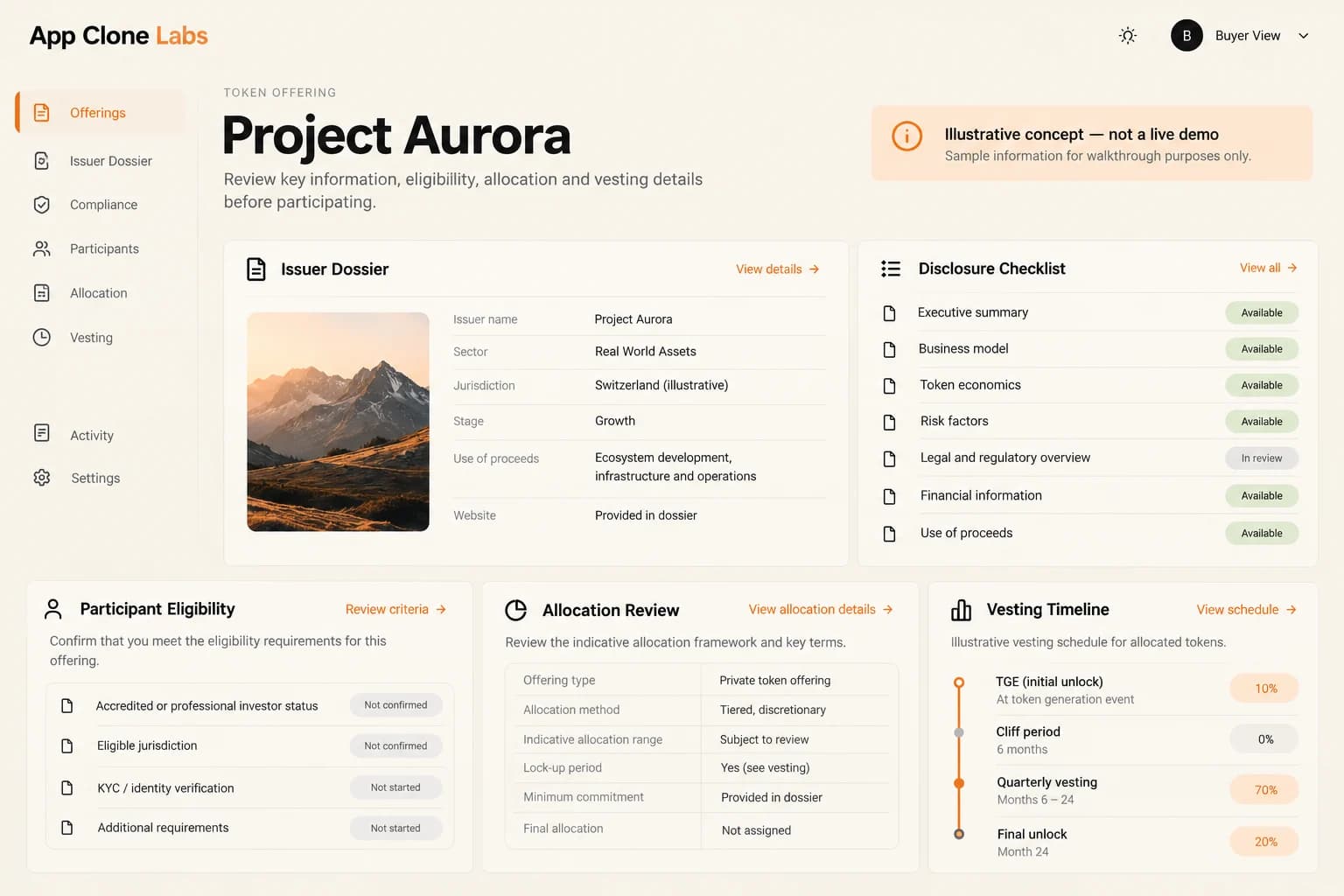
Offering review concept reused for this planning model. The image does not show a complete self-service sale wizard, liquidity setup or deployed contract; request those specific paths in a separately validated demonstration.
Product flow
A visual map of how each role interacts with each workflow stage, with operator controls and integration boundaries.
Deployable Product Architecture
PinkSale-style Self-service Token Launch
Monetization
We model monetization early so payments, admin controls, and reporting support the business.
Price defined issuer administration work without implying that payment buys approval, an audit endorsement or guaranteed publication of an offering.
Document supported service fees, funding assets, cancellation treatment and applicable permissions. Avoid revenue assumptions based on token appreciation or guaranteed fundraising.
Specify vesting support, lock evidence, reconciliation and incident ownership. Monitoring availability does not promise prevention of losses or recovery of funds.
Artifact register
Reference screens illustrate workflows, not a contracted feature list. Sample prices, data, and responses are demonstration content; confirm the current scope during a walkthrough.
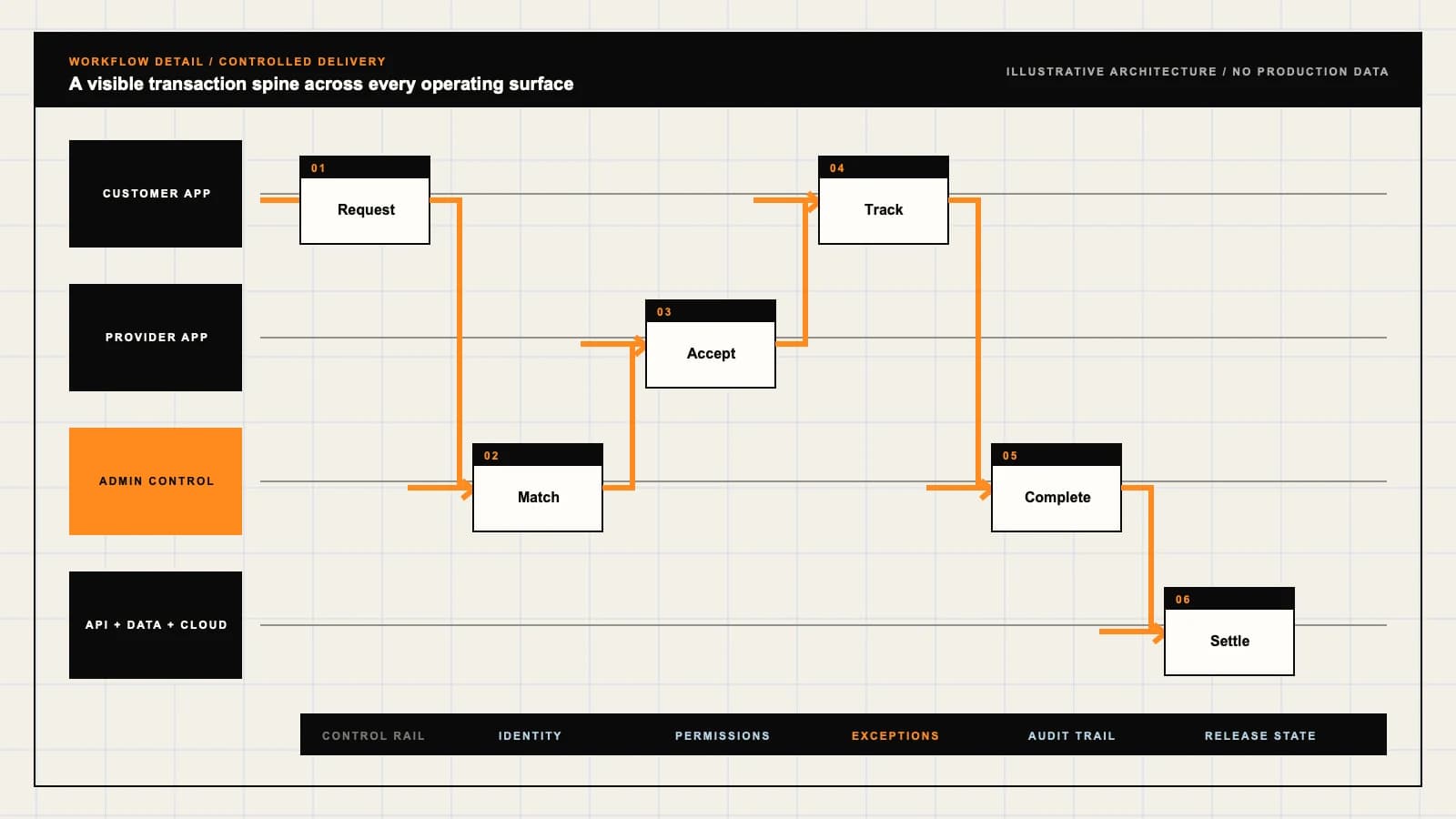
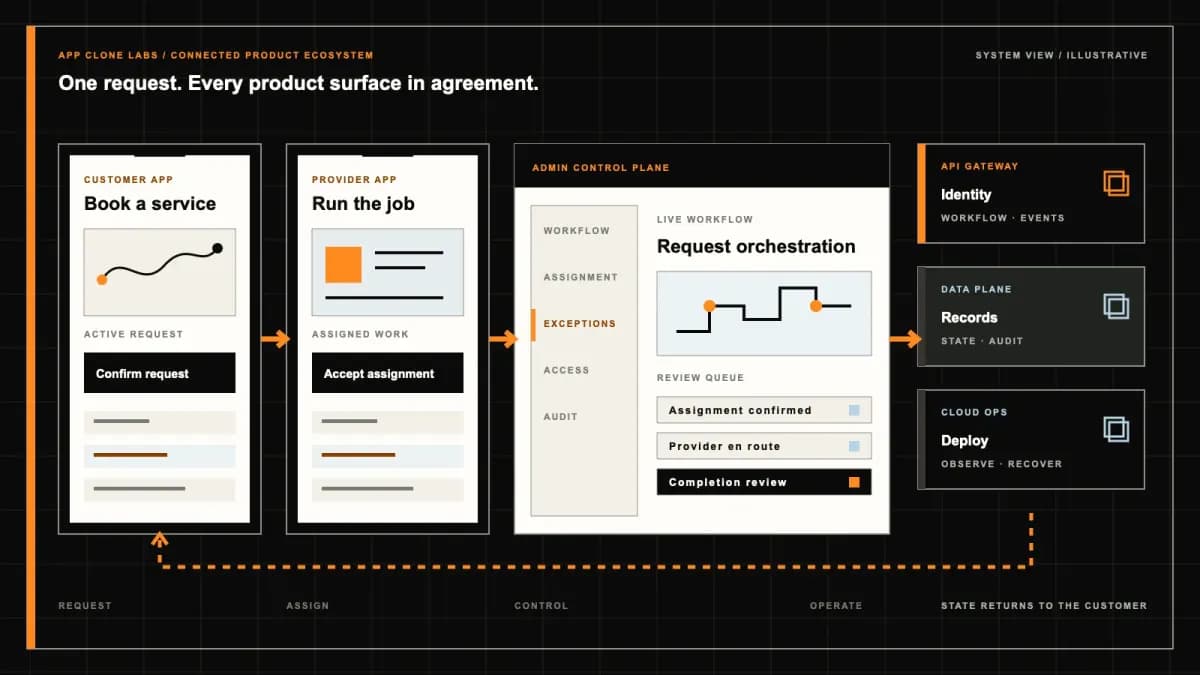
An issuer configures a fictional token, ORCHID, with a minimum funding target, maximum raise, liquidity allocation and monthly participant releases. The screen accepts every field, but the sale contract belongs to another network and the reviewer approved an earlier vesting schedule. A PinkSale-style launch platform must catch that mismatch before publication. A completed form is only a proposed configuration, not evidence that the offering or its transactions are ready.
App Clone Labs scopes independently branded token launch software around accountable issuer setup and participant outcomes. This reference does not imply PinkSale affiliation, access to its contracts or providers, offering permission or guaranteed fundraising. No investment returns are guaranteed. Establish classification, selling permissions and actual provider arrangements separately. The useful product boundary is a launch that reviewers can authorize and participants can follow through contribution, finalization, claim or refund.
Collect the issuer identity, responsible contacts, token purpose, proposed participants and supporting offering documents before enabling a public sale. Record the reviewer, decision and evidence version. Keep an application received separate from permission to market, accept contributions or distribute tokens. A familiar project name, published website or wallet signature cannot establish the legal authority needed for the proposed activity.
Define correction, rejection and renewed review paths. A new token contract, changed fundraising jurisdiction or altered distribution schedule can change the facts behind approval. Retain prior decisions while restricting private documents to their intended reviewers. Test an issuer replacing ORCHID’s contract after approval and an administrator trying to publish an unresolved application. The outcome should identify which decision is missing and who owns it, without exposing confidential diligence material to participants or unrelated issuer accounts.
PinkSale’s presale creation documentation describes token selection, caps, contribution limits, listing configuration, timing and optional contributor vesting. These fields provide a reference for the configuration journey; independently verify the deployed contract and selected network rather than assuming that every launch format shares the same rules.
Validate the token address, funding asset, decimal precision, presale rate and pool identity together. Express amounts in exact units at contract and accounting boundaries. Distinguish token spending approval from the transaction creating the pool, and show the spender and network before signing. Rehearse an approval succeeding while creation fails, an unsupported token transfer rule and a wallet changing networks during review. Preserve transaction references so retrying the form cannot create a second pool or silently reinterpret the funding amount.
A soft cap describes the selected minimum funding condition; a hard cap limits accepted contributions under the actual contract. Per-wallet minimums and maximums add separate constraints. Decide which checks happen before submission and which are enforced during execution. The final accepted total must remain correct when several participants attempt to purchase the last available allocation at once.
Use synthetic contributions to reach ORCHID’s cap boundary, including an amount one smallest unit above the remaining capacity. Test repeated submissions, a participant returning with an existing contribution and an ineligible wallet using a direct contract call. Explain whether an over-limit request fails or follows another explicitly supported behavior. Do not silently change its amount. Describe wallet-based limits honestly: one address is not proof of one person, and browser controls cannot replace restrictions required in the actual acceptance path.
Retain the configuration version and eligibility decision associated with each accepted contribution. A later change to the displayed maximum must not rewrite the terms attached to an earlier transaction. Review how approved amendments are communicated, whether existing participants are affected and which changes the chosen contract actually permits. Reject unsupported amendments before asking an issuer to sign.
Define the sale opening and closing instants, authoritative time source and display timezone. Explain a transaction submitted before close but executed afterward according to the reviewed contract. A countdown reaching zero is not itself evidence that a chain transaction finalized or that a launch achieved its funding condition. Keep scheduled, open, ended and finalized states distinct.
Show disconnected, wrong-network and insufficient-gas states before asking a participant to act. Rehearse an RPC outage at opening, a transaction replaced in the wallet and delayed event indexing after acceptance. An uncertain transaction needs investigation before a retry is recommended. Preserve its network, hash, sender and relevant pool reference. Eligibility decisions also need a defined effective point: a participant approved yesterday may not remain eligible when the contribution is accepted under today’s offering restrictions.
The official contribution withdrawal guide describes participant withdrawal after failed funding conditions or cancellation, using the contributing wallet and a withdrawal transaction. It also distinguishes a sale meeting its soft cap from one failing that condition. These documented conditions do not create universal refund rights for an independent deployment.
Specify the selected contract’s failed-sale and cancellation paths before accepting funds. Separate refunds of contributions from return or burning of unsold token inventory; similar interface labels must not conceal different assets or recipients. Test a failed soft cap, a canceled pool, a second withdrawal attempt and a wallet without gas. Keep refundable, submitted and confirmed amounts distinct. Support should inspect transaction evidence when a balance display lags rather than promise that every failure or dissatisfaction can be reversed.
Meeting the configured funding condition does not prove that finalization completed. Document who may finalize, required token inventory, permitted fees, proceeds destination and the resulting participant claim state. Reconcile accepted contributions against fees, liquidity allocation and remaining proceeds using the actual selected calculation. A browser success banner cannot replace evidence that the relevant transaction executed.
Test finalization with insufficient token inventory, a rejected router interaction and a signer losing connectivity after submission. Preserve confirmed steps and unresolved obligations instead of replaying every instruction blindly. Operations should know whether a retry is safe and which contract state permits it. A failed liquidity action must not become an unexplained disappearance of participant claims. Maintain historical configuration and transaction records so reviewers can reconstruct the authorized distribution, including any rounding remainder and its documented disposition.
Choose automatic or manual liquidity provisioning explicitly. Record the router, asset pair, intended contribution, listing rate and evidence required before describing liquidity as added. Manual instructions require an accountable owner and verification; issuing a task to create a pool is not equivalent to a confirmed pool. Initial configuration also cannot guarantee a future trading price or usable market depth.
For a lock, display the locked asset, amount, beneficiary, contract and release conditions supported by transaction evidence. Distinguish liquidity positions from issuer tokens and contributor vesting. Test the wrong pair, an unconfirmed lock and expiry while participants still hold vested tokens. A lock restricts the specified asset under its contract; it does not prove issuer legitimacy, eliminate every administrative power or prevent all losses. Review the remaining token and contract authorities separately before publishing claims about protective controls.
Assign an owner to lock expiry notices and discrepancies between published terms and observed state. Keep the original promise visible during investigation, with a dated correction when evidence changes. A refreshed chart should never silently replace the historical record a participant relied on when contributing.
Specify the initial release, cliff if any, cycle interval, subsequent amounts and final remainder. Show total entitlement, previously claimed tokens, currently claimable tokens and future releases independently. Use the reviewed schedule and authoritative contract state to calculate availability. A marketing calendar or locally advanced browser clock must not make an early release appear authorized.
Rehearse ORCHID’s first claim, a request immediately before the next cycle, a duplicated claim and the final smallest-unit remainder. Confirm that repeated processing cannot distribute the same entitlement twice. Distinguish a claim submitted from tokens confirmed in the participant wallet, including a failed transfer caused by token restrictions. Keep contributor vesting separate from team allocations and proceeds release. Each schedule has different beneficiaries and obligations, even when a dashboard groups them under a single vesting label.
Separate issuer drafting, diligence approval, launch publication, cancellation and treasury actions. Inspect the actual contract’s owner and upgrade powers alongside application roles. Removing a staff account from the website does not revoke a separately held on-chain administrative key. Review delegated access, departed team members and emergency authority with named owners and evidence of revocation.
Rehearse an issuer attempting to edit an approved cap, a reviewer trying to withdraw proceeds and support attempting to reveal another participant’s private documents. Record consequential decisions and preserve the configuration used for each transaction. Badges should state what was checked, by whom and against which evidence; a contract audit is not permission to sell a token. Incident handling needs a defined escalation and communication path, with uncertainty stated clearly when the available evidence cannot establish the final funds position.
Compare the ICO offering administration portal when the central requirement is issuer diligence, offering documents and controlled subscriptions. A self-service presale brief concentrates on the reviewed configuration that will actually execute, including limits, liquidity instructions, claims and failure outcomes.
Review the BSCPad-style allocation portal for tiered participation and allocation administration. Begin here with one approved presale format, supported network and funding asset. Expand only after proving the complete lifecycle and operational ownership. Fair launches, subscriptions and private sales need their own reviewed rules; copying a configuration form cannot establish equivalent distribution behavior, participant eligibility or selling permissions. Price the scope around supported combinations and exception coverage, with service charges disclosed independently of token performance.
Use a synthetic sandbox with fictional ORCHID tokens, participant wallets and controlled transaction records. Buyer acceptance should reject a changed contract, enforce concurrent contribution limits and expose an uncertain submission. Run both successful and failed funding outcomes. Verify refund evidence, finalization failure, liquidity-lock references and vesting claims across issuer, participant, reviewer and support views.
Bring one launch configuration and its failure conditions to a scope discussion. Agree the contracts, permissions, provider dependencies and operational decisions requiring independent verification before estimating a delivery commitment. Illustrative screens are not evidence of a deployed offering or protective control.
Use our delivery process to define acceptance evidence, access review and handover ownership. The buyer should receive the configuration history, transaction trace and unresolved exception record needed to judge the supported lifecycle.
FAQ
It covers independently branded presale configuration and administration, including reviewed issuer intake, contribution rules, launch outcomes, liquidity instructions and participant claims. Provider access requires separate arrangements.
No. Token classification, issuer diligence, marketing restrictions and selling permissions need independent review. Technical deployment and a completed configuration form cannot establish lawful authorization.
Bind both funding conditions to the reviewed contract and exact funding units. Test concurrent contributions at the boundary and explain what happens to rejected requests.
No. One wallet address is not proof of one person. Define independently required participant checks and enforce applicable restrictions in the actual contribution acceptance path.
Availability depends on the reviewed contract and offering conditions, including supported failed-sale or cancellation paths. Distinguish contribution refunds from unsold token return or burning.
No. Finalization, liquidity actions and participant claims have their own conditions and evidence. Reconcile each step before describing proceeds or tokens as successfully distributed.
No. A lock restricts a specified asset under particular contract conditions. It cannot establish issuer legitimacy, selling permission, guaranteed market depth or protection against every loss.
Automatic provisioning uses the selected contract path, while manual provisioning needs an accountable owner and verified completion. Neither configuration alone proves a usable trading market exists.
Show total entitlement, previous claims, current availability and future releases under the reviewed schedule. Test early requests, duplicate claims and the final smallest-unit remainder.
Review issuer editing, approval, publication, cancellation and treasury authority alongside contract ownership and upgrade powers. Website account removal does not revoke independently controlled administrative keys.
Start with one reviewed presale format, network and funding asset. Include complete contribution, refund, finalization, liquidity evidence, vesting and support exception paths before expanding.
Use fictional tokens and synthetic wallets to test changed configurations, concurrent caps, uncertain transactions, failed funding, refunds, finalization failures, lock evidence and repeat vesting claims.
Solution reference register
01 / Reference and IP
This page references third-party product names only to describe familiar product models and planning references. App Clone Labs is not affiliated with or endorsed by those brands. Build decisions require independent legal, regulatory, and operational review for your market.
02 / Regulatory caveat
Confirm licensing and market-specific authorization before enabling regulated activity · Define whether assets or funds are held by the operator, a qualified custodian, or not held at all · Apply security review, strong authentication, encryption, audit logging, recovery, and incident response · Present educational product information only and prohibit personalized financial, legal, tax, or wagering advice · Obtain legal classification of each token and offering and enforce investor, marketing, sanctions, and distribution restrictions · Self-service configuration must not bypass issuer diligence, legal approval, contract review, or custody controls
Primary sources
Dated official documentation, standards, and research that support the factual claims on this page.
How to read this page
Scope, cost and timeline figures are planning guidance until confirmed in a written proposal. Diagrams and screens are illustrations, not client deliverables, and source-code rights and handover follow the signed agreement. See the delivery process and the full disclaimer.
Next decision
Define outcomes, constraints, evidence, rights and handover before delivery begins.
Commercial rights, repositories, environments, documentation, acceptance and handover remain contract-defined.
App Clone Labs is not affiliated with, sponsored by, or endorsed by PinkSale. The name identifies a familiar product category; every delivered product is independently designed and built, and the mark remains its owner's property. Read the full legal notice.
