
01Evaluate and configure
Approve the asset and each supported route
Review classification, contracts, networks, precision and custody compatibility. Keep a draft listing unavailable until the required operating decisions are recorded.
Digital-asset exchange
Centralized digital-asset venue with a broad listing pipeline and spot market operations. Planned for authorized exchanges managing asset intake, spot liquidity, and transfer risk at catalog scale with role-specific workflows, operator controls, integrations, and a handover boundary defined for the selected market.
See product screens and demo accessCustom workflows
Brand-safe product strategy
Admin and operations tooling
Reference walkthrough by arrangement
Workflow
Each workflow stage is mapped to a role, screen, API, notification, admin control, and measurable launch outcome.
Review classification, contracts, networks, precision and custody compatibility. Keep a draft listing unavailable until the required operating decisions are recorded.
Enable selected spot pairs with versioned order rules, fresh data and independently established participation. Monitor issuer changes, abuse signals and network health.
Scope pauses and delisting across orders, deposits and withdrawals. Reconcile executions and remaining balances, preserve notices and staff outstanding transfer exceptions.
Deployable Product Architecture
Workflow / system register
Product delivery loop
A focused release proves one complete workflow
Approve the asset and each supported route
Publish a coherent market state
Coordinate closure with customer obligations
Control note
Scope the customer action and the operator response as one system.
Operator controls
The control center is scoped as a first-class product surface, not an afterthought.
Version identifiers, precision and order filters. Reject stale or unsupported inputs rather than treating a familiar ticker as sufficient evidence of asset identity.
Separate trading, account and network restrictions with attributable decisions. Paid listings or data access must not bypass admission standards or surveillance.
Restrict signing and administrative changes, reconcile customer liabilities and preserve withdrawal exceptions after delisting. No interface state guarantees recovery or liquidity.
Integrations
External systems that determine launch readiness, data flow, and operational continuity.
Authorized asset diligence, contract analysis and issuer evidence systems with restricted documents and versioned admission decisions
Selected spot matching and market-data services with exact asset metadata, freshness checks and independently established liquidity arrangements
Permitted custody, network monitoring, surveillance and support systems with distinct transfer permissions and reconciliation ownership
Scope drivers
The variables that most influence build effort, cost, and launch readiness.
Choose admitted assets, supported networks and review cadence. Each new contract or issuer change adds identity, maintenance and customer-notice responsibilities.
Define precision, order filters, permitted participants and stale-data handling. A large catalog does not establish usable market depth or lawful operating authority.
Define order cancellation, deposit suspension, withdrawal windows and residual-balance cases. Scope remedies around actual custody and network capability.
Deployable Product Architecture
Scope drivers / system register
Product delivery loop
A focused release proves one complete workflow
Count operating commitments beyond pairs
Validate rules and data per pair
Staff what remains after a market stops
Control note
Scope the customer action and the operator response as one system.
V1 scope
Launch the smallest complete operating loop first, then scale the product with confidence.
Support selected fictional assets with contract, network and market metadata. Demonstrate a rejected application and a changed contract awaiting renewed review.
Provide selected pairs, exact-unit orders, execution records and restriction states. Rehearse a stale feed and precision change with an existing open order.
Separate trading closure from transfer availability with notices and reconciled balances. Test a late deposit, uncertain withdrawal and a customer retaining a residual amount.
Later phases
Capabilities that should usually wait until real usage proves the core loop.
Add contracts and networks only after validating custody, market rules, notice delivery and staffed exception coverage for the expanded catalog.
Add attributable contract and issuer signals with reviewer decisions. A detected change can require investigation rather than immediate classification as misconduct.
Add reviewed feed or custody redundancy with consistent asset identity and replay reconciliation. Derivatives require a separate permissioned product scope and are outside spot v1.
Deployable Product Architecture
Later phases / system register
Product delivery loop
A focused release proves one complete workflow
Expand after operational evidence
Monitor changes without automatic conclusions
Extend tested recovery paths
Control note
Scope the customer action and the operator response as one system.
Regulatory review
Each flag must be reviewed by qualified counsel for your target market before build or launch.
Reference walkthrough
Ask us to confirm which reference surfaces are currently available for this product model. Rather than publishing shared demo credentials, we schedule a private guided walkthrough for qualified buyers.
Request a role-specific demonstration and confirm which capabilities are currently available. Review the proposed responsibility: Review admitted pairs, current rules and lifecycle notices before trading or transferring. Distinguish a trading restriction from a network-specific withdrawal interruption.
Request a role-specific demonstration and confirm which capabilities are currently available. Review the proposed responsibility: Evaluate asset evidence, publish approved metadata and coordinate suspensions or delisting. Listing staff cannot acquire custody signing authority merely by enabling a pair.
Request a role-specific demonstration and confirm which capabilities are currently available. Review the proposed responsibility: Review transfer restrictions, suspicious activity and balance differences. Maintain accountable customer cases across trading closure and residual asset handling.
Request a live, private walkthrough of the reference implementation. We will confirm scope and discuss configured deployment versus custom build for your market.
Open registerDeployable Product Architecture
Reference walkthrough / system register
Product delivery loop
A focused release proves one complete workflow
Eligible spot participant: Inspect market and network availability
Listing and market operations reviewers: Own admission and lifecycle decisions
Custody, integrity and support teams: Resolve catalog exceptions with evidence
Book a walkthrough
Control note
Scope the customer action and the operator response as one system.
User roles
Clone-inspired platforms usually need several coordinated interfaces, not just a customer app.
Review admitted pairs, current rules and lifecycle notices before trading or transferring. Distinguish a trading restriction from a network-specific withdrawal interruption.
Evaluate asset evidence, publish approved metadata and coordinate suspensions or delisting. Listing staff cannot acquire custody signing authority merely by enabling a pair.
Review transfer restrictions, suspicious activity and balance differences. Maintain accountable customer cases across trading closure and residual asset handling.
Use this original withdrawal-review concept to assess a MEXC-style venue brief with selected assets and networks. Ask to connect listing decisions to market activation, custody support and transfer controls, then follow an exception without confusing market availability with permission to withdraw an asset.
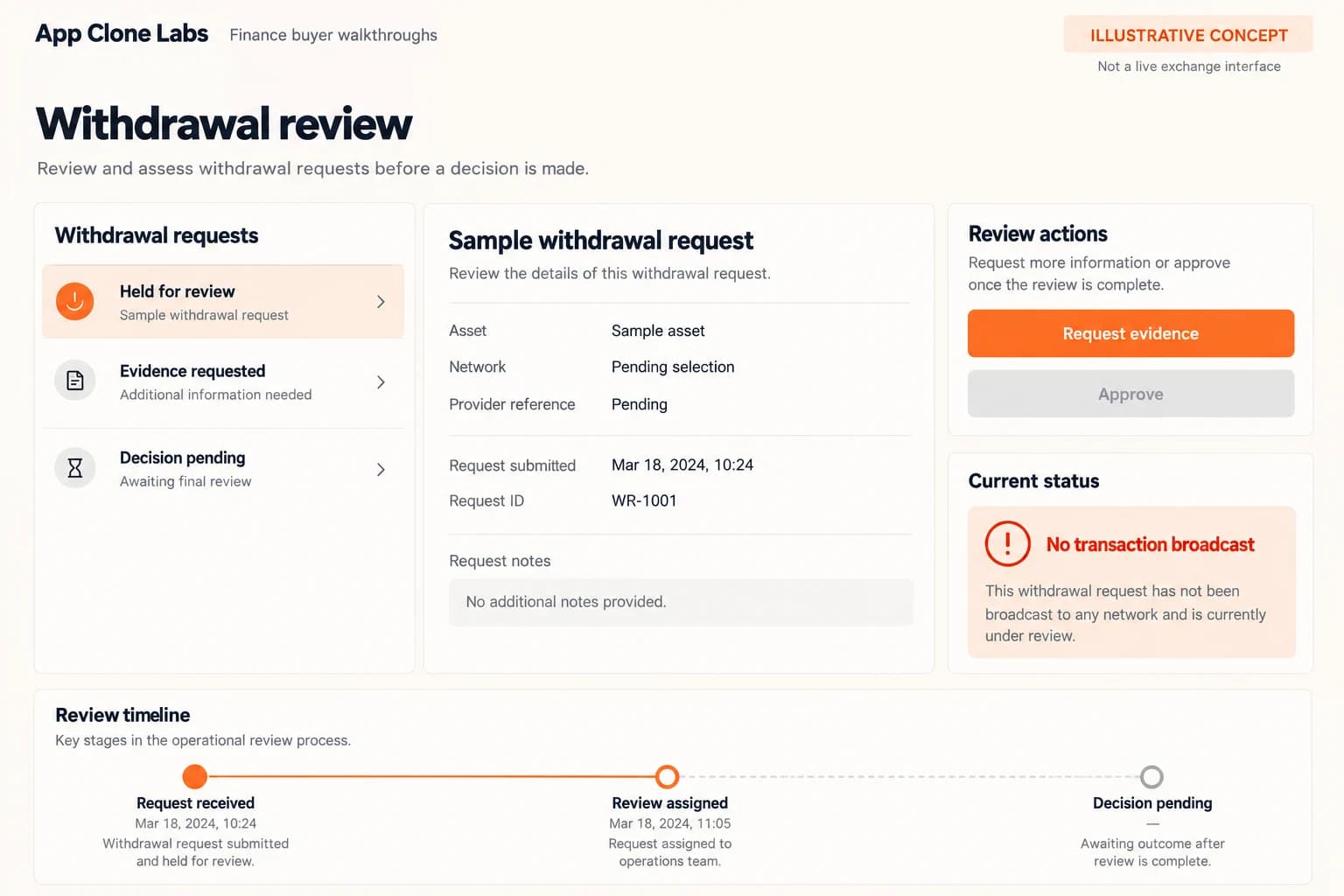
Original App Clone Labs withdrawal-review concept at 1536×1024, illustrating a held withdrawal awaiting manual review and a provider response, with no broadcast recorded. It is not an official MEXC interface or an affiliation claim, and does not demonstrate actual custody, execution, provider connectivity or operating authorization.
Product flow
A visual map of how each role interacts with each workflow stage, with operator controls and integration boundaries.
Deployable Product Architecture
MEXC-style Broad-market Asset Venue
Monetization
We model monetization early so payments, admin controls, and reporting support the business.
Disclose fee assets and schedules for supported pairs. Do not equate listing breadth, activity or a promotional price with guaranteed execution or returns.
Price supported interfaces and operational support with measured limits. Commercial access does not override customer eligibility, market pauses or custody controls.
Specify licensed redistribution, update behavior and outage handling. Establish rights independently rather than assuming the reference brand supplies feeds or market participation.
Artifact register
Reference screens illustrate workflows, not a contracted feature list. Sample prices, data, and responses are demonstration content; confirm the current scope during a walkthrough.
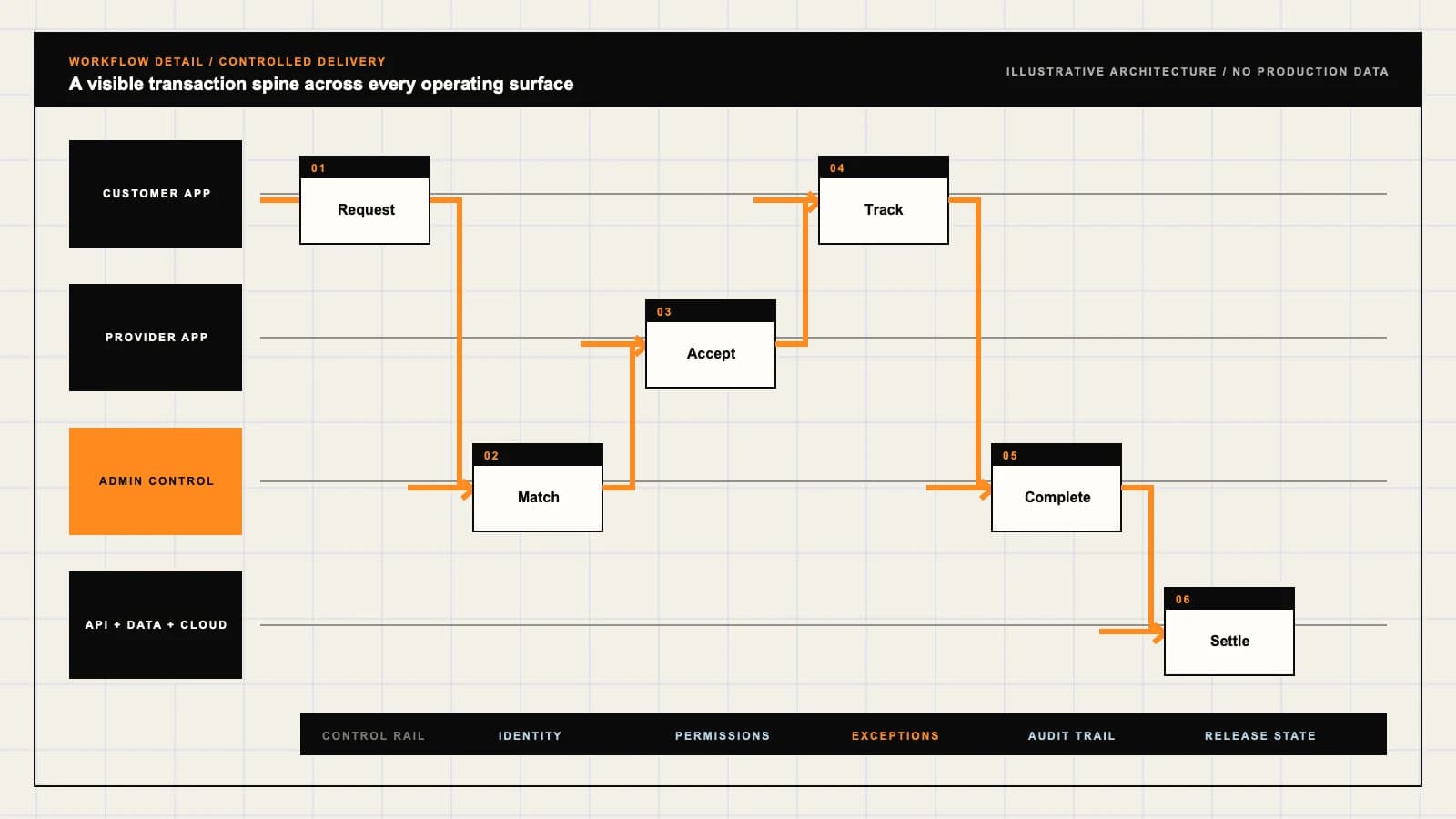
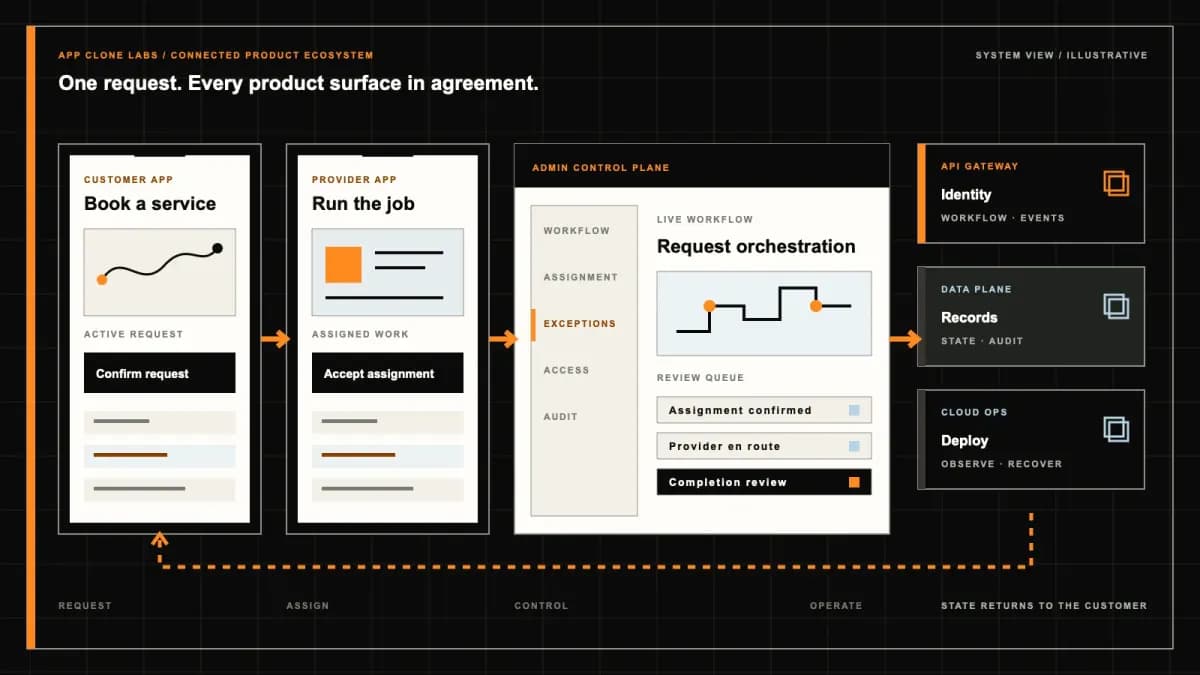
A fictional asset, LUMEN, trades against a fictional quote asset called QUNIT. Its supported network enters maintenance while the venue decides to close one pair. A customer still has an open order, another sends a deposit and a third requests a withdrawal. A MEXC-style broad-market venue must explain those different states. Removing a row from the trading catalog cannot resolve the orders, custody records and customer obligations attached to that asset.
App Clone Labs scopes independently branded spot software around reviewed admission, current metadata and orderly restriction handling. This reference does not imply MEXC affiliation, operating authority, provider access or available liquidity. No trading returns are guaranteed. Establish lawful permissions, custody relationships and actual market participation separately. Catalog breadth is an operational commitment: each admitted asset needs review ownership and a credible response when the circumstances supporting its admission change.
Collect the issuer identity, proposed asset purpose, contract references, supported networks and documents required by the selected operator policy. Separate an application received from an asset technically reviewed or approved for customers. A token team supplying a contract address does not establish classification, lawful distribution or custody compatibility. Record the decision owner and version of the evidence reviewed before making the asset selectable.
Define rejection, correction and renewed review paths. A replaced contract or material issuer change should not inherit an approval issued for different facts. Test an application using a duplicate ticker and an approved issuer changing the token address before activation. Keep commercial negotiations separate from admission authority; a fee agreement cannot substitute for diligence. Restrict sensitive documents to their legitimate reviewers and publish only the customer information that the operator can substantiate under the actual offering and market arrangement.
Bind each catalog asset to explicit contract or native-asset identity, network and decimal rules. Two unrelated assets can use the same ticker, and one asset may have several supported representations. The customer needs enough information to choose the intended transfer route. Avoid merging balances merely because labels match or accepting a deposit through an unsupported chain because another network for that symbol is enabled.
Establish how contract migrations, renamed symbols and network replacements affect historical records. Preserve the identifiers used for earlier executions and transfers. Rehearse LUMEN appearing on two fictional networks while only one is admitted, then introduce a second asset with the same display name. The deposit screen, ledger and support case should reference the exact identity consistently. A migration needs reviewed conversion and reconciliation rules; it must not become an unannounced edit that changes what the customer’s previous transaction appears to have delivered.
MEXC’s Spot API reference documents exchange information, asset precision and wallet-related interfaces. This is a narrow reference for distinct market and transfer records. It does not establish identical capabilities or integration access for an independent venue; verify the actual selected services and metadata contracts.
Specify base and quote assets, price and quantity precision, supported order types and applicable order filters for each spot pair. Use exact units at validation and accounting boundaries. Publish a rule version and enforce it when accepting an order, including requests from older screens or connected clients. Test a quantity increment changing while a customer edits an order. Reject unsupported values with an explanation rather than silently rounding them into a different trade. Define what the change does to existing open orders and preserve the rules that governed earlier acceptance.
Display the source and freshness of prices, trades and order-book information under the selected data contract. An old last-traded price does not prove that a new order can execute at that value. Define when a disconnected feed triggers a visible stale state, bounded recovery or a market restriction. A polished chart should not conceal the absence of current evidence about the market the customer is about to use.
Keep indicative information distinct from executable orders and established participation arrangements. Rehearse a frozen LUMEN book while another pair remains fresh, a reconnect replaying earlier events and a newly listed pair with no recent trades. Operations should identify the affected source and market without halting unrelated activity unnecessarily. Any capacity or depth claim requires its own evidence. A software demonstration with synthetic orders cannot establish real liquidity, competitive pricing or the willingness of independent counterparties to trade.
A reviewed asset can still have deposits disabled, withdrawals under preparation or a pair awaiting activation. Model these permissions separately and explain their effect before the customer acts. A single green asset badge cannot communicate whether order entry, incoming transfers and outgoing transfers are all available. Restrict consequential administration so enabling a pair does not silently enable signing or change network confirmation requirements.
Record the planned activation sequence and its responsible owners. Rehearse market activation before a custody adapter is ready and a deposit permission changing during address display. The current server decision must control acceptance even if the customer opened an earlier screen. Explain unresolved requests and preserve any received funds for authorized investigation. Technical readiness does not confer legal eligibility, and account verification does not override an asset-specific restriction. Establish customer and jurisdiction rules independently of whether the trading screen can render the pair.
The official MEXC announcements hub separates listing, delisting and maintenance categories. Those categories support a lifecycle-oriented reference, without supplying the independent venue’s maintenance schedule, notice policy or withdrawal commitments. The operator must define its own supported behavior and verify each external dependency.
Distinguish planned maintenance from an unexpected network interruption. Explain which asset representation is affected and whether trading remains available under the selected risk decision. Track pending deposits and withdrawals through the interruption rather than relabeling them failed simply because monitoring paused. Test maintenance beginning after a transfer instruction was accepted and a network recovering while reconciliation remains incomplete. Resume affected functions only through the documented checks. Avoid promising a universal restart time or safe recovery where chain conditions and the custody arrangement remain uncertain.
Define whether a restriction blocks new orders, cancels open orders or allows only specified operations. A partially filled order contains completed executions and a remaining reservation. Closing the pair should not erase trades or release amounts already spent. Preserve fees, order identity and the reason for the current restriction so customers and support can reconstruct what happened before and during the change.
Rehearse a final fill racing a market pause and a duplicate execution event arriving during cancellation recovery. Reconcile the trade ledger before describing the balance as available for another action. A paused trading pair can coexist with permitted withdrawal review, while a custody restriction can block movement even if the market remains open. Make that distinction visible. Support must have an escalation route for disagreements, with restricted adjustment authority rather than permission to overwrite history until the totals look plausible.
Choose evidence and reviewer capacity for suspicious trading, concentrated ownership and issuer-related activity across admitted markets. New or thinly traded pairs may require different attention under the operator’s reviewed policy. A high listing count says nothing about market integrity. Keep alerts connected to the relevant market, accounts and rule versions without treating a threshold crossing as a proven legal conclusion.
Investigate suspected self-trading, abrupt activity changes and coordinated cancellation patterns with attributable decisions. Test simultaneous alerts across several fictional pairs and a reviewer unavailable during an urgent restriction. Define who may pause activity and how decisions reach support. Paid connectivity or a listing relationship must not suppress investigation. Preserve appropriate records while minimizing exposure of private customer information. Surveillance automation can assist triage, but the operator still needs staffed accountability and separately established obligations for the actual jurisdictions and activities.
Specify the decision, effective dates and separate handling of trading, deposits and withdrawals before announcing a delisting. Distinguish removal of one pair from removal of the underlying asset across every market. Notify affected customers through the agreed channels and retain the published version. A notice sent is not proof that every customer read it, so account views should continue to explain relevant restrictions and next steps.
Rehearse a late deposit, an open order at closure and an amount below the normal withdrawal minimum. Establish the supported residual-balance process with qualified review and actual custody capability. Do not invent automatic conversion, guaranteed refunds or universal recovery windows. Keep balances and historical statements accessible under the applicable policy after the market disappears from discovery. An unresolved asset liability remains an operational responsibility; hiding a symbol must not close its outstanding support cases or delete the evidence needed to investigate them.
Compare the Binance-style multi-market exchange when the main concern is the customer order journey across selected spot pairs. This broad-market brief centers on admitted asset identity, continuous metadata and coordinated restriction or exit decisions. Start with a small reviewed catalog that the team can actually operate.
Use the configurable crypto exchange core when selecting shared matching, ledger and custody boundaries. Catalog lifecycle rules still need their own owners and acceptance evidence. Keep derivatives outside spot v1; leverage, funding and liquidation require a separately permissioned product decision. Expand assets or networks only after demonstrating that maintenance, abuse review, closure and customer support can absorb the additional obligations without losing traceability.
Illustrative screens should accompany a synthetic sandbox walkthrough with LUMEN and QUNIT, fictional participants and controlled transfer records. Buyer acceptance should reject a duplicate identity, activate a reviewed pair, mark a feed stale and interrupt one network. Partly fill an order, pause the market and introduce a delisting with a late deposit and uncertain withdrawal. Follow remaining balances and case ownership across customer, listing, treasury and support views.
Bring one asset lifecycle and closure exception to a broad-market venue scope discussion to establish admission evidence, custody restrictions and staffed remedies.
Use the delivery process to agree source-code terms, provider permissions, notice ownership and acceptance records. Synthetic participation demonstrates behavior, not available liquidity or authorization to operate a real venue.
FAQ
It emphasizes asset admission, exact identity, metadata changes, network maintenance and orderly delisting across a broad spot catalog, with accountable customer and custody exceptions.
No. Establish independent branding, lawful operating permissions, custody relationships, provider access and actual market participation. Synthetic orders do not supply real liquidity.
No. Classification, technical evidence, market eligibility and custody compatibility need reviewed decisions. A commercial agreement cannot replace the admission process or confer operating authority.
Unrelated assets can share a ticker, and an asset can have several representations. Bind transfers and balances to the reviewed identity and supported network.
Version the rules, enforce current acceptance constraints and explain the treatment of existing orders. Preserve earlier rule evidence instead of silently rounding a new request.
No. Show source freshness and stale-data states. A last trade or synthetic order book cannot establish current depth, available counterparties or execution at that price.
No. Keep order entry, deposits, withdrawals and network permissions distinct. A market activation role should not inherit custody signing authority or override account restrictions.
Retain their actual state and references, identify the affected representation and reconcile external evidence before resumption. An interrupted monitor alone does not prove failure.
Completed executions remain recorded. Resolve concurrent fills, cancel the supported remainder and reconcile its reservation without erasing trades, fees or restriction evidence.
Use market-specific evidence, accountable triage and sufficient staffing. Alerts support investigation; listing relationships or paid connectivity must not suppress restrictions or justify unsupported accusations.
No. Establish actual remedies, withdrawal handling and residual-balance procedures through qualified review and custody capability. Preserve outstanding obligations and customer records after discovery removal.
Use fictional markets to test duplicate identities, changed metadata, stale feeds, network maintenance, partial fills and closure, including late deposits, uncertain withdrawals and attributable support cases.
Solution reference register
01 / Reference and IP
This page references third-party product names only to describe familiar product models and planning references. App Clone Labs is not affiliated with or endorsed by those brands. Build decisions require independent legal, regulatory, and operational review for your market.
02 / Regulatory caveat
Confirm licensing and market-specific authorization before enabling regulated activity · Define whether assets or funds are held by the operator, a qualified custodian, or not held at all · Apply security review, strong authentication, encryption, audit logging, recovery, and incident response · Present educational product information only and prohibit personalized financial, legal, tax, or wagering advice · Apply customer verification, sanctions screening, blockchain monitoring, asset-listing review, and travel-rule processes where required · Never treat listing volume as a substitute for legal classification, technical review, or market-integrity assessment
Primary sources
Dated official documentation, standards, and research that support the factual claims on this page.
How to read this page
Scope, cost and timeline figures are planning guidance until confirmed in a written proposal. Diagrams and screens are illustrations, not client deliverables, and source-code rights and handover follow the signed agreement. See the delivery process and the full disclaimer.
Next decision
Define outcomes, constraints, evidence, rights and handover before delivery begins.
Commercial rights, repositories, environments, documentation, acceptance and handover remain contract-defined.
App Clone Labs is not affiliated with, sponsored by, or endorsed by MEXC. The name identifies a familiar product category; every delivered product is independently designed and built, and the mark remains its owner's property. Read the full legal notice.