
01Prepare and review
Admit the collection with explicit rights
Bind creator evidence, chain, contract and edition settings before publication. Reject a copied name or unsupported mint configuration without losing the review record.
Digital collectible marketplace
Creator-led collectible minting and marketplace interface with community curation. Planned for creator platforms organizing digital editions, collection governance, and wallet transactions with role-specific workflows, operator controls, integrations, and a handover boundary defined for the selected market.
See product screens and demo accessCustom workflows
Brand-safe product strategy
Admin and operations tooling
Reference walkthrough by arrangement
Workflow
Each workflow stage is mapped to a role, screen, API, notification, admin control, and measurable launch outcome.
Bind creator evidence, chain, contract and edition settings before publication. Reject a copied name or unsupported mint configuration without losing the review record.
Preview metadata and wallet permissions, record submitted transactions and reconcile confirmation before offering supported units. Show current fees and royalty treatment before signing.
Moderate reports, refresh metadata and resolve stale ownership or listings. Preserve confirmed records and explain unresolved transactions through an accountable support process.
Deployable Product Architecture
Workflow / system register
Content platform
Publishing is only the start of the system
Admit the collection with explicit rights
Separate the creator instruction from confirmation
Keep community views consistent with evidence
Control note
Entitlements, discovery, delivery quality, and governance work together.
Operator controls
The control center is scoped as a first-class product surface, not an afterthought.
Bind listings to explicit chain, contract and token identity. Review creator claims and permissioned metadata changes without presenting token possession as copyright ownership.
Validate royalty recipients, exact amounts and approval scope. External marketplace enforcement and future secondary earnings cannot be guaranteed by a royalty field.
Separate moderator actions from chain state, flag stale data and reconcile replayed events. Paid placement must not override rights review or suppress complaints.
Integrations
External systems that determine launch readiness, data flow, and operational continuity.
Supported wallets and reviewed minting or marketplace contracts with explicit chain checks, scoped approvals and transaction evidence
Authorized chain indexers and metadata storage with stable collection identity, refresh limits, freshness signals and replay reconciliation
Creator rights review, community reporting and moderation systems with restricted evidence, attributable decisions and appeal ownership
Scope drivers
The variables that most influence build effort, cost, and launch readiness.
Choose supported chains, standards, quantities and metadata mutability. Each configuration requires a reviewed mint, ownership and listing acceptance path.
Define creator admission, collection curation, reports and appeals. More collections create continuing impersonation and misleading-promotion review work.
Select supported settlement paths, royalty sources and recovery behavior. More chains or external listings add data consistency and provider-permission obligations.
Deployable Product Architecture
Scope drivers / system register
Content platform
Publishing is only the start of the system
Decide what creators can actually publish
Staff review rather than relying on badges
Bound external dependencies explicitly
Control note
Entitlements, discovery, delivery quality, and governance work together.
V1 scope
Launch the smallest complete operating loop first, then scale the product with confidence.
Support a selected chain and collection configuration with rights-aware metadata, preview and permissioned publication. Demonstrate a rejected impersonation attempt.
Rehearse mint submission, fixed-price listing and supported settlement with synthetic assets. Include rejected signatures, stale listings and uncertain transaction outcomes.
Provide reporting, moderation cases and indexer freshness states. Test a metadata refresh, duplicate event and appeal without rewriting confirmed transfers.
Later phases
Capabilities that should usually wait until real usage proves the core loop.
Add supported standards or chains only after proving supply, metadata, wallet and settlement behavior for each selected combination.
Consider collection submissions and curator workflows with conflict disclosure and staffed appeals. Governance tokens require a separate reviewed product decision.
Evaluate external order sources or backup indexers under actual provider permissions. Verify royalty treatment and reconciliation separately for every additional route.
Deployable Product Architecture
Later phases / system register
Content platform
Publishing is only the start of the system
Expand after the first lifecycle works
Extend participation with explicit authority
Add dependencies with observable recovery
Control note
Entitlements, discovery, delivery quality, and governance work together.
Regulatory review
Each flag must be reviewed by qualified counsel for your target market before build or launch.
Reference walkthrough
Ask us to confirm which reference surfaces are currently available for this product model. Rather than publishing shared demo credentials, we schedule a private guided walkthrough for qualified buyers.
Request a role-specific demonstration and confirm which capabilities are currently available. Review the proposed responsibility: Submit rights evidence, collection identity and reviewed mint metadata. Keep publishing, contract administration and royalty-recipient changes separately permissioned.
Request a role-specific demonstration and confirm which capabilities are currently available. Review the proposed responsibility: Review contract identity, edition terms, current listing state and disclosed fees. Curation signals do not certify copyright, resale value or future creator performance.
Request a role-specific demonstration and confirm which capabilities are currently available. Review the proposed responsibility: Investigate impersonation, abusive promotion and indexer differences with traceable cases. Hiding a collection does not reverse an already confirmed blockchain transfer.
Request a live, private walkthrough of the reference implementation. We will confirm scope and discuss configured deployment versus custom build for your market.
Open registerDeployable Product Architecture
Reference walkthrough / system register
Content platform
Publishing is only the start of the system
Creator and collection administrator: Publish an attributable digital edition
Collector and community curator: Inspect the collection before a wallet action
Moderation and marketplace operations: Resolve visibility and transaction disagreements
Book a walkthrough
Control note
Entitlements, discovery, delivery quality, and governance work together.
User roles
Clone-inspired platforms usually need several coordinated interfaces, not just a customer app.
Submit rights evidence, collection identity and reviewed mint metadata. Keep publishing, contract administration and royalty-recipient changes separately permissioned.
Review contract identity, edition terms, current listing state and disclosed fees. Curation signals do not certify copyright, resale value or future creator performance.
Investigate impersonation, abusive promotion and indexer differences with traceable cases. Hiding a collection does not reverse an already confirmed blockchain transfer.
Use this digital-collectibles concept to define a creator-led publishing model: establish rights, approve edition metadata, then review wallet actions and collection visibility. It is not Rarible UI or proof of minting, ownership, royalties, liquidity or affiliation.
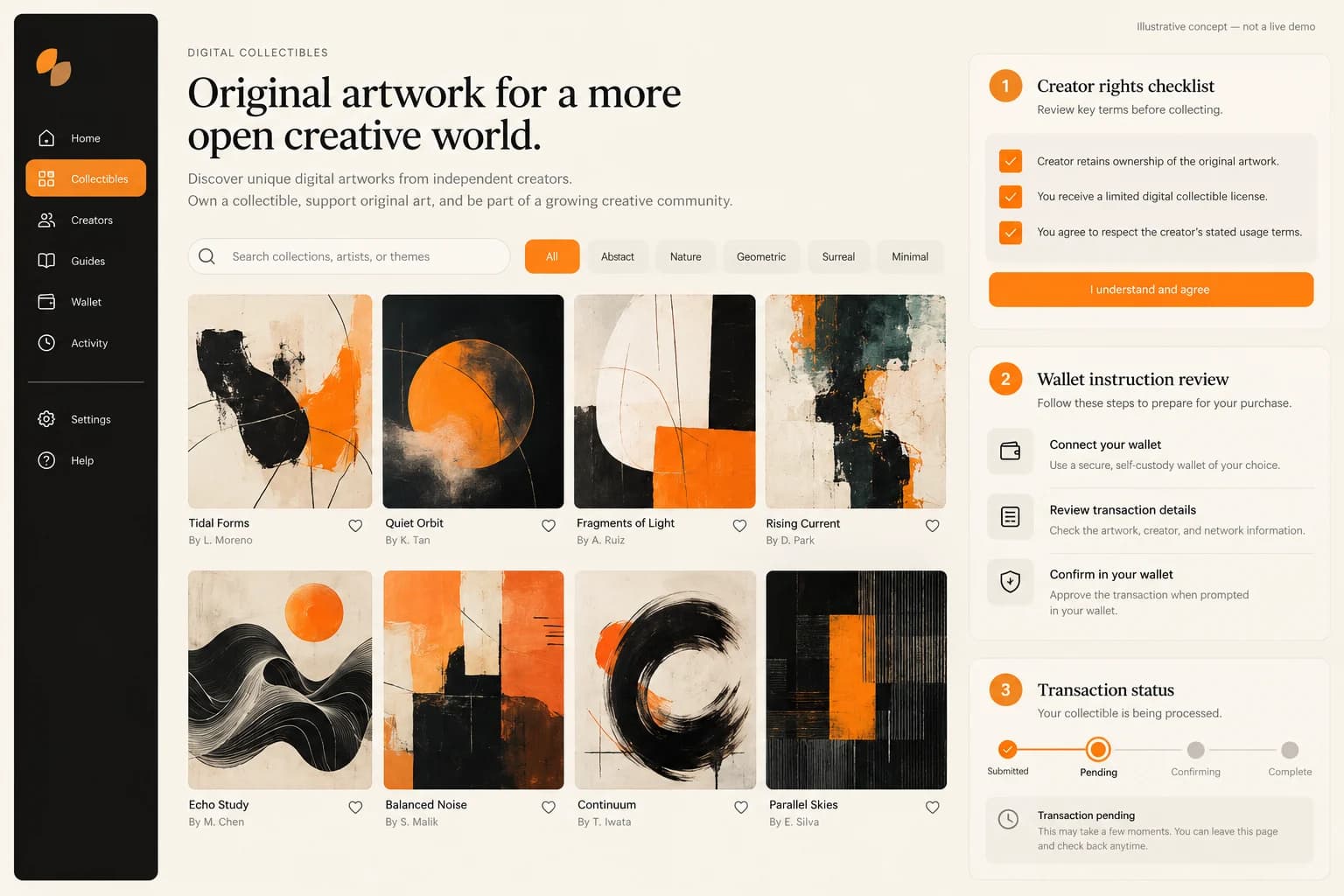
Digital-collectibles reference concept. Edition controls, mint execution and community voting are not established by the catalogue image. Royalties depend on the agreed contract and marketplace behaviour and are not guaranteed.
Product flow
A visual map of how each role interacts with each workflow stage, with operator controls and integration boundaries.
Deployable Product Architecture
Rarible-style Creator Collectible Market
Monetization
We model monetization early so payments, admin controls, and reporting support the business.
Disclose buyer and seller deductions before signing and retain fee-version evidence. Distinguish platform revenue, creator royalties and network transaction costs.
Offer collection setup and supported edition management with clear limits. Purchasing tools does not include sales, audience growth or independently reviewed artwork rights.
Label sponsored placement and specify duration and review conditions. Commercial relationships do not establish authentic provenance or purchase community moderation immunity.
Artifact register
Reference screens illustrate workflows, not a contracted feature list. Sample prices, data, and responses are demonstration content; confirm the current scope during a walkthrough.
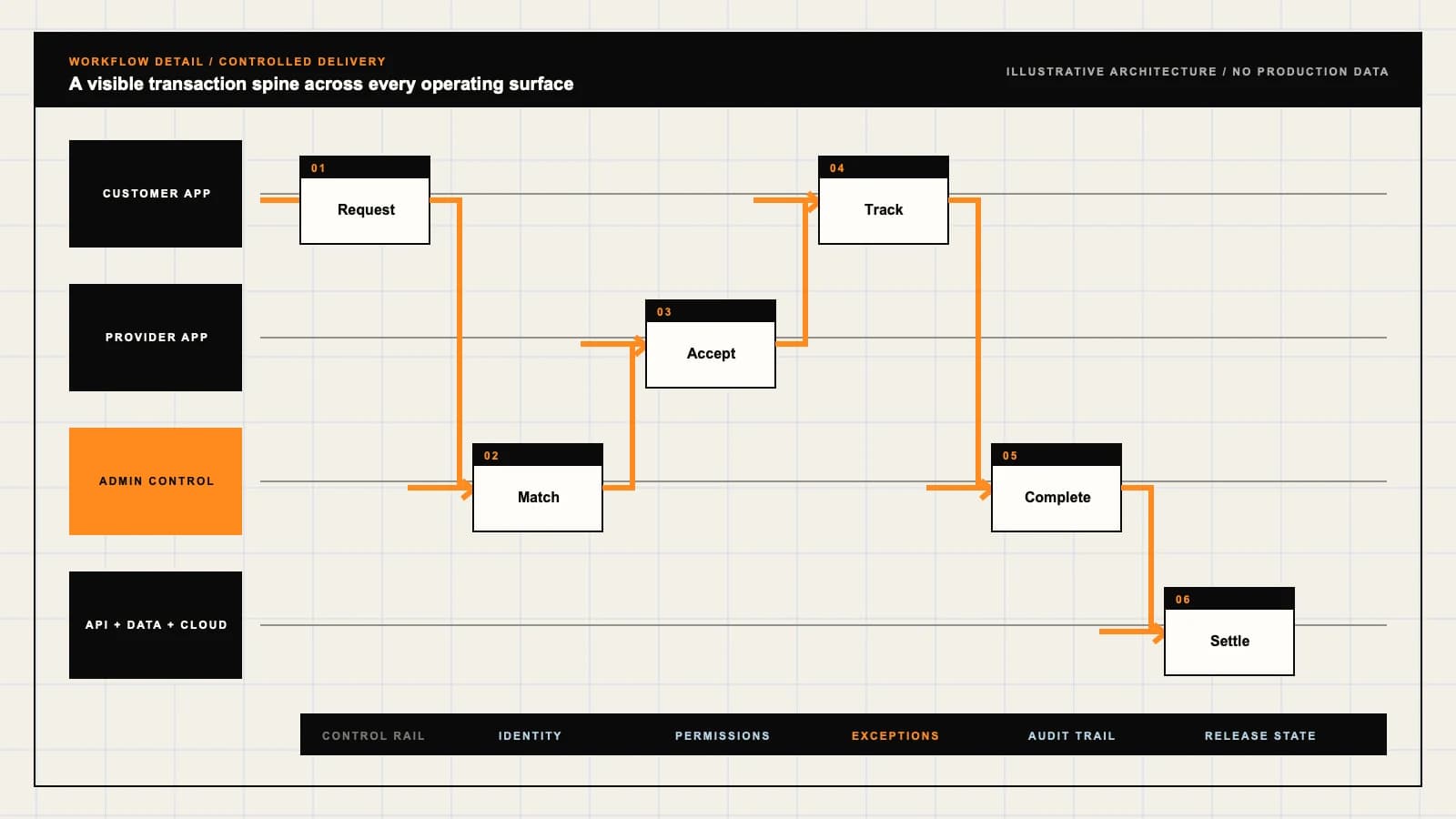
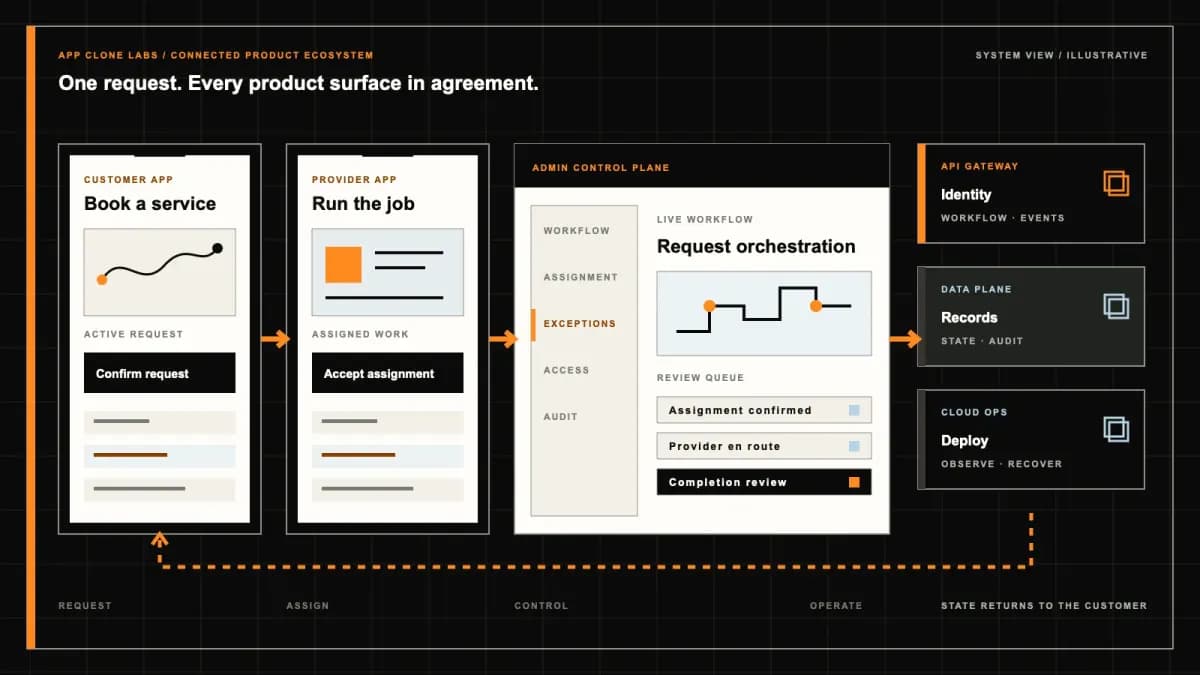
A fictional illustrator publishes the Lantern Atlas collection. A collector buys an edition, the creator corrects its description and a community member reports a copied storefront using the same artwork. The marketplace now has three different obligations: preserve the purchase record, explain the metadata change and investigate impersonation. A Rarible-style creator marketplace needs those connections before adding another mint button. Collection identity must remain understandable when discovery, ownership and community visibility change at different times.
App Clone Labs scopes independently branded creator software around rights-aware publishing, wallet transactions and accountable community review. This reference does not imply Rarible affiliation, access to its audience or permission to use another creator’s work. No resale returns or royalty income are guaranteed. Establish applicable operating permissions, contract review and provider access separately. Begin with a collection model the operator can support through minting, listing, disputed visibility and uncertain transaction outcomes.
Ask who controls the creator account, who owns or licenses the submitted artwork and which collection administrator may publish it. Keep the evidence behind these answers distinct. A wallet signature demonstrates control of a signing key at that moment; it does not independently establish the signer’s legal identity or copyright. A verified account badge should explain the checks actually performed rather than implying that every item has been authenticated.
Define correction, refusal and renewed review paths before onboarding creators. A collaborator joining a collection may have publishing permission without authority to redirect royalties or alter existing licence terms. Rehearse a copied portfolio, an expired licence and a creator disputing an administrator’s upload. Restrict private documents to reviewers who need them. Preserve the decision and its evidence version so support can explain why the collection was admitted or restricted when the facts later change.
The official Rarible NFT item reference identifies an item through a chain, token contract and token identifier. This supports a narrow identity distinction; it does not certify authorship or grant an independent product API access. Confirm the selected provider’s permissions and supported environments before integration.
Use explicit chain, contract and token identity wherever ownership, listings or support cases depend on the same collectible. Collection names, profile pictures and display symbols can be copied. Show enough of the underlying identity for a collector to distinguish Lantern Atlas from a lookalike, with accessible ways to inspect full identifiers. Rehearse two collections sharing a title and one creator operating separate contracts. Search results, creator pages and transaction records should agree on which collection the user selected without silently merging their history.
Choose the supported token standard, edition quantity, recipient and storage arrangement before asking the creator to sign. Distinguish uploading artwork, preparing a mint and submitting an actual transaction. Show the precise collection and edition settings in the confirmation view. A successful upload is not a minted token, and a wallet prompt accepted is not evidence of chain confirmation. Make incomplete preparation recoverable without representing a draft as available inventory.
Record the rights statement and metadata version used at submission. Test a missing image, an unsupported quantity and a creator changing wallets between preparation and signing. Establish whether metadata may change after minting and which administrator holds that authority. An immutable token identifier does not make every linked file permanent. Document the selected storage service, retention responsibilities and any continuing costs so a collection does not depend on an unstated promise of perpetual artwork availability.
A corrected description and a substituted artwork file are materially different changes. Define allowed edits, review ownership and how collectors learn about them. Preserve earlier metadata references where required for transaction or dispute evidence. A collection reveal should follow declared rules rather than replacing an item without explanation. Treat remote metadata and artwork as untrusted input, with supported formats and bounded retrieval before presenting them in the storefront.
Rehearse an unavailable storage gateway, a malicious metadata link and a refresh that finishes for only part of the collection. Keep the last known display state visibly distinct from current verified information. Refreshing a cache should not change chain identity or overwrite the buyer’s historical receipt. Set an owner for unresolved artwork retrieval and explain what the platform can restore under its actual storage arrangement. Avoid promising recovery of files that the operator never controlled or retained.
Explain the requested wallet action before handing control to the wallet. Signing in, minting an edition, approving a contract and signing a sale order have different consequences. Bind each request to the selected chain and collection, display its purpose and recheck the current account before submission. A connected wallet should not authorize arbitrary later actions. Never ask collectors to provide recovery phrases or private keys to customer support.
A listing needs current ownership, supported quantity, price, currency and validity conditions. Recheck these at the consequential boundary because a collector may transfer an edition elsewhere after opening the page. Test a rejected signature, a network change and an approval revoked after listing. Explain whether the order remains discoverable while it cannot execute. Preserve cancellation and expiry evidence so a stale storefront cannot persuade a buyer that an unavailable edition is still offered on the displayed terms.
The ERC-2981 royalty standard defines royalty information retrieval, while leaving payment execution to a separate mechanism. It cannot force every external marketplace or wallet transfer to pay a creator. This is a technical boundary for the product brief, not a promise about a particular venue’s current policy.
For each supported settlement route, disclose the royalty source, recipient, calculation and enforcement behavior alongside platform fees and network costs. Keep requested royalties separate from amounts actually included in confirmed settlement. Review recipient changes with appropriate authority and preserve which rules applied to the sale. Rehearse a missing royalty response, an invalid recipient and an external order whose treatment differs from the local storefront. Do not describe every token transfer as a sale or count a requested amount as earned income.
A chain indexer can lag behind a submitted transaction or replay earlier events after reconnecting. Give minting, ownership, listing and activity views explicit freshness and confirmation states. An absent event is not enough to declare a transaction failed. Store the relevant transaction reference and distinguish submitted, confirmed, reverted and unresolved outcomes under the selected network policy. Support should see the same evidence and uncertainty that the collector sees.
Rehearse the Lantern Atlas purchase confirming while the indexer remains unavailable, followed by duplicate events and a changed chain history. Reconcile state before allowing an obsolete listing to appear executable again. Avoid duplicate activity entries, duplicate fee recognition or invented ownership transitions during recovery. Select a documented confirmation policy and escalation owner rather than claiming universal instant finality. Define when the affected function pauses and how operations prove that replay and reconciliation have restored a coherent collection view.
Give collectors and creators a reporting path for impersonation, stolen artwork, abusive comments and misleading promotion. Capture the collection identity, relevant content and reason without exposing unnecessary personal information. Triage urgent threats separately from ordinary disagreements and attribute the decision to an authorized reviewer. Community popularity does not establish that a rights complaint is unfounded, and a report count alone should not determine ownership or wrongdoing.
Define restrictions on storefront discovery, comments, new listings and creator publishing independently. Hiding an item from discovery does not burn a token, recover a buyer’s payment or remove it from every external service. Preserve existing transaction records and explain supported next steps. Rehearse a paid curator reporting a rival collection, a creator appealing a removal and a moderator unavailable during an urgent complaint. Separate commercial placement from review authority and retain the evidence needed for an attributable appeal.
Present primary sales, resale activity, platform fees and royalty receipts as separate records with clear sources. A collection page with enthusiastic comments does not establish an available buyer or a future resale price. Disclose sponsored placement and explain what creator subscriptions or publishing tools actually include. A paid storefront package should not imply that the platform will supply an audience, guarantee sales or arrange transactions to improve activity statistics.
Define responsibility for support, complaints, transaction costs and any permitted remedy before launch. A failed transaction may still involve network costs depending on its outcome; avoid a blanket refund promise. Preserve a calculation example using fictional amounts and verify exact units for the chosen currency. Reconcile confirmed service charges with their underlying transaction references. Keep synthetic demonstrations clearly labelled so sample sales, floor prices and royalty totals cannot be mistaken for commercial evidence or proof of sustainable creator earnings.
Compare the OpenSea-style collectible marketplace when collection discovery and wallet trading across selected inventories are the main concern. This creator-led brief instead centers on publishing authority, edition metadata, community curation and continuing responsibility for the collection after minting.
Review the white-label creator monetization platform if the intended product is memberships, paid content or recurring creator access. Those entitlements and payment obligations need a separate scope from collectible ownership. For this marketplace, keep v1 to one reviewed chain, one edition model and supported fixed-price settlement. Add auctions, external orders or governance features only after testing their distinct permissions, accounting and moderation consequences. The smallest useful release is a complete collection lifecycle with staffed exceptions.
Use Lantern Atlas, fictional creators and synthetic wallet assets in a sandbox. Buyer acceptance should follow rights review, mint preview, a rejected signature, confirmation and listing. Then change permitted metadata, interrupt the indexer and report a copied collection. Demonstrate stale ownership, duplicate event recovery, differing royalty treatment and an attributable appeal. Inspect the collector, creator, moderator and support views against the same transaction and collection references; attractive screens alone do not establish correct settlement or safe operations.
Bring a collection model and one disputed transaction to a creator marketplace scope discussion to agree storage responsibility, wallet permissions and community review ownership.
Use the delivery process to establish source-code terms, actual provider access and acceptance evidence. Require a record of the unresolved state and its next owner when recovery cannot finish in the demonstration. Synthetic activity proves the agreed behavior only; it supplies neither audience demand nor permission to operate.
FAQ
The scope centers on creator admission, edition publishing, metadata authority and community curation, with wallet settlement and continuing support for the collection after minting.
No. Establish independent branding, provider permissions and creator acquisition separately. Reference functionality and synthetic demonstrations do not supply Rarible affiliation, audience access or sales demand.
No. A signature demonstrates control of a key for that action. Review creator identity, artwork permissions and collection administration through separate attributable evidence and decisions.
Bind items and listings to explicit chain, contract and token identity. Display names and images can be copied and should not determine ownership or provenance.
Choose the supported standard, quantity, recipient, storage arrangement and metadata authority. Preview the actual instruction and distinguish upload, transaction submission and confirmed minting states.
That depends on the reviewed contract and storage arrangement. Declare allowed edits, preserve relevant versions and explain changes without implying every linked file is permanently available.
No. Explain each requested action, validate the current chain and account and distinguish login, approval, minting and sale instructions before the wallet requests a signature.
No. Royalty information does not force external settlement behavior. Define and verify treatment for each supported route, distinguishing requested amounts from confirmed creator receipts.
Retain the transaction reference, show uncertainty and reconcile chain evidence before updating ownership or listing availability. Test replay without duplicating activity or recognizing fees twice.
No. Moderation can restrict supported platform visibility or actions. It does not reverse confirmed transfers, recover payments or remove items from every external service.
No. Disclose the actual publishing service and fees. Paid placement, comments and sample trading activity do not establish audience demand, future prices or royalty income.
Use fictional collections and synthetic assets to test rejected signatures, stale ownership, metadata refresh, indexer replay, royalty differences, impersonation reporting and a documented moderation appeal.
Solution reference register
01 / Reference and IP
This page references third-party product names only to describe familiar product models and planning references. App Clone Labs is not affiliated with or endorsed by those brands. Build decisions require independent legal, regulatory, and operational review for your market.
02 / Regulatory caveat
Confirm licensing and market-specific authorization before enabling regulated activity · Define whether assets or funds are held by the operator, a qualified custodian, or not held at all · Apply security review, strong authentication, encryption, audit logging, recovery, and incident response · Present educational product information only and prohibit personalized financial, legal, tax, or wagering advice · Verify collection rights and provide counterfeit, copyright, fraud, sanctions, moderation, and takedown processes · Disclose that royalties may depend on marketplace and contract enforcement and are not assured
Primary sources
Dated official documentation, standards, and research that support the factual claims on this page.
How to read this page
Scope, cost and timeline figures are planning guidance until confirmed in a written proposal. Diagrams and screens are illustrations, not client deliverables, and source-code rights and handover follow the signed agreement. See the delivery process and the full disclaimer.
Next decision
Define outcomes, constraints, evidence, rights and handover before delivery begins.
Commercial rights, repositories, environments, documentation, acceptance and handover remain contract-defined.
App Clone Labs is not affiliated with, sponsored by, or endorsed by Rarible. The name identifies a familiar product category; every delivered product is independently designed and built, and the mark remains its owner's property. Read the full legal notice.
