
At 9:10 in the morning, a cleaner cancels two visits, a plumber requests approval for extra parts and a customer reports that nobody arrived. A revenue chart cannot resolve any of those situations. The admin dashboard needs to expose the affected appointments, explain the current state and give the right operator a safe next action.
This guide helps home-service operators and founders specify the back office behind an on-demand platform. It covers dispatch, provider eligibility, scheduling, quotations, service evidence, complaints and financial handoffs. Examples are fictional workflow exercises, not client case studies or performance claims. Employment, licensing, consumer-protection, privacy, tax and payment obligations depend on your operating model and require appropriate specialist review. The goal is a usable requirements brief, not a claim of universal compliance.
Start with the operating model, not dashboard widgets
Decide whether the platform employs staff, contracts service companies or connects independent providers with customers. Identify who sets prices, accepts work, supplies materials, manages complaints and invoices the customer. Those responsibilities change the permissions and evidence the back office needs. A marketplace and an internally managed field-service business should not share assumptions simply because both offer cleaning appointments.
Choose one launch envelope: service categories, locations, operating hours, booking methods and payment arrangements. Distinguish fixed-price tasks from quotations after inspection. State whether multiple technicians can work on one job and whether a booking can contain several services. These decisions belong in the brief before a supplier estimates the admin panel.
Use a synthetic appointment to connect the requirements. Trace request, eligibility, allocation, acceptance, arrival, work, completion, customer follow-up and financial reconciliation. Include the point at which an operator can intervene and the evidence required. This flow gives every proposed widget a purpose and makes missing responsibilities easier to identify than a long menu of screens.
Make the opening screen a prioritised work queue
Operators need to know which appointments require attention now. Separate unassigned work, expiring provider offers, late arrivals, approvals waiting on a customer and unresolved complaints. Show age, urgency, service window and responsible owner. A single total labelled pending hides the distinction between a harmless future request and today's appointment with no available provider.
Define how urgency is calculated and who can change it. A fictional rule might flag an unassigned appointment approaching its agreed start window, but the real threshold should follow your operating policy. Avoid arbitrary red badges that create alert fatigue without helping staff decide what to do next.
Each queue row should open the relevant case with context intact. Preserve filters, assignment and the reason it entered the queue. Support search by safe operational references as well as permitted customer identifiers. Test long addresses, repeated surnames and multiple appointments for the same household. A queue that works only with six clean sample records will be frustrating when several operators use it during a busy morning.
Use a booking state model operators can explain
A request is not a confirmed appointment, and an assigned provider is not proof that a visit occurred. Define states that reflect actual commitments: awaiting clarification, awaiting provider acceptance, confirmed, in progress, awaiting approval, completed or cancelled, as appropriate to your workflow. Keep payment and complaint states related but separate.
For each transition, specify who may perform it, what evidence is needed and which notifications follow. Prevent impossible combinations or make exceptional states explicit. If a customer cancels while a provider accepts, the system needs a predictable result rather than whichever screen saved last.
Preserve a readable history with actor, timestamp, reason and relevant references. Operators should be able to explain why an appointment moved without asking a developer to reconstruct database updates. Correct mistakes through a controlled action instead of erasing history. The acceptance test should include a booking with rescheduling, a declined offer and a later complaint, not only a straight path from created to completed.
Separate provider eligibility from availability
A provider may be free at a certain time but unsuitable for a particular service. Capture the capabilities and constraints the business legitimately needs: categories, service area, working hours, team capacity and relevant approved credentials. Determine who verifies documents and how expired or disputed information affects eligibility. Software should implement the approved policy rather than invent professional qualifications.
Availability must account for existing commitments, travel time, planned leave and the duration of the proposed work. Decide whether a provider can change hours immediately or requires review. A simple online toggle is not a reliable scheduling model for someone travelling between appointments.
Ask the vendor to demonstrate an available provider who is ineligible for the task, and an eligible provider who lacks enough travel time. Both should be distinguishable in the admin interface. Show reasons without exposing unnecessary personal information to every dispatcher. Good requirements make exclusions understandable so staff do not repeatedly override the system because the shortlist appears arbitrary.
Give dispatch suggestions and controlled overrides
Dispatch can consider skills, area, appointment time, workload and travel estimates. Begin with explainable rules before buying a promise of AI optimisation. An operator should see why a provider is suggested and what constraints remain unresolved. If there is no suitable provider, show that honestly instead of assigning the nearest dot on the map.
Define whether work is offered sequentially, broadcast to a group or assigned directly. Set acceptance windows and what happens when offers expire. Prevent two providers from accepting the same exclusive assignment. Record each offer and response so the business can diagnose slow allocation without confusing an unanswered notification with a deliberate rejection.
Overrides need appropriate permission, a reason and any necessary confirmation. Warn about a scheduling conflict or missing capability; decide which conditions cannot be bypassed. Test two dispatchers working on the same appointment simultaneously. The result should preserve one valid allocation and a clear response to the second operator, not silently replace the first assignment while both believe their action succeeded.
Make the calendar respect real service capacity
Display appointments in the relevant local time and make the time-zone context visible when teams span regions. Distinguish a promised arrival window from the estimated duration of work. Include travel and preparation buffers where the operating model requires them. A two-hour calendar block should not conceal whether the customer expects arrival at the beginning or anywhere within that interval.
Rescheduling should check capacity, price implications, cancellation policy and required approvals. Preserve the old commitment and the new agreement. If the provider changes, decide which notes and customer permissions carry forward. Avoid treating a drag on the calendar as unconditional authority to alter a customer's booking.
Test daylight-saving boundaries where relevant, overlapping visits, recurring appointments and blocked provider time. A recurring series needs a defined way to change one occurrence without accidentally changing all future bookings. Begin with the recurrence rules the launch actually needs, but test them precisely. Staff should not need spreadsheet workarounds to discover which date was changed or which customer still expects the original visit.
Support quotations and additional work explicitly
A diagnostic visit may produce a quotation rather than an immediate repair. Define what the initial booking covers, who prepares the quote and how the customer approves it. Record labour, parts, applicable charges and expiry according to the agreed commercial model. A free-text note saying extra work approved is weak evidence for a later billing dispute.
Additional work should have a versioned proposal and an identifiable acceptance event. If a provider changes the amount after acceptance, the application should require the appropriate next step rather than editing the original approval invisibly. Handle rejection, no response and partial acceptance according to policy.
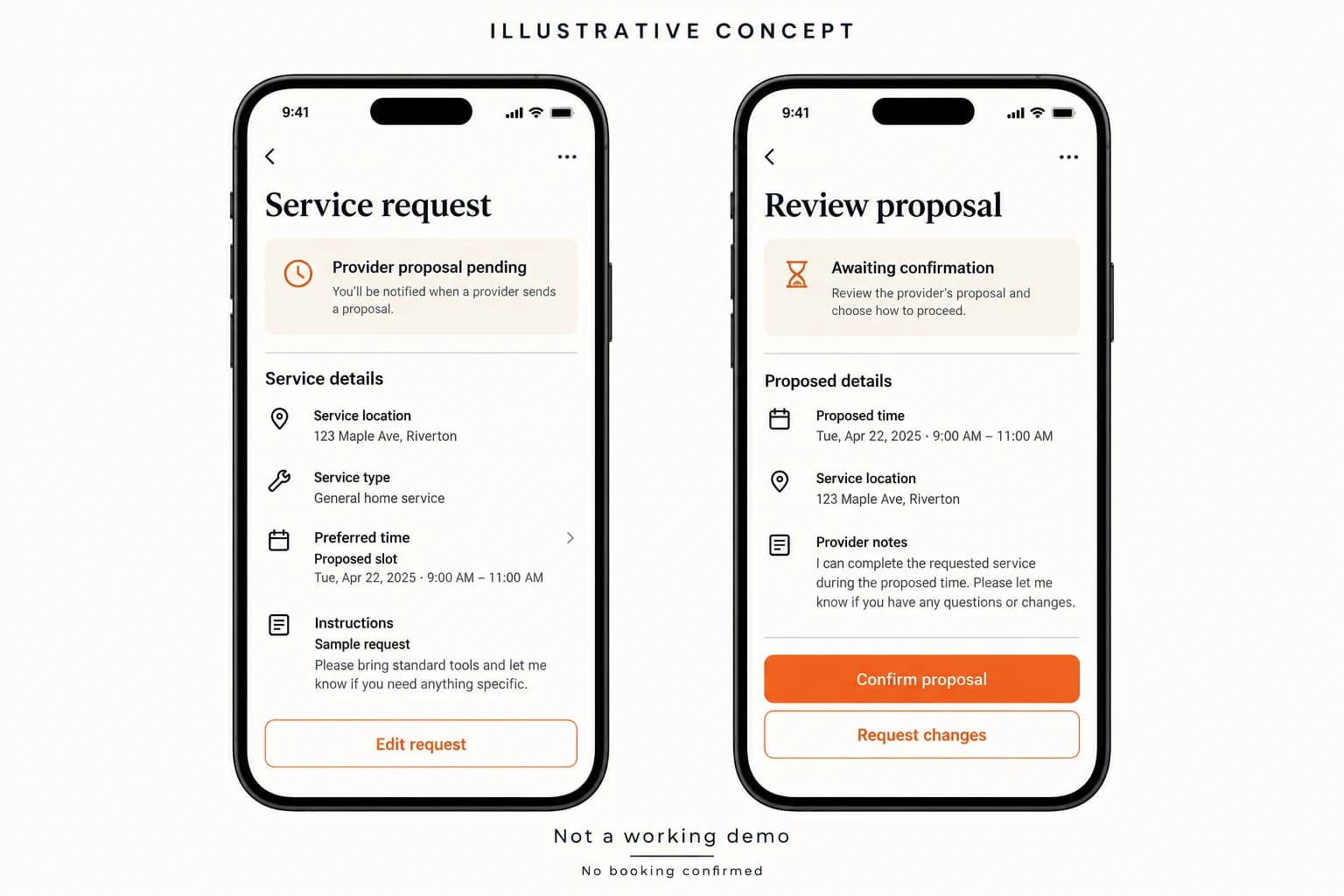
The concept image illustrates a proposed service slot awaiting confirmation; it is not a working dispatch demo or evidence that a job is booked. In procurement, ask to see a synthetic inspection visit followed by a quotation, a customer change request and final approval. Show what the technician can do before approval. That demonstration reveals whether commercial consent is a real workflow or merely a label on a screen.
Design the technician handoff for intermittent connectivity
Providers need the appointment details required for their task, an understandable status and a way to report delays. Decide when full customer contact or access information becomes available and when it should expire. Do not expose an entire customer history simply because a provider accepted one appointment.
Define start, pause and completion evidence according to the service and privacy policy. Location, photographs and signatures can have limits and should not be collected indiscriminately. A location point alone does not prove satisfactory service. Explain retention, permitted viewers and the role of customer confirmation where appropriate.
Test a provider losing connectivity after submitting completion. On reconnection, the application should not create duplicate evidence, charges or notifications. Operators need to distinguish an unsent update from a provider who never started work. If offline functionality is excluded from the initial scope, define the safe alternative and communicate the limitation to staff rather than discovering it during the first poorly connected visit.
Treat complaints as cases, not scattered notes
A complaint needs a link to the booking, the reported issue, supporting evidence, responsible owner and an agreed next step. Distinguish quality complaints, property-damage reports, billing questions and safety-related escalations. The appropriate procedure depends on the issue; software should route staff to approved processes without inventing emergency or legal advice.
Give operators a case timeline containing relevant customer and provider communications. Separate internal notes from messages visible outside the organisation. Require deliberate confirmation before sending sensitive information. If a complaint creates a rework visit, link the new appointment without deleting the original service and financial records.
Define closure conditions and reopening behaviour. A refund request, a goodwill credit and a completed repair are different outcomes. Record approvals and provider responsibilities where applicable. Ask vendors to demonstrate a complaint arriving after payout, because the operational and financial position may differ from a complaint raised before completion. A support screen that works only before money moves is not sufficient for the full service lifecycle.
Make provider earnings understandable
Show the basis of each earning: booking, agreed amount, commission or deductions, adjustments and current payment position. Distinguish work completed from funds eligible for payout and a payout confirmed by the payment provider. A single green paid label should not cover several economically different events.
Have finance and appropriate advisers approve the deduction and compensation model. Employment or contractor classification is not determined by a database field. The software should preserve the agreed rule and its effective period so a later rate change does not rewrite historical earnings.
The admin console needs reconciliation and discrepancy handling, not unrestricted balance editing. A duplicate payment callback must not generate duplicate provider earnings. A refunded booking may require a defined adjustment rather than deletion. Demonstrate a synthetic provider statement from booking through final payment and explain every line. Include exports in a usable format and access controls over bank-related changes. These requirements protect the business from opaque calculations even at modest transaction volume.
Enforce permissions beyond hiding menu items
Create roles around responsibilities: dispatcher, customer support, provider reviewer, finance operator and administrator, adapted to your organisation. Define which records each role can access and which actions require approval. Scope by region or organisation where necessary. A staff member who can view tomorrow's schedule does not automatically need payout settings or bulk customer exports.
OWASP's authorisation guidance recommends least privilege, default-deny behaviour and permission checks on requests. Translate those principles into negative tests: an operator from one region tries to change another region's appointment, a support user attempts a restricted refund, and a provider requests another provider's statement.
Test backend behaviour directly as well as the interface. Removing a button does not prevent an unauthorised request. Audit sensitive changes, permission changes and exports with appropriate context, while avoiding unnecessary personal data in general logs. Review temporary elevated access and revocation. Administrative convenience should not depend on sharing one account whose actions cannot be attributed to the person who performed them.
Make notifications observable and safe to retry
Map each business event to the recipient, channel, template and fallback. Booking confirmation, provider offer, changed arrival time, quotation approval and cancellation are different messages. Avoid sending contradictory notifications when an operator corrects a booking or a delayed event arrives after a newer change.
Provider acceptance of a message request is not proof that a person read it. Twilio documents webhook callbacks and message-related fields; the application should interpret actual provider states and avoid overstating delivery certainty. Store the relevant safe references and expose failed or unresolved notifications to the responsible team.
Use deduplication so a retried background job does not repeatedly contact the customer. Separate transactional messaging from marketing preferences and obtain appropriate review of consent and regional requirements. Budget authentication abuse protection, sender setup and ongoing message costs. A dashboard that records message sent for every attempted API call can leave dispatchers believing a provider saw an urgent offer when the provider was never reached.
Measure operations without misleading averages
Define metrics with event boundaries and denominators. Assignment time might mean request to first offer, request to accepted provider or confirmation to final allocation. Late arrival needs an agreed service-window definition. Completion and customer satisfaction should not be inferred from a provider pressing a button without the relevant validation.
Show distributions and exceptions alongside averages. A fictional team averaging ten-minute allocation can still have several appointments waiting an hour. Segment by category, region and operating hours where that helps explain the cause. Preserve cancelled and manually corrected cases rather than excluding inconvenient records until a chart looks favourable.
Keep dashboards actionable. If repeated delays relate to missing provider capacity, the next step may be operational recruitment or a narrower booking window, not a new chart. Label estimates and incomplete data. Build an export or report that lets an authorised manager trace a metric back to its underlying appointments. The objective is a defensible operating decision, not a wall of counters that nobody can explain.
Specify audit, recovery and retention together
Record consequential actions such as assignment changes, price approvals, cancellations, refunds and permission updates. Include actor, time, reason and linked record references. Protect the audit history from casual modification and define who reviews it. Do not copy all customer communications and attachments into every log stream simply to claim comprehensive traceability.
Set retention rules with appropriate business and specialist input. Service photographs, addresses, access instructions and provider documents can have different needs. Make deletion and access restrictions deliberate, including backups and exported copies where relevant. Sensitive property-entry instructions should not become permanent general-purpose notes visible to every staff member.
Test restoration in an isolated environment and prevent restored jobs from sending live notifications or issuing money-moving requests. Establish recovery targets and operational fallback. Staff need to know how to handle appointments already underway if the console is temporarily unavailable. A backup schedule without a successful restore exercise does not establish that tomorrow's assignments or financial references can be recovered correctly.
Use a requirements matrix in procurement
The comparison table pairs each operational capability with the evidence a buyer should request. Use it to compare the same scope across suppliers. A calendar screenshot cannot substitute for a rescheduling test, and a payout menu cannot substitute for a reconciled statement. Ask which demonstrated features are included, configured, newly engineered or excluded.
Run a synthetic busy-morning exercise involving two operators. One provider cancels, another submits additional work and a customer disputes arrival. Ask the team to reassign work, preserve approvals, notify the right people and retain an understandable history. Test concurrency and denied permissions, not only the happy path chosen by the salesperson.
Keep unresolved items visible with an owner and an acceptance criterion. A prototype can establish interface direction, but it does not establish provider integration, operational policy or release readiness. If discovery is needed, contract for a bounded discovery output rather than pretending unknown rules are already included in a fixed build price. That makes the eventual estimate more accurate and easier to govern.
Design shift handover and bulk changes deliberately
An appointment may outlast one dispatcher's shift. The next operator needs the current owner, unresolved commitments, next action and relevant customer promise. Separate those operational facts from a long stream of unstructured chat. A concise handover view can show appointments requiring follow-up without giving every incoming employee unrestricted access to unrelated records.
Test a handover with an unanswered provider offer and an approved quotation awaiting scheduling. The new operator should see the latest evidence and know which actions remain safe. Define when case ownership changes and whether a previous operator can still act. Otherwise two staff members can independently promise different arrival times while each believes they own the same case.
Bulk actions need stronger safeguards than a convenient select-all checkbox. A regional closure may require cancelling or rescheduling many appointments, but not every record should receive the same action. Preview the affected set, show exclusions and require confirmation appropriate to the risk. Record individual outcomes so a partial failure does not appear as a fully successful campaign.
For a fictional weather disruption, select six future visits and identify one that has already started. The console should not silently cancel the active visit under a rule intended for unstarted work. Show the operator which notification was issued for each eligible booking and which records need separate handling. Use this exercise to test stale selections: a record can change after the preview but before confirmation. A safe bulk workflow rechecks the relevant conditions rather than trusting an old browser snapshot.
Plan delivery by usable operational slices
The first slice can cover one service category, one region and one complete appointment lifecycle with controlled exceptions. Add quotation work, recurring visits or specialised teams when the underlying rules are understood. Reduce optional models rather than removing access controls, cancellation history or financial correctness to meet an arbitrary launch date.
For each slice, agree the demonstration, data requirements, test evidence, training and operational owner. Hand over source code, configuration, permitted access and documentation according to the contract. Test a real operator's ability to complete the approved workflow using synthetic data without a developer explaining every step. Include readable errors, keyboard access and responsive behaviour; an admin product deserves usability testing too.
App Clone Labs can help translate your service model into booking states, dispatch rules, permission boundaries and acceptance exercises. Bring sample jobs, cancellation policies, provider arrangements, quotation rules and the current operational workarounds. The linked on-demand services and process pages can frame that scoping discussion. Commission a console that helps staff resolve today's exceptions, not merely report that exceptions exist.
OWASP authorisation guidance: least privilege and request-level checks
Twilio message webhook and callback reference
W3C WCAG 2.2 accessibility quick reference
Stripe webhook reference as an example of asynchronous payment events
Comparison register
Home-service admin procurement matrix
Workflow requirements and synthetic acceptance exercises, not a claim about an existing product's capabilities or legal suitability.
| Capability | Evidence to request | Failure to test |
|---|---|---|
| Work queue | Owner, urgency and safe next action | Unassigned near-term visit hidden in one pending count |
| Dispatch | Eligibility reasons and accepted assignment history | Two operators allocate the same appointment |
| Scheduling | Capacity check and versioned reschedule | Changed occurrence alters an entire recurring series |
| Quotations | Versioned customer approval | Provider changes amount after acceptance |
| Complaints | Linked case, evidence and approved resolution | Complaint arrives after provider payout |
| Permissions | Backend negative-access tests | Support account performs a restricted financial action |
| Handover | Operator exercise and recovery runbook | Restored jobs send duplicate live notifications |
- 01
- 02
- 03
- 04
Reviewed by Aditya Bhimrajka
This guide is written for founders and operators planning clone-inspired platforms, SaaS products, marketplaces, and mobile apps. It is reviewed against App Clone Labs delivery patterns, product scoping standards, and current implementation realities before being published.
Review the editorial team structureRelated product paths
Continue with the services, solutions, guides, and articles that connect this topic to a real software build.