
A fifteen-minute grocery promise can fail while the server is almost idle. The last carton exists in the catalogue but not on the shelf, the replacement needs approval, and the only available rider is outside the service zone. A larger cloud instance does not solve those problems. A useful budget connects inventory, picking, payment and dispatch before it estimates hosting.
This guide is for founders and grocery operators commissioning a controlled quick-commerce launch. It separates implementation effort, monthly technology overhead, store hardware and operational working capital. All dollar examples below are invented planning inputs, not supplier quotations, industry averages or measured App Clone Labs results. Replace them with regional prices, observed workloads and your actual operating model.
Define what the fifteen minutes actually measures
Write the start and end events before buying software. Does the clock begin when a customer opens the app, confirms payment, or receives store acceptance? Does it stop at the building entrance or customer handover? Which addresses, opening hours and product types qualify? Marketing, engineering and operations must use the same definition.
Consider a fictional budget of two minutes for acceptance, four for picking, two for packing and rider handover, and seven for travel. That adds to fifteen minutes with no spare capacity for a missing item or inaccessible building. It is an illustration of a fragile promise, not a recommended service standard. Measure each segment in a pilot before publishing a delivery commitment.
The product should support honest alternatives. An overloaded store can stop accepting orders, show a longer estimate or offer a later slot. Returning a truthful delivery window is better than presenting a fixed countdown that staff cannot meet. Scope the controls and customer messages explicitly: they require capacity information and reliable state changes, not merely different wording on the checkout screen.
Use one operating envelope for every quotation
A comparable brief might specify one city, two dark stores, one currency, a fixed service area, a limited catalogue and a single payment provider. It should also identify who owns inventory and employs or contracts riders. A retailer operating its own stores has different settlement and permission needs from a marketplace connecting independent merchants.
State whether orders can span stores. A single-store basket keeps stock reservation, picking and refund decisions within one fulfilment location. Cross-store baskets add separate preparation times, delivery coordination and potentially multiple financial allocations. They should not enter a pilot as an innocent checkbox labelled multi-store support.
Define exclusions as carefully as inclusions. Scheduled subscriptions, wholesale ordering, loyalty accounting and third-party marketplace aggregation can wait if they are not essential to the first transaction. Essential exception handling cannot: unavailable stock, duplicate payment notifications and failed delivery still happen in a small launch. Ask every bidder to price the same successful order and the same five failure scenarios before comparing totals.
Start with an auditable transaction architecture
A practical baseline is a customer application, a picker workspace, a rider application and an operations console connected to a backend with explicit order states. A relational database can hold orders, reservations and financial records; object storage can hold product assets; background jobs can handle retryable work. These are responsibilities, not a mandatory vendor shopping list.
A modular application may be easier to operate than several independent services during an early launch. Separate inventory, pricing, payment and dispatch in the code and data model without assuming each requires its own deployment. Split services when measured load, ownership or isolation requirements justify the operational overhead.
Choose mobile technology around actual devices and workflows. A shared cross-platform codebase may reduce duplicated interface work, but barcode scanning, camera permissions, intermittent connectivity and background rider location still need platform testing. The picker device sitting on a charging dock and the rider phone losing connectivity are different environments. Include both in estimates and acceptance tests instead of quoting only the customer app.
Price picker work as its own product
The picker workflow begins before a customer complains about an unavailable item. Staff need an ordered queue, shelf locations, quantity confirmation, shortage reporting and a clear handover state. Weighted goods may require actual weight entry and a final price adjustment. Substitution preferences must be visible at the moment a decision is made.
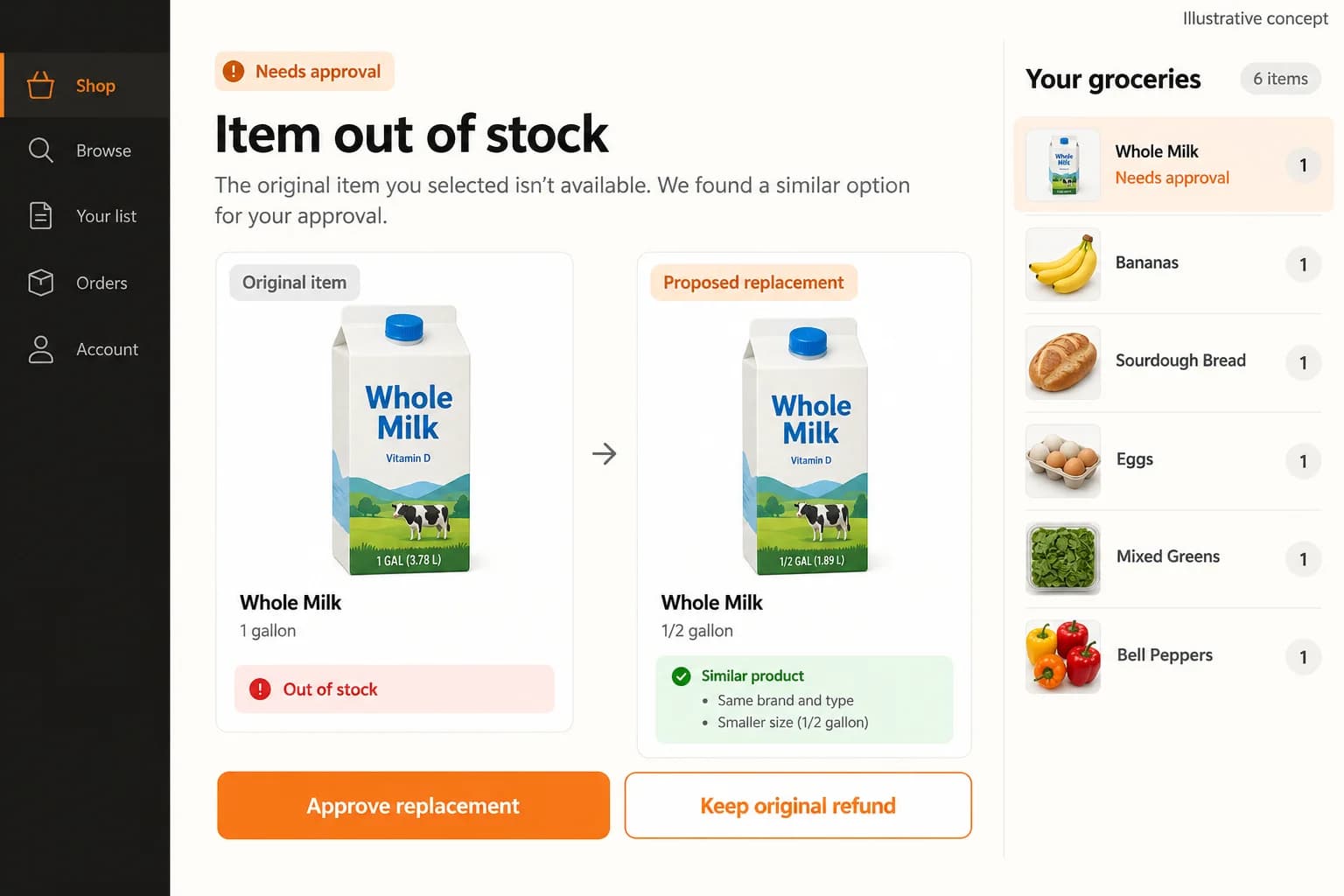
The accompanying concept illustrates a replacement approval, not a production-ready inventory system. Replacing a gallon of milk with a smaller carton changes quantity and price. The software must represent that difference and ask for approval according to the agreed policy. A visually similar product is not automatically an acceptable replacement, particularly where dietary restrictions or allergens matter.
For budgeting, divide picker development into queue management, scan and quantity validation, substitutions, packing and offline recovery. Then add realistic device tests. A scan recorded twice after reconnection should not reduce stock twice. A picker taking over an interrupted order should see which items are already confirmed. These behaviours are costed engineering work, not polish to be negotiated after delivery.
Make inventory reservation a financial decision
Available-to-sell stock is not simply the last number imported from a spreadsheet. The application must account for reservations, damaged items, replenishment and physical stock corrections. Decide when a reservation starts, how long it lasts, and who can release it. Expired baskets should not permanently remove products from sale.
PostgreSQL documents explicit locking as one mechanism for coordinating competing transactions. A team can also use conditional updates and appropriate constraints, depending on the design. The procurement requirement is the outcome: two concurrent checkouts cannot both acquire the last available unit. A particular database brand does not prove that the application implements this correctly.
Ask for a repeatable concurrency test and an explanation of failed transaction recovery. Inventory changes need a reason, actor and reference to an order or adjustment. Corrections should be distinguishable from sales. Budget the initial catalogue cleanup and stock-count process too; accurate software cannot reconstruct shelf quantities that were never counted. Store staff and product owners need a shared definition of the authoritative stock source.
Separate initial development from recurring infrastructure
Implementation includes discovery, design, application development, integrations, testing, release preparation and operational training. Recurring infrastructure includes compute, database capacity, storage, backups, monitoring and network traffic. Support labour, payment fees and store connectivity are additional lines. Combining everything into one monthly number conceals which expenses change with orders.
The comparison worksheet uses fictional implementation allowances: sixty hours for discovery, one hundred eighty for customer ordering, one hundred forty for picking and inventory, one hundred twenty for dispatch, one hundred for payment reconciliation, and one hundred sixty for testing and handover. That is seven hundred sixty hours. At an assumed fifty dollars per hour, labour would be thirty-eight thousand dollars.
Those figures do not include licences, hardware, cloud services, taxes, data migration, working capital or contingency. They are not a promise that your product can be built in that time. Their purpose is to make the estimate challengeable. If a supplier removes a workstream, ask which acceptance scenarios disappear with it. If it adds effort, ask what complexity the additional hours cover.
Build a monthly cloud worksheet with explicit units
Use instance-hours for always-on compute, storage capacity and retention for data, request volume for transactional APIs, and transfer volume for outbound media. Include staging and backups rather than treating production as the only environment. Record the region, currency, pricing date and service configuration alongside each estimate.
AWS provides separate pricing references for RDS PostgreSQL and S3. Use those references and the provider calculator for your selected deployment. Do not transplant a public example from another region or assume a stopped application eliminates every storage charge. Availability choices and retained copies can materially change the bill even when order volume stays flat.
A fictional monthly allocation might reserve two hundred dollars for application capacity, two hundred fifty for database capacity, sixty for storage and backups, ninety for monitoring and one hundred for staging and background work. The subtotal is seven hundred dollars before maps, messaging, payment fees, taxes and support. These are budget allowances only, not current AWS rates or a tested capacity plan. Obtain a configured estimate before committing money.
Model maps and messaging from events, not downloads
An installation does not reveal API consumption. Count address lookups, route estimates, dispatch candidate evaluations and customer map refreshes. In a fictional month with six thousand orders, three route calculations per order means eighteen thousand calculations. A change to ten per order produces sixty thousand before support or operational calls are counted.
Google's Routes documentation distinguishes billing behaviour by method and selected functionality; matrix work can be counted by elements. Model the actual requests and selected features rather than assuming every map action has one identical price. Apply current provider terms, regional availability and permitted storage behaviour to any caching strategy.
Messaging needs the same discipline. Distinguish authentication codes, order confirmations, substitution requests and support conversations. Push delivery can fail or be disabled, so an urgent replacement decision needs a defined timeout and fallback. Put spending limits and abuse controls around repeated authentication requests. A useful forecast shows both expected usage and an adverse case caused by retries, bot traffic or a campaign concentrated into one evening.
Include hardware and store connectivity
A dark store needs more than smartphones. The budget may include barcode scanners, label printers, charging equipment, spare batteries, protective cases, dependable wireless coverage and a backup connectivity plan. Some operations need scales or temperature-monitoring equipment. Food-safety requirements and equipment suitability require appropriate operational and specialist review, not a software vendor's blanket assurance.
Price each physical location separately. In a fictional two-store pilot, four picker devices at two hundred dollars each, two printers at two hundred fifty each, and six hundred dollars for connectivity equipment and accessories total nineteen hundred dollars. This excludes installation, consumables, warranties, local taxes and any specialised equipment. It is arithmetic for a worksheet, not a purchasing recommendation.
Check integration before ordering devices. A scanner that acts as keyboard input differs from a device requiring a proprietary SDK. A printer may need a network bridge or platform-specific driver. Ask the development partner to test one actual unit early. Replacing incompatible equipment after staff training is more expensive than validating the exact model before purchasing the rest.
Design payments around changes to the basket
Grocery totals can change after checkout because quantities, weights or replacements differ. Establish the payment model with your provider before implementation. Whether you can authorise first and capture a revised amount depends on provider capabilities, payment method and contractual conditions. Do not assume that a generic payment integration includes every adjustment path.
Keep the customer order, payment attempt and refund as related but distinct records. A successful payment notification does not prove that picking began. A refunded item does not mean the entire order was cancelled. Customer support should see the original amount, final amount, adjustment reason and provider reference without handling sensitive card details.
Acceptance scenarios should include an expired authorisation, a failed capture after picking, a partial refund and repeated provider notifications. Reconcile the provider's financial records against the application's records on a defined schedule. Budget the reconciliation report and discrepancy queue. An attractive receipt screen is not a substitute for evidence that money movement matches the order history.
Test peak demand and operational bottlenecks together
Average orders per day hides the busy interval. A fictional store receiving one hundred twenty orders over two hours has a different staffing and queueing problem from the same volume over twelve hours. Record basket sizes, item availability, pick duration and rider readiness as well as technical request volume.
Build a test workload from the order lifecycle. Include browsing and searching, simultaneous stock reservations, picker updates, payment callbacks and dispatch changes. Use synthetic data, realistic catalogue sizes and a documented environment. Report response-time percentiles, error rates, database contention and queue delay. A single successful checkout or an unqualified requests-per-second figure is weak acceptance evidence.
Then run a supervised operational exercise. Have staff process shortages and rider delays while the technical workload runs. The system might respond quickly while the picking queue becomes impossible. Define what pauses orders, who can intervene and what customers see. Scaling an API and increasing physical fulfilment capacity are separate decisions; the budget should show both rather than attributing every delay to hosting.
Budget recovery before spending on expansion
A database backup is useful only if someone can restore it within the agreed recovery window. Ask for a documented restore exercise, access ownership and a statement of acceptable data loss and downtime. These targets belong in the operating plan; they are not guaranteed by the presence of a backup checkbox.
Plan bounded logs and monitoring from the start. Retain enough information to investigate failed orders without filling storage indefinitely or exposing customer details. Alert on disk utilisation, repeated job failures, inventory-import failures and unusual payment discrepancies. Assign a person or support team to each alert. Monitoring without ownership creates another unattended dashboard.
Release procedures should preserve customer orders and permit a controlled rollback. Database changes may need compatibility across application versions. Ask what happens to an active picking session during deployment. Budget maintenance and security updates, including mobile operating-system changes. These are recurring responsibilities even when the initial feature list is finished and no new city has been added.
Compare unit economics without hiding store costs
Technology cost per order is a useful diagnostic, not the business's entire contribution margin. In the fictional seven-hundred-dollar infrastructure allocation, six thousand monthly orders yield roughly twelve cents per order before usage-based APIs and all excluded costs. At two thousand orders, the same fixed allocation becomes thirty-five cents. Lower volume changes the denominator, not necessarily the bill.
Add payment fees, messaging, picking labour, delivery labour, packaging, refunds, shrinkage, rent and acquisition costs in separate columns. Keep revenue assumptions visible. A delivery fee collected from a customer does not automatically cover a rider shift or an unsuccessful trip. Store replenishment and capital tied up in inventory can matter more than application hosting.
Create an adverse scenario with lower order density, more substitutions and higher support demand. Show how those conditions affect both cost and promised delivery time. Use the model to decide whether the pilot should expand, change its service window or reduce its radius. The software can expose operational evidence; it cannot make an uneconomic fulfilment model profitable by renaming it quick commerce.
Ask vendors to demonstrate the expensive exceptions
For a procurement walkthrough, supply a synthetic order with one unavailable item, a replacement requiring approval and a rider who disconnects. Ask the supplier to show the complete history from stock reservation to final receipt. Explain in advance that concept images and scripted screens are not evidence of working integrations.
Request access to a suitable sandbox, not production customer data. Confirm which demonstrated capabilities are included in the proposed licence and which need engineering. A supplier may have a functioning customer app but only a planned warehouse integration. That distinction should be written into the proposal with dependencies, acceptance criteria and change-control rules.
Finish the demonstration with an export and a recovery discussion. Can your team retrieve orders, inventory adjustments and financial references in a usable format? Who controls hosting, provider accounts and signing keys? Which components are owned, licensed or third-party? Practical handover rights and documentation are part of the buying decision, especially if you later switch partners or operate additional stores yourself.
Run a replenishment rehearsal before adding stores
Most demonstrations start with a full catalogue and enough stock. Start another exercise with an incoming delivery, a damaged item and a shelf count that disagrees with the system. Ask the team to receive stock, quarantine the damaged quantity and explain the correction without changing historical customer orders. This exposes the work hidden behind a simple inventory screen.
Specify who can adjust quantities and whether adjustments need review above an agreed threshold. Preserve the source document or internal reference appropriate to the process. If an external inventory platform owns the stock record, test a delayed import and a repeated import. An old message must not erase a newer correction without detection. Import frequency should reflect the real system's capability, not a claim of real-time synchronisation added to marketing copy.
Catalogue maintenance needs similar ownership. Decide who changes pack sizes, units, tax classifications and product availability. A change from an individual item to a multipack can affect pricing, stock and the customer receipt. Staff need a safe method of retiring an item without breaking existing order history. Include training and migration checks in the estimate rather than asking operators to learn through live mistakes.
Before opening a second store, compare the first store's exceptions with the original assumptions. Identify whether shortages originate in counting, replenishment, reservations or picking. Expansion should follow demonstrated control of those causes, not a new store button working in the console. This review produces a more defensible infrastructure forecast too: actual event volumes replace guesses about how often inventory, notifications and dispatch services are called.
At the procurement review, keep a dated assumptions sheet alongside the price. Record the number of locations, expected busy interval, catalogue size, device models, integration owners and external dependencies. If one changes, identify the affected tests and cost lines before approving expansion. This gives operations and engineering a common change record. It also prevents a later infrastructure increase from being presented as unexplained overspending when the original workload or availability requirement has materially changed.
Decide what must be proven before launch
A launch gate should require an approved stock source, tested reservation behaviour, workable picker devices, complete refund paths and trained operational owners. It should also require a truthful delivery estimate and an agreed response when capacity is exhausted. These conditions protect the customer experience more directly than a large catalogue of optional features.
Use the pilot to collect a baseline rather than announce a performance record. Track order acceptance, shortages, replacement approval, packing, handover, delivery and reconciliation separately. Mark incomplete or manually corrected records. Review whether the evidence actually supports the advertised service window across eligible addresses instead of selecting only the fastest orders.
App Clone Labs can scope the connected ordering, inventory, picker and dispatch workflows against a defined pilot. Bring store count, device models, catalogue ownership, payment constraints and the proposed service area to discovery. The useful output is a priced implementation boundary and an operating-cost worksheet with explicit assumptions, not an unconditional fifteen-minute guarantee. Use the linked grocery solution and delivery-process pages to frame that discussion.
AWS RDS PostgreSQL pricing: configure a regional estimate
Amazon S3 storage and request pricing
Google Routes API billing and usage units
PostgreSQL explicit locking and concurrent transactions
Comparison register
Illustrative grocery implementation worksheet
Invented allowances at USD 50/hour, not a quote or market average. Excludes licences, infrastructure, hardware, taxes, capital and contingency.
| Workstream | Assumed hours | Illustrative labour |
|---|---|---|
| Discovery | 60 | USD 3,000 |
| Customer ordering | 180 | USD 9,000 |
| Picking and inventory | 140 | USD 7,000 |
| Dispatch | 120 | USD 6,000 |
| Payment reconciliation | 100 | USD 5,000 |
| Testing and handover | 160 | USD 8,000 |
| Total | 760 | USD 38,000 |
- 01
- 02
- 03
- 04
Reviewed by the App Clone Labs product strategy team
This guide is written for founders and operators planning clone-inspired platforms, SaaS products, marketplaces, and mobile apps. It is reviewed against App Clone Labs delivery patterns, product scoping standards, and current implementation realities before being published.
Review the editorial team structureRelated product paths
Continue with the services, solutions, guides, and articles that connect this topic to a real software build.