Editorial dossier / Education Apps
EdTech Admin Panel Design Guide: Governance, Support and Learning Operations
Design an EdTech admin panel for learner access, instructor governance, curriculum versions, cohorts, assessments, support, privacy and reliable reporting.
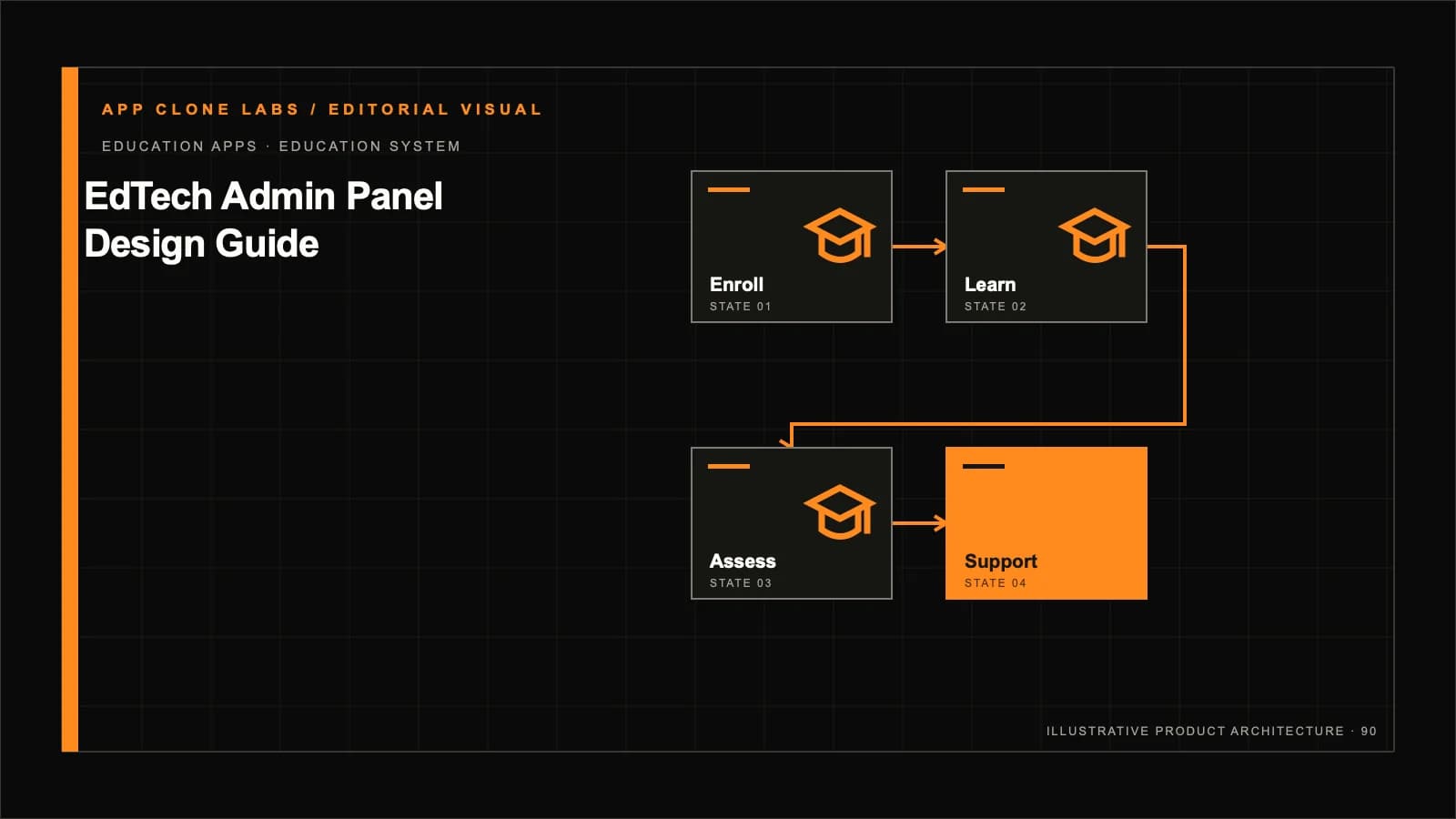
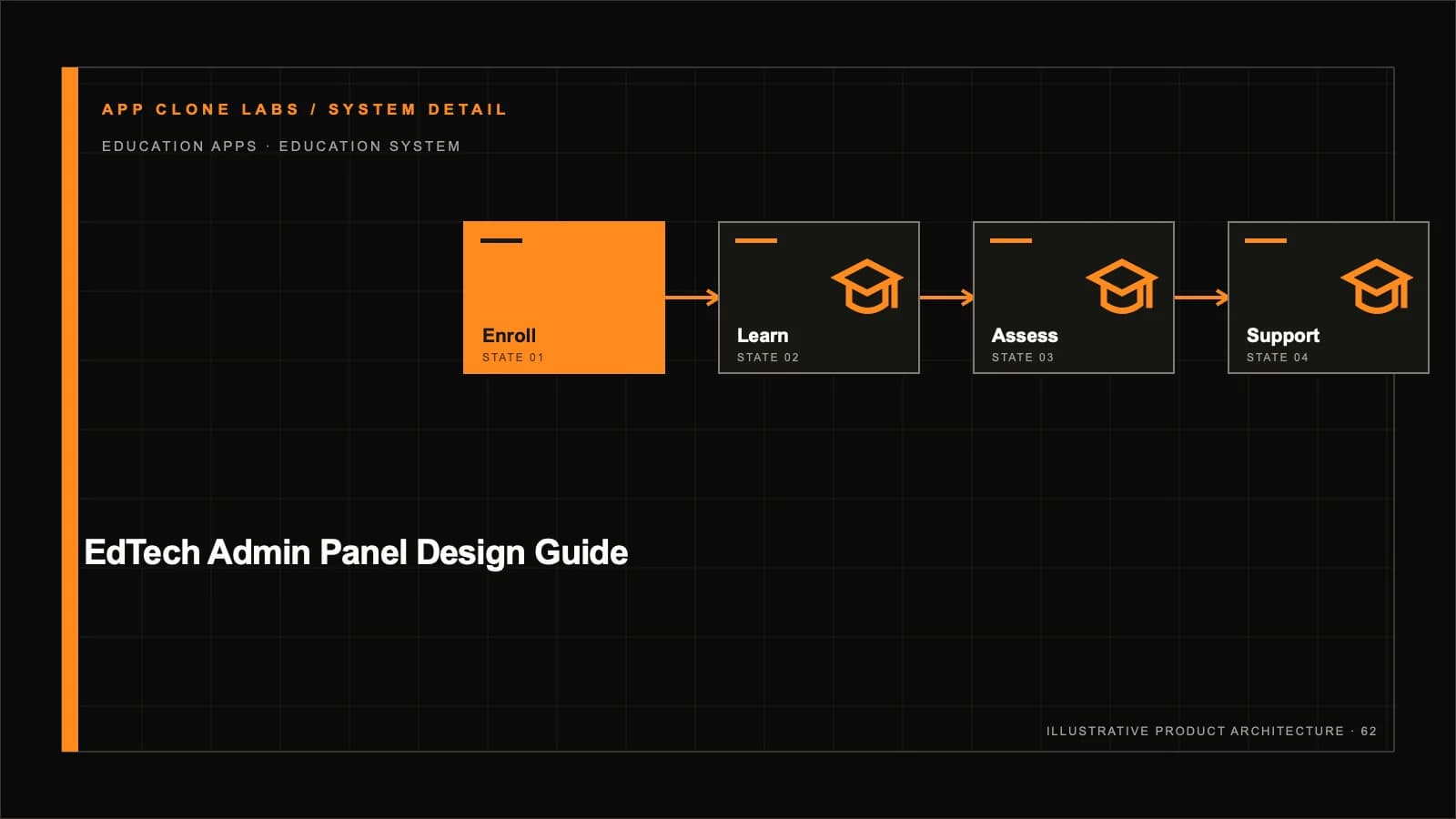
An administrator changes a learner from suspended to active, but the course entitlement remains revoked. Another operator edits a rubric and silently changes historical grades. A third exports a spreadsheet containing more student data than the support case requires. Each screen appears to work; the operating system does not.
An EdTech admin panel is the control surface for educational promises, permissions and exceptions. Its job is not to expose database tables. It must help authorized people understand current state, make bounded changes, retain reasons and recover mistakes without corrupting learning history.
This guide designs that control plane around decisions and evidence rather than a collection of CRUD screens.
Map operator jobs before navigation
Admissions, learning operations, instructors, support, finance and privacy teams make different decisions.
The failure mode is concrete: one enormous sidebar exposes every record to every employee. This is not solved by adding another screen or background job. The product has to define ownership, permitted transitions, and the evidence retained when the transition occurs.
For the first release, inventory jobs, frequency, risk and required context before drawing menus. Write that decision as an enforceable server-side rule, not guidance that depends on a client, operator, or AI model remembering the intended boundary.
Implementation should include job, role, trigger, decision, evidence, action, escalation and service target. Keep the public response smaller than the internal record: users need a clear outcome and recovery path, while authorized operators need correlation IDs, policy versions, timestamps, and the before-and-after state.
Validate it with new enrolment, late assessment and access complaint. Test the ordinary path, then repeat under timeout, duplicate delivery, stale state, partial failure, revoked authority, and concurrent requests. A feature is not ready when only the demonstration succeeds.
- Owner: operations lead
- Release evidence: job-to-screen map
- Stop condition: a common task requires several untracked workarounds
Build capability-based access
Admin titles vary between institutions and teams.
The failure mode is concrete: permission checks rely on labels such as admin or instructor. This is not solved by adding another screen or background job. The product has to define ownership, permitted transitions, and the evidence retained when the transition occurs.
For the first release, grant explicit capabilities within organization and course scope. Write that decision as an enforceable server-side rule, not guidance that depends on a client, operator, or AI model remembering the intended boundary.
Implementation should include view, create, publish, grade, export, refund, impersonate and audit capabilities. Keep the public response smaller than the internal record: users need a clear outcome and recovery path, while authorized operators need correlation IDs, policy versions, timestamps, and the before-and-after state.
Validate it with multi-role user, expired assignment and direct API call. Test the ordinary path, then repeat under timeout, duplicate delivery, stale state, partial failure, revoked authority, and concurrent requests. A feature is not ready when only the demonstration succeeds.
- Owner: security owner
- Release evidence: authorization matrix
- Stop condition: the interface is the only permission boundary
Separate learner identity from enrolment
A person can join several courses and organizations over time.
The failure mode is concrete: suspending one enrolment disables the whole identity. This is not solved by adding another screen or background job. The product has to define ownership, permitted transitions, and the evidence retained when the transition occurs.
For the first release, manage identity, membership and enrolment as distinct lifecycles. Write that decision as an enforceable server-side rule, not guidance that depends on a client, operator, or AI model remembering the intended boundary.
Implementation should include person ID, account status, organization membership, enrolment, entitlement and effective dates. Keep the public response smaller than the internal record: users need a clear outcome and recovery path, while authorized operators need correlation IDs, policy versions, timestamps, and the before-and-after state.
Validate it with course transfer, duplicate account and organization departure. Test the ordinary path, then repeat under timeout, duplicate delivery, stale state, partial failure, revoked authority, and concurrent requests. A feature is not ready when only the demonstration succeeds.
- Owner: identity owner
- Release evidence: lifecycle tests
- Stop condition: one local action unexpectedly removes unrelated access
Give every high-impact action a reason
Manual corrections are sometimes necessary but must be explainable.
The failure mode is concrete: operators overwrite values without context. This is not solved by adding another screen or background job. The product has to define ownership, permitted transitions, and the evidence retained when the transition occurs.
For the first release, require structured reason codes, notes and before-and-after evidence. Write that decision as an enforceable server-side rule, not guidance that depends on a client, operator, or AI model remembering the intended boundary.
Implementation should include actor, capability, target, old state, new state, reason, case and timestamp. Keep the public response smaller than the internal record: users need a clear outcome and recovery path, while authorized operators need correlation IDs, policy versions, timestamps, and the before-and-after state.
Validate it with grade correction, access restoration and cohort transfer. Test the ordinary path, then repeat under timeout, duplicate delivery, stale state, partial failure, revoked authority, and concurrent requests. A feature is not ready when only the demonstration succeeds.
- Owner: governance lead
- Release evidence: audit reconstruction
- Stop condition: support cannot explain who changed a learner outcome
Checkpoint 4: reconcile the product promise with the recorded state. Support, finance, security, and delivery teams should be able to reach the same conclusion from the same identifiers without reconstructing events from chat messages or screenshots.
Version courses and published content
Active learners depend on the material they were assigned.
The failure mode is concrete: editing a lesson mutates every historic cohort. This is not solved by adding another screen or background job. The product has to define ownership, permitted transitions, and the evidence retained when the transition occurs.
For the first release, publish immutable course versions and schedule migrations deliberately. Write that decision as an enforceable server-side rule, not guidance that depends on a client, operator, or AI model remembering the intended boundary.
Implementation should include course version, status, author, approver, release notes, dependencies and effective date. Keep the public response smaller than the internal record: users need a clear outcome and recovery path, while authorized operators need correlation IDs, policy versions, timestamps, and the before-and-after state.
Validate it with urgent typo, removed resource and major curriculum revision. Test the ordinary path, then repeat under timeout, duplicate delivery, stale state, partial failure, revoked authority, and concurrent requests. A feature is not ready when only the demonstration succeeds.
- Owner: curriculum lead
- Release evidence: version comparison
- Stop condition: historical learning evidence loses its source context
Manage cohorts as scheduled operations
Capacity, facilitators, sessions and deadlines vary per delivery instance.
The failure mode is concrete: cohort data is scattered across calendar and spreadsheets. This is not solved by adding another screen or background job. The product has to define ownership, permitted transitions, and the evidence retained when the transition occurs.
For the first release, provide a single cohort control surface tied to a course version. Write that decision as an enforceable server-side rule, not guidance that depends on a client, operator, or AI model remembering the intended boundary.
Implementation should include dates, timezone, capacity, instructors, sessions, milestones, communications and status. Keep the public response smaller than the internal record: users need a clear outcome and recovery path, while authorized operators need correlation IDs, policy versions, timestamps, and the before-and-after state.
Validate it with reschedule, instructor replacement and delayed start. Test the ordinary path, then repeat under timeout, duplicate delivery, stale state, partial failure, revoked authority, and concurrent requests. A feature is not ready when only the demonstration succeeds.
- Owner: programme manager
- Release evidence: cohort rehearsal
- Stop condition: operators cannot identify the current delivery promise
Protect assessment integrity
Questions, rubrics, attempts and grades have separate authority boundaries.
The failure mode is concrete: one operator can edit an assessment and its submitted results invisibly. This is not solved by adding another screen or background job. The product has to define ownership, permitted transitions, and the evidence retained when the transition occurs.
For the first release, separate authoring, publishing, grading, moderation and correction. Write that decision as an enforceable server-side rule, not guidance that depends on a client, operator, or AI model remembering the intended boundary.
Implementation should include assessment version, attempt, evaluator, rubric, score, feedback, correction and appeal. Keep the public response smaller than the internal record: users need a clear outcome and recovery path, while authorized operators need correlation IDs, policy versions, timestamps, and the before-and-after state.
Validate it with invalid question, regrade and reviewer conflict. Test the ordinary path, then repeat under timeout, duplicate delivery, stale state, partial failure, revoked authority, and concurrent requests. A feature is not ready when only the demonstration succeeds.
- Owner: assessment lead
- Release evidence: grade lineage sample
- Stop condition: a final result cannot be reproduced
Design an exception queue
The valuable admin work concerns failures and edge cases.
The failure mode is concrete: urgent exceptions hide in broad record lists. This is not solved by adding another screen or background job. The product has to define ownership, permitted transitions, and the evidence retained when the transition occurs.
For the first release, surface prioritized cases with ownership and bounded actions. Write that decision as an enforceable server-side rule, not guidance that depends on a client, operator, or AI model remembering the intended boundary.
Implementation should include case type, severity, learner impact, source evidence, owner, due time and resolution. Keep the public response smaller than the internal record: users need a clear outcome and recovery path, while authorized operators need correlation IDs, policy versions, timestamps, and the before-and-after state.
Validate it with missed session, payment mismatch and inaccessible material. Test the ordinary path, then repeat under timeout, duplicate delivery, stale state, partial failure, revoked authority, and concurrent requests. A feature is not ready when only the demonstration succeeds.
- Owner: learning operations
- Release evidence: queue service report
- Stop condition: a learner-impacting case has no owner
Checkpoint 8: reconcile the product promise with the recorded state. Support, finance, security, and delivery teams should be able to reach the same conclusion from the same identifiers without reconstructing events from chat messages or screenshots.
Make search safe and useful
Operators need identifiers, names, cohorts and cases, but results may contain sensitive data.
The failure mode is concrete: global search returns full records regardless of role. This is not solved by adding another screen or background job. The product has to define ownership, permitted transitions, and the evidence retained when the transition occurs.
For the first release, authorize query scopes and minimize result previews. Write that decision as an enforceable server-side rule, not guidance that depends on a client, operator, or AI model remembering the intended boundary.
Implementation should include search purpose, capability, tenant, fields, result type, access event and retention. Keep the public response smaller than the internal record: users need a clear outcome and recovery path, while authorized operators need correlation IDs, policy versions, timestamps, and the before-and-after state.
Validate it with partial name, copied identifier and cross-organization query. Test the ordinary path, then repeat under timeout, duplicate delivery, stale state, partial failure, revoked authority, and concurrent requests. A feature is not ready when only the demonstration succeeds.
- Owner: privacy owner
- Release evidence: negative search tests
- Stop condition: unauthorized information appears in snippets
Constrain impersonation and support access
Seeing the learner experience can resolve defects but creates powerful access.
The failure mode is concrete: staff enter accounts without consent or audit. This is not solved by adding another screen or background job. The product has to define ownership, permitted transitions, and the evidence retained when the transition occurs.
For the first release, use time-limited support sessions with purpose and prominent indication. Write that decision as an enforceable server-side rule, not guidance that depends on a client, operator, or AI model remembering the intended boundary.
Implementation should include case ID, approver, scope, start, expiry, actions blocked and audit. Keep the public response smaller than the internal record: users need a clear outcome and recovery path, while authorized operators need correlation IDs, policy versions, timestamps, and the before-and-after state.
Validate it with expired session, financial action and learner notification. Test the ordinary path, then repeat under timeout, duplicate delivery, stale state, partial failure, revoked authority, and concurrent requests. A feature is not ready when only the demonstration succeeds.
- Owner: support security lead
- Release evidence: impersonation review
- Stop condition: support can perform irreversible learner actions
Treat exports as data products
CSV and report downloads often bypass interface-level minimization.
The failure mode is concrete: one export includes every learner field. This is not solved by adding another screen or background job. The product has to define ownership, permitted transitions, and the evidence retained when the transition occurs.
For the first release, define purpose-specific exports with permissions, expiry and provenance. Write that decision as an enforceable server-side rule, not guidance that depends on a client, operator, or AI model remembering the intended boundary.
Implementation should include columns, filters, requester, purpose, generated time, expiry and watermark. Keep the public response smaller than the internal record: users need a clear outcome and recovery path, while authorized operators need correlation IDs, policy versions, timestamps, and the before-and-after state.
Validate it with large cohort, small subgroup and revoked requester. Test the ordinary path, then repeat under timeout, duplicate delivery, stale state, partial failure, revoked authority, and concurrent requests. A feature is not ready when only the demonstration succeeds.
- Owner: data governance owner
- Release evidence: export inventory
- Stop condition: a file contains fields unnecessary for its purpose
Show data freshness and lineage
Roster, analytics and payment integrations update asynchronously.
The failure mode is concrete: operators treat stale imported data as current truth. This is not solved by adding another screen or background job. The product has to define ownership, permitted transitions, and the evidence retained when the transition occurs.
For the first release, display source, synchronization status and last verified time. Write that decision as an enforceable server-side rule, not guidance that depends on a client, operator, or AI model remembering the intended boundary.
Implementation should include system of record, source ID, fetched time, processing state, mismatch and retry. Keep the public response smaller than the internal record: users need a clear outcome and recovery path, while authorized operators need correlation IDs, policy versions, timestamps, and the before-and-after state.
Validate it with connector outage, partial batch and deleted source. Test the ordinary path, then repeat under timeout, duplicate delivery, stale state, partial failure, revoked authority, and concurrent requests. A feature is not ready when only the demonstration succeeds.
- Owner: integration lead
- Release evidence: reconciliation dashboard
- Stop condition: an operator acts on data with unknown freshness
Checkpoint 12: reconcile the product promise with the recorded state. Support, finance, security, and delivery teams should be able to reach the same conclusion from the same identifiers without reconstructing events from chat messages or screenshots.
Design accessible dense interfaces
Admin work involves tables, filters, dialogs and keyboard-heavy workflows.
The failure mode is concrete: visual density removes labels, focus and readable alternatives. This is not solved by adding another screen or background job. The product has to define ownership, permitted transitions, and the evidence retained when the transition occurs.
For the first release, make semantic structure and keyboard operation release requirements. Write that decision as an enforceable server-side rule, not guidance that depends on a client, operator, or AI model remembering the intended boundary.
Implementation should include headings, table headers, labels, focus order, errors, contrast, zoom and shortcuts. Keep the public response smaller than the internal record: users need a clear outcome and recovery path, while authorized operators need correlation IDs, policy versions, timestamps, and the before-and-after state.
Validate it with screen reader, keyboard, 200% zoom and long translated label. Test the ordinary path, then repeat under timeout, duplicate delivery, stale state, partial failure, revoked authority, and concurrent requests. A feature is not ready when only the demonstration succeeds.
- Owner: accessibility owner
- Release evidence: task-based accessibility test
- Stop condition: a core operation requires vision or pointer input
Use dashboards as navigation to evidence
Counts should help operators find and resolve underlying cases.
The failure mode is concrete: decorative charts replace operational detail. This is not solved by adding another screen or background job. The product has to define ownership, permitted transitions, and the evidence retained when the transition occurs.
For the first release, connect each metric to definition, freshness, denominator and drill-down. Write that decision as an enforceable server-side rule, not guidance that depends on a client, operator, or AI model remembering the intended boundary.
Implementation should include metric owner, formula, population, time range, source, status and target queue. Keep the public response smaller than the internal record: users need a clear outcome and recovery path, while authorized operators need correlation IDs, policy versions, timestamps, and the before-and-after state.
Validate it with zero denominator, late events and permission-limited view. Test the ordinary path, then repeat under timeout, duplicate delivery, stale state, partial failure, revoked authority, and concurrent requests. A feature is not ready when only the demonstration succeeds.
- Owner: analytics owner
- Release evidence: metric lineage review
- Stop condition: a number cannot be traced to records
Rehearse recovery and rollback
Admin mistakes can affect many learners quickly.
The failure mode is concrete: bulk actions have no preview or reversal. This is not solved by adding another screen or background job. The product has to define ownership, permitted transitions, and the evidence retained when the transition occurs.
For the first release, preview impact, require stronger confirmation and retain compensating actions. Write that decision as an enforceable server-side rule, not guidance that depends on a client, operator, or AI model remembering the intended boundary.
Implementation should include selection snapshot, count, exclusions, approver, execution job, failures and rollback. Keep the public response smaller than the internal record: users need a clear outcome and recovery path, while authorized operators need correlation IDs, policy versions, timestamps, and the before-and-after state.
Validate it with partial bulk update, browser retry and wrong cohort filter. Test the ordinary path, then repeat under timeout, duplicate delivery, stale state, partial failure, revoked authority, and concurrent requests. A feature is not ready when only the demonstration succeeds.
- Owner: delivery lead
- Release evidence: bulk-action recovery drill
- Stop condition: a mistaken operation cannot be contained
Implementation references
Use U.S. Department of Education FERPA guidance and record the version used for the release.
Validate implementation against 1EdTech OneRoster and record the version used for the release.
Review 1EdTech Learning Tools Interoperability and record the version used for the release.
Compare with 1EdTech Caliper Analytics and record the version used for the release.
Continue with Education and EdTech when translating the operating model into delivery scope.
Frequently asked questions
What belongs on an EdTech admin dashboard?
Owned exceptions, delivery risks, freshness indicators and decision-ready summaries—not every available metric.
Should every administrator have the same access?
No. Use explicit capabilities scoped to organizations, courses and operational responsibilities.
How should course edits affect active learners?
Publish versioned course changes and migrate active cohorts only through an intentional, recorded decision.
Is impersonation acceptable for support?
Only as a constrained, time-limited, audited workflow tied to a case, with sensitive actions blocked.
What should a learner export contain?
Only the fields required for its declared purpose, with requester authority, filters, generation time and expiry recorded.
How should grade corrections work?
Retain the original attempt and grade, add the corrected decision with reason and reviewer, and preserve appeal history.
How can an admin panel remain usable at scale?
Prioritize task queues, scoped search, saved filters, bulk previews and drill-downs while keeping permissions server-side.
What should be rehearsed before launch?
Role changes, cohort rescheduling, grade correction, support impersonation, connector delay, exports, bulk mistakes and rollback.
Turn the model into release evidence
A credible release connects its public promise to durable states, scoped authority and recoverable operations. The team should be able to explain ordinary journeys and important exceptions without reconstructing truth from screenshots or chat.
Keep the initial scope narrow enough to rehearse. Expand only after access, money, evidence and support outcomes remain consistent under retries, stale data, partial failures and human mistakes.
- 01
- 02
- 03
- 04
- 05
- 06
Reviewed by the App Clone Labs product strategy team
This guide is written for founders and operators planning clone-inspired platforms, SaaS products, marketplaces, and mobile apps. It is reviewed against App Clone Labs delivery patterns, product scoping standards, and current implementation realities before being published.
Review the editorial team structureRelated product paths
Continue with the services, solutions, guides, and articles that connect this topic to a real software build.
Services, solutions, and guides
Read next