Editorial dossier / Education Apps
Learning Analytics for LMS Products: Event Design, Metrics and Intervention
Build trustworthy LMS analytics across event definitions, learning evidence, cohort metrics, instructor workflows, privacy, accessibility and intervention measurement.
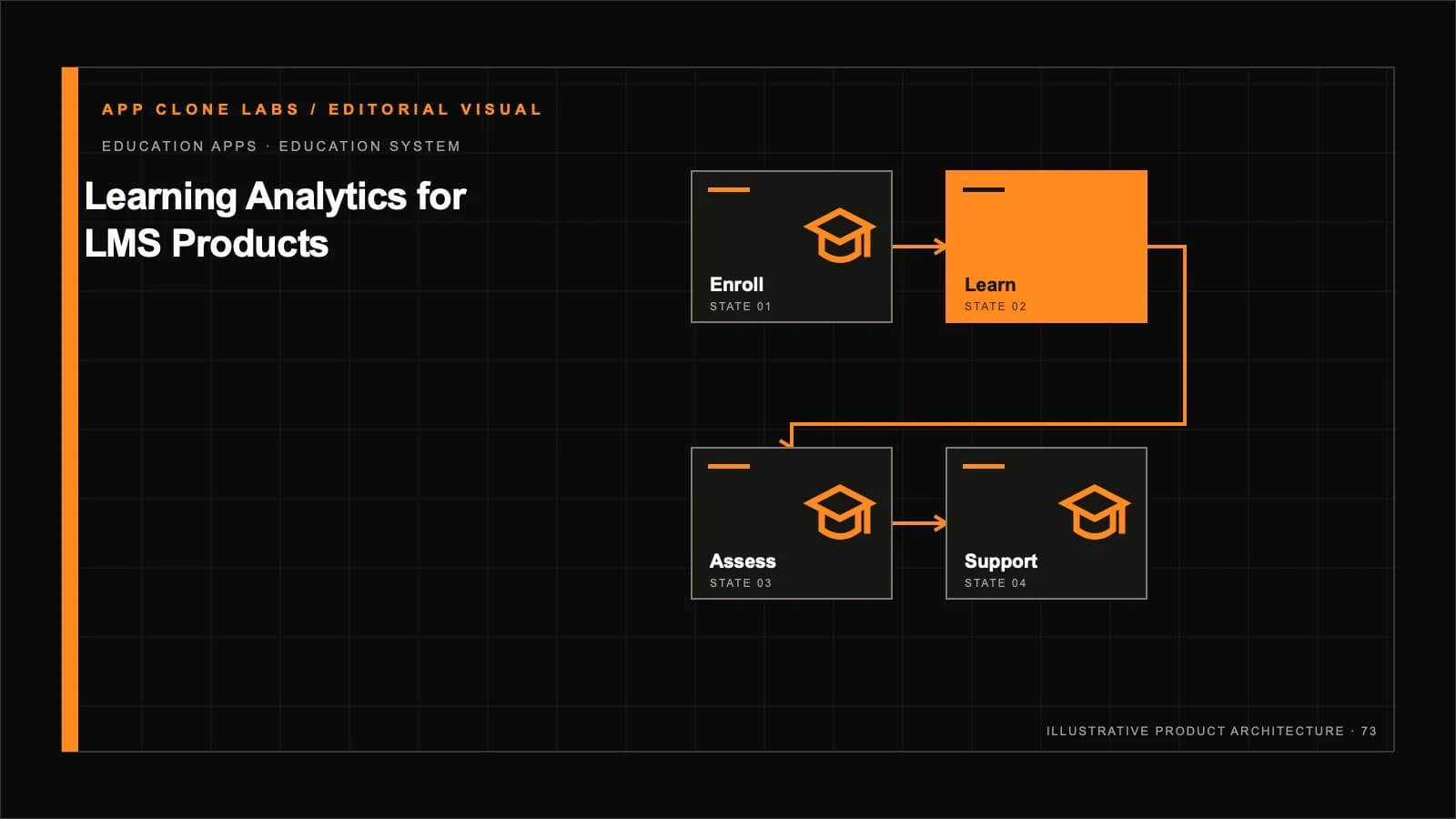
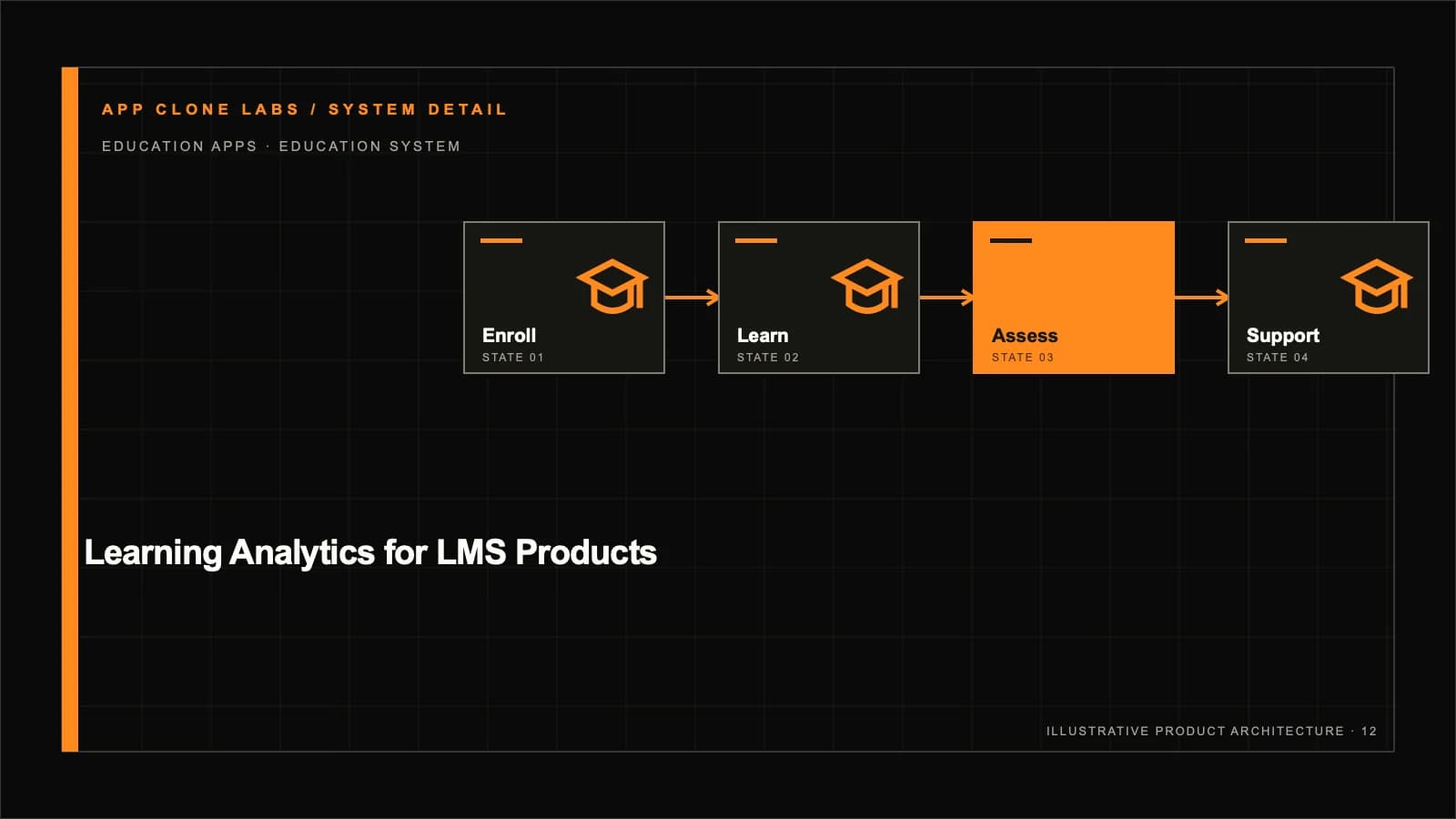
A learner opens a lesson in three tabs, watches ten minutes at double speed, loses connectivity, returns on a phone and passes an assessment on a second attempt. If the dashboard reports five lesson completions and one hundred percent mastery, the event pipeline is technically busy and educationally wrong.
Learning analytics must distinguish interaction from progress, progress from assessment, and assessment from an outcome that the product can responsibly claim. The work begins with definitions and context, not a chart library.
This guide shows how to create evidence that learners, instructors and operators can act on without turning activity exhaust into false certainty.
Start with decisions, not dashboards
A metric earns its place by supporting a learner, instructor or product decision.
The failure mode is concrete: teams collect every click and later search for meaning. This is not solved by adding another screen or background job. The product has to define ownership, permitted transitions, and the evidence retained when the transition occurs.
For the first release, write the decision, accountable user and acceptable action first. Write that decision as an enforceable server-side rule, not guidance that depends on a client, operator, or AI model remembering the intended boundary.
Implementation should include question, decision owner, cadence, required context, uncertainty and prohibited interpretation. Keep the public response smaller than the internal record: users need a clear outcome and recovery path, while authorized operators need correlation IDs, policy versions, timestamps, and the before-and-after state.
Validate it with one learner decision, one cohort decision and one product decision. Test the ordinary path, then repeat under timeout, duplicate delivery, stale state, partial failure, revoked authority, and concurrent requests. A feature is not ready when only the demonstration succeeds.
- Owner: analytics product lead
- Release evidence: decision-to-metric map
- Stop condition: no user can name an action the metric supports
Define the learning object hierarchy
Programs, courses, modules, lessons, activities and assessments create different denominators.
The failure mode is concrete: completion is calculated across mixed object types. This is not solved by adding another screen or background job. The product has to define ownership, permitted transitions, and the evidence retained when the transition occurs.
For the first release, version the hierarchy and bind events to stable identifiers. Write that decision as an enforceable server-side rule, not guidance that depends on a client, operator, or AI model remembering the intended boundary.
Implementation should include object ID, type, parent, version, required status, order and effective dates. Keep the public response smaller than the internal record: users need a clear outcome and recovery path, while authorized operators need correlation IDs, policy versions, timestamps, and the before-and-after state.
Validate it with moved lesson, optional activity and retired course version. Test the ordinary path, then repeat under timeout, duplicate delivery, stale state, partial failure, revoked authority, and concurrent requests. A feature is not ready when only the demonstration succeeds.
- Owner: learning architect
- Release evidence: hierarchy reconciliation
- Stop condition: historical progress changes after curriculum editing
Use a governed event contract
Events need shared semantics across web, mobile and integrations.
The failure mode is concrete: each client invents names and properties. This is not solved by adding another screen or background job. The product has to define ownership, permitted transitions, and the evidence retained when the transition occurs.
For the first release, maintain a versioned event catalog with validation at ingestion. Write that decision as an enforceable server-side rule, not guidance that depends on a client, operator, or AI model remembering the intended boundary.
Implementation should include event ID, actor, verb, object, context, result, timestamp, source and schema version. Keep the public response smaller than the internal record: users need a clear outcome and recovery path, while authorized operators need correlation IDs, policy versions, timestamps, and the before-and-after state.
Validate it with offline replay, duplicate ID and unknown property. Test the ordinary path, then repeat under timeout, duplicate delivery, stale state, partial failure, revoked authority, and concurrent requests. A feature is not ready when only the demonstration succeeds.
- Owner: data platform owner
- Release evidence: contract tests
- Stop condition: the same action produces incompatible events
Separate event time from processing time
Mobile and integration events may arrive late or out of order.
The failure mode is concrete: arrival order rewrites the learning journey. This is not solved by adding another screen or background job. The product has to define ownership, permitted transitions, and the evidence retained when the transition occurs.
For the first release, retain occurrence, receipt and processing timestamps with an explicit lateness policy. Write that decision as an enforceable server-side rule, not guidance that depends on a client, operator, or AI model remembering the intended boundary.
Implementation should include client time, server time, timezone, sequence, source and correction state. Keep the public response smaller than the internal record: users need a clear outcome and recovery path, while authorized operators need correlation IDs, policy versions, timestamps, and the before-and-after state.
Validate it with offline week, clock drift and replayed batch. Test the ordinary path, then repeat under timeout, duplicate delivery, stale state, partial failure, revoked authority, and concurrent requests. A feature is not ready when only the demonstration succeeds.
- Owner: data engineer
- Release evidence: late-arrival test set
- Stop condition: a delayed event corrupts closed reporting
Checkpoint 4: reconcile the product promise with the recorded state. Support, finance, security, and delivery teams should be able to reach the same conclusion from the same identifiers without reconstructing events from chat messages or screenshots.
Make identity resolution reversible
Learners may begin anonymously, use several devices or move between institutions.
The failure mode is concrete: email becomes the permanent analytics key. This is not solved by adding another screen or background job. The product has to define ownership, permitted transitions, and the evidence retained when the transition occurs.
For the first release, use internal subject identifiers and audited merge or split operations. Write that decision as an enforceable server-side rule, not guidance that depends on a client, operator, or AI model remembering the intended boundary.
Implementation should include subject, account, organization membership, external IDs, validity and provenance. Keep the public response smaller than the internal record: users need a clear outcome and recovery path, while authorized operators need correlation IDs, policy versions, timestamps, and the before-and-after state.
Validate it with duplicate account, shared device and organization transfer. Test the ordinary path, then repeat under timeout, duplicate delivery, stale state, partial failure, revoked authority, and concurrent requests. A feature is not ready when only the demonstration succeeds.
- Owner: identity owner
- Release evidence: identity lineage report
- Stop condition: a mistaken merge cannot be undone
Define completion as a rule
Opening content, reaching the end and satisfying required activities are different.
The failure mode is concrete: page view equals completion. This is not solved by adding another screen or background job. The product has to define ownership, permitted transitions, and the evidence retained when the transition occurs.
For the first release, version completion rules at the learning-object level. Write that decision as an enforceable server-side rule, not guidance that depends on a client, operator, or AI model remembering the intended boundary.
Implementation should include required activities, thresholds, exemptions, attempts, manual override and rule version. Keep the public response smaller than the internal record: users need a clear outcome and recovery path, while authorized operators need correlation IDs, policy versions, timestamps, and the before-and-after state.
Validate it with optional lesson, inaccessible activity and curriculum update. Test the ordinary path, then repeat under timeout, duplicate delivery, stale state, partial failure, revoked authority, and concurrent requests. A feature is not ready when only the demonstration succeeds.
- Owner: curriculum owner
- Release evidence: completion recomputation
- Stop condition: the platform cannot explain why a learner is complete
Keep mastery distinct from completion
Finishing material does not prove the intended knowledge or skill.
The failure mode is concrete: watch time is labelled mastery. This is not solved by adding another screen or background job. The product has to define ownership, permitted transitions, and the evidence retained when the transition occurs.
For the first release, tie mastery claims to defined assessment evidence and limitations. Write that decision as an enforceable server-side rule, not guidance that depends on a client, operator, or AI model remembering the intended boundary.
Implementation should include outcome, instrument, rubric, score, attempts, evaluator, validity and expiry. Keep the public response smaller than the internal record: users need a clear outcome and recovery path, while authorized operators need correlation IDs, policy versions, timestamps, and the before-and-after state.
Validate it with guessing, retake, rubric change and manual evaluation. Test the ordinary path, then repeat under timeout, duplicate delivery, stale state, partial failure, revoked authority, and concurrent requests. A feature is not ready when only the demonstration succeeds.
- Owner: assessment lead
- Release evidence: outcome evidence sample
- Stop condition: marketing language exceeds the available evidence
Model assessment attempts honestly
First attempt, best attempt and latest attempt answer different questions.
The failure mode is concrete: one score overwrites all prior evidence. This is not solved by adding another screen or background job. The product has to define ownership, permitted transitions, and the evidence retained when the transition occurs.
For the first release, retain attempts and define aggregation per assessment policy. Write that decision as an enforceable server-side rule, not guidance that depends on a client, operator, or AI model remembering the intended boundary.
Implementation should include attempt ID, version, start, submit, score, feedback, integrity signals and status. Keep the public response smaller than the internal record: users need a clear outcome and recovery path, while authorized operators need correlation IDs, policy versions, timestamps, and the before-and-after state.
Validate it with timeout, autosave recovery, invalidated attempt and appeal. Test the ordinary path, then repeat under timeout, duplicate delivery, stale state, partial failure, revoked authority, and concurrent requests. A feature is not ready when only the demonstration succeeds.
- Owner: assessment systems owner
- Release evidence: attempt lifecycle tests
- Stop condition: a score cannot be reproduced from the attempt
Checkpoint 8: reconcile the product promise with the recorded state. Support, finance, security, and delivery teams should be able to reach the same conclusion from the same identifiers without reconstructing events from chat messages or screenshots.
Calculate cohort metrics with denominators
Rates are meaningless without who was eligible and for how long.
The failure mode is concrete: withdrawn or late-joining learners disappear opportunistically. This is not solved by adding another screen or background job. The product has to define ownership, permitted transitions, and the evidence retained when the transition occurs.
For the first release, store numerator, denominator, inclusion rule and observation window. Write that decision as an enforceable server-side rule, not guidance that depends on a client, operator, or AI model remembering the intended boundary.
Implementation should include cohort version, enrolment state, start, end, exclusions, count and rate. Keep the public response smaller than the internal record: users need a clear outcome and recovery path, while authorized operators need correlation IDs, policy versions, timestamps, and the before-and-after state.
Validate it with transfer, withdrawal, late join and incomplete data. Test the ordinary path, then repeat under timeout, duplicate delivery, stale state, partial failure, revoked authority, and concurrent requests. A feature is not ready when only the demonstration succeeds.
- Owner: analytics lead
- Release evidence: metric dictionary
- Stop condition: two dashboards show the same label with different populations
Build an instructor exception queue
Analytics should direct attention, not merely rank learners.
The failure mode is concrete: a red dashboard offers no next action or context. This is not solved by adding another screen or background job. The product has to define ownership, permitted transitions, and the evidence retained when the transition occurs.
For the first release, create explainable, bounded signals with workflow ownership. Write that decision as an enforceable server-side rule, not guidance that depends on a client, operator, or AI model remembering the intended boundary.
Implementation should include signal reason, evidence window, confidence, learner context, owner, action and outcome. Keep the public response smaller than the internal record: users need a clear outcome and recovery path, while authorized operators need correlation IDs, policy versions, timestamps, and the before-and-after state.
Validate it with new learner, accommodation, data gap and false alarm. Test the ordinary path, then repeat under timeout, duplicate delivery, stale state, partial failure, revoked authority, and concurrent requests. A feature is not ready when only the demonstration succeeds.
- Owner: learning operations
- Release evidence: intervention simulation
- Stop condition: staff cannot distinguish risk from missing telemetry
Measure interventions, not alerts alone
An alert has value only if it changes an appropriate action or outcome.
The failure mode is concrete: the team celebrates notification volume. This is not solved by adding another screen or background job. The product has to define ownership, permitted transitions, and the evidence retained when the transition occurs.
For the first release, record assignment, action, acknowledgement, resolution and subsequent evidence. Write that decision as an enforceable server-side rule, not guidance that depends on a client, operator, or AI model remembering the intended boundary.
Implementation should include signal ID, intervention type, actor, timing, learner response and outcome window. Keep the public response smaller than the internal record: users need a clear outcome and recovery path, while authorized operators need correlation IDs, policy versions, timestamps, and the before-and-after state.
Validate it with no response, reassignment and repeated signal. Test the ordinary path, then repeat under timeout, duplicate delivery, stale state, partial failure, revoked authority, and concurrent requests. A feature is not ready when only the demonstration succeeds.
- Owner: student-success lead
- Release evidence: intervention funnel
- Stop condition: no one knows whether alerts helped
Expose uncertainty and freshness
Pipelines fail and recent activity may not yet be processed.
The failure mode is concrete: dashboards present stale estimates as exact current truth. This is not solved by adding another screen or background job. The product has to define ownership, permitted transitions, and the evidence retained when the transition occurs.
For the first release, display freshness and suppress claims when completeness falls below policy. Write that decision as an enforceable server-side rule, not guidance that depends on a client, operator, or AI model remembering the intended boundary.
Implementation should include last processed time, expected lag, source coverage, confidence and incident state. Keep the public response smaller than the internal record: users need a clear outcome and recovery path, while authorized operators need correlation IDs, policy versions, timestamps, and the before-and-after state.
Validate it with connector outage, delayed batch and partial tenant load. Test the ordinary path, then repeat under timeout, duplicate delivery, stale state, partial failure, revoked authority, and concurrent requests. A feature is not ready when only the demonstration succeeds.
- Owner: data reliability owner
- Release evidence: freshness SLO
- Stop condition: users act on silently stale data
Checkpoint 12: reconcile the product promise with the recorded state. Support, finance, security, and delivery teams should be able to reach the same conclusion from the same identifiers without reconstructing events from chat messages or screenshots.
Apply privacy minimization
Educational activity can reveal sensitive patterns and relationships.
The failure mode is concrete: every raw event is retained forever and exposed broadly. This is not solved by adding another screen or background job. The product has to define ownership, permitted transitions, and the evidence retained when the transition occurs.
For the first release, collect purpose-bound fields with role-based access and retention. Write that decision as an enforceable server-side rule, not guidance that depends on a client, operator, or AI model remembering the intended boundary.
Implementation should include purpose, lawful basis, sensitivity, audience, retention, deletion and aggregate threshold. Keep the public response smaller than the internal record: users need a clear outcome and recovery path, while authorized operators need correlation IDs, policy versions, timestamps, and the before-and-after state.
Validate it with export request, account deletion and small cohort. Test the ordinary path, then repeat under timeout, duplicate delivery, stale state, partial failure, revoked authority, and concurrent requests. A feature is not ready when only the demonstration succeeds.
- Owner: privacy lead
- Release evidence: data inventory and access review
- Stop condition: a field has no documented learning purpose
Design accessible reports
Color-only risk labels and dense visualizations exclude users.
The failure mode is concrete: the dashboard passes numbers visually but not semantically. This is not solved by adding another screen or background job. The product has to define ownership, permitted transitions, and the evidence retained when the transition occurs.
For the first release, provide text equivalents, keyboard access and understandable table views. Write that decision as an enforceable server-side rule, not guidance that depends on a client, operator, or AI model remembering the intended boundary.
Implementation should include heading order, labels, contrast, focus, alternative view and export. Keep the public response smaller than the internal record: users need a clear outcome and recovery path, while authorized operators need correlation IDs, policy versions, timestamps, and the before-and-after state.
Validate it with screen reader, 200% zoom, keyboard and monochrome display. Test the ordinary path, then repeat under timeout, duplicate delivery, stale state, partial failure, revoked authority, and concurrent requests. A feature is not ready when only the demonstration succeeds.
- Owner: accessibility owner
- Release evidence: WCAG-oriented review
- Stop condition: a required decision cannot be made without vision or pointer input
Reconcile and govern metric changes
Event code, curriculum and metric logic all evolve.
The failure mode is concrete: a silent query change rewrites historical trends. This is not solved by adding another screen or background job. The product has to define ownership, permitted transitions, and the evidence retained when the transition occurs.
For the first release, version metrics, test against fixtures and publish material changes. Write that decision as an enforceable server-side rule, not guidance that depends on a client, operator, or AI model remembering the intended boundary.
Implementation should include definition, owner, code version, effective date, backfill policy, approval and lineage. Keep the public response smaller than the internal record: users need a clear outcome and recovery path, while authorized operators need correlation IDs, policy versions, timestamps, and the before-and-after state.
Validate it with new event version, course migration and bug correction. Test the ordinary path, then repeat under timeout, duplicate delivery, stale state, partial failure, revoked authority, and concurrent requests. A feature is not ready when only the demonstration succeeds.
- Owner: analytics governance lead
- Release evidence: reproducible release report
- Stop condition: a changed result has no change record
Implementation references
Use 1EdTech Caliper Analytics and record the version used for the release.
Validate the implementation against ADL Experience API specification and record the version used for the release.
Review U.S. Department of Education FERPA guidance and record the version used for the release.
Compare with NIST Privacy Framework and record the version used for the release.
Continue with Education and EdTech when turning the operating model into delivery scope.
Frequently asked questions
What is the first learning metric to define?
Start with the decision the product must support, then define the smallest valid metric and its denominator. There is no universal first dashboard metric.
Is lesson completion a learning outcome?
No. Completion records fulfilment of a defined activity rule; mastery requires appropriate assessment evidence.
How should offline mobile activity be handled?
Retain event occurrence and processing times, deduplicate stable event IDs and apply an explicit late-arrival policy.
What should an at-risk learner signal include?
The reason, evidence window, freshness, uncertainty, relevant context, responsible owner and a bounded intervention path.
Should all learner events be retained forever?
No. Collection and retention should be tied to documented purposes, access roles and deletion obligations.
How do cohort transfers affect reporting?
Use effective-dated enrolment state and explicit inclusion rules so both the original and destination cohort retain explainable histories.
How can analytics be accessible?
Use semantic headings and tables, text equivalents, keyboard operation, sufficient contrast, visible focus and formats that work under zoom.
What should be tested before changing a metric?
Run the versioned definition against fixed fixtures, compare historical output, review downstream decisions and document whether a backfill is appropriate.
Turn the plan into release evidence
A credible release connects the public promise to durable states, explicit permissions and recoverable operations. Teams should be able to explain an ordinary journey and every high-impact exception from the same records.
Keep the first scope narrow enough to rehearse end to end. Add breadth only after access, money, evidence and support outcomes remain consistent under retries, failures and human mistakes.
- 01
- 02
- 03
- 04
- 05
- 06
Reviewed by the App Clone Labs product strategy team
This guide is written for founders and operators planning clone-inspired platforms, SaaS products, marketplaces, and mobile apps. It is reviewed against App Clone Labs delivery patterns, product scoping standards, and current implementation realities before being published.
Review the editorial team structureRelated product paths
Continue with the services, solutions, guides, and articles that connect this topic to a real software build.
Services, solutions, and guides
Read next