Editorial dossier / Education Apps
Education Marketplace App Planning Guide: Roles, Commerce and Learning Operations
Plan an education marketplace across instructor onboarding, catalog governance, enrolment, learning delivery, payouts, safeguarding, support and measurable outcomes.
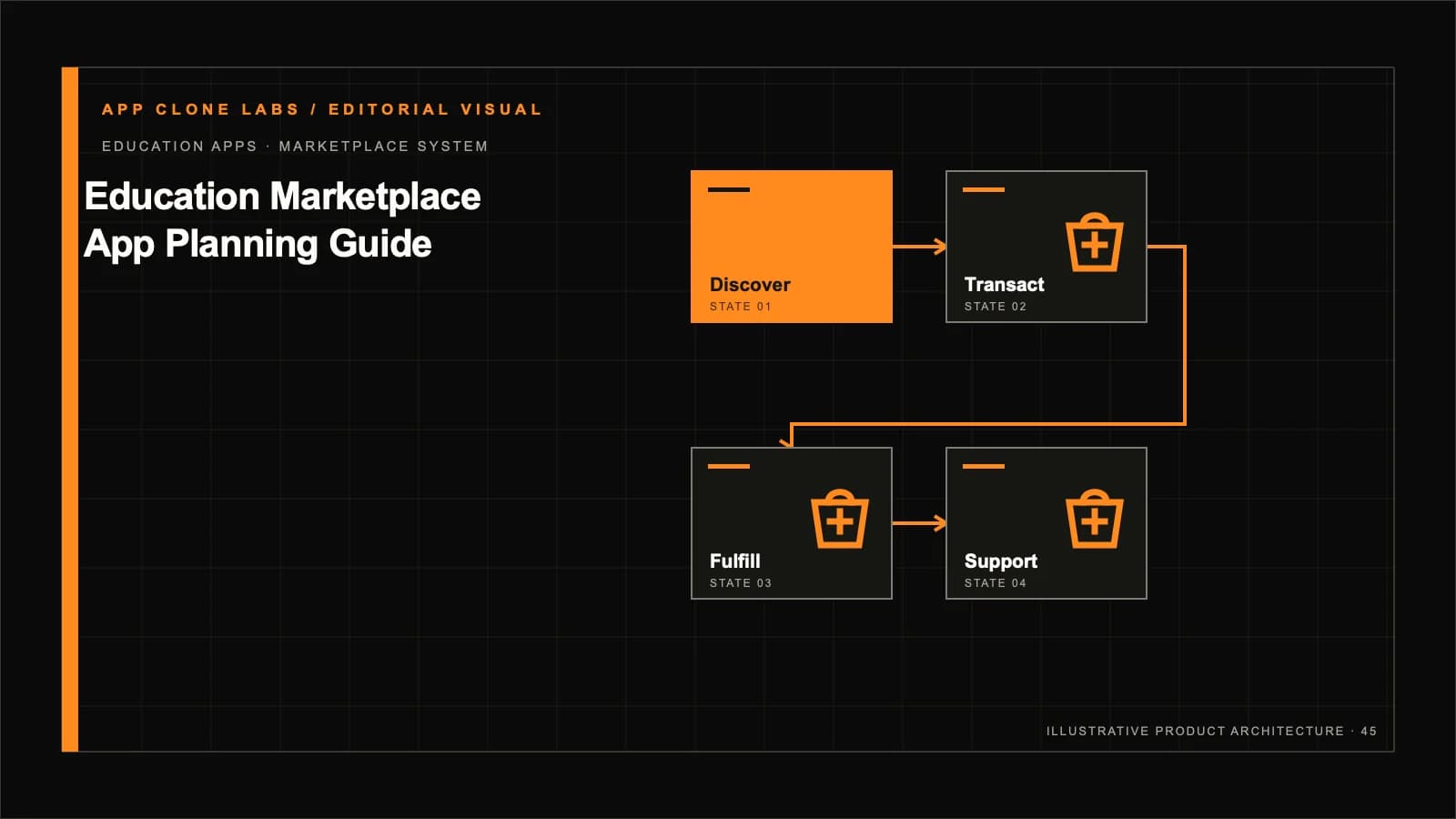
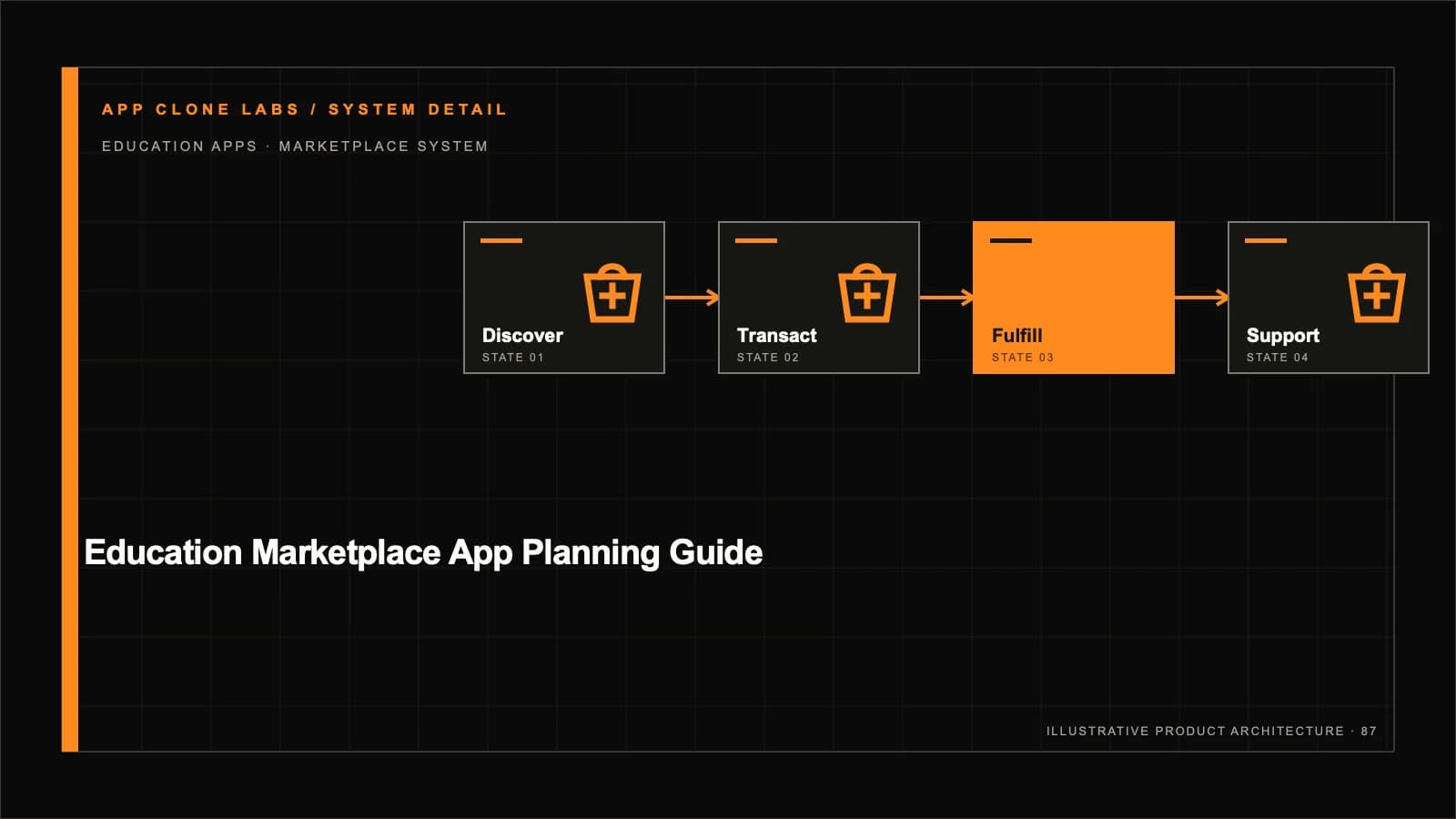
An education marketplace is not a course catalog with checkout. A learner can pay successfully and still receive the wrong cohort, an instructor can publish material they do not own, and a platform can calculate a payout before the refund window or teaching obligation has closed.
The credible product is a governed exchange: educators offer a defined learning promise, learners make an informed purchase, the platform controls access and delivery, and operators can resolve disputes without rewriting records. Learning, commerce and trust must therefore be scoped together.
This guide follows that complete operating loop, from supply onboarding to outcome evidence and settlement.
Define the marketplace promise
Choose whether the product sells self-paced courses, cohorts, tutoring, memberships or a controlled combination.
The failure mode is concrete: the homepage promises every learning model while operations support only one. This is not solved by adding another screen or background job. The product has to define ownership, permitted transitions, and the evidence retained when the transition occurs.
For the first release, write one versioned service definition for the first release. Write that decision as an enforceable server-side rule, not guidance that depends on a client, operator, or AI model remembering the intended boundary.
Implementation should include audience, learning format, fulfilment, refund boundary, support level, geography and prohibited supply. Keep the public response smaller than the internal record: users need a clear outcome and recovery path, while authorized operators need correlation IDs, policy versions, timestamps, and the before-and-after state.
Validate it with three representative purchases and one deliberately out-of-scope offer. Test the ordinary path, then repeat under timeout, duplicate delivery, stale state, partial failure, revoked authority, and concurrent requests. A feature is not ready when only the demonstration succeeds.
- Owner: product lead
- Release evidence: approved service blueprint
- Stop condition: sales cannot describe what the platform guarantees
Separate identities from marketplace roles
A person may learn, teach, buy for a team or administer an institution.
The failure mode is concrete: one role field creates duplicate accounts and permission leakage. This is not solved by adding another screen or background job. The product has to define ownership, permitted transitions, and the evidence retained when the transition occurs.
For the first release, attach scoped capabilities to one identity and organization membership. Write that decision as an enforceable server-side rule, not guidance that depends on a client, operator, or AI model remembering the intended boundary.
Implementation should include identity, role assignment, tenant, verification, status, expiry and audit. Keep the public response smaller than the internal record: users need a clear outcome and recovery path, while authorized operators need correlation IDs, policy versions, timestamps, and the before-and-after state.
Validate it with instructor who also enrols and manager leaving an organization. Test the ordinary path, then repeat under timeout, duplicate delivery, stale state, partial failure, revoked authority, and concurrent requests. A feature is not ready when only the demonstration succeeds.
- Owner: identity owner
- Release evidence: role-transition matrix
- Stop condition: changing one role corrupts another journey
Build staged instructor onboarding
Supply quality begins before a listing becomes searchable.
The failure mode is concrete: uploading a profile automatically creates a trusted instructor. This is not solved by adding another screen or background job. The product has to define ownership, permitted transitions, and the evidence retained when the transition occurs.
For the first release, use draft, review, approved, restricted and suspended states. Write that decision as an enforceable server-side rule, not guidance that depends on a client, operator, or AI model remembering the intended boundary.
Implementation should include identity evidence, expertise, payment readiness, agreements, review notes and renewal. Keep the public response smaller than the internal record: users need a clear outcome and recovery path, while authorized operators need correlation IDs, policy versions, timestamps, and the before-and-after state.
Validate it with expired evidence, rejected application and later suspension. Test the ordinary path, then repeat under timeout, duplicate delivery, stale state, partial failure, revoked authority, and concurrent requests. A feature is not ready when only the demonstration succeeds.
- Owner: supply operations
- Release evidence: review checklist and decision log
- Stop condition: operators cannot explain why an educator was approved
Govern course claims and ownership
Titles, outcomes, prerequisites and media shape the purchase decision.
The failure mode is concrete: unreviewed claims or copied material are published immediately. This is not solved by adding another screen or background job. The product has to define ownership, permitted transitions, and the evidence retained when the transition occurs.
For the first release, version listings and require attestation plus risk-based review. Write that decision as an enforceable server-side rule, not guidance that depends on a client, operator, or AI model remembering the intended boundary.
Implementation should include owner, source rights, learning outcomes, prerequisites, level, language and moderation status. Keep the public response smaller than the internal record: users need a clear outcome and recovery path, while authorized operators need correlation IDs, policy versions, timestamps, and the before-and-after state.
Validate it with copyright report, misleading outcome and edited approved listing. Test the ordinary path, then repeat under timeout, duplicate delivery, stale state, partial failure, revoked authority, and concurrent requests. A feature is not ready when only the demonstration succeeds.
- Owner: catalog lead
- Release evidence: listing provenance record
- Stop condition: a disputed asset has no accountable source
Checkpoint 4: reconcile the product promise with the recorded state. Support, finance, security, and delivery teams should be able to reach the same conclusion from the same identifiers without reconstructing events from chat messages or screenshots.
Model catalog variants explicitly
A course may have cohorts, languages, instructor editions and price variants.
The failure mode is concrete: every variation becomes a duplicate course page. This is not solved by adding another screen or background job. The product has to define ownership, permitted transitions, and the evidence retained when the transition occurs.
For the first release, separate the canonical learning product from purchasable offerings. Write that decision as an enforceable server-side rule, not guidance that depends on a client, operator, or AI model remembering the intended boundary.
Implementation should include course, edition, cohort, seat inventory, delivery mode, locale, price and availability. Keep the public response smaller than the internal record: users need a clear outcome and recovery path, while authorized operators need correlation IDs, policy versions, timestamps, and the before-and-after state.
Validate it with sold-out cohort, retired edition and instructor replacement. Test the ordinary path, then repeat under timeout, duplicate delivery, stale state, partial failure, revoked authority, and concurrent requests. A feature is not ready when only the demonstration succeeds.
- Owner: catalog architect
- Release evidence: variant relationship tests
- Stop condition: learners purchase an ambiguous offering
Make discovery honest and measurable
Ranking influences educator income and learner choice.
The failure mode is concrete: sponsored or popularity signals are presented as neutral relevance. This is not solved by adding another screen or background job. The product has to define ownership, permitted transitions, and the evidence retained when the transition occurs.
For the first release, document ranking inputs and label commercial placement. Write that decision as an enforceable server-side rule, not guidance that depends on a client, operator, or AI model remembering the intended boundary.
Implementation should include query, filters, eligibility, quality signals, sponsorship, diversity controls and explanation. Keep the public response smaller than the internal record: users need a clear outcome and recovery path, while authorized operators need correlation IDs, policy versions, timestamps, and the before-and-after state.
Validate it with new instructor, zero results and manipulated engagement. Test the ordinary path, then repeat under timeout, duplicate delivery, stale state, partial failure, revoked authority, and concurrent requests. A feature is not ready when only the demonstration succeeds.
- Owner: search owner
- Release evidence: ranking evaluation set
- Stop condition: the team cannot explain a prominent result
Protect enrolment and seat inventory
Payment, invitation and learning access are related but separate transitions.
The failure mode is concrete: checkout success grants access before payment and capacity are final. This is not solved by adding another screen or background job. The product has to define ownership, permitted transitions, and the evidence retained when the transition occurs.
For the first release, reserve the offering, verify payment and confirm enrolment idempotently. Write that decision as an enforceable server-side rule, not guidance that depends on a client, operator, or AI model remembering the intended boundary.
Implementation should include attempt ID, learner, offering, held seat, payment state, entitlement and timestamps. Keep the public response smaller than the internal record: users need a clear outcome and recovery path, while authorized operators need correlation IDs, policy versions, timestamps, and the before-and-after state.
Validate it with two buyers for the final seat, retry and abandoned checkout. Test the ordinary path, then repeat under timeout, duplicate delivery, stale state, partial failure, revoked authority, and concurrent requests. A feature is not ready when only the demonstration succeeds.
- Owner: commerce engineer
- Release evidence: capacity and replay invariants
- Stop condition: confirmed enrolments exceed capacity
Design refunds around fulfilment
Refund rights depend on policy, delivery and consumed value.
The failure mode is concrete: support decides each request from chat history. This is not solved by adding another screen or background job. The product has to define ownership, permitted transitions, and the evidence retained when the transition occurs.
For the first release, encode request, eligibility, evidence, decision and financial reversal as a workflow. Write that decision as an enforceable server-side rule, not guidance that depends on a client, operator, or AI model remembering the intended boundary.
Implementation should include policy version, deadline, attendance, content access, reason, approver and outcome. Keep the public response smaller than the internal record: users need a clear outcome and recovery path, while authorized operators need correlation IDs, policy versions, timestamps, and the before-and-after state.
Validate it with partial attendance, cancelled class and payment dispute. Test the ordinary path, then repeat under timeout, duplicate delivery, stale state, partial failure, revoked authority, and concurrent requests. A feature is not ready when only the demonstration succeeds.
- Owner: customer operations
- Release evidence: refund decision matrix
- Stop condition: similar cases receive unexplained outcomes
Checkpoint 8: reconcile the product promise with the recorded state. Support, finance, security, and delivery teams should be able to reach the same conclusion from the same identifiers without reconstructing events from chat messages or screenshots.
Release educator payouts from a ledger
Gross payment is not immediately distributable income.
The failure mode is concrete: the platform transfers money before refunds, fees and disputes settle. This is not solved by adding another screen or background job. The product has to define ownership, permitted transitions, and the evidence retained when the transition occurs.
For the first release, calculate obligations in an immutable double-entry-style ledger and release on policy. Write that decision as an enforceable server-side rule, not guidance that depends on a client, operator, or AI model remembering the intended boundary.
Implementation should include charge, tax, fee, commission, refund reserve, adjustment, available balance and transfer. Keep the public response smaller than the internal record: users need a clear outcome and recovery path, while authorized operators need correlation IDs, policy versions, timestamps, and the before-and-after state.
Validate it with partial refund, negative balance and failed transfer. Test the ordinary path, then repeat under timeout, duplicate delivery, stale state, partial failure, revoked authority, and concurrent requests. A feature is not ready when only the demonstration succeeds.
- Owner: finance systems owner
- Release evidence: reconciled settlement report
- Stop condition: a payout cannot be reconstructed from source events
Connect commerce to durable entitlements
Access can depend on purchase, cohort membership, subscription or institution license.
The failure mode is concrete: content routes check a client-side paid flag. This is not solved by adding another screen or background job. The product has to define ownership, permitted transitions, and the evidence retained when the transition occurs.
For the first release, derive server-side entitlements from verified commercial and enrolment state. Write that decision as an enforceable server-side rule, not guidance that depends on a client, operator, or AI model remembering the intended boundary.
Implementation should include resource scope, source, effective time, expiry, revocation and exception. Keep the public response smaller than the internal record: users need a clear outcome and recovery path, while authorized operators need correlation IDs, policy versions, timestamps, and the before-and-after state.
Validate it with refund, transfer, subscription lapse and removed learner. Test the ordinary path, then repeat under timeout, duplicate delivery, stale state, partial failure, revoked authority, and concurrent requests. A feature is not ready when only the demonstration succeeds.
- Owner: platform owner
- Release evidence: authorization tests
- Stop condition: revoked access remains usable through a direct URL
Make learning delivery observable
The platform must know whether promised lessons, sessions and feedback are available.
The failure mode is concrete: operations learn about missing delivery through public reviews. This is not solved by adding another screen or background job. The product has to define ownership, permitted transitions, and the evidence retained when the transition occurs.
For the first release, track fulfilment milestones without treating surveillance as learning. Write that decision as an enforceable server-side rule, not guidance that depends on a client, operator, or AI model remembering the intended boundary.
Implementation should include content release, session status, submission, feedback deadline, exception and owner. Keep the public response smaller than the internal record: users need a clear outcome and recovery path, while authorized operators need correlation IDs, policy versions, timestamps, and the before-and-after state.
Validate it with instructor absence, late feedback and inaccessible file. Test the ordinary path, then repeat under timeout, duplicate delivery, stale state, partial failure, revoked authority, and concurrent requests. A feature is not ready when only the demonstration succeeds.
- Owner: learning operations
- Release evidence: fulfilment exception queue
- Stop condition: a paid obligation can silently expire
Protect minors and vulnerable learners
Age, location and learning context may create additional safety duties.
The failure mode is concrete: community and direct messaging are enabled uniformly. This is not solved by adding another screen or background job. The product has to define ownership, permitted transitions, and the evidence retained when the transition occurs.
For the first release, define age gates, guardian flows and bounded communication before launch. Write that decision as an enforceable server-side rule, not guidance that depends on a client, operator, or AI model remembering the intended boundary.
Implementation should include age band, consent basis, messaging rules, reporting, moderation and retention. Keep the public response smaller than the internal record: users need a clear outcome and recovery path, while authorized operators need correlation IDs, policy versions, timestamps, and the before-and-after state.
Validate it with underage signup, instructor contact and safeguarding report. Test the ordinary path, then repeat under timeout, duplicate delivery, stale state, partial failure, revoked authority, and concurrent requests. A feature is not ready when only the demonstration succeeds.
- Owner: trust and safety lead
- Release evidence: safeguarding rehearsal
- Stop condition: a serious report has no escalation owner
Checkpoint 12: reconcile the product promise with the recorded state. Support, finance, security, and delivery teams should be able to reach the same conclusion from the same identifiers without reconstructing events from chat messages or screenshots.
Measure outcomes with context
Completion, satisfaction and mastery answer different questions.
The failure mode is concrete: one completion rate becomes proof that every course works. This is not solved by adding another screen or background job. The product has to define ownership, permitted transitions, and the evidence retained when the transition occurs.
For the first release, publish a metric dictionary with cohort, version and denominator context. Write that decision as an enforceable server-side rule, not guidance that depends on a client, operator, or AI model remembering the intended boundary.
Implementation should include enrolment population, activity, assessment, withdrawal, survey and correction. Keep the public response smaller than the internal record: users need a clear outcome and recovery path, while authorized operators need correlation IDs, policy versions, timestamps, and the before-and-after state.
Validate it with transferred learner, repeat attempt and missing event. Test the ordinary path, then repeat under timeout, duplicate delivery, stale state, partial failure, revoked authority, and concurrent requests. A feature is not ready when only the demonstration succeeds.
- Owner: analytics lead
- Release evidence: reproducible dashboard sample
- Stop condition: a headline metric cannot be recomputed
Give support a joined timeline
Learners experience catalog, payment, access and delivery as one journey.
The failure mode is concrete: agents switch systems and manually change database state. This is not solved by adding another screen or background job. The product has to define ownership, permitted transitions, and the evidence retained when the transition occurs.
For the first release, show authorized evidence with narrow, reasoned recovery actions. Write that decision as an enforceable server-side rule, not guidance that depends on a client, operator, or AI model remembering the intended boundary.
Implementation should include listing version, order, entitlement, cohort, activity, messages, case and audit. Keep the public response smaller than the internal record: users need a clear outcome and recovery path, while authorized operators need correlation IDs, policy versions, timestamps, and the before-and-after state.
Validate it with duplicate purchase, wrong cohort and instructor suspension. Test the ordinary path, then repeat under timeout, duplicate delivery, stale state, partial failure, revoked authority, and concurrent requests. A feature is not ready when only the demonstration succeeds.
- Owner: support lead
- Release evidence: case-resolution simulation
- Stop condition: routine recovery requires engineering access
Launch with a closed-loop pilot
Marketplace risk appears in interactions, not isolated screens.
The failure mode is concrete: launch readiness is based on a buyer demo. This is not solved by adding another screen or background job. The product has to define ownership, permitted transitions, and the evidence retained when the transition occurs.
For the first release, pilot a small catalog through discovery, purchase, delivery, refund and payout. Write that decision as an enforceable server-side rule, not guidance that depends on a client, operator, or AI model remembering the intended boundary.
Implementation should include named participants, seeded exceptions, monitoring, support rota, reconciliation and rollback. Keep the public response smaller than the internal record: users need a clear outcome and recovery path, while authorized operators need correlation IDs, policy versions, timestamps, and the before-and-after state.
Validate it with failed payment, cancelled session, refund and rejected payout. Test the ordinary path, then repeat under timeout, duplicate delivery, stale state, partial failure, revoked authority, and concurrent requests. A feature is not ready when only the demonstration succeeds.
- Owner: delivery lead
- Release evidence: end-to-end pilot evidence
- Stop condition: money or access state remains unexplained
Implementation references
Use U.S. Department of Education FERPA guidance and record the version used for the release.
Validate the implementation against 1EdTech Learning Tools Interoperability and record the version used for the release.
Review 1EdTech OneRoster and record the version used for the release.
Compare with 1EdTech Caliper Analytics and record the version used for the release.
Continue with Education and EdTech when turning the operating model into delivery scope.
Frequently asked questions
What is the smallest credible education marketplace MVP?
A governed instructor supply flow, versioned offerings, discovery, verified checkout, enrolment and access, one delivery model, support, refunds, a payout ledger and admin review.
Should instructors and learners use separate accounts?
Usually no. Keep one identity and grant scoped marketplace roles so a person can teach and learn without duplicated credentials or history.
When should instructors be paid?
After the applicable fulfilment and refund conditions are satisfied, using a reconciled ledger rather than the checkout total.
How should course quality be controlled?
Use structured claims, rights attestation, versioning, review states, learner reporting and evidence-based suspension or remediation.
What learning metric matters most?
There is no universal single metric. Track participation, completion, assessment evidence, satisfaction and withdrawals separately with clear denominators.
Does an education marketplace need an LMS?
It needs a delivery system, but its depth depends on the promise. A tutoring marketplace and a self-paced course catalog require different learning infrastructure.
How should refunds affect access?
Apply an explicit policy that coordinates the financial reversal, learner entitlement, cohort status and educator ledger adjustment.
What should be tested before launch?
Run a complete pilot including educator approval, purchase, final-seat concurrency, learning access, cancellation, refund, dispute, payout and support recovery.
Turn the plan into release evidence
A credible release connects the public promise to durable states, explicit permissions and recoverable operations. Teams should be able to explain an ordinary journey and every high-impact exception from the same records.
Keep the first scope narrow enough to rehearse end to end. Add breadth only after access, money, evidence and support outcomes remain consistent under retries, failures and human mistakes.
- 01
- 02
- 03
- 04
- 05
- 06
Reviewed by the App Clone Labs product strategy team
This guide is written for founders and operators planning clone-inspired platforms, SaaS products, marketplaces, and mobile apps. It is reviewed against App Clone Labs delivery patterns, product scoping standards, and current implementation realities before being published.
Review the editorial team structureRelated product paths
Continue with the services, solutions, guides, and articles that connect this topic to a real software build.
Services, solutions, and guides
Read next