
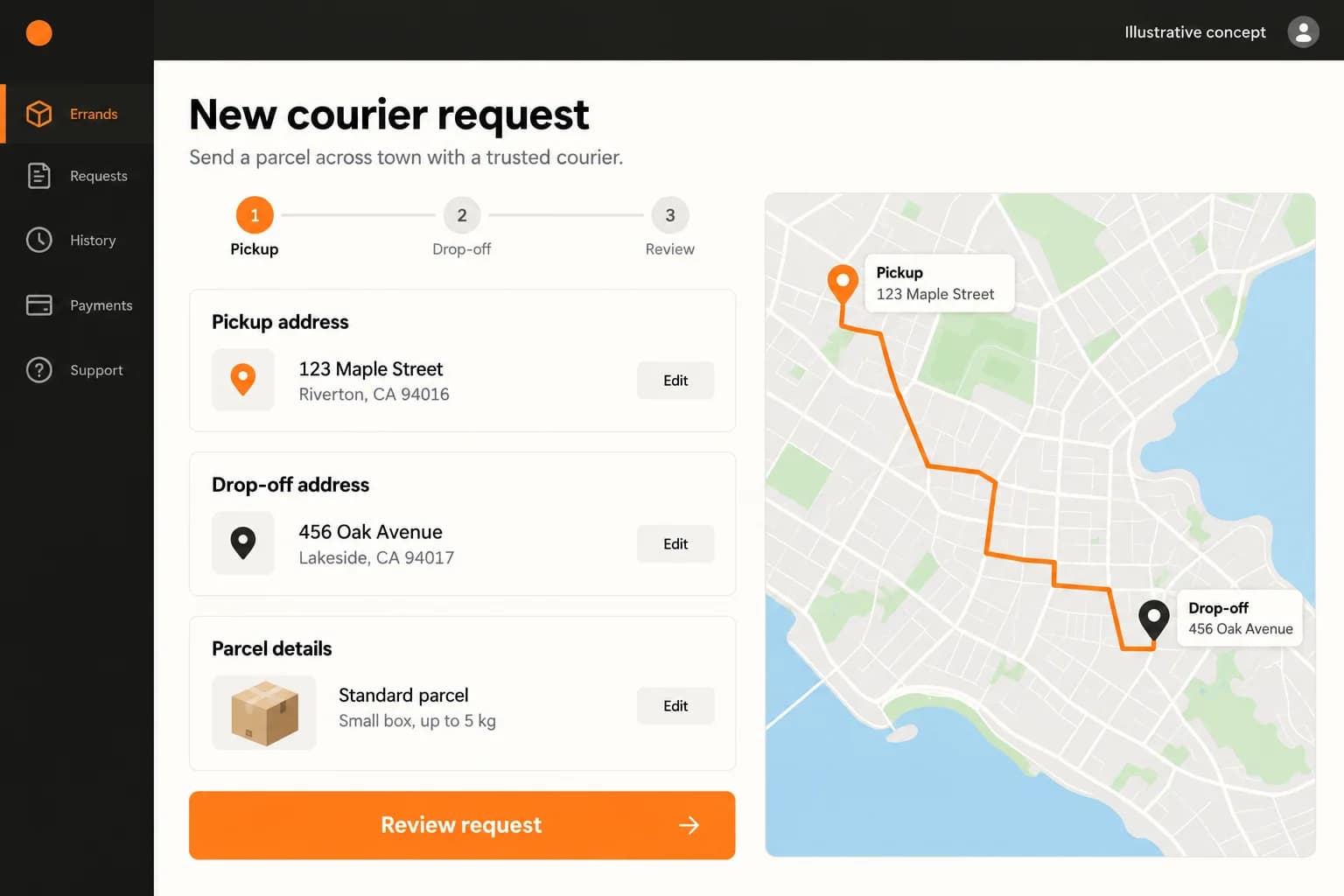
A fictional founder budgets for a customer app, driver app and administration panel, then discovers that launching the service also requires merchant onboarding, support coverage, payment reserves and a team authorized to resolve disputed orders. The software proposal was not necessarily wrong. The capital plan described only one part of the business.
A super app combines several services behind a shared customer experience. That combination can reduce repeated sign-ins and reuse useful infrastructure, but it does not erase the operating requirements of each service. A food order, a ride and a home-service booking have different suppliers, fulfilment states and failure modes. A common navigation bar is the easy part.
This guide helps founders and enterprise sponsors prepare a capital and infrastructure brief before commissioning a multi-service platform. Every financial example below is invented for planning, not a quotation, market average or promise of launch cost. Actual investment depends on jurisdiction, operating model, integrations, staffing, contractual liabilities and the evidence produced during discovery.
Define what your first super app actually operates
Start with the transaction you intend to fulfil, not the number of tiles on the home screen. A platform that links to partner services has a different risk and cost profile from one that collects payment, dispatches providers and handles refunds. State who is responsible for the customer promise in each service. That responsibility determines much of the implementation and operating capital.
Choose a first market, a first customer group and a limited set of connected services. A restaurant-delivery business adding grocery fulfilment may reuse parts of its dispatch operation. A financial-services company adding mobility cannot assume the same overlap. Describe the operational advantage that makes a combined experience useful. If there is no shared customer need or delivery capability, bundling may simply create several unfinished businesses.
Write a launch boundary that can fit on one page. Name the services included, their operating hours, supported areas, payment methods and support commitments. List what is explicitly excluded. This becomes the reference for the capital model and the acceptance test plan. Without it, every estimate can quietly assume a different business while appearing to price the same super app.
Separate implementation funding from operating runway
Implementation funding covers discovery, design, software adaptation or development, integrations, testing and release preparation. Operating runway covers the people, vendors and obligations required after customers arrive. Some activities cross the boundary, such as onboarding the first merchants or preparing customer support. Assign them once in the budget and explain the assumption rather than omitting or double-counting them.
A practical capital model also includes launch operations, commercial acquisition, working capital and a contingency reserve. Working capital can be needed even when a platform is technically asset-light: refunds, delayed provider settlements and contractual deposits can create timing gaps. The actual treatment needs finance and legal advice. Software architecture cannot determine whether holding customer funds is permissible in a given business model.
Specify which costs are one-time, monthly fixed, transaction-linked or conditional. Do not divide the total development quote by the planned launch month and call the result runway. That hides the cash required after release. A sponsor should be able to see how long the operation survives under a low-volume scenario and what happens if adoption is slower than planned.
Build an illustrative capital worksheet with visible exclusions
Consider a deliberately fictional programme with USD 90,000 for implementation, USD 18,000 for initial integration and security review, and USD 12,000 for launch operations. The initial subtotal is USD 120,000. If you add a 20 percent planning reserve to that subtotal, the reserve is USD 24,000, producing USD 144,000 before operating runway. None of these figures is a supplier rate or recommended capital threshold.
Now assume monthly fixed operating allowances of USD 8,000 for technical support and maintenance, USD 12,000 for service operations and USD 5,000 for commercial administration. Six months at the resulting USD 25,000 monthly allowance adds USD 150,000. Combined with the illustrative initial amount, that is USD 294,000 before variable transactions, taxes, insurance, acquisition spending and working capital. Those exclusions are material.
This arithmetic demonstrates why a software-only budget can understate funding needs. It does not imply every super app needs that amount, or that it would be sufficient. Replace each line with a documented quote, employment plan or financial assumption. Then create a downside case with a delayed launch, lower volume and higher support effort. Capital decisions should not depend solely on the most favourable forecast.
Choose shared capabilities without forcing identical workflows
Customer identity, authentication, notifications, consent records and support entry points are candidates for shared services. Product-specific fulfilment rules often are not. A ride can have an assigned driver, a grocery order can require substitution approval, and an appliance repair can require an on-site quote. Preserve those differences in the domain model instead of putting every service into a universal status field.
Define a shared transaction reference that lets support find the relevant service record. Keep a consistent account experience while allowing the service to own its state transitions. The customer should understand which provider accepted the request, what has been paid and which cancellation rules apply. Consistency should make the differences clearer, not conceal them behind a misleading single timeline.
Also separate shared permissions from service permissions. A merchant manager should not gain access to ride histories because both products use one administrative portal. A support agent may need a cross-service summary without access to every sensitive detail. Establish the scope of each role before building dashboards. Otherwise, convenience for operators can create avoidable security exposure across the whole platform.
Prefer an understandable architecture over a fashionable one
A modular application can be a reasonable starting point when the team is small and the transaction boundaries are still evolving. Separately deployable services may become useful where workloads, ownership or isolation requirements justify them. Neither route is inherently proof of enterprise readiness. Request an architecture that the proposed team can operate, test and restore within the agreed budget.
Document the boundary around each service, its data owner and its external dependencies. The critical question is what happens when part of the system fails. Can users view existing orders if search is unavailable? Can support identify a payment whose fulfilment event is delayed? Can a grocery outage avoid blocking a ride request? These are operating questions with architectural consequences, not reasons to create services automatically.
Require a record of major tradeoffs. If the implementation shares a database initially, explain the access boundaries and migration options. If it distributes transactions across several services, explain reconciliation and recovery. Excess complexity consumes engineering and on-call capacity before it produces customer value. Simplicity is useful only when it preserves correctness, security and a credible path to the expected workload.
Treat payments as several connected records
A combined cart is not automatically a single financial transaction. Merchants can have different settlement rules, tax treatment and refund responsibilities. Determine the merchant of record, payment provider relationship and permitted fund flows with qualified advisers. Do not describe an internal balance as a wallet or escrow service unless the legal and commercial structure genuinely supports that description.
Stripe documents separate charges and transfers as a Connect payment pattern, including responsibilities around refunds and transfers. That is a concrete example of why collecting a payment and paying providers are different events. Provider availability, supported countries and contractual eligibility still need validation for your deployment. A generic gateway integration does not establish that your intended business model is accepted.
Keep order, payment and settlement states distinct. If a food order is cancelled after a transfer was initiated, support must know which actions remain possible and who bears any shortfall. Reconciliation should match internal records to provider records and identify exceptions. Budget for this work explicitly. A successful checkout animation is not evidence that the platform can account for money after an operational failure.
Model the infrastructure bill from service activity
Registered users are not a useful stand-alone predictor of cloud cost. Estimate peak active sessions, location updates, catalogue reads, image delivery, order writes and background tasks. Each workload has a different shape. A quiet application with frequent driver location messages can still create a substantial real-time processing load, while media-heavy discovery can spend heavily on delivery without creating many transactions.
Use a regional cloud calculator with named assumptions for compute, databases, storage, backup, network transfer and monitoring. AWS's Cost Optimization guidance emphasizes managing cost as an ongoing operating discipline. The practical implication for procurement is to ask who owns the estimate, who observes actual consumption and who approves changes when usage diverges. A spreadsheet without an accountable owner will become stale quickly.
Prepare a usage worksheet for external services too. Mapping, messaging, identity verification and customer-support tools can bill in different units. A notification attempt is not always equivalent to a delivered message, and a route calculation is not equivalent to one order. Document the relationship between the business action and the billable operation before multiplying by forecast volume.
Test a numerical usage scenario without calling it a benchmark
Suppose, purely for illustration, a pilot receives 6,000 monthly service requests and performs four billable mapping operations per request. That assumption creates 24,000 operations before retries, browsing and background refreshes. If the implementation actually performs eight, the workload doubles to 48,000. These are invented inputs, not a measured system result or a statement about any mapping provider's pricing.
Build similar drivers for notifications, media and background tasks. Keep provider rates in separate dated cells so that a changed tariff does not require rewriting the business forecast. Where a provider offers tiers, minimum commitments or region-specific charges, apply its actual terms rather than a single blended number. Have someone other than the implementer review the worksheet formulas.
Then compare forecast activity with a controlled pilot. Measure the operations produced by real workflows using synthetic data where feasible. Account for failed requests and recovery, not only the happy path. If the actual multiplier is higher, investigate polling, unnecessary refreshes and duplicated work before increasing spend. Cost reduction should remove waste without weakening important audit, security or recovery capabilities.
Plan for concurrency, inventory and duplicate events
A grocery order and a ride request can arrive at the same time, but their scarce resources differ. One competes for inventory, another for driver availability. Define what is reserved, when the reservation expires and how a failed payment releases it. A shared platform should preserve the correct constraint in each service instead of assuming a generic booking record is sufficient.
PostgreSQL's transaction-isolation documentation explains that concurrent operations can observe different states depending on the chosen isolation level and query behaviour. The buyer does not need to prescribe one database setting universally. The buyer does need acceptance tests for double allocation, repeated requests and interrupted updates. Ask the engineering team to demonstrate the invariant it protects and the recovery path when a conflict occurs.
External events may be delayed or repeated. A payment webhook arriving twice should not create two provider credits. A courier's old location update should not overwrite a newer position without a defined policy. Keep identifiers and event history sufficient to reconcile those cases. Correctness under retries is more valuable than a headline claim about requests per second on an unspecified test system.
Size the team around responsibilities, not job-title totals
A capital brief should name who owns product decisions, service operations, engineering, quality, design, security and support. One person may cover several responsibilities initially, but the responsibility does not disappear. Record who is available when a production incident overlaps a merchant escalation. The cheapest staffing plan is not credible if it assumes the same individual is continuously available for incompatible tasks.
Ask suppliers to explain the delivery team and the operating team separately. Developers implementing a feature are not necessarily contracted to provide overnight incident response. A project manager is not automatically the business's dispatch manager. Specify availability, escalation channels and the handover between internal staff and external partners. Put recurring coverage costs into runway rather than concealing them inside a vague maintenance allowance.
Avoid prescribing a universal team size. A restricted partner-link pilot and an operator-owned multi-city service require different staffing. Build the plan from the launch boundary, workload and support promise. Use a responsibility matrix and a realistic weekly schedule. That gives the finance team evidence to challenge, rather than an impressive but unexplained headcount copied from an unrelated business.
Budget security across the shared account boundary
A shared identity system increases the consequences of an account compromise. Review customer sessions, staff access, recovery procedures and service-level authorization. OWASP's API Security Top 10 is a useful source for framing API risks, particularly authorization mistakes. It is an awareness framework, not a certificate that a platform becomes secure by referencing it in a proposal.
Test with fictional users who belong to different merchants and service roles. Try to access an unrelated transaction through exports, search and direct API requests, not only the visible interface. Review how support grants elevated access and how that access expires. Record findings and remediation evidence. A hidden button is not an access-control boundary if the underlying endpoint still permits the action.
Keep sensitive data out of unnecessary logs and support tools. Location histories, identity documents and payment-related records deserve explicit retention and access decisions. Requirements vary by market and contractual role, so obtain appropriate privacy and legal advice. Budget for review and incident readiness. Do not market a platform as universally compliant because its database is encrypted or its provider has a certification.
Design administration for exceptions before adding services
The first operational dashboard should help staff resolve a stuck transaction, not simply display growth charts. Show the service owner, current state, elapsed time and permitted next action. Require a reason for sensitive interventions. Distinguish an action that requests a refund from one that confirms the payment provider completed it. The wording should prevent staff from promising outcomes they cannot yet verify.
Use service-specific queues beneath a shared support view. A pharmacy question, where that service is lawfully supported, requires different escalation from a missing takeaway order. Do not place every issue in a generic customer chat and assume agents can improvise. Define escalation ownership and after-hours boundaries before the feature is offered publicly. Some categories should remain outside the initial launch entirely.
Measure unresolved cases, reconciliation exceptions and manual effort alongside completed orders. A service that appears profitable while generating extensive unpriced support work can weaken the whole platform. Operations staff should help define these measures. Their experience reveals where software must change and where a business process or supplier agreement is the actual constraint.
Release one dependable service combination first
Select a combination that shares a customer need and an operating capability, then complete the full lifecycle. An integration is not finished until cancellation, refund, reconciliation and support work. Keep unready services unavailable rather than presenting a decorative catalogue of promises. Feature controls should make it possible to restrict rollout by market, merchant or customer cohort without redeploying unrelated capabilities.
Set launch gates that connect engineering and operations. Partners are onboarded, payment flows are approved, support staff can use the tools, recovery is rehearsed and responsibility for incidents is clear. Test degraded modes and a rollback in a non-production environment. A platform can pass software tests and still be unready because a supplier contract, operational licence or service desk is missing.
Expand only after reviewing the pilot evidence and cash consumption. More categories can create additional revenue opportunities, but also more integration and support obligations. Require a fresh business case for each addition. The reusable platform should reduce proven implementation work; it should not become an excuse to skip discovery for a service with materially different risks.
Put capital approvals behind evidence gates
Instead of authorizing every category at once, tie funding releases to concrete evidence. Discovery should establish the operating boundary and unresolved dependencies. The first integrated release should demonstrate a complete transaction with controlled recovery. A pilot should show what support work and infrastructure consumption actually occur. These gates are management recommendations, not a promise that a fixed sequence suits every organization.
Record who can approve additional expenditure and what changes require a revised forecast. An extra city can add supplier onboarding, tax questions, support hours and routing assumptions as well as software configuration. A new payment method can introduce provider approval and reconciliation work. The change request should show all affected lines, not only the developer's estimated effort to expose another setting.
Reserve commercial experiments separately from essential service operation. A promotional credit can increase transactions while obscuring whether customers will buy at the sustainable price. Finance needs to distinguish discounts funded by the platform, contributions from merchants and ordinary service revenue. If an experiment exceeds its approved limit, there should be a controlled way to stop it without disrupting already accepted orders.
Finally, decide what evidence would justify postponing expansion. Persistent unresolved payments, excessive manual interventions or unverified supplier coverage are reasons to repair the operating model before adding categories. A capital plan becomes more credible when it explains how management limits losses, not only how it funds growth. Preserve the ability to say not yet while protecting existing customer commitments.
Request a proposal that explains the whole commitment
Give prospective partners the launch boundary, service ownership model, transaction scenarios and cost worksheet. Request an explicit division between existing capabilities, new engineering, third-party fees and operating responsibilities. Ask for assumptions and exclusions in ordinary language. A dependable proposal should make uncertainty visible enough to manage rather than replacing it with an unconditional promise of price and speed.
Require source and licence terms, deployment access, support obligations and a usable exit plan in the agreement. Third-party components retain their own terms, and provider accounts should be controlled by the appropriate contracting organization. Rehearse a non-production restore and preserve operating documentation. Continuity depends on practical access and knowledge, not merely receiving a code archive at handover.
App Clone Labs can help scope a multi-service platform around a defined launch and agreed delivery responsibilities. Start with one credible customer promise and fund the operation required to fulfil it. Build the shared capabilities that genuinely reduce repeated work, preserve service-specific controls and expand from measured evidence. That is a stronger capital plan than buying more home-screen icons and hoping the business catches up.
AWS Well-Architected Cost Optimization Pillar
Stripe Connect separate charges and transfers
Comparison register
Fictional capital worksheet for arithmetic only
Invented USD allowances, not a quote, market average or sufficient funding recommendation. Excludes variable transactions, taxes, insurance, acquisition spending and working capital. Reserve applies only to the initial USD 120,000 subtotal.
| Capital line | Assumed basis | Illustrative amount |
|---|---|---|
| Implementation | One-time allowance | USD 90,000 |
| Integration and security review | One-time allowance | USD 18,000 |
| Launch operations | One-time allowance | USD 12,000 |
| Initial subtotal | Sum of three initial lines | USD 120,000 |
| Planning reserve | 20% of initial subtotal | USD 24,000 |
| Fixed operating runway | 6 months at USD 25,000 | USD 150,000 |
| Illustrative combined total | Initial subtotal plus reserve and runway | USD 294,000 before exclusions |
- 01
- 02
- 03
- 04
Reviewed by Aditya Bhimrajka
This guide is written for founders and operators planning clone-inspired platforms, SaaS products, marketplaces, and mobile apps. It is reviewed against App Clone Labs delivery patterns, product scoping standards, and current implementation realities before being published.
Review the editorial team structureRelated product paths
Continue with the services, solutions, guides, and articles that connect this topic to a real software build.