
A customer pays for a parcel collection, the browser closes before confirmation, and dispatch sees an unpaid order. Adding a wallet would not resolve that contradiction. The first release needs to discover what happened to the payment and decide whether anyone should collect the parcel. A balance screen adds another source of financial truth before the original one is reliable.
For a tightly bounded logistics pilot, remove stored customer funds from the critical path. Build an order-specific provider payment, an owned dispatch task, a recorded handover, delivery evidence and a recoverable refund. This is a proposed nine-day scope exercise, not a claim that App Clone Labs delivered a production logistics business in nine days. Team experience, existing components, provider approval and operational readiness determine whether that timetable is realistic.
The useful question is not how many screens fit into nine days. It is which complete customer promise can be operated safely at the end. This guide defines that promise, separates a wallet from ordinary payment records and sets evidence gates that can extend the schedule when necessary.
Start with one paid delivery, not a feature inventory
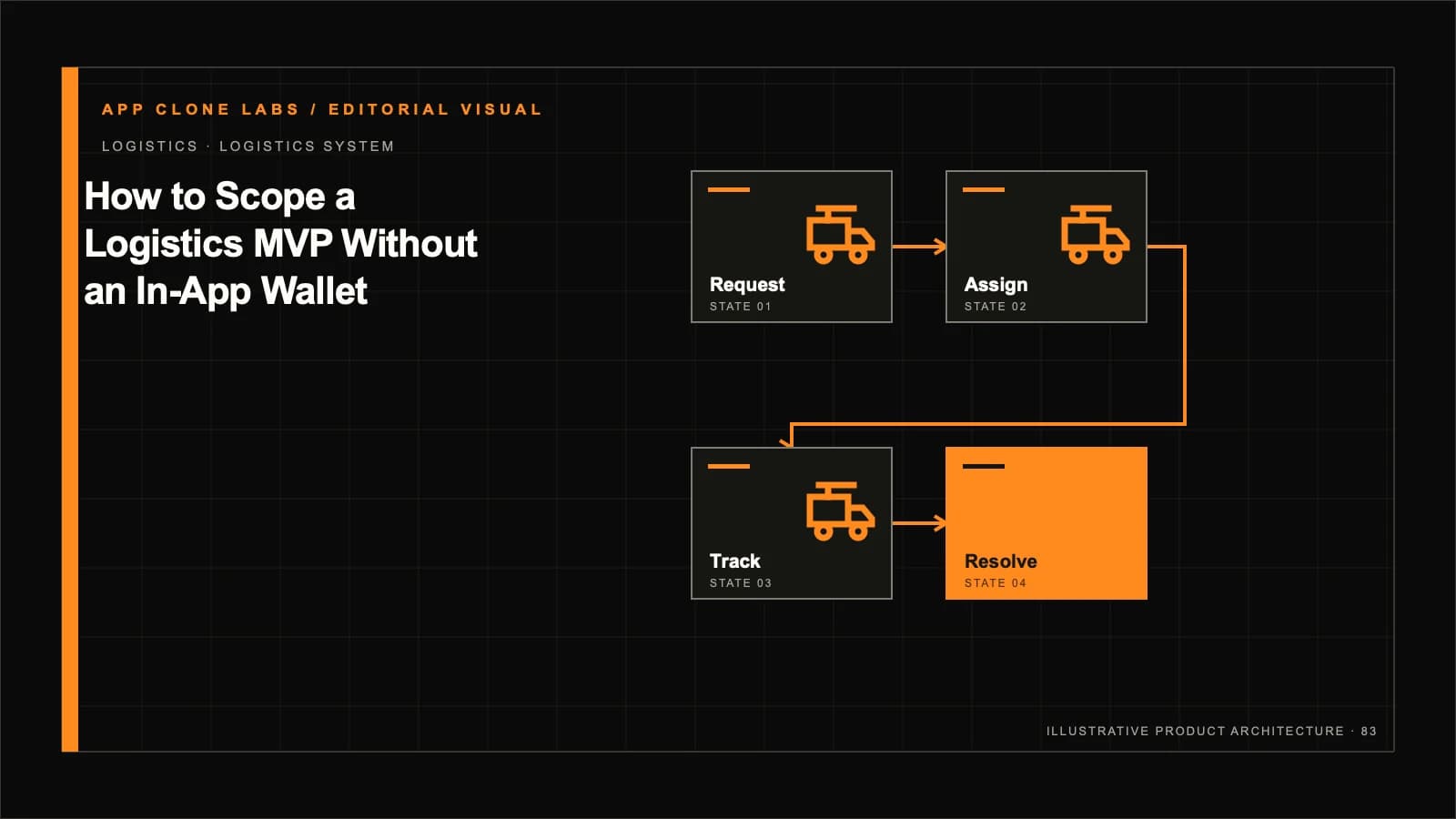
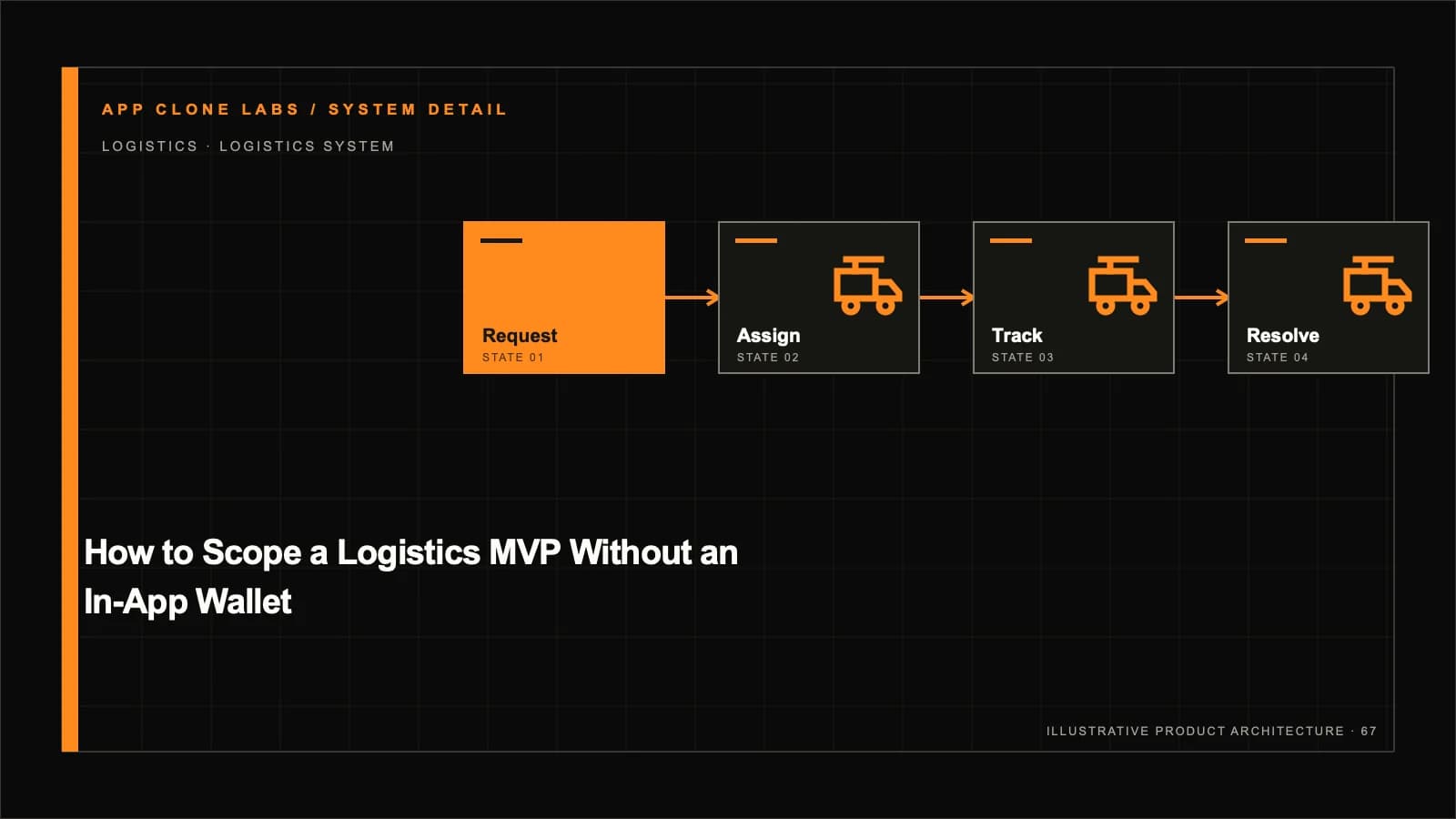
Imagine a hypothetical pilot serving one local zone, one parcel category and scheduled pickup windows. A customer requests a quote, confirms the address, pays using a supported provider and receives an order reference. An operator assigns an eligible courier. Collection and delivery produce evidence. Failed service leads to an explained exception and, when appropriate, a refund to the original payment method.
Write the commercial boundaries beside that journey. Identify the business selling the delivery, the payment recipient, the courier relationship, item exclusions, customer support hours and cancellation terms. A provider account being technically connected does not establish that its owner is authorized to collect for every participant. Eligibility and contractual questions belong before real transactions.
Use the MVP development approach to protect this whole loop. Cut another service zone or payment method before cutting the ability to resolve a paid order with no available courier. The founder MVP checklist provides a broader scope review; this article focuses specifically on excluding stored value without leaving payment and delivery disconnected.
What removing the wallet actually removes
An order payment answers whether a particular delivery has been funded, authorized, captured or refunded through a provider. A wallet lets someone hold reusable value and apply it later, sometimes with transfers, withdrawals or multiple funding sources. Those capabilities create product, accounting, security and potentially regulatory questions beyond displaying a transaction history.
Removing the wallet means no customer top-ups, reusable cash balance, peer transfers or withdrawal promises in this first release. Do not quietly reintroduce the same behavior as delivery credits if those credits function as spendable stored value. Name discounts, refunds and promotional entitlements accurately and review their terms rather than assuming a different label changes their consequences.
The app still needs financial records. Retain the quote, agreed amount, currency, provider references, payment attempts, adjustments and refund history. It also needs a process to compare those records with the provider. Deferring a wallet reduces the kinds of money behavior the platform offers; it does not remove the responsibility to explain money already collected.
Freeze the assumptions before starting the clock
The nine-day plan assumes an available team, an existing deployment route, approved operational owners and a provider sandbox that supports the intended payment flow. Production onboarding, legal review, account verification and app-store approval can take longer and cannot responsibly be compressed by a content timetable. Mark them as external prerequisites, not tasks that engineering can guarantee.
Choose a restricted audience and transaction limit appropriate to a controlled pilot. Define who can suspend booking, what happens to accepted jobs and which staff are on duty during the test. A pilot is not unmonitored public availability with a smaller advertising budget. The plan must state what evidence allows expansion and which failures stop new commitments.
Keep the user surfaces deliberately small: customer booking and receipt, courier task and evidence capture, operator assignment and exception handling. A responsive customer web flow may be sufficient for validation, depending on the service. The food-delivery blueprint illustrates customer, courier and operator responsibilities, but its wider feature set is not this pilot's acceptance checklist.
Days one and two: service rules and transaction records
On the first day, complete a serviceable-order example with the person who will dispatch it. Specify accepted items, collection and delivery zones, time windows, pricing, cancellations and proof. Walk through an unavailable courier and a recipient who cannot be reached. If staff disagree about the outcome, record the decision before coding multiple interpretations.
On the second day, establish durable records and allowed transitions. An order can progress from quoted to awaiting payment, dispatchable, assigned, collected and completed, with explicit exception branches. Payment has a separate lifecycle. Support cases and refund requests also need their own records. Do not force all of these into one status whose meaning changes between screens.
Create stable identities for the order, quote version, payment attempt and dispatch task. Store monetary values with an explicit currency and an appropriate minor-unit convention for the selected provider and currency. Preserve the agreed price rather than recalculating historical orders from today's tariff. Passing this gate means staff can explain every state and its owner without interpreting raw database fields.
Days three and four: checkout and verified payment effects
Use provider-hosted or provider-managed payment collection where it fits the product. Avoid building a card-entry system merely to make the pilot appear complete. The selected integration should fit the provider's current recommended flow, payment methods and merchant arrangement. Stripe is one documented example here, not a claim that it supports every logistics business or jurisdiction.
The Stripe PaymentIntent lifecycle distinguishes collecting a payment from setting up a payment method. Inspect the actual objects used by the chosen checkout integration. Do not treat a saved method as collected money, or an authorization requiring capture as a completed capture. Decide which verified provider state makes the order dispatchable for that specific payment method.
Bind the payment attempt to the server-approved quote and order. Check currency, amount, environment and provider account before applying its outcome. A customer must not be able to change a client-side price and receive the same service. A late payment against an expired quote needs an explicit resolution path rather than automatic dispatch at an unapproved tariff.
Handle the moment the browser disappears
The success page is a customer interface, not the authoritative trigger for collection. A customer can close it, lose network access or refresh it repeatedly. The server should receive and process verified provider events and use provider-side status checks for recovery when necessary. Until it has the required evidence, the receipt should say that confirmation is pending rather than inventing a failure or success.
Stripe's webhook documentation describes signature verification, retries and event-ordering considerations. A valid signature is necessary but does not establish that an event belongs to this order or permits its next transition. Deduplicate received events, check their business context and make the downstream dispatch effect safe to retry. Return success only after the event has been durably accepted for processing.
Build a timeout queue for orders stuck between customer action and confirmed provider outcome. Staff need the payment-attempt reference and a safe recheck action. They should not tell the customer to pay again until the first attempt's status is understood. A visible pending state with a defined follow-up is more honest than a red failure screen over an unresolved charge.
Retry the operation, not the charge
Double taps, mobile retries and worker restarts are ordinary operating conditions. Use distinct operation identities for order creation, provider payment submission, accepted events and refunds. Reusing an order identifier everywhere is not a complete design: one order may have a failed payment attempt followed by a legitimate new attempt.
Stripe's idempotency reference explains its provider-specific retry mechanism. Apply the documented semantics for the API actually used. Your own server also needs to recognize repeated requests and reject reuse with inconsistent inputs. Provider idempotency does not automatically deduplicate a local order, notification or dispatch task created before or after the provider call.
Rehearse a connection loss after provider acceptance but before your server stores the response. Recovery should locate or safely repeat the original operation according to the integration, then reconcile it with the order. It must not create a second charge because the first response was unavailable. Leave evidence of the original attempt and the recovery decision for support review.
Prevent a confirmed payment from losing its dispatch task
Consider a crash after the order becomes dispatchable but before its task reaches the dispatch worker. Processing the payment event only once is not enough if the service obligation disappears between systems. Persist the accepted state change and its pending downstream instruction together where the storage design permits, then deliver that instruction through a retryable worker. A transactional outbox is one implementation option; the requirement is that unfinished dispatch effects remain discoverable.
Give the instruction its own identity and make the consumer recognize repeats. If delivery to the worker succeeds but acknowledgment is lost, another attempt should find the same task rather than book another courier. Track how long accepted instructions remain pending and provide a restricted recovery action. Clearing a queue manually should not be the only way to restore paid customer work.
The same boundary applies to notifications, but with different consequences. A delayed receipt does not necessarily block collection; a missing assignment does. Define the operational priority instead of treating every background job as interchangeable. During an incident, operators should be able to see that money is confirmed, dispatch is pending and a named team owns recovery, without inferring those facts from application logs.
Confirm financial actions with the right operator
Keep ordinary dispatch staff from changing payment destinations or issuing unrestricted refunds. The pilot can have a small team while still distinguishing service coordination from financial approval. Set amount and role boundaries appropriate to the operation, record the reason and show the proposed action before confirmation. For a higher-risk adjustment, require the approved second review rather than sharing an administrator password.
Test those rules through direct requests as well as hidden buttons. A courier or customer must not gain authority by copying an operator's request shape. Revoking a staff account should prevent new actions even if an old page remains open. These controls belong in the initial money flow because recovering an unauthorized refund is not simplified by the absence of a wallet.
Days five and six: assignment, custody and proof
Begin with manual assignment if the pilot's volume allows it. Check service area, vehicle suitability, shift and existing commitments before offering the job. Acceptance should consume the assignment once, with a clear result for a stale operator screen or a late courier response. An attractive automated map is not required to prove a small dispatch process works.
Follow the courier dispatch requirements for the operator's critical decisions. Staff should find paid but unassigned work immediately and distinguish insufficient capacity from a failed worker. Define the cutoff that triggers customer communication or cancellation. Payment confirmation without an owned service obligation leaves the pilot collecting money it cannot explain operationally.
Collection establishes custody and delivery establishes a completed obligation. Choose evidence appropriate to the parcel service: identified courier, accepted item reference, time and required recipient acknowledgment or other approved proof. A photograph alone is not universal proof. If a handset is offline, show pending synchronization and preserve the evidence until durable server acceptance, with an owned route for conflicts.
Day seven: cancellations and refunds that do not invent credit
Canceling a booking, releasing a payment authorization and refunding a captured payment are different operations. The support interface should offer the action appropriate to the actual payment state. It must not advertise that money has been returned merely because an operator approved a refund request. Show requested, submitted, processing and completed or failed outcomes as the chosen provider supports them.
Link every refund to the original transaction, amount, reason and authorized actor. Check prior refunds and concurrent requests before accepting another instruction. A retry should not refund twice. If a partial refund is permitted, preserve its relationship to service charges and earlier adjustments instead of overwriting the order's original amount to make the totals look equal.
Communicate the destination as the original payment method where applicable, along with the provider-supported expectation rather than an invented instant-return promise. Customer support needs a reference to investigate delays. Do not substitute a reusable app balance because the provider refund path is inconvenient; that would reopen the stored-value scope the pilot deliberately excluded.
Day eight: reconcile the digital and physical outcomes
Construct an order-level reconciliation view before publishing a revenue dashboard. For each order, show the agreed price, provider-collected amount, authorized refunds, provider-confirmed refunds, service outcome and unexplained difference. Fees and settlement amounts may belong in separate columns. Money reaching the merchant's bank is not the same event as a customer payment succeeding.
Use exception categories with owners: provider payment without an associated order, paid order without dispatch, completed delivery with unresolved payment, duplicate transaction reference and refund still uncertain. Investigate them through recorded references. Editing an amount to eliminate a discrepancy destroys the evidence needed to understand it. Corrections should explain a cause and retain the earlier record.
Courier compensation may still require an approved process even without customer wallets. Document who pays the courier, how completed work is approved and how disputes are recorded. The marketplace payout ledger guide addresses richer settlement designs. Do not describe the pilot as solving automated multi-party settlement if it only exports approved jobs for a separate finance process.
Day nine: run the release drill, then decide
Execute the paid-delivery journey with production-like permissions and controlled test identities. Include successful delivery, no available courier, cancellation before collection, failed delivery after collection and a disputed proof record. Capture the customer view, courier action, operator intervention and financial outcome for each. A developer clicking through their own administrator account does not establish that ordinary roles can operate it.
Inject the failures most likely to expose an incomplete boundary: duplicate booking, expired quote, delayed payment event, replayed event, stale assignment, offline proof and interrupted refund submission. For each, specify the expected durable result and person responsible if automatic recovery cannot finish. Accept a release based on observed evidence, not the end of a calendar cell.
Keep a deployment rollback and booking suspension procedure ready. A code rollback does not reverse collections, completed deliveries or provider transactions. If the pilot stops, someone must reconcile accepted work and communicate its disposition. A missed gate extends the schedule or narrows the pilot further. The nine-day label never overrides an unresolved money or custody defect.
Keep store, privacy and access obligations in scope
For native distribution, review the actual purchase against Apple's App Review Guidelines and Google Play's payments policy. Physical delivery services are not interchangeable with digital content or in-app functionality. A later subscription, digital feature or mixed purchase needs its own policy assessment; external provider checkout is not blanket store compliance.
Limit address, phone, location and proof access to the people performing the service. A courier should not enumerate unrelated customers or retain indefinite access after assignment ends. Operators need task-specific authority for assignment, refund requests and evidence review. Audit sensitive actions without placing payment secrets, authentication tokens or unnecessary personal information in general logs.
The OWASP Transaction Authorization Cheat Sheet is relevant when confirming consequential financial instructions. Bind approval to the operation being authorized, including its amount and destination where applicable. These are engineering controls to assess, not a legal certification. Qualified owners must determine the business's jurisdictional, contractual and data-protection obligations.
Preserve an honest path to a later wallet
Separate orders, provider transactions and courier compensation now so a later financial product does not require rewriting the meaning of delivered. Preserve stable customer and business identities, currency-specific values and reasoned adjustments. Record the ownership and licensing boundaries of any reused components. Do not add unused wallet endpoints or a pretend balance solely to claim the architecture is future-proof.
Require evidence of a recurring problem before adding stored value. Perhaps approved business customers need prepaid spending controls, or a specific settlement arrangement needs a different model. Establish the users, funds movement, restrictions and financial owner first. Have qualified specialists review applicable obligations and provider eligibility before promising top-ups, transferable credit or withdrawals.
Assess the resulting wallet as its own release: ledger correctness, holds, reconciliation, authorization, disputes, incident response and migration. Existing order history should remain intelligible if the wallet project is delayed or canceled. The broader logistics industry planning page can guide operational expansion, but expanding transport capability and launching a stored-value product are independent decisions.
Frequently asked questions
Can a logistics MVP genuinely launch without a wallet?
Yes, if the chosen service can use order-specific provider payments and the business has an approved way to handle courier compensation. Customers can see their receipt, payment state and refund history without holding reusable funds. The MVP still needs reconciliation and operational recovery. Removing stored value should simplify the product promise, not hide unresolved financial responsibilities.
Is nine days a delivery guarantee?
No. It is a planning constraint for a hypothetical bounded pilot with ready prerequisites and an experienced team. Provider onboarding, operational agreements, security issues or failed acceptance tests can extend it. The responsible response to a missed gate is to reduce scope or delay release, not rename unfinished work as a successful launch.
What should replace the wallet screen?
Use an order-specific payment summary: agreed amount, method summary, receipt reference, current outcome and any refund progress. Give the customer a way to seek help about that transaction. Do not display unsettled internal calculations as spendable money. A useful payment history explains completed purchases without implying that a general-purpose account balance exists.
Can payment confirmation trigger dispatch automatically?
It can when a verified provider outcome satisfies the service's dispatch rule and all order prerequisites still hold. Deduplicate the resulting task and handle events that arrive after expiry or cancellation. Check provider account, currency and amount rather than trusting the browser redirect. An authentic event is an input to the business decision, not permission to ignore its context.
What happens if payment succeeds but there is no courier?
Keep the order visible in an owned exception queue, notify the customer under the agreed service terms and apply the defined resolution deadline. Staff may find eligible capacity, offer an approved alternative or cancel and initiate the appropriate financial action. Never leave the order silently waiting while treating its collected amount as uncomplicated revenue.
Are refunds simpler without stored credit?
The product has fewer refund destinations to manage, but the provider process still needs accurate states and reconciliation. Tie the refund to the original payment, prevent duplicates and communicate pending or failed outcomes. Do not promise immediate availability unless the actual mechanism supports it. A support team's approval is not proof that the customer's financial institution has completed the return.
Does deferring a wallet eliminate compliance work?
No. Payment collection, courier contracts, consumer disclosures, privacy, taxes and service-specific obligations still need appropriate review. Avoiding reusable funds may change the risk and operational scope, but it is not a universal legal exemption. Document the actual flow and obtain qualified advice for the markets and commercial relationships involved.
When should the team reconsider a wallet?
Reconsider it when observed user needs justify reusable value and a named owner can operate the financial controls. Compare the benefit with simpler alternatives such as order payments or approved invoicing. Fund a separate discovery and acceptance plan. A wallet should solve a demonstrated problem, not compensate for a missing refund workflow or make a small pilot look more sophisticated.
Comparison register
Order-specific payments versus a later wallet
| Decision | Bounded logistics pilot | Separate wallet release |
|---|---|---|
| Customer funds | Payment tied to a defined order | Reusable funds only after approved discovery |
| Customer view | Receipt and transaction-specific status | Balance backed by ledger and reconciliation |
| Refund recovery | Original payment reference and provider outcome | Credit rules and permitted destinations separately defined |
| Acceptance | Paid delivery and exception drills | Stored-value controls and applicable obligations reviewed |
- 01
- 02
- 03
- 04
- 05
- 06
Reviewed by the App Clone Labs product strategy team
This guide is written for founders and operators planning clone-inspired platforms, SaaS products, marketplaces, and mobile apps. It is reviewed against App Clone Labs delivery patterns, product scoping standards, and current implementation realities before being published.
Review the editorial team structureRelated product paths
Continue with the services, solutions, guides, and articles that connect this topic to a real software build.